
The modern American gun debate began in 1967, when 30 protesting members of the Black Panther Party marched into the California Capitol with loaded handguns, shotguns and rifles. In California there were few restrictions on carrying loaded weapons in public.
That soon changed. The Panthers’ efforts to “police the police” already had led Republican Assemblyman Don Mulford to propose legislation to ban the “open carry” of loaded firearms within California cities and towns. After the Panthers showed up in the Capitol, his bill sailed through and was signed by then-Gov. Ronald Reagan. It’s hard to say which now seems more unlikely: that two dozen revolutionaries could legally stroll into the state Assembly chamber with semi-automatic rifles, or that a Republican governor would champion stricter gun control.
In the years since, California’s progressive politicians have layered on restrictions while gun owners and manufacturers continue to try to find their way out of them.
The latest: On June 4, 2021 — National Gun Violence Awareness Day — a federal judge deemed California’s ban on assault weapons a “failed experiment” and unconstitutional, although he stayed his own ruling to give the state time to appeal, which it did. And on June 21, 2021, a three-judge panel of the U.S. 9th Circuit Court of Appeals blocked the judge’s decision while other gun cases are pending. The case could end up before the U.S. Supreme Court.
A 2016 ballot measure championed by Newsom required background checks to purchase ammunition, but that and another provision of the measure, banning high-capacity magazines have both stalled after a federal district court judge declared them unconstitutional. Both rulings are also being appealed.
The battle continues. Gov. Gavin Newsom denounces “a gun lobby willing to sacrifice the lives of our children to line their pockets.” A National Rifle Association spokesman predicts the Trump-altered Supreme Court means “winter may very well be coming for gun laws in California.”
How strict are California’s gun laws compared to other states?
California has a reputation for being tough on guns. That reputation is well-earned.
Researchers at Boston University have counted 111 California laws that in some way restrict “the manner and space in which firearms can be used.” They include regulations on dealers and buyers, background check requirements, and possession bans directed at certain “high risk” individuals.
By their count, no other state out-regulates California when it comes to sheer quantity of rules. And we’ve held that top spot since at least 1991, the year the researchers started counting.
The Giffords Law Center To Prevent Gun Violence, a gun control advocacy group, awarded California one of only two “A” grades in its 2020 state gun law scorecard.
“There are not a lot of As out there,” said Ari Freilich, the organization’s California legislative affairs director. “California has driven the conversation nationally.”
In contrast, Guns and Ammo magazine labeled California the 5th worst state for gun owners. (Washington D.C. was the top jurisdiction, followed by New York.)
California’s pattern: tragedy, legislation, repeat
The story of how California became, according to many, the state with the nation’s most restrictive gun laws has largely followed a familiar pattern: alarm or tragedy, then a legislative response.
Getting specific: What are California’s gun rules?
Guns laws cover the who, what, where, when and how of buying, selling, lending, leasing, storing and firing guns. By national standards, California law is strict on just about all of these points.
How does gun violence in California compare to elsewhere?
The United States is not an especially crime-ridden nation. Overall crime rates here are roughly on par with other high-income countries. Where the country stands out—way out—from its international peers is in gun violence.
The U.S. has a gun death rate (all causes of death, including suicide and accidental death) of roughly 11 per 100,000 people. According to research out of the University of Washington, that puts the U.S. in the company of Panama and the Dominican Republic.
Recently guns became the second leading cause of death of children and teens across the country.
At 7.5 gun deaths per 100,000, gun violence in California is much lower than the national average. But that isn’t particularly low by international standards. We have roughly the same gun fatality rate as South Africa. In 2019, 2,945 Californians were killed by guns.
Homicides and suicides by gun claim very different victims
As in the rest of the country, gun violence in California is not equally distributed.
Firearm fatalities are a disproportionately male tragedy. According to research from UC Davis, men are more than seven times more likely to be killed by someone else with a gun than women. Men are also more than eight times more likely to take their own lives with a firearm.
While mass shootings seize public attention, they do not claim the most lives. Half of gun deaths in California are suicides—a disproportionate number of them among white men over the age of 50. Most gun homicides, meanwhile, are not high-profile acts of mass carnage, but random outbursts of violence that strike communities least likely to draw news crews.
The geography of violence
There is some good news.
Over the last decade and a half, the average annual homicide rate has fallen nearly in half in California. That’s a steeper drop off than across the nation as a whole. According to a UC Davis study, most of that decline here has occurred in the state’s biggest urban areas. Contrary to the stereotype of gun-ridden big cities, there is now no significant difference in the rate of gun violence between rural and urban areas in California.
Do California’s gun laws work?
Supporters of California’s rigorous gun controls have a pretty compelling argument on their side: California has tough gun laws and it has relatively low rates of gun violence. And that’s a relationship that generally holds true across all 50 states.
But as with any thorny sociological question—particularly one where lives, livelihoods, deeply held values and constitutional law all hang in the balance—it’s probably more complicated than that.
Do tight gun laws lead to lower deaths? Or is it that states with less gun violence (due to different cultural attitudes about guns or varying economic and demographic patterns) are more likely to adopt tighter gun controls?
There seems to be relatively strong evidence that denying firearms to at least certain “high-risk” individuals leads to lower levels of violence. Three separate studies found that in states that keep guns away from those under domestic violence restraining orders, gun homicide rates between partners are 9 to 25 percent lower. California has such a law on the books. A similar study found that denying guns to those with misdemeanor violent crime convictions reduced their chances of being rearrested for another violent crime by 30 percent. California has this type of gun ban in place too.
Do comprehensive background checks keep guns away from those who shouldn’t have them?
One study concluded California’s law had relatively little effect—suggesting vendors skirting the rules and lax enforcement could be why. But another study estimated that when states require gun vendors to get licensed, conduct background checks and are subject to inspection, gun homicides can be expected to fall by more than 50 percent. An overview of the research from the RAND Corporation found suggestive but “limited evidence that background checks reduce violent crime.”
And concealed carry laws?
A landmark economic study from the mid-1990s found evidence that making it easier for people to carry reduced crime, supporting the NRA’s “good guy with a gun” theory. But more recent research using the same statistical techniques but with a larger dataset claims to show the exact opposite.
“What probably has the greatest impact are a number of things acting together—just the pure volume of laws,” said Eric Fleegler, a pediatric emergency physician at Boston Children’s Hospital and professor at Harvard University. “We are studying legislation and not randomized control trials. But overall, when you look at systematic reviews of legislation on homicides and suicides, it is fairly clear that legislation designed to place reasonable restrictions on how firearms are sold or maintained or stored does lead to decreased fatality rates.”
The politics of California’s gun debate
Gavin Newsom’s first press conference as governor-elect took place on the morning of November 8, 2018, just eleven hours after a gunman opened fire at the Borderline Bar and Grill in Thousand Oaks killing 13 people including himself. “The response is not just prayers,” Newsom said. “The response cannot just be more excuses. The response sure as hell cannot be more guns.”
A few days later he doubled down on Twitter, calling the National Rifle Association “a fraudulent organization” and “completely complicit” in the massacre.
No one familiar with Newsom’s career could have been surprised. He was the driving force behind Proposition 63, a 2016 ballot measure that put sweeping new restrictions on ammunition sales and banned high-capacity magazines (like the ones used in Thousand Oaks).
“We’re preparing for the worst,” said Chuck Michel, head of the California Rifle and Pistol Association.
Pro-gun arguments once resonated in California. In 1982, a proposition to cap the number of handguns* in California lost by 63 percent of the vote—taking the gubernatorial campaign of Democrat Tom Bradley along with it. The reason, according to a Washington Post analysis from the time, was that “people who did not ordinarily bother with politics and politicians were coming out in droves to save their unrestricted right to bear arms.”
But that silent, well-armed majority failed to materialize in 2016 when Prop. 63 passed—also with 63 percent of the vote.
Nearly two-thirds of respondents in a recent survey from the Public Policy Institute of California said that gun laws should be “more strict” than they are now. Included in that group were 49 percent of the conservatives surveyed.
According to Craig DeLuz, the California director of legislative affairs for the Firearms Policy Coalition, those numbers reflect a misconception of what’s already on the books.
“If there are reasonable firearms regulation out there, we’ve already passed that point,” he said. “A lot of people are completely unaware that most of the things that the average voter believes to be ‘reasonable’ are already in place in California.”
Brave new world: The tech future of guns
California is often considered the innovation hub of the United States. Why should it be any different for guns?
The state’s tough firearm laws have led “many entrepreneurs to ‘innovate’ ways around the law,” said Ari Freilich of the Giffords Law Center To Prevent Gun Violence.
Consider the case of the bullet button.* In 2001, California expanded its ban on new “assault weapons”* to include any modern semi-automatic rifle* with a detachable magazine* and at least one of a handful of other features, including a protruding pistol grip* or an adjustable stock*. To get around the ban, many gun owners came up with a solution: install a small lock on the magazine that can be easily opened with a small tool (or the tip of a bullet). Legally speaking, that tiny bit of hardware would transform a contraband assault weapon with a detachable magazine into a perfectly legal rifle with an ever-so-slightly-less detachable magazine.
In 2017, California lawmakers caught on and amended the law. That prompted the development of yet another workaround device: the Patriot Pin. And so the arms race over arms design continues in California.
With so many regulations now in place on newly manufactured firearms, many gun enthusiasts are simply building their own guns—or at least, they’re putting together the final pieces.

One of the most popular firearm products in California are “80 percent” or “unfinished” receivers.* Receivers are the central frame of a firearm onto which all the other components are connected. “Unfinished” simply means it lacks a few cavities and holes. But legally, that makes all the difference. Under both federal and California law, an unfinished receiver is just an elaborately shaped piece of metal. Under a law passed in 2016, Californians with home-finished receivers were given until January 1st of 2019 to register their gun with the state. It’s not clear how widespread compliance has been.
Still, plenty of lawmakers are worried about the spread of unidentifiable “ghost guns.” In 2017, a man with two home-built semi-automatic rifles killed five people and shot up an Elementary School in Tehama County. In 2019, a man killed a highway patrol officer in Riverside County with a home-assembled AR-15-style rifle. A student at Saugus High School in Santa Clarita also used a kit-assembled weapon to murder two fellow schoolmates before killing himself. In 2016, a proposal to designate unfinished receivers as legal “firearms” passed both the Assembly and Senate, but was vetoed by Gov. Jerry Brown.
“By defining certain metal components as a firearm because they could ultimately be made into a homemade weapon, this bill could trigger potential application of myriad and serious criminal penalties,” Brown wrote in his veto message.
But with a new governor came a new approach. In 2019, Gov. Newsom signed a law requiring anyone hoping to purchase an unfinished receiver to undergo a background check. The law doesn’t go into effect until 2024.
And in 2021, newly-elected president Joe Biden followed suit. In early April, Biden announced three new executive orders aimed at curbing gun violence. One would require unfinished receivers to be etched with a serial number and subject ghost gun purchasers to a background check.
The gun fight in court
California’s Department of Justice is holding the line as gun rights advocates push back in ways that could have dramatic consequences for state law.
In 2016, state voters passed Proposition 63, which banned magazines with a capacity to hold 10 rounds or more. Though a 2000 law restricted the sale and manufacture of new high-capacity magazines, existing owners had been grandfathered in. Prop. 63 effectively un–grandfathered them. Five gun owners and the California Rifle & Pistol Association (the state branch of the National Rifle Association) sued. After the courts agreed to place a temporary hold on the Prop. 63 ban, federal district judge Roger Benitez issued a searing opinion, holding that the Second Amendment also applies to commonly-owned high-capacity magazines. “Without a right to keep and bear…the magazines that hold ammunition, the Second Amendment right would be meaningless,” he wrote. California appealed the decision. In August 2020, the three-judge panel of the Ninth Circuit Court of Appeal agreed. “Even well-intentioned laws must pass constitutional muster,” wrote Judge Kenneth Lee, a Trump appointee. “Firearm magazines are ‘arms’ under the Second Amendment.” The state has asked for another hearing before the entire Ninth Circuit.
Prop. 63 also requires Californians to get their ammo only from state-licensed vendors in face-to-face transactions. Out-of-state vendors hoping to get into the California cartridge* market are therefore required to go through a certified California vendor to broker the transaction. A lawsuit filed by the California Rifle & Pistol Association (NRA) and California-born Olympic skeet shooter Kim Rhode contends the new law puts an excessive burden on “interstate commerce” and that it violates the Second Amendment. In April 2020, the same federal district judge who slapped the state down in the Duncan case put a hold on the background check law writing that such checks “do not work,” that “every law-abiding responsible individual citizen has a constitutionally-protected right to keep and bear firearms and ammunition” and that Prop. 63 is “precisely what the Bill of Rights was intended to protect us from – a majority trampling upon important individual rights.” The state appealed the ruling to the Ninth Circuit U.S. Court of Appeals. In March 2021, three judges from the court put the proceedings on hold to wait for a ruling in the Duncan case.
Since 2001, California has only allowed handguns to be sold, imported, or manufactured in California if they are considered “not unsafe” by the state. The Department of Justice maintains a list of these approved firearms, known as the “roster.”* In 2009, gun rights activists sued, arguing that the roster impinges on gun owners’ Second Amendment rights and that the rationale the state uses to keep certain guns off the list is “arbitrary and capricious.” In recent years, as the state has placed more restrictions on new firearms, opponents of the roster have said it amounts to a “slow-motion handgun ban.” On June 15, 2020, the U.S. Supreme Court declined to take up the case.
In 2015, the U.S. State Department settled a case with the Texas nonprofit Defense Distributed, allowing it to publish its 3D-printable gun designs online. California joined a multi-state lawsuit filed by the State of Washington against the federal government. The states argue that allowing the release of those codes violated their right to regulate firearms within their own borders. In November 2019, a federal judge sided with the states. But this being the Internet, the files are out there.
The U.S. Supreme Court in early 2019 agreed to hear a constitutional challenge to a New York City law that did not allow most handgun* owners to take their firearm outside their homes unless they’re going to an authorized shooting range and barred them from taking their guns outside the city entirely. California has a lot at stake in the outcome. In 2010 the Supreme Court affirmed every American’s individual right to bear arms “in the home for the purpose of self-defense.” An expansive ruling on the case from New York, as some court watchers initially predicted, could find that the right to bear arms exists outside the home as well, potentially sweeping away California’s restrictions on both open and concealed carry in a single decision. “Winter may very well be coming for gun laws in California,” the head of the California Rifle and Pistol Association, Chuck Michel, told NRATV. “We may be able to knock more than a few of those out.” But New York City has since repealed the rule and in April 2020, the Court dismissed the case as moot.
Pro-gun rights advocates, two 20-year-old gun enthusiasts and a handful of gun shops sued the State of California in July 2019, arguing that a new state law setting the legal gun-purchasing age at 21 unjustifiably “prohibits an entire class of adults from exercising their Second Amendment right to keep and bear arms.” The law in question was authored by Sen. Anthony Portantino, a Democrat from La Cañada Flintridge, and signed by Gov. Jerry Brown in late 2018. It extended the age limit from handguns to all firearms, but some exceptions remain for young police officers, members of the military and anyone with a valid hunting license.
Building off an early victory in Duncan v Becerra, when a district court judge held that the state’s ban on large capacity magazines violates that Second Amendment, gun rights groups from San Diego doubled down, challenging California’s entire “assault weapon” ban on the same grounds. The 19-year-old ban defines an assault weapon as any semiautomatic rifle with some combination of suspect features, including a detachable magazine. Because the court already froze the state’s large magazine ban, the San Diego County Gun Owners Political Action Committee argues, any law that forbids the purchase of a weapon based on its use of such a magazine must also be unconstitutional.
On June 4, 2021, Roger Benitez, the same federal district judge who struck down the state’s ban on large magazines, sided with the San Diego gun owners. In a lengthy and scalding opinion, he called California’s assault weapons ban a “30-year-old failed experiment” and ruled that the Second Amendment only allows firearms to be banned outright in “extreme cases,” such as “bazookas, howitzers, or machineguns.”
Attorney General Rob Bonta appealed, and on June 21, 2021, a federal appeals court blocked Benitez’s ruling.
How to sound smart about guns: a glossary
Guns are complicated. So is gun policy. Here are some terms and phrases to help you make sense of it all.
AR-15-style rifle: A particularly popular style of semi-automatic rifle, this one is based on the original ArmaLite AR-15, built for U.S. military in the late 1950s which relabeled it the M-16. Since the expiration of the AR-15 patent, many manufacturers have produced a wide array of similarly designed, modular semi-automatic rifles. The AR-15 style is among the most popular in the United States. People who aren’t gun enthusiasts will likely recognize it as the weapon of choice for mass shooters at San Bernardino, California; Sandy Hook, Connecticut; Parkland, Florida; and Las Vegas, Nevada.
Assault rifle: A rifle capable of fully automatic and semi-automatic modes of fire. Based on this definition, federal law prohibits civilians from owning assault rifles manufactured after 1986. However, other definitions are occasionally used. Adding to the confusion, an “assault rifle” is not the same thing as an “assault weapon” (see below).
Assault weapon: A nebulous, politically-charged term that dates back to at least 1980. California law offers a wide-ranging definition that encompasses any “semi-automatic, centerfire rifle” with a detachable magazine and at least one of a handful of other features, including a protruding pistol grip or an adjustable stock. This mix and match approach to defining a banned weapon has led to some creative workarounds from gun enthusiasts. But California also explicitly includes a number of makes and models in its ban, including the original AR-15 and other high-powered rifles. Gun control activists argue that the term “assault weapon” is a useful term to describe a weapon with enhanced killing power, while gun rights advocates dismiss it an imprecise catch-all designed to turn the public against any firearm that happens to looks like an assault rifle, regardless of its actual lethality.
Automatic: A firearm or firearm setting that will allow the gun to be fired continuously until the trigger is released or the gun runs out of ammunition.
Bullet: A projectile shot from a firearm. A bullet is one component of a complete round or cartridge. To reiterate: a bullet is not a cartridge.
Bullet button: A magazine release that can only be activated with a pointed tool or the tip of a bullet (hence the name). These devices were invented to convert a firearm with a detachable magazine into a firearm with slightly-less detachable magazines so as to comply with California’s assault weapon ban. California includes a detachable magazine as one of the components in its definition of restricted weapons. A 2017 state law effectively closed the “bullet button loophole,” meaning that any firearm with the device is still legally considered to have a detachable magazine and therefore, possibly, an assault weapon.
Bump Stock: An adjustable rifle stock that uses the force of the firearm’s recoil to allow the trigger to be repeatedly pulled. A kind of multiburst trigger activator, this effectively allows a semiautomatic weapon to simulate automatic fire. Bump stocks gained national attention after a shooter used one to kill nearly 60 people and wound hundreds more in Las Vegas in 2017. They are banned by both federal and state law.
Caliber: The diameter of a cartridge (or sometimes the bore of a firearm itself). Typically measured as fractions of an inch (for example, .22) or millimeters (for example, 9 mm).
Cartridge: A unit of ammunition for a firearm that often includes a bullet, primer and propellent (i.e. gunpowder) within a casing. Also called a “round.” To reiterate: a cartridge is not a bullet.
Casing: The metal container for a unit of ammunition. Sometimes called a “shell.”
Clip: A device used to hold multiple rounds together, which allows multiple rounds to be loaded into a firearm with an internal magazine at once. Clips are rarely used today except with older long guns.
Centerfire: A round-type that, when fired, is struck by the firing pin in the center of the back—used in most modern firearms as the rounds can accept higher power (as opposed to rimfire).
Concealed carry license: California is one of eight states that allow civilians to carry a concealed weapon only if local law enforcement agencies decide to give them a permit. This distinguishes California from “shall issue” states, in which concealed carry permits must be issued as long as an applicant meets the legally specified requirements, and “permitless” or “right to carry” states where no permit is required.
Gauge: A unit of measure for the diameter of a firearm barrel, typically used for shotguns. The origin is slight anachronistic: a gauge refers to the number of lead balls that one could snuggly fit inside the barrel of the gun if only drawing from one pound of lead. In other words, the smaller the gauge, the bigger the gun.
Gun Show Loophole: Under federal law, individuals can sell firearms without a license as long as they don’t make a living off the trade. These amateur sellers are not subject to federal requirements—namely, that they must conduct background checks on their purchasers. In California, all sales must be conducted through a licensed vendor, closing the “loophole.”
Handgun: California defines a handgun as “any pistol, revolver, or firearm capable of being concealed upon the person.” Also sometimes a “short-barreled rifle or a short-barreled shotgun.”
Handgun Roster: California law bans the sale or manufacture of any handgun that doesn’t meet state safety standards. According to data compiled by the CalGuns Foundation, a gun rights organization, the number of firearms on the list has declined each year since 2013. As of the end of January 2019, there were over 700 models on the list.
Magazine: A spring-loaded device used to hold multiple rounds designed to load each round into the firearm’s firing chamber with a spring. Some firearms have internal magazines into which ammunition must be manually loaded, while others have detachable magazines which allow for quicker unloading and reloading.
Microstamp: Any technology that stamps a unique identifying mark on the round casing when the gun is fired. In theory, this acts like a fingerprint, allowing law enforcement to track an empty shell at a crime scene to a particular gun. California law requires all new semi-automatic pistols sold in the state to include microstamping technology. Gun advocates argue that the technology is untested and prohibitively expensive for manufacturers to implement and that the law is effectively a “backdoor ban” on an entire class of newly manufactured firearms.
Multiburst trigger activator: Any enhancement that allows a semi-automatic weapon to fire multiple rounds with each pull of the trigger simulating automatic fire. A bump-stock is a notable example. Other devices use recoil, a crank, or internal mechanisms to the same effect.
Pistol: A handgun in which the chamber that holds that ammunition is part of the barrel. This is opposed to a revolver.
Pistol Grip: A grip that extends beneath the receiver allowing the shooter to hold and fire the weapon like a pistol (with a straight wrist). Under California law, a “pistol grip that protrudes conspicuously beneath” the weapon can be one of the defining features of an “assault weapon.”
Revolver: A handgun in which the chambers holding ammunition revolve around a cylinder.
Rimfire: A round that can be fired by striking anywhere on the back of the round—rarely used today except for low powered firearms. As opposed to centerfire.
Receiver: The frame of the gun that houses the firing mechanisms. Under U.S. federal law, this is considered the firearm and regulated as such. As of January 1, all receivers in California must have a state-issued serial number.
Semi-automatic: A firearm that will fire a single shot and then automatically load a new round into the chamber each time the trigger is pulled.
Stock: The rear portion of a rifle or shotgun that is often held to shoulder for support.
Unfinished Receiver: The frame of the gun that houses the firing mechanisms, but which lacks a channel or pocket for the gun’s firing mechanism. Once those modifications have been made with a drill press or another tool, the receiver is legally considered a firearm (though only legally; additional components are required before it can shoot). Also called “80 percent lower receivers.” As of January 1, all finished receivers must be serialized under California. A bill requiring unfinished receivers be registered was vetoed by Gov. Jerry Brown.




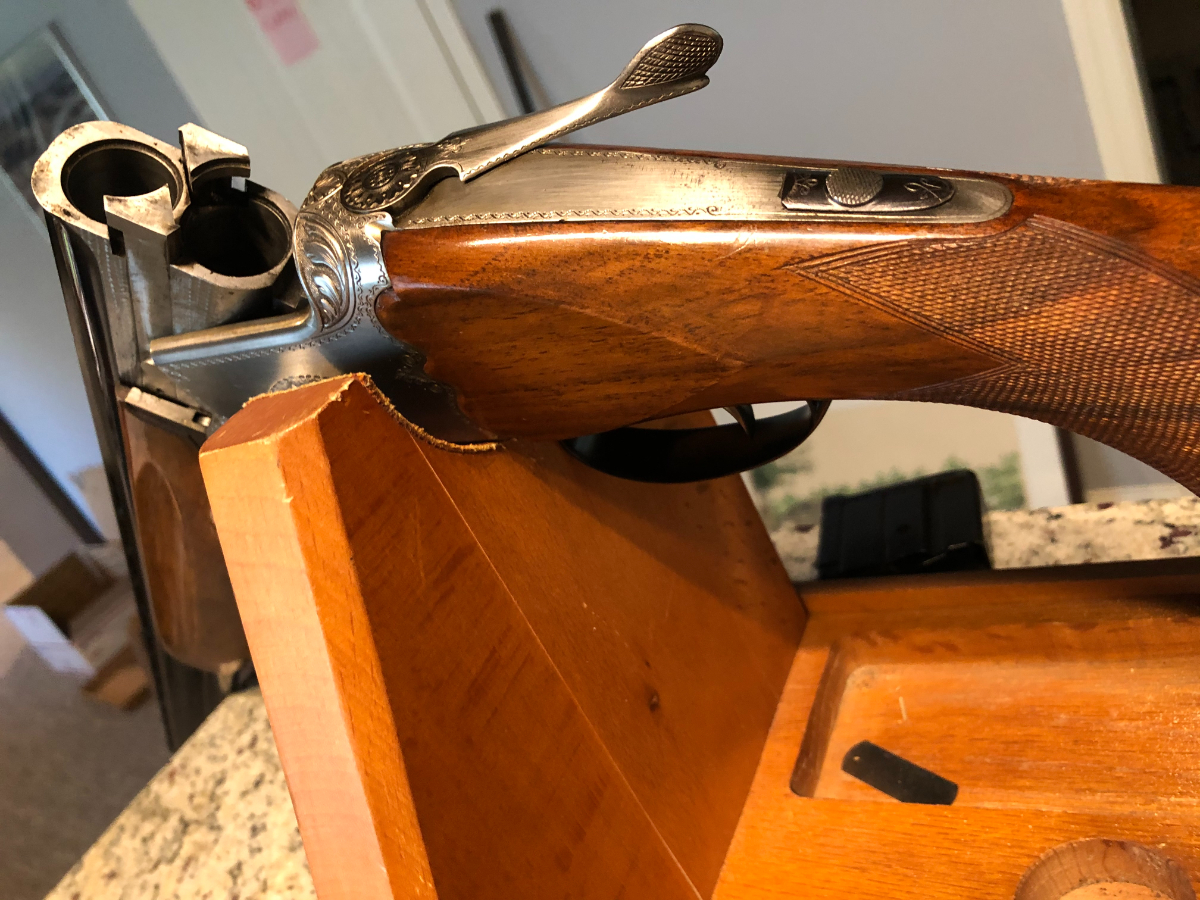
 After the classroom discussion was complete, we broke to get our gear together and hit the range. We started with handgun work. Specifically, Matt identified the grip as the most important fundamental of shooting a handgun. (This was refreshing to hear as I constantly stress the importance of gripping the firearm effectively to allow you to shoot accurately with any notable speed.) The first piece of instruction was to grip the handgun the way he wants us to. Luckily, his method was 99% identical to the way that I am used to gripping a handgun, with a minor alteration of the placement of my thumb on my shooting hand. From the grip, we moved into stance/posture and the presentation of the firearm. Matt believes in a “head up, gun up, roll out” method of presentation, and breaks down the process simply with various explanations and demonstrations. We worked on this dry for a few repetitions and then got into the live fire portions of the exercise. We began with what Matt calls “ladder drills” where we would present the firearm and fire one round. The next rep would produce two rounds. Then three… Then start over at one. Rinse and repeat as needed. We worked this drill with reloads as Matt would walk the line and make corrections where needed.
 Day 3 began inside the shoothouse. The facility is amazing and offers multiple examples of problems in every form that you would encounter in a home or urban environment. To start off the day, Matt encouraged us to walk around for about 20 minutes and explore the compound. The beauty of the shoothouse is that there are really few ways to “game it” because the opposing forces are also living, thinking people. They are moving, adapting, and changing their methods just as you are. Therefore, Matt ominously told us that we could walk around, ask questions, or whatever we wanted to do.
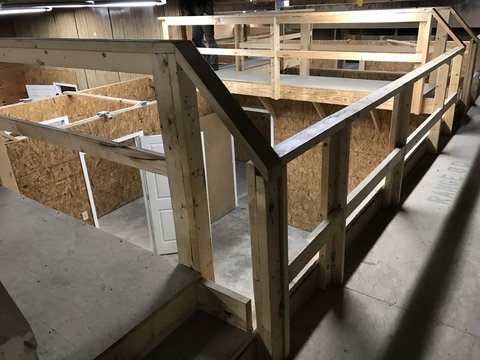 The facilities that Matt has arranged for this training are perfect. They are laid out in such a way that Matt can maximize the amount of time instructing and learning and minimize the down time. The shoothouse allows for low-light runs to happen during mid-day, and the house is inside so weather is not a factor. The live-fire happens in a very large action bay with plenty of room for shots out to 50 yards. There is a covered area for gear and equipment that also has lighting under it. All in all- this course is run out of fantastic facilities that strongly contribute in countless positive ways.