Category: All About Guns

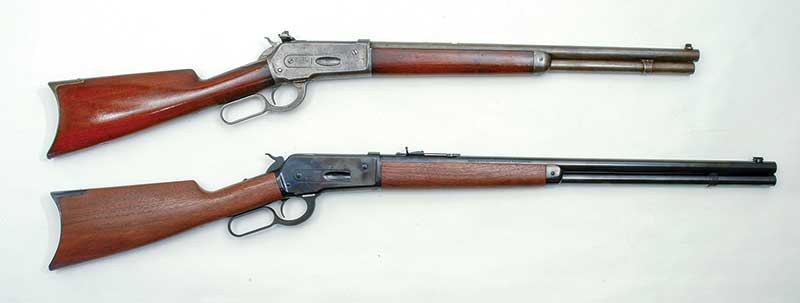
Duke’s altered Model 1886 .40-82 (top) with a 20″ barrel shown for comparison
with a new Japanese Winchester Model 1886 .45-70 with its standard 26″ barrel.
Naturally we clearly remember the “firsts” in our lives — first gun, first car, first date, etc. I remember fondly my first experience with an antique lever gun because it started my career on a path still followed today: learning the ins and outs of safely shooting old and obsolete guns and their cartridges.
Back in the late 1970s a friend, knowing of my handloading and bullet casting experience, asked if I would load some .40-82 cartridges if he supplied brass, dies and bullet mold. His lever gun was a nice Winchester Model 1886 .40-82 manufactured in the late 1880s. It was a family heirloom but had not been fired in decades due to the lack of factory ammunition. His request sounded like an easy way to introduce myself to Winchester lever guns. The experience turned out to be more complicated, but more educational, than expected.
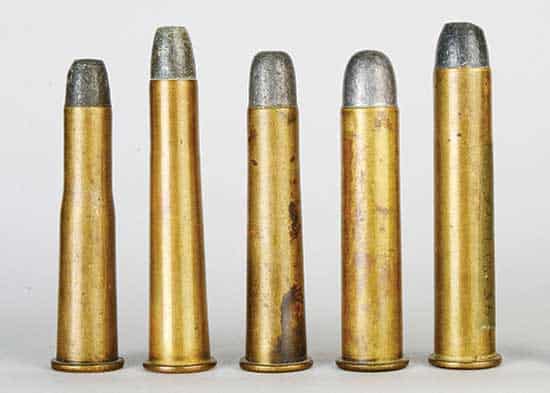
This photo shows a .40-82 in comparison to several other popular Winchester Model
1886 factory chamberings (left to right): .38-56, .40-82, .40-65, .45-70 and .45-90.
The Loads
The mold supplied was an Idea/Lyman #406169 which dropped a 0.408″ bullet weighing 260 grains of the wheel weight alloy I had on hand. I lucked out because the groove diameter of old .40-82 measured 0.408″ instead of the nominal 0.406″. Cases supplied were RCBS .45 Basic with a length of 3.25″. Those were hacksawed to just over the .40-82’s length of 2.40″ then trimmed to the final spec. Next, a now-forgotten charge of a likewise forgotten smokeless powder was dumped in 20 cases. Bullets were seated and crimped and I was ready to shoot.
Only I wasn’t! The rounds were too fat to chamber. It had not occurred to me the .45 basic case walls increased in thickness from case mouth to case rim. Thinning the case walls was the cure so RCBS tooling for the chore was acquired. Again I thought everything was a go. It wasn’t. Every shot fired gave a click-bang. The click was the hammer falling. The bang was the powder charge firing a second or so later, meaning it wasn’t igniting properly. At least the bullets passed through paper targets point on. Some research revealed an old remedy for poor powder ignition was to fill the case atop the powder charge with corn meal. The fix worked and the old rifle began to shoot beautifully. In fact we took it hunting and I shot an elk with it.
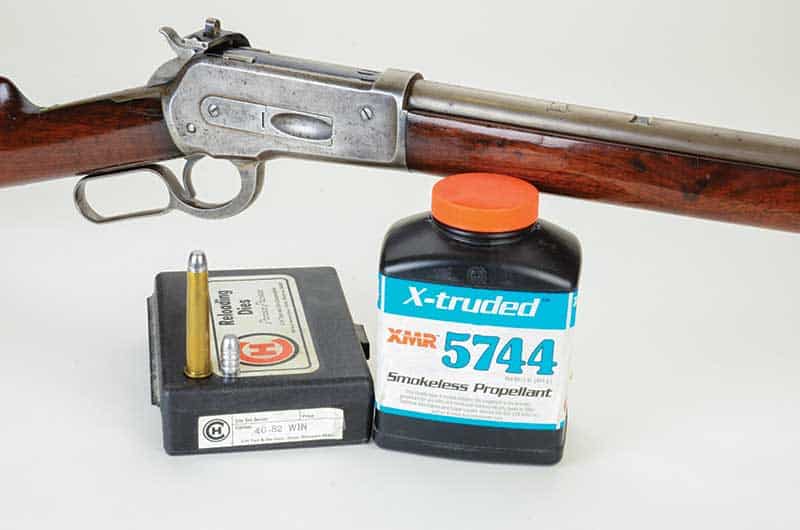
Duke’s Winchester Model 1886 .40-82. Note the filled sight dovetail and
new cut one a few inches ahead of it.
Collecting
As I began to assemble an array of vintage Winchesters, for my own Model 1886 slot I wanted a .40-82. What I finally landed was one made in 1887 as indicated by its serial number. However, it was not a prime specimen. Its buttstock and receiver actually were very nice and it even had a Lyman No. 21 side-mounted peep sight. The problem was the barrel. While bore condition was very good, it had been shortened from 26″ to 20″ with the magazine tube cut correspondingly. Also, someone had roughly filled the original barrel sight’s dovetail and cut another one a few inches ahead of it but left it empty. Because of those problems the price was right.
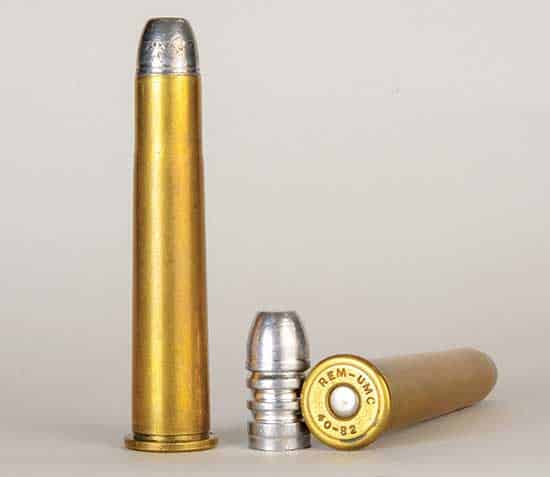
Duke had custom bullet mold maker Steve Brooks cut a set of blocks for a slightly
oversize .40-82 bullet because his Winchester’s bore was likewise oversize.
Cleaning Up
In my mind the idea was to restore it someday with an intact .40-82 barrel and magazine tube. In the meantime I wanted to enjoy shooting it. Times had changed a bit. I knew to slug the barrel first — it was a whopping 0.409″, so I had custom mold maker Steve Brooks (brooksmoulds.com) cut a set of blocks for a 0.410″ bullet with a gas check shank. From my favorite 1–20 tin to the lead alloy I favor, the mold dropped them a mite heavy at 280 grains. A batch of .45 Basic cases were cut and inside reamed as before.
Between my first .40-82 and the one I purchased there was a new smokeless powder introduced. The powder was Accurate 5744 and it revolutionized all my thinking about smokeless powders in voluminous cases. Because it easily ignites in large cases there is no filler necessary. To my great pleasure, 100 yard groups from my .40-82 were outstanding from the very beginning. When I pull the trigger properly, most are in the 2″ to 3″ range at 100 yards. My favored 5744 charge of 25 grains pushes those 280-gr. bullets out at about 1,390 fp. All ideas about getting a replacement barrel for my cut down ’86 were forgotten.
Other shooters might prefer more glamorous ’86 chamberings like .45-90 or .50-110. I’ve even had such but it’s the .40-82 I’ve kept.

With a production run that only lasted for two seasons of Miami Vice, the S&W Model 645 is a solid classic. (Photo: Chris Eger/Guns.com)
What’s big, stainless, chambered in .45ACP and lived only in the 1980s? Smith & Wesson’s Model 645, of course.
In the early 1980s, S&W was producing a series of second-generation semi-auto 9mm pistols that followed up on the company’s earlier Model 39— itself the first non-European designed 9mm produced for the U.S. market– and Model 59 offerings. These included 8+1 shot single stacks like the S&W 439/639 and the “Wondernine” 14+1 double stack S&W 459/659.
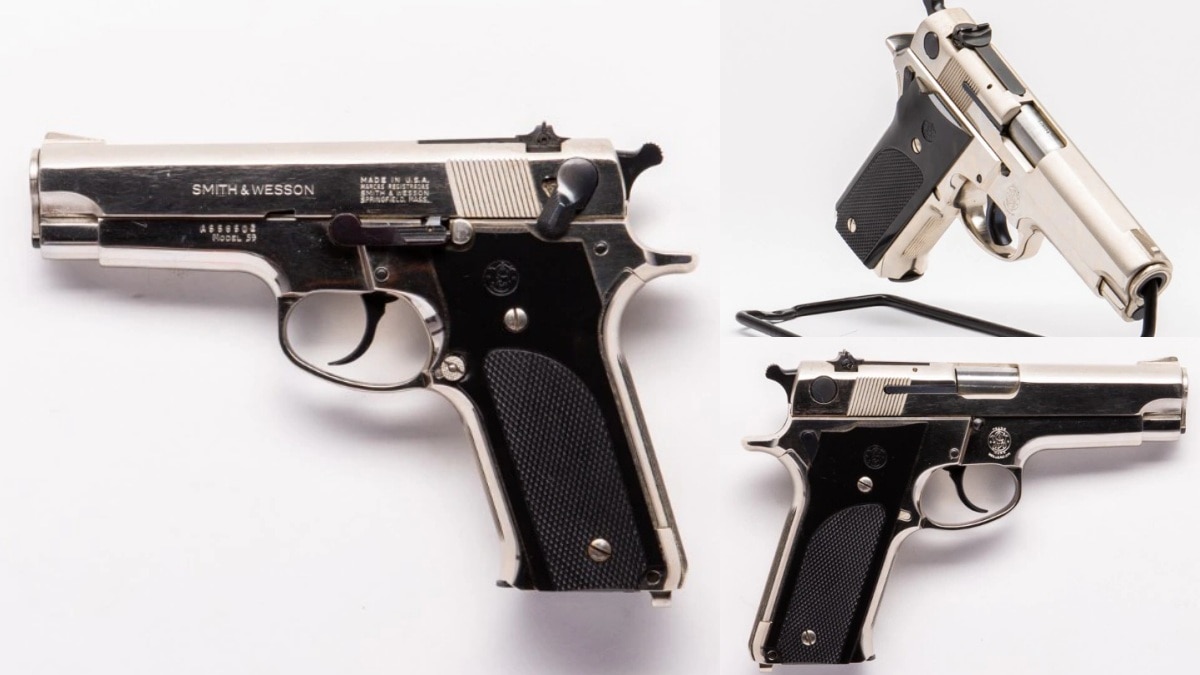
The S&W 59. Produced from 1972 until 1981, these were S&W’s first so-called “Wondernine” pistols, a term affixed to them as they had a 14+1 flush fit magazine capacity, a feat at the time only narrowly bested by the Czech-made CZ75 or Italian Beretta 92. The pistols in this family had a distinctive profile with their slide-mounted safety/decock levers and thin triggers. This nickel-finished specimen in up for grabs in the Guns.com Vault today.
These double-action models, with alloy frames, were light and, using a slide-mounted safety/decocker, safe for new users. As such, they proved popular with not only consumers but also law enforcement agencies looking to upgrade from .38/.357-caliber wheel guns.
However, there were no comparable .45ACP pistols in the lineup.
ENTER THE MODEL 645

Prefaced by M1917 revolvers and later N-frames, the Model 645 was Smith & Wesson’s first commercial .45ACP semi-auto. Only made from 1985 through 1988, this child of the Miami Vice-era is up for grabs in the Guns.com Vault, Pachmayr grips included.
First produced in 1985, the S&W Model 645 was similar in size to the classic M1911 Government Issue, with an 8.5-inch overall length and a 5-inch barrel. Unlike the iconic .45ACP, it carried an extra round (eight in the mag rather than seven), had a squared-off and serrated trigger guard, and was double-action with a safety decock lever. This latter feature meant that the gun was more appealing to officers in departments that wanted to carry a .45 but was forbidden to do so in cocked-and-locked single-action pistols such as the M1911.
Speaking of departments, the 645s greatest claim to fame of its period was that it was carried and used– extensively– by the fictional Detective Sergeant James “Sonny” Crockett, as portrayed by Don Johnson in Miami Vice.
Replacing the chromed Bren Ten the vice detective with a penchant for pastels sported in the first two seasons of the show, the new-to-the-market S&W 645 appeared on-screen in seasons three and four. The good folks at IMFDB noted this was because “the producers wanted to keep up Crockett carrying a State-of-the-Art pistol.”

Season 3 of Miami Vice premiered in September 1986 while the fourth season concluded in May 1988, almost mirroring the 645’s production run. Incidentally, the Jackass shoulder holsters Johnson wore in the show led to today’s Galco International. (Photo: IMFDB)
It should be noted that Michael Mann, of Crime Story, Heat and Vega$ fame, was the executive producer of Miami Vice and the show was noted for its wide array of interesting firearms. This included everything from the Franchi SPAS-12 to the .44 Auto Mag and Desert Eagle hand cannons, the uber-cool HK P7, and even a LaFrance M16K. Competition shooter Jim Zubiena served as a firearms instructor on the production and even famously appeared on screen in an episode as a hitman pulling off a lightning-quick Mozambique drill from cover.
ANYWAYS, BACK TO OUR GUN…

The 645 was only offered in an alloy frame and stainless slide format but did have an option between the fixed (shown) or adjustable sights. (Photo: Chris Eger/Guns.com)

The 645 disassembles largely like an M1911, although notably without a barrel bushing. Also, note the lack of a grip safety but a large beavertail to help with hammer bite. (Photo: Chris Eger/Guns.com)

The author’s gun chews through a wide array of .45ACP FMJ ammo with ease and sports aftermarket Pachmayrs but, like most stainless guns, gets extremely dirty in the process. The standard grips are black plastic. (Photo: Chris Eger/Guns.com)

You can almost hear the Reaganomics in the distance. Smith & Wesson in the 1980s also marketed a line of “American Series” knives produced by Vermont Knives which were sold through their dealers, often in combos with the guns. At the same time, Smith also had offers for a free Member’s Only-style windbreaker ($49.95 value!) with the purchase of a 645 or similar. (Photo: Chris Eger/Guns.com)

An all-metal gun other than the orange insert in the front sight and the grip panels, the 645 weighs in at 42-ounces, unloaded. (Photo: Chris Eger/Guns.com)

It fills the hands, even if you have big hands. (Photo: Chris Eger/Guns.com)
Smith followed up on the 645 with the very similar but more successful “third-generation” Model 4506 (with some of the early guns accidentally mismarked as 645s) which included a one-piece Delrin grip and adjustable sights. Notably, Sonny Crocket carried the 4506 in Miami Vice‘s fifth and final season.
The 4506, as well as its more abbreviated 4516 and 4566 little brothers, remained in production for a full decade while the line branched out to include DAO variants and a TSW series gun which lived on in S&W’s catalog until 2004. The short-lived carbon steel Model 4505 was meanwhile only made in 1991 while a third-generation “Value Line” Model 457 was marketed until 2006. These spawns of the 645 were Big Blue’s only all-metal .45ACP semi-autos until the company began making their GI longslide variants, the SW1911.
But that is another story.
|


Twice a year for the past half-century or so, the rolling hills around the small Kentucky town of West Point have echoed with the sounds of full-auto rifles, booming explosions, and the roar of the crowds at the Knob Creek Gun Range’s Machine Gun Shoot. But while the gun range will continue its operations, this weekend will be the last hurrah for the venerable festival of firepower.
That’s right. The Knob Creek Machine Gun Shoot is coming to an end.
The April shoot was canceled because the COVID-19 pandemic, so crowds are expected to be big. WDRB started getting calls about traffic backups on Dixie Highway and Highway 44 before 8 a.m. on Friday, when people started making their way to the site.
Anyone who has ever attended the events over the past 50 years can describe feeling the vibration of the barrage of bullets during the open shoots. Those participating in the shoot take aim at a variety of targets including used appliances, abandoned vehicles, and barrels of fuel with pyrotechnic charges attached. When one of the bullets hits the barrels, there is a huge explosion and flames that last for several minutes.
One of the highlights of the twice-a-year event has been the nighttime shoots, which will thankfully live on in videos that have received hundreds of thousands of views online.
As you can see in the videos above, the Knob Creek Machine Gun Shoot is a big deal, drawing in thousands of attendees for a shooting celebration that’s become a treasured tradition for many gun owners. So why is it going away?
According to a comment on the gun range’s Facebook page, it’s not government intrusion or the rising cost of ammunition that’s to blame. The owners of the range say that they’re just ready to slow down a little.
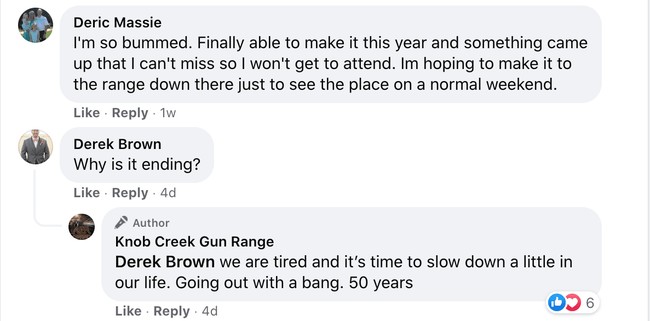
Putting on these events twice a year has to be a major undertaking for the Sumner family, who’ve owned the range for decades. In another message on Facebook, the individual running the range’s account said that “we all agreed the work load is more than we want anymore,” while adding that “most won’t understand until they are in our shoes.”
I believe that most gun owners do understand, just as I imagine the Sumners are well aware of the sadness that many longtime attendees are feeling this weekend. The Knob Creek Machine Gun Shoot has become a legendary experience in the 2A community, and while it’s not the only machine gun shoot around, it’s perhaps the biggest and certainly the longest-running event of its kind.
So when last tracer round is fired on Saturday night, the 50-year history of the Knob Creek Machine Gun Shoot will come to an end. I know I’m not alone in hoping that after a little break the Sumners decide to bring the event back, but for the moment it sounds like they’re not planning on revisiting their decision. Thankfully the range itself will remain open for business, and I’m still keeping my fingers crossed that we haven’t heard the last enormous boom echo across the hills of Bullitt County.