Category: All About Guns
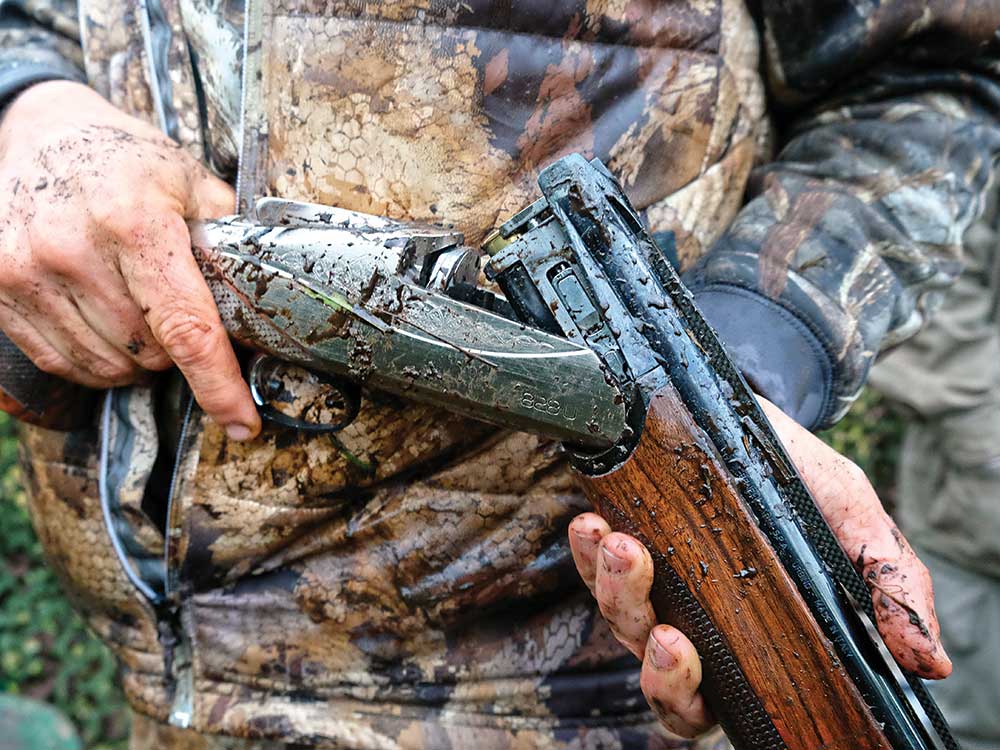
In Uruguay, the Benelli took a mud bath but kept on firing. Andrew McKean

Iwas skeptical when the folks from Benelli invited me to take their first-ever over/under shotgun on a high-volume South American bird hunt last year. I didn’t think the lightweight 12-gauge, called the 828U, could take the abuse that thousands of shells can deliver to a gun in a single day. I’ve seen robust semi-autos fall to pieces in the dove fields of Argentina. But even more personally, I wasn’t sure my shoulder was up to the punishment of the daily pounding of spicy dove loads, interspersed with a steady diet of magnum duck loads. After all, the 828U with 28-inch barrels weighs only 6.6 pounds and feels even lighter.
But Benelli was persuasive, so I packed a recoil-absorbing shoulder pad—my hunting buddies call it a “sissy pillow”—to help tame the kick, and I headed to Uruguay’s bird-rich interior to hunt doves, ducks, and perdiz, the so-called false partridge of the pampas.
A First for Benelli
The name Benelli, of course, is synonymous with semi-automatic shotguns. The Italian company’s family of inertia-driven guns includes the versatile M4, M2, Ethos, Super Black Eagle, and Vinci. When Benelli announced it would produce an over/under, brand loyalists sniffed almost as dismissively as connoisseurs of traditional Italian doubles. No way could a stodgy over/under continue the company’s reputation for technologically advanced operation, pronounced the former. No way could a double-barreled Benelli, with its modern styling, perpetuate Italy’s standards for Old World craftsmanship, denounced the latter.
What I discovered in Uruguay is that the 828U is very much a 21st-century over/under. It is elegant, in the same over-the-top way a Baroque castle is elegant, layered with rococo flourishes. And, like other Benellis, it is technologically advanced. The 828U packs more features into what is at heart a simple mechanism than you’d notice from its glammy exterior.
Aft of the cryogenically treated—and distinctively separated—barrels, the Benelli’s steel breech block mates into steel races machined into its weight-saving aluminum receiver. The design contains pressure to the barrels and doesn’t allow it to transfer to the floating bolt face or to the hinge pins, the linkage that is often first to fail on traditional over/under shotguns.
That’s a great attribute for a high-volume shotgun, but my shoulder celebrated the Benelli’s less visible technology: recoil-eating buffers embedded in the stock. The polymer fingers flex in proportion to the directional recoil exerted by charges of different intensity. A light target shotshell might trigger only one level of buffers. A high-brass field load might activate two levels, and a magnum duck load might bring the whole system of baffles into play.
A recoil-reducing gel pad in the comb and a shim system that allows shooters to customize cast and drop to their anatomy—as a lefty, I like a little bit of cast—makes the 6 ½-pound 828U a pleasure to shoot with almost any load. I didn’t need my sissy pillow after all.

The Birds of Uruguay
So far, so good. But how would the gun handle the variety of bird hunting that David Denies’ Uruguay Lodge would throw at us? Our first shoot was for eared doves. Our group drove into a vast cattle pasture and set up facing a grove of spiky trees that looked like the hawthorns of my native Missouri. It was evening, and doves bombed into the trees looking to roost. Others rocketed across the open pasture. Shots were often tricky and required everything from sustained leads for long crossers to quick points at acrobatic incomers. I went through four cases of shells to down maybe 150 birds, not exactly stellar shooting, but these weren’t the routine 20-yard quartering shots of Argentina, either.
The next morning we hunted ducks, a mix of Brazilian teal, yellow-billed pintails, and rosy-billed pochards. There’s nothing particularly tough about a South American duck hunt. Little hunting pressure and copious amounts of corn make for cooperative birds. But the liberal limits and ounce-and-a-half lead loads gave me ample opportunity to experience the 828U’s ability to tame recoil. My main complaint with the Benelli was that I was limited to only two shots.
Even after the gun went down in the Uruguayan mud—a slurry of cow dung and pampas sludge—the 828U kept performing, though I routinely struggled to hit right-to-left crossers.
Each day, we spent a few hours hunting perdiz, little quail-sized flushing birds that are related to kiwi. Perdiz love to scatter in vast fields of knee-high grass, where they’ll fly only when approached by a pointing dog. It’s a game for wide-ranging dogs and long-legged hunters. And it’s a game for the 828U. Of all the hunting I did in Uruguay, the Benelli was best suited for perdiz. The light gun balanced beautifully just fore of the hinge, and it jumped to my shoulder almost of its own volition.
It handled towering birds and wild flushers. It scratched out doubles on covey rises, and was such an easy-carrying gun, I could have hunted all the way to Paraguay had I not been called away to hunt more doves.

One Gun for Every Hunt?
In idle moments back home—usually when the ducks stop flying—my friends and I kick about a simple question: If you could own only one shotgun, and use it for all your hunting, what would it be? Most of us answer a reliable pump gun, though some favor lighter semi-autos for mornings of geese and afternoons chasing pheasants and grouse, plus the occasional wild turkey.
Not once, in years of asking that question, has someone recommended an over/under. My experience with the 828U makes it an unexpected candidate for the one-gun award.
It is not a cheap gun—the wood-stocked version I shot retails for $2,500. But when you consider all the technology and styling of the Benelli, it’s on the accessible side of Italian over/unders. And its recoil-eating features, plus a mechanism that should never wear out—and if for some reason it does, you simply replace the steel breech—make it an heirloom gun that you can shoot all you want before passing it on.
The best testament I can give the Benelli is that, after my return from Uruguay, I held onto the gun. I wanted to use it for Montana’s pheasant and duck seasons. And to show it off to my skeptical buddies.
Categories
Test – Find the Shotgun!

Categories
Winchester model 1901 10ga
Legendary Marine Colonel John Dean “Jeff” Cooper was possibly one of the greatest ambassadors of the arts of combat shooting. The Colonel was and remains among the most influential thinkers on modern tactical shooting yet his greatest foray into the handgun market was the ill-fated Bren Ten.
WHAT COL COOPER WANTED IN A HANDGUN
Though he often taught pistol with 1911s, Cooper was a fan of the Czech designed CZ-75, a 1970s double stack 9mm with great ergonomics. The Colonel liked everything there was about the CZ, except its caliber, deeming it too low-powered. After reading an article Cooper wrote about the CZ and its perceived limitations, two like-minded gunmakers, Tom Dornaus and Mike Dixon, reworked the basically public domain design, stretching it out to a 10-shot doublestack magazine holding .45 ACP.

Bren Ten in 10mm. note the Cooper Raven on the frame.
This gun in hand, they went to talk to the Colonel.
PROTOTYPES
Dixon and Dornaus brought Colonel Cooper in as an unpaid consultant and he liked the potential of what
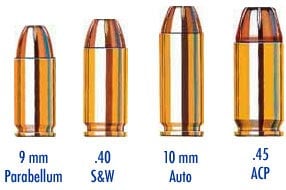
Comparison of pistol rounds including 10mm.
the D&D guys called the CSP-80 (Combat Service Pistol of 1980). This early gun used a short recoil operated, locked breech semi-automatic pistol with a Browning Hi-Power style linkless system. Cooper suggested they change the caliber from .45 ACP to a new (and very hot) .40 cal. round and even offered the use of his signature raven image to grace the gun’s frame. The .40 Special morphed into the 10mm Auto once Norma in Sweden got a hold of the design, while the CSP-80 designation was changed to Bren (after Brno the town that the CZ plant is in). The Bren Ten was christened with the ‘Ten’ alluding to both the caliber and magazine capacity.

Bren Ten above Jeff Cooper’s signature raven insignia.
FINAL DESIGN

Bren Ten diagram.
The final design incorporated a single-action/double action capability with the ability to be carried either cocked and locked (like the 1911) or with the hammer down. The gun had a huge tactile loaded chamber indicator down the right hand side of the slide, a firing pin safety, and a thumb safety. Aggressive front and rear grooves and the pebbled grips gave the large framed handgun a good level of control. The Bren Ten used so-called Power-Seal rifling which advertised better accuracy at long range. This, coupled with the spicy 10mm round made the pistol fully capable of taking game or winning combat engagements out to 50-yards and beyond.
It was very rugged with an all-carbon steel frame and slide; just plain old 1980s sexy. This also meant the gun was quite heavy, at 38-ounces with its 5-inch barrel and 8.75-inch overall length. By 1982, the gun was being rushed into low-rate production by the newly formed Dornaus & Dixon Enterprises, Inc., and soon appeared in the hands of fictional Miami Vice detective Sonny Crockett. But we are getting ahead of ourselves.
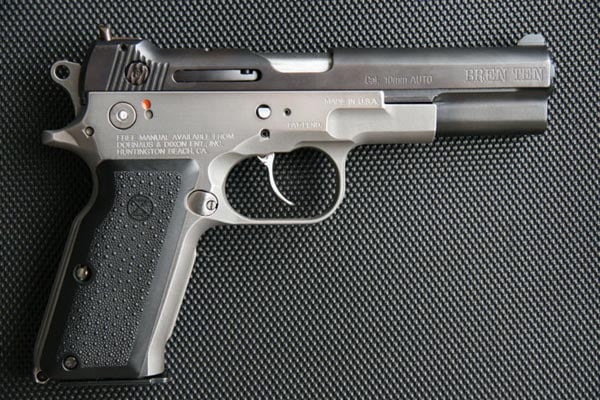
Bren Ten standard.
TEETHING PROBLEMS
When we said ‘rushed into production’ we weren’t kidding: the Bren Ten went from the drawing board to the field in just under three years. Unfortunately, this made the first customers essentially beta testers and when minor problems came up with the gun’s handling, warranty issues threw a wrench in the assembly line. Some early Brens even shipped without magazines, as supplies that worked (the original Mec Gar mags did not) were low. While this wouldn’t have hurt a large company like S&W or Ruger, it was disastrous to a new gunmaker with a single product line.
Shooting the Bren 10 with the original load was a beast, compared by many to ripping a .44 Auto Mag. Even with today’s underpowered loads it has stout recoil due to the high bore axis incorporated into the design. There are a number of Brens floating around that have suffered slide failures or even frame fatigue after firing a good bit of the old ‘single malt’ 10 mil ammo. Rare but significant problems like these further contributed to the gun’s demise. The ammo itself never caught on in its full power loadings and almost died out in the 1990s had it not been for the Colt Delta Elite and the S&W 1006.

Even two tones couldn’t save the Bren Ten.
Despite all of these fatal flaws, the gun was still a good, strong attempt at being perfect and much like the legend of Icarus, the boy who learned to fly but got too close to the sun, the Bren 10 was something of an over-reach. In an attempt to expand, the company tried to introduce variants such as an all-black “Special Forces Model” as well as a chromed slide model (similar to the one carried in Miami Vice), but it was just adding lead to the balloon.
Construction costs of such a strong firearm, coupled with the limited operating capital of a small business, compounded by warranty work on early guns proved too much for the company and Dornaus & Dixon shut their doors in 1986. Cooper himself even admitted the pistol was “not entirely sound” in 2004.
OTHER 10MM PISTOLS
Today the 10mm auto pistol is still around with the Glock Model 20, Colt Delta’s and legacy S&W Model 1006’s being readily available for much cheaper than the D&D special. Vltor teased the market for years with bringing a redesigned Bren Ten back as the ‘Fortis’—but no guns ever showed up.

The never released Vltor ‘Fortis’, a redesign of the Bren Ten.
In the 1990s, Tanfoglio of Italy, known for their EAA Witness series of CZ-75 clones in 9mm and 45ACP, brought out a 10mm Auto version. This gun was many of the things the Bren Ten tried to be but wasn’t, yet
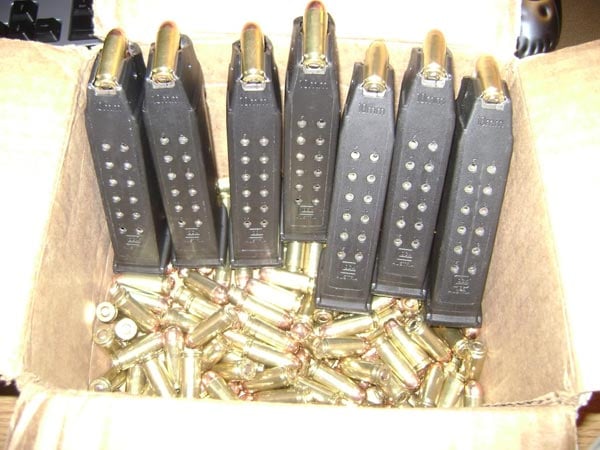
A big ol’ box of expensive 10mm ammo.
still suffered from cracked slides if shot often with hot ammo. However, these spaghetti 10-millys can be found for around the $400 mark—which may leave some change to put towards the rare ammo.
Speaking of which, current 10mm Auto that is on the market from PMC, Hornady, Federal, CCI and others is loaded much lighter than the old school stuff the Bren Ten was made for and as such is often snidely called “-P” because of this fact. Even this compromise ammo is expensive, with current Gunbot quotes all going well over $1 per round.
COLLECTABILITY TODAY
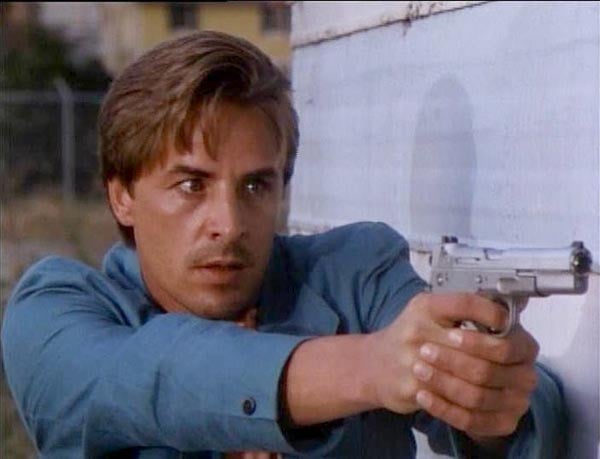
Sonny Crockett (Don Johnson) levels out a Bren Ten on Miami Vice.
Genuine Dorius and Dixon B10s in good condition, especially with the correct plain white craft paper box with the manual, are crazy rare. Just under 1500 of them left the factory before and collectors have snatched most up. The early Miami Vice tie-in has also ensured that a generation that grew up watching Crockett and Tubbs will keep an interest in these rare hoglegs.
The Standard Model is the most common of these rare guns with the slightly shorter (4-inch barrel) Special Forces guns bringing higher prices. When we say higher prices, we mean don’t expect to get a real D&D Inc. Bren Ten Standard for less than $2K.
Pastel shirts, designer stubble, and Ferraris’ not included.

Categories
[Review] Smith & Wesson Model 686+
Revolvers don’t get enough love.
We live in an age of All Things Tactical from our poly pistols to our not-a-45-ACP 1911s.
Then there’s the rampant wearing of 5.11 cargo pants and ‘Merica shirts. So, where has all the revolver love gone?
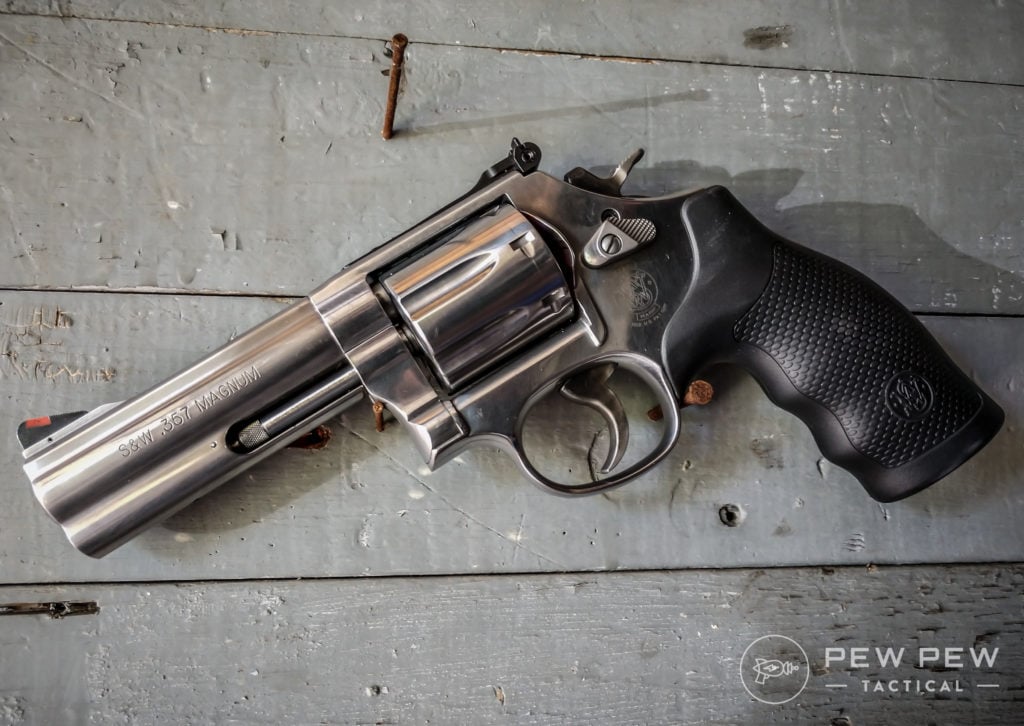
It’s fallen by the wayside thanks to the greater capacity and simplicity of semi-autos and I think that’s a shame.
If you want to be a well-rounded shooter you need to learn to run a revolver.
Meet your “My First Revolver”, revolver: the Smith and Wesson Model 686.
Into The Weeds
The 686 can trace its lineage back to 1981, making it not quite as elderly as other revolvers out there. It’s basically the stainless version of 1980’s blued Model 586.
Smith and Wesson designed it to be a reliable, accurate gun that gets used, not a safe queen or casual pocket carry pistol. The 686 is meant to be used.
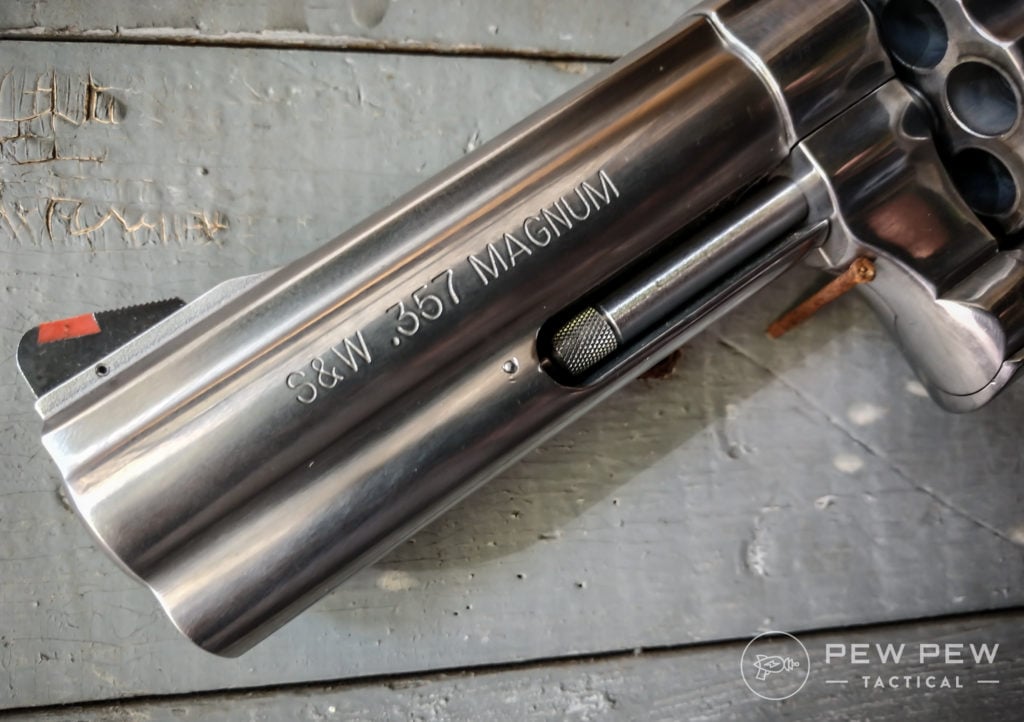
Details for the detail lovers.
The 686 was created based on the older K-frame .357 Magnums that were, at the time, favored by a ton of law enforcement (I’m speaking of the Model 19 and Model 66).
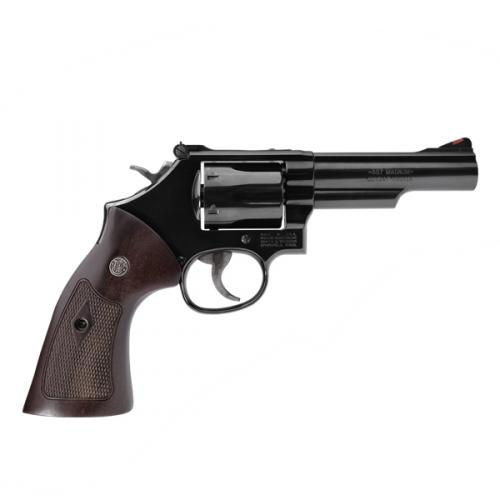
This model is built on an L frame, a size similar to the K only with a larger cylinder and a bit more heft in general.
There have been multiple iterations of the 686 – you’re going to hear them referred to as variants and dashes – featuring different barrel lengths and cylinder capacities.
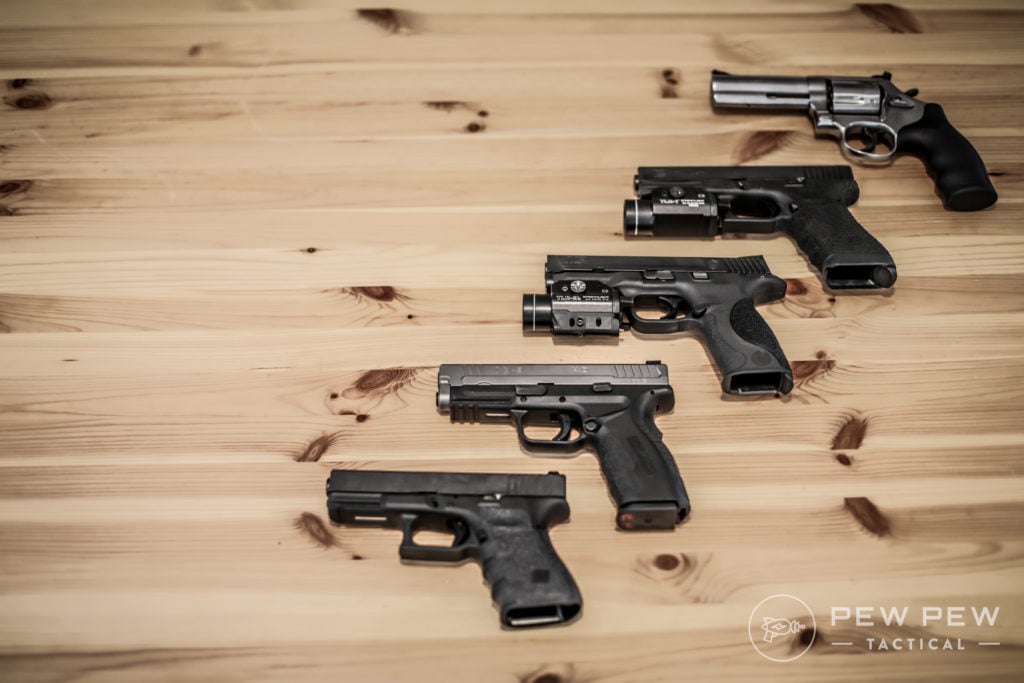
My baby is the 686+, a variant with a seven-round capacity and 4.125-inch barrel chambered in .357 Magnum. Sure, you could also run .38 Special through this revolver, but why skimp on oomph?
The 686P has a slim enough grip to allow a good hold on the gun, magnum rounds or not, and is rather hefty. It weighs in at 39.0 ounces, empty, a big chunk compared to the 21.16-ounce empty weight of my Gen 4 Glock 19.
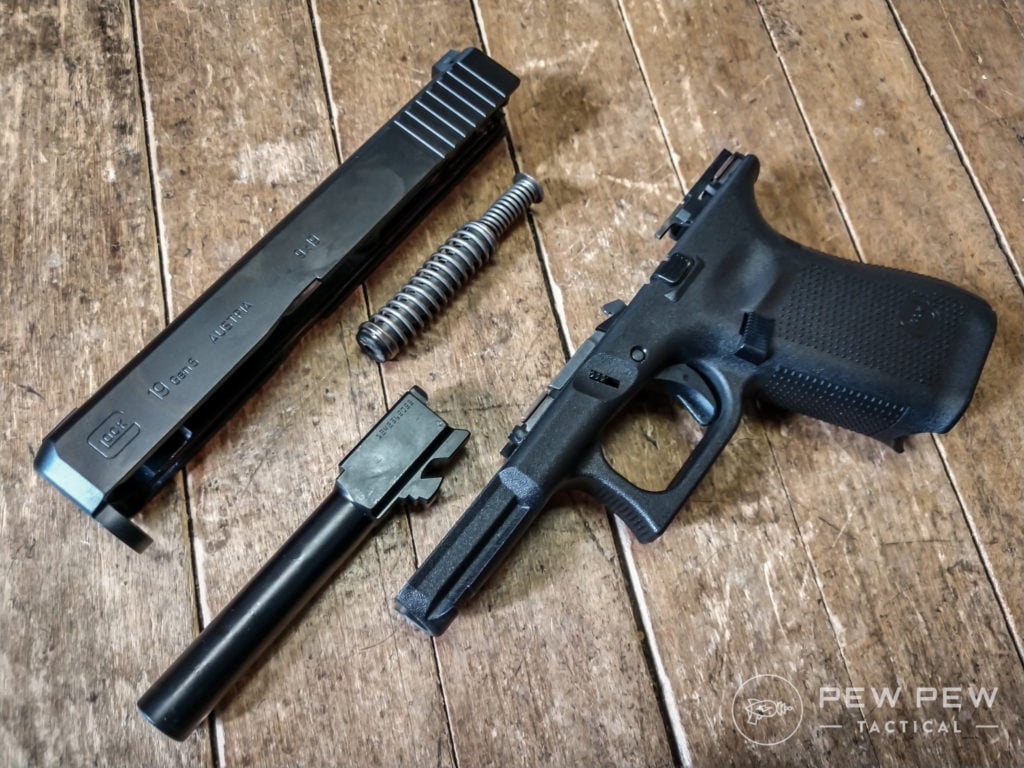
Some of that weight comes from a heavier top strap and forcing cone, important features to mitigate felt recoil and increase accuracy.
Specs include an overall length of 9.56-inches, satin finish, and factory front blade and adjustable rear sights. The gun ships with black rubber grips with finger grooves.
As I mentioned before it’s chambered in .357 Magnum so you can also fire .38 Special rounds through it – .38 Special +P, if you like – and is an L-frame, stainless steel, seven-shot revolver.
Here is our editor Eric shooting his 686+ with 38 Specials.
Revolvers aren’t like semi-autos. There is no external safety, no magazine release, and no slide lock on this DA/SA bad boy, just the hammer and cylinder release, both checkered for smoother operation.
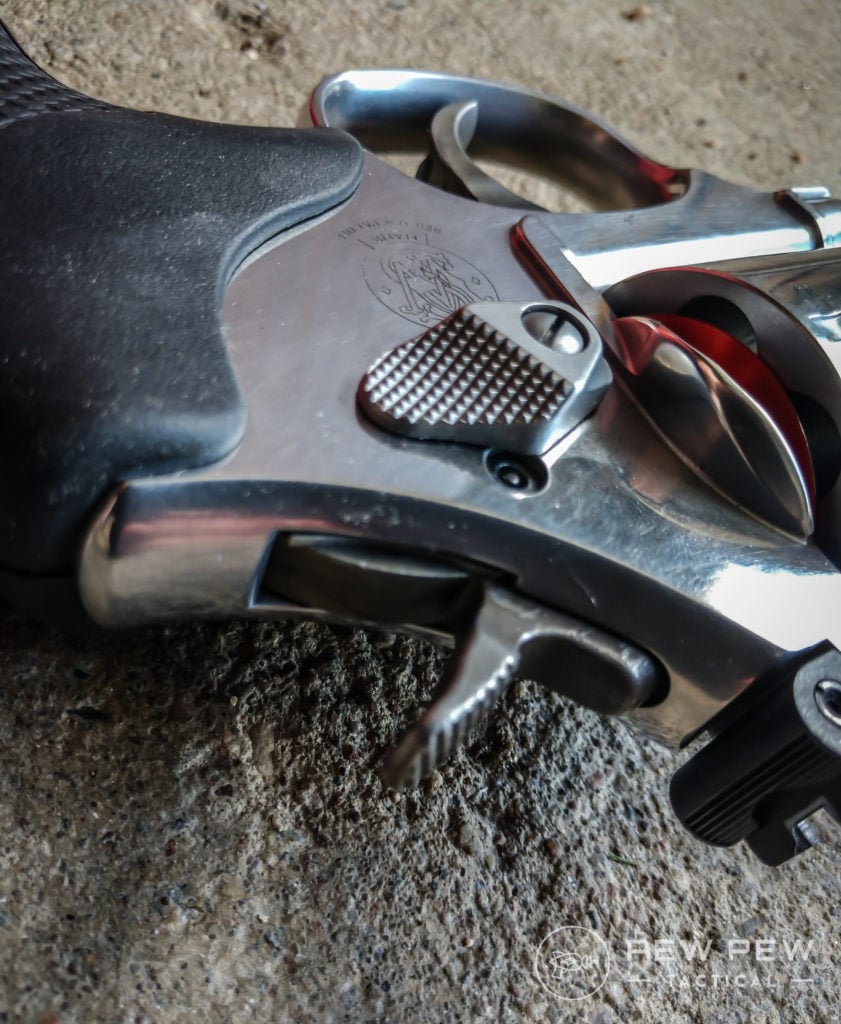
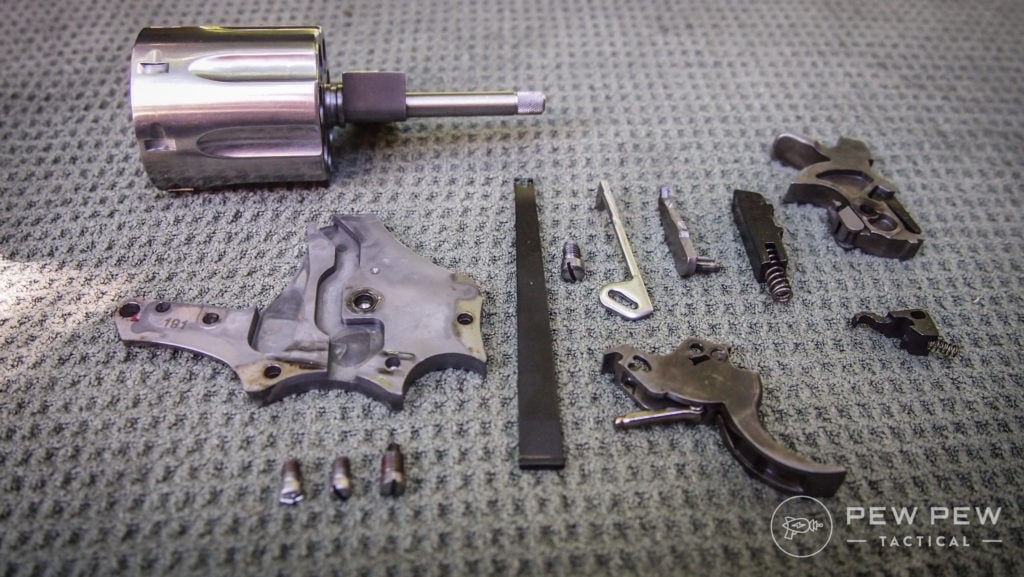
Granted, although revolvers appear simpler on the outside they are a bit more complex internally; if your Glock goes down odds are good you can repair it yourself but if your revolver fails it frequently becomes a case for a qualified gunsmith.
Then again, you haven’t lived until you’ve sorted out the internals of a revolver. Come on, I can’t be the only gun geek here.
Pew Pew
This specific 686+ has seen a lot use over the years and eaten every kind of ammo imaginable.
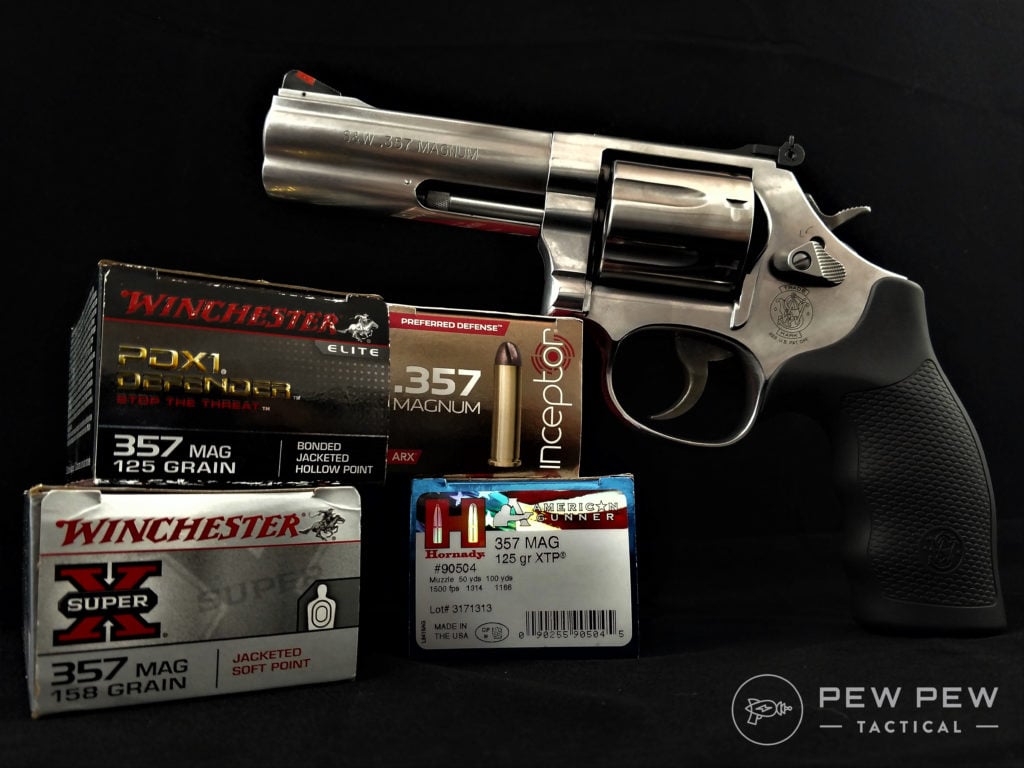
Barnes VOR-TX .357 Magnum 140 grain XPB HPs are a great option but if you want a bit less felt recoil there’s always Hornady .38 Special 110 grain FTX. Don’t do yourself the disservice of using only one or the other.
Make use of the gun’s .357 Magnum and .38 Special capabilities and learn to be fast and accurate with both as well. Oh, and learn to run that trigger DA and SA, not either/or.
The factory rubber grips fit my hands well; some people immediately ditch the grips but they happen to appeal to me. Even the finger grooves fit my hands properly which is not something I can say for the finger grooves on, say, Glocks.
The beefy design of the top strap does make the gun slightly heavier toward the muzzle, meaning it is not as carefully balanced as some of the semi-autos you might be used to using.
There’s one good thing about that weight, though: recoil control.
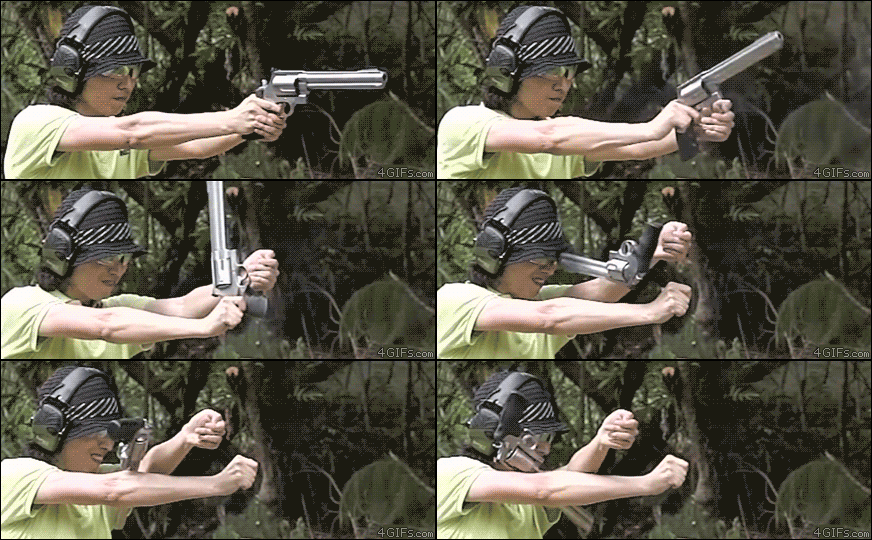
If you run the 686P with .357 Magnum, be prepared for noticeable felt recoil. It’ll take you some trigger time to learn to fire the gun smoothly, especially for follow up shots.
Here is Eric again with full load .357 Magnums…
That doesn’t mean it isn’t accurate; this revolver is precise and performs beautifully offhand and from the bench.
Under 15 yards it is possible to maintain a just-barely-single-hole, five-shot group firing the first shot DA and all other shots SA – that requires me to take my sweet time.
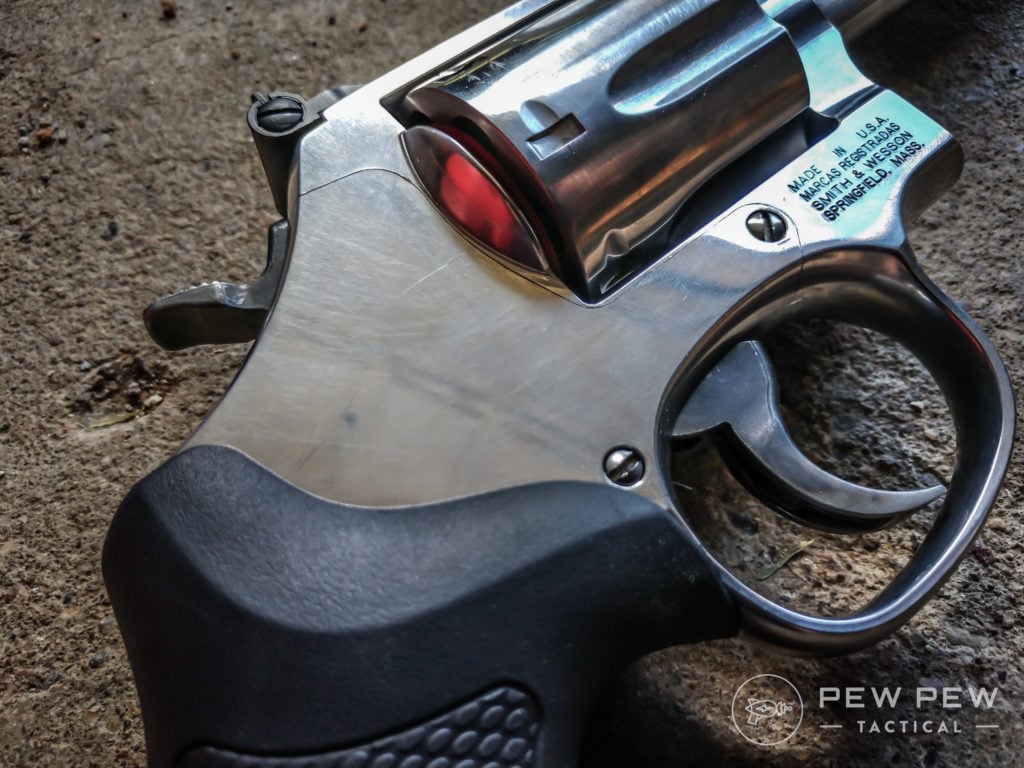
Stretching out to 25 yards, shooting from the bench, the average five-shot group measures around four inches.
Double-action for all shots fired expands my groups at 15 yards to an average of three inches with some exceeding four inches. Again, that’s slow-fire, no rush.
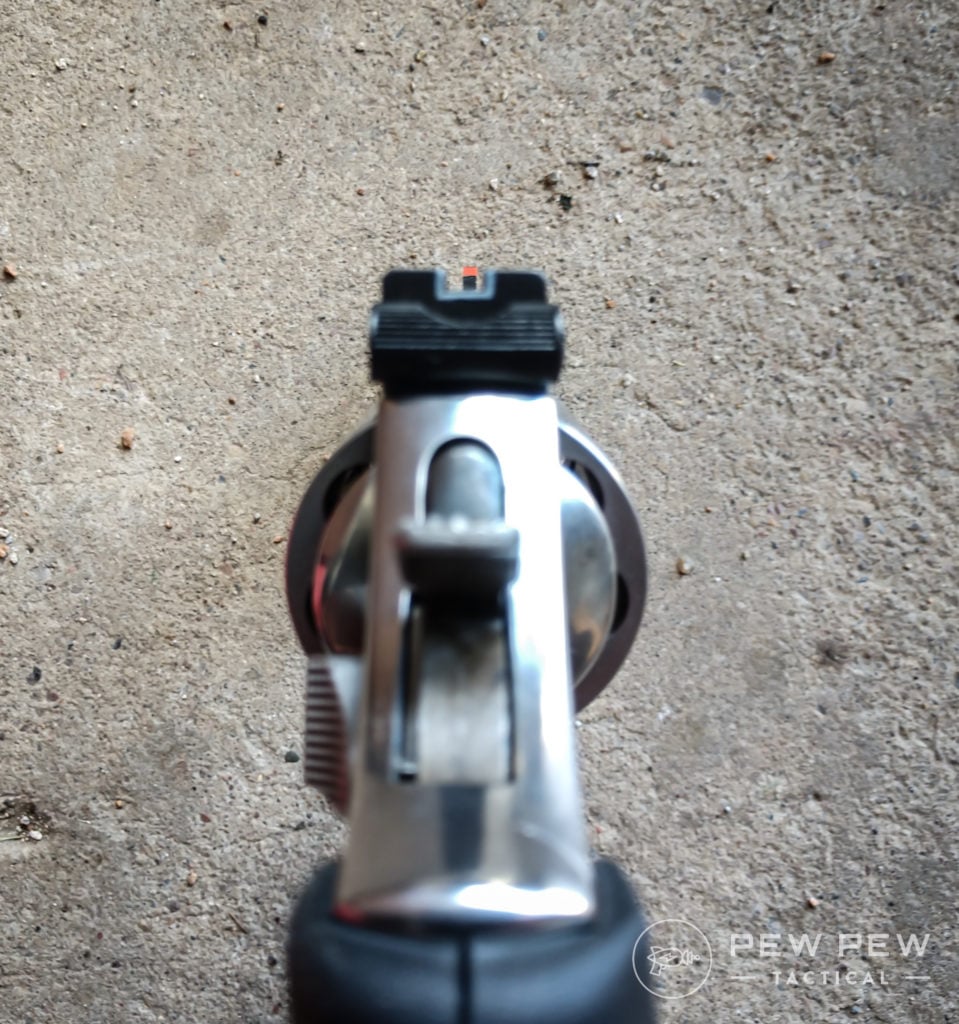
Using .38 Special does take some of the recoil-driven yikes out of the 686P. This is a gun that loves its Inceptor .38 Special 77 grain ARX; shooting offhand at ten yards the gun delivered a five-shot group of 1.3 inches.
Some brands of ammo don’t seem to agree with it especially when you start using +P. For example, Federal Personal Defense .38 Special HST +P use resulted in five-shot groups at ten yards averaging six inches.
So, what happens if you end up rapid-firing the Smith and Wesson 686P? My first disclaimer is to remind you that practice is king. If you don’t put the work in you will not be able to run the gun as well; if you put the work in your revolver skills will be on point.
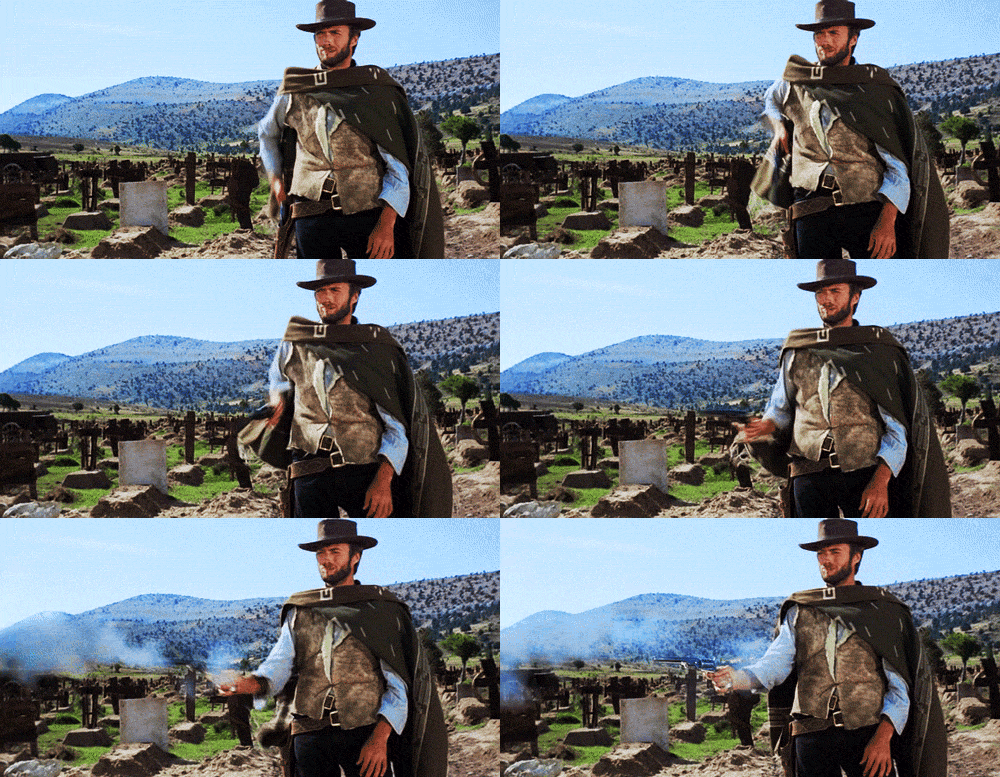
Firing the first shot DA and all other shots SA I can keep most shots in the A zone of an IPSC target but I would not call it pretty. That’s with .38 Special. Switch it up to .357 Magnum and I can just keep shots in the C zone. Practice, guys. We all need it.
The trigger of this gun is worth a mention. Double-action the pull weight is around ten pounds; single-action it drops to 4.3 pounds. The Performance Center did nice work on this trigger.
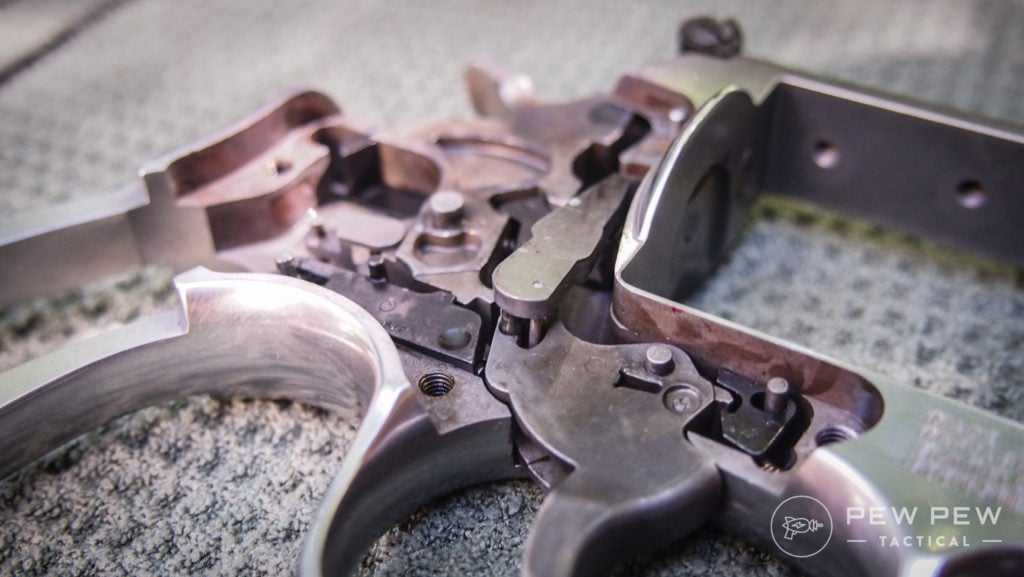
The pull is smooth and consistent when shooting double-action; there is no stacking or grit. Best of all is the crisp, clean break. This is a good factory trigger. Reset is longer than you may be used to from semi-autos, depending on your gun, but it remains workable.
Kudos to Smith and Wesson for producing a nice factory trigger.
If you intend to carry the 686P, be prepared for some differences from carrying a semi-auto.
First of all, is the bulk; the 686P cylinder is wider than a Glock’s frame and the curves of a revolver can be harder to conceal, too. This gun is a bit large for concealed carry.
It isn’t that you couldn’t do it just that it isn’t ideal. For open carry or handgun hunting hogs it works well. You’ll find your drawstroke is markedly altered from drawing a lighter, smaller pistol, so get some practice.
Everything makes it different from the weight to the shape to the overall size. It might feel awkward at first but eventually, you’ll get the hang of it.
Failures
Yes, revolvers can fail. Anyone who claims otherwise either doesn’t know what they’re talking about or…doesn’t know what they’re talking out. In fact, I had a failure with the 686P.
I haven’t tracked round count as well as I perhaps should have but I would guess the gun was perhaps 1500 rounds in when it failed.
It was loaded, the trigger was partially engaged, and the cylinder wouldn’t move. And when I say it wouldn’t move, I mean it would not budge at all. In the end I pulled an old business card out of my range bag to release the cylinder.
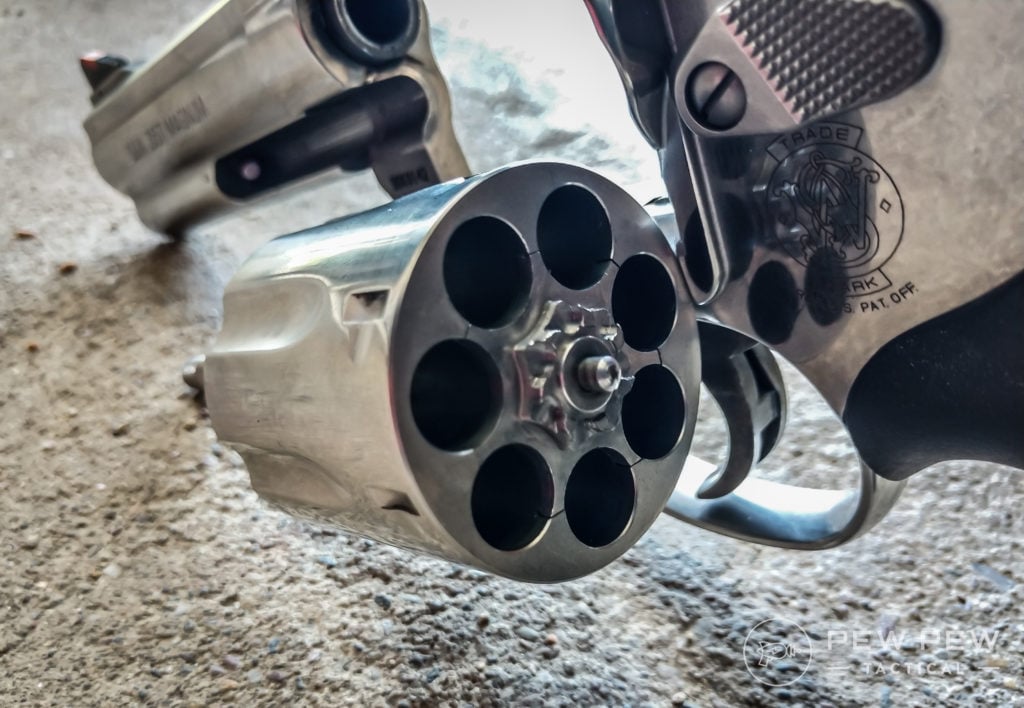
The ejector rod was backing out – not exactly a unique problem – and it was a fixable issue. However, there was no warning; the revolver simply stopped functioning.
Now imagine yourself experiencing this kind of failure while using a revolver to defend your life. You won’t be able to jimmy the cylinder open with a business card and tighten the ejector rod, you’ll be without a gun.
This makes the case for backup guns but should also serve as a warning about revolvers as EDCs. A revolver can make a good EDC but you must be familiar with the reality of failures.
We aren’t talking a tap-rack-bang scenario, we’re talking you’re out of the fight.
Reality Of Revolvers
It’s a good idea to be competent with all platforms. Whether you like revolvers or not you should be able to use one. The Smith and Wesson 686P is a preferred revolver of mine because it’s well-made, accurate, and comfortable.
Yes, .357 Magnum makes it a bit less comfortable and is not my favorite cartridge ever to run through a handgun with a four-inch barrel, but the gun’s bulk really does negate felt recoil.
That said, I would suggest good .38 Special loads if you’re going to carry this gun. In addition, learn to use either speedloaders or speed strips. I prefer speedloaders, personally.
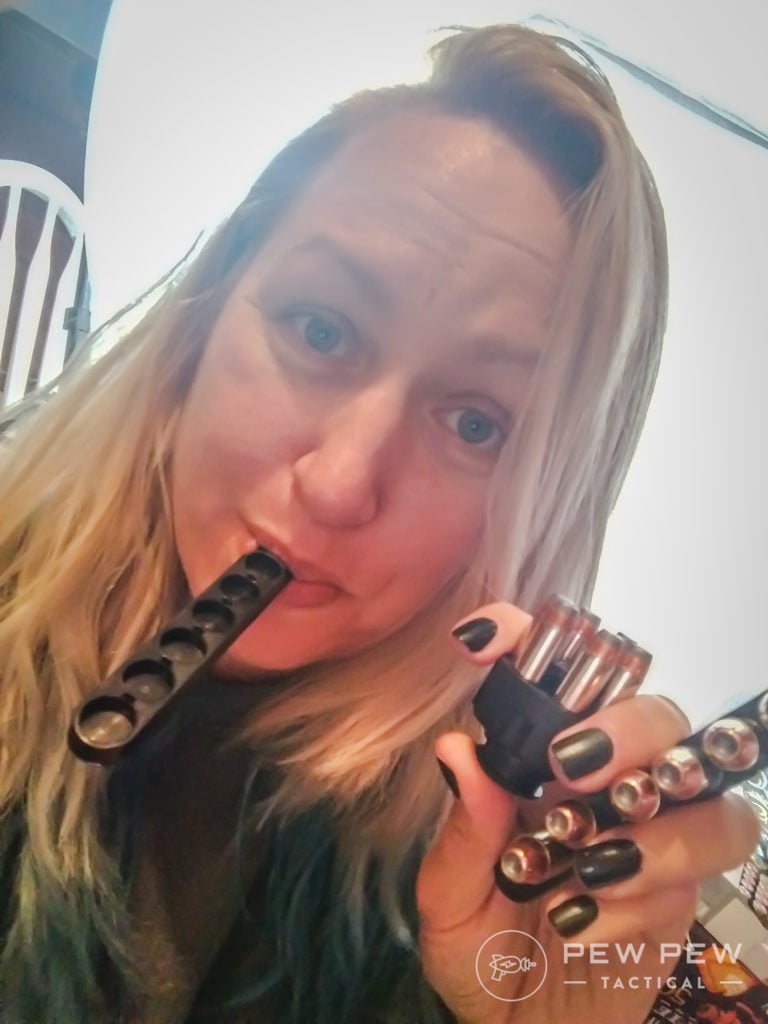
This is a nicely done revolver and a solid choice for your first – or tenth – revolver. Hey, you can’t do Wheel Gun Wednesday if you don’t own a revolver. Spend some hands-on time with the 686P.
It’ll win you over!
By The Numbers
Reliability: 4/5
The 686P is a reliable gun but I’m docking a point for the ejector rod issue. Although it was an easy enough fix it would be a catastrophic failure in a self-defense scenario. Revolvers do tend to fail less often than semi-autos but they also fail in big ways.
Ergonomics: 4/5
Ergonomically the Smith and Wesson 686P is well-done. If you don’t like the rubber grips it ships with, swap them out for something you do like. I like the angle of the grip on this revolver (there are revolvers out there with grip angles I despise). The gun is made for a solid grip and the accuracy that comes with it.
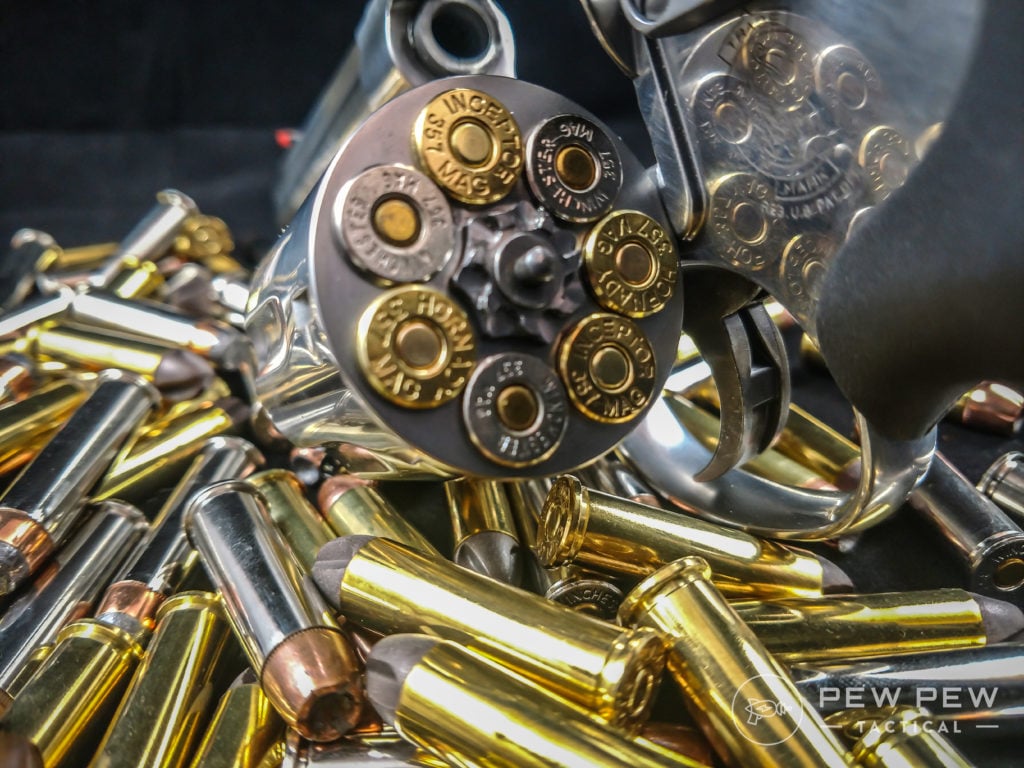
A word on balance. I wish this was a more balanced gun. Having the added weight all in the front makes firing for extended periods more difficult and has a negative effect on accuracy.
Accuracy: 3/5
This one might seem harsh but I’d prefer my carry guns be a little more precise. It isn’t that the 686P isn’t accurate – it definitely is – it just doesn’t produce groups quite as tiny as I’d like from a potential carry gun.
Do I trust it to hunt hogs? Yes.
Could it be used as an EDC? Of course, it could, but you’d better put in the practice. Remember, accuracy degrades when adrenaline floods your system.
Customization: 3/5
There isn’t a lot of room for customizing revolvers. Sure, you could have a gunsmithing genius like Bobby Tyler work it over – and he would do a stellar job – but it’ll cost you.
If you’re doing it yourself, grips are the most obvious part you can change. We also have a guide to Tuning Revolvers. Otherwise, go to a professional.
Value: 4/5
This is a decent value. You’ll probably find it around $700 at your local gun store. If you want a quality revolver for handgun hunting this one is a logical choice; if you want one for EDC this gun might be a bit oversized.
Looking for a good revolver for the range? This is your gun.
Overall: 4/5
Conclusion
The Smith & Wesson 686 is a fantastic revolver with utter reliability, comfortable ergonomics, and beautiful aesthetics. Its accuracy and customization are par for the course. But for a personal protection gun it’s perfect and comes in different barrel lengths and even a Plus model with 7 rounds of .38 Special or .357 Magnum.
So I’ll go ahead and say it.
I love this gun.
Although my go-to for concealed carry leans toward semi-autos I do believe revolvers have their uses. Revolvers can be carried – but for heaven’s sake, carry a speedloader – or used for hunting. Or range time. It’s up to you.
.357 Magnum is a fantastic cartridge, too. Everyone should own at least one gun chambered in .357 Magnum. Just saying.

Written By Kat Ainsworth Stevens