Category: All About Guns
I’m baffled to have received a few messages from readers, suggesting that my article yesterday titled “Self-defense under a justice system that’s no longer on your side” went too far in suggesting that, in certain jurisdictions, we might need to be very careful to leave no evidence behind if we’re forced to defend ourselves, because the law enforcement and justice system authorities there are biased towards the lawless and against the law-abiding.
I don’t think it went too far at all. In fact, I think I pulled my punches too much, if people are still laboring under the misapprehension that the rule of law is still intact throughout these United States. I have news for them. It isn’t.
Please consider the impact of far-left-wing, progressive District Attorneys (DA’s) that have been elected to office in various urban centers (usually with the assistance of massive funding from George Soros and organizations that distribute his support). Consider Seattle, WA; Portland, OR; Philadelphia, PA; Baltimore, MD; Chicago, IL; New York, NY; St. Louis, MO . . . it’s a long list. In those jurisdictions, how many rioters and violent demonstrators have been arrested by police, only to be released without charge by local DA’s? You can research the news reports and other sources for yourselves. I’m sure that by now, the total must run well into four figures across the country. They’re sending a very public message. If you do something illegal, but politically correct, you’ll get off scot-free.
Police forces across the country, particularly those in riot-plagued areas, are losing officers hand over fist as they hand in their retirement papers, or resign and seek employment in areas that appreciate law and order. However, the left-wing authorities in such areas are making it as difficult as possible for them to do so. In some cases, they’re trying to assert their authority over neighboring law enforcement agencies as well, to ensure that they control all police activity affecting their residents.
The latest example comes from Seattle, which is a city so large that it effectively controls King County in Washington state through its voters. Many Seattle PD police officers have resigned, and some have joined the King County Sheriff’s Office, where they continue to serve the people of their communities – but out from under the control of SPD and those in authority over it. Now comes news that the left-leaning King County Council is to ask voters in a referendum to give it greater authority over the Sheriff’s Office, including making the incumbent an appointed rather than an elected leader, abolishing checks and balances that prevent the Sheriff’s Office being politicized, and ignoring the role of the sheriff as defined in state law. It’s very clear why they’re doing this. The thought of a law enforcement agency that’s outside their control is anathema to them. They want to make sure that the KCSO becomes as politicized as the SPD is already. Would you feel “protected and served” in King County if they get their way? I know for sure I wouldn’t.
I agree that many of our police forces have overstepped the mark, and need to be reined in. I’ve said as much in these pages often enough. However, the “bad cops” who do that are, I think, outnumbered by the “good cops” who want to maintain law and order, and in doing so serve the communities where they live. How are those cops being treated by the authorities? In most cases, they’re being described publicly as part of the problem. Talk of “defunding the police” is a slap in the face to their law enforcement authority, and emboldens those who hate them. No, hate is not too strong a word. When BLM activists chant, on camera, “Pigs in a blanket! Fry ’em like bacon!”, I submit there’s only one way to understand those words – and it’s not as an invitation to a peaceful neighborhood game of tiddlywinks.
Progressive, far-left-wing DA’s are openly siding with anti-police activists these days. Just look at Philadelphia, where the Soros-supported and -supporting DA has threatened criminal charges against federal law enforcement officers that the President is sending to his city. He’s trying to intimidate them before they even arrive. Look at the reaction of various progressive, far-left-wing mayors who’ve protested the (entirely lawful) actions of Federal officers in defending Federal property against rioters in their cities.
In many ways, such “in-justice system” officials are fouling their own nests, and the jurisdictions where they operate. Consider St. Louis, where it’s emerged that a senior prosecutor in the DA’s office actually instructed a police crime lab to tamper with evidence. He then allegedly used the altered evidence to bring charges. That’s a felony under color of law – but did he care? Like hell he did! If I were a defense attorney, I’d be rubbing my hands in glee at the thought of calling for the dismissal of all charges against my client(s) on the grounds of egregious prosecutorial misconduct. Whether or not that’ll happen is up to local courts, of course. One wonders how objective and non-partisan they are. I suspect we’ll soon see. Meanwhile, I can only refer readers to my article yesterday. Do these events in St. Louis help to illustrate why I wrote it? They should.
Consider a pro-police rally in Denver, CO last weekend that was attacked by anti-police activists. It’s now emerged that the police commander on scene gave a “stand down” order and allowed the attack to continue, rather than protect the peaceful demonstrators against the thugs. Impartial policing? Protecting and serving? Law and order? Well, so much for that . . .
Michelle Malkin was one of the speakers at that rally. She comments:
The America you grew up in is not the America we live in now.
One nation under God? Ha.
Land of the free? Ha.
Domestic tranquility? Ha.
Equal protection under the law? Ha.
The right to bear arms? Ha.
Freedom of speech? Association? Peaceable assembly? Ha. Ha. Ha.
It’s not “socialism” or “communism” under which we suffer. Our dangerously chaotic, selectively oppressive predicament is more accurately described as “anarcho-tyranny.”
. . .
The toxic combination of “pandemic panic” and “George Floyd derangement syndrome” has thoroughly destroyed the home of the brave. It is a paradise for the depraved and dictatorial.
Anarcho-tyranny is how hoodlums can toss statues into rivers with impunity, while citizens disgusted by Black Lives Matter street graffiti are charged with “hate crimes”—as David Nelson and Nicole Anderson in Martinez, California, were by a George Soros-funded district attorney two weeks ago.
Anarcho-tyranny is how rioters can shut down highways and byways on a whim without fear of arrest, while commuters trying to escape the window-smashing barbarians obstructing traffic are charged with “assault”—as poor Jennifer Watson of Denver, Colorado, was this week.
. . .
Anarcho-tyranny is how 1,000 black militia members can take over the streets in Georgia and point their guns at motorists as they demand reparations, while white citizen militia members in Idaho, Utah and New Mexico have been smeared publicly as racists and face injunctions for peacefully defending their neighborhoods.
Where do the police stand in this regime? It pains me to say it, but those of us who have backed the blue so loyally and vocally can no longer do so under the assumption that the blue will back us.
. . .
It was rank-and-file cops in Denver who watched as my patriotic friends and I tried to hold a Law Enforcement Appreciation Day this past Sunday and were besieged by Black Lives Matter and antifa thugs who had declared that their sole intent in invading our permitted celebration was to “shut us down.” I livestreamed the chaos as pro-police attendees were beaten, including the organizer Ron MacLachlan, who was bloodied in the face and head just a few feet from me by black-masked animals. One antifa actor wielded her collapsible baton just inches from me.
. . .
If we had brandished or used our weapons in self-defense, we’d be facing felony assault charges—as armed citizen Steven Baca is in Albuquerque, New Mexico, at the hands of another Soros-subsidized district attorney.
If any of our men had tried to peel the female antifa thugs off of MAGA ladies who were assaulted, they’d be charged with battery, too—just like Baca.
. . .
So the message is loud and clear. When push comes to bloody shove in end-stage America, under the rule of the anarcho-tyrants, we, the law-abiding, are the enemy. Those in uniform sworn to protect and serve will turn their backs on us because their bosses don’t answer to the public. They protect and serve the mob.
There’s more at the link.
Our justice system has, in far too many jurisdictions, become an Augean stable of corruption, disrespect for the law and partisan political prosecutions. In some cases, District Attorney’s offices may be so far gone that they can’t be cleaned up at all. The only solution may be to fire the entire staff en masse, and start from the beginning with new, non-partisan appointees.
Meanwhile, those of us who are law-abiding citizens and refuse to be intimidated by thugs, rioters and criminals, find ourselves between a rock and a hard place. The letter of the law, and its spirit as traditionally understood, give us the right to defend ourselves, our loved ones and our property (subject to greater or lesser restrictions, depending on where we live). The new, far-left-wing, progressive administrators of our justice system don’t give a damn about that. They want to intimidate us into abandoning our legal rights and allowing the mob to ride rough-shod over us.
If we refuse to permit or tolerate that, we will be targeted by such officials. They’ll try to make examples of us to intimidate others. Witness what’s happening to the McCloskeys in St. Louis. Their actions were entirely justifiable under law – so much so that the State’s Attorney-General has filed suit to quash the charges brought against them by the local DA. However, the DA didn’t care about the law, only about radicalizing the system of justice she administers and making the McCloskeys into an example to all those who object.
I repeat what I said in conclusion yesterday, and urge you to read that article in full if you haven’t already done so.
By observing [the] precautions [that I recommended], law-abiding citizens fearing persecution from a law enforcement system that’s become biased and one-sided can help to make unjust, partisan charges against them much harder to bring, and even more difficult to prove. Sadly, in this day and age, in some jurisdictions, that’s no longer a far-fetched, remote possibility.
If you live in a jurisdiction dominated by such left-wing parasites, you need to very seriously consider leaving before it’s too late. Some of them are, I think, already too far gone to save. Among them I’d include all the cities I cited in the third paragraph of this article, plus a large number of others. Is your life worth the risk that remaining there poses? Only you can answer that question. In my case and my wife’s, we voted with our feet, as have many others of our acquaintance. If you think you can’t afford to leave, due to lower salaries and other inconveniences, I can only ask . . . what makes you think you can afford to stay?
Peter
When it comes to a precision chassis rifle, the Howa HCR hits the sweet spot on accuracy and affordability.
Does the Howa HCR go the distance?
- The new Howa HCR is available in .308 Win., .223 Rem., .243 Win., and 6.5 Creedmoor.
- It boasts a 24-inch barrel with a medium-heavy contour and Howa’s 1500 action.
- Accurate-Mag builds the chassis, milled from 6061-T6 aluminum.
- It successfully and consistently engaged targets around 600 and 909 yards downrange.
- It’s priced reasonably compared to other chassis rifles yet remains highly accurate.
It’s safe to say that I go back a ways with chassis rifles and Howa firearms manufacturing. I’ve hauled around my personal Weatherby Vanguard Back Country in .257 Weatherby Magnum for many years, and because the folks at Howa manufacture the Vanguard action and barrel, I feel pretty safe in saying that the Howa is a top-end barreled action, and well worthy of respect among serious shooters.
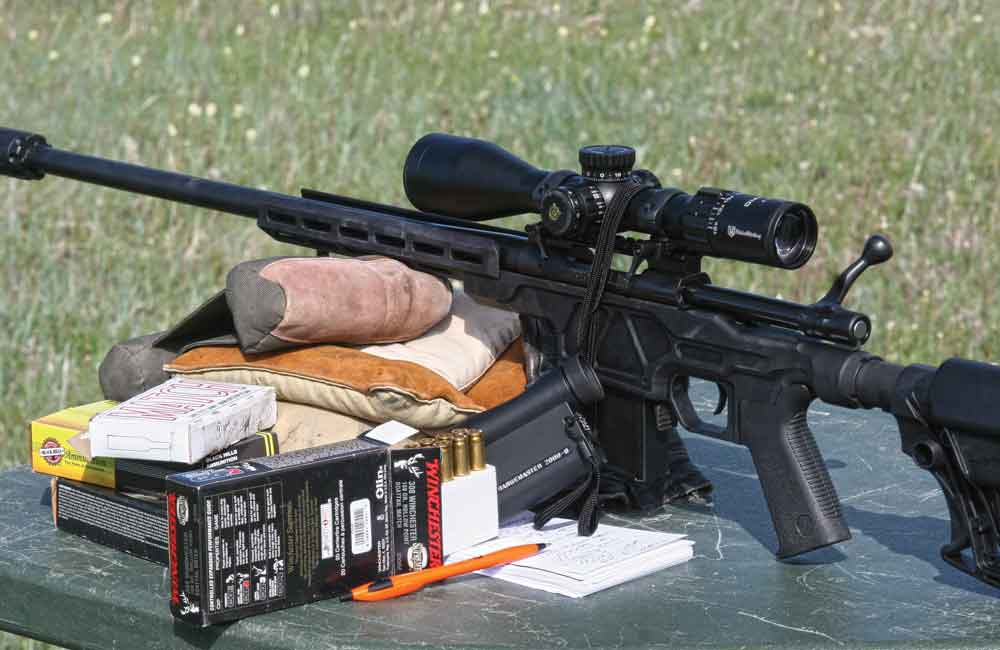
I’m also no stranger to chassis-style rifles. I’ve published three books on the subject of long-range high-performance rifles, and am in the process of writing a fourth, and in the course of researching and testing rifles for those projects, I’ve come across many different chassis rifle designs. In the past 7 years or so, the topic of chassis rifles has figured prominently in my written work. There is no doubt in my mind that this design has completely revolutionized the whole quest for rifle accuracy within the past 10 years. In fact, its promise is clearly evident based on the fact that just about every major rifle maker in the industry is now offering a chassis rifle as part of its lineup.
The Howa HCR chassis rifle is a representative example of the all-metal rifle versus the more conventionally stocked products available to shooters. Long-range, target and military shooters learned long ago that when a barreled action is married to a rifle stock system with a solid bolt-to-frame link up, the end result is no variation of drift or accuracy. The bottom line here is that the total system won’t change the impact point of bullets, as will some of the more standard wood- and plastic-stocked designs.
A Rifle of Many Faces
Howa builds a vast number of different models of the HCR rifle, so I can only state that due to space and time constraints here, the buyer needs to check out a complete catalogue to see all the available offerings. I quit counting the number of different models, which vary in terms of chambering, furniture additions, colors, as well as a multitude of add-on features, at number 110. Yes, there were more. The Howa HCR is offered in a total of 19 base combinations, and each of those retains from six to eight variants as well. While some companies offer a chassis rifle (one or two), Howa pulled the plug out of the bathtub on this deal. Just think about it, they build it as an over the counter box rifle.
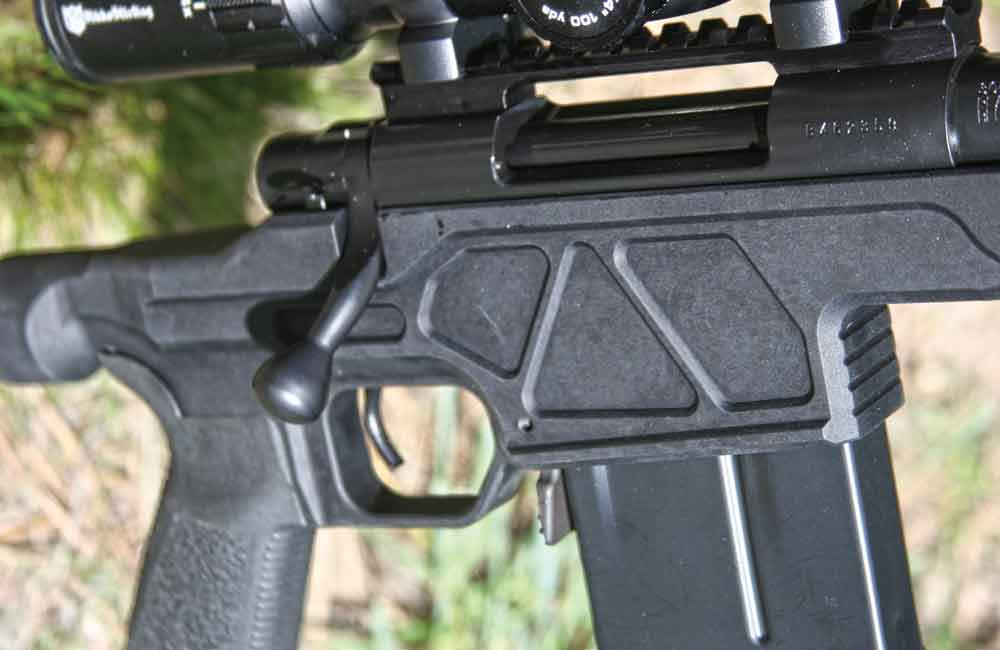
The rifle sent to me by Legacy Sports International/Howa was quite representative of this chassis rifle line. My rifle retained a medium-heavy barrel (.880 inch) that also had the threaded muzzle with steel cap installed as a suppressor-ready system. The HCR, being chambered in .308 Winchester, is also available in .223 Rem, .243 Win. and 6.5 Creedmoor. The .308 Winchester model utilized a 24-inch barrel with a 1:10 twist (right hand). When the rifle is ordered in the 6.5 Creedmoor or .308 Winchester, a longer 26-inch barrel can also be obtained as another option.
The receiver of the chassis rifle is the basic Howa Model 1500, which is CNC machined from a single steel block. As a “short action” throw, this push-feed twin-lug bolt travels 4.540 inches. Howa changes the bolt travel length based on cartridge length. Receiver controls consisted of a left-side bolt release that is simple to use and a sliding thumb safety on the right side of the receiver’s rear. The 10-round AI-style Accurate-Mag box is coated so as to aid in smooth magazine well function.
The forend and receiver base housing is built using 6061-T6 aluminum. This is not grandma’s pots and pans aluminum but rather a special blend to aid in strength retention, and it offers some ability to fight off field wear as well. This complete chassis is built by Accurate-Mag with a free-floating M-LOK mounting system.
Again, one of the outstanding qualities of a chassis rifle is that they all make use of a barrel that stands alone down the forend tube, being attached only to the receiver ring itself. The butt stock as a system is AR styled with full length of pull and comb adjustments on board. This system is the LUTH-AR MBA-3, and it provides six-position adjustment for length by way of the AR-style primary tube. The chassis stock is also adaptable in terms of add-on AR-type accessories. Whereas the rifle could be used for competitive shooting, varmint applications or informal long-range steel shooting, it has been built with the ability to become exactly what the shooter desires.
The trigger on this Howa HCR is a two-stage system with a measured break of 2 pounds, 9 ounces, based on my Timney trigger scale. The trigger is very smooth, with a clean, sharp let off. I’ll talk more on this later when I cover accuracy testing.
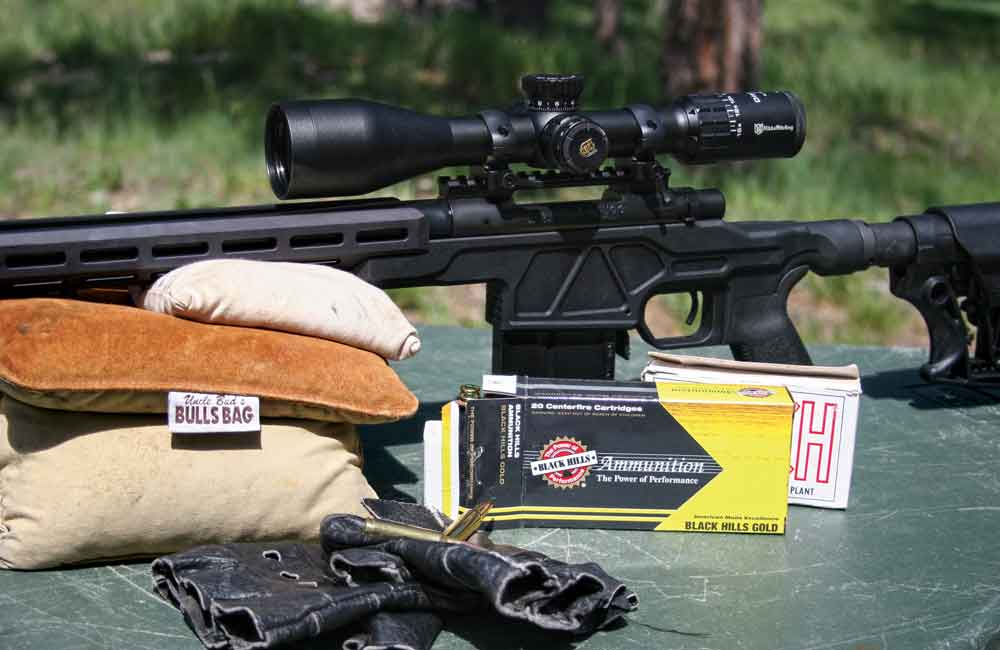
As a package rifle — and all of these systems are just that, with many options available to the shooter — my test rifle retained a set of high rings and bases that locked onto a 20 MOA angled, Weaver-style rail. The scope used on this rifle was a Nikko Stirling Diamond Long Range. This glass features a 4-16×50 optic with MOA graduations on a large volume turret setup. With 4 MOA available off the reticle directly, the second focal plane system was without question set up for direct turret elevation applications.
When under live fire testing at extended ranges, it becomes evident that this rifle was set up for long-range applications. And at its fair price of less than $1,600, it’s an affordable option to budget-conscious shooters looking to make the jump into long range. Included in this package system is a complete bottom metal system in the event the owner wants to set a standard plastic or wood stock system against the barreled action for lighter carry weight for use in hunting applications, etc. The short form here is that Howa has thought of just about everything in terms of marketing this rifle to serious long-range shooters.
DownRange
With bad weather closing fast within the week on the great western Dakota prairie country, getting out to the range and performing an accuracy test before the weather worsened was vital. I needed to establish a zero with the scope and then shoot and measure some representative groups at 100 yards. Once I established a zero at 100 yards and shot several groups, my next step would be to stretch the Howa’s legs and see how it performed at long range.
When shooting for groups at 100 yards, I found that the new Sierra (Tipped MatchKing) TMK 168-grain bullet handloads I had loaded off my old RCBS C frame at home using military match cases and Varget powder had taken top marks. The best three-shot group with this Sierra handload measured .770 inch. Later on in testing, I would use this same load for the lion’s share of the work on the long-range targets.
I continued to use the Sierra TMK projectile, but this time a 155-grain offering from Black Hills Ammunition, and it produced a best group of .862 inch at 100 yards. The final entry selected as a test round would be Winchester’s 168-grain HPBT Match load. This round again produced solid groups of .972 inch during the zero process and did well in green-bore shooting prior to going long with the now prepped and seasoned rifling.
I mounted a 12-inch Mack Brothers “Varmint” series suppressor from Dakota Silencer, Inc., to the Howa’s 24-inch barrel, ending up with a combined length of 36 inches. This would do two things for my long-range shooting. First, it would increase velocity at the muzzle regardless of the bullet or load, and secondly, it made for an almost recoil-free environment when I tried to follow my bullet impacts (splash) for target correction at long range.
In general, and this is mostly just a WAG (wild ass guess), the .308 168-grain bullet, by my estimations, would now carry as much velocity at 3,400 feet above sea level as would the .30-06 Springfield round at sea level. I do know that going from shooting at sea level to shooting at 13,000 feet in the mountains changes everything about a bullet’s performance downrange. Based on this element of performance enhancement, the Howa HCR in .308 Winchester had a good chance of showing some good stuff against targets even a half-mile or more away.
Open Range
With zeroing, bore prep and a general shakedown of the rifle completed on day one, I then turned to a second morning out on the vast South Dakota prairie. This time my focus would be on engaging selected targets at long range. I set up my portable bench rest and ranged a target out at just under 600 yards, based on readings from my Leica 2000 rangefinder.
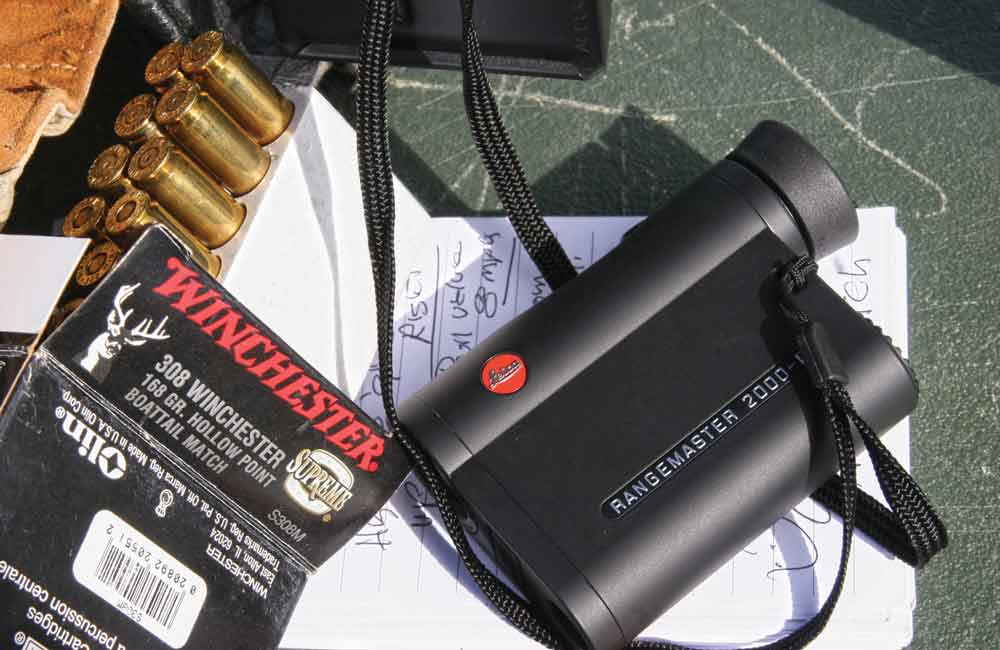
Clicking 12.6 MOA up on the scope’s turret, based on my pre-configured DOPE, I then pushed a full MOA into a 35-percent value cross wind of 8 mph and gusting. I sent the first round, one of my 168-grain Sierra TMK handloads, downrange at a basketball-sized round boulder. At the shot, the earth erupted just over the top of my target, sending a cloud of dust into the air. With a single click correction, the next round returned a solid slap and rock chips went everywhere.
With two more confirming shots on the small boulder, and then two additional solid hits, I turned my attention toward a small dark rock against a high butte that the Leica measured at 909 yards downrange. The target measured about 25 inches in size, and the range required a 26.3 MOA click adjustment from zero. I had a wind advantage now, as my shot would carry in an almost following airflow. It took two rounds to get zeroed on the target (visual splash), but round three slapped dead on, and that shot was followed by a series of eight timed shots that produced three solid hits and two skimmers against my almost 1,000-yard small boulder target.
Shooting on the third day afield produced some very interesting target events. I wanted to test the Howa HCR on a warm target, and with that in mind, I searched out a 100 or so acre prairie dog town that stood above a large stock tank.
From a static position, I let loose some of the Black Hills 155-grain Sierra TMKs at dogs ranging from 174 to 300 yards. Dialing up or down, and taking my time by keeping my suppressor and barrel cool, the rifle flat out performed like a well-oiled machine. Over the course of an hour’s time, I had 27 kills and four missed dogs stacked up to the rifle’s credit.
Additional fun, however, came when I cranked up on the turret adjustments and then sent some Winchester 168-grain Match rounds out to 799 yards, and straight through the passenger window of an old junk Desoto. Many readers here might not even know what a Desoto is, a dead giveaway as to the car’s age, and mine as well for that matter.
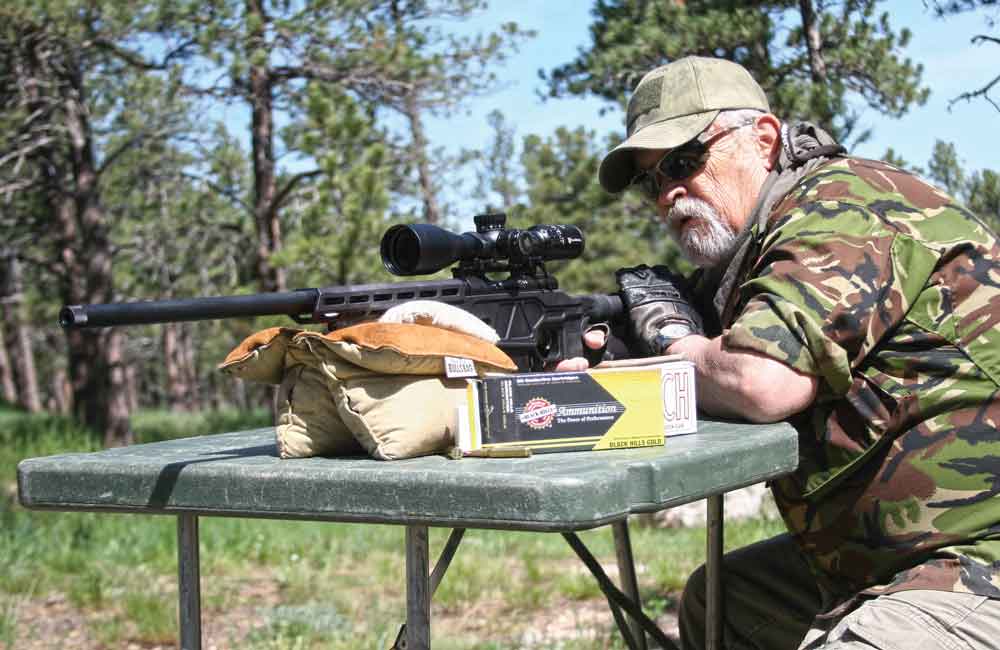
I spent the next hour shooting parts off junk pile vehicles at one half-mile away. I quickly came to the realization that the Howa HCR in any of its massive number of variants will shoot right along with any of the high-grade long-range systems on the market today. The only thing holding this rifle back from the super one-mile-plus rifles is cartridge size, bullet weight and muzzle velocity. Until the .308 cartridges used in this test went transonic, the Howa HCR did everything required of it and more.
Specifications:
Howa HCR
Type: Bolt-Action, Chassis
Caliber: .308 Win., .243 Win., .223 Rem., 6.5 Creedmoor
Action: Howa 1500
Barrel: 20 to 24 in.
Overall Length: 39 to 47.25 in.
Weight: 9 to 10.5 lbs.
Finish: Black, Multicam/FDE, many options
MSRP: $1,239 to $1,725
Editor’s Note: This article is from the August 2017 issue of Gun Digest the Magazine.



They’re not exactly what we might call “moderate Democrats” by any stretch of the imagination.
Unsurprisingly, they’ve had issues with gun rights in this country, as the archives of their website clearly illustrate.
But that was then, this is now. In the now, we have Russia invading Ukraine.
As noted, the Ukrainian government handed out a pile of AK-47s to any citizen who wanted one to fight the Russian invasion.
It seems OccupyDemocrats is now in support of armed citizens.
So now citizens with guns are a good thing?
How long ago did we hear from people like them telling us that our AR-15s would be useless in fending off a modern army? That they’d be ineffective against tanks and jet fighters?
Now, Ukrainians are facing a modern army with tanks and jet fighters and OccupyDemocrats are tripping over themselves to praise armed citizens.
It’s absolutely hilarious to see.
I’m not alone in thinking that, either.
Based Zelensky. If only Ukraine had something like the 2nd Amendment before this. It might have made Putin think twice.
— Christina Pushaw #BuckTheCDC 🐊🚛 (@ChristinaPushaw) February 25, 2022
Pushaw is completely correct, of course. If Ukraine had a Second Amendment, people would have been armed long before and would have known how to use those guns. The Ukrainian government could have more easily provided additional training so they could integrate into the defense plan without needing to worry about arming them.
But they didn’t and so they ended up handing out AK-47s like free pizza.
It almost made me wish I were Ukrainian for a minute there.
Of course, OccupyDemocrats doesn’t stand for all Democrats. Frankly, too many of the things they say are too extreme for most Democrats to stomach. However, if the more extreme wing of the party is celebrating armed citizens, one could only assume some of the more mainstream members of the party are at least fine with such a development.
If so, though, why do they support armed citizens half a world away and not here in the United States?
Look, what we’re seeing in Ukraine is part of why the Founding Fathers wanted the Second Amendment in place. Even with a standing army, there’s always the possibility of someone bigger storming across the borders. They wanted us to have the means to defend this nation from foreign aggression.
Ukraine didn’t have that and so they had to scramble. They likely didn’t get enough guns in civilian hands to make enough of a difference, not at this phase, at least. They simply didn’t have time because they thought of citizens as being untrustworthy to possess such weapons.
Now, they’re regretting that decision.
Yet now it seems Democrats are seeing what happened, praising it, while still working to take some guns with superficial similarities out of our hands because we can’t be trusted.
To call it hypocritical is something of an understatement.

When preparing to hunt with a muzzleloader, it is extremely important to choose the right bullet for the job. A good bullet must shoot accurately out of your muzzleloader and offer acceptable terminal performance.
While there are a number of high-quality muzzleloader bullets currently on the market, they are not all created equal and some bullets are better choices than others. Here is how to choose the right muzzleloader bullet for hunting.
The first step is to determine the rifling twist of your muzzleloader. Usually, you may find out this information by looking in the manual. For best accuracy, you must use bullets the rifling in your muzzleloader will stabilize. Generally speaking, when comparing bullets of the same caliber, longer bullets need a faster rifling twist in order to be properly stabilized.
For instance, a muzzleloader with a 1:66″ rifling twist (one full rotation every 66″) is designed for shooting round balls. This is a very slow rifling twist, and it will likely shoot round balls, which are relatively short and light, accurately. However, a muzzleloader with a 1:66″ twist will probably not shoot conical bullets well. Pictured, from left: 320gr Thompson Center Maxi-Ball, 177gr Round Ball, 350gr Thompson Center Maxi-Hunter.
 Pictured, from left: 300gr Thor Bullet, 348gr PowerBelt Copper, 270gr PowerBelt Platinum, 250gr PowerBelt AeroLite, 350gr Hornady FPB.
 Pictured, from left: 250gr Hornady SST, 250gr Barnes T-EZ, 250gr Barnes TMZ bullets with and without sabots.
While there are a number of high-quality muzzleloader bullets currently on the market, they are not all created equal and some bullets are better choices than others. Here is how to choose the right muzzleloader bullet for hunting.
The first step is to determine the rifling twist of your muzzleloader. Usually, you may find out this information by looking in the manual. For best accuracy, you must use bullets the rifling in your muzzleloader will stabilize. Generally speaking, when comparing bullets of the same caliber, longer bullets need a faster rifling twist in order to be properly stabilized.
For instance, a muzzleloader with a 1:66″ rifling twist (one full rotation every 66″) is designed for shooting round balls. This is a very slow rifling twist, and it will likely shoot round balls, which are relatively short and light, accurately. However, a muzzleloader with a 1:66″ twist will probably not shoot conical bullets well.
Pictured, from left: 320gr Thompson Center Maxi-Ball, 177gr Round Ball, 350gr Thompson Center Maxi-Hunter.
There is nothing wrong with using a plain, round ball, especially for hunting deer. After all, that is the type of bullet Daniel Boone and Davy Crockett used, and plenty of hunters these days still use round balls in their muzzleloaders with great success. They are also cheap, and you can even make them yourself. However, when comparing them to most modern muzzleloader bullets, round balls are relatively lightweight, have a low ballistic coefficient and offer the least reliable penetration.
That being said, there are some better bullet choices to use for hunting with a muzzleloader. There are two broadly-defined types of conical bullets: full bore conicals and sabots. Though conical bullets typically require a faster rifling twist to properly stabilize, most modern inline muzzleloaders have a 1:28″ rifling twist, which is usually quite good for stabilizing most conical bullets as well as sabots.
There are dozens of full bore conical bullets on the market today. They range from lead conicals, like the Thompson Center Maxi-Hunter and Maxi-Ball (above) to the copper Thor bullets (below left).
Generally speaking, full bore conical bullets tend to be heavier and have a higher ballistic coefficient when compared to a round ball. While the actual accuracy and terminal performance of full bore conical bullets varies, they are generally good choices for hunting.
Pictured, from left: 300gr Thor Bullet, 348gr PowerBelt Copper, 270gr PowerBelt Platinum, 250gr PowerBelt AeroLite, 350gr Hornady FPB.
Another option is to use a sabot (pronounced “say-bo”). This is a bullet smaller than the bore diameter (like a .45 caliber bullet shot from a .50 caliber muzzleloader) that sits in a plastic sleeve (called a sabot) that falls off in flight.
Saboted bullets generally obtain the highest velocities and have the flattest trajectories out of all bullets designed for muzzleloaders. Like with full bore conicals, the accuracy and terminal performance of saboted bullets varies, though they are also generally great choices for hunting.
Pictured, from left: 250gr Hornady SST, 250gr Barnes T-EZ, 250gr Barnes TMZ bullets with and without sabots.
Each muzzleloader is unique, and there are often significant differences between different brands, models and even individual muzzleloaders with regard to which particular load shoots the most accurately.
Because of this, the best way to find out which bullet shoots most accurately out of your muzzleloader is to pick a couple of different brands and bullet weights and test them out at the range. The manual for your muzzleloader can be used as a reference for a few recommended bullets types and weights, but the only way to know for sure is to shoot them yourself.
Finally, before you go hunting, make sure you check the hunting regulations for your state, because they can vary widely. For instance, some states (like California) mandate the use of a lead-free bullet (like the 100 percent copper Barnes bullets). On the other end of the spectrum, Idaho mandates that only lead or lead alloy (no jacketed or saboted) bullets must be used.
Regardless of where you intend to hunt, ensure that you are in compliance with the hunting regulations for that area.