Categories
Category: All About Guns
Categories
Shooting the Carcano Rifle!
Categories
Winchester Model 92 .44-40

By Dan Walters
CalMatters
Inevitably, last weekend’s horrendous fusillade of bullets on a downtown Sacramento street that left six people dead and at least a dozen wounded generated demands for new gun controls in state that already has the nation’s most restrictive firearms laws.
However, if anything, what happened just two blocks from the state Capitol underscores the folly of believing that “gun violence” can be meaningfully reduced by trying to choke off the supply of firearms – any more than the prohibition of liquor or the war on drugs succeeded.
The state’s gun laws have hassled law-abiding hunters and gun hobbyists and some are in danger of being declared unconstitutional. However, Californians already own more than 20 million rifles, shotguns and handguns and are buying hundreds of thousands more each year.
Nor have these laws prevented the lawless from obtaining weapons via theft, smuggling from other states or the illicit manufacture of untraceable “ghost guns.” Indeed, state restrictions have made the black market even more lucrative, mirroring the side effects of Prohibition and the decades-long drug war.
Initial evidence indicates that those who fired more than 100 rounds in a street crowded with bar and nightclub patrons probably were violating one or more gun laws. The two brothers that police arrested and are suspected of involvement in the mass shooting were charged with illegal possession of weapons – one for possession of an illegal fully automatic firearm.
So why, if California’s much-vaunted gun control laws have failed to choke off the supply of legal and illegal weapons, do politicians continue to claim that enacting even more will have an effect?
Some may believe it, the evidence notwithstanding, while others want to appear to be doing something about a problem because they don’t have any other answers. And those who propose and enact new gun laws are often woefully ignorant about guns or even existing laws.
In the aftermath of the shooting, Sacramento Mayor Darrell Steinberg lamented to a radio interviewer about California’s difficulty in reducing the number of guns, saying, “You just have to go to a gun show in Reno to buy an assault weapon without a background check and come right back to California.”
Advocates of more laws often cite a “gun show loophole” but it’s a myth. Under federal law, one must be a resident of Nevada and undergo a federal background check to legally buy a gun in Reno.
Moreover, while California professes to have banned “assault weapons,” the state’s definition of them involves cosmetic features, rather than their lethality. Perfectly legal semi-automatic rifles that lack those features are available for sale everywhere in the state.
The newest effort at gun control in California, backed by Gov. Gavin Newsom, would authorize personal lawsuits against the manufacturers and sellers of illegal assault rifles or ghost guns, mirroring a new Texas law allowing suits against those who perform abortions.
The legislation, Senate Bill 1327, is just a stunt – one of Newsom’s periodic jabs at a rival state. Those who could be sued under the bill are already committing criminal acts in California and a federal law prohibits suits against manufacturers of legal firearms, including the “assault weapons” that California and a few other states purport – but fail – to outlaw.
The bottom line is this: Actor Alec Baldwin’s claims notwithstanding, guns don’t fire on their own. Someone must accidentally or purposely pull the trigger and that should be the focus of efforts to reduce violence – such as more vigorous enforcement of laws banning gun possession by felons and those under court order.
We’ve talked a lot about the service weapons utilized by the military here. We’ve covered rifles, SMGs, shotguns, handguns, and more. Typically the service weapons we cover are fairly good, or even revolutionary in their designs. Sometimes they are odd–and that’s fun too–but today we’re going in a different direction… Let’s discuss the five worst service weapons the United States ever issued in its 245-year run. The following weapons are presented from the best-worst gun to the worst of the worst.
Krag-Jorgensen
Underneath our starry flag. Civilize ’em with a Krag.
I want to be fair to the Krag-Jorgensen and say it wasn’t necessarily a bad design. It was reliable, had a very smooth bolt, and a magazine that was easy to top off. The primary reason why it was a bad service weapon is that it was literally outdated from the first day it was adopted.
As soon as the Krag went against contemporary Mauser designs, the Army realized they had a problem. The Mauser was more accurate, could fire faster, and leveraged more powerful rounds. The Krag’s design was weaker overall and, in particular, couldn’t handle high-pressure rounds.

In fact, the Krag was replaced by the Springfield 1903, which was a Mauser clone. The U.S. even paid a royalty fee to Mauser… right up until World War 1, anyway.
The Krag served for only 12 years, making it rather short-lived as far as service rifles go. That being said, if you ever get the chance to handle a Krag, do so. They are unique and fun guns to shoot.
Related: The strangest Spec-Ops firearms in SOCOM’s armory
The M14
Speaking of short service lives, the M14 served for only six years, making it the shortest-lived general issue service rifle in American history and one of the worst service weapons in general. People like to talk about how great the M14 was, but I think that can be largely attributed to nostalgia for wood and metal service rifles. The M14 was a big heavy rifle designed to replace the M1 Grand, the BAR, and the M3 Grease gun.
In reality, it was a clumsy, heavy weapon chambered in a round that was only chosen because the Army couldn’t break away from the 30 Caliber. While you may have heard legends of soldiers tossing their M16s in favor of old M14s, it’s far from true.

The Army did a survey among Marines who’d seen combat, and almost unanimously, they wanted the M16. The M14 wasn’t suited for jungle or urban combat by any means and, in general, required more labor to build.
The M14 promised to use Garand tooling, but that turned out to be a lie, so production quickly proved more expensive and problematic than expected. During an inspection of firearms from Springfield, H&R, and Winchester, the Army found not a single rifle was built correctly. In-country, when the rifle broke, it broke big. And, unfortunately, they broke often. It was the shortest-serving modern service rifle for a reason, legends or not.
Related: The Infantry Automatic Rifle is nothing new
The M50/55 Reising
The M50 and 55 Reising were SMGs issued to Marines in the Pacific. These guns were quite innovative for SMGs, utilizing a closed bolt and a delayed recoil system. They really had the potential to be great guns. They offered controllable, compact firepower, were extremely accurate and well-balanced guns, and maybe most importantly, they were much cheaper than the Thompson.
The problem was that they broke, and they broke often. Despite their forward-leaning design, many Reisings served more time as paperweights than as guns. Many of the gun’s fragile pieces needed hand fitting when replaced, so they could rarely be fixed in the field, especially when hopping from island to island.
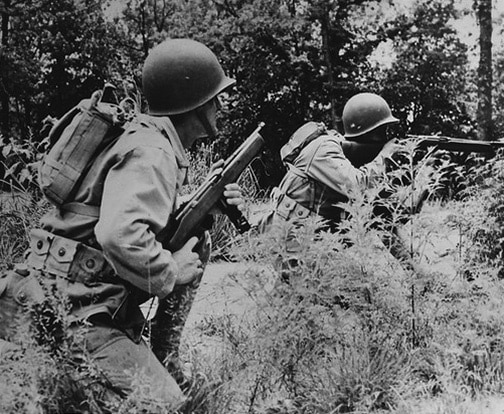
But to be fair to these weapons, the M50 and M55 Reising were service weapons designed for stateside law enforcement, not the brutal rigors of an island-hopping campaign.
On top of the reliability issues, these weapons also came with very fragile sights that broke easily. The weapon needed to be cleaned often to avoid failures, but breaking them down for cleaning was complex and difficult. As a result, they were probably rarely cleaned, further exacerbating their reliability issues. The Fleet marines gladly got rid of the Reisings as soon as the opportunity arose, and they went on to serve the role they were intended for, as service weapons for police officers, Sailors serving on Naval guard duties, and the like.
Related: Suppressed machine guns: A worthwhile proposition
Colt New Model Revolving Rifle
Take a revolver–you know, the cowboy-type–stretch the barrel and add a stock, and you get the best thing since sliced bread! At least that sounded like a good idea in 1855. The service weapons of the era were percussion cap-based guns, so rifles were single-shot guns that took time to reload after each shot.
As a percussion weapon, making a repeater rifle was difficult. Percussion revolvers were successful, so Colt made their revolver into a rifle, and now a soldier could fire 5 to 6 shots before he had to reload.
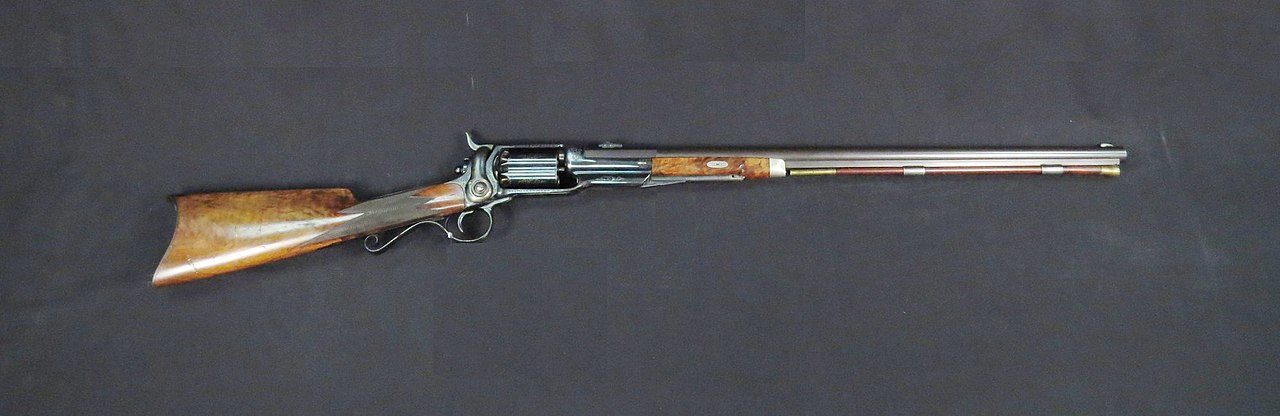
This greatly increased the rate of fire for the average soldier. It seemed like a brilliant idea and maybe it was, in theory. However, in practice, the revolving rifle was plagued with issues.
First, the gap between the cylinder and bore allowed a substantial amount of blast to escape, which could injure the shooter’s arm. To combat this, shooters had to wear special gauntlets or adopt an awkward shooting style that positioned their body parts out of harm’s way. Worse still, the paper cartridges of the era would leak black powder, and if that powder was ignited while firing, a chain fire could result. Six full chambers going off at once would seriously harm the user, and potentially cost them an arm or worse. It’s pretty easy to see why this technologically advanced (for its time) rifle went the way of the dodo as a service weapon.
Related: The weaponry of the future Marine Corps Rifle Squad explained
Chauchat Machine Rifle
The French-designed Chauchat Machine rifle promised to bring automatic fire to the average infantryman in World War 2 (just like the Marines are doing with the M27 today). The U.S. saw the potential in the weapon and adopted the Chauchat as a machine rifle, chambered in the famed .30-06 service cartridge. Unfortunately, the Chauchat turned out to be one of the least reliable machine rifles ever made. It was a finicky weapon that was plagued with issues.
First, it wasn’t made for the hot and heavy .30-06, and that created wear issues. Additionally, the construction mixed well-made, high-quality components with shoddy and sub-standard parts, oftentimes reused from other guns.
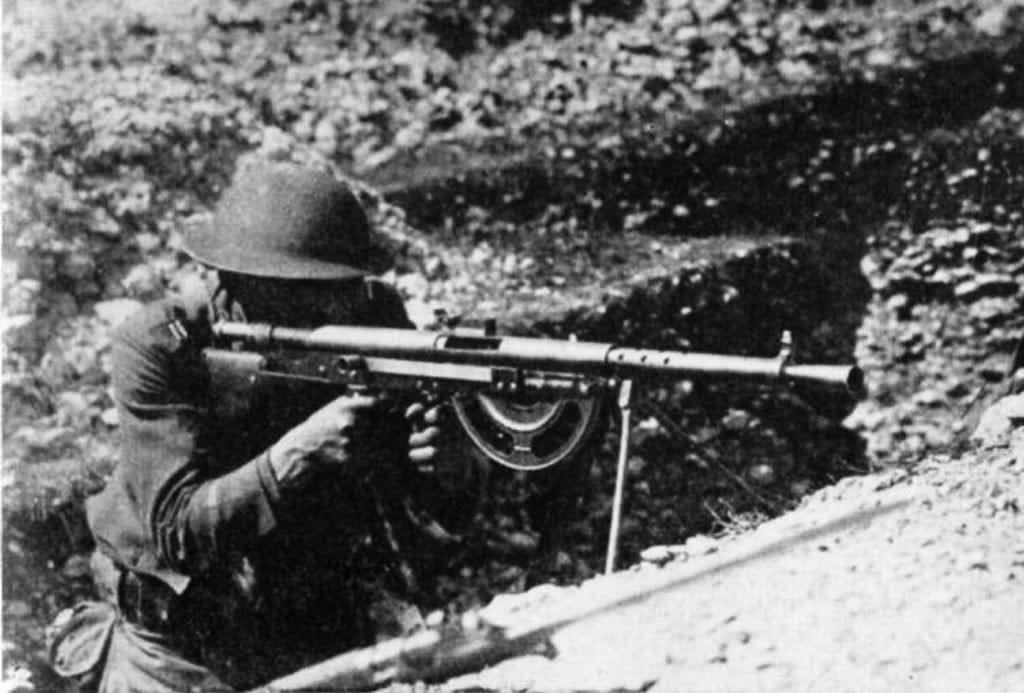
Side plates were held on with screws that became loose under consistent firing. The sights were a mess, and the open magazine invited dirt and mud, both common in the trenches, into the gun.
These magazines reportedly caused two-thirds of reported stoppages. The Chauchat was bad enough that American soldiers would (reportedly) really would ditch the weapon in favor of a bolt action Springfield. American inspectors at the Chauchat manufacturer rejected 40% of the guns off the line, and the rest worked just well enough to pass inspection. From the cradle to its early grave, the Chauchat was a mess.
The Worst Service Weapons
These weapons may have failed, but they often came with certain innovations or good ideas that would eventually find their way into later service weapons. However, good ideas and innovation only go so far when the gun hits the field. A failed service weapon may be a portent of better things to come, but that doesn’t make it any easier to manage in a fighting hole.
Read more from Sandboxx News

Travis Pike

Categories
ARTV: Melvin Johnson’s Automatics
Categories