Category: All About Guns
National gun surrender launched
A new national gun surrender will allow people to anonymously hand in weapons and ammunition including heirlooms, shotguns and antique revolvers, as well as illegal stun guns and gas-firing blank pistols bought overseas.
Many such guns are held in innocence and ignorance that having them is against the law, according to the National Police Chiefs Council (NPCC) and The National Ballistics Intelligence Service (Nabis).
Weapons handed in during past surrenders included old wartime service revolvers, war trophies – including grenades – and gas-operated blank-firing pistols and stun-guns – bought during trips to Europe , or online.

However innocently held, such weaponry can be acquired by crooks through robberies or distributed to criminal networks in other ways.
The surrender – the first since 2019 – gives the opportunity to dispose of a firearm, gun components or ammunition by simply taking it to a local designated police station and handing it in.
The campaign will see nominated police stations flagged as locations for people to take guns, stun-guns, gas-powered weapons, imitation firearms, ammunition, hand grenades or other weaponry.
The surrender is starting on May 12, and runs for two weeks.
People should check police station locations in advance by visiting their local force website or calling 101.

Deputy Chief Constable Helen McMillan, NPCC lead for the Criminal Use of Firearms, said “We’re inviting people from May 12, for two weeks, to contact local police or attend local police station and surrender any firearms – or any type of weapon – that they’re concerned about, that they have in their possession.
“They can do that anonymously and there will be an amnesty for them in order to transport that weapon or be in possession of that weapon at the point they surrender it.
“No-one needs to be concerned about walking into a station or contacting their local force.
“We don’t need to know your name, we don’t need to know how you came into possession of it, all we need you to do is give us the gun.”

Mr Taylor also urged people to check “blank-firer” imitation guns they may have, adding that the “gas-gun” type were “legal in Europe – but definitely illegal in the UK”.
“If you don’t know the status of the gun or are unsure – take the chance to hand it in,” he added.
He also said there were also “a lot of unregistered firearms and (particularly) shotguns, pre-dating the 1988 (Firearms) Act” in homes, often “hanging over the mantelpiece”, which should be handed in, if unlicensed.
The last surrender saw shotguns making up 69% of all lethal weapons handed in.

Changes to firearms’ laws last year also closed a loophole allowing people to own some old guns – particularly revolvers – perfectly legally as antiques, because they used ammunition in calibres which were no longer manufactured.
Ms McMillan urged antique weapon-owners to “know your gun, and know the law”, adding “if you are no longer in possession legally, surrender that weapon”.
Illegal possession of a firearm can mean five years behind bars and if you are found guilty of possession with intent to supply that can lead to a life sentence.


Like every “mass shooting,” a recent gunfight in Sacramento initially received breathless coverage in the media. But as the sordid details about the suspects became known, coverage of the bloodshed tapered off.
Six people died. It became clear the reason was gang violence. One of the shooters was recently released early from prison – jailed for the felonious assault of his girlfriend – against the recommendation of the parole board. The man was previously convicted on gun charges, and was also awarded a settlement from the state for alleged poor treatment while behind bars.
While devastating – particularly to the families involved – the incident was not amenable to the left-wing/media narrative about guns.
 As Project 21 member Craig DeLuz pointed out in a commentary first published by the California Republican Assembly:
[T]here are a number of underlying truths that they will dare not share with the public. Because if they do, it will become clear that they and their policies are not the solution. They are, in fact, the root of the problem.
These truths, he stated, shred the alleged need for “common sense” gun laws.
Here are the truths Craig highlighted that shatter leftist lies:
- It’s a violence problem, and not just guns. “[O]nly recent generations… have concluded that violence is an acceptable way to address the myriad of issues confronting them. The firearm is not the cause of this. In fact, it is not even the weapon of choice.” Most crimes involve other kinds of weapons or none at all. “Guns are no more the cause of this violence,” he wrote, “than cars are the cause of drunk driving.”
- Gun laws are not a crime deterrent. “A 2020 study done as a part of the RAND Corporation’s Gun Policy in America initiative” found “there is zero evidence that gun control laws have any effect on violence in general or gun violence specifically.”
- “Soft on crime” policies are the cause of rising crime. Spiking violent crime in the 90s led to more money for police and harsher sentences for crooks in the form of things like mandatory minimums. This led to a 20-year decline in crime. “While the media and politicians deny the correlation and instead seek to blame guns; the increase in crime, especially violent crime, directly corresponds with the change in our criminal justice policies.”
- Gun control is racial. From “black codes” to California’s “Mulford Act” to gun ownership bans targeting Native Americans and Asians, “[g]un control has always been about keeping “Those People” from being able to own firearms.”
Commenting further on how “the gun debate has always been rooted in racism” with “those who push these policies [being] the true victimizers, Craig explained:
We are often told that young black and brown men are disproportionately impacted by gun violence. But it is rarely noted that young black and brown men are disproportionately the ones pulling the trigger. The sad fact is that people who seek to victimize others (black, white, Latin, Asian, etc.) tend to go after people who look like them.
So, while it is noble to try and reduce the number of young black men in our criminal justice system, we cannot ignore that in doing so, we have put black men, women and children at risk of being their victims.
At the same time, we are limiting the ability of these very same folks to be able to defend themselves from the very danger we have put in their path.
“If we are to ever address the scourge of violence in our streets,” Craig wrote, “it will only happen when we all come to grips with these and many other truths.”

Throughout its history, Browning has manufactured several unique and novel designs. One of the most unique rifles to come from the company is its straight-pull, bolt-action rimfire design, the T-Bolt. Straight-pull, bolt-action rifles were nothing new in concept, as several militaries had already fielded well-known examples like the Canadian Ross Rifle and Swiss K-31. However, the T-Bolt was unique from other designs due to its bolt design and rimfire chambering.
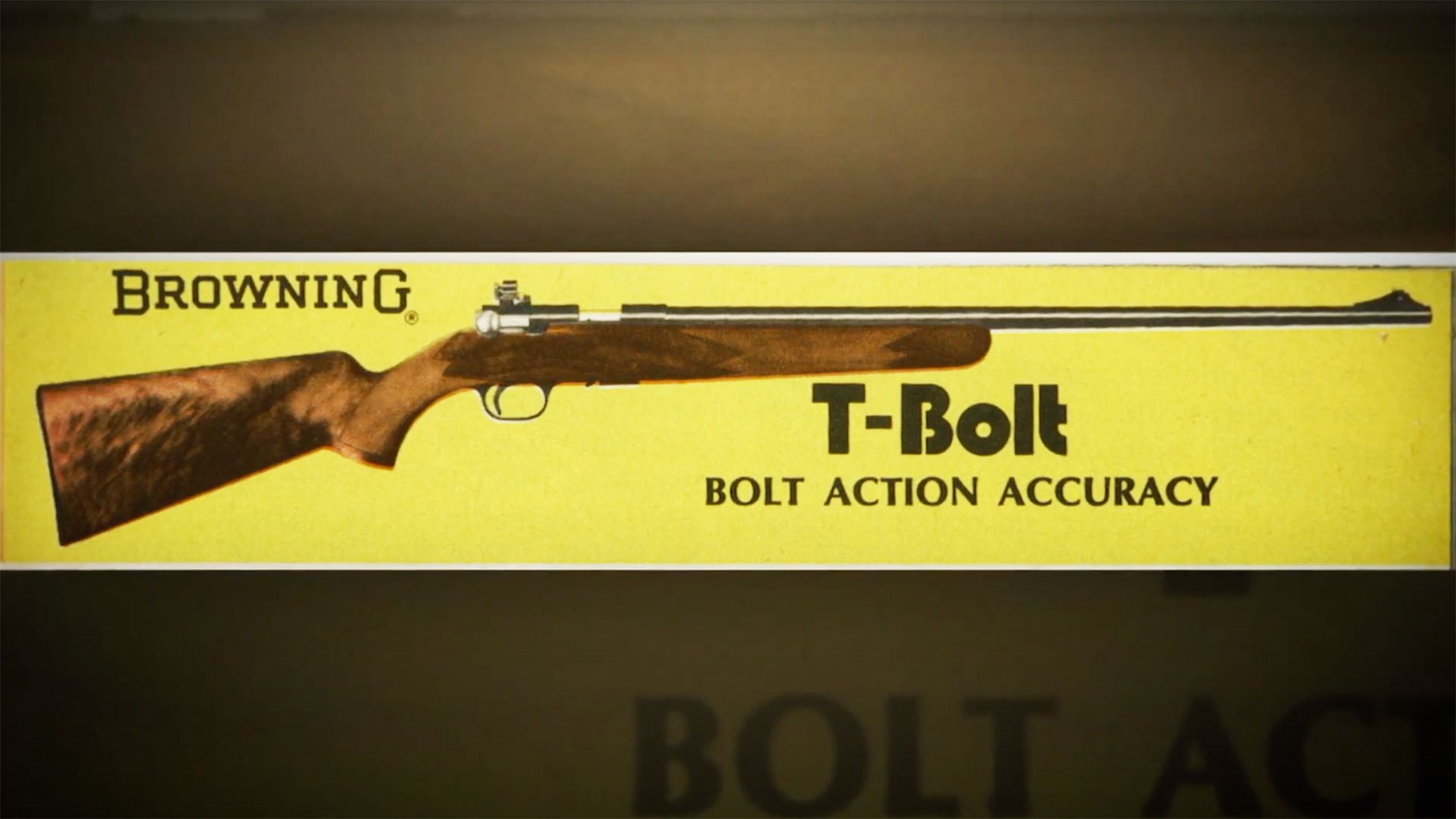
Chambered for .22-cal rimfire cartridges fed from a detachable box magazine, the T-Bolt was first released in 1965. At the time, Most rimfire rifles on the market had more traditional actions, like lever, slide and bolt actions. The T-Bolt derived its name from the unique ball-and-socket, bolt-handle design, which is “T” shaped and interlocks with the receiver when pushed forward. Two circular cut lugs on the handle engage with the bolt body and receiver to create lockup. The handle design is relatively simple, with the handle consisting of a single component that is linked to the bolt via a pin.
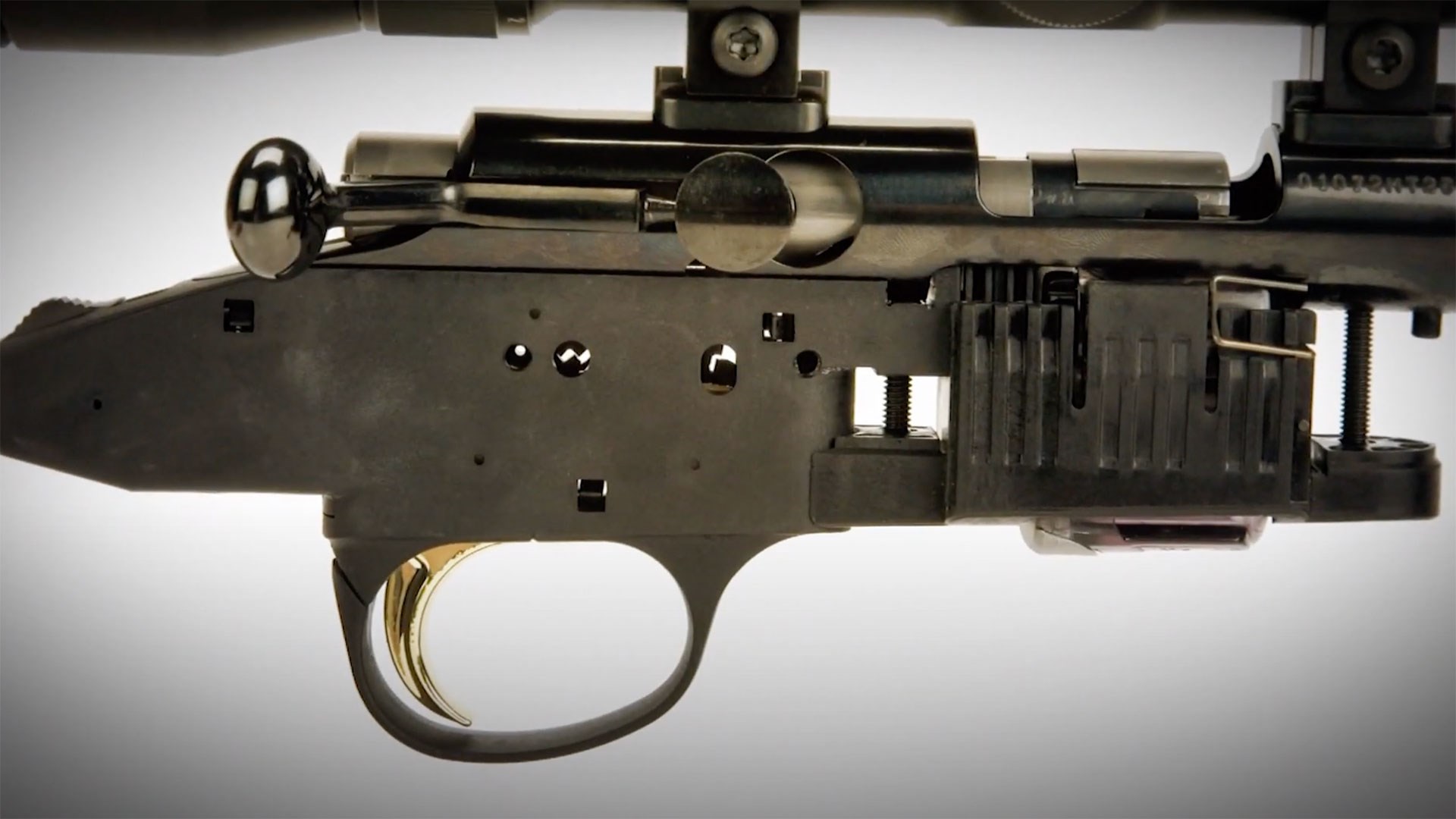 A Browning T-Bolt taken out of the stock to reveal some of the inner parts. Note that the bolt is unlocked and partially pulled back.
As a result, the operation of the bolt simply requires a pull back to unlock the action and a push forward to close and lock. The end result is a simplistic action that only requires a pull and a push to extract, eject and chamber a new round. Fitted with a walnut stock with blued metal, the Browning T-Bolts of old manufacture were set up and finished like many other sporting rimfire rifles of the time, albeit with a more unusual action. It became a favorite of rimfire enthusiasts and Boy Scouts on the target range. Left-handed versions were also produced, making the platform more accessible and friendly for southpaws.
 The action of a Browning T-Bolt in action on the range.
In 2006, Browning redesigned some aspects of the T-Bolt, and released an improved version. This new generation of T-Bolt incorporates a 10-round double-helix rotary magazine, which stacks the rounds in an “S” shape internally. However, the basic design principles of its distinctive action remain the same on modern production examples. The current T-Bolt rifles also come in a wide range of configurations, from the basic wood-stocked sporter version to the laminate-stocked, heavy-barreled Target and Varmint versions.
 An example of a newer-production Browning T-Bolt with a synthetic stock.
While older production T-Bolt rifles had iron sights included from the factory, current production rifles come only with drilled-and-tapped receivers for attaching scope mounts. For more information on the current line of the T-Bolt offered by Browning, along with its other rimfire rifles, visit browning.com.