

The M1891 Carcano was a frequent butt of jokes by shooters after WWII.
The reputation went from bad to worse when an M38 Carcano was used
to kill President John F. Kennedy
Like cats, people seem to dislike Carcanos for no good reason. Unfortunately, the weapon’s main claim to fame among Americans is forever tied to an M38 found on the sixth floor of a Dallas school book warehouse on November 22, 1963. As if such ignominy wasn’t enough, during America’s golden age of military surplus bolt actions in the 1950s and 1960s, it was frequently the butt of jokes going something like this: “Italian Carcano Rifles For Sale: Excellent shape, barely fired, dropped once.”
Compared to the Germans and Japanese, Italy’s military performance in WWII perhaps warranted the zinger but the Carcano never deserved the reputation it had by the 1970s of being weak, unsafe and badly designed.
This was about the time I got really interested in military guns and if you mentioned you were looking at a Carcano, some gun wag would claim anybody foolhardy enough to shoot one was asking for a bolt in the cranium. For me, such criticism never passed the common sense test. It was, in fact, completely false.
The Italians made most of their Carcanos, over two and a half million, between 1893 and the end of World War I and used them for over half a century with no significant changes aside from sights, stocks and barrel length. Does this sound like a bad gun? I’d like to set the record straight and elevate the Carcano back up to its rightful place among its first generation, small-bore, smokeless powder peers — the French 1886 Lebel, the German Gewehr Model 1888, the Russian Mosin Nagant M1891, the Danish Krag-Jorgensen and the Austro-Hungarian M1895 Mannlicher.
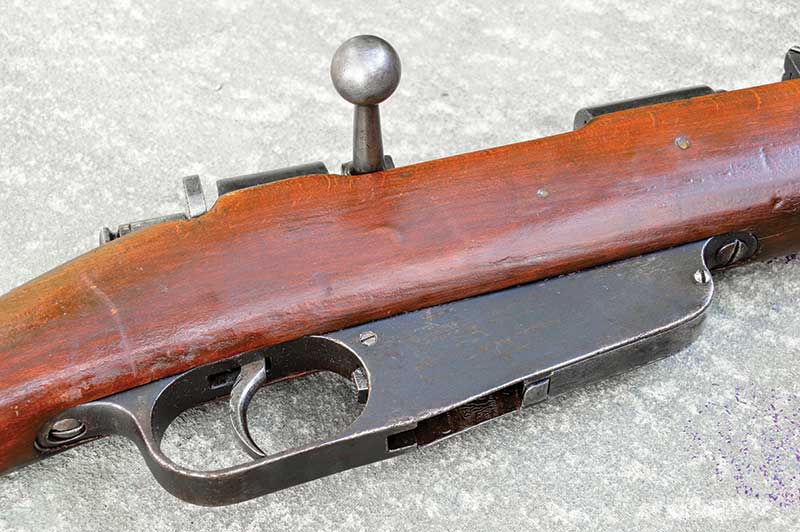
The Carcano had a unique feature allowing its Mannlicher clip to fall free
when empty — but also allowing a portal for mud and grime to enter the action.
In response to France’s revolutionary 1886 Lebel rifle, Italy created a new smokeless, small bore, 6.5 x 52 mm rimless cartridge and rifle to shoot it. While the United States, France, England, Germany and Austrian Hungary were going with various .30 caliber projectiles, the Italians opted to go small with a long, skinny, round-nosed 162-grain 0.268″ bullet traveling around 2,300 feet-per-second. They were the first nation to do so and were ahead of their time in recognizing the military advantages of sub-.30 caliber projectiles — flatter trajectory, less recoil, less weight for the soldier to carry and from a strategic standpoint, smaller ammunition required less material to manufacture.
Their new rifle was the Modello 1891 (M91). Weapons engineer Salvatore Carcano was largely responsible for its design which was well suited to Italy’s industrial capabilities. Italy was a world power, but the weakness of its economy put it substantially behind its European neighbors in the wherewithal to produce, much less pay for, new armaments. When viewed through this lens, the simplicity — and one might even say relative crudeness — of the Carcano put it within Italy’s reach. While it lacked the mechanical refinement and precision of other designs, it did the job. Unlike Japanese Arisakas or German Mausers, there are no “last-ditch” Carcanos. The Italian design was minimalist right at the start which — to me — demonstrates practical brilliance at the strategic level.

The combined trigger, sear, ejector, bolt stop and bolt release mechanism
requires no screws. It has a single pin, held in place by the stock.
The Carcano’s design simplicity is immediately apparent in its combined trigger, sear, ejector, bolt stop and bolt release mechanism. With no screws, it is held in place by a single pin you can usually pull out with your thumbnail. When the action is in the stock, the wood keeps it from falling out. In addition, every Carcano I ever examined had a lot of play in parts fit but they worked fine. As loose tolerances are easier and cheaper to maintain in production than tight tolerances, nothing is gained by keeping tight tolerances where they aren’t needed — a lesson the Germans never fully learned.
The Carcano was also easier to load than a stripper-clip-charged gun thanks to its modified Steyr-Mannlicher clip-fed magazine that Italy purchased the patent rights to manufacture. The disposable clip, made of thin gauge brass or steel, was inserted through the open action as a single unit until the clip release latch in the trigger guard engaged a notch on the spine of the clip. The latch held the clip and bullets in the action until the last round was fired. With no more cartridges, the empty clip was free to drop through the opening in the bottom of the magazine. The Italians modified the clip design so it could be loaded regardless of orientation, as long as the bullet’s pointy end was toward the enemy.
Loading a Carcano was idiot-proof, a desirable characteristic for a military weapon. Better still, Italian clips held six rounds instead of the typical five, giving their soldiers a slight edge in firepower. The downside of this system was the open bottom of the magazine allowed mud and sand to infiltrate the action and, without clips, the rifle became a single shot.
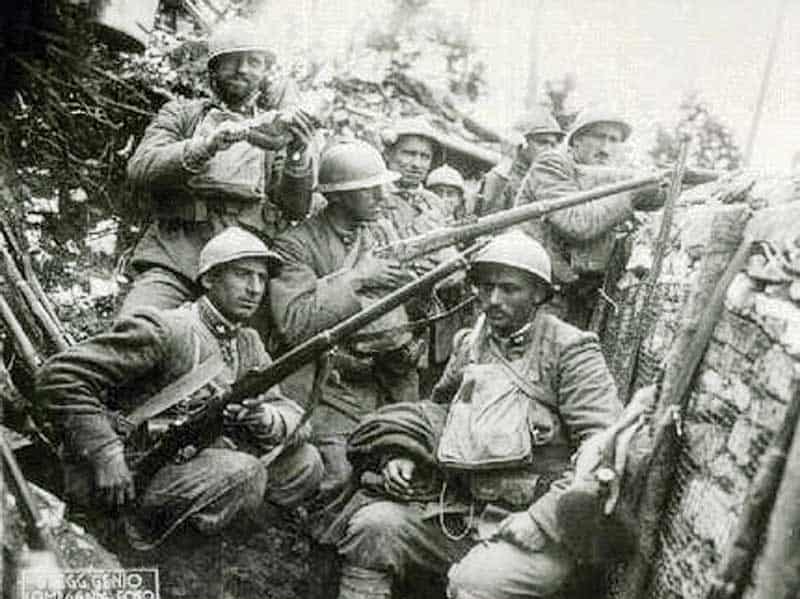
WWI Italian troops in a trench armed with the then-new M1891 Carcano.
It was one of the first sub-.30 caliber main battle rounds.
Though Italy’s 6.5 x 52 mm cartridge had some growing pains, it became a model for the other military 6.5 mm cartridges later adopted by Sweden, Portugal, Greece, Romania, Holland and Japan. To improve bullet performance and extend barrel life, Carcano utilized gain-twist rifling on the M91. It was a unique solution and it worked though I suspect improvements in ammunition manufacturing eventually made its value moot.
In combat, the rifle and cartridge performed adequately except in areas where heavier bullets excelled. I had the pleasure to know a Brooklyn gentleman by the name of Vincenzo Vella who fought in the Italian Army in World War II. He was an infantry sergeant among the 10 divisions sent by Mussolini to fight with the Germans on the Eastern Front. He was wounded and evacuated just in time to miss the spectacular axis disaster at Stalingrad. Vella had no complaints about the Carcano, finding It comparable in weight to the German Kar98 and Russian Mosin Nagant 91/30, but faster to shoot and reload than either, along with six shots to their five. The Carcano action was not as smooth as a Mauser, but better than the Mosin Nagant.
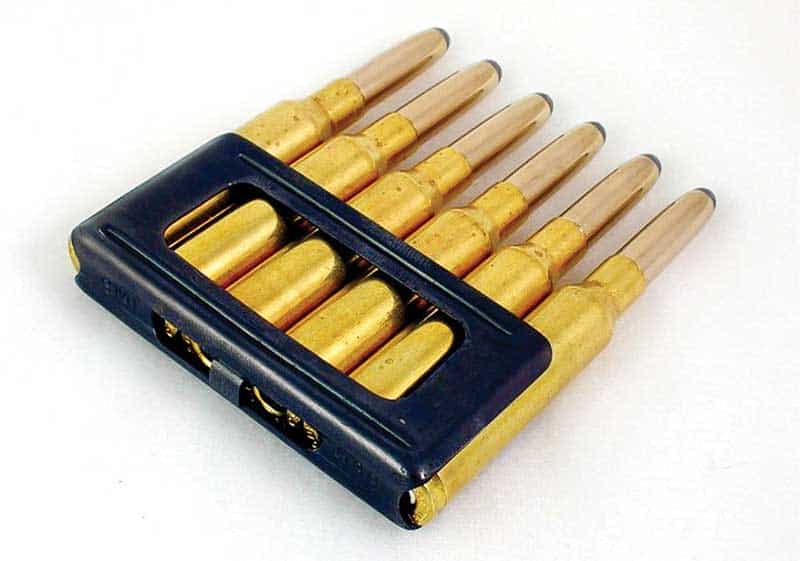
The 6-round Mannlicher clip made from brass or soft steel. They were easier to load than stripper clips and gave the Italians a slight ammo superiority, but also rendered the rifle a single shot if no clips were available.
Original Carcanos in good shape and in their original chambering are pleasant and safe to shoot but stick to modern commercial ammunition. Don’t mess with any military surplus ammo. Prvi Partizan of Serbia makes cases and 0.267″ jacketed bullets for handloading as well as finished ammo. It’s all available through Graf and Sons (Grafs.com). Reduced power, gas-checked cast bullet loads are domestically produced by Steinel Ammunition (SteinelAmmo.com) but cost a little more.
Be aware some Carcanos were even rechambered in 8×57 mm Mauser by the Germans in World War II. They seem to have fared well despite the higher pressure cartridge, but again, I would never shoot any military surplus ammo through these guns. For example, the Germans made many types of 8×57 mm during the war, some of which were NEVER intended for rifles. Stick with the original Italian 6.5mm (or 7.35mm) chamberings and modern factory ammo, or downloaded handloads for the sake of safety. Remember the newest Carcano is 76 years old!

The CZ Scorpion went from being a single sub-gun and large format pistol to an entire series made up of rifles, pistols, and even a bullpup. One of the latest models is the CZ Scorpion EVO 3 S2, aka the Micro Scorpion. The Micro Scorpion took the standard Scorpion and shrunk it a fair bit. They sell it with a folding brace, a collapsing brace, and a brace-free variant. This little (but big) pistol gives you something PDW-sized for home defense and for a ton of fun at the range.
I’m a PCC/subgun fan, and out of the three Scorpions I have, the Micro Scorpion is my very favorite. The Micro Scorpion is just plain cool. I’ve always had an affinity for the so-called K model submachine guns. Guns like the Micro Scorpion represent the closest I’ll ever get to a real K-model anything. The Micro Scorpion keeps things short but fairly stout.

The barrel is 4.12 inches long but covered with a SilencerCo No Octane faux suppressor. Once removed, the Micro Scorpion is the perfect host for a suppressor. Plus, in 9mm, the weapon just wants to be suppressed, and it keeps things super quiet with 147-grain subsonic rounds. The overall length of the firearm is 16.35 inches with the brace collapsed and 23.35 inches with the brace extended.
The Micro Scorpion weighs 5.5 pounds and is 9.4 inches tall. The Micro Scorpion has an MSRP of $1,349 dollars and appears to retail for around $1,000. It’s a tall order for a 9mm subgun, but for fans like me, it’s the cost of entry.
The Micro Scorpion utilizes a very simple straight blowback system that’s been trusted by the world of submachine guns since the very beginning. It’s not refined or fancy, but it works. Part of the downside with such a system is the requirement of a big heavy bolt and some stiff recoil springs. That translates to the 5.5-pound overall weight and the rather stiff action when the shooter charges the weapon.
Over the top, we get a full-length optic rail and CZ’s impressive set of Scorpion iron sights. The front sight features an AR-like front post, and the rear sight is where the magic happens. The rear sight has a rotating system of rear sights of varying width peep sights. They go from fully opened to tight and narrow for varying degrees of precision and speed.

Around the barrel sits a very short M-LOK rail system that’s the right size for small lights and the basics. I added a QD slot for a front sling post, and that’s really it. The rail itself is all metal and quite robust. Previous Scorpion rail systems utilized a polymer rail system, so it’s nice to see an upgrade in design.
The brace is rather nice. It’s mostly metal, including the arms. It can spring into action with just a single pull. It lacks at one setting, so hopefully, your forearm is fairly long. Collapsing the brace requires a quick hit of a button mounted to the top of the brace. Press it, collapse it, and call it done.
CZ did ergonomics right…mostly. My main complaint came from the safety. It’s ambidextrous, which is great but also digs into your hand every time you pull the trigger. CZ has yet to fix this, and you can do so with a Dremel or with any of the numerous safety deletes. I used the strike industries safety delete to make it a right-handed only design.
The pistol grip is perfectly acceptable, but I wanted to swap it for a more American grip with a sharper angle and went with the Strike Industries model as well. It’s a little thinner and short as well, so it fits the theme of the Micro Scorpion.

Other than that, the Magpul Scorpion is fantastically ergonomic. The safety throw is short and sweet. It’s tactile and moves without argument. The magazine release is AK-like and allows you to drop mags easily and reload on the fly. Magazines do drop-free, so it’s a nice touch.
The charging handle can be swapped from one side to the other, and it’s very easy to do so. The bolt release is positively massive and L-shaped. Push it down a bit, and the bolt slams home. For lefties, the charging handle also works easily enough to drop the bolt and send it home. HK fanboys will be happy to know that the charging handle is locked upwards, and a slap sends it home.

Overall the Micro Scorpion is a well-balanced weapon that’s easy and fun to use. It’s my wife’s favorite gun, and she’s become quite proficient with it. Executing reloads, clearing malfunctions, and blasting through boxes of 9mm is lots of fun.
Speaking of blasting through 9mm, I’ve been lucky enough to own this firearm for years. As such, the Micro Scorpion and I are close friends. The cold hammer-forged barrel squeezes out a fair amount of accuracy from the short 4.12-inch barrel. If the trigger was better, it would be a card splitter. Even with the long, heavy, and spongy trigger, the Micro Scorpion can produce tight 1 inch groups at 50 yards and easily ding steel targets of various sizes.
With good trigger control, you can back out to 100 yards and let the lead fly. I can go ten for ten with a good holdover. On a man-sized target, it’s as simple as aligning the sights and letting the rounds fly even at 100 yards.

Recoil isn’t bad per se, but blowback actions create more recoil than necessary. It’s plenty controllable with very minimal muzzle rise. I’d put it in the same vein as an AR pistol in 5.56. It’s mild, but recoil is present. Since it’s 9mm, the muzzle flash and concussion are almost non-existent.
The Micro Scorpion excels at being maneuverable due to its short size and well-balanced design. Moving rapidly from target to target takes just a slight spin of the body. With all the weight near your body, it moves very naturally, and you won’t ‘overshoot’ your target’s vitals with your sights. Even small targets like clay pigeons on the berm are easy to acquire and destroy.

From a reliability standpoint, the Micro Scorpion eats it all. The blowback system has been around so long and used so much because it works. That’s readily apparent here as this thing chews through 9mm ammunition without complaint. Even really crappy steel-cased stuff operates the feeds, fires, and ejects.
The Micro Scorpion puts some sting into the really big pistol world. As far as really big pistols go, it’s quite light and fairly maneuverable. The little gun always goes bang, and with a few upgrades, it’s one of the most ergonomic platforms on the market. It’s a niche product for sure and does have a high price point, but if you want a K model subgun, this might be the most common and affordable option.
MSPR $1299
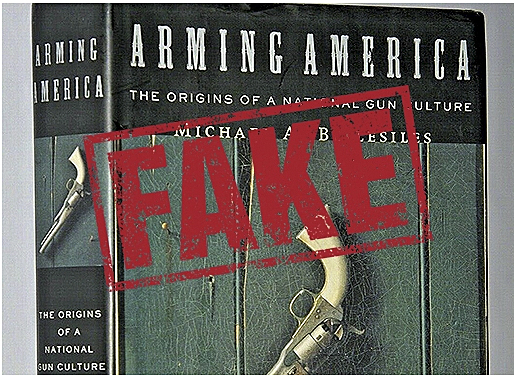
Like it or not — and many on the leftward side of the political spectrum don’t — firearms and civilian gun ownership have been part of our history and culture since before the nation’s founding and have become as American as mom and apple pie. May it ever remain so for lawful citizens. Not that my assertion based on historical reality would be accepted by many undaunted public health researchers and others dedicated to civilian disarmament.
The foes of civilian firearm ownership have a long and sordid record of revising history to fit their anti-gun narratives.
One researcher, an Emory University professor and Bancroft Prize winner, Michael A. Bellesiles, faked historical data to “prove” in his now discredited book Arming America: The Origins of a Natural Gun Culture that widespread gun ownership in early America was really a fiction.
Bellesiles contended that guns were, in fact, uncommon in the civilian population during the colonial and early periods of the Republic. Consequently, most Americans weren’t proficient with guns.
Bellesiles argued, citing non-existent probate court records, that widespread firearm use by the civilian population occurred only after the Civil War and that was only because the mass production of firearms had lowered to cost in owning one.
Only one of Bellesiles’ contentions was correct; that mass production decreased the cost of firearms while increasing their quality and accuracy. The rest of his argument was fabricated mendacity. His conclusions were wishful thinking, tailor-made for the liberal intelligentsia who opposed civilian gun ownership and received his book with great fanfare, and enthusiastically supported the great revelation he produced.
Yet Bellesiles’ conclusions, which contradicted well-known facts of American history, were preposterous for anyone with even a modicum of historical knowledge. How could early Americans survive the wilderness without possessing firearms and not be proficient in their use? How could colonists on the frontier, subject to Indian raids, protect their families? How could the colonial militia be ready at a moment’s notice not only to repel Indian raids but also to join with the British army in fighting in the French and Indian War (1756-1763), as Colonel George Washington and his militia did?
Most astounding of all, how could the celebrated event in American history we now refer to as Patriot’s Day (April 19, 1775) have taken place without the availability and familiarity with firearms? How could the minutemen, summoned by Paul Revere in his famous ride, assemble so quickly and with their muskets to fire “the shot heard around the world”? Why would American patriots prevent the British army’s attempt to disarm them and seize the arm depots at Concord, while passing by Lexington in the colony of Massachusetts? How could they have harassed the Redcoats all the way back to Boston if they were unarmed?
Bellesiles’ preposterous attempt at historical revisionism was truly audacious. Only an anti-gun “scholar” with a supreme capacity for arrogance and hubris would have even attempted this kind of fraud, but such dishonesty was only an illogical extension of the politicized “research“ that we have been exposing all along.
So, it didn’t take long for scholars to prove that Bellesiles’ “reseach” was fraudulent and his conclusions fabricated. His book a bag of lies conceived to reach the preordained conclusions that the American gun culture was actually a relatively new phenomenon, the result of a tragic civil war and an overabundance of cheap mass-produced weapons.
Bellesiles’ mendacity cost him his reputation, his coveted Bancroft Prize, and his position at Emory University, which is sadly also the alma mater for my post-doctoral neurosurgical training.
Foes of firearm ownership and the right to keep and bear arms lie often when the topic is guns. What they don’t know, they make up, whether in the media, popular culture, or academia. That’s how far the common denominator has fallen — in academics, entertainment, and in politics.
Written by Dr. Miguel Faria
Miguel A. Faria, Jr, MD is a retired professor of Neurosurgery and Medical History at Mercer University School of Medicine. He founded Hacienda Publishing and is Associate Editor in Chief in Neuropsychiatry and World Affairs of Surgical Neurology International. He served on the CDC’s Injury Research Grant Review Committee. This article is excerpted, updated, and edited from his book, America, Guns, and Freedom: A Journey Into Politics and the Public Health & Gun Control Movements (2019).
This article was also published on TheTruthAboutGuns.com on February 20, 2022 with the title of “The Anti-Gun Left Never Lets History Get in the Way of Its Narrative.“
This article may be cited as: Faria MA. Revising American History for the Sake of “Gun Control.” HaciendaPublishing.com, February 20, 2022. Available from: https://haciendapublishing.com/revising-american-history-for-the-sake-of-gun-control-by-miguel-a-faria-md/.