
Category: All About Guns


We live in a curiously black and white world. The Information Age has given us unprecedented insight into people’s private lives. If something is ever published on the Internet it is there forever. This allows those who don’t actually accomplish a great deal to sit back in a position of comfort and pick apart the actions of those who do.

Cancel culture is the woke term. Like texting, sexting, dope, Gucci, sick, lit, or the term woke itself, these are words that meant something totally different a generation ago. This deep into the Information Age all it takes is a single errant comment online to disqualify a person from a position of prestige or responsibility. This is based on the flawed assumption that folks are all either innately good or innately bad.

Reality is rarely that clear cut. Not all nuns are angels, and not all Nazis were bloodthirsty psychopaths. We are all of us broken. It is simply that some strive for the light, while others embrace the darkness. However, there does yet remain some weird intangible that attracts certain personalities to certain camps. That ethereal stuff tends to drive some of the most extraordinary behavior.

In some rare quarters you can indeed find a few moral absolutes. I think we can all agree that ISIS, al Qaeda, and the Taliban are reliably bad people. Their sick oppressive ideology attracts aberrant abusive personalities and then cultivates the worst in them. In the West, an errant online comment can be an unforgivable sin. Meanwhile in Afghanistan people have been executed for listening to music. If anybody cares about my opinion, I think we could use a little perspective over on this side of the pond.

Regardless, in the aftermath of 9-11 the free countries of the world banded together to battle the forces of darkness. This was an old school righteous fight. The egregious behavior of our radical Islamist enemies served as the catalyst to unite free peoples in a common cause against tyranny, oppression, and rank terrorism. That single shared mission brought out the very best in some. One of the finest examples extant was that of a young British paratrooper named Joshua Leakey.
Origin Story

Joshua Leakey was born in 1988 in England. His father is a retired RAF officer, while his mom is an Occupational Therapist. He has one younger brother. Leakey attended school in Horsham, West Sussex, before starting a military history program at the University of Kent. Dissatisfied with his studies, Leakey dropped out of school to join the British Army.

There is a certain brotherhood among those of us soldiers stupid enough to jump out of perfectly good airplanes. We are typically somewhat full of ourselves and more than a wee bit arrogant. Joshua Leakey was cut from similar stuff. He ended up with the 1st Battalion of the British Parachute Regiment.

Joshua Leakey did three combat tours with the Paras in Afghanistan and was promoted to Lance Corporal. In August of 2013, Leakey was part of a joint multinational operation in Helmand Province. Fighting alongside US Marines as well as Afghan soldiers, Leakey and his mates were moving into a village to search for illegal weapons. Leakey’s team inserted via CH47 Chinook helicopters and immediately found themselves deep in the suck.
The Fight

Leakey’s element was tasked to provide fire support for the troops assaulting into the village. As such, they set up on the reverse slope of a nearby hill protected from the bulk of the enemy fire. Despite their position of relative safety, they soon found themselves subject to withering automatic weapons and RPG fire.

The command group was pinned down on the exposed front slope of the hill by around 20 heavily-armed Taliban fighters. American Marine Captain Brandon Bocian was subsequently hit and badly wounded. The Taliban insurgents were so close and so ferocious as to negate the effectiveness of the two friendly machineguns as well as the organic mortar section that was collocated with the command group.

Despite being the most junior NCO present, LCPL Leakey rightly assessed the situation as dire and took action. He ran some 100 meters down the hill under heavy enemy fire to get to the command group and render aid to the downed US Marine officer. LCPL Leakey then took charge of the chaotic situation and initiated casualty evacuation procedures.

All the while Taliban forces were suppressing the two automatic weapons in overwatch positions at the top of the hill. LCPL Leakey then ran back up the hill across rugged terrain and under heavy fire to retrieve one of the guns and get it back in action. In the process, the machinegun he was carrying was itself struck by enemy fire though not disabled. LCPL Leakey got the gun working and began pouring fire back onto the attacking insurgents.

While this helped it still did not tip the balance of the engagement in the favor of friendly forces. As such LCPL ran the gauntlet a third time, this time carrying more than 60 pounds’ worth of ammunition and equipment. He retrieved a second machinegun from the pinned down command group and sprinted to a more advantageous position with it, siting it against the enemy before turning its operation over to a subordinate.

With two belt-fed MGs finally working on the enemy, LCPL Leakey returned to the downed Marine and coordinated his evacuation under fire. Along the way, friendly forces killed eleven insurgents and wounded another four. The entire battle lasted some 45 interminable minutes. The fighting did not stop until friendly close air support rolled hot to teach the Taliban a stark lesson in the salient aspects of tactical overmatch.
The Guns

British forces in action in Southwest Asia most frequently carried the SA80 bullpup assault rifle. The SA80 was a thoroughly inspired but badly flawed design when introduced in 1985. Since then the SA80 has undergone several product improvements. In 2000 HK redesigned the weapon into the SA80A2, rectifying many to most of the rifle’s documented deficits. The subsequent SA80A3 first saw issue in 2016 and focused primarily on making the weapon more modular and adaptable. Today the SA80A3 enjoys reliability rates comparable to other modern assault rifles.

I could not find a specific reference to the machineguns LCPL Leakey humped up and down that godforsaken hill in Afghanistan. However, balance of probability these were L7A2 GPMGs (General Purpose Machineguns). The British soldiers I have known all referred to the L7 guns as “Gimpy’s.”

The L7A2 is an evolved version of the original Belgian MAG (Miltrailleuse d’Appui General) gun. Designed in the early 1950s by Ernest Vervier, the MAG gun has subsequently seen service with more than 80 nations and has been license-produced in ten countries to include Argentina, Canada, Egypt, India, Singapore, Turkey, the US, and the UK. The Chinese naturally make an unlicensed copy of the gun they call the CS/LM1. In US service the MAG gun is designated the M240.

The US military first adopted the M240 in 1977 as a coaxial machinegun for main battle tanks. With the well-documented shortcomings of the M60 being made ever more painfully manifest as the guns began to age, some legit rocket scientist realized that we had perfectly good M240’s in storage. Uncle Sam bought the buttstocks and fire controls to convert those early coax guns into ground weapons and fell in love with them. The M240B weighed 28 pounds while the lightened M240G tipped the scales at 24.2 pounds. The more recent M240L dropped the weight to 22.3 pounds by using titanium in certain critical components along with a short barrel, polymer fire control unit, and collapsible stock.
The Rest of the Story

Though LCPL Leakey likely did not know CPT Bocian well, he risked his life multiple times to save the man. LCPL Leakey fully appreciated the desperate nature of the engagement. He selflessly took action to get the injured American to safety and ultimately defeat the Taliban fighters who were so intent upon killing them all. His courageous actions under fire are a study in combat leadership and reflect that weird secret sauce that separates heroes from normal folk on the modern battlefield.

In February 2015, LCPL Joshua Leakey received the Victoria Cross directly from the hand of Queen Elizabeth II. The Victoria Cross is Great Britain’s highest award for bravery in combat. Like most true heroes, LCPL Leakey was humbled by the honor. He had this to say to the BBC, “In that particular incident I was in the best position to do that. If it had been any of my mates they would be in this position now…I don’t look at it about being about me in particular, I look at this as representing everyone from my unit, from my battalion, who was involved in the campaign in Afghanistan.”

LCPL Leakey comes by it honestly. His second cousin, Sergeant Nigel Gray Leakey, earned the Victoria Cross himself in 1941. The elder SGT Leakey was awarded the decoration posthumously for valor while fighting the Italians in North Africa. LCPL Leakey is only the third British soldier to be awarded the Victoria Cross for combat action in Afghanistan. He is the only one of the three who lived to tell the tale.

The Victoria Cross was introduced by Queen Victoria in 1856 to recognize acts of exceptional valor during the Crimean war. Since then it has been awarded 1,356 times. LCPL Leakey is only the fifteenth soldier so recognized since the end of WW2. Each physical medal is formed from the bronze of Russian guns captured at the Siege of Sevastopol during the Crimean War. In military circles, it’s quite the big deal.
Categories
Black Bear – HD Hunting

Shown above are two custom-built revolvers that once belonged to legendary film star Tom Mix. The gold-plated and deluxe engraved Colt Officer’s Model double-action revolvers, serial numbers 532107 and 567346, feature 6″ barrels and have “TOM MIX” inscribed on their backstraps.
Photography by C.J. Walker
Of the many realms of collecting, firearms rank among the most fascinating. Beyond their utilitarian function, firearms have been admired over the centuries for their intrinsic artistic form and, often, their lavishly applied decoration.
The collecting spirit, the iconic relationship between people and firearms, began even while their users were still making history. William F. “Buffalo Bill” Cody called his favorite hunting rifle “Lucretia Borgia.” Artist George Catlin named his Paterson Colt revolving carbine “Sam Colt” for its inventor. Scout and showman “Texas Jack” Omohundro called his Plains rifle the “Widow.”
Businessman, engineer and yachtsman William I. Koch—winner of the America’s Cup in 1992—shares and perpetuates the tradition of collecting firearms in tandem with other objects and artwork.
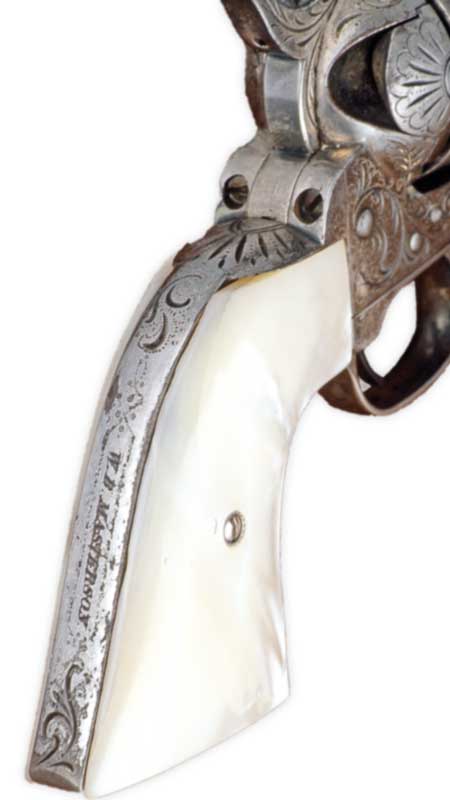
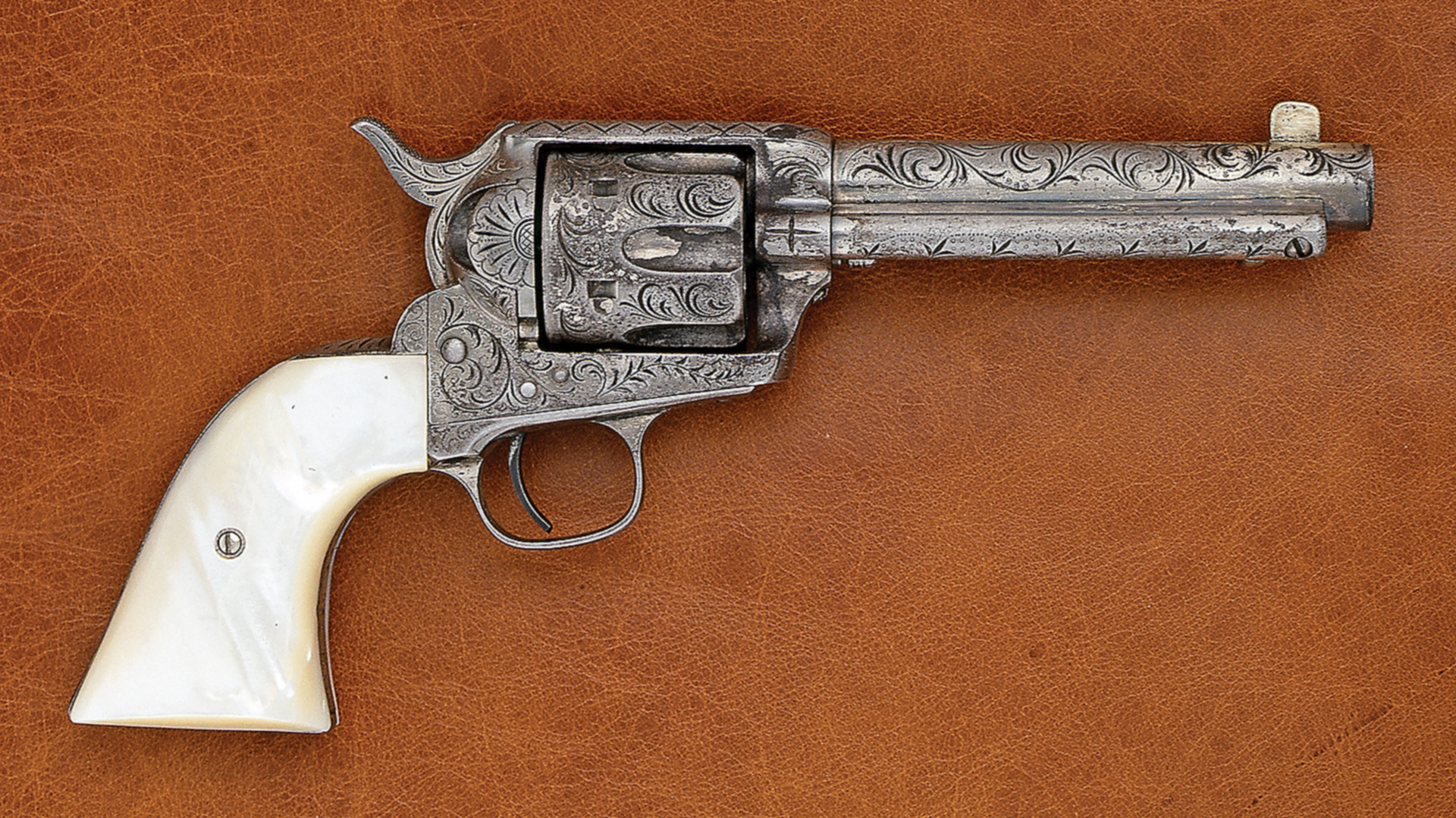
This Single Action Army revolver belonged to W.B. “Bat” Masterson. It was thoroughly engraved and has the inscription “W.B. MASTERSON” on the backstrap.
After many years of hunting the West and following the trails of the Indigenous, mountain men and cowboys, he has collected a raft of artifacts—paintings, sculpture, photographs, Bowie knives, reward posters, 10-gallon hats, tomahawks, lariats and, of course, firearms with direct ties to many of these larger-than-life figures that evoke America’s grand epic, the great West. The following is a glimpse of some of the collection’s more intriguing artifacts.
Bat Masterson’s Finest Colt Single Action
A revolver known to have consistently served on the side of law and order is the Colt .45 Single Action of W.B. “Bat” Masterson (1853-1921). This is the most historic handgun documented in the Hartford gunmaker’s records of its firearms used in the West. Masterson has been celebrated in fact and legend as a close friend of Wyatt Earp and of other renowned frontier figures, and as a man of innumerable adventures: buffalo hunter, U.S. Army scout, railroader, saloon keeper, policeman, deputy sheriff, sheriff, deputy U.S. Marshal, city marshal, gambler, gunfighter (then known as a “shootist”), newspaperman and journalist.
Masterson’s historic six-shooter was shipped from the Colt factory on Oct. 23, 1879, engraved, inscribed, silver-plated, enameled and with carved mother-of-pearl grips. Manufacture had been made on Masterson’s own order with sale to Wright Beverly Company of Dodge City, Kan., and shipment to Simmons Hardware Co., of St. Louis, Mo. The revolver became Masterson’s constant companion for several years thereafter.
In his later years, Masterson served as U.S. Marshal for the Southern District of New York, an appointment by his friend and admirer President Theodore Roosevelt. Masterson died peacefully at his desk at the Morning Telegraph, a New York City sporting newspaper. He survived all the great frontier heroes, except Wyatt Earp, who died in 1929.
Author and columnist Damon Runyon eulogized Masterson as “one of the most indomitable characters this land has ever seen (and) … a 100-percent, 22-karat real man.” Runyon later drew on his close friend as the colorful character Sky Masterson in the long-running Broadway show and hit film, “Guys and Dolls.”
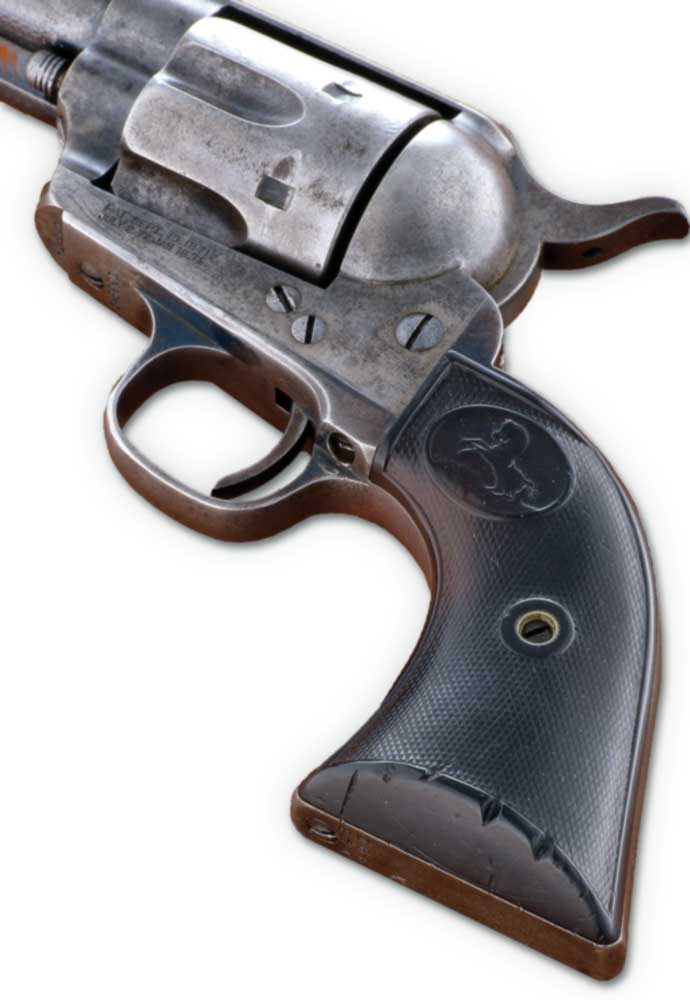
This Single Action Army, serial number 168991, belonged to Tom Horn.
Firearms and Memorabilia of Tom Horn
Tom Horn was born in 1860 to a farm family in Memphis, Mo. He held an assortment of jobs, working as a track layer with the Santa Fe Railroad, a wagon freighter, stagecoach driver, night herder, and, for 10 years, Spanish interpreter and scout for the U.S. Army at the San Carlos, Ariz., Apache reservation. He is credited with playing a major role in the 1886 campaign to capture Geronimo.
When the last of the major Indigenous Wars concluded, Horn sought other lines of employment. In service of the Pinkerton Detective Agency in Denver, from 1890 to 1894, he pursued train and bank robbers in Wyoming and Colorado. Ultimately quitting the Pinkertons (the work was too tame for him), Horn moved on to employment with cattle barons who operated forcefully and without legal niceties in dealing with small ranchers and homesteaders. Horn’scharges included carrying out shootings, as well as hiring and training gunmen.
After a brief interlude as a mule packer for Theodore Roosevelt’s Rough Riders during the Spanish American War, Horn returned to Wyoming and to killing for hire. He was soon in trouble as the prime suspect in the murder of 14-year-old Willie Nickell in an ambush on July 19, 1901. When Horn became intoxicated during the investigation and bragged that the Nickell shooting was his work, he was arrested and charged with first-degree murder. A sensational trial followed, resulting in a guilty verdict and a sentence of death by hanging.
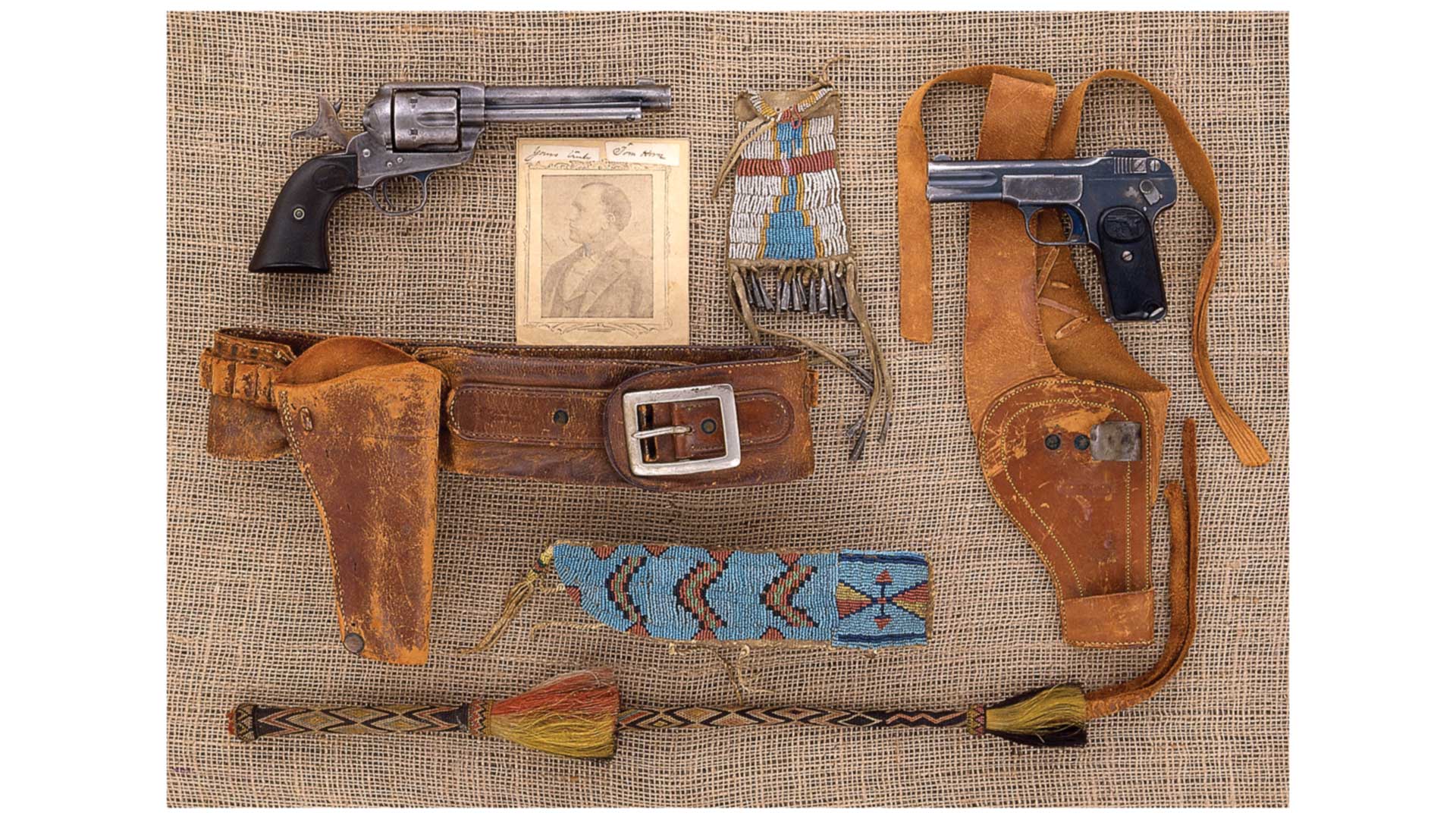
Shown (above) is an FN Browning patent semi-automatic pistol Tom Horn took from a deputy sheriff.
While in prison, Horn and his cellmate, Jim McCloud, concocted an escape scheme. On Aug. 9, 1903, they overwhelmed Deputy Sheriff Richard Proctor and, at gunpoint, forced him to open the safe that held the jail keys. At the same time, Proctor grabbed his FN-Browning patent Model 1903 semi-automatic pistol and opened fire. The prisoners wrestled him to the floor, but Proctor managed to slide the safety switch on the newly designed handgun, preventing firing.
Horn charged into the street but was unfamiliar with how to make the pistol work. In effect unarmed, he was chased down by local citizens, who pummeled him with sticks and clubs until he was rescued by Proctor. Horn accepted the inevitably of his sentence and spent his final weeks weaving horsehair quirts and ropes, including the rope for his own execution. On Nov. 20, 1903, he went to the gallows calmly, asking Proctor to place the noose over his head. Ironically, although responsible for several frontier shootings, Horn was likely innocent of Nickell’s murder.
Horn’s final letter to Proctor expressed appreciation for his friendship and for “the many little kindnesses you have done for me during my confinement under your charge. Only your desperate courage kept me from escaping.” The doomed adventurer also presented Proctor with his Colt six-shooter, a handmade horsehair riding crop and a beaded knife scabbard and bag—all of which today memorialize Horn’s story.
Captain Bill McDonald—Texas Ranger
The heroic role of the Texas Rangers in Western lore is represented in the Koch collection by two Colt .45s of Capt. William J. McDonald (1852-1918). In January 1891, Gov. James P. Hogg appointed McDonald captain of Co. B, Frontier Battalion, Texas Rangers. He soon became one of the most respected and feared lawmen in Texas.
Among his innumerable adventures, McDonald survived several pitched gun battles, served as a hunting guide for President Theodore Roosevelt and a bodyguard to President Woodrow Wilson. Arriving by train to a Texas town in response to authorities’ plea for help in quelling a riot, McDonald was asked where were the other Rangers. His answer became a classic of Texas lore: “Well—you only got one riot, haven’t you?” Reacting to a race disturbance in Brownsville, Texas, it was said of McDonald he would “charge hell with a bucket of cold water.” The captain’s Colts reveal the predilection of not a few Old West luminaries for engraved six-shooters with fancy grips and finishes.
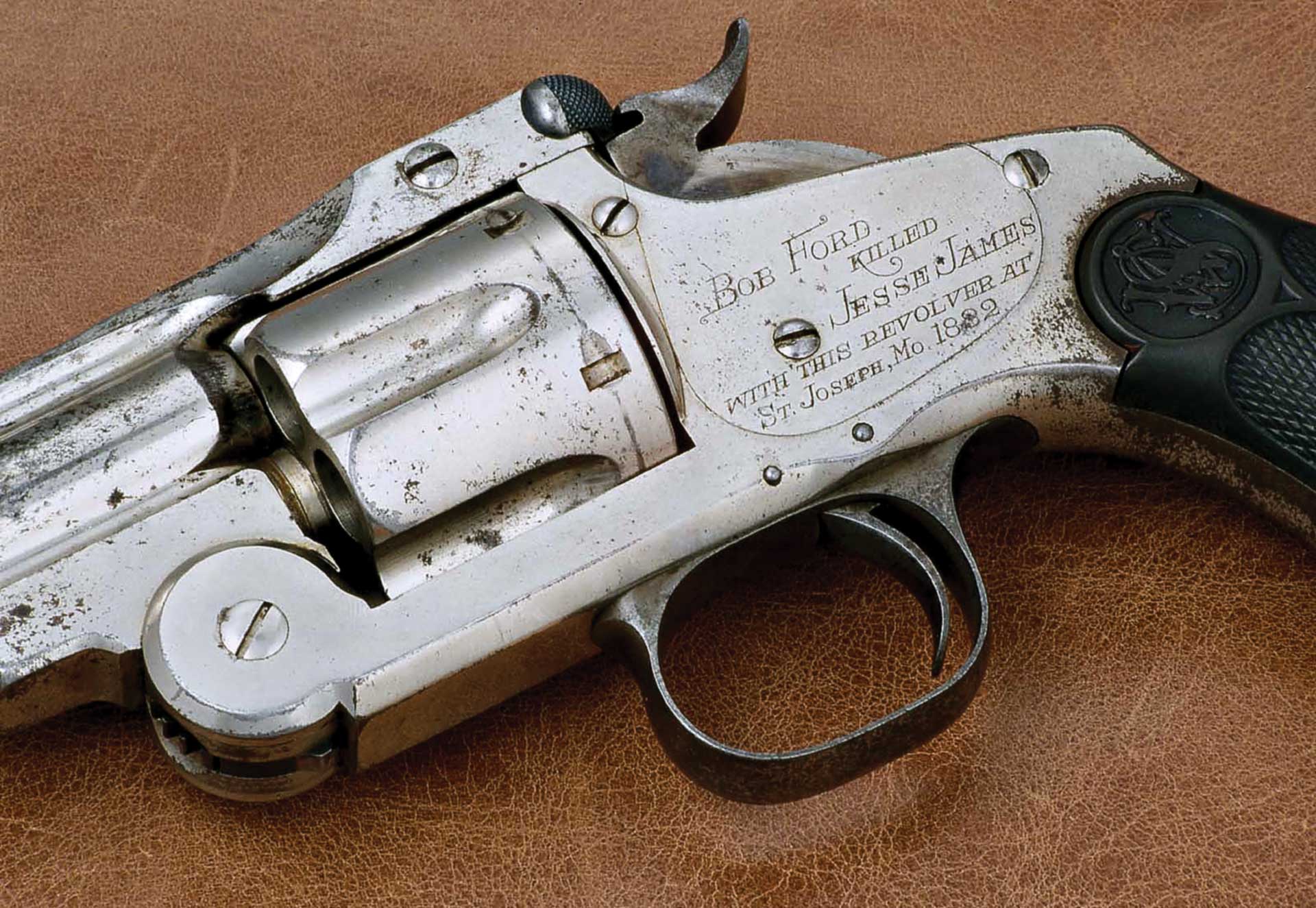
This Smith & Wesson Model No. 3 single-action revolver was used by “the dirty little coward” Robert Ford to kill Jesse James. Note the inscription on the sideplate that indicates this fact (above, r.).
The “Jesse James” Smith & Wesson
Perhaps even more legendary—indeed, maybe the most notorious gun in Koch’s collection—is the Smith & Wesson Model No. 3 Single Action revolver that Robert Ford used to kill the outlaw Jesse James. The sideplate inscription, engraved by the Smith & Wesson factory, documents Ford’s role in the assassination of James at St. Joseph, Mo., on April 3, 1882: “BOB FORD/KILLED/JESSE JAMES/WITH THIS REVOLVER AT/ST. JOSEPH, MO. 1882.” The gun is accompanied by a signed and notarized letter by Col. Corydon F. Craig, to whom Ford presented the gun shortly after the shooting, as well as an article from the Baltimore Morning Herald that details its provenance.
Ford tried to capitalize on his notoriety and occasionally sold other revolvers he claimed to have used in the assassination. But “the dirty little coward”—as he was known in the song commemorating the event—was never able to claim the $10,000 reward. And in an example of frontier justice, Ford was cut down by a shotgun blast at the hands of shootist Ed O’Kelley, in Creede, Colo., in 1892. The deed was partially in revenge for the murder of Jesse James.
The documenting letter and article, along with the Jesse James revolver ensure that the story of this Smith & Wesson will be preserved.
Tom Mix’s Colt Officer’s Model Match Revolvers
A recent acquisition, integrating decorative arts with firearms, is the custom-built matched pair of gold-plated and deluxe-engraved Colt Officer’s Model Match revolvers of matinee idol and superstar Tom Mix. These elaborate pistols also represent the flamboyance common to most of the post-Old West characters, creators of the new West of Hollywood on the silver screen—later magnified for a colossal television audience. Mix, an authentic cowboy, Wild West show performer, rodeo champion and his own stuntman, wryly observed that it was easier for a cowboy to become an actor than for an actor to become a cowboy. Like Gene Autry, Roy Rogers, John Wayne and today’s Tom Selleck, Mix was himself a keen collector of firearms.
As these stories illustrate, aficionados of firearms share a rich heritage—both in the objects they collect and in the pedigrees of past and present collectors. By understanding the time-honored and historic connection between all the arts and antiquities and the field of firearms, and integrating his Western room with his other collections, Bill Koch continues the traditions of the past and inspires the grand collectors of future generations.
—R.L. Wilson
The Museum of Fine Arts, Boston, exhibits “Things I Love: The Many Collections of William I. Koch,” selections from one of the most distinguished private collections of arms of the American frontier. For more information call (617) 267-9300 or go to mfa.org.
NASHVILLE, Tenn. (WKRN) — On Wednesday, families of victims and survivors of the mass shootings in Uvalde and in Buffalo, New York, testified on Capitol Hill.
“I came because I could’ve lost my baby girl,” a Uvalde father told lawmakers.
Many Americans now begging for stricter gun control, universal background checks, banning assault weapons, and red flag laws, which allow certain people to petition a court to have firearms taken away from someone they consider to be a threat.
State representative Vincent Dixie (D-Nashville) said he thinks red flag laws would help keep Tennesseans safer. “Red flag laws will keep people who do not need to have guns from having them. That’s one thing that’s needed. But we also have to do something about the illegal guns on the streets as well.”
Dixie added he’d like to see the permitless carry law repealed and tighter gun regulations overall.
“We definitely need to register each gun. We need to know who has guns and they need to know how to use them,” Dixie said.
On the other side of the aisle, many Republican lawmakers disagree. Some even calling red flag laws unconstitutional. In a statement sent to News 2, Representative Jeremy Faison (R-Cosby) questioned the effectiveness of red flag laws:
“From my perspective, red flag laws appear unconstitutional or ineffective. Forcibly taking someone’s gun from their house without due process creates a hostile environment for law enforcement and potentially criminalizes law abiding citizens. I am interested in how we can better equip our local schools and how we can do better with mental illness.”
On Monday, Governor Bill Lee signed an executive order aimed at strengthening school safety in Tennessee, but it didn’t mention anything about guns. He went on to tell reporters that he currently has no plans to talk about gun reform.
“We’re not looking at gun restriction laws in my administration right now,” Lee said.
Dixie said the governor needs to take a stronger stance. “I think this executive order was extremely weak and I think it puts more work on people that are already strained and stressed in their daily jobs.”
Right now, there are 19 states with red flag laws on their books, including California, Colorado, and Florida.
Categories
Hitler’s Weapons – Vietnam War


