
Category: All About Guns

WASHINGTON (AP) — Senators have moved to the brink of an agreement on a bipartisan gun violence bill, Democrats’ lead negotiator said Tuesday, potentially teeing up votes this week on an incremental but notable package that would stand as Congress’s response to mass shootings in Texas and New York that shook the nation.
Nine days after Senate bargainers agreed to a framework proposal — and 29 years after Congress last enacted a major measure curbing firearms — Sen. Chris Murphy, D-Conn., told reporters that a final agreement on the proposal’s details was at hand.
The legislation lawmakers have been working toward would toughen background checks for the youngest firearms buyers, require more sellers to conduct background checks and beef up penalties on gun traffickers. It also would disburse money to states and communities aimed at improving school safety and mental health initiatives.
“I think we’ve reached agreement,” Murphy said. “And just we’re dotting the I’s and crossing the T’s right now. I think we’re in good shape.”
Sen. John Cornyn, R-Texas, the chief Republican bargainer, spoke on the Senate floor moments later and said he, Murphy and the other two top Senate bargainers had “reached agreement.”
The senators did not initially say how they’d resolved the two major stumbling blocks that had delayed agreement on the plan’s legislative language.
One was how to make abusive romantic partners subject to the existing ban that violent spouses face to obtaining guns. The other was providing federal aid to states that have “red flag” laws that make it easier to temporarily take firearms away from people deemed dangerous or to states that have violence intervention programs.
If enacted, the election-year measure would spotlight a modest but telling shift in the politics of an issue that has defied compromise since Bill Clinton was president.
After 10 Black shoppers were killed last month in Buffalo, New York, and 19 children and two teachers died days later in Uvalde, Texas, Democrats and some Republicans decided that this time, measured steps were preferable to Congress’ usual reaction to such horrors — gridlock.
What’s uncertain is whether the Senate agreement and its passage would mark the beginning of slow but gradual congressional action to curb gun violence, or the high water mark on the issue. Until Buffalo and Uvalde, a numbing parade of mass slayings — at sites including elementary and high schools, houses of worship, military facilities, bars and the Las Vegas Strip — have yielded only gridlock in Washington.
Republicans refused to include proposals in Tuesday’s compromise that were sought by President Joe Biden and Democrats to ban assault weapons or raise the minimum age for buying them, prohibit high-capacity magazines or require background checks for virtually all gun sales.
It seemed likely a majority of Republicans — especially in the House — would oppose the legislation. Underscoring the backlash GOP lawmakers supporting the pact would face from the most conservative voters, delegates booed Cornyn at his state’s Republican convention Saturday as he described the measure.
Senate Majority Leader Chuck Schumer, D-N.Y., has said his goal was for his chamber to debate and vote on the legislation this week. Momentum in Congress for gun legislation has a history of waning quickly after mass shootings. Lawmakers are scheduled to begin a two-week July 4th recess at the end of this week.
Senate Minority Leader Mitch McConnell, R-Ky., said he supported the outline bargainers announced last weekend. House Speaker Nancy Pelosi, D-Calif., also said she backed the effort and seems sure to set up votes on it as quickly as she can.
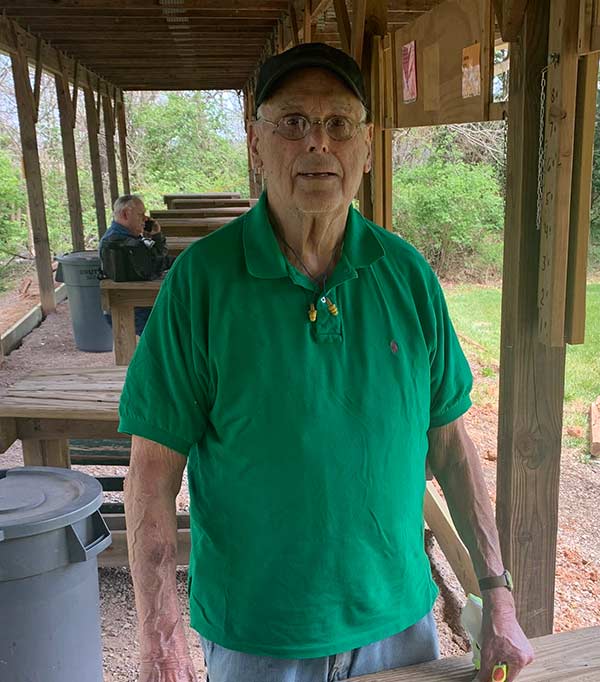
Reliability brings us the same comforts as a warm shelter and full stomach does. Maybe that’s why everyone loves Stan so much? You see, Stan shows up every weekend at our club shooting range. There’s nothing extraordinary about him, unless you count the fact, he’s 92. Some guys show up just a much, but they’re nowhere near as loved as Stan.
Sure, he moves slow, but he’s moving. He takes his time carrying his cased rifle to the bench he’ll be shooting at. Then he gets a few sandbags, a couple of carpeted shooting blocks of wood and shuffles them to his bench. On weekends our range has designated range officers (RO), usually four. When Stan comes, most of the RO, if not busy, help Stan get set up, carrying his blocks and bags for him to his bench.
They’ll help set his target up, usually running it out to the 100-yard line for him. Stan doesn’t ask for help but appreciates the helping hand. He’s earned the respect of every RO at the club with his grit and determination. He just doesn’t give up. He comes every weekend to shoot, while obviously in pain. As he says, “beats sitting at home doing nothing.”
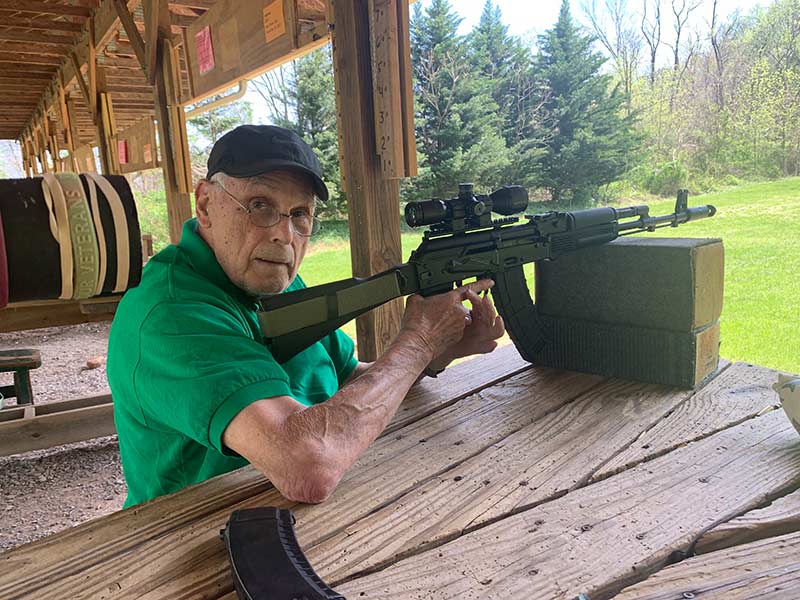
Even at 92, Stan shows good firearm safety and handling abilities.
Smoke Poles
Stan’s favorite shooting rifles are muzzleloaders, beautifully built muzzleloaders. Some were built by Stan, some were bought as is, others were repaired by him. He shoots both flint locks and cap lock guns. He has a steady, methodical ritual when loading his guns. Taking his time, he looks around, smiling, taking in the day, as he loads. Even with the muzzleloaders crude sights and his aging eyes, everyone is amazed how well he still shoots.
As Stan shoots and reloads, everyone always stops by to talk with him. He’s that kind of guy. He usually tells a story if prodded. He grew up in the Bronx and is a Korean War veteran. He married his sweetheart after the war, was a successful businessman, and had several children, two of which are doctors. After the war, he continued his fascination with guns.
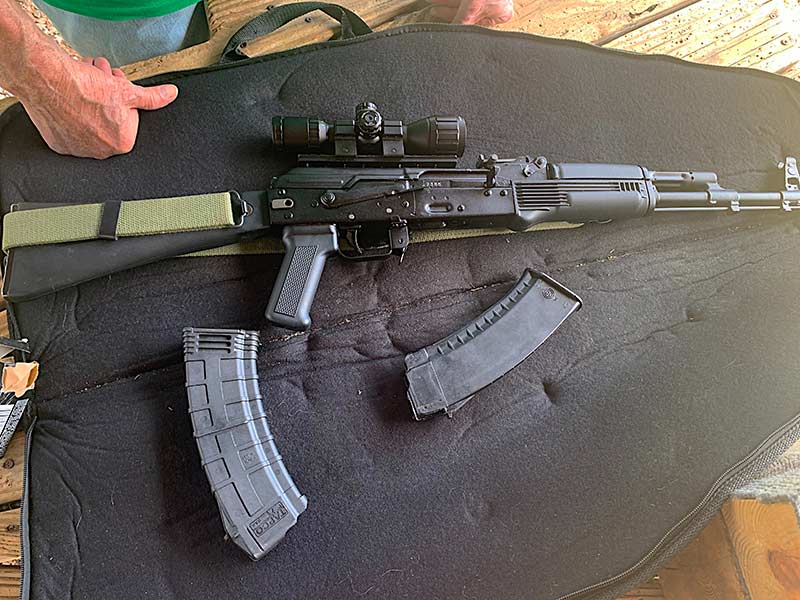
No muzzleloader today! Stan showing me his AK-74.
Surprise! Surprise!
This past weekend, as I write this, it was one of my days to be RO. It was a beautiful day, steady with shooters, and filled with good conversation naturally about guns, handloading and the latest politics.
Around 1 o’clock I see the unmistakable silhouette of Stan walking towards the range house to sign in. The range being slow at this time, everyone acknowledges Stan, helping him get set up. I help Stan carry his cased rifle to his bench, asking him what muzzleloader he brought this day. Stan chuckles, saying I got a surprise for you today.
Stan unzips the case, revealing a scoped AK-74 rifle. He goes on explaining it’s the only scoped rifle he owns, stating, “ever since my eye stroke, I can’t see the front sights on my muzzleloaders. So, Stan improvised, bringing his AK-74 to the range so he could enjoy some rest and recreation. I just laughed when I saw the rifle, surprised a die-hard muzzleloader man would have such a rifle. Not that there’s anything wrong with having an AK-74 rifle. Heck, everyone should have at least one.
Stan goes on telling me about his monthly injections in his eye to hopefully regain vision in it. He says it’s slowly starting to get better. He hopes to be shooting his muzzleloaders before too long.
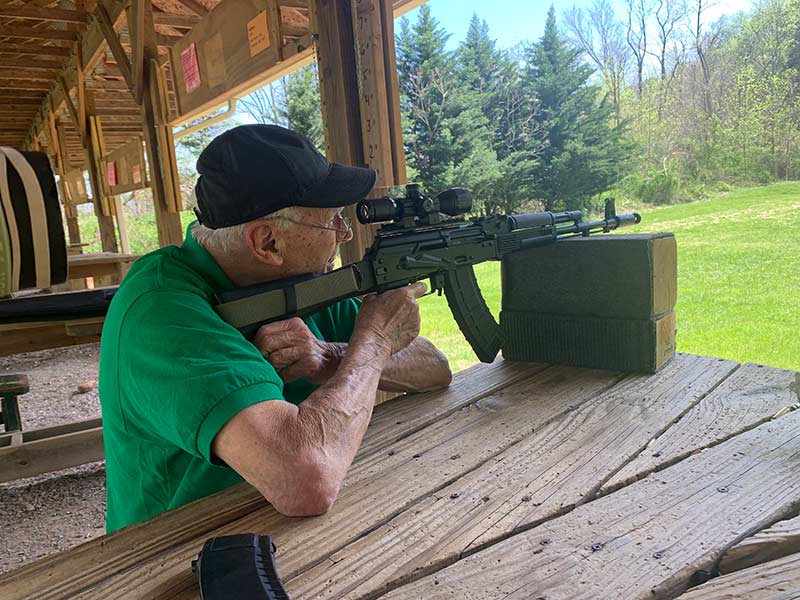
Stan showing good form aiming at his 100- yard target.

How many guys carry a picture of their wives when they first met? Stan Does!
There’s More…
This naturally led to a discussion on today’s Russia/Ukraine conflict. Stan stated his ancestors were from Ukraine, before immigrating here, to the Bronx. Stan continues about meeting his wife, even showing me a picture of her when they first met.
We close the range at 5 p.m. and Stan was waiting for the range to go cold, so he could retrieve his target. Of course, I offer to get it for him. Ol’ Stan had every shot in the black bullseye, his entire box of 5.45X39 in about a 4-5” group. I ask Stan if he wants the target and he says, “yes, because you never know when your last day of shooting will be, and I can always look at the target and remember…”
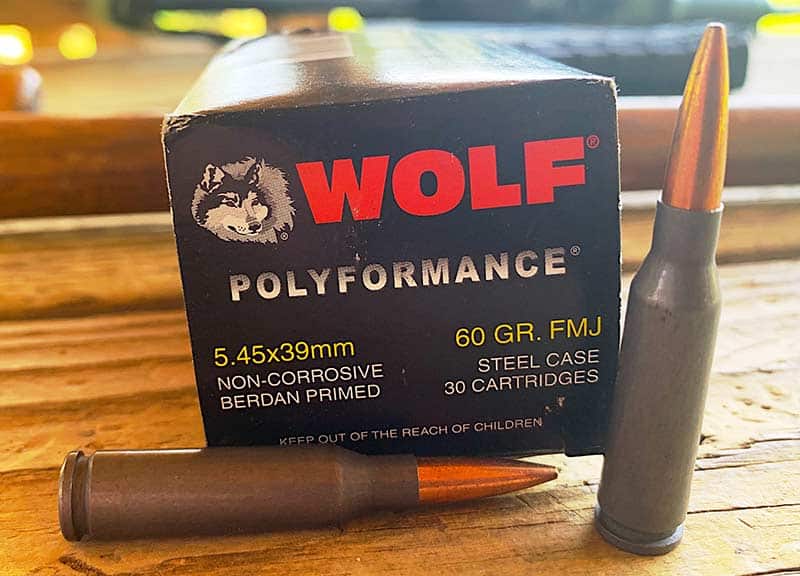
Here’s what Stan feeds his AK-74.
Be Like Stan
I don’t know why this story touches me so, but it does. Maybe its because if we’re lucky enough, we will live to be as old as Stan. I know I was tickled by his diverse choice of guns, but I shouldn’t have been. Gun guys like every type of gun as we rotate through every type of gun type there is, eventually. I know I’m looking at AK-74’s now after shooting Stan’s.
Also, his grit is lovable, making it to the range every weekend and his statement, “beats sitting on the couch.” When I asked Stan how old he was he replied, “92, can you believe it?” I replied, “that’s great!” And he chuckled, “not for me, I hate it” showing we’re still the same 13-year-old voice in our head as our bodies and time betray us.
All I can say is try and be like Stan. He’s truly worthy of someone to aspire to.








In an interview with The Tennessee Star, Knox County Mayor Glenn Jacobs explained the problem with red flag laws, how the Biden administration is hypocritical on the gun issue, and how the real topic of conversation should be securing the safety of schools.
“I think the most important thing to remember is we already have laws on the books to give the government the ability to get weapons out of the hands of people who suffer from mental health issues, but the key thing is those existing laws give them due process,” Jacobs explained, referencing the fact that Baker laws already exist in all 50 states.
“Red flag laws go against all Anglo-American jurisprudence. They deprive people of their rights without due process,” he said.
Jacobs made clear that he does not want weapons in the hands of the mentally ill, but the existing laws are already sufficient to address concerns.
“Of course, we don’t want people who are a danger to themselves or society, I understand that argument, but we don’t need any more laws than are already on the books,” he said.
Jacobs then pointed to Hunter Biden’s lie when he filled out Form 4473 while purchasing a gun as an example of how the Biden administration is hypocritical on the issue.
According to the NRA:
In order to purchase a firearm from an FFL, a buyer must fill out a Form 4473. The form asks, “Are you an unlawful user of, or addicted to, marijuana or any depressant, stimulant, narcotic drug, or any other controlled substance?” Hunter answered “no” to this question.
Lying on a form 4473 is two separate crimes. It is a crime when a person “knowingly makes any false statement or representation with respect to the information required by this chapter to be kept in the records of a person licensed under this chapter,” such as the Form 4473. A violation of this provision is punishable by up to 5 years imprisonment. It is also a crime for a person to “make any false or fictitious oral or written statement” to a dealer “with respect to any fact material to the lawfulness of the sale.” A violation of this provision is punishable by up to 10 years imprisonment.
“Hunter Biden shows more ‘rules for thee and not for me,’” he said.
“He should be charged for lying on his form. If they’re serious about this, the first thing they should do is clean up their own house. They’re [the Biden administration] is trying to clamp down but they’re not talking about that,” concluded Jacobs.
Jacobs then turned the discussion to school safety, which is what he says the public policy conversations should be centered upon.
“We do need to have a very serious conversation about school security. We can make them secure without making them prisons. We do it here in Knox County. We already have single-point entry and SROs and we can do it elsewhere,” he said.
“That’s really what the conversation should be, centered on school safety,” emphasized the mayor.
“If there’s a role the federal government should play, they should look into how they can help the smaller school systems find resources that big ones have but can’t due to lack of resources,” he concluded.
Jacobs had said in a tweet earlier on Wednesday, “The problem with red flag laws is they violate due process by operating under the assumption that one is guilty unless they can prove their innocence. States already have Baker laws on the books, which accomplish the same thing while still respecting due process.”
– – –
Aaron Gulbransen is a reporter at The Tennessee Star
Berlin, April 8, 1989.
Saturday mornings were always busy at the checkpoint at Chausseestraße, and April 8th was no exception. Queues had already formed on both sides when a taxi dropped off Michael Baumann and Bert Greiser shortly after 9:00 a.m.

Wearing sneakers and sweatpants, the two East Berliners took their place in the queue and watched and waited. For 10,100 days the city had been divided by a wall that physically partitioned it just as the country itself had been as a result of the confrontational politics of the Cold War. Baumann and Greiser were both born in the east in 1962, so they had known nothing but the wall and the oppressive Deutsche Demokratische Republik (German Democratic Republic or “DDR”) that built it.
Like so many other young East Berliners before them, Michael and Bert imagined escaping to the socially liberal and more open West, but that was a dangerous idea during the era of the Antifaschistischer Schutzwall (or “Anti-Fascist Protection Rampart”) as it was euphemistically known in the East.
The wall and the strip of ground it was built on were protected by barbed wire, guard towers, guard dogs, anti-personnel mines, machine guns, and the DDR’s controversial Grenztruppen (“border troops”) who patrolled it around the clock. They were there to prevent East Germans from escaping into West Berlin, and they had a deadly reputation because of the Schießbefehl (“order to fire”), a standing order to shoot anyone attempting to defect by crossing the wall – a crime known as Republikflucht.

By 1989 Grenztruppen personnel had killed 140 East Berliners at the wall, with the most recent case happening just two months earlier when 20-year-old Chris Gueffroy was shot attempting Republikflucht during the night of February 5th.
The death of Chris Gueffroy brought down international condemnation on the DDR government and its embattled head of state, Erich Honecker. To make matters even tenser, Soviet President Mikhail Gorbachev had embraced a policy of détente with the West, and shooting unarmed defectors was just not in harmony with that.
In response, Honecker quietly revoked the Schießbefehl on April 3rd with the words, “It is better to let a person run away than to use a firearm in the current political situation.” Although Baumann and Greiser did not know for sure that this had happened, they suspected it. Change was in the air in East Berlin, and with each passing month, it was becoming clearer that the old antagonisms that had given birth to the wall 27 years earlier were beginning to slip away.

So, the two men came up with a plan: they would proceed to the checkpoint at Chausseestraße where Berliners on foot and in automobiles were allowed to cross between Berlin-Wedding (in the West) and Berlin-Mitte (in the East). Even though they did not have credentials to do so, they would line up in the handling queue to cross into the West with the credentialed pedestrians, but then when the Grenztruppen raised the vehicular barrier to allow cars to drive into the checkpoint, the two men would run through it as fast as their feet would carry them.
They only had to cover 500 feet to freedom, but they had to cover it quickly, so the two trained for months by sprinting and jumping hurdles at nearby Stadion der Weltjugend (“Stadium of World Youth”). Earlier that morning, they warmed up by running a few laps there and then climbed into the taxi that dropped them off near the checkpoint.
In the interest of documenting what was about to happen, Greiser had informed a friend in West Berlin when and where he and Baumann would make their escape from the DDR. That friend had taken up a position on the West side of the checkpoint in an observation tower so as to photograph what would hopefully be a successful Republikflucht.
The Day
At 9:30, one of the Grenztruppen raised the barrier to allow an automobile to enter the checkpoint, and that is when Baumann gave Greiser the signal. They burst through the open gate and then hurdled a waist-high barrier beyond it like a couple of gazelles.

Before the Grenztruppen could react, the defectors were halfway through, but they had been noticed by a Passkontrolleinheiten (“Passport Control” or PKE) officer in the last guardhouse. With a lit cigarette in his mouth, the officer stumbled outside, shouted for the men to stop and drew his sidearm.

Baumann and Greiser were only 20 feet from West Berlin when a single shot rang out. They wanted freedom, not death, so they had agreed ahead of time to surrender immediately if shots were fired. Since that threshold had been crossed, both men stopped and put their hands up.

East German border guards armed with MPi-KMS-72 assault rifles hastily swarmed the would-be defectors and took them into custody. Although the entire incident was photographed as planned, Baumann and Greiser’s attempt to reach the West had been foiled by a single gunshot, and the man who fired that shot was caught on film just moments after he pulled the trigger.

The image shows him scowling toward the camera and because he was still smoking at the time, the press quickly gave him the nickname “Kippe-Schütze” – the “cigarette butt shooter.”
The “Kippe-Schütze” was technically not a part of the Grenztruppen, he was a part of the DDR’s Ministry for State Security, or “Stasi” as it was infamously known. When Erich Honecker revoked the Schießbefehl the week before, the news had only reached the Grenztruppen which is why they held their fire as Baumann and Greiser bolted through the Chausseestraße checkpoint that morning.

Since the Stasi did not get the memo, the PKE remained unaware of the change in policy, and that is why the “Kippe-Schütze” did not hesitate to let off a round when none of the other guards would. Fortunately, his bullet did not strike either Baumann or Greiser – but harmlessly zipped off into the no-man’s-land separating East Berlin from West Berlin.
As it turns out, his shot from an East German Makarov was the final shot fired at the Berlin Wall. Throughout 27 years of tense Cold War brinksmanship, firearms had been discharged hundreds of times, but the “Kippe-Schütze” squeezed the trigger on the final round.

Conclusion
While that shot may have prevented Michael Baumann and Bert Greiser from defecting on April 8, 1989, it could not stop what was coming. Just 215 days later – on November 9, 1989 – the wall came down and, after 27 years of being two cities, Berlin became one city again.
Baumann and Greiser could not join the crowds of celebrating Berliners though because they were both serving prison sentences at the time, but they did get to watch the celebrations on television.
Just a few days later they were released, and the following year the era of the DDR came to an end when Germany reunified. Although the DDR is now long gone, Baumann and Greiser are both still alive and well and they are both still living in Berlin.