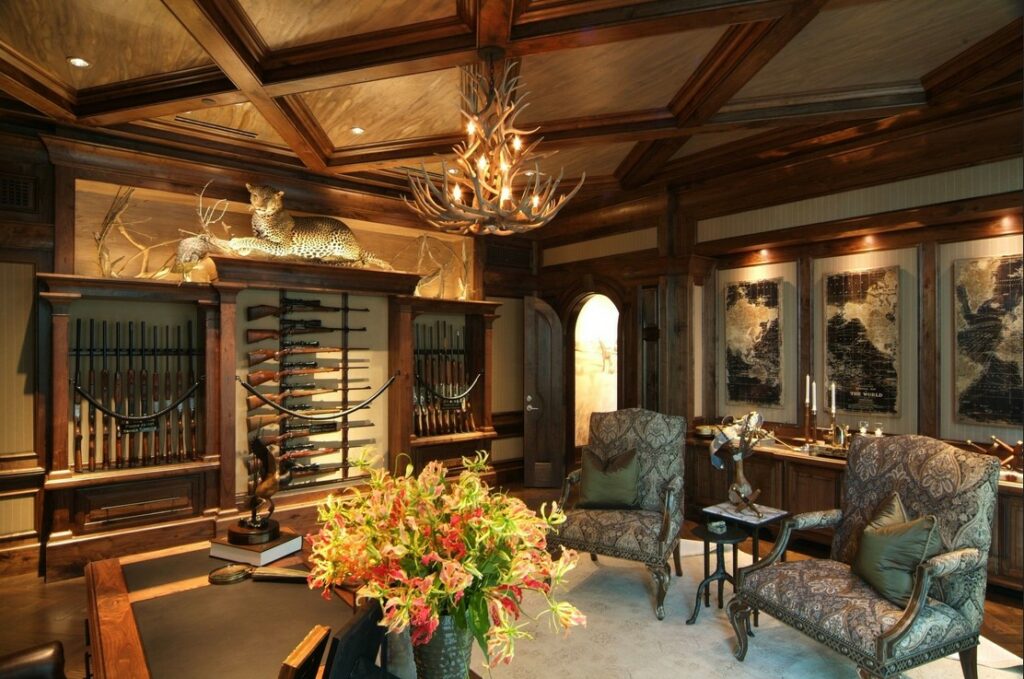
It is very oblivious to me that I will probably never make it to Africa as a Hunter. But I wish that if you dear Reader want, that you get to go! Grumpy
Category: All About Guns

The Screw Gun by Lord Kipling
Smokin’ my pipe on the mountings, sniffin’ the mornin’ cool,
I walks in my old brown gaiters along o’ my old brown mule,
With seventy gunners be’ind me, an’ never a beggar forgets
It’s only the pick of the Army that handles the dear little pets.
For you all love the screw-guns — the screw-guns they all love you!
So when we call round with a few guns, o’ course you will know what to do
Jest send in your Chief an’ surrender — it’s worse if you fights or you runs:
You can go where you please, you can skid up the trees, but you don’t get away from the guns.
They sends us along where the roads are, but mostly we goes where they ain’t:
We’d climb up the side of a sign-board an’ trust to the stick o’ the paint:
We’ve chivied the Naga an’ Looshai, we’ve give the Afreedeeman fits,
For we fancies ourselves at two thousand, we guns that are built in two bits.
For you all love the screw-guns — the screw-guns they all love you!
So when we call round with a few guns, o’ course you will know what to do
Jest send in your Chief an’ surrender — it’s worse if you fights or you runs:
You can go where you please, you can skid up the trees, but you don’t get away from the guns.
If a man doesn’t work, why, we drills ‘im an’ teaches ‘im ‘ow to behave;
If a beggar can’t march, why, we kills ‘im an’ rattles ‘im into ‘is grave.
We’ve got to stand up to our business an’ spring without snatchin’ or fuss.
D’you say that you sweat with the field-guns? By God, you must lather with us;
For you all love the screw-guns — the screw-guns they all love you!
So when we call round with a few guns, o’ course you will know what to do
Jest send in your Chief an’ surrender — it’s worse if you fights or you runs:
You can go where you please, you can skid up the trees, but you don’t get away from the guns.
Smokin’ my pipe on the mountings, sniffin’ the mornin’ cool,
I climbs in my old brown gaiters along o’ my old brown mule.
The monkey can say what our road was — the wild-goat ‘e knows where we passed.
Stand easy, you long-eared old darlin’s! Out drag-ropes! With shrapnel! Hold fast.
For you all love the screw-guns — the screw-guns they all love you!
So when we call round with a few guns, o’ course you will know what to do
Jest send in your Chief an’ surrender — it’s worse if you fights or you runs:
You can go where you please, you can skid up the trees, but you don’t get away from the guns.


Introductory Proviso: I’M BRINGING THIS BACK FROM THE TRUMP YEAR 2018. BECAUSE IT’S TIME TO THINK ON THESE FIRST THINGS.
The following essay on possible gun confiscation is a purely conjectural gedankenexperiment about the future that extrapolates from recent history and current trends. Nothing herein is seditious (per 18 U.S. Code § 2384), nor a call to arms, nor a threat to our government or to any individual, agency, or group. [HT: Ol’ Remus RePost and eMail Widely]
The Collectivist Dream
The current mass media-driven “debate” on firearms (actually more like paternalistic lecturing or chiding) seems to be leading toward greater restrictions by Congress. The collectivist gun grabbers have the dream of ignoring the Second Amendment and somehow magically removing all detachable magazine semi-auto rifles from civilian hands. But it is just that: a dream. If they think that they can disarm us, then they are thoroughly deluded. I’ll explain why, with some simple mathematics.
The United States has the world’s first or second most heavily-armed populace, per capita. (It’s possibly second only to Yemen.) The number of FBI firearms background checks for transfers by Federally-licensed dealers from November 1998 to April 30, 2018 totaled 287,807,015. That isn’t all new guns. It of course includes many second-hand sales that cycled back through FFL holders. But it is still a staggering number. And it does not include any private party (“not through a dealer”) sales of used guns. That is thankfully legal in most states. Nor does it include guns that are legally made at home. (Typically made with 80% complete receivers.) Those home “builds” are becoming quite popular. Their ownership is mostly opaque to any would-be tyrants who might covet seizing them.
There are somewhere between 370 million and 420 million privately-owned firearms in the United States. Let’s just call it 400 million for a nice round figure. Most of those guns are not registered to particular owners. That is why there are only rough estimates. It makes me feel good to know that Big Brother has no idea where those guns are, and who owns them. When I last checked, the total U.S. population is 327,708,500. So that is about 1.2 guns per person. The adult population is around 249,500,000. And according to Wikipedia, the “Fit for service” Military Age Male population (men, ages 16-49) of the U.S. is just 59,764,677. That equates to 6.6 guns per Military Age Male in the United States.
Of the 400 million American guns, roughly 20% are single-shot or double-barreled, 60% are manually-operated repeaters (e.g., bolt action, lever action, pump action, or revolvers), and 20% are semi-automatic. There are only about 175,000 transferable Federally-registered full autos. That number would have been much larger by now but production was sharply curtailed by a hefty $200 tax (starting in 1934) and then there numbers were effectively frozen in 1986. It is noteworthy that if it were not for the National Firearms Act of 1934, selective fire guns would by now be in what the Heller decision calls “common use“. After all, it costs only a few dollars more to manufacture a selective-fire M16 than a semiautomatic-only AR-15.
With every passing year, the predominance of semi-autos is gaining for both rifles and handguns. (In sheer numbers produced, revolvers are becoming almost passé.) The biggest-selling handgun in the country is the Smith & Wesson M&P 9mm, followed closely by the Glock Model 19 9mm. Gaining rapidly is the highly modular SIG P320, which was recently adopted by the U.S. Army. All three of these are semi-automatic. Standard magazine sizes for autopistols range from 13 to 20 rounds. And the most popular rifles of the decade are AR-15s and their clones. Their standard capacity magazines hold 30 cartridges. (That isn’t “high capacity”.)
The Math On AR Clones
AR-15 and AR-10 variants are truly generic and have been sold under more than 120 brand names. The number of ARs (AR-15s, M4s, AR-10s, and variants) sold from 2000 to 2014 was approximately 5,672,900. Since then, AR-15 clones have become even more popular and ubiquitous with approximately 1.2 million more produced in 2015, 1.6 million in 2016, and 1.5 million in 2017. At least 1.2 million will be produced in 2018. It can be assumed that 99% of the ARs produced since the year 2000 are still functional. There were more than 2.3 million other ARs produced for the civilian market between 1962 and 1999. It is safe to assume that at least 95% of those of that vintage are still functional. So the total number of functional ARs in private hands in the U.S. is somewhere around 11 to 12 million. (As of May, 2018.)
Some Math on Other Semi-Autos
Next we come to the more fuzzy math on the wide variety of other models of semi-auto centerfire rifles in private hands. They include detachable magazine, en bloc clip, and stripper clip-fed designs. Here are some rough estimates. (Some of these estimates are based on my own observations of the ratios of different models I’ve seen offered for sale):
- Various semi-auto hunting rifles (Remington 740/7400 series, AK Hunter, Browning BAR, Winchester 100, Valmet Hunter, Saiga Hunter, HK SL7/SL8, HK 630/770, et cetera): 2 million+
- Ruger Mini-14 and Mini-30: 1.2 million
- M1 Garand: 800,000+ (With many more being imported, soon.)
- AK Variants (imported and domestically made, from all makers including Valmet and Galil): 2 to 3 million
- M1 Carbine: 1.5 to 2 million
- AR-180 and AR-180B: 35,000
- M1A and other semi-auto M14 variants: 360,000
- SIG 550 series: 80,000+
- Thompson Semi-Autos (West Hurley and Kahr Arms): 75,000
- HK variants: CETME, HK91/93/94 series, PTR91, etc.: 600,000 to 700,000
- FAL variants: FN-FAL, FNC, and L1A1: 425,000
- SKS variants: 1 million
- Steyr AUG: 110,000
- IWI Tavor & X95: 70,000
- Various semi-autos assembled from military surplus full auto parts sets (M1919, BAR, Sten, M2 Browning, M3, Etc.): 75,000+
- Assorted Other Models (These include: Kel-Tec, Barrett, Leader, FAMAS, Uzi carbines, Wilkinson, Feather, Calico, Hi-Point, SIG AMT, SIG PE57, SIG MCX, SIG MPX, Johnson, BM59, HK USC, TNW, Demro Tac-1, Calico Carbine, ACR, SCAR, Chiappa Carbine, SWD (MAC), Robinson, Hakim, Ljungman, Beretta AR-70, Beretta CX4, CZ Scorpion, Kriss Carbine, FN-49, SVT-40, SVD, PSL, Gewehr 41 & 43, Daewoo, FS 2000, Ruger PCR, Marlin Camp Carbine, et cetera): 2+ million.
The Aggregate GUN Math
If a production and importation ban requiring registration were enacted, there would surely be massive non-compliance. For example, the registration schemes enacted in the past two decades in Australia, Canada, The Philippines, Indonesia, Brazil, and the States of California and New York have been well-documented failures. They have been met with noncompliance rates ranging from 50% to 90%.
Let us surmise that following several years of a registration scheme there were an outright “turn them all in, Mr. and Mrs. America” ban. I predict that even if $1,000 per gun were offered, no more than 11 million would be turned in, by compliant and history-ignorant Sheeple. (An aside: They’ll probably call this a “Buy Back”, but that will be a lie. They can’t “buy back” something that they’ve never owned.)
The SWAT and ATF Manpower Math
So let’s suppose that a full Federal semi-auto rifle ban were enacted with a gun confiscation order issued.
This is where the math gets very interesting: There are only 902,000 sworn police officers in the United States. At most, about 80,000 of them have had SWAT training. There are only 5,113 BATFE employees–and many of those are mere paper shufflers. As of 2017, there were just 2,623 ATF Special Agents. The FBI’s notorious Hostage Rescue Team (HRT or “Hurt Team”) has a cadre strength that is classified but presumably less than 200 agents. Together, they comprise the pool of “Door Kickers” that might be available to execute unconstitutional search warrants.
If they were to start going door-to-door executing warrants for unconstitutional gun confiscation, what would the casualty rates be for the ATF, HRT, and the assorted local SWAT teams? It bears mention that the military would be mostly out of the picture, since they are banned from domestic law enforcement roles, under the Posse Comitatus Act.
The Division Equations
Next, let’s do some addition and then divide:
80,000 SWAT-trained police
+ 2,623 ATF Special Agents
+ 200 FBI HRT Members
= 82,863 Potentially Available Door Kickers
… presumably working in teams of 8, attempting to seize 9,000,000 newly-contraband semi-auto rifles.
Before we finish the math, I’ll state some “for the sake of argument” assumptions:
- That every SWAT-trained officer in the country is pressed into service.
- That there would be no “false positives”–meaning that 100% of the tips leading to raids were accurate. (Unlikely)
- That no local police departments would opt out of serving unconstitutional Federal gun warrants. (Unlikely)
- That all raids would be successful. (Unlikely)
- That each successful raid would net an average of three contraband semi-auto rifles. (Possible)
- That every Door Kicker would get an equal share in the work. (Very unlikely)
- That every Door Kicker would be alive and well through the entire campaign of terror–with no incapacitating injuries or deaths of SWAT officers, no refusals, no resignations, and no early retirements. (Very unlikely)
A lot of those are not safe assumptions. But for the sake of completing a gedankenexperiment, let’s pen this out on the back of a napkin, as a “best case” for an unconstitutional gun confiscation campaign. Here are the division equations:
9,000,000 ÷ 82,863 = 108 (x 8 officers per team) = 864 raids, per officer
Let that sink in: Every officer would have to survive 864 gun-grabbing raids.
Those of course are fanciful numbers. There will be a lot of false tips, and there will be many owners who keep their guns very well-hidden. Each of those raids would have nearly the same high level of risk but yet many of them would net zero guns. And it is likely that many police departments will wisely decline involvement. Therefore the “best case” figure of 288 raids per officer is quite low. The real number would be much higher.
Here is some sobering ground truth: America’s gun owners are just as well trained–and often better trained–than the police. There are 20.4 million American military veterans, and the majority of veterans own guns.
Resistance Strategy and Tactics
The Gun Confiscation End Game
- Declare a cease fire and stand-down for all gun confiscation raiders.
- Repeal all Federal gun laws.
- Order the destruction of all Federal import, purchase, transfer, and registration records
- Issue unconditional pardons for all convicted Federal gun law violators.
- Declare a general amnesty for all involved in the resistance, and drop all pending charges.
- Disband the BATFE.
Without all six of those, the hostilities would continue.
But There’s More
Then there are the estimated 1.5 million unregistered machineguns now in the country. Except for a 30-day amnesty in 1968 that generated only about 65,000 registrations, they have been contraband since 1934. Their number is particularly difficult to accurately estimate, since some semi-autos such as the M1 Carbine, HK91/93/94 series, and AR-15 are fairly easy to convert to selective fire. Similarly, nearly all “open bolt” semi-auto designs are easy to convert to full auto. Large numbers of conversion parts sets have been sold, with little recordkeeping. Some guns can be converted simply by removing sear springs or filing their sears. Just a trickle of unregistered full autos are seized or surrendered each year. This begs the question: If Federal officials have been unable to round up un-papered machineguns after 84 years, then how do they expect to ever confiscate semi-autos, which are 15 times more commonplace?
As evidenced by the 1990s wars in the Balkans, when times get inimical, contraband guns get pulled out of walls and put into use. We can expect to see the same, here.
Now, to get back to the simple mathematics, here are some ratios to ponder:
- NRA members (5.2 million) to Door Kickers (82,863) = 63-to-1 ratio
- Military veterans (20.4 million) to Door Kickers (82,863) = 249-to-1 ratio
- Unregistered machineguns (1.5 million) to Door Kickers (82,863) = 18-to-1 ratio
- Privately owned semi-auto rifles (40 million) to Door Kickers (82,863) = 485-to-1 ratio
Unintended Consequences
I’ll conclude with a word of caution: Leftist American politicians should be careful about what they wish for. Those who hate the 2nd Amendment and scheme to disarm us have no clue about the unintended consequences of their plans. If they proceed, then I can foresee that it will end very badly for them. – JWR
End Notes:
Again, the preceding is a purely conjectural gedankenexperiment about the future that extrapolates from recent history and current trends. None of the foregoing is seditious (per 18 U.S. Code § 2384), nor a call to arms, nor a threat to our government or to any individual, agency, or group.
Permission to reprint, re-post or forward this article in full is granted, but only if credit is given to James Wesley Rawles and first publication in SurvivalBlog (with a link.) It must not be edited or excerpted, and all included links must be left intact.
Reising M50 Submachine Gun

I first fired the Ruger Gunsite Scout Rifle (GSR) chambered in .308 Winchester at a Ruger’s writer’s seminar at Gunsite shortly before it was officially introduced in 2011. It was love at first, er, shot, and I ended up buying the rifle I tested.
Later that same year my grandson Austin, then 11 years old, took his first elk using it with Black Hills’ 168-gr. Barnes TSX load.
The GSR was not only met with popular approval, but has proven to be one of Ruger’s best-selling rifles.
This was followed by a GSR chambered for the 5.56x45mm cartridge. It will, of course, also accept .223 Remington loads.
SCOUT CONCEPT
In the early 1980s Lt. Col. Jeff Cooper considered the need for a light, handy, general-purpose rifle that could be used equally for hunting and fighting. The idea became known as the Scout Rifle.
The concept imagined a rifle weighing around 3 kilograms (6.6 lbs.), with a maximum of 3.5 kilograms (7.7 pounds) and a length of 39 inches or less. The rifle would use a cartridge that could put down a large animal at ranges out to around 400 yards. The .308 Winchester was the round of choice.
Ruger’s original Gunsite Scout Rifle in .308 met most of the Colonel’s specifications.
So is the new rifle chambered for 5.56x45mm truly a Scout Rifle?
The answer is yes…and no.
At 400 yards the 5.56/.223 cartridge is at the extreme edge of its performance envelope so it does not measure up to the original specifications in the caliber category.
However, the cartridge is accurate and effective easily out to 200 yards and does meet the other requirements. The 5.56 round may actually be more desirable in a semi-urban/urban area as there is far less chance of over penetration. For most situations it would make a great choice for a general-purpose/patrol rifle.
The GSR does generally meet the overall size and weight requirements.
5.56 GSR
The GSR has a black laminated stock—though the test sample showed a lot of color—and comes complete with three ½-inch spacers to change the length of pull (LOP) from 12.75-14.25 inches enabling it to be fired comfortably by shooters of all sizes. Both the pistol grip area and forend are checkered for a sure grip. There are sling swivel studs at the rear of the stock and on the forend.
Both right and left-hand versions are available and offered in both matte black alloy steel and matte stainless finishes. My test rifle was a right hand version with the matte black finish.
The 16.1-inch barrel has a 1:8 twist allowing it to fire both light and heavy bullets. The front sight is a ramped post and protected by wings. The rear sight is ghost ring aperture and is fully adjustable. The barrel is crowned with a Mini-14 type flash hider (1/2”x28 threads).
Overall length is 37-38.5 inches and weighs in at a nimble 7.1 pounds.
The safety is a three position-type. The bolt handle is smooth and of ample size to work the action from the shoulder. The bolt uses the time-proven Mauser-type extractor. The magazine release is a push lever on the rear of the magazine such as used on the Mini-14, M14, AK, and many others.
The .223 GSR, like the .308 version, uses a ten-round, steel magazine. The top of the GSR’s magazine is single as opposed to staggered feed, allowing the round to be pushed directly into the chamber.
In the months I had the rifle I read many bloggers opine that Ruger should have used an AR-15 magazine, and they certainly have the right to express their opinions. Apparently, however, they do not take into consideration how the two systems function. AR magazines lock up in a slot on the left side of the mag and, as mentioned above, the GSR locks up at the rear of the mag.
Furthermore, almost all manufacturers use proprietary magazines for their firearms—1911 pistols and AR-type carbines from different manufacturers are the exception, not the rule.
To incorporate a magazine release that would function with AR mags, the rifle would have to undergo a complete—and to my way of thinking unnecessary—costly design change.
A Picatinny rail is mounted on top of the barrel for optics with a long eye relief. For those who prefer the more traditional, rearward mounting above the receiver, the GSR ships with Ruger one-inch rings.
Safety is three position-type. Bolt handle is smooth and of ample size to work the action from the shoulder.
OPTICS
Although Colonel Cooper did not say a scope was mandatory, most versions of the Scout Rifle concept have a low to medium-magnification scope with a long eye relief placed forward of the action. Such a scope allows you to keep both eyes open and allows quick acquisition of a target. Since the Colonel probably forgot more about rifles than I know, I saw no reason to reinvent the wheel when evaluating the new GSR.
For a scope I chose the Burris 2.75X20 Scout Scope. The Scout Scope uses a Heavy Plex™ reticle that has extra thick bolded edges, with a thin crosshair resulting in a clean, simple reticle that is fast into action.
The Burris Scout Scope has a one-inch tube, 7.3-inch eye relief, a field of view of 15 feet 100 yards, .5 MOA click value, is 9.2 inches long, and weighs only seven ounces.
While the Burris Scout Scope tested here is a great little optic, it has one fault and that is in failing light—such as at dusk or dawn. The 20mm objective lens is simply not large enough to transmit much light.
A better choice for a general-purpose/patrol rifle might be a scope with a larger objective lens such as the Burris 2.7X32 Scout Scope or the Leupold FX-II Scout IER 2.5x28mm. When compared to the other Scout Scope the Leupold only adds .5 oz. in weight. The Burris will add a half-pound, but will transmit more light. Your expectations and mission will determine what is best for your needs.
Red dot sights were in their relative infancy when the Scout Concept originated, and battery life and ruggedness was a concern. However, they have made major strides in the interim two and a half decades, having proven their usefulness in two wars.
After the initial evaluation I removed the scope and replaced it with an Aimpoint T-2 red dot sight. The T-2 has a housing that gives protection to the sight’s adjustment turrets and electronic components, and a newly designed front lens with new reflective lens coating technology. The 2 MOA dot made easy work of getting hits from 50 to 300 yards.
AT THE RANGE
As per my usual procedure, evaluated the GSR with a variety of ammunition—specifically 21 different loads from nine manufacturers plus a handload. Bullets ranged in weight from 50-77 grains and included full metal jacket, soft point, Ballistic Tip, and match.
A PACT Professional chronograph was used to establish the average velocity of each load.
The highest velocity was from Black Hills 50-gr. Barnes TSX load streaking along at 3,351.8 feet-per-second (fps). The slowest load was Hornady’s 75-gr. BTHP (.223 load), still reaching a respectable 2,580.3 fps.
A large part of the equation of making an accurate shot is a good trigger, and the GSR’s is very nice. The trigger on the sample rifle exhibited no perceptible take-up and consistently broke cleanly and crisply at four pounds with a barely noticeable amount of over-travel.
I established a rough zero at fifty yards and fine-tuned it at 100. I fired five-round groups from a rest at 100 yards to establish the accuracy potential of each load.
Somewhat to my surprise, the best load in terms of accuracy was the Black Hills 50-gr. Barnes TSX load with a 1.11-inch group. This is the only time I can remember that a load that turned in the highest velocity also came in first place for accuracy.
The least accurate load was my handload—made from fired, swaged.22 LR cases—with a group of just under three inches. Time to back that powder charge down just a tad…
The average of all 22 loads was 2.10 inches. Not bad at all for a general-purpose rifle with a relatively inexpensive scope.
Working some drills at 50 yards with the Aimpoint T-2 I experienced several failure to eject malfunctions. I attributed this to not running the bolt briskly enough to the rear. And, though I’m not an engineer and don’t even play one on TV, I think the 5.56 GSR would benefit from a slightly longer ejector.
SUMMARY
The GSR’s adjustable LOP and light recoil is great for young or smaller stature shooters and is chambered in what is arguably the most popular rifle cartridge today. The rifle is light, handy and with the right bullet—and if you do your part—is capable taking deer and other thin-skinned animals out to around 300 yards.
SOURCES:
Sturm, Ruger & Co., Inc.
(203) 259-7843
www.ruger.com
Aimpoint Inc.
(703) 263-9795
www.aimpoint.com
Burris Company
(970) 356-1670
www.burrisoptics.com


