Categories
Category: All About Guns

Most production hunting rifles can be lumped into three categories: cheap, mid-priced, and expensive. The new Browning X-Bolt Mountain Pro rifle falls in the final category. It is not designed for someone looking for a $300 rifle, and that’s OK. Browning calls it a “semi-custom” rifle, and the price reflects that with an MSRP of around $2,500.
I call it an aspirational rifle, meaning it’s one people will aspire to own once they find out just how good the gun really is. My first reaction, upon receiving the rifle for testing, was that it was a very nice gun but I wouldn’t be buying it. After testing the rifle at the range and hunting with it, my opinion quickly changed. This, I decided, was a gun that I simply must have, and that doesn’t happen very often.

My change of heart was partly due to the fact that my test rifle was chambered in 6.8 Western, a new cartridge from Winchester and Browning which I have hunted with for two seasons and become fond of. This cartridge, which uses long, heavy-for-caliber, high-BC bullets, elevates .277 caliber bullet performance to levels that, in some ways, equal or beat the performance of some 7mm and .30 caliber magnum cartridges. The 6.8 Western is what the 270 WSM should have been, and it’s a perfect chambering for the Mountain Pro rifle, especially for those who hunt the big, open spaces of the West.
The Mountain Pro comes with all the features common to X-Bolt rifles but has some enhancements that take performance to the next level. Before we get to the upgrades, a quick review of the standard features that set X-Bolt rifles apart from the pack is in order.

X-Bolt rifles were introduced in 2008 as a replacement for Browning’s flagship A-Bolt rifle. The X-Bolt was an entirely new design with modernized styling and an emphasis on better accuracy and long-range performance. The receiver is more compact and uses a patented detachable, flush-fitting rotary magazine, which feeds cartridges directly in-line with the bolt rather than feeding from an offset position. This enabled Browning to add material to the bottom of the receiver for greater rigidity and accuracy. The guns have a uniquely strong X-Lock scope mounting system, which replaces four centerline mounting-screw holes with eight outboard holes. Receivers are bedded at the front and rear for stability and are mated to free-floated, high-quality, button-rifled barrels made with a three-step reaming and separate honing process.
X-Bolt rifles retained the short, 60-degree bolt throw of the A-Bolt rifle, but have a bolt unlock button on top of the bolt handle, which allows cycling of the bolt with the tang-mounted safety engaged. Designers also gave X-Bolts a new, crisp-breaking Feather Trigger with chromed, polished components and a trigger pull that’s adjustable from three to five pounds. The rifles are equipped with an Inflex recoil pad that deflects recoil energy downward, away from the shooter’s face, to reduce felt recoil.

The Mountain Pro rifles takes recoil reduction a step further with a new Recoil Hawg muzzle brake, which Browning says reduces recoil by as much as 77 percent. After testing the rifle, I’d say that percentage is about right, which is all the more impressive when you consider that the rifle weighs only 6 lbs., 2 oz. despite the added weight of the muzzle brake and a 24-inch barrel. Weight savings are derived from the use of a carbon fiber stock, a streamlined receiver, and spiral fluting of the barrel and bolt. The stock has stippling in the right places to enhance grip in wet weather and, in addition to sling swivel studs, a trim removable Picatinny accessory rail beneath the forend.
The Mountain Pro is a true go-anywhere rifle designed to withstand the elements. The stainless-steel receiver and barrel are protected with a burnt bronze Cerakote finish that nicely compliments the tan-and-grey accent graphics on the stock which create a unique camouflage pattern.
You can also get the Mountain Pro with a Tungsten Cerakote finish. The overall appearance of the rifle is aesthetically pleasing, with clean, sleek, and tapered lines, but the beauty of this rifle is more than skin deep. Sometimes, it’s the small things you can’t see that make a big difference, and that’s true with the Mountain Pro.
The carbon fiber stock, which weighs 1/4-pound less than predecessor carbon fiber stocks, is filled with noise-dampening foam. The barrel has also been subjected to a proprietary lapping process that reduces fouling, making the rifle easier to clean and minimizing the need for a time-consuming break-in process. The barrel of my test rifle also has a fast, 1:7.5 rate of twist to properly stabilize the heavier bullets used in 6.8 Western cartridges.

Attention to detail is evident with the Mountain Pro, and that extends to the gun’s detachable magazine. It may be made of polymer and composite, but it’s built tough. Rather than simply stacking cartridges, the design retains them by the shoulder, eliminating the possibility of bullet tips deforming by slamming into the forward wall of the magazine under recoil. The release latch is built into the magazine itself and protected within a recess at the bottom of the receiver. Bullets do not rattle around in the magazine, which drops freely into the hand when you operate the release latch.
In addition to 6.8 Western, the Mountain Pro is available chambered for 6.5 Creedmoor, 6.5 PRC, 300 WSM, 30-06 Springfield, 7mm Rem Mag, 28 Nosler, 300 Win Mag, and 300 PRC. Mountain Pro Long Range versions come with heavier 26-inch barrels and weigh about 10 ounces more. They are offered in many of the same chamberings plus the additions of 30 Nosler and 300 Rem Ultra Mag.

Functionally, my test rifle ran with flawless precision. The bolt did not require undue force to operate, despite the short bolt throw. Ammo fed, fired, and ejected without issue. Cycling of the small-diameter bolt, which has three locking lugs, was smoother than I expected since the bolt also has a protective Cerakote finish. The gold-plated Feather Trigger broke at an average pull weight of 3 lbs., 2 oz. That’s slightly heavier than I prefer on a hunting rifle, but I saw no need to adjust the trigger because it broke so cleanly, with no creep, no take-up, and minimal overtravel. It’s one of the better triggers to be found on production guns these days.
As enamored as I was with the rifle, one question remained: Would it shoot as good as it looks? To find out, I mounted one of my favorite hunting scopes, a Trijicon Accupoint 4-16×50 model, in a set of Talley lightweight rings. I only had two 6.8 Western loads on hand to test. One was a Browning Long Range Pro Hunter load that pushed 175-gr. Sierra GameKing Tipped bullets out of the barrel at 2,746 fps. The other was Winchester’s Copper Impact load, which launched 162-gr. Copper Extreme Point bullets at 2,833 fps. Those velocities were slightly slower (minus 89 fps and minus 42 fps, respectively) than factory-stated numbers, but that’s typically the case and was no surprise.

What was surprising was just how well the rifle shot both factory loads. The Browning load produced average groups measuring just 0.46 inches, with a best group of 0.39 inches. Winchester’s copper load shot a best group of 0.42 inches, with an overall average for all groups of 0.58 inches. Notably, that was on a day when the wind blew 5-12 mph.
With the rifle shooting so well, I couldn’t stand the thought of returning it without hunting with it, so I arranged a last-minute whitetail hunt on a ranch in northwest Oklahoma with my pal Troy Cunningham of Legend Waterfowl, Whitetails & Rios. That ranch has produced some big bucks, and during my stay, a couple of hunters in camp shot deer in the 165 class.

I was not as fortunate. We were hunting during the peak of the rut, and bucks were tough to pattern. They were ignoring feeders and cruising big draws with heavy cover, presenting only fleeting shot opportunities at a considerable distance from the hunting blinds. It was like spot-and-stalk hunting, but without the stalk. I briefly had one very good buck in my sights, but couldn’t take the shot because it was 25 minutes before the legal shooting light. The buck was not inclined to hang around while I stared at my watch.
With my hunt winding down, I spotted a big-bodied management seven-point buck in an opening 200 yards away. Wanting to put some more venison in the freezer, I quickly set up for the shot, slowly exhaled, and touched off the trigger, sending a 175-gr. Sierra GameKingTipped bullet his way. The buck ran 20 yards and dropped. It had been a perfectly placed heart shot.
At that moment, I knew I wouldn’t be sending the rifle back. If you get your hands on one, chances are you won’t let go of it, either.

SPECIFICATIONS: Browning X-Bolt Mountain Pro Rifle
Caliber: 6.8 Western, as tested
Action Type: Bolt action stainless
Trigger: Adjustable
Barrel: 24-inch stainless steel
Rate of twist: 1:7.5
Finish: Burnt bronze Cerakote
Stock: Carbon fiber with accent graphics
Magazine/capacity: detachable, 3+1
Sights: None, drilled and tapped
Muzzle brake: Recoil Hawg
Overall Length: 44 inches
Weight: 6 pounds, 2 ounces
MSRP: $2499.99

CONTACTS:
Legend Waterfowl, Whitetails & Rios


Categories
Colt 1902 Philippine Model
https://youtu.be/ALUlQ75rWb0
I am just so sorry that I sold mine, oh so long ago! Grumpy
Categories
The man is way out there!

I like it when Chicken-Little predictions about new technology eclipsing old ways are proven wrong. Nothing tickles me more than the fact that 90-plus percent of readers still opt to keep receiving print copies of American Rifleman two decades after know-it-alls cried that print was dying, if not already dead.
A close second would have to be what I witnessed recently at Ruger’s Mayodan, N.C., factory, to wit, a new generation of Marlin lever-action rifles coming off the assembly line. But for a few small features, they look much like the ones cherished by riflemen for more than a century.
For those who don’t follow shooting-industry news, it’s true that Ruger acquired Marlin brand rights, intellectual property (IP) and hard assets during the Remington Outdoor Corp. (ROC) bankruptcy auction in September 2020. And so any doubts that lever-actions still matter look flimsier than ever.
Auction Fever
The gloom surrounding ROC’s demise parted a bit when a federal bankruptcy court announced an auction to liquidate the conglomerate’s considerable holdings. Up for grabs were Remington fi rearms, Remington ammunition, Marlin, Barnes Bullets, Dakota Arms and other once-plum brands. Questions loomed, however, about the value of those spoils: Were those product lines still relevant and potentially profitable? Could they be revived? America’s top shooting-industry execs were soon kicking the tires.
Among them was Sturm, Ruger & Co. CEO Chris Killoy, who said, “It’s a great fi t for both companies and customer bases—two American fi rearms brands known for delivering great value. We’ve heard from countless [gun folks]—retailers, distributors, writers and collectors—who are delighted.” In short order, he briefed his board of directors, then enlisted top staffers to create a mock profit/loss analysis.
One key player was Mickey Wilson, VP at Mayodan. “Two of us went to visit Remington and take a look for a couple hours,” he noted. “They had ceased operations, and only management and maintenance people were on-site. On such a short trip, it was hard to see the breadth of what was involved. We were there to sniff out if this was a starter, but honestly, I believe Chris was convinced that the iconic brand and its IP alone would be worth the cost.” Ultimately, Ruger topped the bidding at $28.3 million.
“I’ve been a fan of Marlin guns for as long as I can remember,” Killoy said. “The history played a role, but the opportunity alone was the driving factor [in our acquisition].”
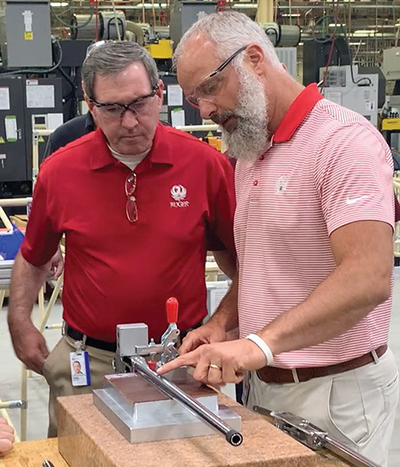
CEO Chris Killoy (l.) and VP Mickey Wilson have led a rigorous effort to integrate Marlin into the Ruger way of efficiency and attention to detail.
Moving Mountains
Ruger promptly dispatched recon teams to Remington facilities in three states. Along with surveying exactly what it had bought, they would start plotting an epic move, principally to Mayodan, where the Ruger brain trust decided to set up its Marlin shop.
Previous Marlin relocations had been simpler. There was a 1969 crosstown trip from central New Haven, Conn., to the suburbs of North Haven, followed in 2008 by another move, when the whole kaboodle was trucked three hours across the state line to Remington’s historic Ilion, N.Y., stronghold. From there, it’s 645 miles to Mayodan, but in terms of management style, manufacturing processes and engineering, it is worlds away from any of Marlin’s previous home bases.
“Things were ambiguous right after the sale,” Wilson recalled, “and even after letting them know when we’d arrive, the process wasn’t clear. COVID was running heavy right then, and we also wondered if the union (at Ilion) might be out picketing and making things hostile. Our corporate security contacted the local police, and it ended up not being a concern at all. In fact, we got a great reception and lots of help understanding what lay ahead.”
“Just before the Ilion visit, two of the engineers had to go into quarantine. Couldn’t go,” Wilson said. “That represented much of the due diligence right there. We had to re-group on the fly.”
Mark Bailey, overall project manager based at Ruger’s Newport, N.H., plant, likewise jumped on the phone. “It was the weekend, and I was asking [colleagues] to drop everything and drive into what might be a hostile environment. And without hesitation, they said, ‘Absolutely, yes.’ It was a testament to all the fantastic human beings who work at Ruger and the passion everyone had for bringing Marlin on board.”
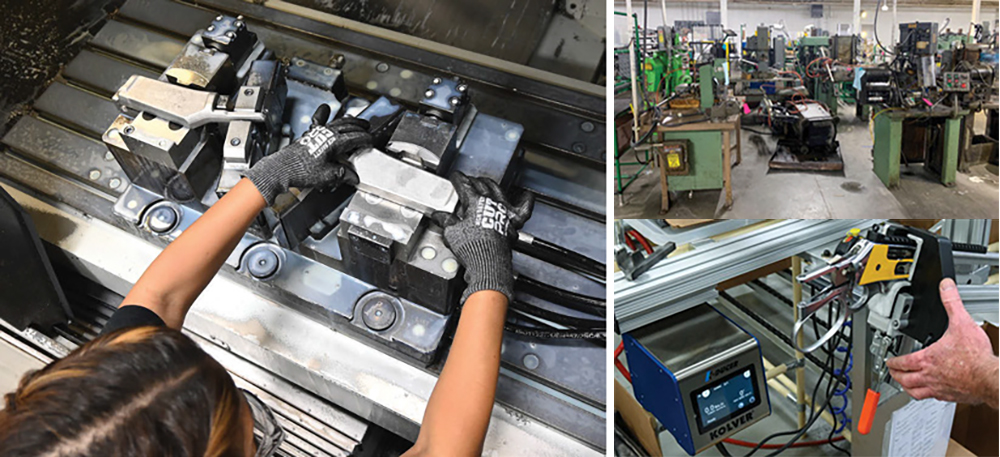
 Wilson added, “Inside we found machines of all types, from high-tech CNCs to World War II-era technology. Though sitting idle, we had to figure out what those machines did. So we took pictures and made videos, while the engineers studied how production had worked. Darryl Freeman, our facilities chief at Mayodan, and his guys focused on decommissioning—disconnecting power, air, hydraulics and coolant—everything to prepare the machines for shipment. You can’t just unplug them and go. We ultimately took ownership of that work.”
“It was a struggle dealing with union rules on who could do what, as well as EPA regulations,” Freeman noted. “The thing is, whoever does something on this scale? There’s no model. That needed to be us. Even so, we did get tremendous help from the folks on-site who took us through and kind of simulated what each machine did.”
Freeman added, “That effort also included record-ing detailed dimensions for each machine and sending them forward, so that the day the trucks arrived (in Mayodan) we would have production lines mapped out on our shop floor.”
“Preparing for the extraction took about a month,” Wilson recounted, “and then we had to await clearance as the lawyers bickered over final details. But our real angst was how to remove the heavy machinery from a cavernous building at the back of the property, an area called ‘the hill.’ We’d have to bring 40,000-lb. loads down this ‘ski slope’ and through the ‘keyhole,’ a tight opening in a brick wall. By then, it was mid-November, and we needed to get it done before the snow and ice flew.”
“Everyone up there told us once it starts, the snow will just keep coming,” Freeman said. “Meanwhile, the riggers were saying the entire move would take eight weeks. Well, I told them daily, sometimes hourly, ‘As much as I like it here, we’re not getting snowed in.’ That even meant keep-ing the lights on and working ’round the clock at the end. And, as the last machine left on Dec. 9, the snow started.”
All told, nearly 150 tractor-trailer loads were required to transport all Marlin belongings to Ruger’s facilities. In addition to the heavy machinery, the plunder included 457 pallets of raw components, parts and more. Forgings and bar stock were set aside for use in production or to be sold on the surplus steel market. Stacks of walnut went to the Ruger wood shop at Newport, while crates of semi-shaped blanks landed in North Carolina. The overflow ended up in a Mayodan warehouse in a scene akin to a gunmaker’s attic a century and a half in the making.
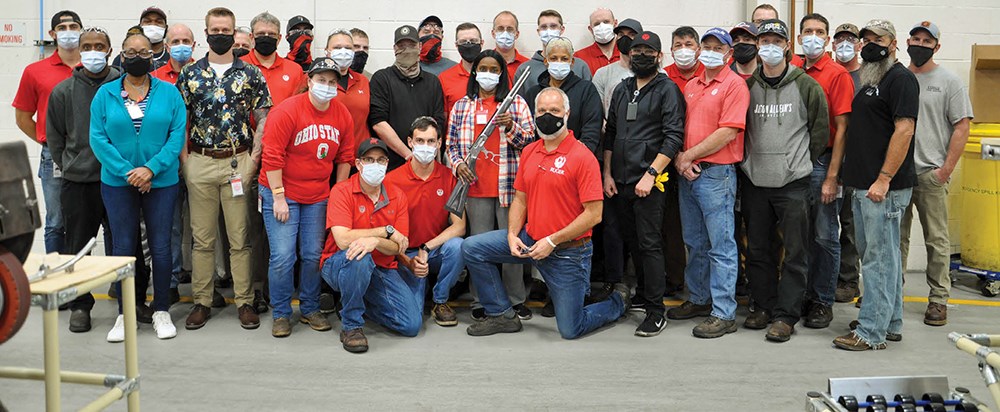
On Sept. 30, 2021, workers at Ruger’s Mayodan, N.C., plant proudly unveiled their first produc-tion Marlin 1895 (r.). An epic move of Marlin machinery, plus extensive re-engineering, set the stage for building lever-actions true to their original design in the state-of-the-art “lean manufacturing” facility.
The War Room
As the big move progressed, a fast-growing Marlin work-group formed and took over Mayodan’s conference room, which eventually gave way to a doublewide annex. From those open-space incubators—the “war room”—managers and engineers tackled every detail, with a goal set by CEO Killoy to put newly built Marlins into the retail chain by the end of 2021.
Priorities included: determining exactly what machines would be needed and whether those machines were among the incoming cargo; planning overhead hookups needed to run the equipment; creating fixtures to support cutting and assembly stations; and envisioning how to position all that within the allotted space on the factory fl oor. Later, there would have to be a staffing plan, plus streams of hard-to-get raw materials and sourced parts, including barrels from Mayodan’s in-house hammer forges and stocks from Newport. Meanwhile, Chief Design Engineer Nate Brown launched a fine-toothed analysis of how to refine components and methods to eliminate inherent weaknesses that had a history of resulting in loose tolerances, production do-overs and compromised performance. At the same time, the factory’s existing lines continued to run full-tilt to meet America’s unprecedented demand for fi rearms and in no way could that be disrupted.
Coordinating the works, Bailey alternated on-site stints with marathon video calls from his New Hampshire office. “Everyone put in long hours and debated hard but stayed professional and worked through issues.
“For example, in process analysis we ask: How do we make ‘this part?’ How do we hold it to our functional datums?” Bailey posed. “While in quarantine, [manufacturing engineers] Collin Buckles and Carl Westergard disassembled a rifle and looked at the prints, at the models and at the IP, thinking: ‘If we hold the part like this, op 10 could be cutting this and op 20 could be cut-ting that.’ So we were already understanding how to do things the Ruger way. But we couldn’t re-engineer the whole process. We also had to digest previous production methods and then strike a balance, concentrating on things we had to fix.”
The factory specialists made floor maps, using paper cutouts based on the machine dimensions sent from Ilion. There were so many iterations, the layout artist joked that he was on “Rev 58.” According to Freeman, “Before the trucks arrived, we had to work in parallel. But as the machines came through the doors, the plan shaped up and they went right in.”
Fresh Eyes On A Timeless Design
Leadership set the bar high by selecting the Model 1895 SBL in .45-70 Gov’t to be the first Ruger-made Marlin. The fast-running big-bore carbine, favored both for hunting and self-defense, was actually a shoo-in, according to Product Manager Eric Lundgren. “Sales were great (in Remington’s final years), plus it’s the only stainless lever rifle on the market. It’s a gun with a lot of white space.”
Wilson agreed, “We wanted to start there. Stainless requires the longest machine time because it’s harder to cut. The cycle time with carbon steel would be faster, our volumes would have been higher and we’d be feeling good. But we opted to take the pain up front and start with the hardest one. When we roll into carbon-steel models, it’ll be gravy.”
With the objective settled, Nate Brown’s technical deconstruction began and was guided by two key principles: building guns “the Ruger way,” while at the same time retaining Marlin’s original design intent. Brown explained, “When you inherit something like we did here, you start by looking for good and bad, and soon we learned about some function issues. But fixes proved tough, because the documentation we inherited didn’t always match actual specs.
“So we analyzed a lot of ‘stacks,’ which are the combined tolerances from groups of parts that need to work together,” Brown said. “Stacks are critical because they predict the variance within a certain operation. Parts with tolerances of three or four thousandths may not be bad in themselves, but put one on top of another and then analyze worst-case scenarios and the effects on manufacturability and functionality. Our goal is to ensure we can hold tolerances true to our drawings and that the guns work even at the extremes. Our modern CNCs can hold one to two thousandths. That’s the standard. That is Ruger’s way.”
Fortunately, help was available from Bruce Rozum, chief engineer at the Newport plant. Rozum headed up R&D at Marlin North Haven before it closed in 2008 and was well acquainted with the Model 1895 chassis and parts that sometimes needed hand-fitting.
“We acquired the original North Haven documentation, including older auto-CAD drawings, and leaned into it for certain things. Hybrid methods developed that made sense for the existing factories, but we went back to the original design intent from the North Haven documents and made tweaks to enable producing those parts to original specs with our machinery,” Brown said. “So far, the guns are going together well, and the action feels pretty dang good.”
Numerous adjustments were made to a design that hasn’t changed greatly over a 125-year life span. Most won’t be noticed by owners, and some visible ones were vetted through the Marlin Firearm Collectors Ass’n, accord-ing to Lundgren, an ex-Remington employee who jumped right back into Marlin when given the opportunity. Among other solutions, here are some ways Ruger has revamped its Marlin template without fundamentally alter-ing the look, feel and capabilities of the original.
1) Heat-treating stainless-steel receiver and finger-lever slugs before machining to eliminate subsequent warpage that can complicate assembly, notably fitting the trigger guard plate to the receiver.
2) Improved stock inletting so that recoil forces interact with the right parts of the stock, eliminating any possibility of damage during proof testing.
3) Corrected cycling issues that could cause the lever to hang up when rifles were tipped off-axis.
4) Machined barrel and receiver threads to a very high degree of precision and consistency allowing for the elimination of the barrel shim. It also helps to hold sight-orientation tolerances at 0.75 degrees or less.
5) Introduced wire-EDM technology to cut hammer notches, ensuring smooth, consistent trigger pulls.
“What we’ve developed is a core chassis,” Wilson said, “that can be adapted to whatever follows. This last year has been well spent building a foundation.”
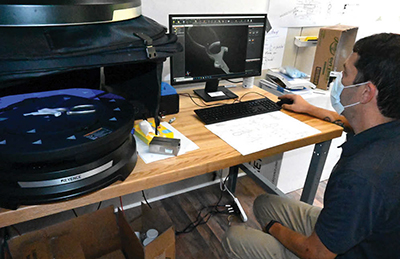
From 3-D analysis (l.) to real-world torture testing, Ruger has taken every step to ensure the new Marlins are the best ever built.
Up And Running
Corporate memory paid dividends as Marlin production got underway. In particular, Mickey Wilson and others cited their personal experience working on revolvers. “
It’s a pretty complex mechanism,” Nate Brown con-ceded, “but those of us who were on revolvers at Newport see a lot of parallels. That’s big in helping us guide line techs who aren’t familiar with such complexities. And it’s not just functional stuff, but also because looks are a big part of this gun’s appeal.”
The Mayodan plant practices lean manufacturing, where guns are built A to Z in self-contained “cells.” Marlin’s footprint now occupies a 180’x105′ space. Arranged in a loop, the line’s CNCs typically occupy the space of an arcade game, while fixtures and quality-control stations approximate voting booths. Standing in the middle of this busy corridor of tooling and skilled labor, you could track a receiver as it enters the flow, then watch its progress until finishing the loop as a completed rifle, which is then handed off for proof-firing in a secured trailer just a few steps away. The “lean” approach minimizes movements of workers and parts while enhancing quality by reducing the number of operations.
On the shop floor, I joined Senior Engineer Carl Westergard, a leader in designing the line. Along with orienting a visitor, his attention was fixed on early-stage workflow and quality control. However, he told me that wasn’t unusual. “Here, manufacturing engineers have desks in production cells. They help make it possible to build quality parts by being available to the techs at any time.”
Carl turned me over to Line Lead Teresa Crane, whose experience building Marlins started under Remington. She said she welcomed the chance to join Ruger and live in North Carolina, “… doing what I know best. The way we do it here makes it very easy to maneuver. The fixtures are simplified—it’s like you have an extra set of hands.” In a spin around the line, Crane walked me through the 53 steps involved in making each new Model 1895.
Co-worker Carlos Malloy talked about his new role as a polisher, with examples illustrating how tooling marks are removed from the bright metalwork. “We’re now develop-ing this competency,” Westergard said, “because polishing wasn’t present on our other lines, on duty guns. So we had to learn from our skilled 40-year guys at Newport and then train seasoned associates. It’s an art, and it’s important in making Marlins the right way.”
Finishing the loop, Todd Pearson performed final inspections. “I start at the muzzle end and work back,” he explained and then reminded me there are no hammers, files or manual screwdrivers on the line, because they’re not needed.
Next the rifles moved along to be packed for ship-ping. Handling that pivot was William Levings, a former gunsmithing student at Colorado School of Trades who moved his family cross-country upon learning that Marlin production was ramping up. In short order, he attended a job fair and made a dream come true. “As a westerner, I grew up with lever-actions and came to love them while in school,” he said. “It’s absolutely amazing, all this.”
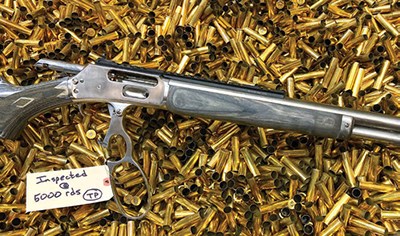
With its gleaming barreled action and gray laminate stock, Serial No. RM0001001—the first actual production Marlin—was built on Sept. 30, 2021. While that rifle is destined for wall-hanger duty, other examples were hard at work on the Mayodan test range, where I found technicians filling a bin with brass. The rifle they were shooting had topped 5,000 rounds and had experienced “about 10 failures,” mostly misfires likely not caused by the rifle. We’ve since learned firsthand that T&E models typically average 1½” or tighter 100-yard groups, an impressive showing for any lever gun, let alone a large-caliber carbine.
 How Marlin Fits
It’s clear Ruger has methodically set the table to build Marlins that live up to, and perhaps even exceed, their heritage. Anticipation has been bullish, but will it spark lasting new interest in lever-actions? And can two alpha brands co-exist long-term?
“Marlin’s 150-year history of great, American-made firearms is nothing less than a perfect fit for Ruger,” Chris Killoy stated. “We believe both brands will stand as American icons in the firearms industry.” That’s not merely flag-waving, either, since the new Marlins, like Rugers, will contain 100 percent U.S.-made components.
Killoy added, “I have been a fan of Marlin products for as long as I can remember, and we’ve heard from hundreds of the Marlin faithful and countless firearms consumers who are as excited as we are to have this legendary brand as part of Ruger. I believe you will see what a perfect fit it is in how we bring the brands to market together.
“Our plan is to maintain the historic brand and produce Marlin firearms with the same quality and attention to detail that is a hallmark of Ruger. We know there exists a large, very passionate and loyal customer base of Marlin firearms owners, myself included—we want the Marlin brand to continue for them and for future generations.”
Rob Werkmeister, VP of marketing, echoed that sentiment: “We always viewed these rifles as Ruger-made Marlin rifles … so there was never any question about how we were going to market or brand them. Consumers should view it similarly to how the Ford Motor Company manufactures a variety of products across numerous brands, one of which happens to be under the ‘Ford’ moniker, while others stand alone in value and offering under different brand names. That is our approach.”
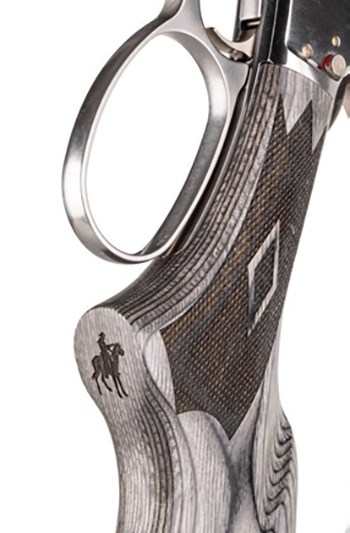
It’s telling that, aside from barrel markings and serial numbers, the lone outward identifier of the ownership change is the decorative little bullseye inset into countless Marlin buttstocks since 1922. Always black and white, its center is now Ruger red. A few inches away, the traditional horse-and-rider logo graces the grip cap. All that adds up to just the right treatment, in my opinion.
Even better is the quality I’ve observed at the factory and in the field, plus newfound confidence that the future for Marlin and lever-actions is as secure as it’s been in many decades.

Please Dear Readers, Don’t do this stupid stunt! Grumpy
William Pickering was out of his depth. Born into poverty in the slums of Birmingham, England in 1758, he had rightfully expected to live out his days toiling in the ironworks alongside his father. Neither of the Pickerings had any real formal education.
It was the soul-crushing drudgery that had ultimately driven him from home. Bill Pickering reported to his local recruiting station, proved that he had the requisite minimum number of opposing teeth, and made his mark on the enlistment form. Now fourteen months later he crouched in a reinforced redoubt outside Yorktown, Virginia, under the command of Charles Cornwallis. He was fairly certain he was about to die.

The colonists advanced behind their bayonets, their heavy muskets silent. They hacked their way through the wooden abatis that Pickering and his comrades had felled to block the advances and began to scale the works. On the command of his senior NCO, William Pickering and 69 of his mates lined up their Brown Bess muskets and pulled their actions to full cock. At a range of 50 yards, his Sergeant gave the command to fire, and all 70 British weapons detonated in a single, ragged volley.
As the smoke cleared, Pickering’s blood chilled. The failing sun danced across dozens of American bayonets as the colonists kept coming. Pickering looked to his left and right before dropping his musket and throwing up his hands. The imminent prospect of cold steel rearranging a man’s entrails can be a powerful motivator. Three days later Cornwallis surrendered in absentia, claiming an illness.

William Pickering was treated surprisingly well by the victorious Americans. As a result, he was among the roughly 10 percent of defeated British soldiers who elected to remain behind in the new nation and start a fresh life. By the time of his death, he was a landowner with three sons and a modest plantation. Without realizing it, William Pickering’s story was the beginning of the American dream.
The Weapon
The British Brown Bess was first introduced in 1722. The formal appellation was the Land Pattern Musket, and it served until 1838. Both the British and their opponents used these weapons in dozens of wars across the globe. The Brown Bess evolved through several variations during its protracted service life.

Nobody is really certain where the term Brown Bess originated. There are lots of suggestions, none of which is completely reliable. The most likely is that the term Brown Bess somehow spawns from some forgotten bawdy harlot, an otherwise nameless prostitute who found herself unusually popular among British soldiers centuries ago. Rudyard Kipling’s 1911 poem titled, “Brown Bess” implied this to have been the case. The potentially vulgar origins of the term just add to the romance of the piece.
Tactical Details
The maximum effective range was listed as 300 yards. A skilled and drilled Redcoat was expected to get off four rounds per minute. In reality, the smoothbore gun was only really reliably effective at less than 100 yards, but it inflicted some truly ghastly wounds.

For close-quarters work at bad breath ranges, the Brown Bess was frequently loaded with buck and ball, a devastating combination of buckshot atop a musket ball. Imagine the Royal Navy repelling boarders in The Pirates of the Caribbean if you need an example. The bore was a gaping 0.75″, but the balls were a bit undersized to compensate for the inevitable muzzle fouling. As a result, the gun was innately inaccurate. The most common version of the weapon weighed 10.5 lbs. and was 58.5″ long.

Around four million of these old muskets saw service. To put that in perspective, using the most modern production techniques available at the time and operating at maximum capacity, American industry produced some 6,121,309 M1 Carbines via 10 major manufacturers during World War II. The guys who made these old muskets used machines powered by horses, water or steam. An original Brown Bess is typically both crazy expensive and quite long in the tooth these days.
Cutting-Edge Tech
While the Brown Bess is fairly archaic by modern standards, in its day it reflected the state of the military art. In the skilled hands of British troops, the Land Pattern Musket enforced the will of the English regent around the globe. A decent Brown Bess musket adds flare to any seasoned gun collection.

My Brown Bess was a proper fixer-upper purchased online. What came out of the box looked like it had been stored at the bottom of the ocean. The wood was worm-eaten and friable, though the metal bits retained ample character. However, it didn’t look much like a regal British military weapon. As a result, my kit included a new-made buttstock along with fresh screws and a few modern replica brass bits.


