Category: All About Guns
Categories
Marlin 1895G Guide Gun

A quick way to keep a couple of guys occupied is to pose this question, “Batman versus the Terminator—Go.” The typical American male can entertain himself for hours with such banal stuff as this. I know I can.

Unlike Superman, Captain America, or the Flash, Batman is just a dude. Sure, he has ninja training and more cool-guy gadgets than Delta Force, but at his heart, he’s really no different from the rest of us. What always befuddled me, however, is how anybody could philosophically oppose his violent nocturnal forays into the Gotham underworld.

Batman is a vigilante, a private citizen who fights crime on his own nickel. This is illegal almost everyplace. However, kind of like removing mattress tags or driving 57 in a 55, this always struck me as the kind of rule that should remain a bit pliable. However, there yet remains a surprisingly large percentage of folks who really do think that in the face of violent crime one should just embrace the victim role and wait for the cops to sort it out. I struggle with that myself.

Certain events are watershed moments in cultural history. Compelling optics or a moving narrative can drive sweeping policy changes. One such episode was the sordid tale of Bernhard Goetz.

Bernie Goetz was born November 7, 1947, in Queens, New York, to Bernhard William Goetz and his wife Gertrude. The senior Goetz was a German immigrant who owned a large dairy farm in upstate New York as well as a bookbinding concern. When young Bernie was 12 his dad got into some trouble. The details don’t much matter, but Bernie was subsequently sent to boarding school in Switzerland.

Bernie returned to the US to attend New York University where he studied electrical and nuclear engineering. At the time of his infamous subway attack, he owned a small business that calibrated precision electronic equipment. In January of 1981, Goetz was traveling on the New York subway with a parcel of expensive electronic gear when he was attacked by three teenagers.

The teens threw him into a glass door, injuring his knee and tearing his jacket. A nearby off-duty NYPD officer arrested one, but the other two escaped. The apprehended teen spent less time in the police station than it took Goetz to complete his report.

The kid was charged with criminal mischief, an obviously benign offense. As he had to travel regularly with expensive electronic equipment Bernie Goetz applied for a concealed carry permit. The New York City bureaucracy denied his application citing insufficient need.

On a subsequent trip to Florida, Goetz purchased a Smith and Wesson .38-caliber revolver. While I could not find any specifics concerning the type of pistol he carried, the gun did pack five rounds. That narrows the field considerably.
The Watershed Event

In the early afternoon of December 22, 1984, four Bronx teenagers climbed aboard a downtown 2 train. Troy Canty, James Ranseur, Barry Allen, and Darrell Cabey were all four already convicted criminals. They later admitted that they set out that day to rob a Manhattan video arcade.

The R22 subway car number 7657 was the seventh of ten. When Bernie Goetz entered from the rear there were between fifteen and twenty other passengers onboard. Goetz took a seat opposite where Canty was stretched out on a long bench. The other three teens were arrayed nearby. Canty asked Goetz how he was doing. Bernie responded simply, “Fine” but otherwise kept to himself.

“You can’t let yourself be pushed around. You can’t live in fear. That’s no way to live your life.”
-Bernard Goetz

Goetz later claimed that the teens exchanged quiet signals and moved to surround him. Canty said, “Give me five dollars.” Bernie Goetz then produced his revolver and shot all four men in rapid succession.

From the horse’s mouth, “I decided to shoot as many as I could as quickly as I could. I did a fast draw, and shot with one hand (my right), pulling the trigger prior to the gun being aligned on the targets. All actual shots plus my draw time occurred easily within 1.6 seconds or less. This is not as difficult to do as some might think…The first shot hit Canty in the center of the chest. After the first shot my vision changed and I lost my sense of hearing. The second shot hit lightning fast Barry Allen in the upper rear shoulder as he was ducking (later the bullet was removed from his arm). The third shot hit the subway wall just in front of Cabey; the fourth shot hit Cabey in the left. The fifth shot hit Ramseur’s arm on the way into his left side. I immediately looked at the first two to make sure they were “taken care of,” and then attempted to shoot Cabey again in the stomach, but the gun was empty…I had lost count of the shots…I didn’t even hear the shots or feel the kick of the gun. ‘You don’t look too bad, here’s another’, is a phrase I came up with later when trying to explain the shooting while I was under the impression that Cabey was shot twice…Shortly after the shooting my vision and hearing returned to normal.”
“…in a combat situation…you’re not thinking in a normal way. Your memory isn’t even working normally. You are so hyped up. Your vision actually changes. Your field of view changes. Your capabilities change. What you are capable of changes…you respond very quickly, and you think very quickly…You think, you analyze, and you act…you just have to think more quickly than your opposition…Speed is very important.”

Goetz checked on a pair of women who had been knocked down in the chaos, spoke briefly with the train conductor, and jumped out of the car. He then went home, gathered some belongings, rented an automobile, and drove to Bennington, Vermont. There he burned his distinctive blue jacket and dismantled his pistol, discarding the components in the woods nearby. He spent the next several days in New England registering at various hotels under assumed names and paying cash.
The Gun

The snub-nosed .38 revolver was the most popular deep cover concealed carry weapon back in the early days. Colt made a similar pistol called the Detective Special, but Smith owned most of the market. Their Model 36 Chief’s Special was ubiquitous. Goetz’s gun might have differed slightly in its details, but this will be close.

Designed in the immediate aftermath of World War 2, the Model 36 was introduced in 1950 at the International Association of Chiefs of Police convention. The name “Chief’s Special” was the result of a poll taken at that gathering. The gun was produced with either a 2 or 3-inch barrel and fed from a five-shot cylinder. Serial number 337 was engraved with J Edgar Hoover’s name and shipped directly to him. The Model 37 Airweight was the same gun with an aluminum frame and cylinder. However, the lightweight cylinder proved troublesome. The Model 36 was also marketed as the LadySmith in 1989 with “grips designed especially for women,” whatever that really means. In 1976 a blued Model 36 cost $110. That would be about $516 today.
The Rest of the Story

On December 30, 1984, Bernie Goetz walked into the police station in Concord, New Hampshire, and turned himself in. His case was heard before a grand jury twice, and he was ultimately tried on charges ranging from attempted murder to possession of a weapon in the 3rd degree. Of his twelve jurors, half of them had themselves been victims of street crime in New York. Goetz was ultimately convicted solely on the weapons possession charge and spent eight months in prison.
“Jail is much easier on people who have nothing.”
-Bernard Goetz

Darrel Cabey was rendered paraplegic, but the other three teens recovered. During the trial, they claimed they were simply panhandling but did eventually admit their intent had been to rob Goetz. Paramedics recovered three screwdrivers from the men. Cabey was later awarded a $47 million judgment in a civil suit. As of 2004, Goetz had declared bankruptcy and not paid a penny of it.

“I would, without any hesitation, shoot a violent criminal again.”
-Bernard Goetz


Goetz was arrested in 2013 for selling marijuana, but the charges were dismissed. Bernie Goetz is now 74 years old and resides today in the same NYC apartment where he lived back in 1980. He has run for public office twice, advocates for the legalization of marijuana, and, no kidding, apparently enjoys raising squirrels.


Whether Bernie Goetz was a hero or a criminal turns on your perspective. However, that brief frenetic gunfight did help catalyze the modern concealed carry movement in America. Biased media coverage notwithstanding, crime rates have generally fallen steadily since that time. The Subway Vigilante shooting was a seminal moment in American history.

“With my time in the limelight, I regret that I didn’t use it more to push vegetarianism. I support vegetarian options in the school lunch program.”
-Bernard Goetz
Perhaps the most sought-after variation of the Winchester 1873 rifle, the Winchester One of One Hundred is one of the rarest of the rare in gun collecting. The One of One Hundred example featured in Rock Island Auction Company’s May Premier is not only the last of its model produced, but the storied rifle has an impressive tale to complement its remarkable pedigree.

Winchester Model 1873 serial number 27179 has been a centerpiece in some of the most esteemed firearms collections throughout the decades, including the Frank R. Sweet Collection, the Carl Press Collection, and The Robert M. Lee Collection. This phenomenally scarce 1 of 100 Winchester was certainly well cared for, though it also bears the marks of a rifle that was carried by its original owner through the unforgiving depths of the Amazon wilderness.
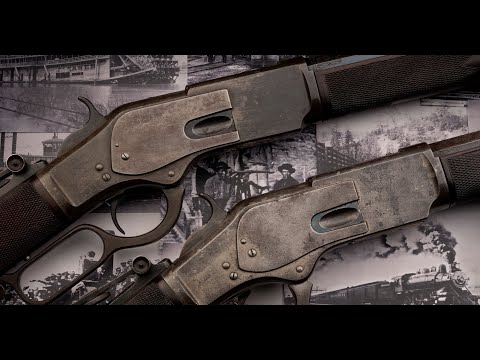
The Winchester 1873 Rifle
Calling the Winchester 1873 “the gun that won the West” may be overstated, but there’s no doubt that the sturdy lever action rifle became one of the bestselling guns of the era and continues to enjoy tremendous popularity with gun collectors today. Oliver Winchester’s steel-framed Model 1873 was a distinct improvement over the 1866 rifle and the 1860 Henry, and settlers pushing westward quickly took notice.

While the Colt Single Action Army revolver ruled the frontier streets, the Winchester 1873 rifle was king of the open range. The Model 1873’s tough frame, stronger chambering, and wide-scale availability helped elevate the rifle above its predecessors and solidified its reputation as one of the most American guns of all time.

From movie sets to modern-day Cowboy Action Shooting competitions, the rugged Winchester 1873 has stood the test of time like few firearms before or since. In 1875, Winchester began to offer higher grade versions of the Model 1873 for sale. Enter the Winchester 1 of 100, one of the most elusive variations of the special order Winchester lever action rifle ever produced.
What is a Winchester 1 of 100?
Although less famous than Winchester One of One Thousand rifles, the Winchester 1873 One of One Hundred has become a true holy grail gun for collectors. Of the eight Model 1873 One of One Hundred rifles produced and shipped from the Winchester factory between April 1876 and April 1878, only six are known today.

The Model 1873 One of One Hundred rifles were announced in 1875 when Winchester discovered that a small percentage of their rifles shot with greater accuracy during factory testing. The company decided to distinguish these exceptional rifles and market them as special order premium models for its wealthier clientele. While the Winchester 1 of 1000 was sold as the model with the highest barrel accuracy, the 1 of 100 was offered as a middle ground between the standard Winchester 1873 and the pricey 1 of 1000.
What is the difference between a 1 of 100 and 1 of 1000 rifle?
A standard Winchester 1873 might cost around $50, but a One of One Thousand could range between $80 to $100 depending on the additional custom features. The Winchester 1873 One of One Hundred fell somewhere between the two, costing a committed frontiersman $60 to $75. For comparison, an acre of farmland in Kansas cost $13 or less in 1876.

Winchester catalogs advertised these new extra-accurate rifles as follows:
“The barrel of every sporting rifle we make will be proved and shot at a target, and the target will be numbered to correspond with the barrel and be attached to it. All of these barrels that are found to make targets of extra merit will be made up into guns with set-triggers and extra finish and marked as a designating name, “One of One Thousand,” and sold at $100.00. The next grade of barrels, not so fine, will be marked “One of One Hundred” and set up to order in any style at $20.00 advance over the list price of the corresponding style of gun.”

Montana pioneer Granville Stuart was certainly a fan of his Winchester 1 of 1000 rifle. In a letter he wrote to Winchester, he marveled, “If the Sioux should come a little further up this way, it will be a mighty handy thing to have in the house. If poor Custer’s heroic band had been armed with these rifles, they would have covered the earth with dead Indians for 500 yards around.”

In 1950, Universal Pictures released “Winchester ’73”, a Western adventure starring James Stewart. A Winchester 1 of 1000 played a key role in the film, and Universal released advertisements before production started seeking these rare rifles as both a promotional campaign and a way to examine authentic 1 of 1000s to create an accurate reproduction for the upcoming movie. The success of “Winchester ‘73” helped stir renewed interest in both the 1 of 1000 and the even more elusive 1 of 100 rifles, and today both models are viewed as crown jewels in arms collecting.
The Special Order Winchester
Special order Winchester 1873 rifles were popular options with those who could afford the extra upgrades. For instance, a buyer could add special stocks, silver or gold finish, custom engravings and monograms, and select from a number of custom barrel butts, grips, triggers, magazine sizes, and barrel length and shape. Though not the most embellished rifles of their era, the Winchester 1 of 100 and 1 of 1000 would have been among the most desirable special order long arms for an experienced frontiersman, hunter, or a dedicated sportsman with the cash to spare. Engineer Robert Hepburn certainly found the investment worthwhile when he purchased the last Model 1873 One of One Hundred ever produced.

The Cody Museum letter that accompanies Robert Hepburn’s Winchester 1 of 100 states that the rifle was received in the Winchester warehouse on August 16, 1877, and shipped on April 16, 1878. In the letter, the rifle is described as “Type: Rifle, Barrel Type: Octagon, Barrel Length: 26 inches, Trigger: Set, Checkered stock, Casehardened.”

The rifle has the Winchester 1873 First Model receiver with a dust cover retained by grooved guides. “One of One Hundred” is engraved on a panel at the top of the barrel in script letters and surrounded by scroll and foliate engraving on a punch-dot background that extends to the barrel side flats, a style unique to the five 1 of 100 Winchester rifles produced with octagon barrels.
The Collins Expedition
Mr. Robert Hopewell “Hope” Hepburn was a graduate of the College of New Jersey (now Princeton University) in 1871. Less than seven years later, his skills would be put to the test in the “Collins Expedition,” an early attempt to connect Bolivia to the Atlantic Ocean Railroad in Brazil. Hepburn’s Winchester 1873 One of One Hundred accompanied him as he sailed over 3,800 miles by tugboat and braved the treacherous Amazon River.

Hepburn’s travels took him down the eastern coast of the United States, through the Caribbean Sea, along the South American coast to the Brazilian state of Para. He was in charge of surveying for the expedition and managing the two tugboats the Collins brothers’ crew would have relied upon as they attempted to lay the groundwork for a railroad along the falls and rapids of the Mamoré and Madeira Rivers.

Philip, Thomas, and Peter Collins, who’d constructed much of the railroad network in Pennsylvania, saw the Madeira-Mamoré Railroad expedition as a lucrative opportunity to access Bolivian rubber markets. Robert Hepburn noted in his 67-page manuscript that some of the men carried rifles and put their weapons to work as they navigated the dangers of the rainforest.
Crossing the Amazon
Robert Hepburn’s written account of the adventure is titled: Transportation on the Amazon and Madeira Rivers with The Disastrous American Expedition of 1878. In the manuscript, he recounts numerous times when firearms were employed for hunting and discouraging both alligators and aggressive tribesmen. On protecting the local workers, Hepburn notes, “They would not return to their camp the next morning unless escorted by an armed guard, so we accompanied them with our Winchesters and skirmished in, among, around, and beyond their shacks… The Indians rarely attempted an attack on a number of armed men.”

In addition to skirmishes with indigenous tribes, diseases like scurvy, dysentery, yellow fever, and other medical ailments took their toll on the Collins Expedition. Reports indicate that one out of every four men brought to work on the Madeira-Mamoré Railroad perished, and Hepburn’s account states that only 26 of the original 54 engineers survived.

The Devil’s Railroad
In Neville B. Craig’s Recollections of an Ill-Fated Expedition to the Headwaters of the Madeira River in Brazil, one worker states, “the men were not accustomed to the jungle, and found it near impossible to make any progress cutting their way through. Supplies and food were lacking, and the men were sieged by insects day and night. Of the 941 Americans who went to Brazil, it is known positively that 221 died, a mortality rate of 23.6%. Many died of tropical fever, and, possibly, starvation.”

Though the Collins Expedition ended in disaster, a subsequent effort to build the railroad began in 1907, a five year bid to tame the deadly terrain and navigate the dangers that had consumed previous endeavors. In his book, Brazil, novelist Errol Lincoln Uys speculated that up to 10,000 lives were lost constructing the railroad, and some estimates place that figure even higher, leading to it being nicknamed ‘the Devil’s Railroad.’

One of the Rarest Winchesters
The Winchester 1873 came to embody the quintessential American rifle, and the One of One Hundred featured in Rock Island Auction Company’s May 13 – 15 Firearms Auction has a remarkable story that more than lives up to its lofty status as a legendary firearm. Owning a gun produced during the frontier era is one thing. Owning a gun that participated in the era, that traveled, fought, and helped deliver its owner home again amid overwhelming odds is something else entirely.
As the world’s number one firearms auction house, Rock Island Auction Company offers some of the finest Winchester rifles publicly available today. As a legacy lever action rifle, one of only six known 1 of 100 Winchesters, and the final rifle of its type produced, Robert Hepburn’s 1873 One of One Hundred ranks as one of the rarest Winchester rifles known.

Winchester’s effort to distinguish these extra-accurate rifles as an elite model was a short-lived promotion, as the gun maker worried that the public might perceive the standard lever action models as significantly inferior to their 1 of 100s and 1 of 1000s brethren. For historians, Old West aficionados, and fine arms collectors interested in the most exclusive level of gun collecting, these ultra-rare Winchesters represent the highest level of the pursuit.

I assume no liability on what these guys say! So be careful Grumpy