Categories
All About Guns Ammo

BIG-BORE CARBINES POWDER-COATED POWERHOUSES WRITTEN BY JEFF “TANK” HOOVER

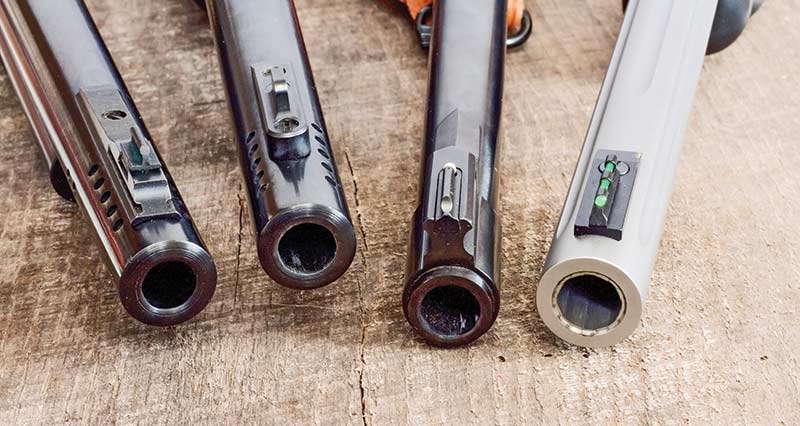
Here’s the “hole” story on the “Fearsome Foursome.” Big bores mean
big bullets! Left to right: The .444 Marlin Outfitter, .45-70 Marlin Guide Gun,
Ruger .475 Linebaugh #1 and lastly, a T/C Encore with .500 S&W Katahdin carbine barrel.


I like big holes, especially at the end of my barrel! Big holes mean big bullets. Big bullets make big holes in things, so there’s no need to rely on expansion to get the results we want. Big holes make things bleed faster and deflate lungs quicker, too. Two holes are better than one at incapacitating the creature we’ve perforated with a sucking chest wound.

Big, heavy, cast bullets have been doing these things for years … just ask any buffalo (actually American Bison). The bullets have a tendency to plow long, deep and straight due to something called momentum. It’s this simple concept that was so effective on Bison with such a


Big Bore, Heavyweight Blunt


Sounds like a motor cop, right? But these are traits we want for our hunk of lead, to be just as, or more effective than the latest controlled expansion, jacketed-bonded wonder bullet. There’s no question these bullets are good, but what fun is it buying them when we can make our own?
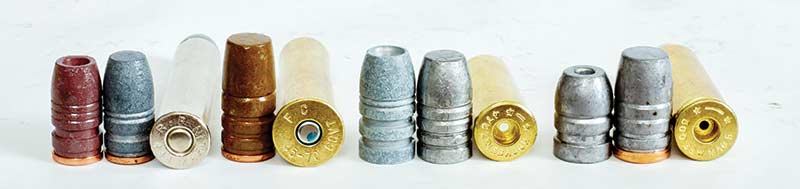
 

Powder-coated cast bullets next to their respective cartridge cases.
As crude as chucking a big hunk of lead is, it’s still very effective.
Big bullets make big holes.

Powder Coat Isn’t Powder Puff


Powder Coating is simply putting a polymer coating on our bare bullets instead of the “greasy kid stuff” we call bullet lube. By simply tumbling your bullets until covered with powder coat powder, you shake off the excess powder and bake your bullets. What you get is a coating sealing the lead projectile in polymer as it scoots down the barrel. I believe Powder Coating to be the best innovation since the humble gas check.


Cast Of Characters


I’m going to define Big Bore as anything over .40 caliber. My cast of characters are a Marlin .444 Marlin Outfitter, Marlin .45-70 Guide Gun, Ruger #1 .475 Linebaugh and lastly, a T/C Encore with a .500 S&W Katahdin carbine barrel. For simplicity and space sake, I’m going to cut to the chase and just list my pet loads I’ve used for years in some of these guns. So sit back, relax and take in the hole story of Big Bore carbines.
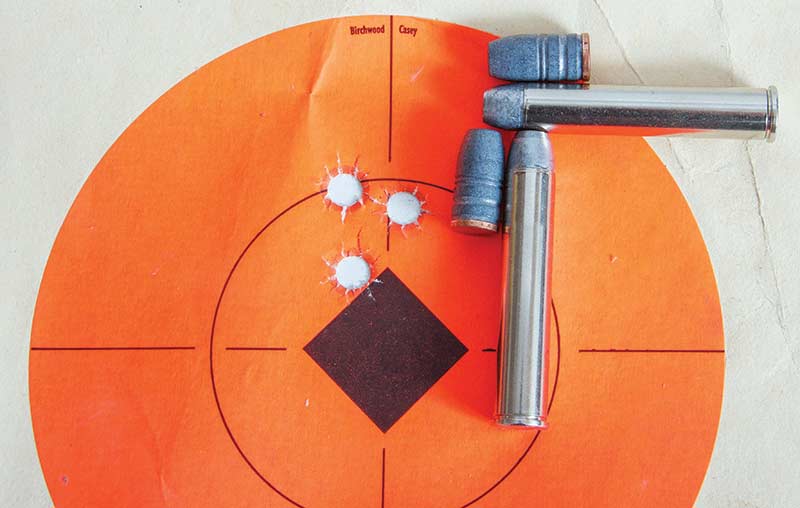
 

Typical group of Tank’s .444 Marlin at 100 yards.

.444 Outfitter


I started shooting the .444 Marlin about 25 years ago. Basically, it’s just a stretched out .44 magnum. What’s not to like? My favorite bullet is of LBT design and is listed as a 330-grain LFNDCGC design. Let me ’splain. LBT stands for Lead Bullet Technology, the LFN means long, flat nose, DC is dual crimp and GC is gas check. Piece of cake, eh?

These bullets are capable of shooting 0.75″ groups of 3 at 100 yards and I’ve done it regularly with many different Marlins in this caliber. For some reason, .444 Marlins are intrinsically accurate. When 330 grains of lead exits at 2,200 FPS, with this kind of accuracy, things drop when hit. Several deer have been pole-axed when hit by this combo. The 56 grains of Hodgdon H335 is my pet load.


.45-70 Marlin Guide Gun


When it comes to lever guns, the old war-horse .45-70 is one of my favorites. Draped in history, modern loadings give the .45 Government a whole new dimension. Pushing 400+ grain cast slugs over 2,100 FPS is pretty impressive for such an ancient cartridge. My favorite cast bullet is dropped from a cherished Rob Applegate brass mold throwing a 425-grain LWFNGC, or Long Wide Flat Nose Gas Check design.

The meplat is between an LFN and WFN. It is accurate and punches 0.460″ holes with each shot. The 50 grains of Alliant Reloder 7 is my pet load. Its 3-shot groups average around 1.5″ at 100 yards.


Ruger #1 .475 Linebaugh


The .475 Linebaugh gained legitimacy a few years back when factory ammo companies like Buffalo Bore and Hornady started loading for it. Lipsey’s, a large Ruger distributor, had a limited run of these rifles built.

Nothing’s better than carrying a classic single-shot rifle in the woods, the mere act makes a bold statement. It speaks of confidence and the ability to get it done with one shot, as it should be …

My favorite load consists of a 400-grain, powder-coated bullet dropped from a Lee 2 cavity mold retailing for under $20. How’s that for a bargain? I stuff the case with 24 grains of H110 sparked with a Large Rifle primer. From the Ruger, I get just under 1,500 FPS with all the accuracy I could wish for.


T/C Encore Katahdin .500 S&W


While the Ruger #1 is a classic beauty, the T/C Encore is beautiful in its own utilitarian way. The 20″ barrel break-open single-shot makes for a handy package perfect for thick woods hunting. Issued with a dandy peep sight and fiber optic front sight, the T/C Encore is fast pointing and accurate.

My favorite load consisted of a powder-coated, gas-checked cast bullet dropped from a Lee 2 cavity mold. Loaded over 37 grains of Hodgdon H110, velocity was around 1,700 FPS. The 5-shot groups at 50 yards with the factory peeps were around 1″.


‘Holesome’ And Handy


I enjoy shooting and hunting with this “Holesome” bunch of carbines. It’s fun shooting and I like not needing a spotting scope to see where your bullet impacts. There’s also a feeling of satisfaction shooting bullets you’ve cast, powder-coated and loaded yourself.

Your chest will swell and you’ll have to knock the smug look off your face with a grinder after shooting your own big-bore carbines with ammunition of your own making.
Categories
All About Guns

"Push Feed -vs- Control Feed Action" with Ron Spomer

Categories
All About Guns

Star BM 9mm – Collection on a budget

Categories
All About Guns Art

Machine Gun Sonata

Categories
All About Guns Well I thought it was neat!

1890 Wax Bullet Duelling Pistols

Categories
All About Guns

What’s unique about this Taiwanese Sten?

Categories
All About Guns I WANT ONE ASAP!!!

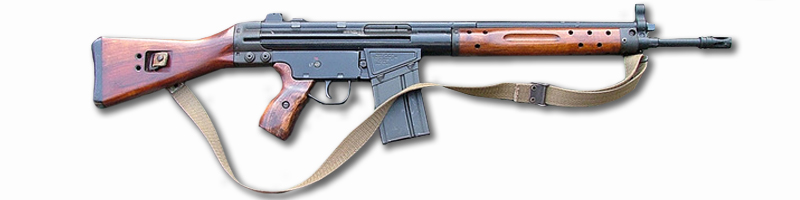
A CETME in 308

CETME

Categories
All About Guns

How Effective Was The Vickers Machine Gun?

Categories
All About Guns

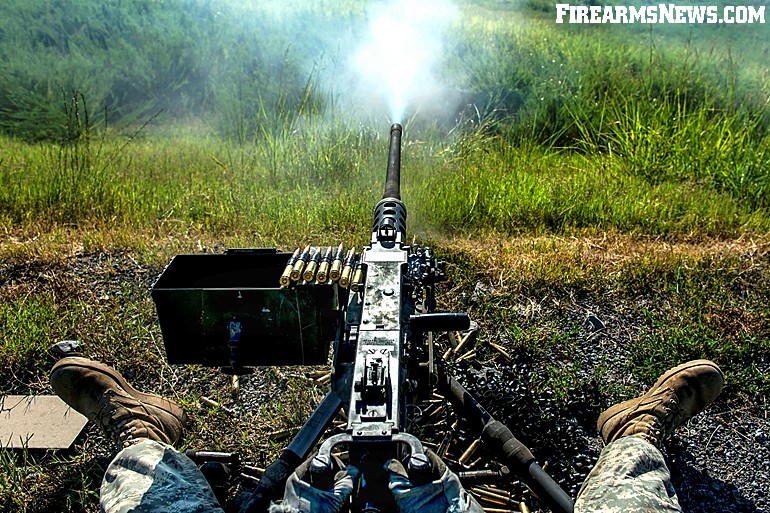
Oldest M2 Browning .50-Caliber MG Still in Service? Originally manufactured in 1933, this Colt manufactured .50-caliber machine gun was still in front-line service!

Oldest M2 Browning .50-Caliber MG Still in Service?

A Colt manufactured M2 .50-caliber machine gun bearing the serial number 324, dating it to 1933, was discovered by Anniston Army Depot still in front-line US service! Photo courtesy US Army.

It’s common when someone refers to a subject like the best service pistol or longest serving rifle that they are talking about a certain model of firearm and not an individual unit. When it comes to “longest serving”, it would be hard to rummage through inventories and find an exceedingly old piece. Such is the nature of a firearm used in military service. Normal wear and tear takes their toll. Yet every so often something is found that defies expectation and makes one rethink old notions.

There was a recent discovery at the Anniston Army Depot, where various small arms for the US Army are refurbished and upgraded before returning to unit armorers. An M2 Browning .50 caliber machine gun bearing the serial number 324 arrived from an active duty unit for maintenance and an upgrade to the M2A1 configuration. That low of a production number would have it in the original 1933 run by Colt (although FN in Belgium has been making them continuously since 1933) for an amazing run of 87 years!

Now if you are not familiar with the history of the M2, affectionately called “Ma Deuce”, its life started at the tail end of World War I. The arrival of armored vehicles and heavier aircraft brought forth a call for new weapons to deal with them, as the US Army had nothing effective against either. While others started in 1917 the famed designer John M. Browning came on board in 1918. His plan was to start by enlarging his 1917 .30-caliber machine gun design. In conjunction with Winchester, the new firearm would use a scaled up version of the standard issue .30-‘06 cartridge. The first prototypes were not a resounding success however. They were slow with a 500 rounds per minute rate of fire and a muzzle velocity of just 2,300 feet per second. Needless to say it didn’t meet any criteria.

By 1921 lots of improvements were made in no part thanks to Browning and others studying the German 13.2mm Gewehr Mod 1918 anti-tank rifle. Velocity was improved to over 2,700 fps, and soon experimental prototype .50-caliber M1921 machine guns were being tested. Later A1 and E2, among other models were developed. Now Browning passed away in 1926, but others like S.H. Green continued with the project, and made many advancements. Most importantly, the receiver was designed to be a single base-unit which could be configured in seven different variations, depending upon platform and purpose. By 1933 the M2 was adopted and put into production.

Oldest-50cal-MG

The M2 receiver was designed to allow it to be assembled into various configurations for ground, naval, aircraft and vehicle use.

The rest they say is history as by World War II an M2 .50-caliber machine gun was mounted on every variation of vehicle, airplane and warship in the US military. In order to build the thousands needed during that conflict companies like Frigidaire and AC Spark Plug added their manufacturing talent. The M2’s timeless design is easily recognized by any generation to have served since that conflict. Even today there are no plans to replace this design, as there is little currently available that would be truly an upgrade. Today the M2 proudly serves as the heavy machine gun of militaries around the globe. Its estimated that over 3 million M2s have been built. This doesn’t include the numerous variations based on the M2 design.

Serial number 324 was discovered at Anniston Army Depot in 2011 after the US Army called for its older inventory of M2s to be upgraded into the A1 configuration. The most notable change from M2 to M2A1 being fixed headspace and timing. It’s important for a tight and consistent headspace to prevent unsafe chambering or support of a live cartridge. Timing refers to the proper alignment of parts after going through the recoil process. If either is not within accepted specifications the firearm may not run reliably, may not fire or even could even blow up under the worst conditions and injure the soldier. The Army has currently upgraded over 14,000 M2s so far.

Now another surprise was that upon stripping down the receiver for inspection it was found that its tolerances were not just within acceptable values. They were actually in the best set of values for functionality. Meaning No. 324 was in better shape than many of newer examples made recently. Even more amazing is it was the first time this particular unit had been overhauled. So when one thinks that items made over a century ago can’t complete with modern manufacturing processes guess again. Old school machinists on simple equipment can indeed churn out impressively made equipment.

Sadly, because of other field modifications done to No. 324 its likely she will not return to service to continue her impressive run at defending our nation. It’s reported that officials at the Depot are busy going through the complicated process of not only getting it delisted, but saving it from the cutter’s torch. The government seems to prefer destroying history rather than allowing it to be saved. Hopefully it finds a new home as a display piece. Currently its fellow unit, No. 389, is on display at the Small Arms Repair Facility as the oldest surviving M2. It was removed from service several decades ago.

Categories
All About Guns

Parallel-Bore Side by Side Shotgun – Look Ma, No Rib!