
Category: All About Guns
Categories
Clips: Spirlet Revolver Breakdown

Originally introduced in 1936, the Winchester Model 70 is an icon of the American rifle market. The two most notable features of the original Model 70 were it’s three position safety and non-rotating controlled round feed extractor.
In 1964, Winchester redesigned the rifle and changed it from controlled to push feed. These newer Model 70s, known as “post-64” rifles, were produced until 2006. Frowned upon by the pre-64 Model 70 fans for its less refined construction and lack of controlled round feed, the post-64 Model 70s can serve the rifleman well.
My friend brought over his post-64 Model 70 243 Winchester rifle. The gun spent most of its life serving an across-the-course high power rifle shooter. The mix of the overbore 243 Winchester cartridge, years of competitive use, and high round count resulted in a shot out barrel.
He didn’t have a new barrel blank, however, he did have an old factory take-off Remington 308 Varmint barrel to install. Taking a quick look at the barrel and action, it looked like the project would work, so we decided to give it a shot. REMchester anyone?
The contents of Rifleshooter.com are produced for informational purposes only and should be performed by competent gunsmiths only. Rifleshooter.com and its authors, do not assume any responsibility, directly or indirectly for the safety of the readers attempting to follow any instructions or perform any of the tasks shown, or the use or misuse of any information contained herein, on this website.
Any modifications made to a firearm should be made by a licensed gunsmith. Failure to do so may void warranties and result in an unsafe firearm and may cause injury or death.
Modifications to a firearm may result in personal injury or death, cause the firearm to not function properly, or malfunction, and cause the firearm to become unsafe.
For use in this project, the following items were ordered from Brownells:
- Rosin
- Brownells action wrench
- Brownells barrel vise
- Kroil
- Depth micrometer
- 3/8″ 35-degree profile tool
- 1/2″ High-speed steel threading tool
- Manson 308 Winchester reamer
- Manson GO and NOGO gauge
- Thread pitch gauge
- Feeler gauges
- .308 Match rifle headspace gauge set
All lathe work is conducted on a Grizzly gunsmith’s lathe.

Before we can install a new barrel the old one needs to be removed. On this rifle, the threads were soaked in Kroil (a penetrating oil that is an essential item for gunsmithing) for a couple of days to make removal easier. The outside of the barrel is coated in rosin to prevent it from rotating in the barrel vise.

The Brownells barrel vise we’ll be using to remove the barrel from this action holds barrels with interchangeable aluminum bushings to match different barrel shank diameters.

The barrel is secured in the vise and an action wrench is used to unscrew the action. It is important to make sure the action wrench fits well against the action.
In this case I am using the Brownells action wrench with the universal jaw. It grabs the flat bottom of the front of the Winchester action.

Note the tight fit of the bushing against the barrel.

The factory barrel tenon is measured to determine it’s length and headspace.

A quick check with the thread pitch gauge confirms the threads are 16 teeth per inch.

The action is also measured with a depth micrometer to check the barrel tenon dimensions. This serves as a check against the dimensions recorded from the factory barrel tenon.

The factory Remington barrel tenon (left) compared to the factory Winchester tenon (right). The Remington tenon is longer, has 1 1/16″-16 threads and a .150″ deep bolt nose recess on its face. The shorter Winchester tenon has 1″-16 threads and no counterbore.

Barrel tenon’s dimensions in hand, we can start fitting the barrel.
The first step is to remove the old tenon. I like to use a cold saw. A cold saw is basically a miter box for steel, the one I have uses a special carbide blade. It makes short work of barrels, gives a fairly smooth finish, and does not induce heat into the part.

The barrel is mounted in the lathe. Since we only removed the threads from the barrel, the front part of the chamber is still in the barrel. A dial indicator is used to dial the barrel in on the lathe.

A facing cut is made across the breech end of the barrel with the high-speed steel 135-degree profile tool.

The tenon is cut to length and diameter. This cut was made with a 135-degree high-speed steel profile tool.

The tenon is coated in Dykem and the end chamfered.

Since I’m threading against the shoulder, I decided to use a lay down carbide threader (left), instead of the high-speed steel insert threader I normally use (right). Comparing the shapes, the carbide tool can cut closer to the shoulder.

While I normally prefer using the high-speed steel cutter, the carbide does work well.

A test fit shows the action can screw snugly against the barrel tenon.

The chamber is now cut with a Manson live pilot reamer. The reamer is fed with a MT3 blank held in the tailstock. This pusher set up allows the reamer to float in the bore and follow what remains of the factory chamber.

The headspace is initially checked with the go gauge and a depth micrometer.

As the headspace gets closer to the final dimensions, it can be measured with feeler gauges measuring the space between the bolt and action screwed onto the barrel with the go gauge in place.

A view of the tenon after the chamber has been cut to depth.

The bolt handle should close easily on go gauge, and stay open on the nogo gauge (above).

The last step is to cut a small radius on the end of the chamber to aid in feeding.

The barrel can now be installed on the action. For this task the barrel is secured in a barrel vise and the action wrench is used to torque the action on.

One last headspace check. For final inspection I use a .001″ match headspace gauge set. In this case, the bolt closes easily on the 1.630″ gauge (SAAMI minimum) and stays open on the 1.631″ gauge (.001″ over SAAMI minimum)- the rifle is chambered to minimum headspace.


The assembled rifle looks good pretty good. One day we will do something about the green paint on the barrel.

The real question is how does it shoot? When he headed to the range with the REMchester, the first few groups weren’t too shabby!165 grain Sierra GameKing over Varget, looks like a keeper!

A 200 yard ladder test with the 165 grain Sierra GameKing and H4895 showed promise as well (below).

The project came along better than we had expected. What a great way to give new life to a worn out rifle and keep a used barrel from ending up in the scrap bin.

I first laid eyes on the Beretta 92X Performance at the 2019 NRA Annual Meetings conference in Indianapolis, IN. It was a featured attraction at the Beretta booth, and as a self-confessed Beretta enthusiast, I could not wait to see it in-person. There are two reasons why the 92X Performance’s launch was significant. First, before the pistol’s arrival Beretta 92 pistols with all-steel construction and frame-mounted safeties were rarities or extremely limited-release items that only seemingly changed hands between serious collectors. The 92X Performance’s release curtailed this phenomenon, as these new pistols are easier to source and retailed for less money.
The second reason is that these guns are outfitted to go directly from the gun shop to a match like a USPSA or IPSC event. Beretta also started shipping an IDPA-legal variant of this pistol called the 92X Performance Defensive in late 2021. In the past, Beretta built pistols like the 92 Stock or 92 Combat for IPSC competition. However, these models are also extremely rare, coveted and hard to find. The Stock or Combat versions were only released intermittently, and production numbers were low, unlike these new competition pistols.
The heavier all-steel construction of the 92X is great for absorbing felt recoil, especially in the context of competitive shooting. The Beretta Brigadier slide was originally fielded on Beretta 96, chambered in .40 S&W. The slide was meant to reduce felt recoil and increase reliability by keeping extra material around the slide’s critical areas. Beretta 92 pistols with Brigadier slides are sought both by serious collectors and shooters.
Shooters love them because these slides are cut with front and rear sight dovetails, allowing sights to be swapped out. Collectors favor them for their exclusivity and rarity. Compared to a standard frame, the 92X Performance frame features an internally beveled magazine well. Reloading and inserting mags is subtly easier with this pistol.
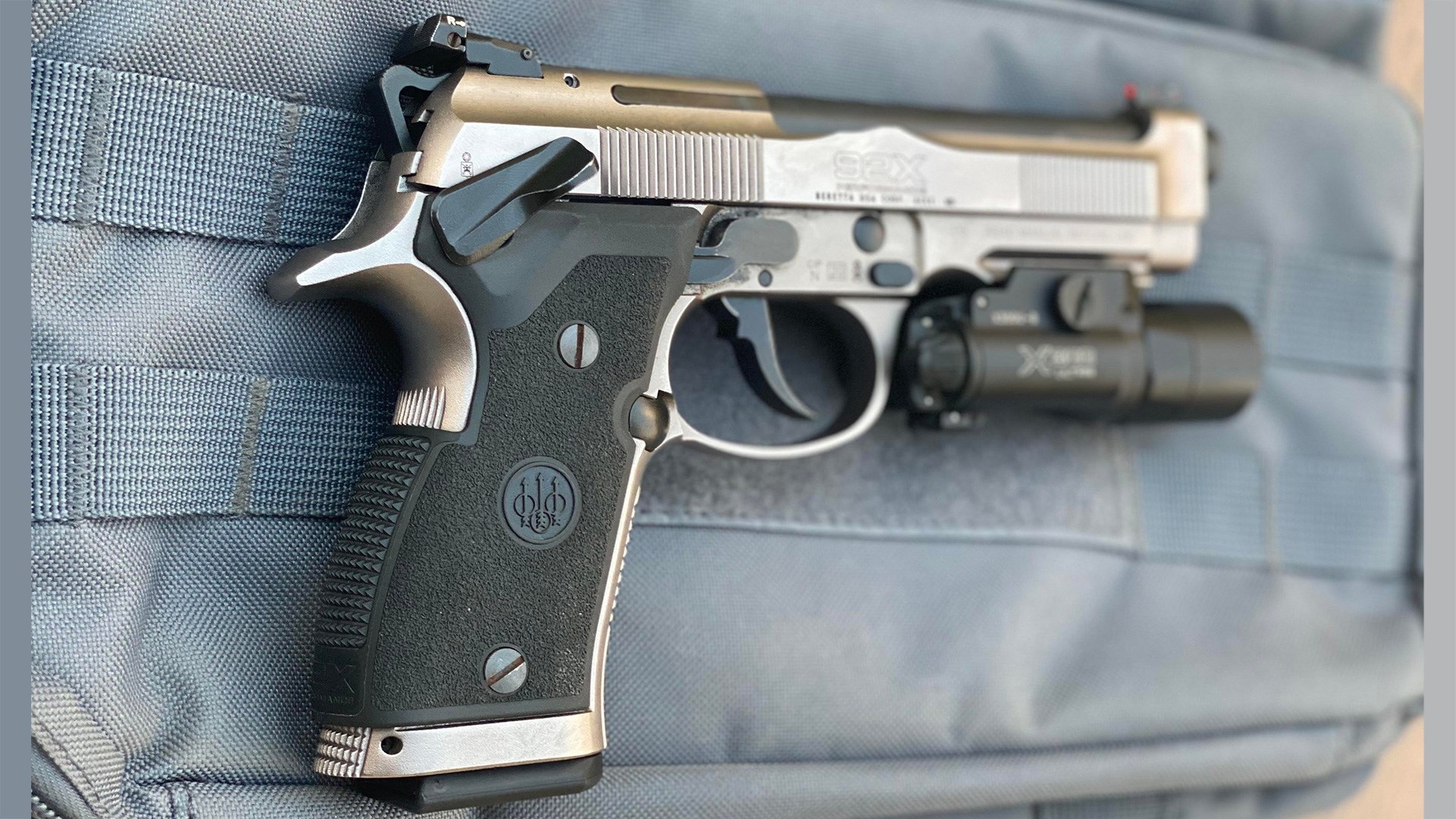
The 92X Performance has an excellent sight picture, which is one of my favorite aspects about this pistol. Picking up steel plates, poppers and paper targets is quite easy with the red fiber-optic front sight and the horizontally serrated LPA rear sight, which is fully adjustable for windage and elevation and has a generous wide square notch. Though the 92X Performance is a traditional double-action pistol, it comes with ambidextrous oversized “competition” style frame-mounted thumb safeties, not the standard slide-mounted safety/decocker found on most Beretta 92s.
However, this pistol must be manually decocked by carefully and deliberately pinching the hammer with the thumb and index finger and holding it tightly until the hammer rests against the back of the slide. This can get tricky, but it is important as decocking is required in certain divisions in the action shooting sports. The takedown lever on the left side of the frame has an extended ledge (aka a “gas pedal”) where right-handed shooters can rest their left thumb for a little more recoil control. 92X Performance barrels come in the traditional Beretta 92 profile and length of 4.9 inches. The pistol includes a steel guide rod, adding mass towards the front of the frame helping to mitigate muzzle flip.
The 92X Performance’s “Xtreme-S” trigger system is optimized for competition from the factory. All “Xtreme-S” critical trigger components have a diamond-like coating that reduces friction and protects parts from wear. The trigger itself has vertical grooves reminiscent of Smith & Wesson wide revolver target triggers of old, and the trigger is adjustable for overtravel. The first time I dry-fired this gun, both its double and single action pulls were noticeably smoother compared to a stock Beretta 92 trigger.
The pistol also has a Beretta Elite 2 skeletonized hammer and a competition-weight mainspring. Like the Brigadier slide, the Elite 2 hammer is a Beretta 92 icon and somewhat of a status symbol, which is why these hammers are commonly found on specialized Beretta 92 models. Similarly, the oversized magazine catch found on the 92X Performance pistol originates from the Beretta 92 Billenium, another highly coveted and collectible all-steel model. The Billenium style mag catch works very well and its inclusion as a standard part in the 92X Performance is a great idea.
I have been shooting my personally owned 92X Performance since late 2020. Though the “Xtreme-S” system is touted for competition use, I find the pistol’s ignition system to be wholly reliable after shooting a myriad of factory 9mm options in addition to my own handloads that are loaded with primers of varying hardness. I have shot my pistol at several USPSA matches, various range trips and one high-round count weekend training class. At this point, I estimate that I have probably fired over 3,000 rounds of handloads and factory ammo. The 92X Performance, like any other Beretta 92 in good mechanical condition, has been highly reliable in my experience. Shooters just need to ensure that the slide, locking block and lugs are properly lubricated and the design advantages inherent to the Beretta 92 will take care of the rest.
Accuracy-wise, the 92X Performance has plenty to offer and I admit I will not be outshooting this pistol any time soon. I shot some NRA-B8 repair centers, freestyle, at a distance of 25-yards with a double action first shot. I used three different 9mm loads: 115gr Blazer Aluminum, 124gr Federal Syntech and my own 147gr subsonic handloads loaded with 3.3grs of HP38. I fired 10 rounds at each target for score.
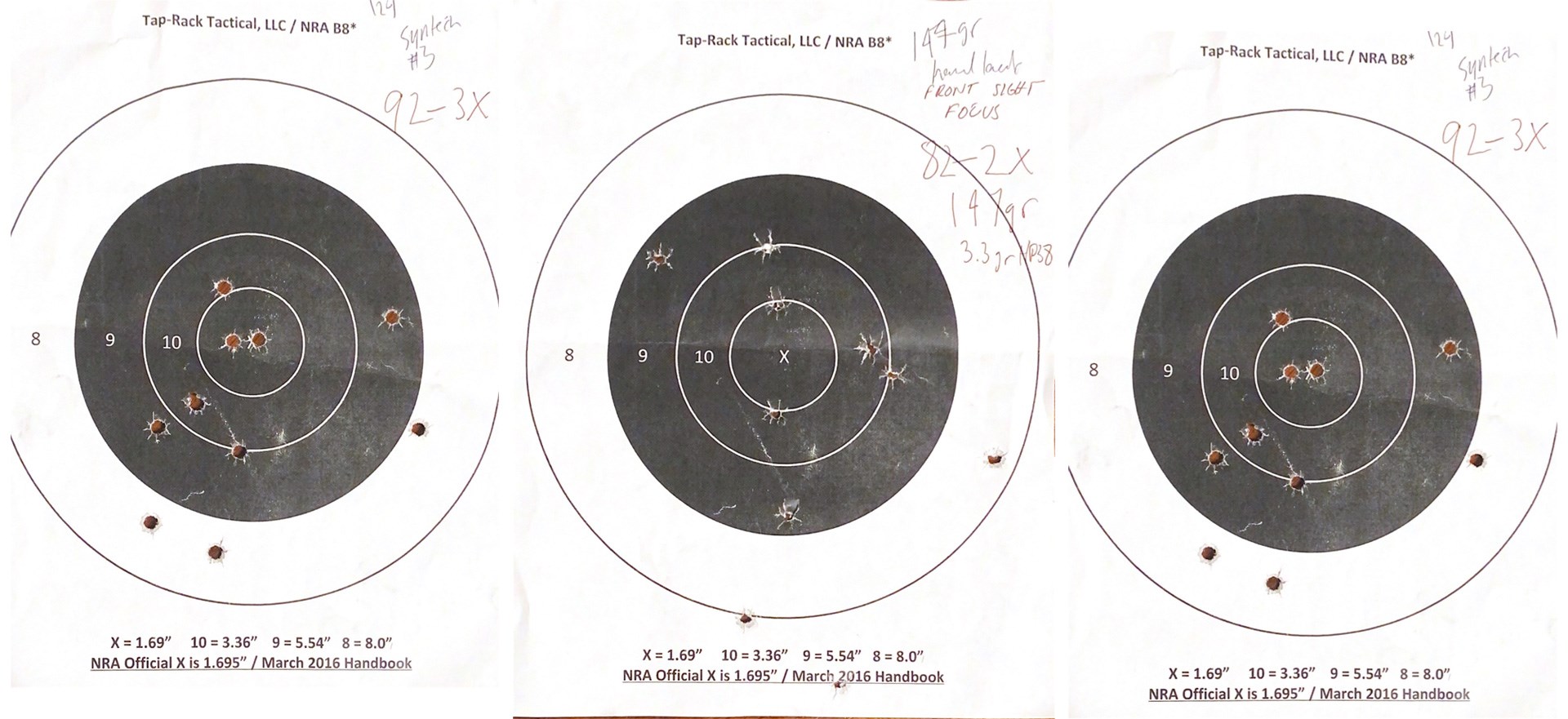
| Blazer Al 115 | 95-2X |
| Fed Synth 124 | 92-3X |
| SBHandLd 147 | 82-2X |
The attractive Nistan finish found on this pistol’s frame and slide contrasts handsomely with the rest of the black metal parts. However this finish can be susceptible to corrosion, so 92X Performance shooters would do well to wipe their pistols after shooting them to avoid blemishes, especially during the hot and humid summer match months. Because I am left handed and use my trigger finger to fire the gun, release magazines and actuate the slide release, I would have preferred more neutrally sized safeties out of the box as these oversized parts can make pistol manipulations feel clunky. For me, the size of the safeties is large enough to somewhat crowd out the ledge of the slide release.
This can also be a concern for right-handed shooters with shorter thumbs. Since the 92X Performance has a Vertec frame, it also ships with an optional full-size grip insert. My own pistol wears this insert, but it does not fully mimic the natural curvature of traditional full-size Beretta 92 backstrap. The 92X Performance’s beavertail has a downward beak-like shape, and I think the standard beavertail would have suited this pistol just fine. One of the stronger shooters who competes with this pistol at local matches told me this beavertail shape clashed with his drawstroke and had to shift his hands accordingly.
Since its launch in 2019, there is an ever-growing number of accessories being released for the 92X Performance. Not only do I keep seeing them for sale at more gun shops nowadays, but I also notice them in other match participants’ holsters. As a hobbyist level competition shooter and all-around Beretta 92 enthusiast, I can say that a pistol like the 92X Performance with its excellent trigger, useful sights, great accuracy, strong reliability and match ready configuration is a welcome addition to the selection of available metal framed competition pistols.

James Montgomery Doohan was born on March 3, 1920, in Vancouver, British Columbia. His father was a veterinarian, pharmacist, and dentist who developed an early form of high-octane gasoline. Starting in 1946 Doohan took on roles as a voice actor for radio, developing a reputation for his broad range of accents and dialects. Over the next decade, he performed in more than 4,000 radio programs.


In the mid-1950s, James Doohan played forest ranger Timber Tom in the Canadian version of Howdy Doody. Oddly, at the same time, William Shatner was playing Ranger Bill in the American version of the show. Both men later appeared together on the Canadian TV series Space Command.

Over the years Doohan played a wide range of roles on screens both large and small. However, the one part for which he is best remembered is that of Montgomery Scott, the chief engineer on Star Trek‘s starship Enterprise. Though he was neither Scottish nor an engineer, James Doohan’s depiction of the longsuffering Starfleet officer created a cinematic icon.

While auditioning for the part before Gene Roddenberry, the creator and producer of Star Trek, Doohan suggested that all the best engineers were Scottish. He personally chose the first name of Montgomery to honor his grandfather. The resulting beloved character became a fixture across three years’ worth of live-action television, an animated series, and seven major films.

Doohan’s vocal range was indeed remarkable. He voiced a variety of entities on the TV series to include Sargon in “Return of Tomorrow,” the M-5 in “The Ultimate Computer,” the Mission Control Voice in “Assignment: Earth,” and the Oracle in “For the World is Hollow and I have Touched the Sky.” He voiced a total of fifty different characters during the animated series to include as many as seven in a single episode. He also contributed heavily to the development of both the Vulcan and Klingon languages for the films.

The Trekkie truly committed to his craft might appreciate, however, that throughout the run of both the TV shows and movies, Doohan takes care with how he positions his hands. However, in “The Trouble with Tribbles” we do get a quick glance. James Doohan was missing his right middle finger. The tale of how he lost that digit is indeed fascinating.
A Young Man Goes to War

Doohan’s father was an alcoholic who made life miserable for Jimmy and his three older siblings. At age nineteen, Doohan enlisted in the Royal Canadian Artillery and was assigned to the 14th (Midland) Field Battery of the 2d Canadian Infantry Division. He was later commissioned a Second Lieutenant and assigned to the 14th Field Artillery Regiment of the 3d Canadian Infantry Division. In 1940 he was deployed to England. By 1944 he was ready to go to war.

LT Doohan landed on Juno Beach on June 6, 1944, alongside 14,000 other Canadian troops. Juno was one of five invasion beaches designated as part of Operation Overlord, the Allied invasion of Normandy. Opposing the invading Canadians were two battalions of the German 716th Infantry Division with elements of the 21st Panzer in reserve near Caen. The initial landing was a fairly bitter thing. One in every eighteen Canadian assault troops became casualties that first day.

LT Doohan led his men across the beach strewn with antitank mines and personally killed a pair of German snipers. Doohan was ultimately in combat less than 24 hours. At around 2300 that first evening the young Canadian officer was making his way between a pair of Allied positions when an inexperienced Bren gunner fired at the noise. Doohan caught a total of six not-so-friendly .303 rounds.

Doohan took four rounds to his left knee and leg and one to the chest. The sixth round blew off the middle finger on his right hand. The chest wound would have undoubtedly been fatal had it not struck a glancing blow that deflected off of a cigarette case Doohan kept in his left breast pocket. The case had been a gift from his brother. Doohan joked later in life that he was one of the few people for whom smoking had actually saved his life.
The Guns

LT James Doohan’s No 4 Lee-Enfield rifle was an evolutionary development of the Short Magazine Lee-Enfield (SMLE) with which Commonwealth forces fought the First World War. These Tommies called their SMLE rifles “Smellies.” The SMLE was itself a development of the previous Lee-Metford.

The No 4 Lee-Enfield was cheaper and faster to produce than the WW1-era weapon. Fed from either a detachable ten-round box magazine or top-fed stripper clips, the No 4 also cocked on closing and had an abbreviated 60-degree bolt throw. These attributes made the Lee-Enfield arguably the fastest bolt-action military rifle ever produced. In 1914 a British musketry instructor named SGT Snoxall put 38 rounds inside a 12-inch target at 300 yards in 60 seconds, a record that purportedly stands even today.

The Bren gun was a license-produced development of the Czech ZGB-33 light machinegun. The name “Bren” is a portmanteau combining Brno, the Czech city where the gun was first designed, and Enfield, the location of the British Royal Small Arms Factory. The ZGB-33 was itself developed from the previous Zb vz.26 designed by Czech designer Vaclev Holek.

Originally adopted in 1935, the Bren fired the rimmed .303 British cartridge and weighed about 23 pounds. The gun’s sedate 500 rpm rate of fire, its superb reliability, and its quick-change barrel made it an efficient and effective support weapon. The Bren fed from the top via a sharply curved 30-round box or a 100-round pan magazine. However, the latter was a bit ungainly in action. All members of the rifle squad would typically pack spare magazines for the Bren.

In the 1950’s the British re-barrelled the Bren gun to fire the NATO-standard 7.62x51mm round and designated it the L4A4 LMG. This variant served through the war in the Falklands. Final production of the Bren by the Indian Ordnance Factories continued until 2012.

Though expensive and fairly heavy, the Bren has been described as the best light machinegun of its era. Filling roughly the same tactical space as did the American BAR, the Bren benefitted from its quick-change barrel and increased magazine capacity. The L4A4 version used a magazine that was interchangeable with those of the L1A1 SLR rifles employed by British forces at the time.
The Rest of the Story

LT Doohan obviously recovered from the wounds he incurred on D-Day. Afterward, he was selected for pilot training and graduated from Air Observation Course 40 alongside eleven other Canadian artillery officers. Doohan trained to fly the Taylorcraft Auster Mark V observation aircraft. He was assigned to the 666 Air Observation Post Squadron RCAF at Andover, England, in support of the 1st Army Group Royal Canadian Artillery.

Captain Doohan soon developed a reputation for his daring at the controls of his nimble little spotter plane. Once in the late spring of 1945 while flying a Mark IV Auster on the Salisbury Plain north of Andover he came across a series of telegraph poles. Doohan then slalomed his little plane back and forth around the poles, in his words later, “to prove it could be done.” He was strongly reprimanded for this stunt. He left the Canadian Army shortly after the end of the war.

Many of the Star Trek cast, particularly Leonard Nimoy, resented being type-cast in those roles. James Doohan did also strive for a time to shake off the inevitable baggage that came with playing such a popular character. However, he eventually came to embrace his Scotty persona and was a popular fixture at conventions for decades. Most of his film and TV roles after Star Trek included some reference or parody to his most famous part.

William Shatner who played Captain Kirk was notoriously difficult. The strained relationship between Shatner and the rest of the cast is beautifully parodied in the simply spectacular spoof Galaxy Quest. If you have any interest in classic science fiction at all and haven’t yet seen Quest then stop what you’re doing immediately and go watch it. You’ll thank me later.

Doohan once said of Shatner, “I like Captain Kirk, but I sure don’t like Bill.” Of the original cast, Doohan was the only one who refused to be interviewed for Shatner’s Star Trek: Memories books about the show and subsequent films. I’m not too proud to admit to having read and enjoyed both tomes. By their final convention appearance together in 2004 Doohan and Shatner seemed to have mended their relationship.

Jimmy Doohan was married three times and had seven children. Like most Hollywood personalities, his personal life was tumultuous. However, it was of his contributions in the Real World that Doohan was most proud. Doohan once corresponded with a young fan who was contemplating suicide. After subsequently meeting at a Star Trek convention Doohan’s encouragement and support not only got the young woman through her emotional slump but inspired her to complete engineering school. At James Doohan’s final stage appearance before his death in 2005 at age 85 Astronaut Neil Armstrong told him, “From one old engineer to another, thanks, mate.”

 A native of the Mississippi Delta, Will is a mechanical engineer who flew UH1H, OH58A/C, CH47D, and AH1S aircraft as an Army Aviator. He has parachuted out of perfectly good airplanes at 3 o’clock in the morning and summited Mount McKinley, Alaska, six times…always at the controls of an Army helicopter, which is the only way sensible folk climb mountains. Major Dabbs eventually resigned his commission in favor of medical school where he delivered 60 babies and occasionally wrung human blood out of his socks. Will works in his own urgent care clinic, shares a business build-ing precision rifles and sound suppressors, and has written for the gun press since 1989. He is married to his high school sweetheart, has three awesome adult children, and teaches Sunday School. Turn-ons include vintage German machineguns, flying his sexy-cool RV6A airplane, Count Chocula cereal, and the movie “Aliens.”