.jpg)
Categories
.jpg)

Gun owners in Delaware are now being forced to turn in their “large-capacity” magazines to law enforcement following the passage of the “Delaware Large Capacity Magazine Prohibition Act of 2022” in June of this year.
The new law broadly prohibits the production, sale, purchase, receipt, transfer, and possession of magazines with a capacity of over 17 rounds.
The Delaware Department of Safety and Homeland Security (DSHS) issued guidelines late last month along with dates, locations, and compensation for the mandatory “buyback” program.
The DSHS said that “residents are eligible to receive fair market compensation for” their LCM or large capacity magazine.
Delawareans providing valid identification for proof of residency may receive:
“This buyback program is for Delaware residents only,” states the DSHS. “The program is only intended for individuals and does not apply to wholesale, retail, manufacturers, and distributor business entities. Anonymous relinquishments will be permitted. However, no compensation will be provided.”
Violators face a misdemeanor charge for their first offense and a class E felony for subsequent offenses.
A felony conviction for the possession of an LCM would result in the permanent loss of one’s 2A rights.
There are some key exemptions. Active and retired law enforcement, members of the U.S. military, and licensed concealed carriers are excluded from the ban.
The NRA-ILA is actively suing Delaware over its magazine ban and its 2022 ban on modern sporting rifles, known as the Delaware Lethal Firearms Safety Act of 2022.
However, while gun-owning Delawareans await the outcome of the lawsuits, state officials are hoping to complete the “buyback” program by June 30, 2023 — the end of the fiscal year, according to WHYY.
Mark Oliva, the managing director of public affairs for the National Shooting Sports Foundation, the firearms industry trade association, lamented the present situation in Delaware.
“There was a time when Delaware was respected for standing for freedom and against restricting God-given rights. Now, the state is literally financing magazine seizures with taxpayer funds,” he told GunsAmerica via email.
“The state cannot buy back something it never owned. As a matter of intellectual honesty, state officials should call it what it is. This is a state-sanctioned seizure of magazines done to bolster President Joe Biden’s gun control agenda,” he continued.
Oliva spoke about the legal challenges the magazine ban is currently facing, especially in light of the landmark Bruen decision.
“The audacity of Delaware lawmakers to move forward with this plan is astounding. The U.S.Supreme Court ordered the U.S. Court of appeals for the Ninth Circuit to revisit its ruling upholding California’s magazine restriction law in light of Bruen,” he said.
“It’s clear that Delaware lawmakers are determined to cause as much damage as possible to the Second Amendment rights of their fellow citizens and it will be the taxpayers that find it and potentially compensate those harmed by this effort,” Oliva concluded.

Operation Overlord. In the overall pantheon of cool military names, Overlord flirts with perfection. The term projects the sort of gravitas demanded of the event.

June 6, 1944, was a Tuesday. From the comfortable vantage of my favorite writing chair, it is tough to comprehend the truly timeless significance of D-Day. Comprising the largest amphibious invasion in human history, on that fateful morning, some 156,000 Allied ground troops supported by another 195,700 sailors seized a foothold on mainland Europe. Never before had there been such a single seminal moment that so starkly reflected the struggle between the forces of good and evil.

Europe was engulfed in darkness. For four long years, mainland Europe had endured under the heel of the Nazi jackboot. In 1940 Hitler’s thugs had waltzed across France and the Low Countries like they owned the place. As D-Day approached Dwight David Eisenhower’s boys now stood poised to give the Germans a healthy dose of perspective.

It cost the Allies more than 10,000 casualties to acquire title to that precious beachfront property in Normandy, all in that single day. Of those thousands of casualties, some 4,414 were confirmed dead. We lost 185 Sherman tanks. Casualties on the German side ran somewhere between 4,000 and 9,000. So many of them were buried underneath untold tons of rubble that the final tally was known only to God.

Around 15,000 Frenchmen died in the pre-invasion bombardment. Roughly the same number perished in the crossfire during the invasion. In aggregate that’s more folks than live in my thriving little Southern town. The French equivalent of every man, woman, and child in Oxford, Mississippi, died to evict the Germans from Western France. Through the lens of history, it is easy to overlook such extraordinary stuff as that.

Those numbers are the purview of the Generals, politicians, and historians. The few men I have known well who were there gave a very different perspective. Their world was much, much smaller. One gentleman, a member of the 5th Ranger Battalion who landed in the first wave, described events as utter chaos. They cared little for strategy. Life is distilled down to resisting death whenever possible and killing the enemy. It was here on that blood-soaked beach that General Norman Cota coined the epic phrase, “Rangers, lead the way!”

In times of such unimaginable madness, a man’s true nature bubbles forth. Many self-described brave men turn out cowards, while some of the more quiet sort show unimaginable resolve. Such combat is the ultimate crucible. It burns away the dross and leaves a man’s core character exposed for all to see.

Of the 83,115 British troops who landed as part of Operation Overlord only one man earned the Victoria Cross. Abbreviated VC, the Victoria Cross is England’s highest award for valor in the face of the enemy. It is the British equivalent of our own Medal of Honor, and it is not easily acquired.

Stanley Hollis was born in Middlesbrough, North Riding of Yorkshire, England, in 1912, six years before the end of the First War to End All Wars. As a child, he worked in his parents’ shop selling fish and chips. At age 17 he apprenticed as a ship’s navigator, making regular voyages to the western coast of Africa. He contracted blackwater fever, a particularly vile malarial variant, and was forced to quit the merchant marine.

Hollis came home, married, and started a family. In 1930 he enlisted in the Territorial Army, the British counterpart to our Army National Guard. With the outbreak of WW2, he deployed to Europe with the British Expeditionary Force. He narrowly escaped during Operation Dynamo, the evacuation of Dunkirk. Dynamo may be the second coolest military operation name ever contrived.

Hollis fought at El Alamein with Montgomery’s Eighth Army and was subsequently wounded during the invasion of Sicily in 1943. This was but one of multiple combat wounds Hollis received during the war. He was shot or hit with shrapnel so many times his men came to think him unkillable.

On June 6, 1944, Hollis had recovered sufficiently to join the 6th Green Howards as they stormed Gold Beach. Serving as a Company Sergeant Major Hollis moved forward with his troops. In their rush to get off the beach, the British inadvertently overlooked a pair of German fortifications.

Realizing that these active emplacements now threatened the flank of the British invasion force, CSM Hollis charged the first, his Sten gun blazing. Once he reached the pillbox under heavy fire he shoved the muzzle of his Sten through the embrasure and emptied his magazine. Leaping atop the fortification he swapped magazines, threw a Mills bomb through the back door, and emptied his second magazine behind it. In the process, he killed two of the German defenders and captured the rest.

Hollis immediately indexed to a nearby slit trench and supporting fighting position, singlehandedly taking another 26 prisoners. Later that day Hollis led an assault on a heavily fortified position that included a field piece and several MG42 machineguns. Seizing a PIAT gun, Hollis fired upon the German cannon from a range of 50 meters. This attack was ultimately repulsed, but two of his men were pinned down in the aftermath.

Hollis then rushed back into the enemy fire, this time with a Bren gun. He distracted the German defenders long enough for his men to escape. In the process, he threw a Mills bomb but forgot to prime it. The German defenders, however, did not appreciate this. As they scattered in the face of the inert grenade Hollis charged their position and cut them down with his Bren.

The Sten gun was a desperation weapon developed by Reginald Shepherd and Harold Turpin while working at the Enfield Small Arms Factory. The name Sten is a portmanteau combining elements of all three names. Designed in 1940 specifically to be inexpensive and easy to produce, the Sten was intended to help stave off the expected seaborne invasion by the Germans. More than 4 million copies were produced, making the Sten the second most-produced SMG of the war after the Soviet PPSh.

The Sten was manufactured in five different marks during the war. The Mk IIS and the Mk VS were the world’s first operational sound suppressed SMGs. The Sten fed on a ghastly side-mounted double-column, single-feed magazine and cycled at a sedate 500 rounds per minute. At a time when an American M1928A1 Thompson cost $200, the Sten ran about $11. That’s roughly $200 today.

The PIAT (Projector, Infantry, Anti-Tank) was technically a spigot mortar. Designed to replace the obsolete Boys antitank rifle, the PIAT was a 32-pound beast of a thing. While the published maximum effective range was 115 yards, in reality, the weapon was only reliable out to about half that. However, it did launch a shaped charge warhead that, when it detonated properly, was quite effective at penetrating German armored vehicles.

The PIAT benefitted from not having any backblast upon firing, but the recoil was said to be murderous. The gun itself contained a massive spring that kicked the 2.5-pound round out. The recoil force from firing would theoretically re-cock the heavy action. 115,000 copies were built.

The Mills bomb was the standard British hand grenade from 1915 into the 1980s. More than 75 million were produced. The Mills bomb was named after William Mills and produced at the Mills Munitions Factory in Birmingham. This patented design was based upon a previous Belgian grenade contrived by a Captain Leon Roland. There actually resulted in a most acrimonious row over patent rights.

The Mills bomb evolved over time. It was eventually configured such that it could be fired from a rifle equipped with a grenade discharger cup. The serrations in the grenade body were included to make the bomb easier to grip, not to enhance fragmentation.

The Mills bomb was a defensive grenade. This means that it produced a large volume of lethal fragments. By contrast, the German stick grenade was an offensive grenade that produced a great deal of blast but not so many fragments. A competent British Tommy was expected to throw a Mills bomb between 15 and 27 meters. The effective range of the grenade’s fragments was on the order of 90 meters.

The Bren gun was developed from the Czech ZB vz.26 light machinegun in the mid-1930s. Chambered for the British standard .303 cartridge and cycling at around 500 rpm, the Bren was one of the most reliable and effective light machineguns of the war. After WW2 the British rechambered the Bren for 7.62x51mm and redesignated it the L4A4. In this configuration modernized Bren guns served all the way through the First Gulf War.

Three months after the D-Day invasion CSM Hollis was wounded once more, this time in the leg. He was subsequently evacuated back to England. He received his Victoria Cross a month later from the hand of King George VI himself. After the war ended, like so many of those great old heroes, Stanley Hollis simply wanted to have a life.

Hollis worked as a sandblaster at a local iron works before opening a motor repair business. He spent five years as a ship’s engineer from 1950 until 1955. Apparently earning your nation’s ultimate award for gallantry in combat trumps a little malaria.

The man needed some stability. Stanley Hollis took over the operation of the “Albion” public house in Market Square, North Ormesby. Under his management, the name of the pub was changed to “The Green Howard” after his wartime combat unit.

Stanley Hollis never fully recovered from his wartime injuries. His children later reported that he carried ample German shrapnel as well as a couple of bullets around in his body for the rest of his life. If he stood too long at the pub his leg and foot wounds would purportedly begin to bleed spontaneously. On February 8, 1972, CSM Stanley Hollis, VC, died. He was fifty-nine years old.

A commemorative plaque followed, as did a bronze statue of Hollis with his Sten gun. A Middlesbrough school was renamed Hollis Academy in his honor in 2016. Stanley Hollis’ Victoria Cross is on display in the Green Howards Museum in Richmond, North Yorkshire, today. We just don’t seem to make guys like that anymore.

LANSING, Mich. (FOX 2) – From the streets of Detroit to the woods of the Upper Peninsula, it may seem as if residents in Michigan can’t agree on much. But a new statewide survey shows that a majority of citizens are in favor of more stringent gun control.
When you ask Michigan residents if they support strong gun control laws, you would assume that Up North a majority would oppose it. As it turns out, you would be wrong.
Across the entire state, 66% of all citizens back tougher gun control. Included in that is 50% of Up North residents.
In the Metro Detroit tri-county area, 73% of all those surveyed support stricter controls while central Michigan – including Lansing – is around 54%.
EPIC-MRA Pollster Bernie Porn conducted the poll and made sure to sample gun owners in the survey.
“To include gun owners which represent 53% having one or more gun owners in the household. Concealed Pistol License holders represent 29% and also NRA members – which represents 14%,” Porn said.
It appears that after years of school shootings like at Oxford High School, an impact is registering with citizens. Porn makes this poignant point.
“Several of the proposals that are supported by all those groups would have prevented or could have prevented the Oxford shooting,” Porn said.
A majority of Michigan voters support a ban on assault weapons, a limit on the size of gun magazines, a ban on guns in schools, and 90% in the EPIC-MRA survey want stronger background checks before gun buyers get a weapon.
The GOP legislature, with strong support from the NRA has resisted these controls. In light of this data, will that change?
“That should suggest that no legislator – Republican or Democrat – unless they are pretty much well-owned by the NRA, should vote for these gun safety laws,” Porn said.
Only time will tell if that happens with the Republican-led legislature.
With somebody that knows what they are doing. You can get almost anybody to agree on almost anything. Grumpy
Perhaps no gift is more American than a fine firearm, and Samuel Colt presented one of the most desirable guns available to Muragaki Norimasa, the Vice Ambassador of the first Japanese embassy to the United States in 1860.

Representing the feudal Tokugawa Shogunate government of Japan, Muragaki Norimasa’s delegation was not only the first group of Japanese to visit America, but also the first Japanese embassy dispatched to any Western country in more than two centuries. The Colt New Model 1855 military revolving rifle inscribed to Muragaki Norimasa is an immensely historic firearm that represented a first exchange of technology, culture, and philosophy between two nations on opposite ends of the globe at a time when the world was growing ever more connected.
In 1630, Japan’s Tokugawa Shogunate government closed the country to the West except for a small Dutch outpost in the port of Nagasaki. For the next 223 years, Japan remained isolated from the world and all its innovations, including evolving gun technology. Japan’s seclusion was shattered in 1853 when U.S. Navy Commodore Matthew C. Perry rolled into Tokyo Bay with a force of steam-powered battleships, fired a cannon volley, and demanded the nation open its doors to American trade.
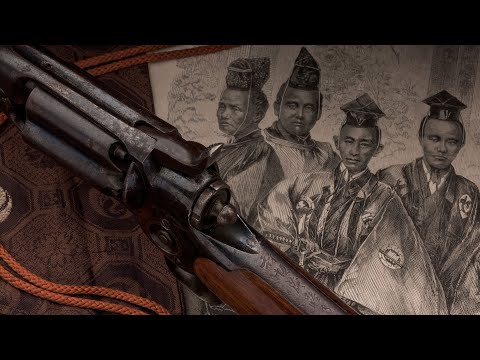
Nearly seven years later, three samurai ambassadors and their entourage were chosen to deliver a Treaty of Amity and Commerce to President James Buchanan. Traveling to Hawaii, then San Francisco, then crossing Panama by rail and sailing to New York, the samurai envoys recorded their experiences in vivid detail. Muragaki Norimasa was particularly impressed by the advanced arms of Industrial-age America, and Japanese gun production took great inspiration from Western manufacturers like Colt in the decades to follow.

This new relationship between Japan and the United States was also a remarkable business opportunity for enterprising Americans such as Samuel Colt, who presented an engraved Colt Model 1855 revolving rifle to the samurai delegation with an eye toward procuring a Japanese military contract. Offering the finest custom revolvers to celebrities, dignitaries, and war heroes had proven an effective marketing tool for Colt in America, and it was a strategy he hoped would pay off in foreign markets as well.

Samuel Colt’s efforts to expand his business internationally were well known. In the 1850s, Colt went to great lengths to display his guns at various European World’s fairs and exhibitions, placed stories featuring his revolvers in various magazines, and opened an ill-fated factory in London. Though the Japanese military only purchased a limited number of Colt guns, they became enormously popular with the civilian market.

The arrival of the three samurai ambassadors and their 74-man entourage was a major event in the United States. Congress had provided a lofty $50,000 budget to host the historic embassy, and these funds ensured that an endless succession of parades, parties, and lavish tours would greet the Japanese envoys at every stop. The samurai kept careful records of their visit, noting the stark differences in culture, customs, and technology between Japan and America.

Thousands of spectators appeared to cheer on the samurai delegation, including an onslaught of press coverage that included aggressive attempts to photograph the reluctant ambassadors. Muragaki Norimasa was taken aback by the brash American hospitality and repulsed by the “lack of distinction between high and low,” though the stoic samurai was impressed by American architecture and the steam-powered engines that carried the Japanese embassy by sea and by rail.

For their part, the American media was fascinated by the kimono garments, top-knot hairstyles, and the formal manner of the samurai ambassadors. And most notable of all was the presence of their prominent samurai swords, which famed poet Walt Whitman was quick to include in the poem he penned to honor the Japanese envoys.

Over the western sea, hither from Niphon come,
Courteous, the swart-cheek’d two-sworded envoys,
Leaning back in their open barouches, bare-headed, impassive,
Ride today through Manhattan.
– Walt Whitman, ‘A Broadway Pageant’
In May 1860, the samurai ambassadors arrived in Washington D.C. to tremendous fanfare. Between reviewing troops, touring the American capital, and meeting with countless senators, cabinet members, and dignitaries, the Japanese envoys found time to attend a session of Congress. Muragaki Norimasa remarked that the chaotic and theatrical debates he observed within the U.S. Capital Building “resembled somewhat that of our fish market at Nihonbashi.”

President James Buchannan received the Japanese delegation in the East Room of the White House, where the Treaty of Amity and Commerce to the United States, an agreement seven years in the making, was finally officially ratified.

Despite being shocked that the American president was “dressed exactly like a merchant”, Muragaki Norimasa fondly remembered James Buchanan as “a silver-haired man” with “a most genial manner without losing noble dignity.” When the samurai delegation made a final call on President Buchanan on June 5, he presented them with several medals specially struck to commemorate the visit.

Ever since our arrival at the American capital we have frequently been asked by photographers to allow our photographs to be taken, but we have hitherto refused, as it is not the custom in our country. Today, however, we had to submit, in deference to the President’s wishes. – Muragaki Norimasa, June 4, 1860
After departing Washington, the samurai ambassadors toured Baltimore, Philadelphia, and finally New York City. While they did not travel to Hartford, Connecticut, the Japanese envoys were shown numerous American firearms that were significantly more advanced than the matchlock guns the samurai had been using for more than two centuries prior to Commodore Perry’s arrival.

The Colt New Model 1855 revolving percussion rifle may have been presented to Muragaki Norimasa through Colt’s New York office or one of the navy yards the samurai delegation visited. For example, Muragaki mentioned that the commandant of the Navy Yard showed the samurai various American guns and “demonstrated in the making of a six-chambered gun or pistol” which “greatly impressed us.”

In addition to presenting a revolving rifle to Muragaki Norimasa, Samuel Colt ensured that the samurai delegation would return home to Japan with a selection of Colt firearms. Among the guns presented to the samurai were two Colt carbines and two Colt revolvers, as well as 100 sets of revolver spare parts and 59 sets of carbine spare parts. Most of these items would have been transferred to Japan’s shogunate government.

In 1860, the Colt Model 1855 military pattern revolving rifle would have been one of the most advanced guns in production and one of the few repeating rifles of the Civil War era. The samurai were impressed by Colt’s guns for a reason, as the introduction of the revolver was a substantial leap forward compared to Japan’s dated arms technology.

The Japanese characters on the right side of the rifle’s buttstock have been translated in an included document from the Historiographical Institute at the University of Tokyo as meaning “Jin-Shin [Meiji year 5]/Ni-Sen-Hyaku-Ku-Ju-Ku [series No. 2199]/Myo-To-Ken.” The markings indicate the gun was in the possession of the Kōchi Prefecture in Eastern Shikoku in 1872.

The samurai delegation’s departure from New York Harbor in June of 1860 was met with a tearful sendoff from their American hosts, but Muragaki Norimasa was eager to see his homeland again. By visiting America before other western nations, the Japanese had conferred a great honor on the United States and successfully accomplished their mission of observation, discovery, and normalizing trade relations with their American neighbors across the sea.

The samurai’s visit to America marked the first Japanese delegation outside of Asia in more than two hundred years. Their voyage crossing the Pacific, then returning across the Atlantic down and around the Indian Ocean made them among the first Japanese to circumnavigate the globe. It had been an epic voyage, but the country to which Muragaki Norimasa returned to in November was even more fraught with turmoil than the one he had left.
Looking back at the hills of the American shore joyous is our heart as we set out on our homeland voyage. – Muragaki Norimasa, June 30, 1860
Just as America was rearing closer to Civil War near the end of Buchanan’s term, Japan was bracing for a rebellion of its own. While Muragaki Norimasa was still en route to Washington, Chief Minister Ii Naosuke of the Tokugawa Shogunate was assassinated on March 24, 1860 by Ronin samurai who opposed western influence and shot the Chief Minister with a Japanese copy of a Colt Model 1851 Navy outside the Sakurada Gate of Edo Castle.

Tensions exploded into all-out war in 1868 as the question of how to respond to Western influence turned Japan upside down. The pro-imperial nationalists defeated the shogunate forces in 1869, ending the Boshin War and ushering in what is known as the Meiji Restoration, marking an end to the Edo Period and restoring the country to direct imperial rule. Japan’s once feudal military government would soon transform itself into a modern empire.

Commerce between the United States and Japan was delayed during the American Civil War and the Meiji Restoration, but ultimately Muragaki Norimasa’s samurai delegation had been a critical step in establishing a prosperous trade relationship between the two countries. Japan’s Treaty of Amity and Commerce to the United State would remain enforced for the next 40 years.
The Colt rifle presented to Muragaki Norimasa found its way to America again in May of 1946 when it was brought back by 1st Lieutenant Stuart M Beard III after Japan’s defeat in WW2 and subsequent occupation by Allied forces. As historic presentation pieces go, this Samuel Colt presentation Model 1855 revolving rifle to the first Japanese embassy to America is one of the most significant guns featured in Rock Island Auction Company’s May Premier Firearms Auction, and the impressive rifle checks all the right boxes as a one-of-a-kind collector’s gun.

The guns gifted to the samurai delegation represented an offer of trade and future weapons deals, but Colt’s revolving rifle inscribed to Muragaki Norimasa also symbolized a new age for Japan in many ways. The Industrial Revolution had arrived by force in the Land of the Rising, and after more than two centuries of isolation and a brutal Civil War, the Japanese would enter the modern world as a major power.
In 1968, American troops in Vietnam reported scattered incidents where dead NVA soldiers were found with parts of their exploded rifles protruding from their skulls. Technical Intelligence attributed this to poor metallurgy and bad ammunition. The situation was a little more complicated than it appeared.

My uncle Harvey was a Green Beret who served with MAC-V SOG in Vietnam. When I was a kid, I pestered him to tell me about their missions. They would go deep into the North Vietnamese Army (NVA) base areas and tap communications wire, take prisoners and do bomb damage assessment.
My favorite story was how they used to carry in ammunition and put it in NVA storage bunkers. Well, to be accurate, they put it BACK in the bunkers and some other places too.
Military Assistance Command Vietnam’s Studies and Observations Group (SOG) was America’s top-secret special operations task force in the Vietnam War. SOG’s operators worked directly for the Joint Chiefs, executing highly classified and deniable missions in Laos, Cambodia, and North Vietnam. From 1966 to 1968, SOG was commanded by Colonel John K. Singlaub.
Singlaub was an old school unconventional warfare pro. He parachuted behind German lines with the OSS in August 1944 to fight with the French Resistance fighters supporting the D-Day invasion.
After WW2, Singlaub joined the Central Intelligence Agency (CIA) and worked in Manchuria during the Chinese Civil War. In 1951 he became Deputy Chief of the CIA station in South Korea. Later he ran CIA operations in Manchuria and led troops in the Korean War. He was the perfect guy to run SOG.
SOG teams ran deniable missions into Laos and Cambodia to gather intelligence, wiretap communications, kidnap personnel, ambush convoys, raid supply dumps, plant mines, and generally spread the joys of unconventional warfare across the NVA rear.

This may not sound as romantic as fighting front line infantry units, but without a secure rear, the bad guys at the front got less food and ammunition. As these operations began to effect NVA operations, several divisions of NVA regulars were put on security missions along the Ho Chi Min trail.
Special NVA units were formed and specific tactics were developed to find and kill SOG teams. Landing zones were watched, trackers and dogs were deployed, and a system of communications established to allow a rapid response to any contact with SOG. While finding the NVA could be a problem for infantry units, they trucked guys in for the SOG teams to mow down.
While skulking around, these teams often encountered ammo caches with millions of rounds. Being Green Berets, their first inclination was to steal the ammo, but there was just too much of it and it was in very remote areas. Demolition was not feasible as it would only scatter small-arms ammunition, not destroy it.
They could have booby-trapped the caches so that when the NVA picked up a case it would blow up but that would have only impacted a small number of enemy soldiers and the NVA could develop countermeasures. Singlaub came up with a deeper game. He would take some of the ammo, booby trap the individual rounds of ammunition, and give them back.
Like most unconventional tactics, ammunition sabotage was nothing new. In one well-documented operation, the British slipped exploding rifle cartridges into enemy caches during the Second Matabele War (1896-1897) in what is now Zimbabwe. The British scouts were led by an American, Frederick Russell Burnham, who probably put them up to it.
During World War, the British Special Operations Executive (SOE) and American Office of Strategic Services (OSS) collaborated on Operation Natterjack to plant sabotaged ammunition in the Japanese supply chain. OSS Detachment 101 distributed the ammunition in Burma but little is known about the results.

The SOG ammunition enhancement plan was briefed all the way to the Joint Chiefs of Staff in the Pentagon. On August 30, 1967, they approved the plan and two weeks later, Singlaub watched a CIA technician load a sabotaged 7.62X39 mm cartridge into a bench-mounted AK rifle at Camp Chinen, Okinawa. “It completely blew up the receiver and the bolt was projected backwards,” Singlaub said, “I would imagine into the head of the firer.”
The first cartridges were reloaded with an explosive powder similar to PETN high explosive. The problem was that this white powder looked nothing like Chinese gunpowder, so if the NVA pulled apart an altered round it would be detected. SOG’s technical expert, Ben Baker obtained a substitute explosive that so closely resembled gunpowder that it would pass inspection by anyone but an ordnance expert.

Communist block 7.62X39 weapons such as the SKS, RPD, AK47, and Type 56’s could handle up to 40,000 p.s.i. of chamber pressure. The new powder produced 250,000 p.s.i. enough to blow up the weapon and kill the soldier shooting it.
The secret CIA lab in Okinawa developed more than just rifle ammunition. Tiger striped fatigues, Time Delayed fuses and Astrolite explosive (developed from NASA rocket fuel) all came from this small group of evil geniuses. Later CIA ordnance experts developed a special fuse for the 82 mm mortar round that would detonate inside the mortar tube. Rounds for 12.7x108mm heavy machine guns soon followed.
After the process was developed in the lab, a specialized ordnance team was formed to modify the ammo. Chinese AK bullets were sealed into steel cases with a thick coat of lacquer where the bullet entered the case. The rounds were pulled apart by hand and the powder was replaced with a high explosive substitute. The bullets were then re-seated and the ammo cans and crates resealed just like the original.
While operating deep in enemy territory on other missions, Green Berets carried booby-trapped rounds and cases of ammunition cases with them and slipped them into the enemy ammunition supply chain whenever possible. If the SOG team encountered an ammo dump, they would plant a case of doctored ammo.

When a SOG team ambushed an enemy patrol, they would load one round into an AK magazine or RPD belt left on enemy bodies with the expectation it would be recovered and re-used. When the gun later exploded, all the evidence of sabotage would be destroyed as the round was fired.
The rigged ammo turned up all over the battlefield, weapons exploded, killing NVA riflemen and sometimes entire mortar crews. Now it was time to initiate SOG’s black psychological operations exploitation plan. The strategic objective was to aggravate the Vietnamese traditional distrust of the Chinese.
At the tactical level, individual soldiers questioned the safety of their Chinese-supplied arms and ammunition. One forged Viet Cong document spread rumors of exploding ammunition while another acknowledged ammo problems resulting from poor Chinese quality control.
The forged document stated, “Only a few thousand such cases have been found thus far,” and concluded, “The People’s Republic of China may have been having some quality control problems but these are being worked out. We think that in the future there will be very little chance of this happening.”

Any NVA soldier, looking at ammunition lot numbers, would see that, due to the length of the supply chain, his ammo had been loaded years earlier. No fresh ammo could possibly reach soldiers fighting in the South for years. The possibility of compromised ammunition would never disappear.

Military Assistance Command Vietnam (MACV) published a Technical Intelligence Brief titled “Analysis of Damaged Weapons” which was widely circulated to U.S. and South Vietnamese units. The study examined several exploded AKs, concluding they were destroyed by “defective metallurgy resulting in fatigue cracks” or “faulty ammunition, which produced excessive chamber pressure.” Enemy agents passed this information directly back to Hanoi.
American G.I.s were warned against using enemy weapons in public service announcements on Armed Forces Radio and TV which were duly monitored by the Vietnamese. The Army Times warned, “Numerous incidents have caused injury and sometimes death to the operators of enemy weapons.”

Mortars work by using a low pressure charge to throw a bomb with a fragment producing case down range. There is a firing pin in the bottom of the tube which hits a primer in the mortar round when the round is dropped in the tube. A fuse ignites the main charge when it hits the target. The modified fuse blows the main charge inside the mortar tube.
As the rigged ammo spread through the system, Forward Air Controllers observed mortars in Laos, Cambodia, and even in Southern Vietnam blown apart in a star shape pattern. Usually, there were a few 3-4 NVA bodies present.
Planting munitions was risky. On November 30, 1968, a helicopter carrying a SOG team with seven cases of CIA modified 82 mm mortar ammunition was flying 20 miles west of the Khe Sanh Marine base. It was hit by 37 mm anti-aircraft fire and exploded in mid-air with no survivors. The remains of Maj. Samuel Toomey and seven U.S. Army Green Berets were recovered at the crash site 20 years later.
Despite the warnings, American soldiers fired captured arms, and at least one souvenir AK exploded, inflicting serious injuries. To avoid ironic self-injury, SOG stopped using captured ammunition in their own AKs and RPD machine guns and purchased 7.62X39mm ammunition from Finland. This ammo, which SOG’s Green Berets fired at the NVA had been manufactured in a Soviet arsenal in Petrograd. Thank you, Comrades.
To keep it secure, the code name changed through the course of the war. The Project began as Eldest Son, then was changed to Italian Green and ultimately Pole Bean.
In mid-1969, articles in the New York Times and Time magazine compromised the mission. Ordered by the Joint Chiefs to dispose of their remaining stockpiles of ammo, SOG teams rushed to insert multiple missions on the Laotian border to get rid of the stuff before their authority expired.
Even after the enemy was aware of the sabotaged ammunition, the program was psychologically useful. The NVA could never again trust their ammo supply. Radio intercepts confirmed the NVA’s highest levels of command were disturbed by their exploding weapons, Chinese quality control, and sabotage.
Declassified reports reveal that SOG operatives inserted 3,638 rounds of sabotaged 7.62 mm, plus 167 rounds of 12.7 mm and 821 rounds of 82 mm mortar ammunition over the life of the program.
Like all great ideas, this one has been copied. Doctored ammunition of undetermined source is still turning up all over the world. There are reports of a special thermite rifle round that melts in the chamber destroying the gun with no injury to the shooter. This protects innocent users such as American G.I.s while denying weapons to the bad guys.
Former Green Beret Jack Murphy, author of “Murphy’s Law”, tells the story of attempting to shoot a captured SVD in Iraq. The primer popped and the round got intensely hot melting the chamber and barrel together. No need for fake Technical Intelligence Bulletins to protect friendlies here.

Israel Weapon Industries (IWI) is a legendary gun maker. Its Tavor and Jericho weapons systems are in service in law enforcement and military agencies all over the world, but until last year, IWI had yet to develop a striker-fired handgun.
That changed with the Masada. The polymer-framed, striker-fired, 9mm mimics the best attributes of its plastic-gun predecessors. It’s comfortable and easy to shoot, and it boasts a great trigger and oversized, ambidextrous controls. It’s optics-ready and comes with four plates to accommodate the Trijicon RMR, Vortex Venom, Leupold Delta Point Pro, and Sig Sauer Romeo1. And it comes with three backstraps to customize the grip size.
“With other countries, including NATO allies, running to the striker-fired pistol, we decided to go down this path sooner than later,” Jeremy Gresham, IWI US’s Director of Sales and Marketing, told me via phone. “Rather than fighting it, we needed to be a part of it. Thus, came the Masada pistol as we know it today.”
An optics-ready striker-fired handgun from IWI would be news enough, but the Masada’s serialized trigger assembly is what really turned heads. Much like the uber-popular Sig P320, the IWI’s trigger assembly is what “counts” as the “firearm.” The entire unit can be removed and placed into a different sized frame that can accommodate a different sized slide and barrel (theoretically, at least – more on this below).
Here’s the real kicker: IWI is offering the Masada for the ridiculously low price of $480 MSRP.
| Model Number(s) | M9ORP10, M9ORP17 |
|---|---|
| Caliber | 9mm Parabellum |
| Action | Semi-auto |
| Operating System | Striker Fired |
| Magazine Type | IWI, Steel |
| Magazine Capacity | 10 Round, 17 Round |
| Barrel Material | Polygonal Rifled, Cold Hammer Forged |
| Barrel Length | 4.1″ |
| Overall Length | 7.4″ |
| Weight | 1.43 lbs. |
| Rifling | 1:10 RH |
| Sights | 3 Dot |
| MSRP | $480.00 |
For most gun nuts, IWI needs no introduction, but it doesn’t have quite the same name recognition in the U.S. as companies like Ruger, Smith & Wesson, or Springfield. IWI began as Israel Military Industries (IMI) in the 1930s, and in the 1950s the company started working directly with the Israel Defense Forces (IDF). IWI is the privatized small arms division of the IMI, and the U.S. based IWI US, Inc. launched in 2013.
IWI works directly with the IDF to, according to the company’s website, “develop small arms based upon the dynamic changes in real-world applications due to the ongoing threat of global terrorism.” IWI’s firearms have been adopted by militaries in Chile, Columbia, Georgia, India, Mexico, Nigeria, Peru, Portugal, Thailand, Ukraine, Vietnam, and many more.


When I asked Gresham what makes the Masada unique, he cited IWI’s storied history and rock-solid R&D process.
“We’re not another fly-by-night company. We’re a company that’s over 80 years old,” he said. “We do things right, out of the gate. We don’t release a product until it’s ready. Far too often a company releases product and it needs updates.”
They understand from experience the need for a quality product. IWI’s team in the U.S. is filled with former law enforcement and military, and much of the team in Israel has served in some kind of armed conflict.
“We took in end-user input whether from current employees or users in the field and built a solid weapons system backed by over 80 years of being in business,” Gresham said.
That’s a good start, but how did IWI ensure its product is ready for the real world?
Testing, testing, testing, Gresham said.
The team in Israel doesn’t send a product to the U.S. until it’s passed a 30,000-round torture test. Then, in the U.S., the Masada underwent another 30,000-round torture test. In this test, product engineers ensured that the slide locked back to the rear at the end of each mag, and testers put the slide back into battery by pressing the optic onto a solid barrier. They then tested to ensure that point of impact hadn’t shifted.
“Mounting systems have always been the Achilles heel of slide-ride type optics, and we wanted to make sure ours was solid,” Gresham said.
That testing paid off. I wasn’t able to conduct a 30,000-round torture test (thanks, COVID), but I did send quite a few hollow-point and round-nosed rounds down range without any malfunctions. I even replicated IWI’s back-into-battery optics test and achieve the same result: no noticeable point of impact shift.

The Masada is a pleasure to shoot. I say that about a lot of guns (guns are fun!), but I really mean it this time. The ergonomics are excellent, and the texturing on the grip is a great balance of grippy and smooth.
I also really liked the oversized and ambidextrous controls. I prefer using the slide release lever rather than gripping the back of the slide to return the gun to battery, so the oversized button was perfect for me. The mag release is also positive and slightly oversized, and the mags drop freely.
Serrations on the front and rear of the slide aid in loading and the rail allows for optics and lasers to be mounted.


The sights are no-nonsense three-dot affairs, but this gun screams electronic optics, so you may not ever use them. Unlike many other firearms (here’s looking at you, HK), the Masada comes with all the plates and screws you need to mount any of the compatible optics. I didn’t have any trouble mounting the Leupold Delta Point Pro I used for this review, and the optic held steady during the course of my testing.
The optics plates are polymer, which I realize won’t appeal to some folks. Maybe polymer plates are less reliable than steel, but, again, IWI says they conducted extensive torture testing without an issue, and my experience matched theirs.

The trigger is good. Mine was mushy towards the wall, but the six-pound break is still relatively clean, and there isn’t any overtravel. In that way, I’d say it’s comparable to a factory Glock trigger – maybe a little better. The trigger isn’t the gun’s strongest suit, but I didn’t find it to hinder my ability to put shots on target. On the contrary, I hit everything I aimed at with the Masada.
That’s probably also due to the gun’s inherent accuracy. At 25 yards, the gun grouped in the 3-4” range, and at 15 yards those groups shrunk down to 1.5-2”. I used a Ransom Multi Cal Steady Rest for all testing along with two different 9mm loads from Hornady.


Sig’s P320 was a big deal when it was released because it was the first totally modular, widely available handgun. Sig accomplished this feat by serializing the trigger assembly rather than the frame. With a serialized trigger, users could swap out smaller or larger frames and slides without having to do paperwork for a different gun. This functionality also allowed users to customize their firearm to suit their specific needs and physical characteristics.
The Masada also features a removable serialized trigger assembly, but unlike Sig, IWI hasn’t released any different frames or slides.
I asked Gresham about this, and here’s what he said:
“Obviously, that would make the most sense, but I do not have any information about that at the current moment. But being that it is a modular system, that would make the most sense, yes.”
When I pointed out that there would be a huge market for another modular handgun, he just said, “Agreed.”

You can read between the lines and form your own theories. Maybe IWI developed the gun for a modular handgun contract they didn’t secure. Maybe they have different priorities right now. From Gresham’s statements, it sounds like IWI knows the Masada could rival the P320, but right now, for whatever reason, they aren’t pursuing that at this time.
It’s similar to the P320 in other ways, however. The Masada’s barrel and overall length are both about 0.5” shorter, and it’s about 5oz lighter (25.2 oz), but the overall dimensions feel familiar. I’d give the nod to the P320’s trigger based on the P320’s I’ve used, but otherwise, the Masada is equally comfortable to shoot and just as user-friendly.
I can see this firearm filling a variety of needs – from home defense to competition to concealed carry. It’s probably a little big for that last option, but Gresham said it’s been approved for USPSA Production and Carry Optics competitions.
While Gresham admitted that it might not stand up against purpose-built race guns, I agreed with his overall assessment: “It’s a well-built pistol that generally can serve any role you put it in,” he said.

With a 17-round magazine, rail for a flashlight, and plates for optics, it’s a perfect home defense firearm. If you’re a first-time gun owner looking to defend your home without spending more than $500 on a firearm, I’d give the Masada a look. If you don’t plan on purchasing an optic, however, be sure to get the sights swapped out for night sights.
Gresham mentioned that IWI has submitted the Masada to law enforcement all over the U.S., along with agencies abroad. While none of them haven’t bitten yet, he said individual officers have purchased it for duty use.

Considering its features and the reputation of IWI, the Masada might be the best value in full-sized striker-fired handguns on the market. It may not be able to challenge the P320 yet, but that might change in the near future. If you can find a Masada in the middle of this panic-induced gun-buying spree, snatch it up – and get on the Masada bandwagon before it leaves you behind.
And, to some extent, that’s true.
However, it seems they suck more at their jobs than we thought.
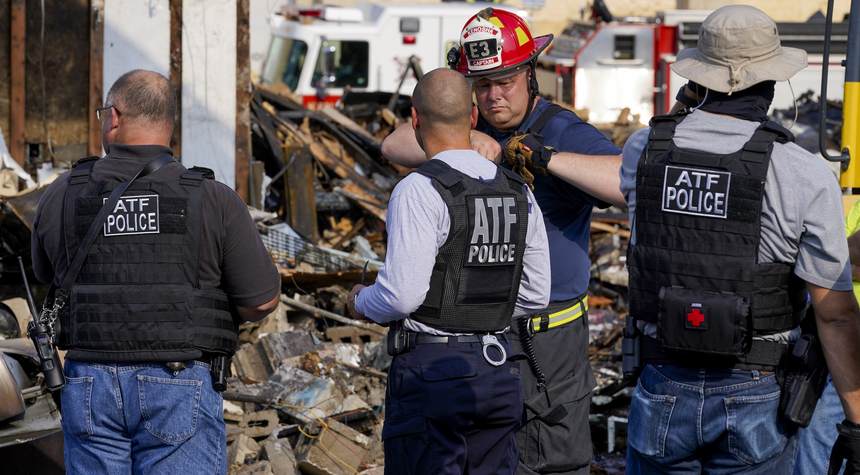
With inflation, prices are up pretty much across the board, but if you’re looking for a new gun for recreation or self-defense, here’s a hint: the Bureau of Alcohol, Tobacco, Firearms, and Explosives (ATF) is offering them at an absolute steal. Seriously, the federal agency tasked with enforcing firearms regulations has such poor security that thousands of guns and gun parts once in its possession disappeared in the hands of thieves. And it has yet to fully implement recommended reforms.
“Since September 2015, the ATF has utilized the National Disposal Branch (NDB), formerly the National Firearms and Ammunition Destruction (NFAD) Branch, to centralize and streamline the disposal process of forfeited and ATF-owned firearms. Each year, the ATF destroys thousands of firearms at the NDB,” the U.S. Justice Department’s Inspector General noted in announcing a recent report. “The DOJ Office of the Inspector General (OIG) undertook this audit following the discovery that thousands of firearms, firearm parts, and ammunition had been stolen from NFAD from 2016 to 2019.”
So, for three years, the agency that enforces every petty and intrusive federal regulation regarding firearms (as well as alcohol, tobacco, and explosives) let its own security personnel (“a DHS contract security guard was convicted in connection with these thefts”) pilfer its inventory.
Strictly speaking, the report isn’t about the thefts themselves, which were discovered by accident during a traffic stop. The recent report delved into the ATF’s progress in implementing anything resembling the security procedures it requires of the private gun dealers it oversees—or maybe just something more challenging than leaving “intact weapons … in unsecured boxes and unlocked containers.” So, how is the ATF doing at storing firearms at least as securely as you might expect of private businesses?
In short, not particularly well.
Now, let’s understand here that the ATF has been quick to hammer gun stores for every clerical error they can find, shutting down stores now over what would have been a warning at most a year or two back. They expect everyone to get everything perfect and if you don’t, your FFL is in jeopardy.
Meanwhile, they’re leaving guns around in boxes for literally anyone to walk off with.
I’m not a big fan of the ATF, but they exist and our tax dollars pay for them to do a certain job. That job isn’t to harass mom-and-pop gun stores into extinction. It’s to keep guns out of the hands of the bad guys.
Yet by not implementing basic security measures from the start, they’ve facilitated those same bad guys getting guns.
I mean, did they think thieves wouldn’t want to get their hands on seized firearms or something? Did someone honestly not realize this could potentially be a thing?
Now that they know, I’m left wondering why they haven’t already tripped over themselves to implement every necessary security measure possible to try and prevent this kind of thing.
What I do know is that the ATF lost any moral authority it had, not that it had much to begin with.