

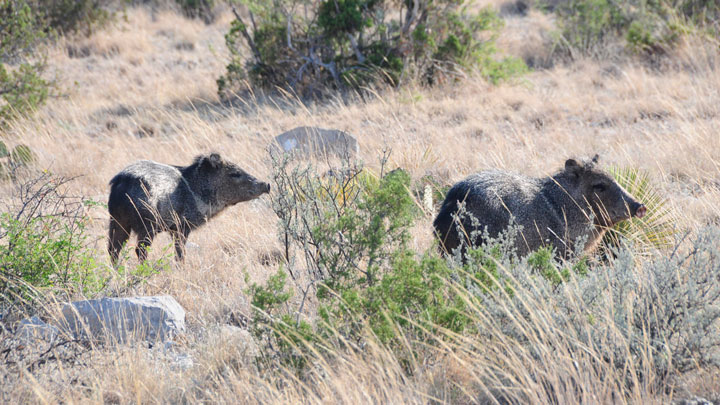
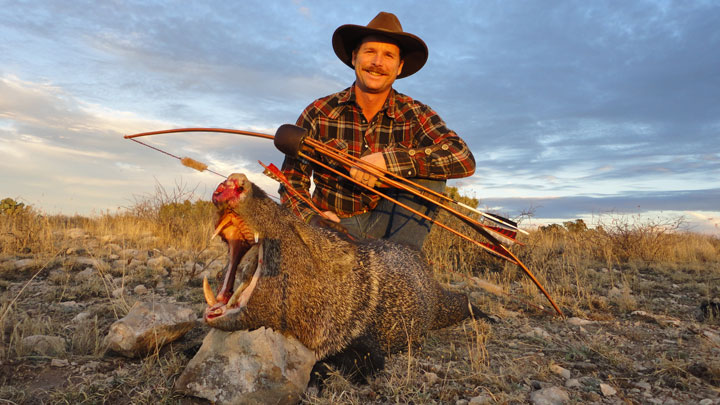
The afternoon sun was settling westward behind a bank of disconsolate grey clouds, as I worked my way across a huge flat-topped mesa just north of Texas’s famous Big Bend country. A huge javelina boar showed briefly through the short-brush. Readying my handmade Osage self bow and stone-pointed arrow, I moved to intercept him. The hunting gods must have been pleased, for the big boar continued his swaggering path directly toward me. My bow was raised, my fingers tight on the string as he crossed behind some brush. Seven short yards were all that separated us when he emerged, broadside, beady-eye gleaming and razor-sharp cutters lifting his lip in a perpetual good-natured snarl. I dropped the string and watched my stone point bury behind his shoulder. It was the second-largest archery-killed Javelina in Texas that year.
Life and Times of Javelina
Javelina (pronounced Hav-uh-leen-uh), or Collared Peccary, reside stateside only in Texas, southern New Mexico and Arizona. Hunting opportunities vary from state to state. Arizona offers the best access to good public-land hunting, but javelina numbers are not terribly high, and in many areas, tags must be applied for and drawn lottery style. Texas is in many ways the reverse—in certain areas of Texas, javelina numbers are super high, and it’s possible to see half a dozen troops in a winter morning’s hunt, with 30 to 40 javelina per band. Most of Texas is private land, however, so you’ll need permission from the owner to hunt just about anywhere, and good properties may require an access fee. Licenses are easy to obtain though, and every hunter is allowed two javies each year with the purchase of a regular Texas hunting license. I’m not familiar with hunting javelina in New Mexico, so I am not in a position to offer an opinion on hunting quality and opportunity there.
Stink Pigs—so called because of the strong musk emitted by a scent gland located atop their hindquarters—are really fun to hunt, especially with a bow. Their sense of smell is superb but their eyesight is pretty bad, so as long as you keep the wind in your face it’s relatively easy to close within 10 or 15 yards of a band of pigs. Their hearing is pretty good, too, but most of the time they make so much noise shuffling about, grubbing for food, smacking their lips and quarreling with each other they rarely hear you. Only pay real attention to being quiet if you’re stalking a lone pig or a herd bedded down for a siesta. If the herd is quiet, you’d better be, too.
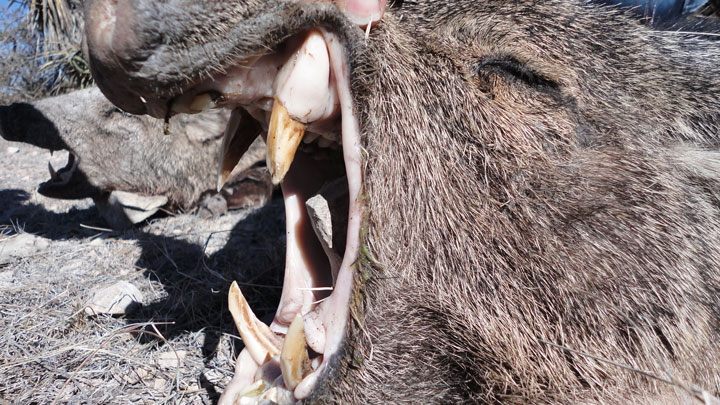
Peccary Teeth
Peccary possess long cutters (or teeth) that protrude fang-like from both top and bottom jaws. These continuously rub against each other, creating razor-sharp edges. Javelinas are tough, courageous critters, very dangerous to dogs and even humans at times, due to their tendency to attack anything that bothers one of their own. When following a wounded javie be careful, and approach any shadowed thicket with caution. If your pig is still alive, you’ll likely hear it popping its teeth at you—a loud, rather intimidating sound—before you see it. Best to put another round (or arrow) into the pig at your first opportunity in this scenario.
Dogs can experience especial problems in confrontations of the javelina variety. A big courageous dog will likely be killed, because he’ll put up a fight and be cut to pieces by the herd. A little dog with more bluster than bite can get its owner in real trouble by picking a fight with a pig, then running to hide behind his owner’s legs when the pig’s buddies all show up with blood in their eyes.
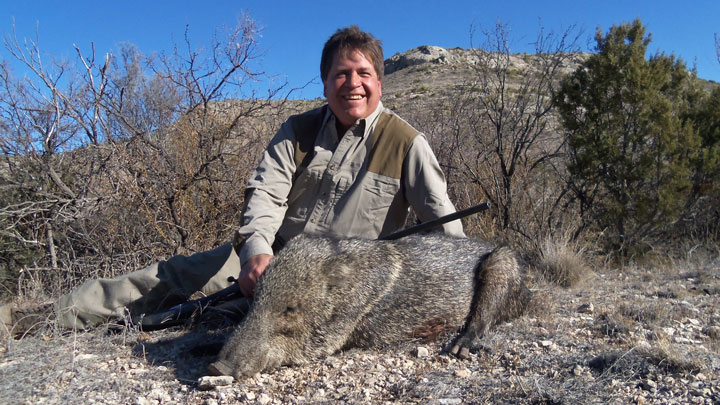
In Texas, Javelinas are scored exactly like a bear or lion, by measuring the length and width of the cleaned skull, then adding the two measurements together for a final score. The biggest, oldest boars usually have worn or broken their cutters down short, so often the best skull mounts come from middle-aged boars that still possess long, impressive fangs. Live weight usually ranges from 35 to 55 pounds. The two biggest Texas boars I’ve weighed pushed the scales to 65 pounds. Females are usually more petite than boars, but still sport long cutters and make admirable shoulder, full-body or skull mounts. Indeed, unless you’re very experienced, it can be quite hard to tell male and female apart while hunting.
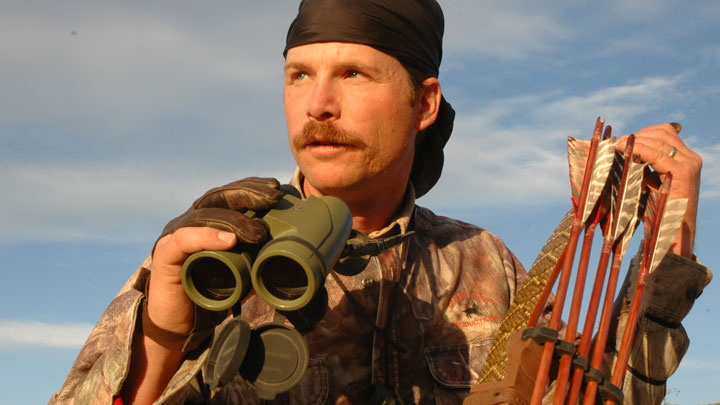
Hunting Javelinas
Finding javelinas is sometimes the toughest element to hunting them. If you’re new to an area, I suggest spending a day scouting for sign left by the little pigs before getting serious about hunting them. Look in dry washes and arroyos for little blunt tracks—somewhat reminiscent of deer tracks, just much shorter. Keep an eye out for chewed-up prickly pear cactus; javelina love to eat the pads, leaving bite-shaped chunks missing. The bite edges will be ragged and stringy, since stink pigs don’t have cleanly meshing front teeth. Look for water sources with sign around them, for though javelina don’t need to drink much when feeding on prickly pear, they prefer to stay hydrated, and will frequent seeps, water troughs and such. In hot or buggy weather you might find evidence of wallowing activity in muddy areas. Also, if there are corn feeders around (as are common in Texas), keep an eye on them. Stink pigs love corn, and will drive deer away and take possession of the area around a feeder.
Once you’ve located an area with plentiful Javelina sign, ready your bow or shoulder your rifle. It’s not super important to be hunting at the crack of dawn; javelinas are not very early risers, and are more likely to be moving once sunshine warms the area a little. Hunt your area from downwind so the pigs don’t scent you, and keep your own sniffer busy—many times I’ve smelled a herd of stink pigs before I’ve seen them. Keep your ears open, too; occasionally javelinas bark or huff at each other, the sound giving you another way to locate them.
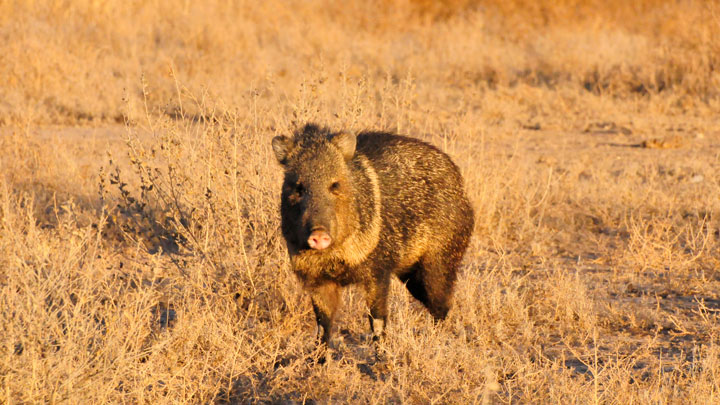
If there is a mesa, ridge, point or other vantage overlooking the area where you found javie sign, it’s a good tactic to sit atop the point and let your binocular do the walking. Be patient and spend plenty of time glassing; an entire herd of javelinas can be hidden in a tiny draw for a couple hours, and you’ll think there’s not a pig for miles. Then suddenly, they stroll out into the sunshine and it seems as though there are pigs everywhere. While sitting and glassing, you can listen, too—you might locate javelina by their sounds.
Once you’ve located a sounder of peccary, it’s time to make your move. Make sure you keep the wind in your favor and approach cautiously, but not too cautiously. Javies stay on the move most of the time, and if you take too long, they may have vacated the area before you arrive. Once you’re within 40 yards, you can slow down and stalk with care. If a pig spots you, just freeze and wait till it relaxes. Then resume your stalk.
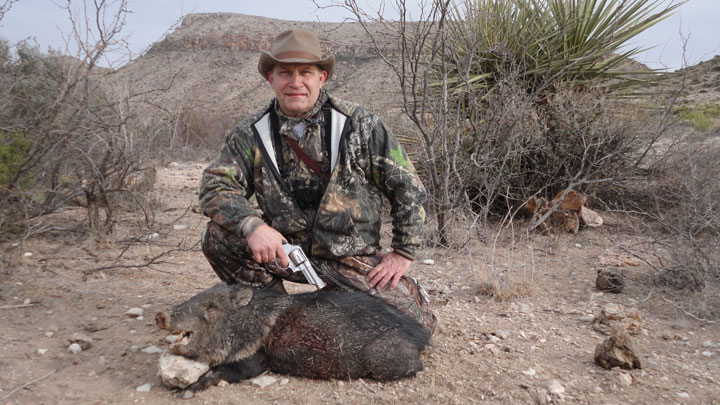
Bullets and Broadheads for Peccary
Your regular deer-hunting rifle or handgun will work fine on javelina, just make sure you use a tough bullet. Stink pigs are dense and hard-boned, as you’ll see from the story below.
I almost simply wrote the same advice regarding archery gear—that the same gear you use on deer will work on pigs—but in good conscience, I can’t. From personal experience guiding peccary hunters in Texas, I believe they are tougher to kill than deer. In my opinion you need a really tough, cut-on-contact, one piece broadhead like a Woodsman, Montec G5 or similar. Here’s a true story to illustrate my point:
A friend who guided for me had never killed a peccary before, so we went out one evening to try to get him a pig. He was carrying an archery setup with which he had recently killed a huge bull elk, shooting expandable points. I told my buddy I had previously seen expandable heads fail on javelina, and suggested he use something else, but he was confident in his setup so we went hunting. His bow pulled 70 pounds of draw weight at 28 inches.
We soon located a troop of stink pigs, with one big boar sniffing around the females. The boar crossed in front of us, stopping broadside at 32 yards. My friend is a crack shot, but javies are pretty small and his arrow impacted about an inch and a half forward of the crease, with a sound like a baseball bat hitting a light pole. We tracked the boar over 450 yards up the side of a mesa before leaving him to live another day. The arrow had penetrated only an inch and a half beyond the broadhead ferrule, stopped cold by the peccaries scapula. It is my belief that a solid, cut-on-contact broadhead would have penetrated that scapula and double-lunged the pig. The moral of the story, of course, is that javelinas are small and very tough. Choose your gear and shots accordingly.
Shot Placement
With a firearm and a tough bullet, you can down a peccary from any angle, but with archery gear the ideal shot angle is broadside, or slightly quartering away. The vitals are small, so take your time and make a careful shot. One helpful tip to remember is that javelinas can’t flex their neck very far to the side, so anytime they hear or see anything they must turn toward the source to investigate. This usually leaves you with a quartered-to angle. That’s fine with a firearm, but don’t risk it with a bow; wait for a better opportunity. Due to the same characteristic, it’s not helpful to make a sound to try to stop a moving pig for a shot—the animal will invariably stop quartered-on.
Following Up
Well-hit javies usually (though not always) tip over quickly. The same rules you’d use when hunting deer apply to any blood trail, except for one: if you believe that the pig is wounded and potentially alive, consider him dangerous. Exercise caution, and if possible, carry a hard-hitting firearm to use if he comes at you. A mad peccary is not likely to kill you, but he sure might leave some cool scars on your legs. Just be careful.
Processing Meat
There are two very important elements to keeping peccary meat tasty: keep it clean and cool it quick. When you approach your first stink pig, you’ll wonder how anyone could possibly eat something that smells like that. Get the skin off and away, exercising real care to keep the scent gland with its oily musk off the meat, and the carcass will look and smell fresh and tasty. Get the meat on ice in a cooler and you’re all set. Grind into breakfast sausage or chorizo, or slow-cook for a pulled-pork barbeque. Bon Appétit!
U.S. soldiers attempting to quell the 1900 Philippines uprising often found their weapons ineffective against the ferocious suicide attacks by Moro swordsmen.
Capt. John Pershing saw one weapon stand out during this close quarters fighting — the Winchester Model 1897 shotgun. While soldiers returned to using .45 Colt revolvers with more stopping power than their .38 Colts, the close quarter fighting also served as the spark for the M1911 in .45 ACP.
As the United States prepared to join the fight in World War I, Pershing, now a general and head of the American Expeditionary Forces, recalled the Winchester’s effectiveness in the Philippines and envisioned how they could be wielded in the trenches of the French battlefields. He asked the Ordnance Department to request modifications.

The popular civilian model Winchesters, invented by John Moses Browning, had 20-inch barrels, a sling swivel, bayonet adapter, and perforated metal heat shield over the 12-gauge barrel. The trench gun was born.
The weapons got good reviews from the troops.
“Shotguns in this regiment have given very satisfactory results. Their effectiveness at short ranges, on raids and patrols makes them a most desirable weapon, and I would recommend that they be adopted,” wrote one unit commander.
Along with the Model 1897, Winchester’s hammerless Model 1912, plus Remington’s M10, and M11 were modified for action in the trenches. About 25,000 Winchesters and 3,500 Remingtons were delivered during World War I. The United States was the only major power to use shotguns during the war.
Shotgun shells were also modified for use on the front lines. The shells went from paper tubes to all brass cartridges because of wet conditions along the battlefront. If the cardboard tubes got wet they would swell and jam the gun or became unusable before they went into the gun.

Eight trench shotguns of various manufacture and eight of their police brethren, the riot shotgun, are available in Rock Island Auction Company’s June 22-24 Sporting and Collector Auction.
The shorter barrel made the guns easier to maneuver in the narrow trenches. The U.S. Army used double-aught buckshot that blasts out nine .33 caliber pellets. Slam firing (we’ll get to that shortly) could clear a trench in ferocious close-in fighting, earning the shotgun the nickname “trench sweeper” or “trench broom.” Gen. John T. Thompson coined the nickname for his Tommy gun though it never saw use in World War I.
One report offered a glimpse at lethality of the trench guns: “[H]is men had one good chance with them (shotguns) at a German mass assault upon his trench—a charge obviously intended to overwhelm the defenders with its solid rush of men. (They) let them come on; and when those shotguns got going—with nine .34 caliber buckshot per load, 6 loads in the gun, 200-odd men firing, plenty more shells at hand—the front ranks of the assault simply piled up on top of one awful heap of buckshot-drilled men.”

In September 1918, the Germans issued a diplomatic protest saying the shotgun caused “unnecessary suffering”: “The German Government protests against the use of shotguns by the American Army and call attention to the fact that according to the laws of war (Kriegsrecht), every U.S. prisoner (of war) found to have in his possession such guns or ammunition belonging thereto forfeits his life. This protest is based upon article 23(e) of the Annex of the Hague convention respecting the laws and customs of war on land.”
The United States rejected the protest. In return, Pershing replied that any German caught with a flamethrower or saw-bladed bayonet would be lined up and shot.
There were no reports of either side committing such executions, but the military did censor photos of doughboys with shotguns.
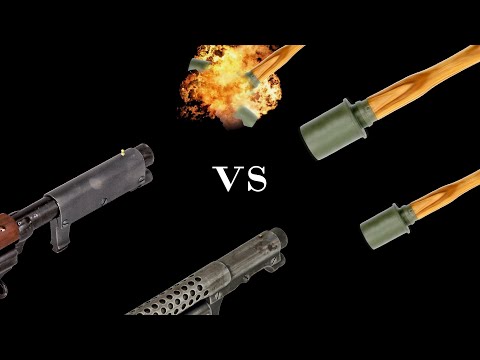
Trench guns don’t have a trigger disconnector, allowing them to be slam fired. Slam firing is pulling the trigger and holding it while working the shotgun’s pump action, repeatedly firing, ejecting a spent shell and chambering a new shell. A trained soldier could empty the shotgun of its six shells with devastating effect in less than two seconds.

The military required heat shields on trench guns because the barrel could become quite hot after firing only a few shells and if hand-to-hand combat was expected, soldiers had to be able to grab the gun to fight with a bayonet.
The shotguns available at auction that slam fire include Winchester Model 1897 and Model 12, the Stevens 620 and 520-30, the Ithaca Model 37, and Remington Model 10A.
Two stories follow the World War I trench shotgun. One is the story of Sgt. Fred Lloyd and the second involves skeet shooting.
According to legend, Sgt. Lloyd single-handedly cleared a German-held French village with his Winchester 97 on Sept. 27, 1918. He moved methodically through the never-named village, pumping round after round from his shotgun, routing 30 German soldiers until he collapsed with exhaustion. Thought the date is always the same and the tale is always worded similarly, it appears to be one of the myths of war.
The second legend goes that skilled skeet shooters were issued trench guns and stationed to watch for flying grenades to shoot from the sky. While it was certainly possible, it wasn’t likely, and at night was truly impossible.
Shotguns were useful in the trenches of World War I, but found less action on the more wide open European battlefields of World War II. They did have their use in the Pacific theater, clearing Japanese bunkers and earthen fortifications.
In Vietnam, Winchester’s Model 12 and the Stevens M520-30 were still in use. The military also contracted with Ithaca for its Model 37 with a Parkerized finish to protect the gun metal. Parkerizing is a method of applying a chemical phosphate that creates a thin adhering layer of iron, zinc, or manganese phosphates over the steel. In Vietnam, shotguns were mostly used for night ambushes and perimeter defense.
By that time, shotgun cartridges were no longer all-brass. They were made of plastic that was water resistant and durable. Also, they contained smaller shot, with No. 4 buckshot.
U.S. Air Force security police carried Winchester Model 1200 or Remington 870 shotguns for base security during Operations Desert Shield and Desert Storm.
Shotguns remain in the American military arsenal as part of potential military response might that might be needed in urban areas or boarding a ship where short-barreled shotguns are more maneuverable and can spray confined spaces.
Special forces units, like the U.S. Army’s Delta Force operatives carry cut-down pump shotguns loaded with solid slugs used to neutralize door locks. This Lightweight Shotgun System (LSS) is fitted underneath the barrel of an M16 and added only 2 lbs., 11 oz. of weight.

On the homefront, police found a use for the short-barreled shotguns after World War I. They could be mounted in cars and served as “the great intimidator.” Police used shotguns may not have a heat shield.
The Philadelphia Police embraced the riot shotgun just as the department began using motorcycles for rapid response. Shotgun wielding officers rode in sidecars.
For decades, shotguns were part of an officer’s gear until the North Hollywood shootout in 1997 when police came up against heavily armed men wearing body armor. Shotguns were no match. That began the call to arm officers with AR15s that have become more standard in policing.

Trench guns have a larger-than-life reputation for their slam fire heroics in World War I, be they Winchester or Remington. The military continued to use short barrel shotguns made by Stevens and Ithaca as they island-hopped across the Pacific. They found a home domestically with police for several decades.
Check out the numerous selections of trench shotguns and riot shotguns in Rock Island Auction Company’s June 22-24 Sporting and Collectors Auction, the perfect gun gift for dad this Father’s Day.
Sources:
The “Trench Gun” in World War I, by Bruce N. Canfield
“Bruce N. Canfield’s Complete Guide to United States Military Combat Shotguns”
“The Trench Shotguns of World War I Were Uniquely American,” by Steve Balestrieri
Fatal shots were fired last month after several young men broke into an Atlanta home on Thanksgiving Day.
Police determined that the suspects attempted to break into a home in the Gresham Park neighborhood of Atlanta. The homeowner exercised his 2nd Amendment rights, firing on the intruders, who appear to have returned fire as well.
A neighbor said that she didn’t realize it was gunfire when she first heard the ruckus.
“I didn’t even think they were gunshots. I thought they were fireworks because there were so many,” she told FOX 5. “It’s very disturbing to see that.”
Preliminary reports stated that police were called by neighbors when shots were detected. They arrived on the scene and found several males, ages 23, 18, and 15.
All three had sustained gunshot wounds and were rushed to a local hospital, where the 18-year-old, Taneaious McCune, died due to his injuries.
Follow-up reports say another man, 30-year-old Telvin Thomas, showed up at the hospital afterward with similar bullet wounds. It has since been determined that he had also been involved in the break-in.
WSBtv reported on the events and disclosed that police say another group had been found and “were detained on the scene with the help of SWAT officers.” This group appears to have been planning to help with the home invasion.
After reviewing information, the authorities told WXIA that they deem the homeowner to have fired the shots in an act of self-defense, which “seemed justified.” No charges are likely to be filed against the homeowner.
Rather, the suspects are facing charges of criminal murder for the death of their accomplice.
The following Sunday, just days after the first incident, a candlelight vigil was being held for 18-year-old McCune. During the vigil, more shots rang out.
Police arrived at the scene to find 1 dead and 2 injured, all of them minors.
The perpetrator had left on foot, and according to The Atlanta Journal, detectives are actively working to identify the suspect.
Unfortunately for the people gathered at the vigil, no one stepped up to defend the group from the shooter. Hopefully, after these two events, residents in the neighborhood will take measures to ensure they can adequately protect themselves and their loved ones.

We spend too much of our time listening without actually hearing, and looking without actually seeing.
This past summer we pulled up to our travel trailer, after dark, and unloaded our two dogs. About the time they got out of the car, the dogs got really upset. They wouldn’t quit barking, they wouldn’t listen to me and they wouldn’t calm down. I figured they were just reacting to a coyote or some other critter in the pasture next to us. Finally, it dawned on me that I ought to find out what they were upset about, and started looking around with my flashlight. Luckily, I found and killed the Mojave rattlesnake before it bit any of us. Col. Cooper would have called me in Condition White, and he would have been right.
Awareness in our everyday lives gives us time to evaluate a situation and prepare to respond to it. Away from home, awareness often helps us spot a potentially bad situation while there is still time to go the other way. Heck, you might even spot the traffic cop while there is still time to slow down and avoid a speeding ticket.
Awareness should be part of the discussion in your family defensive plan. And, it really helps to have friends and family members encouraging each other to be conscious of what’s going on around them. A criminal attack is dangerous, but it should never be a complete surprise. Tune your senses—they are some of the best defensive weapons at your disposal.
If you hang around hunting camp or the shooting range for more than, say, seven seconds, you will soon be regaled with the most outrageous fibs, half-truths, bald-faced mendacities and straight-up Category Five lies ever inflicted on civilized mankind. It’s the nature of our shared passion. Frankly, most of us actually embrace dubious storytelling as a wonderful part of the experience.
In fact, hunters are often chased out of camp by their cohorts brandishing large sticks if they have the temerity to share a tale that includes more than 5% actual verifiable fact. It’s never been done, but if a hunter ever told a shooting-related story that was absolutely true start-to-finish, it’s likely a massive rip would develop in the space-time continuum and we’d all end up exploding into icy clouds of anti-matter.
Therefore, despite my lifelong dedication to “never let the truth get in the way of a good story,” along with my status as a professional writer, I’m going to risk the universe imploding by sharing a supposedly-true story. Though I hang around with hunters, shooters, anglers and other compulsive liars, the person who shared this episode swears and affirms it is true. Where the actual truth lies, I shall leave up to the audience but I will note on humid days my friend did radiate an unusual bouquet, so perhaps there is legitimacy in his claims. Let me explain.
Prelude
The protagonist in this tale shall remain nameless but he is an older gentleman who I’ve known for nearly 40 years. We’ve grown apart over the last decade and haven’t spoken but previously, we spent many years shooting, hunting, fishing and generally committing various outdoor-related outrages together. He is also the person in my life — and we all have one — who can take a simple situation and turn it into a full-blown, four-alarm catastrophe in the name of fun. This was one of those times.
A mutual friend of ours witnessed this incident and told me about it. It occurred sometime in the late 1960s, before I knew either party, and involves a stupid and childish act — of course — but wasn’t illegal and was fairly commonplace at the time.
One fine late-winter day, the person telling the story and my lets-make-matters-worse buddy were driving out to hunt coyotes with rifles. Cruising along the backroads, they happened to spy a large gathering of turkey vultures, also known as “buzzards,” feasting on the odiferous remains of some poor creature that met its demise two weeks earlier on the country road.
Slowing to look upon the group, my friend spontaneously announced he had always wanted a full-body taxidermy mount of a buzzard to grace his home decor. Why this would be a better conversation piece than, say, a nice piece of driftwood or an oil painting remains open for debate to this day.
Before we go any further, we must note the turkey vulture is federally protected under the Migratory Bird Act of 1918, though legal protection wasn’t granted until 1972. Today, like all animals, turkey vultures have advocacy groups and a political action committee in Washington D.C. so please note our admonition: The turkey vulture is a critical part of the ecosystem, a fine fellow and generally misunderstood soul you shouldn’t harm or harass, despite the fact they smell like hot garbage, their vomit is acid enough to destroy car paint and they regularly urinate on their legs instead of bathing. So, regardless of any legitimate aversion, they are illegal to molest without federal permission.
The deed
Showing a critical lack of long-term thinking or any inkling as to how wives and future houseguests might view the acquisition, our heroes unanimously agreed potting the vulture and turning it into an objet d’art was a grand idea. Pulling over to the shoulder of the road, my friend grabbed his bolt-action .22-250, laid it over a weathered fence post and fired. At the shot, one buzzard flopped over as his frightened dining companions took wing.
Our victorious rifleman hopped the fence, walked over to the remains and gingerly picked up the stinking, gore-covered bird. Returning across the fence, the two men discussed what to do with the reeking carcass.
As vultures are known for their normal diet of rotten meat, the witness noted the smell was somewhere between unbelievable and unimaginable.
Because of last-minute mechanical trouble, the pair was driving the car of one of their wives instead of their usual pickup trucks. This meant the only reasonable place to carry the fetid beast was the trunk of the sedan. They figured they could wrap the bird in an old blanket, which they would later burn, and then use some type of disinfectant spray to rid the car of the lingering traces of stench. I’m guessing kerosene.
Satisfied with this dubious plan, the two then drove to another buddy whom they knew was an amateur taxidermist.
At the taxidermist’s home, my friend inquired if it were possible to mount the buzzard in a full, menacing, gothic wing-spread pose. The wildlife “artist” allowed that he could. After a bit of haggling, they agreed upon a price and the three men walked up to the trunk of the vehicle. There was an ominous rustling from inside as my friend turned the key in the lock.
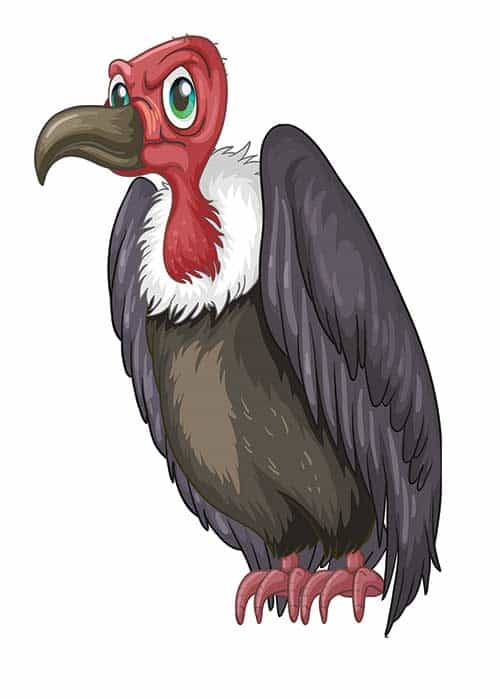
As the trunk lid popped open, the now-conscious and thoroughly angry buzzard stood up like the Phoenix arising to glare at the men. The furious bird then spread its five-foot wings menacingly, squawked loudly and proceeded to vomit with great force and volume.
For those unaware, vomiting is the vulture’s standard first line of defense and they are quite practiced in the art. For what seemed like an eternity, the bird swiveled its head like a lawn sprinkler spewing liquefied roadkill all over the three men and the car.
The smell was excruciating. Most of the trees within 30 feet began shedding leaves and several flying insects died in midair. To make matters worse, in the panic borne of hyper-gagging, my buddy tried to grab the now-apparently-healthy bird by the wings as it continued flopping and spewing the upchuck geyser.
The struggle turned into a short wrestling match with the bird expending its entire arsenal on his hapless tormentor. Locked arm-in-wing, the duo struggled around the driveway in a life-or-death battle as vomit, feces and urine spurted every direction — the majority of which came from the vulture.
The horrific, clinging odor seared every nostril hair within range and in turn each man added their lunch to the gory tableau. The driveway grew slippery with barf and after three or four circuits of the immediate area, the bird and man went down for good.
After several more seconds of driveway grappling, the man finally conceded defeat and curled into a ball in the hopes the whole thing would just be a bad dream — a very wet, extremely smelly, bad dream. His friends didn’t witness this as they were indisposed, crawling on their hands and knees while looking for somewhere cleaner to hurl again.
With this sudden break in the action, the bird took flight with a loud squawk. It was never seen again and no one knows why it flopped over unconscious or if it eventually succumbed to whatever wound it had sustained in the initial encounter. Some believe it just had a sick sense of humor.
In the end, there are several lessons to be learned. First, you shouldn’t shoot vultures because it’s illegal, immoral and serves no purpose, decorating needs notwithstanding. Secondly, if you do happen to need to shoot a buzzard under legal circumstances, as Robert Ruark said, “Use enough gun.” I’d suggest something along the lines of a .458 Winchester Magnum, though my friend now thinks only a .470 Nitro Express safely meets the criteria.
And, most of all, always warn your wife beforehand when the clothes hamper contains an extra-special surprise.