Category: All About Guns
Categories
Weaponology – “PPSh-41”
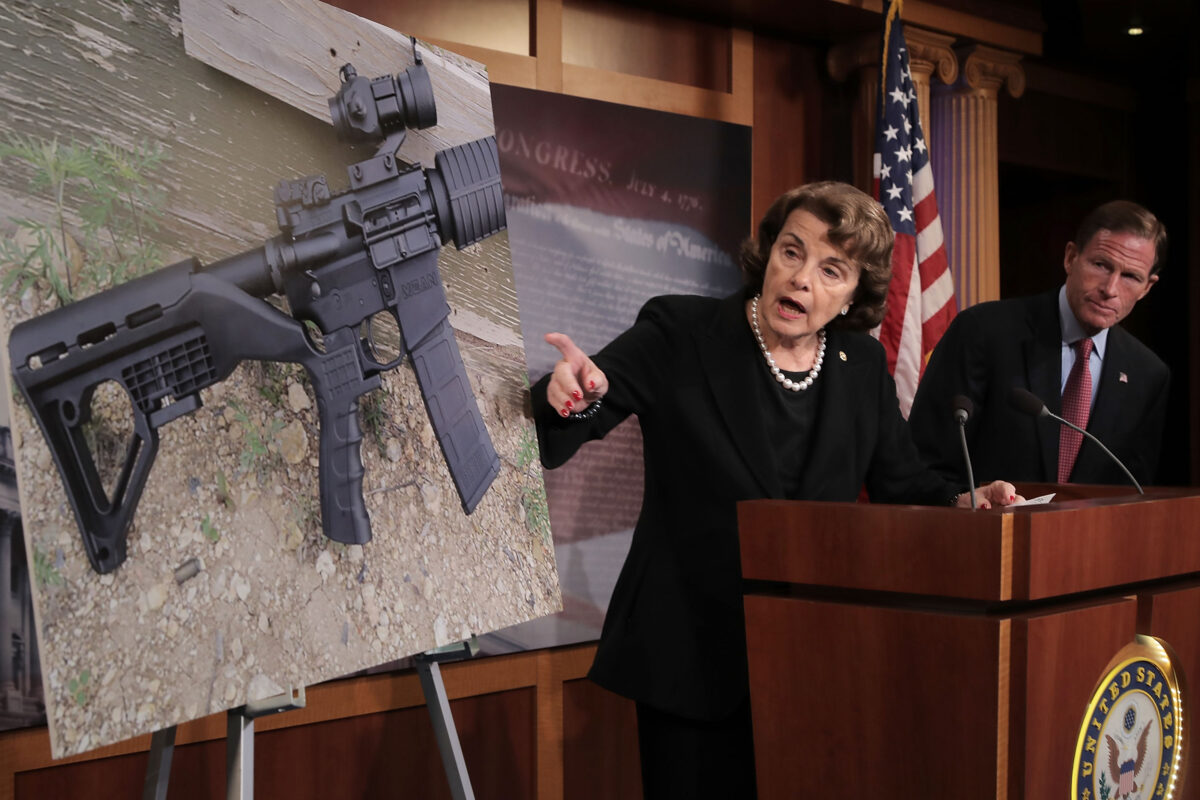
Sen. Dianne Feinstein (D-Calif.), with Sen. Richard Blumenthal (D-Conn.), points to a photograph of a rifle with a bump stock during a news conference to announce proposed gun control legislation at the U.S. Capitol in Washington on Oct. 4, 2017. (Chip Somodevilla/Getty Images)The U.S. government was wrong when it said a ban on machine guns applied to bump stocks, a federal court ruled on Jan. 6.
The U.S. Bureau of Alcohol, Tobacco, Firearms, and Explosives (ATF) in 2018 claimed that two laws banning machine guns meant bump stocks were illegal, reversing its earlier position. The move, backed by then-President Donald Trump, came after a man carried out a mass shooting in Las Vegas, using bump stocks to fire more rapidly.
Michael Cargill, a Texas resident who had to surrender bump stocks due to the reversal, sued in 2019, arguing that the ATF and its parent agency, the U.S. Department of Justice, violated the Constitution by usurping the role of Congress in defining the machine gun ban as extending to bump stocks.
“Cargill is correct. A plain reading of the statutory language, paired with close consideration of the mechanics of a semi-automatic firearm, reveals that a bump stock is excluded from the technical definition of ‘machine gun’ set forth in the Gun Control Act and National Firearms Act,” the U.S. Court of Appeals for the Fifth Circuit said in its new ruling.
Machine guns are defined as a weapon that shoots, or is designed to shoot, or “can be readily restored to shoot,” more than one shot automatically without manual reloading by “a single function of the trigger.” The term includes “the frame or receiver of any such weapon, any part designed and intended solely and exclusively, or combination of parts designed and intended, for use in converting a weapon into a machinegun, and any combination of parts from which a machinegun can be assembled if such parts are in the possession or under the control of a person,” according to the Gun Control Act of 1968, one of the laws cited by the ATF.
The ruling noted that semi-automatic weapons do not fall under the definition because one pull of the trigger corresponds to the firing of a single bullet.
Bump stocks are accessories that, when attached to a weapon, let a shooter speed up the firing mechanism of a semi-automatic weapon, enabling a quicker discharge of bullets. But it does not change the mechanics of a semi-automatic weapon, or the crucial aspect of needing to re-engage the trigger to fire an additional bullet, U.S. Circuit Judge Jennifer Walker Elrod, a George W. Bush appointee writing for the majority, wrote.
“Without a bump stock or the use of an alternative bump technique, the user must provide manual input by pulling the trigger with the muscles of his trigger finger. With a bump stock, the shooter need not pull and release his trigger finger. But the shooter must still apply forward pressure to the weapon’s forebody in order to maintain the shooting mechanism,” Eldrod said. “Again, the manual input remains, even though its form changes.”
Weighing against the government was how the ATF for years after bump stocks were invented in the early 2000s decided they did not fall under the machine gun ban. That changed under public pressure following the 2017 Las Vegas massacre, which left 60 dead and hundreds wounded. The ATF’s final rule stated that the term machine gun “includes a bump-stock-type device, i.e., a device that allows a semi-automatic firearm to shoot more than one shot with a single pull of the trigger by harnessing the recoil energy of the semi-automatic firearm to which it is affixed so that the trigger resets and continues firing without additional physical manipulation of the trigger by the shooter.”
Not Unambiguous
Cargill argued in his suit that the government’s interpretation of machine gun was wrong. Even if it may have been right, Cargill offered, the text of the statute was not unambiguous, which means the rule was not allowed under court precedent.
Courts have been split on whether the ATF’s actions were legal. Several appeals courts had sided with the government against the rule, including the U.S. Court of Appeals for the Fourth Circuit, while several other courts, including a different appeals court, had said the agency overstepped its authority because the law was ambiguous.
In the new ruling, the majority said that the rulings for the government—including one that reasoned “single function of the trigger” could mean “a single pull of the trigger from the perspective of the shooter”—were based “on words that do not exist” in the law, and that a plain reading means bump stocks do not certainly fall under the definition.
“The first thing to note is that the ultimate subject is machine gun, and the subject complement is weapon. In other words, a machinegun is defined by reference to what kind of weapon it is. But identifying the subject of the sentence is only our first step. We next look, second, to the fact that the term weapon is defined by how it shoots. So, again, the definition refers to the device being made to shoot, not the person or thing doing the shooting. Third, the manner of shooting must be automatic. Fourth—and critically—the prepositional phrases define the firing process’s requirements from a mechanical perspective. The process must occur by a single function, and the single act must be by the trigger. In short, there is no mention of a shooter,” the majority said.
“The grammatical structure continuously points the reader back to the mechanics of the firearm. The statute does not care what human input is required to activate the trigger—it cares only whether more than one shot is fired each time the trigger acts.”
Because of the mixed rulings from circuit courts, Cargill’s lawyers expect the government to appeal to the U.S. Supreme Court, which has previously refused to take up cases against the rule.
“We are pleased that a circuit court has finally—and decisively—recognized that Congress must be the one to pass any bump stock ban,” Mark Chenoweth, president and general counsel at the New Civil Liberties Alliance, which has been representing Cargill, said in a statement. “The resulting circuit split should bring this decision to the U.S. Supreme Court’s attention promptly and supply a suitable vehicle for deciding this issue once and for all.”
The Department of Justice did not respond to a request for comment.
The ruling does not have an immediate effect because the court remanded the case to a district court, which had ruled against Cargill, with orders to enter a judgement for Cargill.
Elrod was joined by Chief Judge Priscilla Richman, a George W. Bush appointee, and Circuit Judges Edith Jones, a Reagan appointee; Jerry Smith, a Reagan appointee; Carl Stewart, a Clinton appointee; Leslie Southwick, a George W. Bush appointee; Catharina Haynes, a George W. Bush appointee; Don Willett, a Trump appointee; James Ho, a Trump appointee; Stuart Kyle Duncan, a Trump appointee; Kurt Engelhardt, a Trump appointee; Andrew Oldham, a Trump appointee; and Cory Wilson, a Trump appointee.
Other Opinions
In a one-sentence concurring opinion, Haynes, joined by Richman, said, “I concur in the judgment only because I reluctantly conclude that the relevant statute is ambiguous such that the rule of lenity favors the citizen in this case.”
In a separate concurring opinion, Ho, joined by Richman and Southwick, said that due to the ambiguity, “Congress must take action if it wishes to criminalize bump stocks.”
In a dissent, Circuit Judge Stephen Higginson, an Obama appointee, joined by Circuit Judges James Dennis, a Clinton appointee, and James Earl Graves Jr., an Obama appointee, said that statutory language can be ambiguous enough to bear multiple interpretations but that shouldn’t lead to a ruling that one is incorrect.
“Today, our court extends lenity, once a rule of last resort, to rewrite a vital public safety statute banning machineguns since 1934. In conflict with three other courts of appeals, our court employs its new lenity regime to carve out from federal firearms regulation the bump stock—a device that helped the Las Vegas shooter fire over a thousand rounds during an eleven-minute long attack,” Higginson said.
“Therefore, our court uses lenity to legalize an instrument of mass murder. This is evident from our court’s attempt to confine its new lenity regime only to this statute, giving machinegun owners immunity from prosecution that is not shared by other offenders under the federal code.”
Categories
7 Guns That Really Surprised Me
California planning gun microstamp database
(The Center Square) – On July 1, 2022, California Penal Code section 31910 was revised. The change required semiautomatic pistols sold in California to have microstamping technology. A microstamp acts like a fingerprint in identifying ammunition cartridges and the gun from which it
Anew era of gun sales is taking effect in California.
On July 1, 2022, California Penal Code section 31910 was revised. The change required semiautomatic pistols sold in California to have microstamping technology.
A microstamp acts like a fingerprint in identifying ammunition cartridges and the gun from which it was fired. The firing pin imposes an identifying stamp on the round’s primer as it’s discharged.
The revision now only requires one microstamp in the interior of the handgun instead of two. Supporters hoped that this change in the penal code would encourage manufacturers to employ the technology in their firearm products.
Attorney General Rob Bonta, along with the California Department of Justice, is proposing an additional rule to bolster the use of microstamping. The new rule proposes that the unique microstamp of every handgun in California be kept as a record with the Department of Justice to identify firearms used in criminal activity.
A statement released by the California Department of Justice addressed to “Firearm manufacturers and Interested Parties,” invites comments on specific questions “in developing new regulations to achieve the law’s objectives in the most effective manner.”
The department does not ask whether the rule should be made but rather poses questions on procedure once it is implemented. They invite input on questions such as:
Who is best suited to provide the microstamp to the DOJ?When should the microstamp be provided to the DOJ?How should the microstamp be provided to the DOJ?If a microstamp part needs to be replaced, should the regulated replacement part have the same microstamp as the original?
The department will accept comments from interested parties until 5:00 p.m. on Feb. 1, 2023.
According to the U.S. Bureau of Alcohol, Tobacco, Firearms and Explosives, the number of firearms manufactured in the U.S. has tripled since 2000. Fueling this years-long gun-buying bonanza has been rising demand for handguns. In 2009, semi-automatic handguns began outselling hunting rifles, underscoring a consumer shift toward guns typically used for personal protection. (This is how many guns people bought in each state so far this year.)
A civilian-firearms market the size of the United States means buyers have a wide selection of revolvers and pistols to choose from. How much punch a handgun delivers is typically measured by the pressure on the bullet the moment the firing pin ignites the powder, measured in the U.S. by pounds per square inch (psi), and the velocity of the bullet as it leaves the muzzle, measured by feet per second.
But gauging the power of a handgun isn’t simply a matter of how much explosive pressure is put on the bullet, or even of the bullet type. Some popular handguns for personal protection have lower pressure than other guns but deliver faster muzzle velocity. For example, the Ruger Wrangler single action revolver using .22 LR ammunition has relatively low chamber pressure of 24,000 psi but its muzzle velocity is 41% faster than that of a Ruger LCP semi-automatic pistol firing a .380 bullet with a chamber pressure of 62,000 psi.
To compile a ranking of high-velocity handguns, 24/7 Wall St. reviewed a list of some of the most popular handguns in the U.S. as of July 2022 published by American Firearms, a firearms information site. We considered muzzle velocity – the starting speed of the bullet after the gunpowder has been ignited – as the primary criterion for our ranking. Recommended ammunition and price come from American Firearms and from other online sources. (Compare our list with our roster of the 50 most popular guns in the world.)
Click here to see the world’s 25 highest-velocity handguns.
Among the 25 handguns on this list, prices vary widely, from a Sig Sauer P266 for about $2,500 to a Heritage Rough Rider single-action revolver, which can be found for around $100. The most powerful one of all ranked here, the Ruger GP100 double-action revolver – which boasts a muzzle velocity of 1,525 feet per second – sells for about $950.
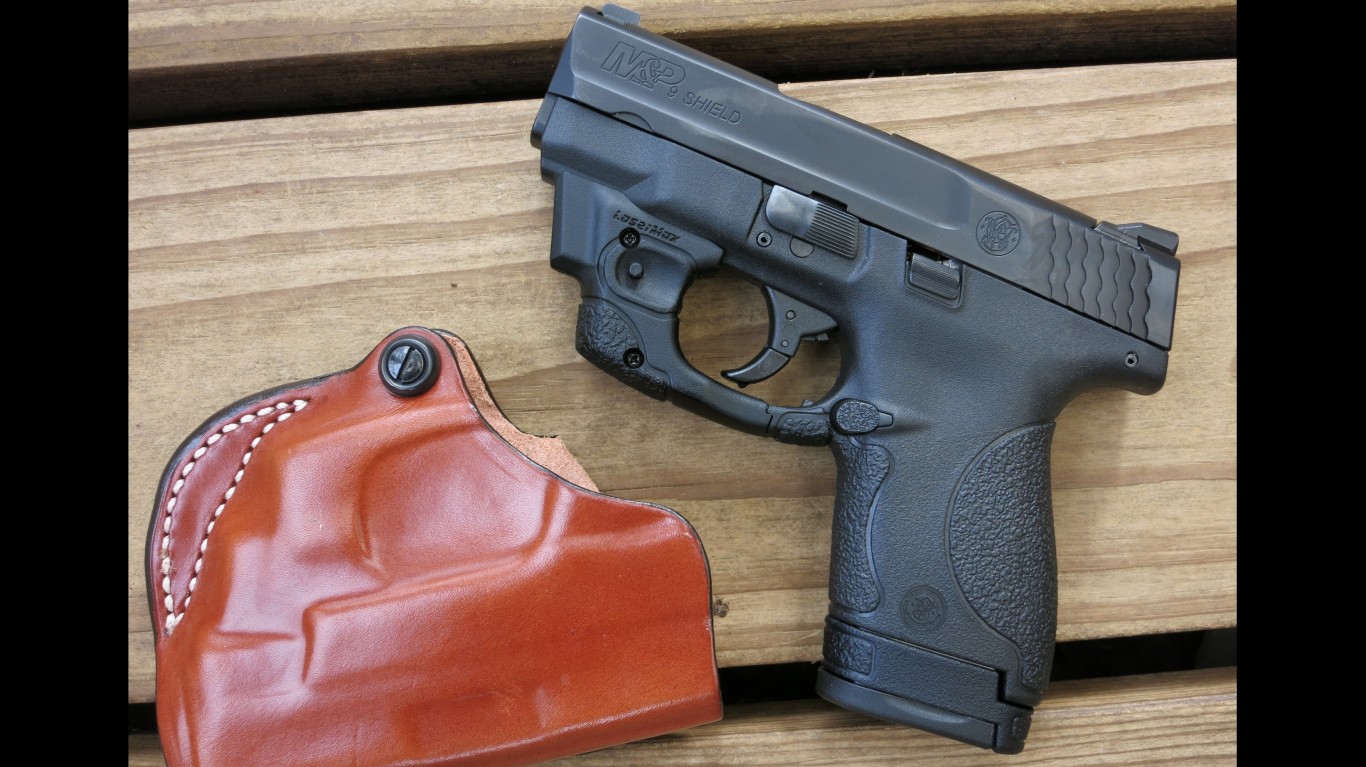
25. Smith and Wesson Shield
> Velocity: 600 ft/s
> Recommended ammunition: .40 S&W
> Pressure: 35,000 psi
> Price: $499

Source: Courtesy of Smith & Wesson
24. Smith and Wesson 442
> Velocity: 830 ft/s
> Recommended ammunition: .38 Special +P
> Pressure: 21,756 psi
> Price: $422
Source: capcase / Flickr
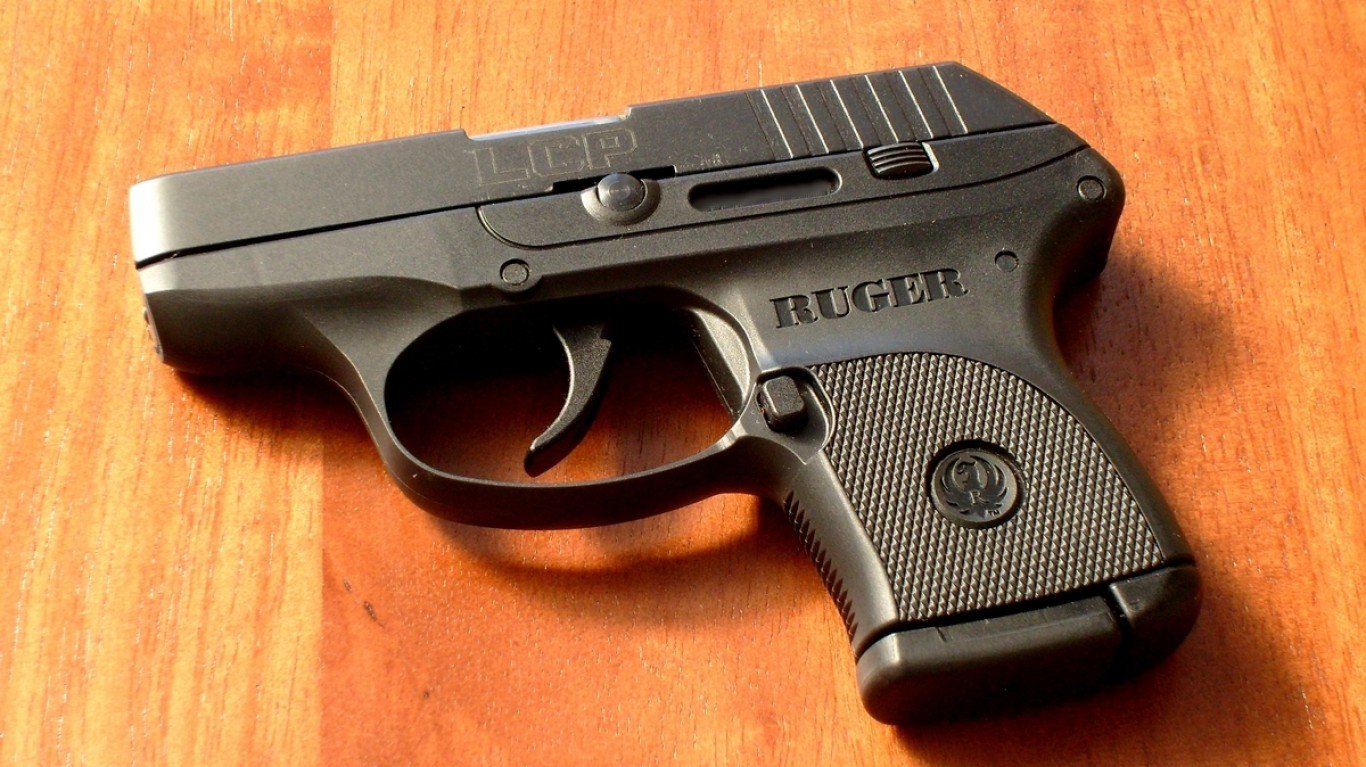
23. Ruger LCP
> Velocity: 891 ft/s
> Recommended ammunition: 0.38
> Pressure: 62,000 psi
> Price: $319
Source: npps48 / iStock via Getty Images
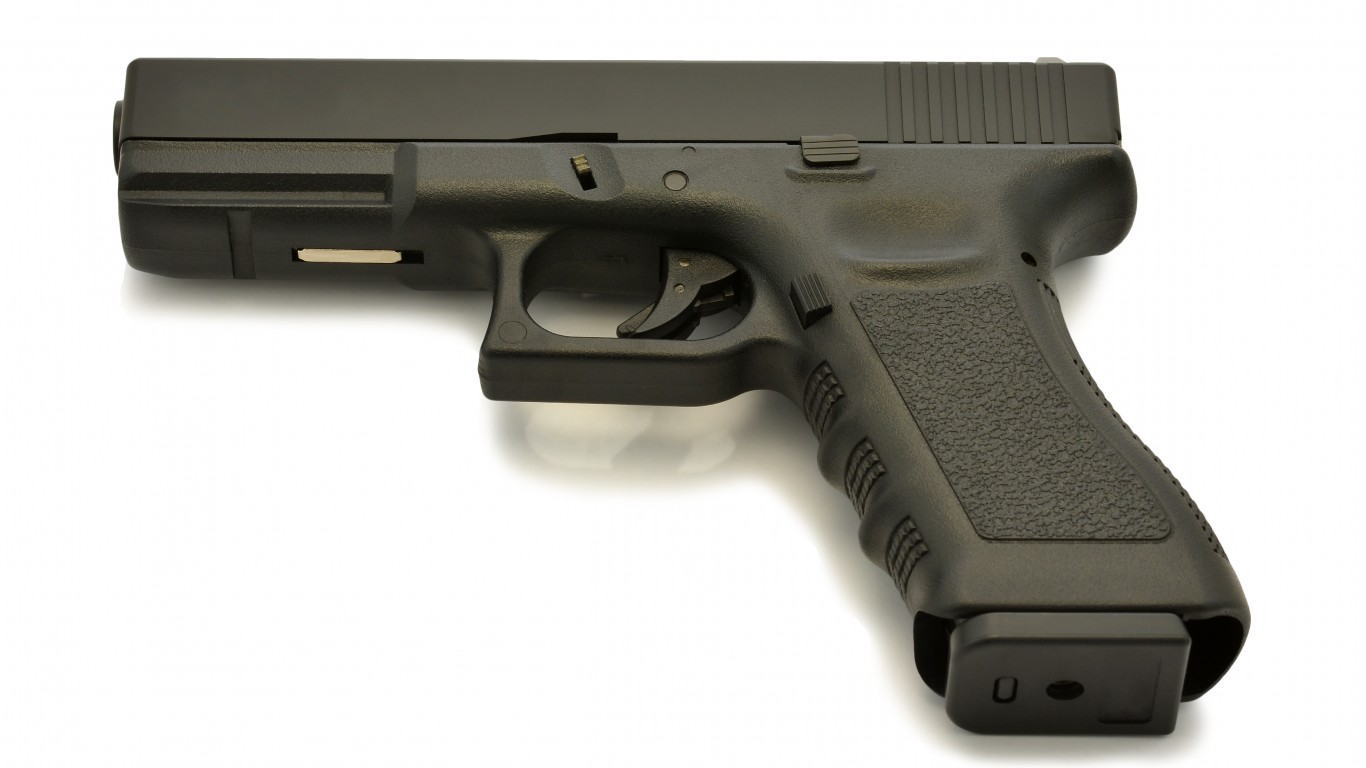
22. Glock 48
> Velocity: 1000 ft/s
> Recommended ammunition: 9mm
> Pressure: 34,084 psi
> Price: $381
Source: Courtesy of Sturm, Ruger & Co., Inc.
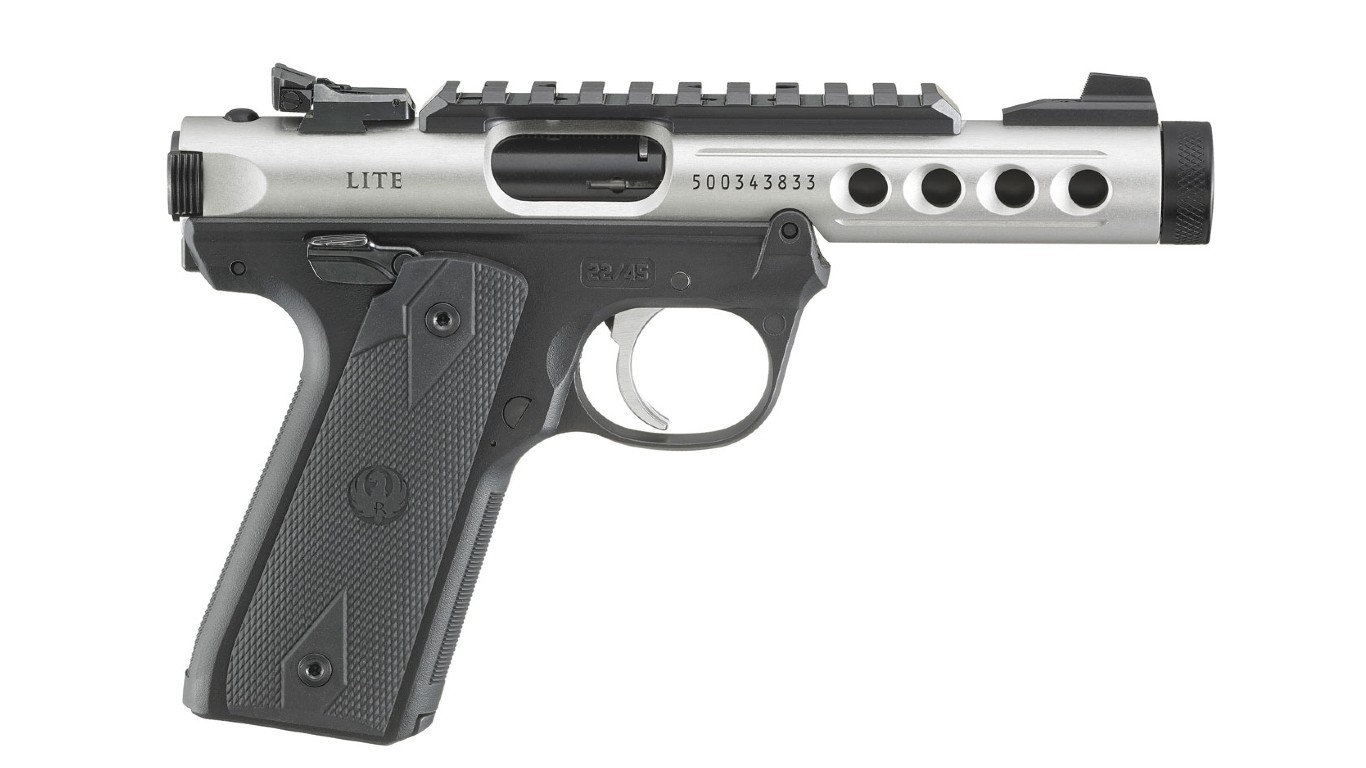
21. Ruger Mark IV 22/45
> Velocity: 1032 ft/s
> Recommended ammunition: .22 LR
> Pressure: 24,000 psi
> Price: $346
Source: Courtesy of SIG SAUER
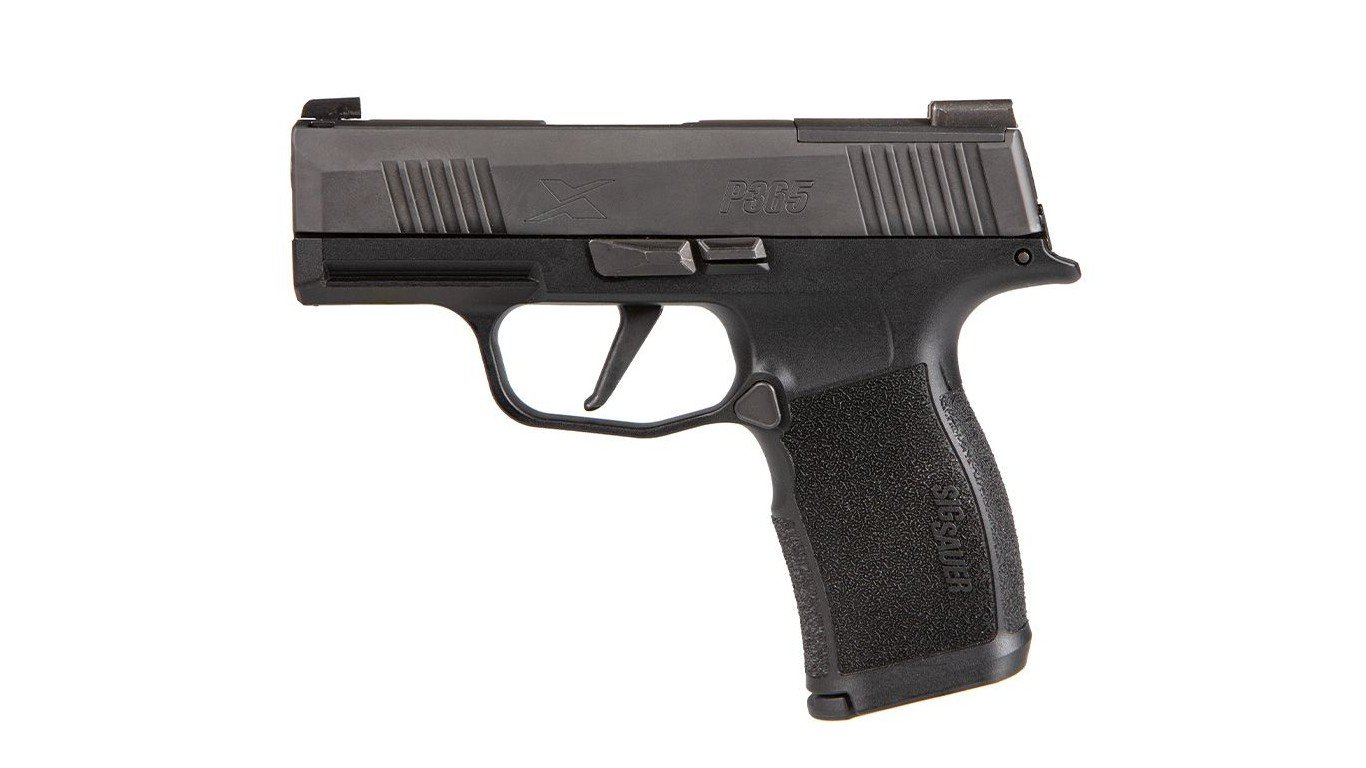
20. Sig Sauer P365
> Velocity: 1050 ft/s
> Recommended ammunition: 9mm
> Pressure: 34,084 psi
> Price: $500
Source: Courtesy of hk-usa.com
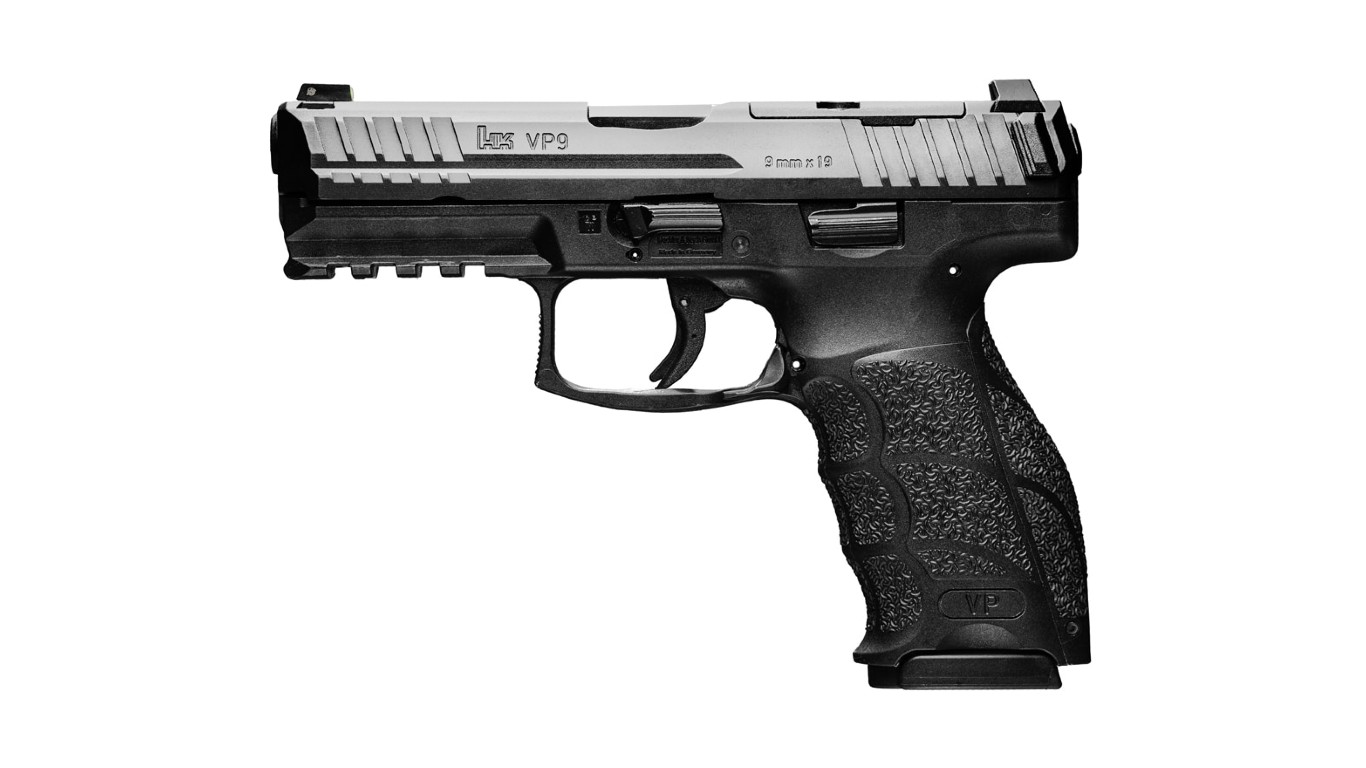
19. Heckler and Koch VP9
> Velocity: 1051 ft/s
> Recommended ammunition: 9mm
> Pressure: 34,084 psi
> Price: $584
 24/7 Wall St.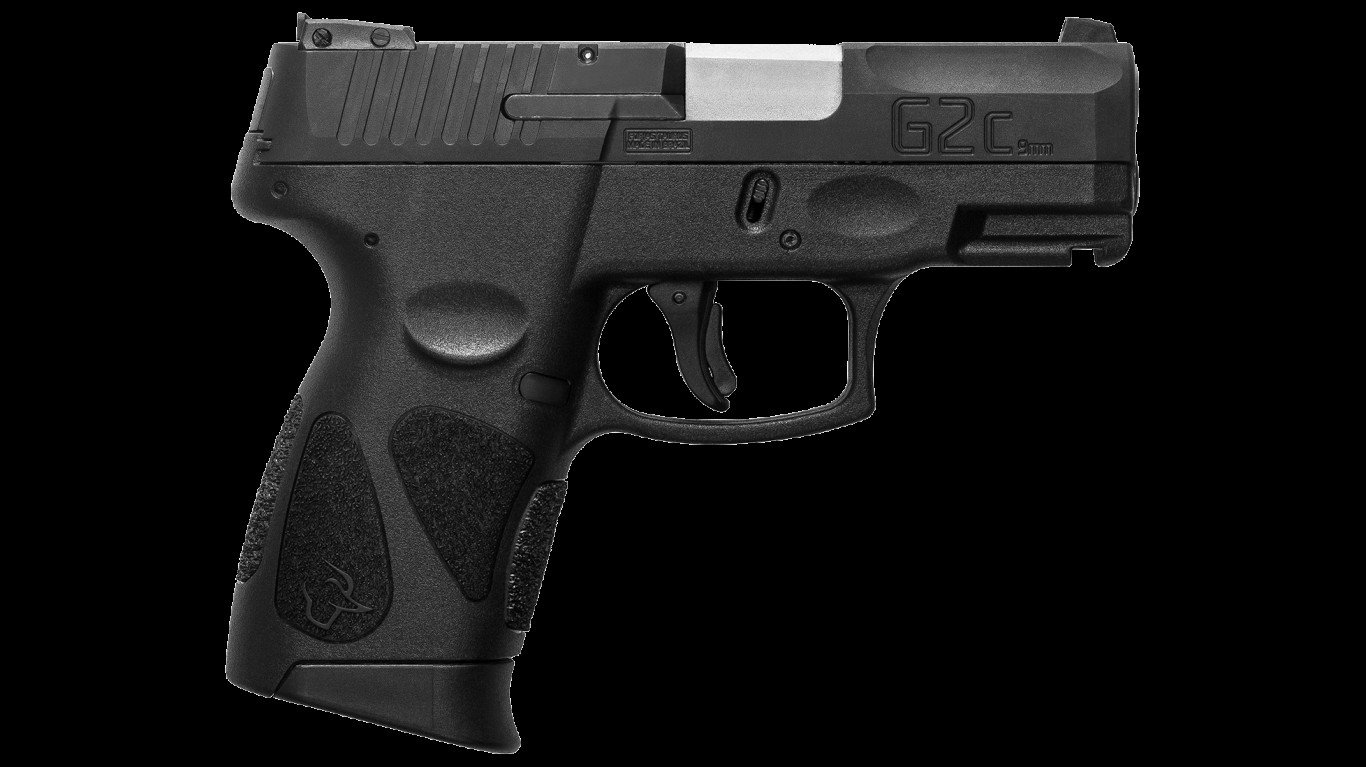
18. Taurus G2c
> Velocity: 1052 ft/s
> Recommended ammunition: 9mm
> Pressure: 34,084 psi
> Price: $210
Source: Courtesy of SCCY
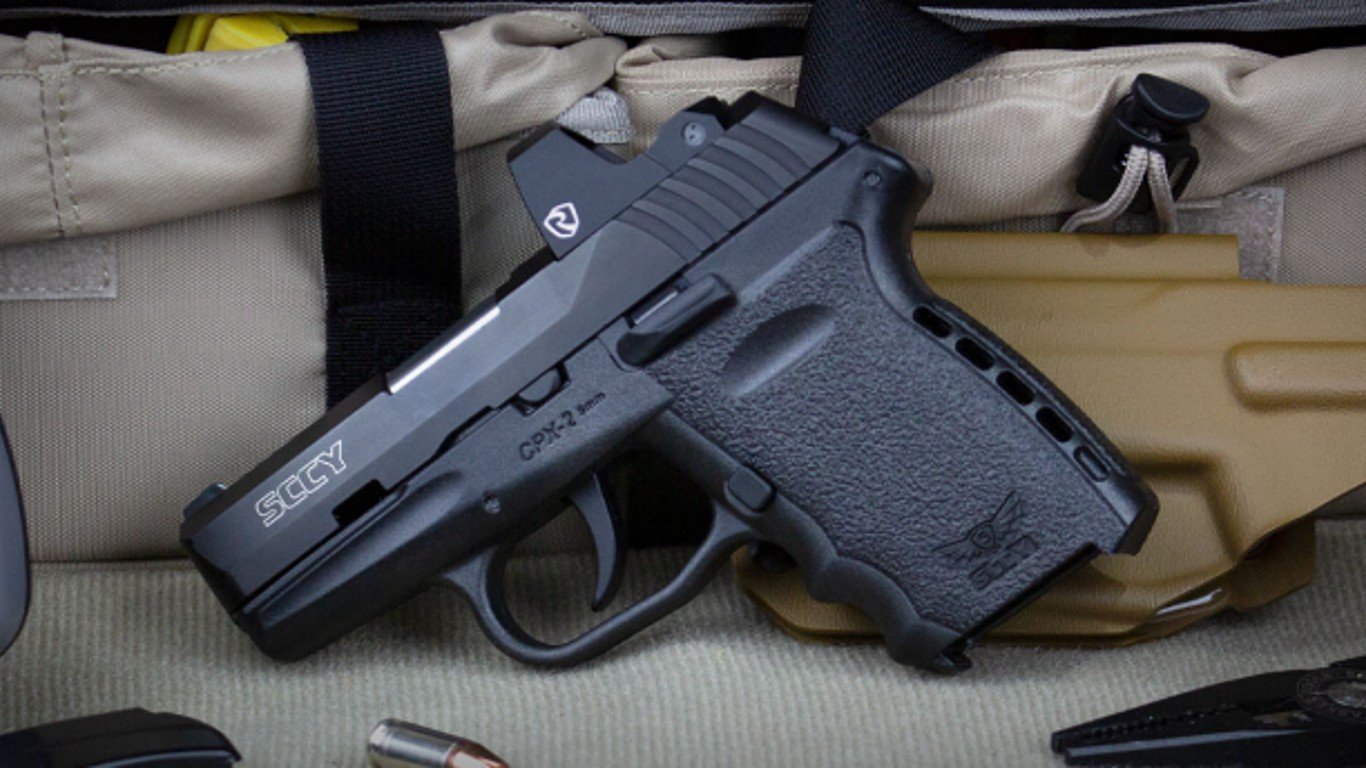
17. Sccy Cpx-2
> Velocity: 1060 ft/s
> Recommended ammunition: 9mm
> Pressure: 34,084 psi
> Price: $172
Source: Courtesy of Kimber America
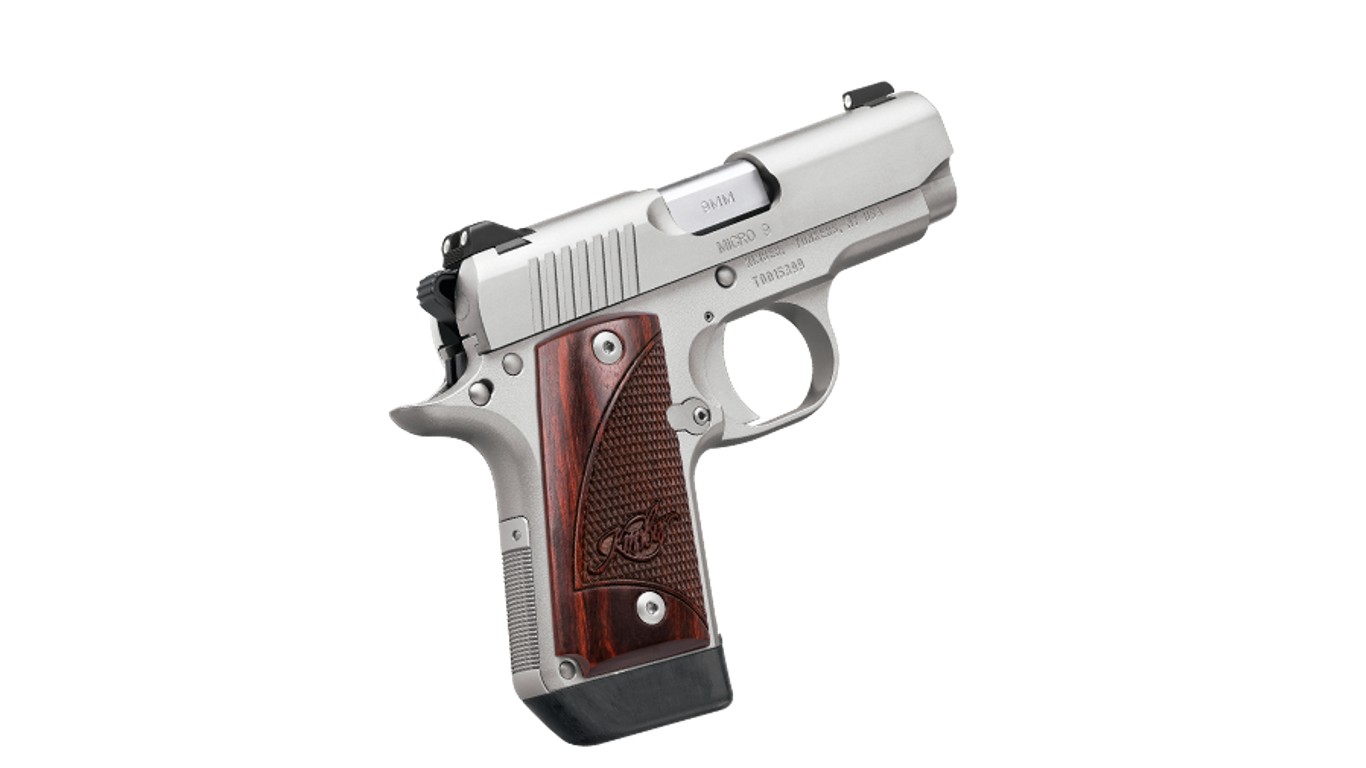
16. Kimber Micro 9
> Velocity: 1,079 ft/s
> Recommended ammunition: 9mm
> Pressure: 34,084 psi
> Price: $486
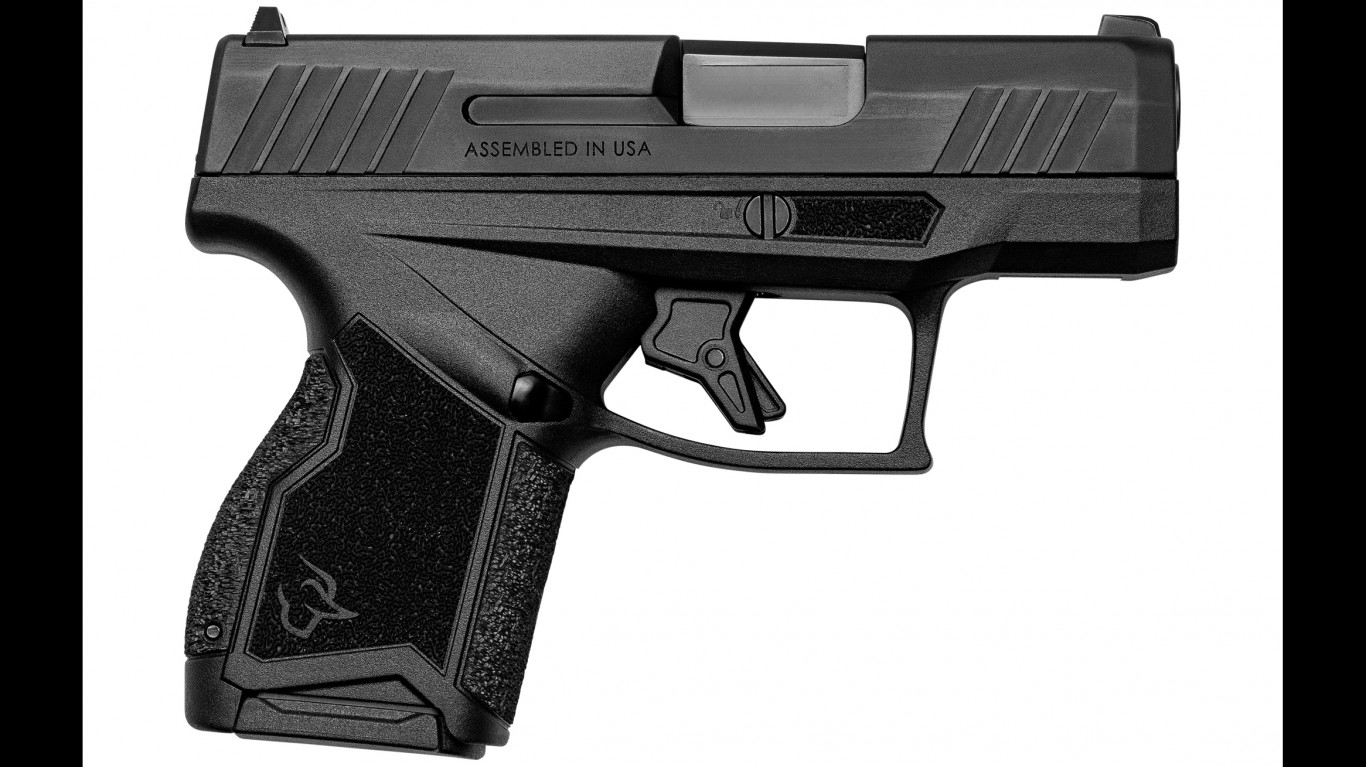
15. Taurus Gx4
> Velocity: 1,100 ft/s
> Recommended ammunition: 9mm
> Pressure: 34,084 psi
> Price: $245
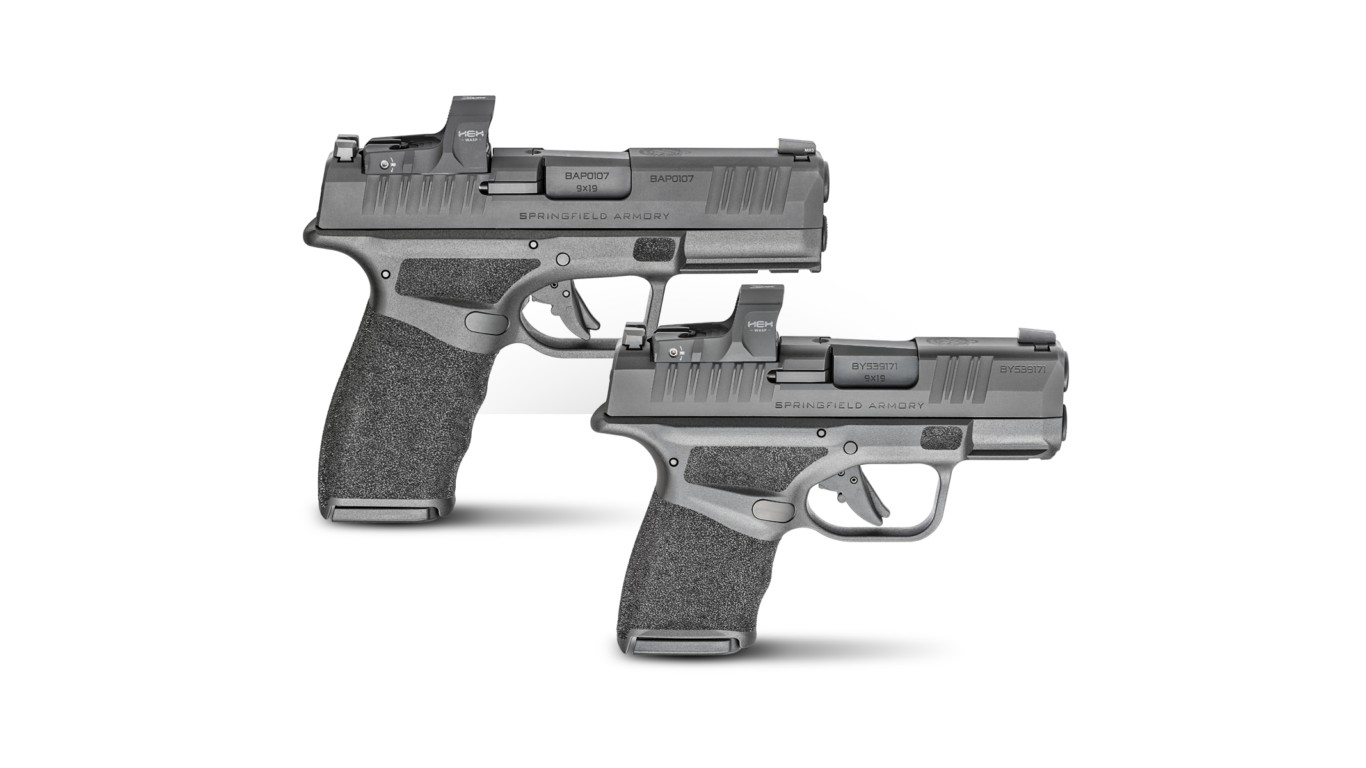
Source: Courtesy of Springfield Armory
14. Springfield Armory Hellcat
> Velocity: 1,123 ft/s
> Recommended ammunition: 9mm
> Pressure: 34,084 psi
> Price: $587
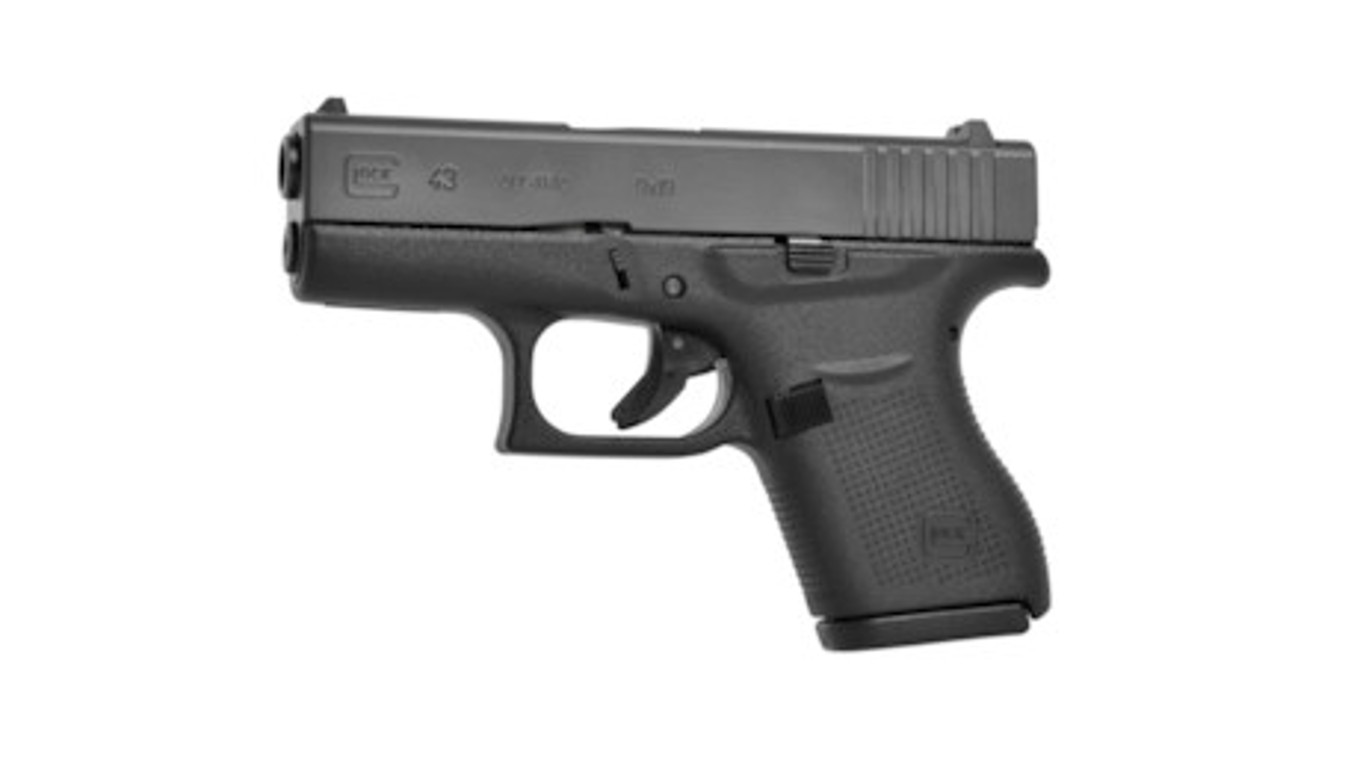
Source: Courtesy of Glock
13. Glock 43
> Velocity: 1,168 ft/s
> Recommended ammunition: 9mm
> Pressure: 34,084 psi
> Price: $469
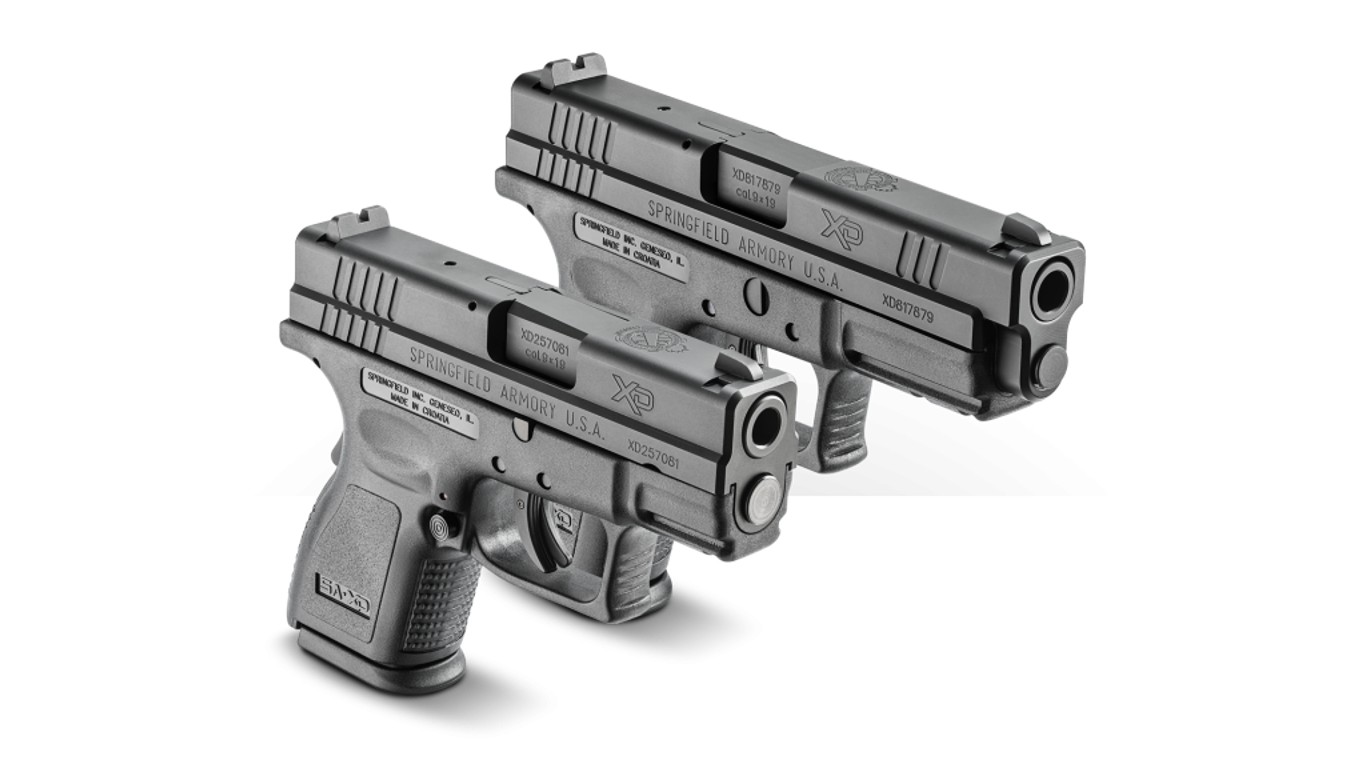
Source: Courtesy of Springfield Armory
12. Springfield XD
> Velocity: 1,173 ft/s
> Recommended ammunition: .45 ACP
> Pressure: 21,000 psi
> Price: $469
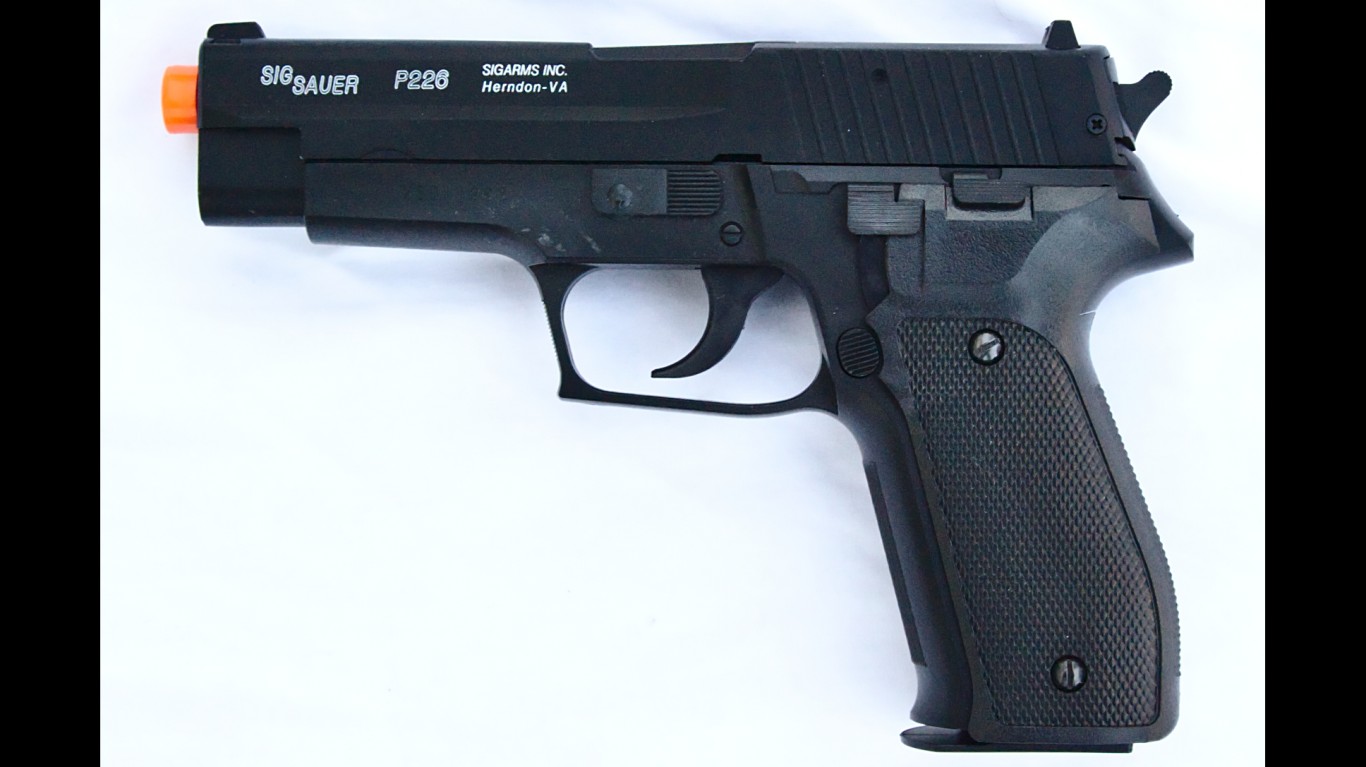
11. Sig Sauer P226
> Velocity: 1,180 ft/s
> Recommended ammunition: 9mm
> Pressure: 34,084 psi
> Price: $2548
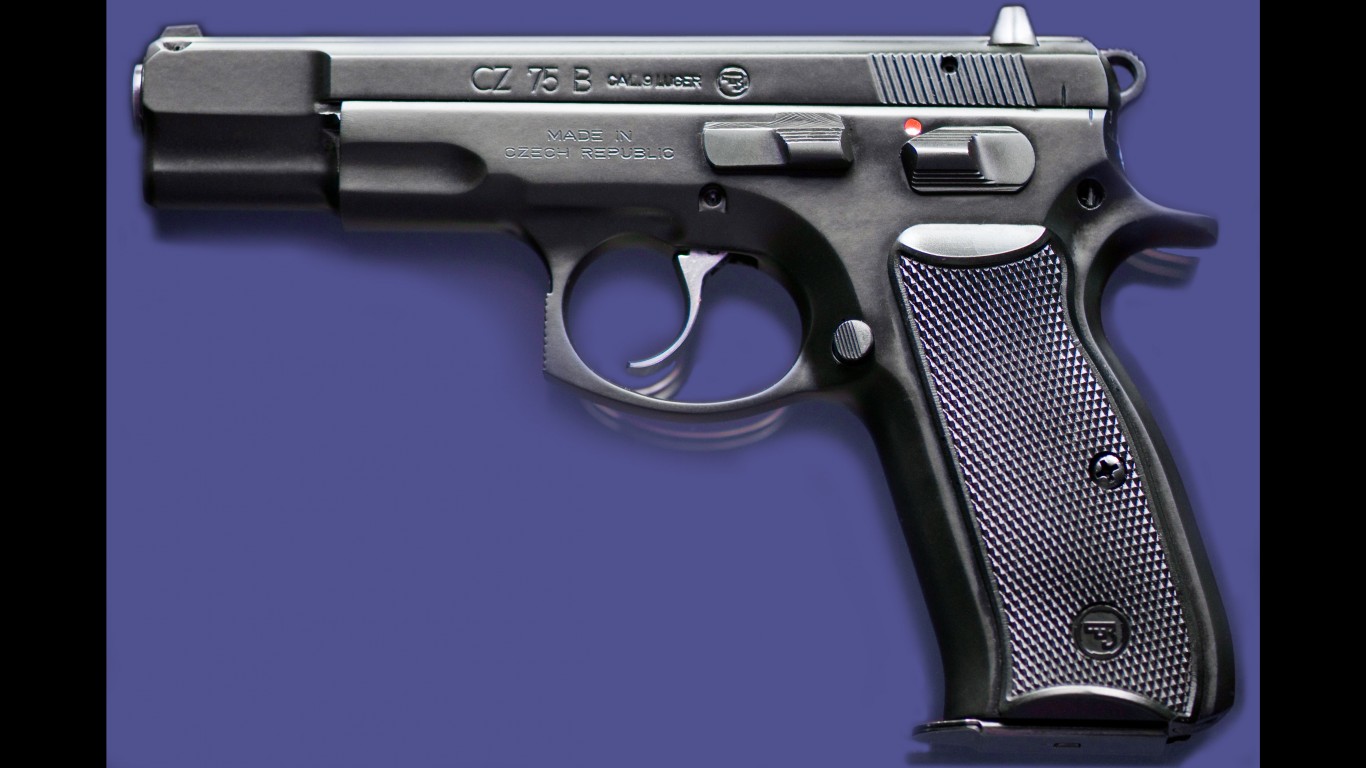
10. CZ 75B
> Velocity: 1,180 ft/s
> Recommended ammunition: 9mm
> Pressure: 34,084 psi
> Price: $1615
Source: Sig Sauer
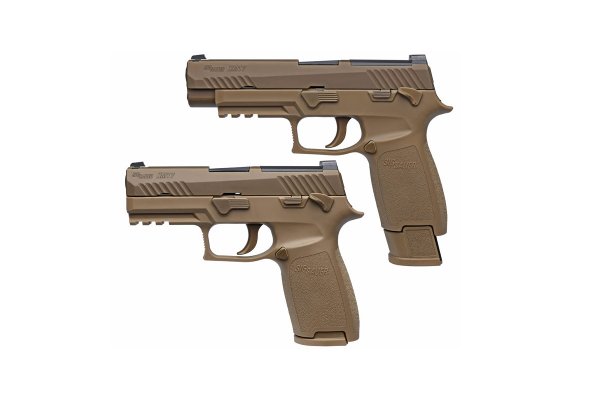
9. Sig Sauer P320
> Velocity: 1,198 ft/s
> Recommended ammunition: 9mm
> Pressure: 34,084 psi
> Price: $529
Source: Courtesy of Kel Tec Weapons
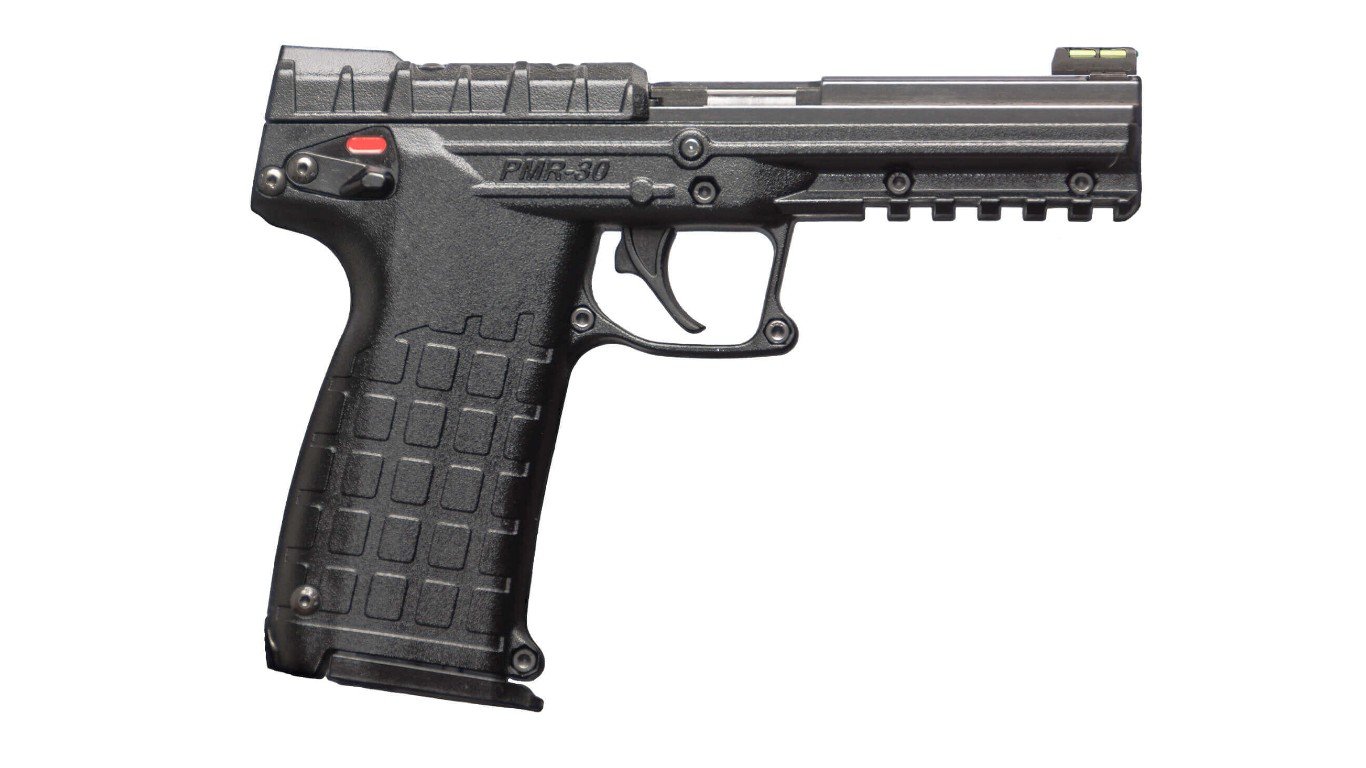
8. Kel-Tec PMR-30
> Velocity: 1,200 ft/s
> Recommended ammunition: .22 WMR
> Pressure: 24,000 psi
> Price: $381
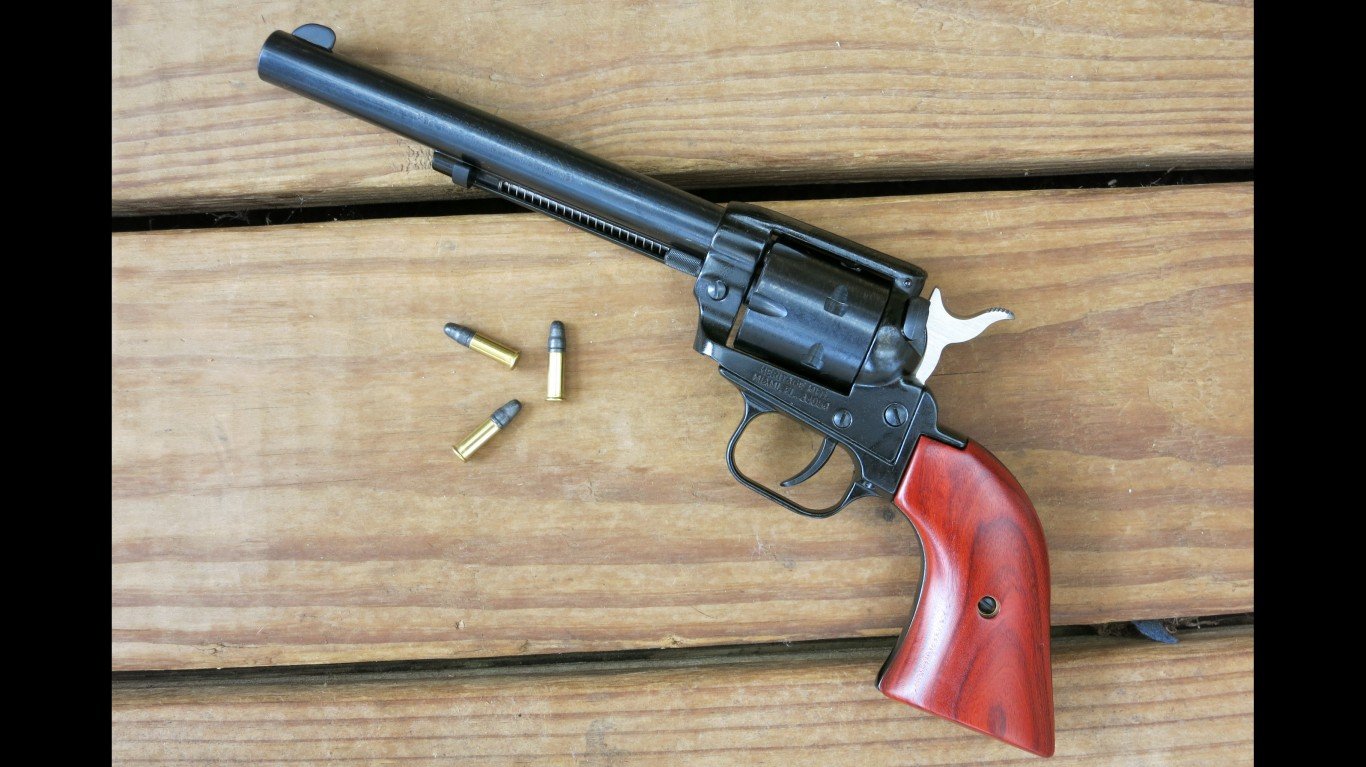
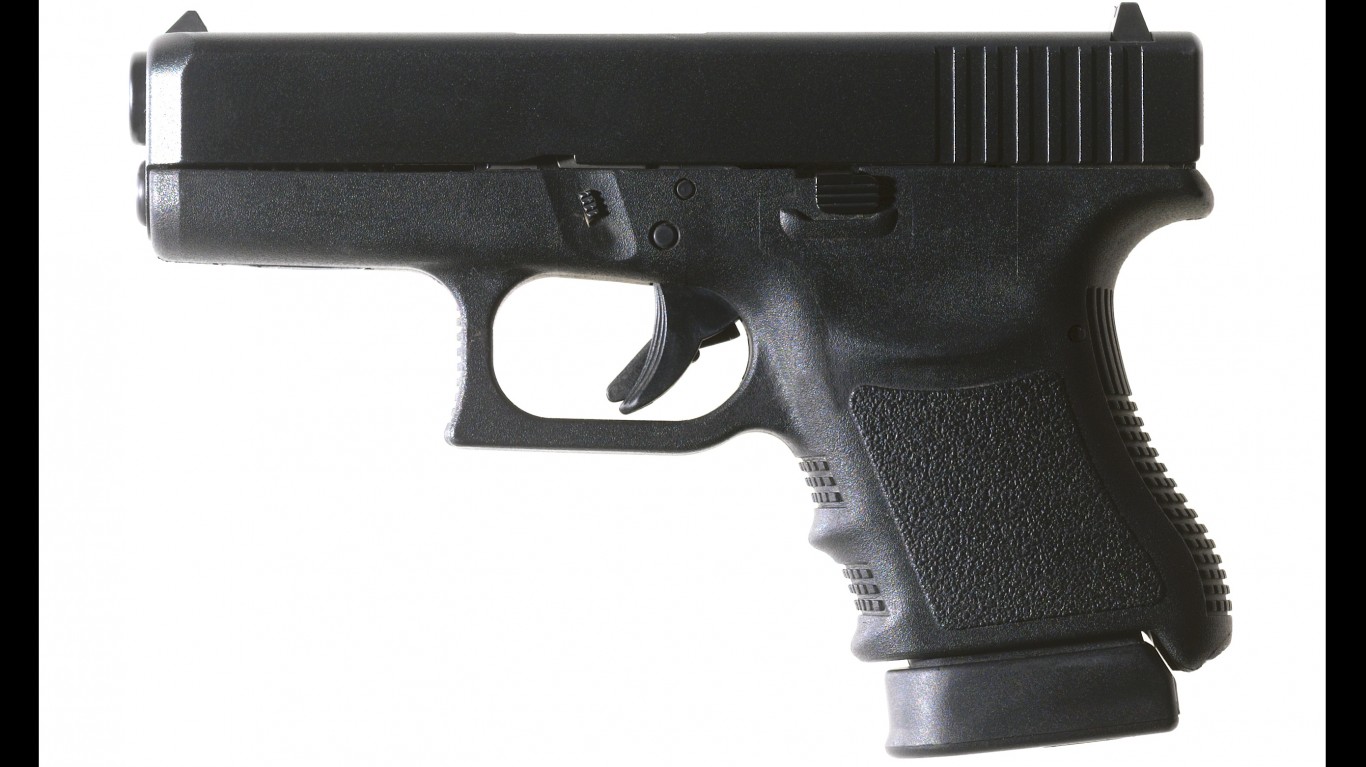
7. Heritage Rough Rider
> Velocity: 1,225 ft/s
> Recommended ammunition: 22 LR
> Pressure: 24,000 psi
> Price: $97
Source: rocksunderwater / E+ via Getty Images
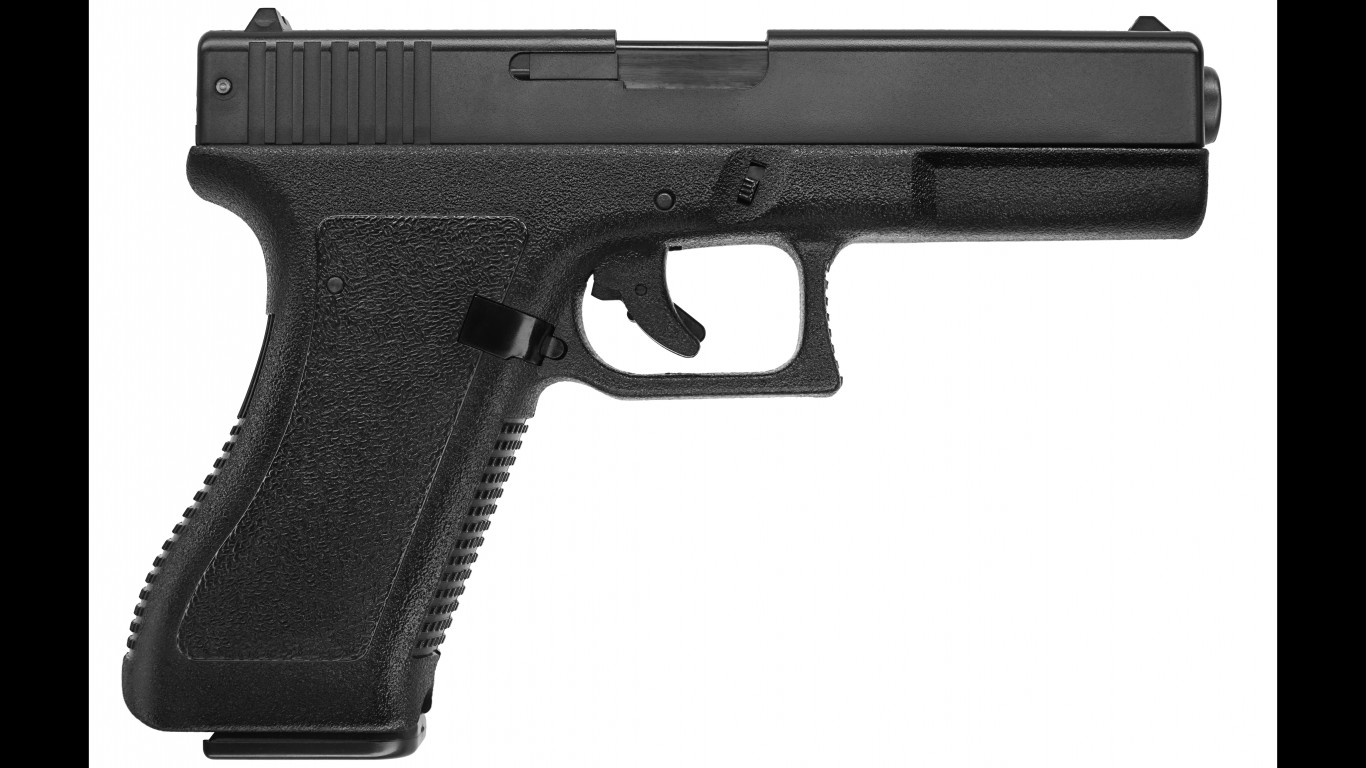
6. Glock 45
> Velocity: 1,225 ft/s
> Recommended ammunition: 9mm
> Pressure: 34,084 psi
> Price: $569
Source: Malachy120 / iStock via Getty Images
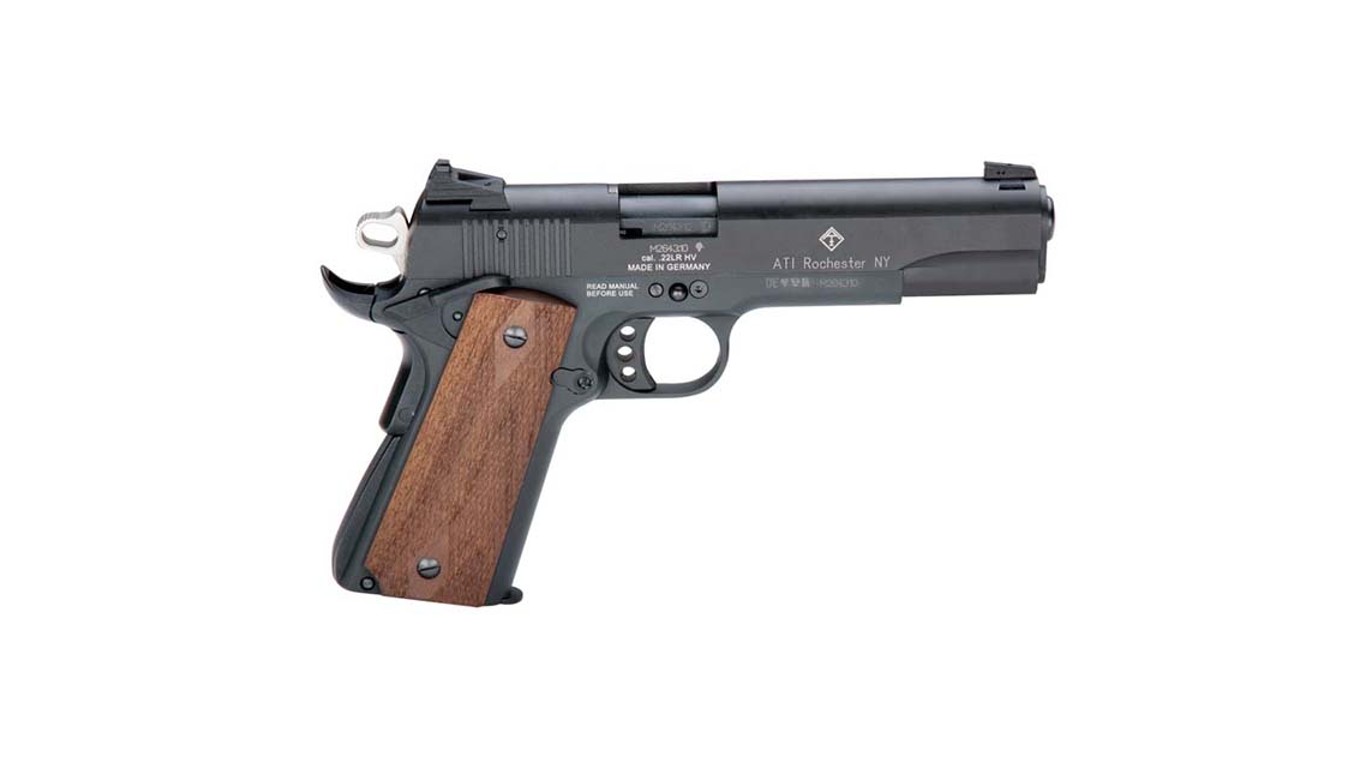
5. Glock 17
> Velocity: 1,230 ft/s
> Recommended ammunition: 9mm
> Pressure: 34,084 psi
> Price: $620
Source: Courtesy of American Tactical US
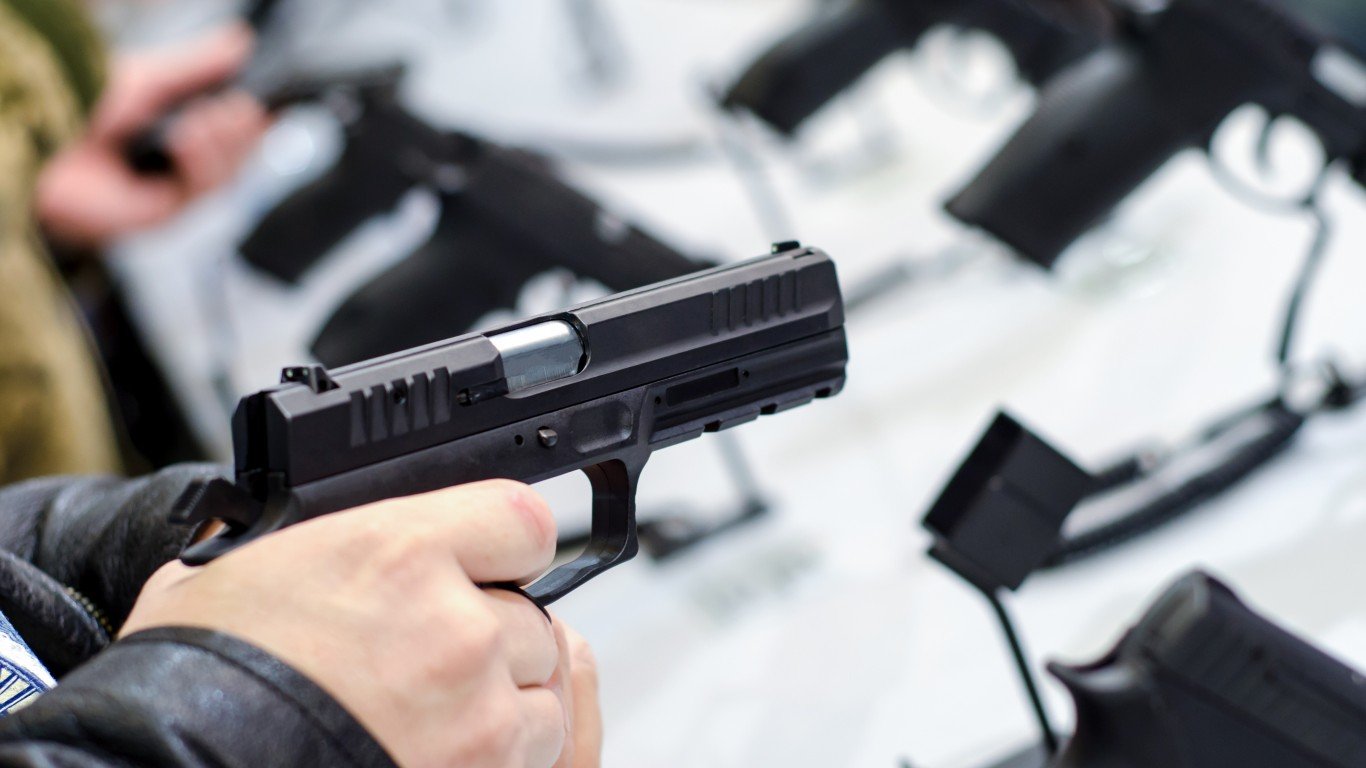
4. ATI GSG 1911
> Velocity: 1,250 ft/s
> Recommended ammunition: .22 LR
> Pressure: 24,000 psi
> Price: $269
 24/7 Wall St.
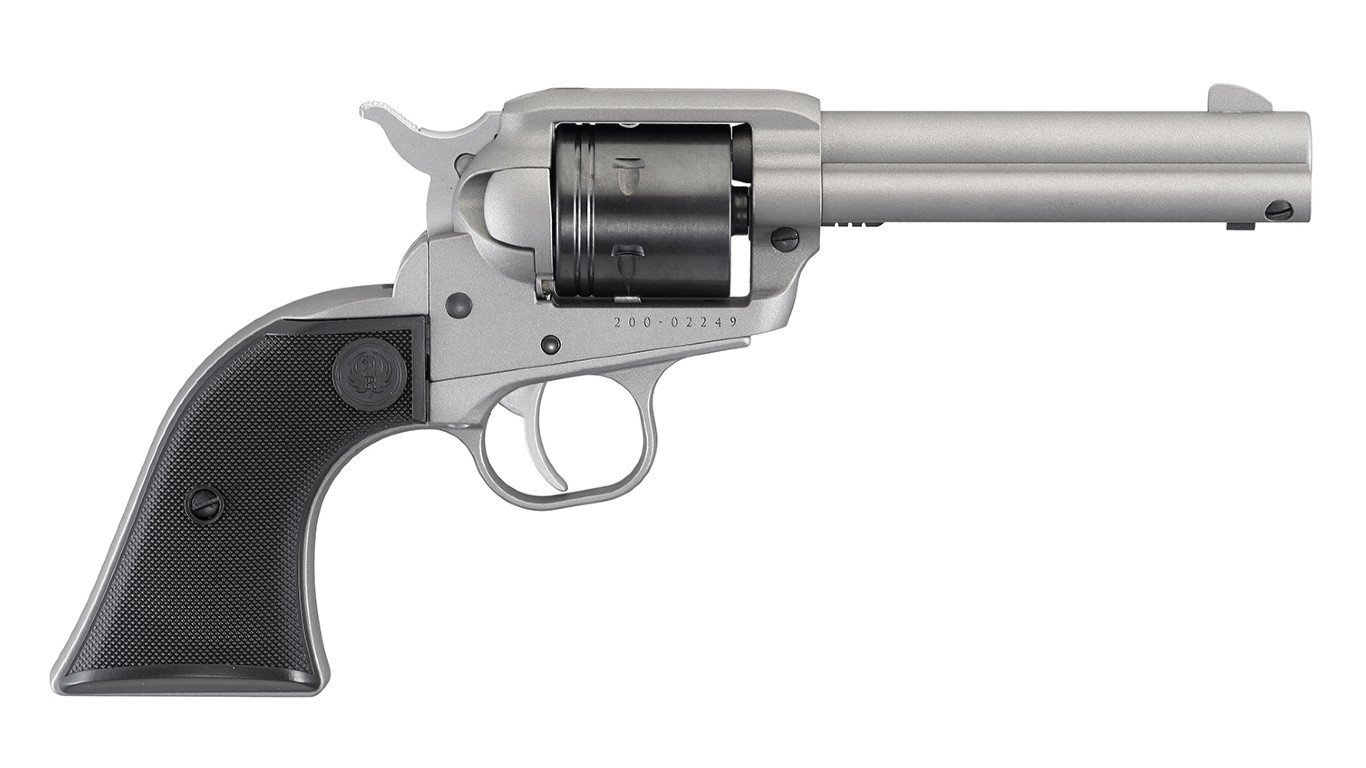
Source: Courtesy of Sturm, Ruger & Co., Inc.
3. Ruger Wrangler
> Velocity: 1,255 ft/s
> Recommended ammunition: .22 LR
> Pressure: 24,000 psi
> Price: $145
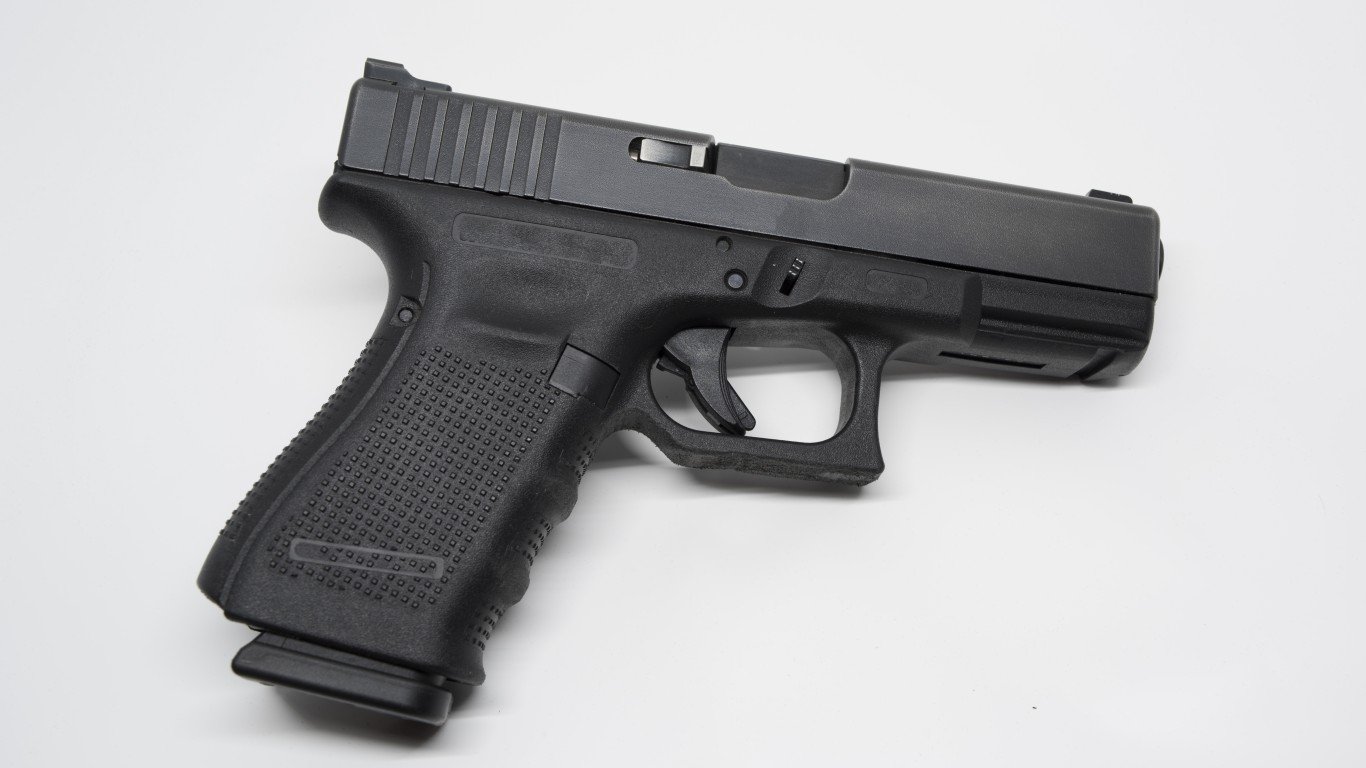
Source: sand86 / iStock via Getty Images
2. Glock 19
> Velocity: 1,500 ft/s
> Recommended ammunition: 9mm
> Pressure: 34,084 psi
> Price: $560
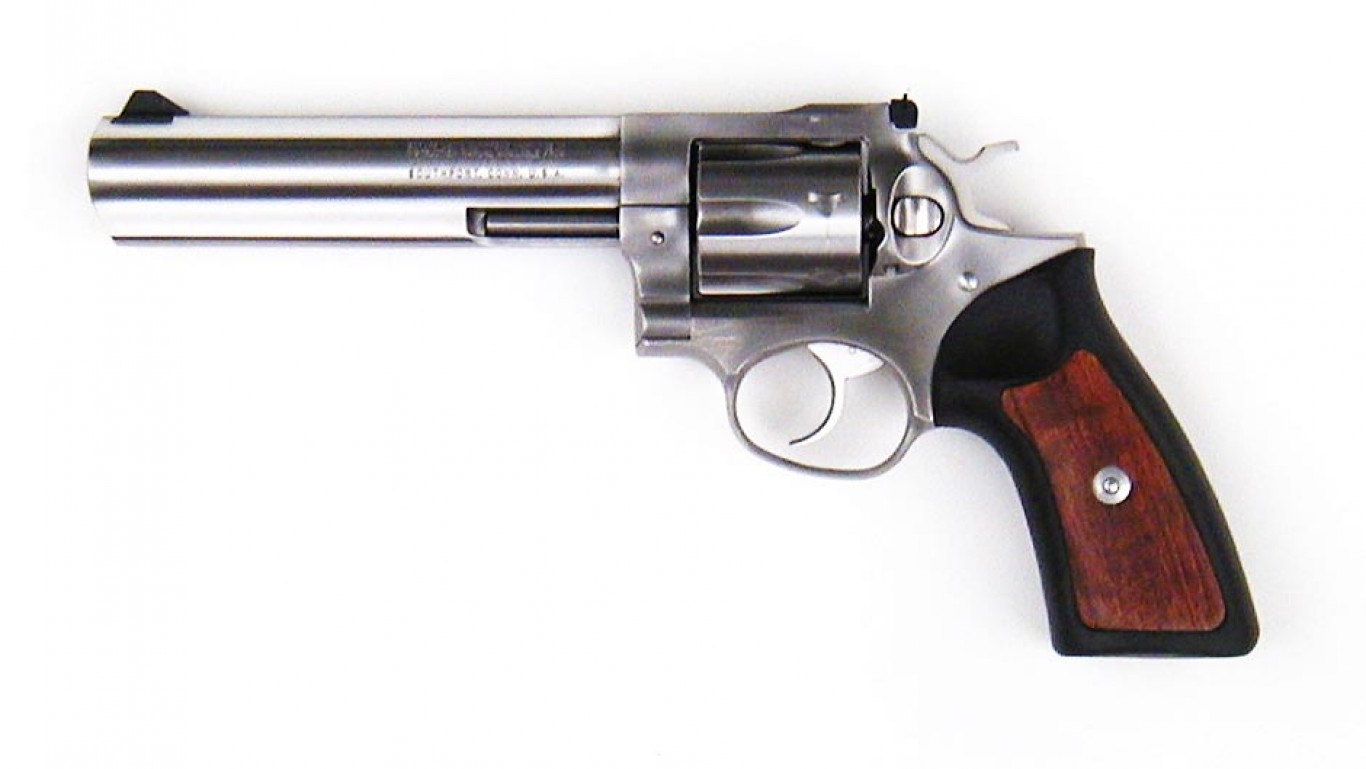
1. Ruger GP100
> Velocity: 1,525 ft/s
> Recommended ammunition: .357 magnum
> Pressure: 43,551 psi
> Price: $949
(I sure would like to know where in the Hell does he get these prices! Grumpy)