Categories
Category: All About Guns
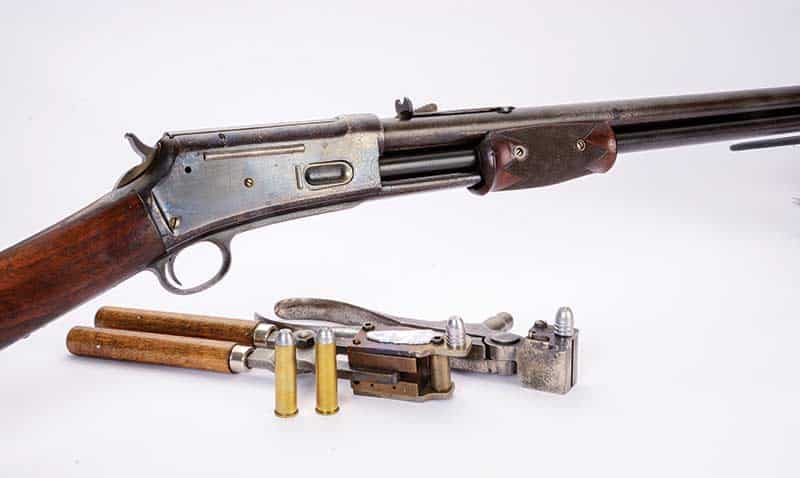
This Colt Lightning .50-95 wears British proof marks. Collectors today call
it a “cat gun,” because it was likely intended for lion or tiger hunting.
From the advent of metallic cartridge ammunition unto this day, .50 caliber rifles have won the hearts and minds of American riflemen. A remarkable variety of rifles chambering the huge .50 BMG are floating about nowadays. Likewise, there was no shortage of .50 caliber rifles in the Old West.
Builders
They were built by all the premier rifle manufacturers of the time. For example, the famous Sharps “buffalo rifles” of the 1870s were made for three lengths of .50 caliber cartridges. Remington only chambered for one .50. However, their factory turned out 900,000 military and sporting No.1 (rolling blocks) by 1877. A significant portion of them were .50-70s so they were likely only second to the U.S. Government in making .50 caliber rifles. Three different .50 cartridges bore the Winchester name between 1878 and the early 1900s, none of which set great sales records.
The U.S. Government got the .50 caliber ball rolling in 1866 with a conversion of leftover Civil War .58 caliber rifle-muskets to shoot a .50 cartridge of 1¾” case length. Military spec loads for the .50 Gov’t were 450-grain bullets over 70 grains black powder — hence the nickname .50-70. The first .50 Gov’t was the Model 1866. It was followed later by Models 1868 and 1870. They were used all over the west.
Sharps Rifle Company grabbed the government’s idea and literally stretched it. Their rifles also chambered the .50-70 but they also developed a .50 with a 2″ case. It went nowhere and is virtually unknown. The third was a .50 with 2½” case famous today as .50-90 Sharps, although the Sharps factory always loaded it with 100 grains of black powder. Remington had to stick with the .50-1¾” case because the long hammer spurs of their No.1s wouldn’t allow passage of longer cases. Their factory loads came with 400- and 450-grain bullets, both over 70-grain powder charges.
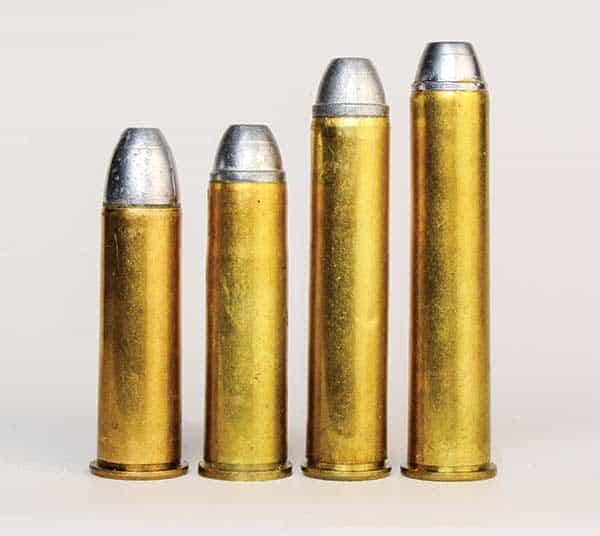
The Murderer’s Row of Old West .50 caliber cartridges. From left:.50
Gov’t (.50-70), Winchester .50-95, Sharps .50-90 (aka .50-100)
and Winchester .50 Express (aka .50-110).
Winchester
Winchester cornered the repeating rifle market early on but had difficulty in coming up with a .50 caliber repeater. In 1878 they gave it a try with their Model 1876. Case length had to be reduced to 1.94″ and bullet weight was only 312 grains. However, the 95-grain powder charge did give it some oomph. In 1887 Winchester gave .50s another try in their strong Model 1886. Using a 2.40″ case, they were able to fit 110 grains of black powder under 300-grain bullets. The round was called logically .50-110 but it seems rifles for it were caliber stamped .50 Ex (Express). Winchester’s .50 Express made it into the smokeless powder era and wasn’t dropped from Winchester’s catalogs until 1919.
There is no lack of bogus information about Old West fifties. For instance, despite original factory records proving no Sharps rifles were ever chambered for a .50 cartridge with 3¼” case, misinformation about such existing still abounds. Actually Winchester did chamber their single shot (aka “Model 1885 High Wall”) for a .50 with 3¼” case for a short while.
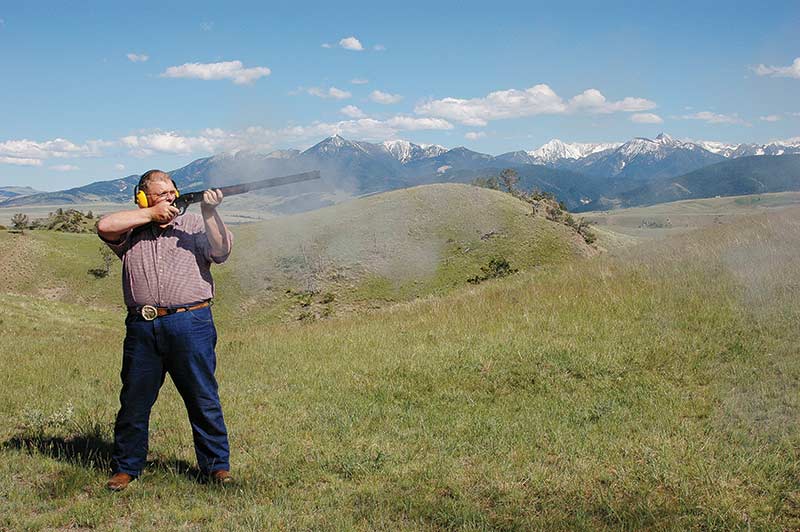
Duke shooting a Uberti/Cimarron Model 1876 .50-95 with black powder handloads.
Short Is Better
There is also the fallacy .50s were long-range cartridges. They weren’t; their bullets were short and wide. Long range bullets were longer and of lesser caliber. Fifty caliber rifles were meant to smack large animals hard! Out west there were bison, elk, grizzly and moose, and there were horse-mounted native warriors of all sorts roaming the west. A .50 caliber hit on a warrior’s horse effectively put him out of the fight.
Interestingly, some Winchester Model 1876 .50-95, Model 1886 .50-110 and even Colt Lightning pump action .50-95’s carry British proof stamps. They were imported to Africa and India for hunting lions and tigers. Collectors today call them “cat guns” and they bring premium prices. The .50 caliber oomph factor in a repeating rifle was important to big cat hunters.
No Speed Demon!
Velocities given by Old West .50 calibers are not impressive compared to the .50 BMG at 2,700 fps. The .50 Gov’t gave about 1,250 fps and Winchester’s .50 Express could break 1,500 fps.
Starting in 1981 I became a Big Fifty shooter and handloader with a modern Shiloh Sharps Model 1874 .50-90. Since then, I’ve gained experience with a few dozen Old West .50s and I’ve shot whitetail deer, mule deer, elk and bison with them. We who appreciate those Old West big bore rifles should give thanks to manufacturers like Shiloh and C. Sharps, and importers such as Cimarron Arms, for making available modern replica Big Fifties!
THE Army has no heavy guns left in Britain after giving them all to Ukraine.
Defence chiefs are scrambling to buy replacements after pledging their 30 working AS90s to Kyiv.

Korean K9 Thunders and Swedish Archer guns are on a shortlist to replace them, if the Treasury unlocks cash.
Top Brass insist the AS90s are best used blasting Putin’s invaders.
A source said: “These guns were designed to fight Russian forces. No one needs them more than Ukraine.”
The self-propelled artillery pieces can blast targets 15 miles away with 155mm shells.
But the decision to give them away has stripped two Royal Artillery regiments, based on Salisbury Plain, Wilts, of all their working weapons.
An artillery source said: “If gunners don’t have guns we can’t fight, we can’t train.”
Defence Secretary Ben Wallace vowed to rush forward replacements with an £800million “mobile fires programme”.
But the new guns are not due until 2029, at the earliest.
Categories
Remington-Keene Repeating Carbine
Categories
S&W Model 53 in 22 Remington Jet

Parkerized and minimalist, the Commando was obviously engineered for hard use on the battlefield • Released by a simple pull latch, the six-round cylinder is robust • Colt’s rollmark indicates the pistol’s martial background.
At the turn of the last century, Colt and Smith & Wesson were the two most prolific American revolver manufacturers. Both were vying for the military and civilian markets that clamored for the newly developed .38 Spl. cartridge. While Smith & Wesson hit the market with its .38 Spl. Military & Police revolver first (1899), Colt was soon in the game with its Army Special, also chambered in .38 Spl., in 1908. By America’s entry into World War II, Colt’s Army Special was now called the Official Police, and sales were brisk at $28.50 each.
 As you can imagine, following the attack on Pearl Harbor in December, 1941, the U.S. Government was scrambling to provide arms and supplies to millions of new recruits. The standing army of the U.S. was slightly less than 500,000 men in 1940, but it would grow to nearly 16 million by 1945. The Defense Supplies Corporation (DSC) was established in 1941 to provide arms and ammunition to the thousands of non-military guards and police charged with protecting America’s munitions plants, war production factories, depots, trains, rail yards and dozens of other sensitive sites. In July, 1942, the DSC contracted with Colt for 20,000 .38 Spl. revolvers. It selected the 4-inch-barrel .38 Spl. Official Police as its choice, but balked at the $28.50 price tag.
Colt countered with a version of the Official Police that was Parkerized (Parco-Lubrite) and had plastic (Coltwood) grips lacking checkering on the trigger, hammer and cylinder release latch. The Colt Commando was born, yielding a $2.50 savings over the MSRP of the Official Police. (Smith & Wesson had done the same with its M&P and called it the Victory Model).
According to Charles W. Pate’s excellent book, “U.S. Handguns of World War II” (1998), a few prototypes of the Commando were initially sent to the Chief of Ordnance in October of 1942 and the first deliveries of the 4-inch Commando were begun in early March, 1943.
In a strange arrangement, the U.S. Army’s Ordnance Department inspected and received all the Commandos produced by Colt initially and then delivered the guns to the DSC, charging them a “handling fee,” which no doubt put the cost of the guns back over the $28.50 price that the DSC had tried to avoid in the first place. By mid-1944, the DSC was able to procure the Commando directly from Colt, eliminating those “handling charges.” (By the end of the war, Colt had raised the price to $32.30).
I’ve often heard folks say, “If this gun could talk, I wonder what tales it would tell.” And to that I would counter, “Let’s give it a look over and see what it can already tell us.” According to Pate, the Colt Commando was serial numbered from No. 1 to No. 50,280, accounting for the full run of more than 50,000 produced during World War II. Of that 50,000, the U.S. Army Ordnance Department received the first 36,000 between March, 1943, and June, 1944. So, if a Commando falls below the serial number of 36,000 it should have U.S. military markings on it such as an Ordnance bomb cartouche on the upper left side of the frame. Of these 36,000 revolvers, 20,000 or so were sent to the DSC for distribution to the non-military end users as stated above. However, 16,000 revolvers were used by the U.S. military in a number of roles. Some made it over to Europe—even GA Eisenhower was known to have one. The CID and OSS were each also recipients of the Commando for clandestine operations. After June of 1944, or serial number 36,000, Commandos encountered without inspector marks were Commandos that were sold directly to the DSC. Those destined for military use were stamped with the ordnance bomb, “W.B.” or “G.H.D.” There are some exceptions to this rule as the Army “loaned” some revolvers to the DSC when urgencies arose unexpectedly and vice versa, so the best way to know is to write to Colt and have the company provide an official letter.
Almost from the receipt of the first prototypes in 1942, Colt began to produce a 2-inch-barreled model that some call “The Junior Commando.” The Ordnance Department began receiving the first shipments of the 2-inch model around the same time that the first shipments of the standard 4-inch model were arriving in March, 1943. It is believed only 3,450 of the 2-inch “Junior Commandos” were manufactured and used during the war.
The Army and the DSC were not the only ones to employ the Commando during the war, as approximately 1,700 were delivered to the U.S. Navy. In early 1944, a U.S. Navy Sailor dropped his Smith & Wesson “Victory” model on the deck of his ship and it discharged, fatally wounding him. The delivery of the Smith & Wesson revolvers was placed on hold while a suitable fix was found to prevent their accidental discharge. Colt was able to bridge the gap somewhat by delivering Commandos to the Navy during the interim period.
The Colt Commando mostly saw service during the war as a stateside guardian, a vital role, no doubt. The limited numbers produced—50,000 total—pale in comparison to the Smith & Wesson Victory model in .38/200 (775,000 manufactured) and .38 Spl. (350,000 manufactured).
According to the “43rd Edition of the Blue Book of Gun Values,” an example of the Colt Commando in “as-issued” condition is worth about $1,350, while the .38 Spl. version of the Smith & Wesson Victory model runs about $100 more.
The reader is encouraged to see Charles W. Pate’s “U.S. Handguns of World War II” as well as Gary H. Peer’s “The Colt Double Action Snub-Nose (Pocket) Revolver” for more information about the fascinating revolvers of this period.

Categories
Uber Cool!

Categories
The 1909 Schwarzlose Pistol Pistol
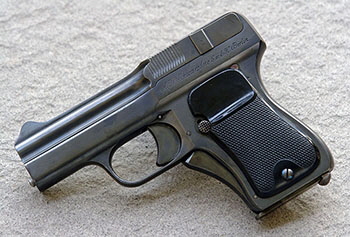
The most notable feature of the 1909 Schwarzlose is its “blow- forward” or “reverse-recoil” action, which allows the barrel to be the same length as that of any “blow-back” pistol, while the overall length of the gun may be shorter than usual, since the magazine is positioned beneath the barrel rather than behind it.
Another feature, not quite so obvious is the flat mainspring that tensions the hammer, the magazine release, and the safety lever. When the grip safety on front of the grip is squeezed it pulls a u- shaped connector bar at the base of the grip forward, putting enough tension on the bottom of the mainspring to allow the gun to be fired.
The magazine release serves as a fulcrum point for the spring. If the grip safety is not squeezed there is insufficient tension in the mainspring to enable the hammer to ignite the primer. In its forward position, the grip safety blocks the trigger. A button on the left side of the gun may be pressed upward and allowed to come down when the safety is squeezed to lock the safety back, which makes it easier to aim the gun carefully for target shooting