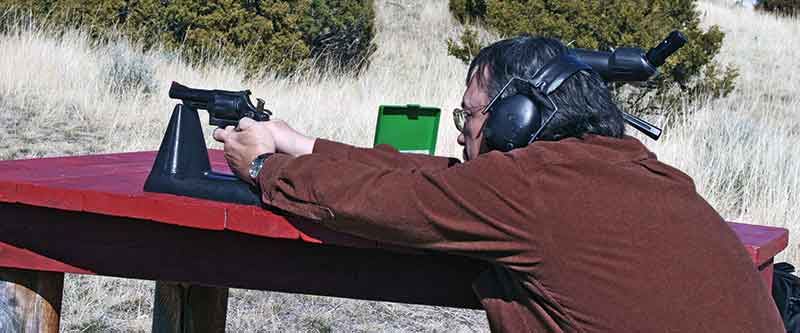
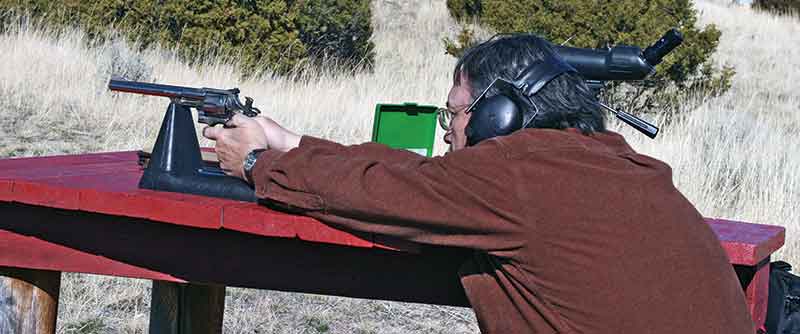
Both Model 57s shot very well, partly because they had great triggers.
The .41 Remington Magnum is in many ways the handgun equivalent of the .280 Remington and 16 gauge, a cartridge regarded by a relatively few True Believers as a perfect combination of ballistics and recoil. Like the .280 and 16, the .41 refuses to die, but all three rounds lag far behind the popularity of the dominant cartridges in their categories, the .44 Remington Magnum, .270 Winchester and 12 gauge.
While most 21st-century shooters remember Elmer Keith as the father of the .41 Magnum, other notable handgunners also had a part in its 1964 introduction, including Bill Jordan and Skeeter Skelton. The .41 was originally conceived as the perfect law enforcement round, more effective than the .38 Special and .357 Magnum then used by most American police departments, but more controllable than the .44 Magnum, considered the world’s most powerful handgun cartridge even nine years after its introduction in 1955.
The public’s fascination with the power of the .44 affected the success of the .41. Even the so-called “police” load produced by Remington, a 210-grain cast bullet at 1,050 feet per second, produced about twice the recoil of the typical .38 Special service load. The “hunting” load was a 210-grain bullet at 1,500 fps, developing over 1,000 foot-pounds of muzzle energy, and nearly the same recoil as the 240-grain “Hi-Speed” load of the .44 Magnum.
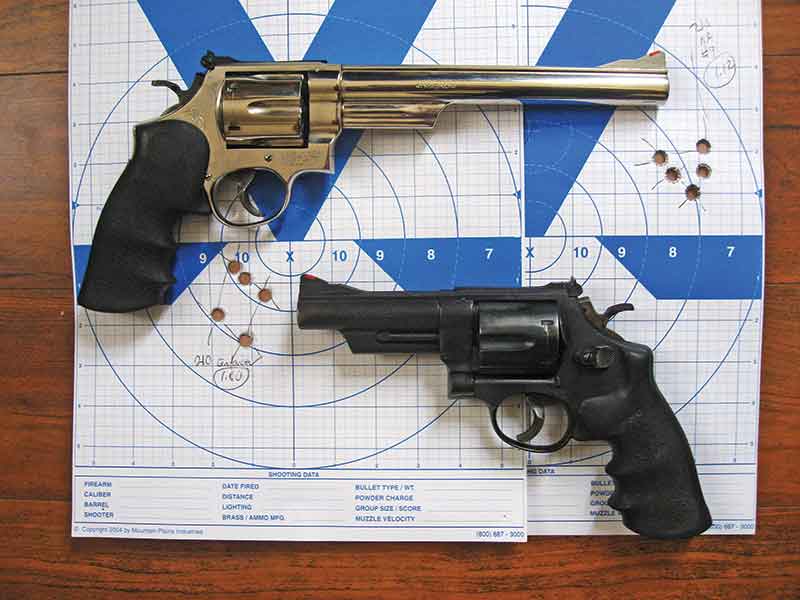
The two test revolvers were both Smith & Wesson Model 57s, one a blued model with a 4″ barrel (above),
the other nickel-plated with an 8-3/8″ barrel.
Too Big And Heavy
Also, Smith & Wesson chambered the .41 in the same large N-frame as the .44 Mag, calling it the Model 57. Instead of being somewhere between S&W’s smaller K-frame revolvers chambered for the .38 Special and .357 Mag and the .44 Model 29, the Model 57 weighed slightly more than the Model 29, due to the smaller hole in the barrel, so didn’t have any advantage as a carry revolver.
One of the oldest rules of breechloading firearms is there’s only so much space in any given cartridge category, and sales of the .41 lagged far behind the .44. Like devotees of the .280 and 16, the .41’s True Believers keep pointing out why this shouldn’t be so, citing small advantages in ballistics, including saying it shot flatter than the .44, a claim that originated with Elmer Keith.
Keith took a Model 57 along on a polar bear hunt, and he and his guide used the .41 to collect meat caribou. His published story pointed out the flatter trajectory of the .41. But if we run the numbers of 1964’s full-power 210-grain .41 and 240-grain .44 factory loads through Sierra’s Infinity ballistics program, using a zero range of 50 yards, we find the .41 only .3″ flatter at 150 yards—a long distance to be shooting at any big game animal with an iron-sighted revolver. With today’s factory loads the .44 shoots flatter, given equal bullet weights, even beyond 150 yards.
Please don’t take this wrong. My first handgun larger than a .357 Mag was a S&W Model 657, the stainless version of the 57, with a 6-1/2″ barrel. It was purchased new in 1989 as an all-around handgun for hunting big game, plus carrying as an emergency sidearm in Montana’s backcountry. The 657 shot very accurately, with a couple of loads grouping five rounds into around 2″ at 50 yards, not 25, partly because the trigger broke incredibly cleanly at around 3 pounds. Eventually I ended up owning two other .41s, a Ruger Blackhawk with 7-1/2″ barrel, and Thompson/Center Contender with a 10″ barrel. Both shot very well too.
New Competition
The 657 served its intended purposes over a decade or so, but eventually I grew weary of carrying 3 pounds of steel even when riding a horse. It also didn’t seem to kick a heck of a lot less than my friends’ .44 Magnums. Expanding handgun bullets had also improved enormously, making the .357 Mag a more definite self-defense round, and a number of single-action shooters had started heating up the old .45 Colt in new revolvers, with modern brass and heavier bullets. The .41 was not only competing with the .44 Magnum but the .45 Colt.
With .44 Magnum and .45 Colt components available in any Montana sporting goods store, I’d also grown weary of trying to find .41 Magnum brass and jacketed bullets. After accumulating a diverse collection of other revolvers, including a Taurus .44 Magnum with a 3″ barrel and a Ruger Blackhawk .45 Colt with a 7-1/2″ barrel, I sold my .41s and their reloading stuff.
Not too long thereafter, of course, the editor of GUNS asked for a handloading column on the .41. After putting an ad for a used .41 in the classified section of the popular Internet chat-room .24hourcampfire.com, but apparently the True Believers had driven up the price of .41s over the past few years.
Luckily, a couple of Montana friends, Kirk Stovall and Billy Stuver, saw the ad and offered to loan me their .41s and some fired brass. Both guns were S&W 57s, Kirk’s nickel-plated with an 8-3/8″ barrel, Billy’s a blued 4″ model. Both had the same great trigger pull as my departed 657, testing right around 3 pounds on a Timney trigger scale. Kirk offered the use of his RCBS dies, and Billy also provided some cast 230-grain bullets. Jacketed bullets were accumulated from several companies, and another 24hourcampfire guy, Ed Musetti, sent some BRP 270-grain cast bullets.
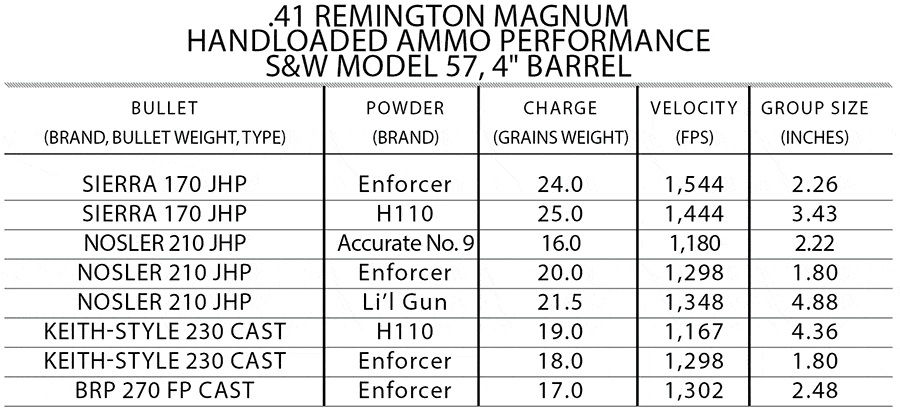
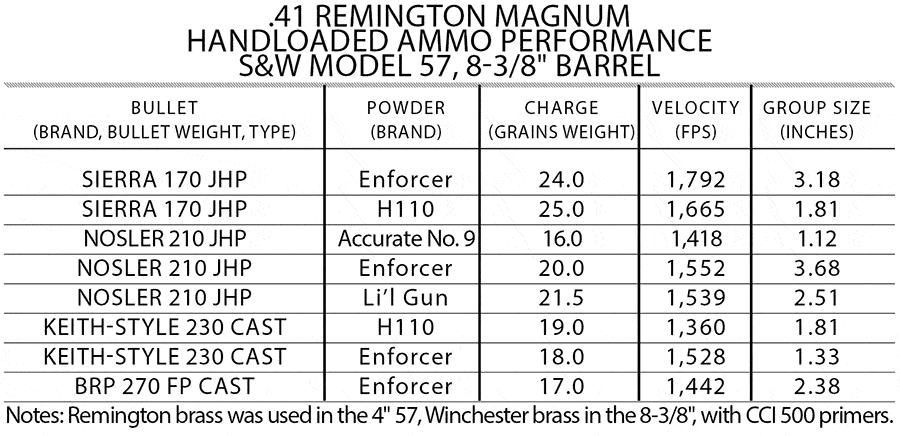
After a search through current data, nine loads were selected for testing. The original plan was to stick with newer powders, but H110/W296 turned up so often in the search it had to be retried. (They’re the same powder in different canisters.)
The first 25-yard group with Kirk’s nickel-plated .41, 16.0 grains of Accurate No. 9 and the 210-grain Nosler jacketed hollowpoint, was very reminiscent of my 657. Five shots went into barely over an inch! Not all the bullet/powder combinations shot as well, of course, but overall both revolvers shot very accurately.
Most .41 Magnums do shoot extremely well. One theory is that since .41s aren’t cranked out like .44 Magnums, the chambers, throats and overall alignment tend to vary less. The .41 also recoils slightly less than the .44 Magnum or a hot-loaded .45 Colt, while still providing sufficient power for most revolver tasks. By the end of the tests I was starting to believe again!
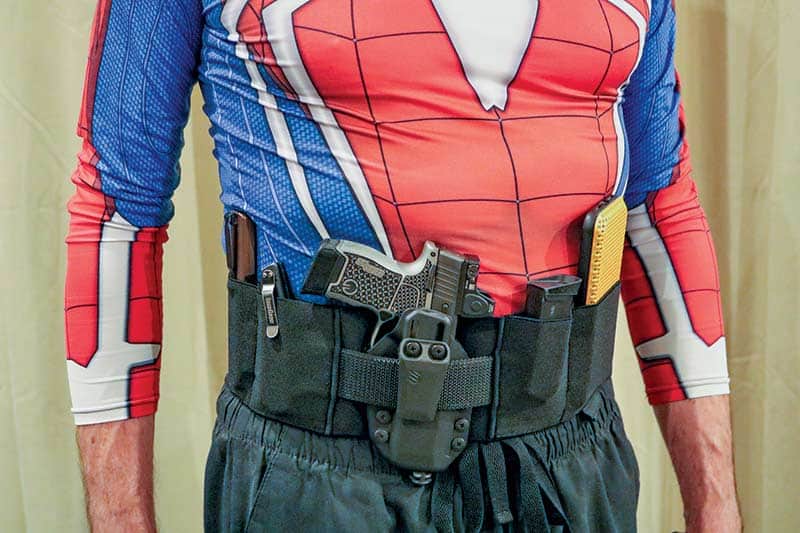
Note how all this rides above the belt. Any shirt will conceal it all.
If you found yourself in the suck, what sort of defensive weapon would you like to have handy? I’m thinking maybe an HK 416 or perhaps an M249 Para SAW with a truckload of ammo. While we’re dreaming, let’s make it a platoon of M1A2 SEP Abrams tanks and Close Air Support stacked up to the International Space Station. However, none of that stuff is terribly practical. It’s tough to conceal an M1 tank underneath a pair of shorts and a T-shirt while out with your best girl on a date.
Reality is that the best defensive firearm is the one you actually have on you. I’d much sooner have a Ruger 22/45 in my hand than that HK416 locked up in a gun box someplace. That’s why figuring out how you’re going to carry your gun is at least as important as the details of the gun itself.
I work in a busy medical clinic, so my daily uniform is basically pajamas. While that’s not THE reason I do what I do, that is indeed A reason I do what I do. Surgical scrubs are the next best thing to being naked, but they’re not necessarily the most efficient foundation for concealed carry.
I’ve tried quite literally everything. Pocket carry, ankle holsters, appendix carry and IWB rigs on a good stiff belt — all have their strengths and weaknesses. The rub is if something is uncomfortable or inefficient, you just won’t use it. The road to Hades is paved with fancy holsters that looked good on the website but rode like a wad of barbed wire stuffed down your Speedos. The Blackhawk Stache N.A.C.H.O. is legitimately different.
The Stache N.A.C.H.O. is like the Bat Belt. Everything you might reasonably
need while out and about rides comfortably in its generous pockets.
Tactical Details
N.A.C.H.O. stands for Non-Conventional Adaptive Carry Holster Option. That acronym seems a wee bit contrived, but the rig it describes is indisputably elegant. The Stache N.A.C.H.O. is a belly band. It comes in five different sizes to suit most any particular body habitus.
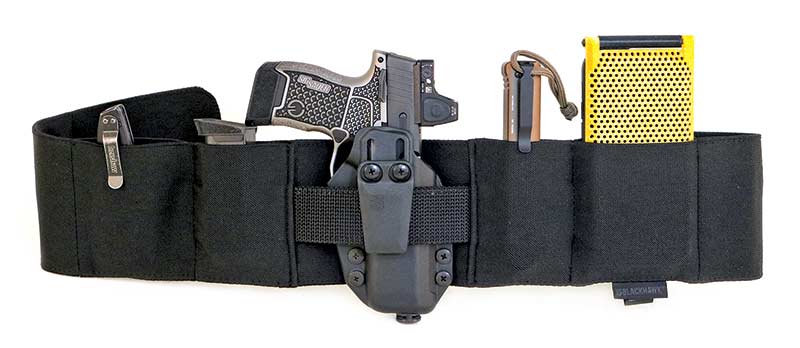
The N.A.C.H.O. is formed from wide, heavy-duty, double-ply 4″ elastic. A generous 3D mesh backer cushions the load and helps the rig breathe in hot climes. The edges are intentionally rounded to prevent chafing. Two integral 3″ pockets accommodate spare magazines or a flashlight. Another pair of 3.5″ pockets will carry your wallet and cell phone. No kidding, it’s like the Bat Belt. Just slap this rascal on, and you’re carrying all the sundry gear you might need to stay connected, supported, and safe while you’re out where the Wild Things roam.
The Stache N.A.C.H.O. includes a length of rigid 1.5″ double-layer scuba webbing to accept your favorite IWB holster. The system is really designed for weapons like the GLOCK 19 or smaller. The adaptive bit means the rig can be configured for appendix, hip, behind-the-hip, or mid-torso carry. I used mine with my SIG SAUER P365XL micro-carry gun.
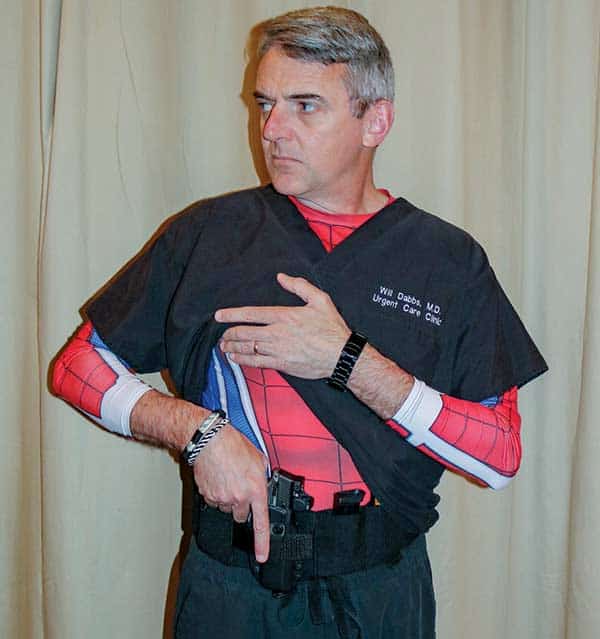
The draw is a bit higher with the Stache N.A.C.H.O. than might be the
case with a conventional belt, but it is easy to master.
Practical Tactical
In case you hadn’t noticed, people these days don’t dress quite like they did back when we were kids. The Stache N.A.C.H.O. is perfect for those times you’re not wearing jeans, 5.11s, or anything that doesn’t lend itself to a proper belt. Sweat pants, yoga pants, shorts and a T-shirt, skirts, dresses, kilts, or most any other sort of truly comfortable attire nicely complement the Stache N.A.C.H.O. This thing is just perfect underneath a pair of untucked surgical scrubs.
For starters, the Stache N.A.C.H.O. really is comfortable. The wide 4″ elastic spreads the weight of your gear out so it doesn’t eat into your anatomy. Pressure always equals force divided by surface area. That’s not just a good idea; that’s the law.
Your weapon is as positively retained as the holster you choose. You can customize your rig to your particular proclivities and circumstances. The Blackhawk Stache IWB base holster is a seamless fit. Even tricked out with my P365XL, smartphone, flashlight, knife and spare magazine, the whole rig still feels more comfortable than my old belt packing just the gun.
My draw was just as fast as with my previous conventional rig. I tried the orientation behind-the-hip, which is my custom, and in the front, both over my appendix as well as covering my belly button. If you can imagine it, the Stache N.A.C.H.O. will put your gun there. I found it fit best riding a bit higher than a typical belt. This changes the draw somewhat, but that’s the reason we train.
So, if you feel less is better when it comes to clothing and the only thing standing between you and that killer loincloth are those antiquated indecent exposure laws, then this is your minimalist concealed carry solution.
As one may recall, the CCIA was enacted this past summer by Gov. Kathy Hochul and her fellow gun controllers in the state legislature after the Supreme Court struck down New York’s “may-issue” licensing scheme as part of the landmark Bruen decision.
In that case, the high court affirmed that one’s right to keep and bear arms extends beyond one’s home into the public square.
Moreover, it found “may-issue” licensing schemes to be unconstitutional. That is to say, government officials cannot arbitrarily deny concealed-carry permits to law-abiding citizens on the grounds that they don’t have a sufficient “proper cause” to exercise this fundamental right.
Irate with the SCOTUS ruling, Gov. Hochul responded by pushing out the draconian CCIA that required applicants for concealed carry permits to do all of the following:
Display “good moral character”
Disclose their social media accounts for review
Have in-person interviews with law enforcement
Provide four “character references”
Undergo 18 hours of combined training, a tremendous increase from the existing 4-hour requirement
The CCIA also banned firearms in a wide-ranging list of “sensitive locations,” which sought to, in effect, make the entire state a gun-free zone.
Gun-rights groups immediately filed suit against the CCIA on the grounds that it violated the Bruen decision. A federal judge — Judge Glenn Suddaby — agreed, saying the CCIA imposed “unprecedented constitutional violations.”
And in November, Judge Suddaby enjoined the following provisions via a temporary restraining order (TRO):
Requiring good moral character
Requiring the names and contact info of spouses and other adults in the applicant’s home
Requiring applicants to disclose social media accounts for review
The restrictions on carrying in public parks, zoos, places of worship, locations where alcohol is served, theaters, banquet halls, conferences, airports and buses, lawful protests or assemblies, and the prohibition on carrying on private property without express consent from the owner
Gun Controllers fought back and appealed the case to the U.S. 2nd Circuit Court of Appeals. The 2nd Circuit decided in December that while it was deciding the matter it would put a stay on Judge Suddaby’s preliminary injunction (TRO).
Put quite simply, the CCIA would go back into effect. In short, it’s on again.
The Gun-rights groups that sued then asked the Supreme Court to intervene and block the 2nd Circuit’s stay on the original injunction granted by Judge Suddaby.
The high court this week declined to do so. But two justices on the bench — Justice Alito and Justice Thomas — made it very clear that this fight was far from over.
“I understand the Court’s denial today to reflect respect for the Second Circuit’s procedures in managing its own docket, rather than expressing any view on the merits of the case,” they wrote.
“Applicants should not be deterred by today’s order from again seeking relief if the Second Circuit does not, within a reasonable time, provide an explanation for its stay order or expedite consideration of the appeal,” they added.
The clock is ticking now for the 2nd Circuit. If it fails to come to a reasonable decision soon, the high court may step in, as Erich Pratt, the Senior Vice President for Gun Owners of America indicated in a press release obtained by GunsAmerica.
“While we would have hoped for immediate relief from the Court, this statement from Justice Alito is incredibly reassuring, in that the court is completely prepared to step in and re-assert the Bruen precedent should lower courts fail to properly, and in a timely manner, apply it in judicial cases where Second Amendment rights are being restricted,” said Pratt.
“We look forward to continuing the fight against New York’s draconian law,” he added.
As both a prequel to Paramount’s hit‘Yellowstone’ series and a sequel to the franchise origin story, 1883, the anticipation for 1923 has been high to say the least. 1923 explores the next two generations of the Dutton family tree and the perils they face in the early 20th century, including war, lawlessness, economic depression, and the encroachment of the modern world on their traditional way of life.
Harrison Ford and Helen Mirren portray Jacob and Cara Dutton, the power couple of the 1923 series who defend their land with guns blazing.
With land disputes and cattle theft an ever-looming threat, being well-armed was essential to the ranchers who tamed the remote valleys of western Montana. The historic accuracy of the series varies, but most of the guns of 1923 are real firearm models that are highly collectible today. Click on the photos throughout this article to find similar gun examples from past and upcoming auctions at RIAC.
If you haven’t watched the series yet and are hoping to remain spoiler free, read no further. You’ve been warned!
The Yellowstone television universe showcases a variety of interesting guns, like the Old West firearms depicted in 1883.
The Dutton Family Tree: James Dutton to John Dutton
The question of who is John Dutton’s grandfather has been on the mind of Yellowstone fans since the 1883 prequel series was first announced. The Yellowstone family tree starts with James Dutton (Tim McGraw) and Margaret Dutton (Faith Hill) as they travel west with their children, John I and Elsa. The Duttons build what becomes the Yellowstone Ranch near their daughter Elsa’s grave, and Margaret gives birth to Spencer several years later.
James Dutton teaches his son John I how to fire the Winchester 1885 High Wall rifle, one of the signature guns of the 1883 Yellowstone series.
Ten years later, James Dutton is gunned down by horse thieves. Margaret writes to James’ brother, Jacob Dutton, begging for his assistance running the ranch. Tragically, Margaret passes away during a harsh winter before Jacob and his wife, Cara, arrive in Montana. Jacob and Cara take the two boys under their wing and raise them as their own. The 1923 series takes place almost three decades later, with Jacob serving as the Dutton family patriarch and John I as the heir apparent.
40 years after the 1883 series, John Dutton I defends the ranch alongside his uncle, Jacob, both wielding Winchester 94 carbines. John I is presumed to be the great-grandfather of Kevin Costner’s iconic Yellowstone Patriarch and one of the key figures in the 1883 and Yellowstone timeline.
As shown in Yellowstone Season 5, Episode 6, James and Margaret are buried on the ranch on either side of their daughter Elsa. John Dutton III has pointed out numerous times throughout the Yellowstone series that the Dutton homestead is a seventh-generation ranch, with five generations Montana born. This places Jack Dutton, John Dutton I’s son, as the most likely link between past and present in the current Dutton family tree, with a 140-year line spanning from James Dutton in 1883 to Tate Dutton as the sole seventh-generation Dutton in the current Yellowstone series.
The Dutton Family Tree, from 1883 to the present day.
“My father had three children,” Elsa Dutton’s ghostly voice narrates as the 1923 series opens. “Only one would live to see their own children grown. Only one would carry the fate of this family through the depression and every other hell the 20th century hurled at them.”
The Winchester 1894: A Yellowstone Legacy Gun
While James Dutton favored the Winchester 1873 lever action rifle in 1883, his brother, son, and grandson are seen toting the Winchester 94 carbine. Invented by the prolific John Browning, the Winchester 94 was affordable, reliable, and frequently chambered in .30-30, a smokeless cartridge that quickly became one of the most wide-serving and prevalent types of ammunition available.
Out of all the guns of 1923 that have seen on-screen action thus far, the Winchester 94 carbine may be the most prominent.
The Winchester 94 carbines carried by Jacob, John I, and Jack Dutton all appear to be the same model, possibly 1940s “flat band” carbines that share similar butt plates and front sights. Though this style of Model 94 is anachronistic to the 1923 time period, the Winchester 94 was certainly one of the most popular guns of the era.
The three Winchester carbines depicted in 1923 all appear to match the gun John Dutton owns in the present-day Yellowstone show, so the intention of the showrunners may be to illustrate that one of these guns was passed down through the Dutton family, a common practice with prized hunting arms like the Winchester 94.
John Dutton III in the present day holding a Winchester 94 carbine, perhaps a heritage gun passed down from one of his ancestors from the 1923 series.
John Dutton’s Yellowstone gun is also a real-life legacy firearm owned by Kevin Costner’s father. “My dad was a fistfighting, single-minded tough guy coming out of the Dust Bowl in the Great Depression,” Costner explained. “He wanted a job and never let it be taken away from him. The [Winchester] .30-30 gun I use in the show was his. When I put it up to my cheek, my dad’s right there. I know what it’s like to be a person that’s kind of a John Dutton—minus the murder.”
Cara Dutton’s Shotgun
The Dutton family tree has no shortage of strong women, and Cara Dutton is no exception. As the matriarch of the series, it’s only appropriate that Cara’s shotgun is the first gun featured on screen in 1923. Cara’s hammerless side-by-side shares a resemblance to an Ithaca Flues Field Grade shotgun, which were manufactured between 1908 and 1926. The model is named for Emil Flues, who designed and patterned the gun. Cara’s shotgun appears to have Damascus barrels, as evident by their twisted steel pattern.
“Violence has always haunted this family,” Elsa narrates after Cara Dutton confronts an intruder with her shotgun.
A solid scattergun has served as a favored firearm for two other leading ladies of the Yellowstone franchise. Margaret Dutton handled a 12 gauge with skill in 1883, and her great-great-granddaughter, Beth Dutton, kept a Parker Brothers 1878 12 gauge close by after improbably surviving an explosive attack.
The trusty 12 gauge side-by-side, a classic choice for self-defense.
Who is Spencer Dutton?
Spencer Dutton’s lineage on the Dutton family tree seems like a potential dead end after Elsa’s ominous prediction, but things may not be that clear cut. Fans of ‘Legends of the Fall’ will find parallels between Tristan Ludlow and Spencer Dutton, both prodigal sons from Montana ranching families. Like many young men of his era, Spencer became caught up in WW1.
An M1911 pistol, Spencer Dutton’s service weapon during WW1, retained as his personal sidearm. The 1911 pistol would have been a popular gun in 1923, with an assortment of military surplus available to police and civilians.
After the war, Spencer Dutton traveled to Africa and became a hunter employed by the British Protectorate of Kenya. In both instances, Spencer’s poise and aptitude with firearms have kept him alive. Spencer also seems to share his late sister Elsa’s wanderlust. Though he was born several years after Elsa’s passing, Spencer honors her memory by carrying his sister’s knife and sheath.
Another Dutton family legacy arm, Elsa’s knife was a gift from Sam, her Comanche husband, and is now carried by her brother Spencer 40 years later.
Guns of WW1
The Great War and its aftermath represented a dramatic change in both the world economy and the firearms industry. It also exposed a generation of young men to the horrors of modern warfare, as depicted in 1923. A variety of guns are seen on screen, from shotguns and bolt action rifles to the latest in belt-fed machine gun technology like the Browning 1917A1.
Sergeant Spencer Dutton fires the Winchester Model 1897. The infamous “Trench Sweeper” shotgun was feared by the Germans, who issued a diplomatic protest to America claiming that the weapon caused “unnecessary suffering.”
Just as James Dutton was traumatized by the Battle of Antietam during the Civil War, his son Spencer is haunted by his experiences in WW1. Given the forested terrain, the ferocity of fighting, and the late-war Browning machine gun depicted in Spencer’s nightmares, this battle may have occurred during the Meuse-Argonne offensive, the final major campaign of WW1, and the deadliest action in American military history.
Charging Germans armed with Gewehr 98 rifles clash with Americans carrying the M1903.
Spencer Dutton’s Rifle
While Jack Dutton’s story is shot against the sweeping mountain landscapes of western Montana, Spencer’s adventures are filmed on location in South Africa and Tanzania. Spencer Dutton’s travels take him from the Nairobi municipality to the Tanganyika territory, tracking down man-eating leopards and lions. His firearm of choice has become one of the most talked about guns of 1923, with its exact make, model, and chambering debated by fans.
Though the production gun is almost certainly neither period-correct nor of British make, Spencer’s rifle is probably intended to represent a British dangerous game gun of the era, such as a Holland & Holland Royal. Some clues can be found in the comparisons the show draws between Spencer Dutton and Col. John Henry Patterson. One of the British tourists asks Spencer if he was the one who killed the man-eaters of Tsavo, and he points out how he was only a child during the incident.
A Holland & Holland Royal in .500/465 Nitro Express, a classic big game double rifle from the golden era of British gunmaking that an African hunter in 1923 might have used.
The two lions of Tsavo were hunted and slain in 1898 by John Patterson, who later recounted the events in a book. Paramount’s Ghost in the Darkness film retold the famous tale using firearms similar to the guns Col. Patterson carried during his hunt, including a double rifle chambered in .450 Express. In 1923, the .450 Black Powder Express would have been long overtaken by John Rigby’s .450 Nitro Express and its competitors, such as Holland & Holland’s .500/450.
In Tanganyika, Spencer meets Charles Hardin, one of the British railroad camp overseers. Charles carries an Enfield rifle in .303 British, similar to the Lee-Speed rifle Colonel Patterson used to slay the man-eaters of Tsavo.
With Spencer’s tale in particular, 1923 embraces archetypical early 20th-century romantic adventure storytelling. As Jim Cornelius, writer and podcast host of ‘Frontier Partisans’ notes, “Part of our enjoyment is purely the visual feast from a period we have always found compelling. In terms of style, this era is right in the wheelhouse.”
“Taylor Sheridan is shamelessly — gleefully — hitting every Hemingway note on the scale with this character.” – Jim Cornelius at ‘Frontier Partisans’
Revolvers of 1923
In 1923, Harrison Ford has traded in his DL-44 blaster for a Smith & Wesson Military & Police revolver. Introduced as the “Smith & Wesson .38 Hand Ejector Model of 1899,” the double action Smith & Wesson Model 10 M&P has been offered in numerous variations and has been purchased by countless military and police departments across the globe.
With a production run of over 6 million and counting, the Smith & Wesson Military & Police revolver is one of the most popular handguns ever produced. The RIAC example pictured on the right appears similar to Jacob Dutton’s revolver.
The Colt Single Action Army is one of the most ubiquitous guns of 1923, carried by John Dutton I and his son Jack, as well as many other ranch hands throughout the series. By the 1920s, production numbers for Hollywood’s favorite cowboy gun had slowed down from its peak popularity. But with nearly 350,000 of the famous SAAs already in circulation, they would have been a widely available and proven sidearm.
In a tense confrontation, Jack struggles to reach for his SAA. Jack’s relationship to Yellowstone’s John Dutton III is currently the most debated portion of the Dutton family tree.
In 1923’s opening scene, Cara Dutton trains her shotgun on a rival rancher, an Irish immigrant scrambling to reload his Webley & Scott top break revolver. These well-known wheelguns, familiar to fans of the Peaky Blinders series, were the primary sidearms of British military officers of the period and also a popular choice with police and civilians throughout the UK from the late 19th century through the early 20th century.
The Webley & Scott Mark VI, a common top break DA revolver throughout the UK in 1923.
Sheriff William McDowell’s gun may be a Colt Officer’s Model Match Fifth or Sixth Issue. Both revolvers would have been too late for the era, though the gun’s predecessor, Colt’s first medium frame double action target revolver, was available starting in 1904. Though McDowell’s gun appears to possess an interesting mix of traits, its 6 inch barrel and front sights are consistent with a later issue Officer’s Model.
While the Colt Officer’s Model Match Fifth and Sixth Issue were produced too late to appear in 1923, Sheriff McDowell’s gun may be intended to represent the period-appropriate Colt Officer’s Model First or Second Issue.
Heavy Firepower of 1923
One of the themes of 1923 is technology clashing with tradition, and nothing embodies that conflict more dramatically than the introduction of automatic weapons. The overwhelming firepower offered by machine guns like the Maxim, Vickers, the Lewis gun, and the Browning Model 1917 contributed to the trench warfare stalemates and high death tolls of WW1
Spencer Dutton mans a Model 1917A1 belt-fed machine gun. The extended flanges for the bottom plate coming up over the sides of the receiver were the chief upgrade between the Model 1917 and the Model 1917A1.
While the heavy machine gun ruled the trenches of Europe, submachine guns like the Thompson found a market with civilians and law enforcement after the war. In the time period of the 1923TV series, the Thompson 1921 AC would have been the likely candidate available. The ‘A’ stood for automatic, while the ‘C’ meant that the gun had been fitted with the Cutts Compensator, an attachment intended to reduce muzzle rise and recoil.
Banner Creighton, played by Jerome Flynn (AKA Ser Bronn of the Blackwater), unleashes one of the most formidable guns of 1923, the Thompson SMG.
During the period following WW1, Auto-Ordnance found themselves with a submachine gun designed for war, but no war to ship it to. They instead turned their marketing efforts to anyone in need of security, including advertising the firearm to ranch owners as the “Thompson Anti-Bandit Gun.”
The “Thompson Anti-Bandit Gun.” In the 1923 series, Banner Creighton, leader of a desperate group of sheepherders competing for healthy grass, employs the gun for less than noble purposes.
The Guns of 1923 and Beyond
As Cara Dutton writes to Spencer at the end of Episode 3, “War has descended upon this place and your family. Whatever war you fight within yourself must wait. You must come home and fight this one.” Foreboding words for the enemies of the Dutton family, as well as a promise of more action and firearms onscreen in the weeks to come, and we’ll update this page accordingly.
Donald Whitfield (Timothy Dalton) brandishes what may be a short-barreled Colt Lightning or Thunderer (or an Uberti/Cimarron reproduction).
Sold by RIAC in 2020, this historic collection of firearms was owned by Granville Stuart, a ranching icon and an inspiration for the Dutton family. He walked a tightrope between what was right and what was legal in order to protect his land in late 19th and early 20th century Montana.
An L.A. Huffman print of the Montana ranch of Glenarrow in January 1926. Through his extensive photography, Huffman documented the peoples, wildlife, landscapes, and industry of Montana during the periods depicted in the two Yellowstone prequels.