Categories
All About Guns Art

The Top 5 Best Machine Gun Scenes of the 1980s by Dr. Will Dabbs, MD

The Top 5 Best Machine Gun Scenes of the 80s

America has an oddly bipolar relationship with automatic weapons. On one hand, we feel that these guns are so extra special deadly that normal folks will often never even touch one.

On the other, they are so cool that we flock to the local cineplex to see them exercised in their natural habitat. That’s honestly pretty weird if you think about it. Regardless, little gets my blood pumping faster than seeing my favorite action star unlimber something cool, select-fire and noisy on the big screen. While there are countless laudable examples, here are my five favorites.

The Hunter

best-auto-movie-scenes-hunter

(Image from MovieStillsDB.com)

Steve McQueen’s The Hunter is an underappreciated gem. This 1980 biographical depiction of real-world bounty hunter Ralph “Papa” Thorsen is funny, poignant, exciting, and cool.

It was also McQueen’s last film before he succumbed to pleural mesothelioma at age 50. The narrative orbits around an incongruously soft-hearted bounty hunter. The sequence wherein Papa Thorsen flees a pair of enraged rednecks throwing dynamite from a combine harvester while behind the wheel of a black 1970’s-vintage Trans Am tearing through a cornfield is just hilarious.

The story follows Thorsen’s exploits as he tracks down sundry bail jumpers. However, there is a dark thread throughout wherein a lunatic psychopath named Rocco Mason hunts Papa and his girlfriend over some unexplained slight.

Eventually Rocco stalks them both in a dark high school armed with an M-16A1 rifle equipped with an AN/PVS-2 night vision sight. Papa eventually rescues his girlfriend Dotty and flees the chemistry lab, turning on the gas taps as he leaves.

Rocco unlimbers his M-16 from the hip on rock and roll, ignites the gas, and subsequently blows himself to smithereens. The classic star-shaped muzzle flash from the M-16 in dim light was adequate to illuminate the dark room. I’ve run that sequence back and forth a dozen times. This scene was shot with good old-fashioned blanks in the days before digital effects. Also, the real Papa Thorsen has a cameo as a bartender.

High Risk

best-auto-movie-scenes-high-rise

There aren’t but about ten people in the world who have seen the low-budget 1981 comedy heist film High Risk. That’s the real crime. High Risk rocks. It’s available for free on YouTube. Four buddies, none of whom have any serious military experience, are trapped in low-paying loser jobs.

On a whim they pool their meager resources and travel to Colombia with the intention of robbing a drug lord and getting filthy rich. They score weapons from a shifty gun runner and arrange for a couple of hippies with a beat-up old DC-3 to exfil them from a jungle airstrip once the mission is complete.

The flight service is cryptically called Adios Airlines. Their logo is a giant marijuana leaf painted on the side of the airplane. The nail-biting climax has our heroes trying to hold the drug lord’s henchmen at bay with some simply epic full auto MAC-10 action.

At one point James Brolin runs his MAC sideways while stabilizing the gun by gripping the extended buttstock with his left hand. I’ve actually tried that myself. It doesn’t work well.

When all seems hopeless the derelict DC-3 arrives just in the nick of time. The pilot then pops in a cassette tape of the Rolling Stones belting out Satisfaction as his crew chief unlimbers a belt-fed M-60 from the cargo door. Just describing that scene made me go back and watch the movie again. Trust me, it’ll change your life.

Scarface

best-auto-movie-scenes-scarface

(Image from MovieStillsDB.com)

The 1983 crime classic Scarface had some fascinating origins. Loosely derived from a 1929-vintage novel of the same name, Scarface took the Depression-era tale of Al Capone and transported it into the 1980’s Miami drug wars.

The end result helped define an era. The story was written by Oliver Stone. The movie was directed by Brian De Palma. Al Pacino’s depiction of Cuban refugee-turned-drug lord Tony Montana helped cement his position as one of the most accomplished actors of the modern era.

Like most De Palma films, Scarface was violent, profane, and messy. However, it was the final shootout that really anchored the film. The trajectory of the narrative follows Pacino’s character as he rises from abject poverty to unimaginable opulence.

Along the way, Tony Montana also loses his soul. At the climax, now stoked on his own dope and bereft of both friends and family, Montana has to face down a veritable army of drug cartel sicarios.

Hopelessly outnumbered and lyrically outgunned, he retrieves an M-16A1 rifle equipped with an M-203 grenade launcher. His timeless line, “Say hello to my little friend!” became cinematic legend. Forget that his 40mm HEDP (High Explosive Dual Purpose) rounds seemed to arm as soon as they left the launcher and nobody paid much attention to friendlies that might be behind their targets, the final gorefest was pretty epic.

As Tony’s lifeless body topples off the balcony into the pool below, a garish globe sports the neon slogan, “The World is Yours.” Brian De Palma was never known for his subtlety.

The host rifle was a full auto M-16A1. The M-203 was a fairly cheesy theatrical prop. I’ve actually held that gun, and it wasn’t terribly impressive up close. The double magazines were held together with gaffer’s tape, and the front ladder sight was actually installed backwards. Regardless, in the right hands that rifle helped create one of the most iconic gun scenes in Hollywood history.

Predator

best-auto-movie-scenes-predator

(Image from MovieStillsDB.com)

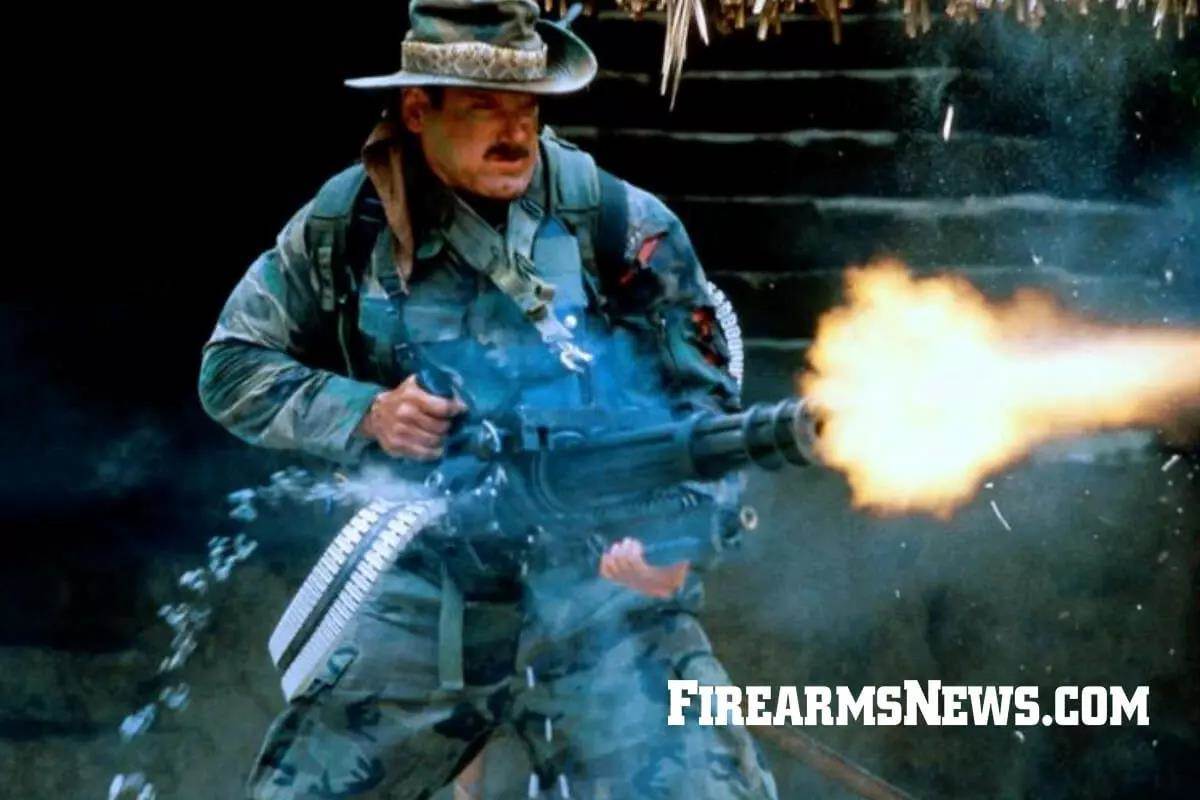
No list of this sort is complete without a nod to the M-134 minigun in the pioneering Arnold Schwarzenegger sci-fi action flick Predator.

While the movie was awesome in its own right, watching Jesse Ventura and Bill Duke run that minigun from the hip set a new standard for Hollywood gun work. I saw the film in the theater back in 1987 when I was a soldier, and it changed my life.

The hulking alien Predator hunting humans has become a theme throughout seven full-length movies, but that was not the original vision for the film makers.

The original Predator was to be played by martial artist Jean-Claude Van Damme. Van Damme even suited up for some of the early scenes shot on location in Mexico.

However, at 5’ 9” tall, his screen presence seemed insufficiently compelling alongside physical specimens like Arnold Schwarzenegger and Carl Weathers. Van Damme was ultimately replaced by 7’2” Kevin Peter Hall who dominated the screen.

Incidentally, Hall also plays the helicopter pilot in the film. The M-134 used in the movie sported a custom mount built from, among other things, the handguard from an M-60 machine gun turned around backwards.

best-auto-movie-scenes-predator2
(Image from MovieStillsDB.com)

The trigger on the weapon was non-functional. The gun was operated off-scene by an armorer with an electrical switch. The power cable was snaked through the actor’s trouser leg.

The weapon was down-regulated to 1,250 rounds per minute so the viewer could see the barrels spin clearly. The ammo pack carried 550 blank rounds which were good for about 25 seconds of continuous fire.

However, to preserve the actors’ mobility, they usually only packed enough ammunition for about four seconds’ worth of mayhem. We have seen the M-134 used in a variety of movies since Predator, but nobody has ever quite captured lightning in a bottle the way director John McTiernan did here.

I am proud to say that I have actually held the original Predator minigun myself. I thought I might never wash my hands again afterwards, but that eventually got kind of gross.

Aliens

best-auto-movie-scenes-aliens

There are lots of cool gun movies out there, but one film easily eclipses them all. When James Cameron was making his studio pitch for his sci-fi magnum opus Aliens, he supposedly just stood up in front of the movie executives with a white board, took up a dry erase marker, and wrote “Alien$.”

What resulted set an unassailable standard. Aliens came along at the end of the era of analog movie effects. That meant that Stan Winston’s aliens were monsters in the real world, and the weapons wielded by the U.S. Colonial Marines were made from the real steel.

Cameron himself designed the small arms used in the film. They were built in England by Simon Atherton and his team at Bapty, the same guys who brought us the guns used in the Indiana Jones movies and Star Wars.

The original M41A pulse rifles were to be built around HK MP5s. You can actually see an MP5 example on the “Peace Through Superior Firepower” t-shirt worn by Marine Ricco Frost if you look closely in the movie.

However, Cameron needed more muzzle flash than could be afforded by the 9mm Parabellum and subsequently opted for a World War II vintage M1A1 Thompson submachine gun as a starting point instead.

The M41A pulse rifle in the movie narrative famously fires 10mm caseless light armor-piercing rounds and includes a 30mm over-and-under pump-action grenade launcher.

The prop furniture came from a Franchi SPAS-12 shotgun, while the grenade launcher was a seriously chopped Remington 870 12-gauge shotgun. I would gladly give my 401k to own a screen-used original. The other paradigm-shattering gun in Aliens was the M-56 smart gun.

This massive gyro-stabilized support weapon was built from a German MG42 belt-fed machine gun mounted on a Steadicam mount originally designed to support a movie camera. When I saw Vasquez yell, “Let’s rock!” and unlimber that puppy in the theater back in 1986, I very nearly wet my pants. Also, if you haven’t yet seen it, surf on over to YouTube and type in “Aliens Sentry Guns Deleted Scenes.” You’ll thank me later.

Aliens (1986): directors cut sentry turrets
byu/RedAndBlackMartyr invideos
Categories
All About Guns COOL!!!!!!!!!!!!!!!!! Good News for a change! Gun Info for Rookies Some Red Hot Gospel there!

In Praise Of The Offhand Plinker ‘Hulkmania’ Should Only Be For Wrestling By Clayton Walker

Most of us have shot a classic .22 plinker but moved on to “bigger” and “better.” However — sometimes — simple pleasures are the best!

Early into my shooting career, some of my absolute favorite moments resulted from cool, calm days where I had all of the time in the world to sling .22 rounds at dime-sized targets — and with little concern about ammo cost or being battered by the forces of recoil!

As I investigated what else the rimfire world had in store for me, I would repeatedly come across articles referencing some of the kings of the category: the Winchester 52 and the Remington 37, for example. Many of these designs were once considered the gold standard of accuracy within 100 yards and my interest was firmly piqued.

Unfortunately, my dreams of owning these legends dissipated once I picked them up. Today, I’m a lot more excited by those rifles that, to me, represent a golden mean between raw accuracy and ease of use. Indulge me and I’ll tell you what I think makes for a perfect “offhand plinker.”

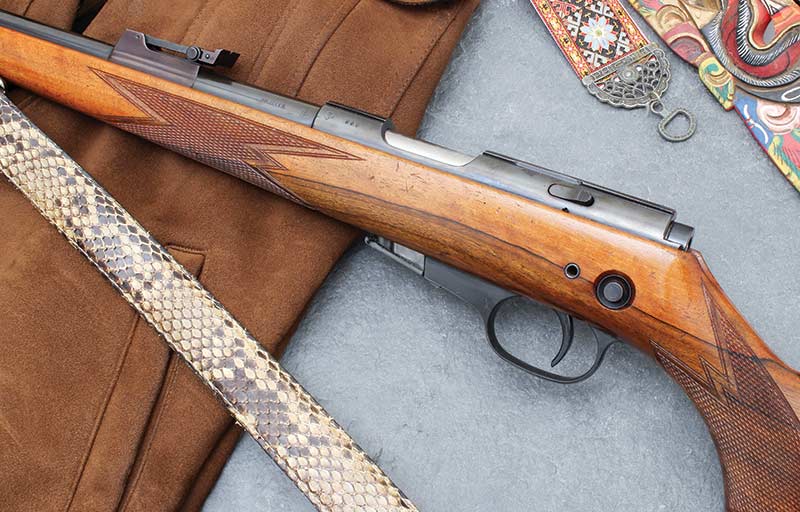
The Walther KKJ is an exceptionally well-made “sporter” rimfire rifle. If you can see it with the naked eye, you’ll hit it with this.

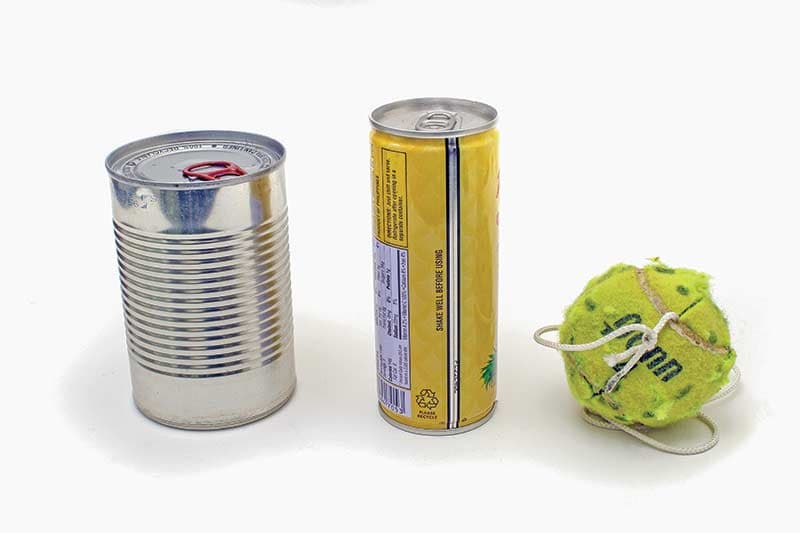
“Seeable” reactive targets don’t much care for minor point-of-impact shifts. A rifle with a pencil barrel can zap them, hot or cold.

Two Ends Of The Spectrum

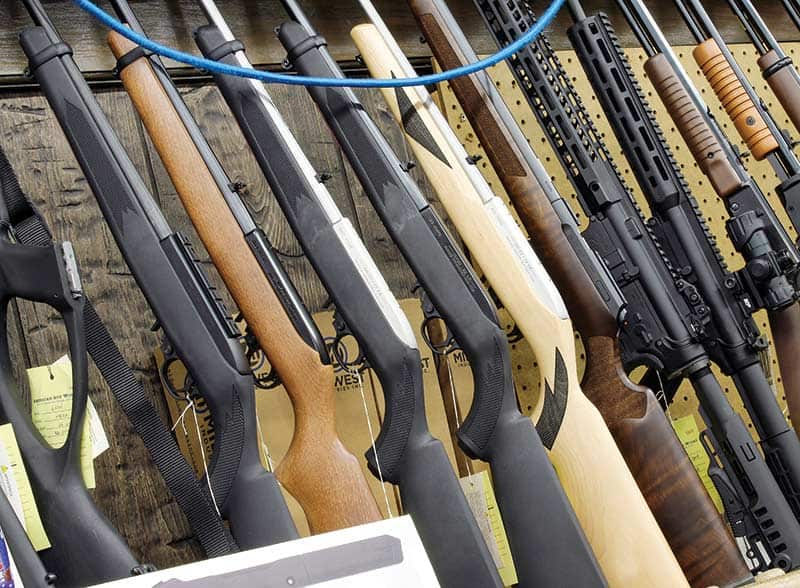
On one hand, we’ve always been awash with lightweight, affordable rifles and many of them have been of extraordinarily high quality. I learned recently that Ruger has produced more than 5 million of its famous 10/22 rifles. I would reason that within a half-hour drive of your current location, you can find a gun store with a 10/22, new or used, currently sitting on the shelf.

It’s no mystery why the rifles are beloved. The 10/22 is easily shouldered and aimed. It is robust and reliable, and tolerant of a wide variety of ammunition. When I was in my late teens, I had fired a gun before. However, the groups I coaxed out of a 10/22 got me to think about shooting differently. “Maybe I have some talent for this,” I told myself.

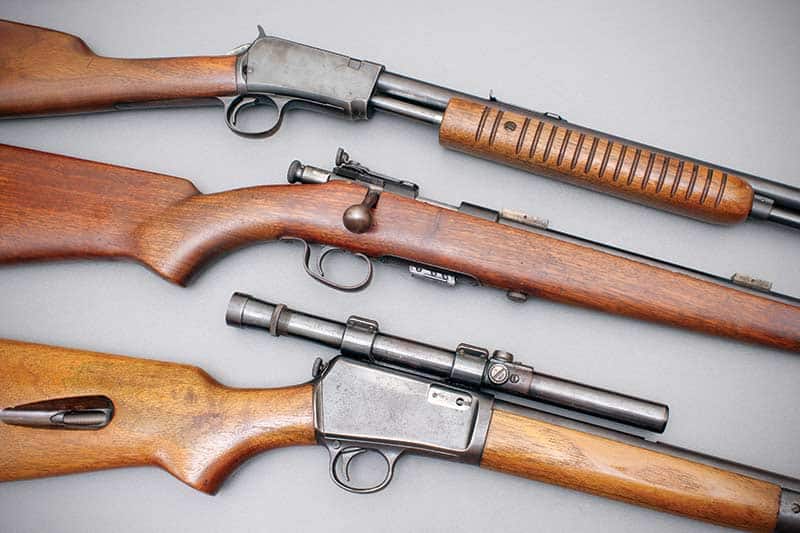
Additionally, America’s used gun market is awash with a number of .22LR rifles intended as either entry-level tools for pest control or “boy’s” or “youth” rifles that would serve as a child’s first introduction to marksmanship without mom or dad having to break the bank. The Winchester 67, Remington 514, and Stevens 15 are all prototypical examples of the type. In general, they are light, easily operated and despite their humble origins and no-frills materials, they tend to shoot surprisingly well!

Still, spend some time with them and their limitations come into focus. Most have very simple folded metal or “buckhorn” sights, thin barrels prone to heating up quickly and stiff triggers. Budget price points often necessitated budget materials so expect beechwood or plastic stocks, along with stamped steel construction of various small parts.

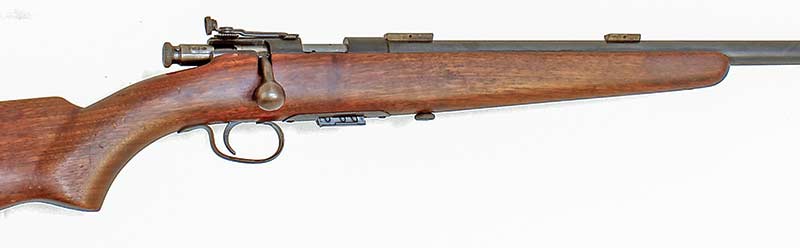
The Winchester 69 has Clayton’s vote for offering
buyers the most usable accuracy for the least spend.

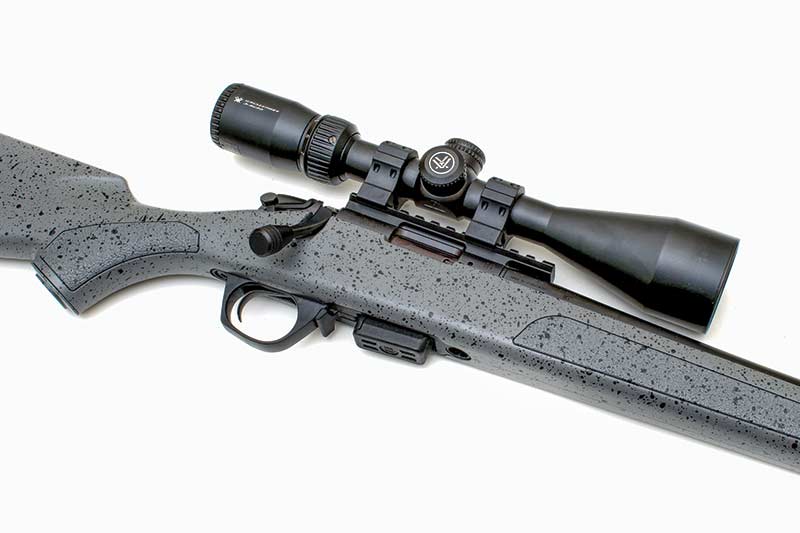
The Bergara BMR — Its light weight makes for a rifle that can still be comfortably shot offhand even with a mounted scope.

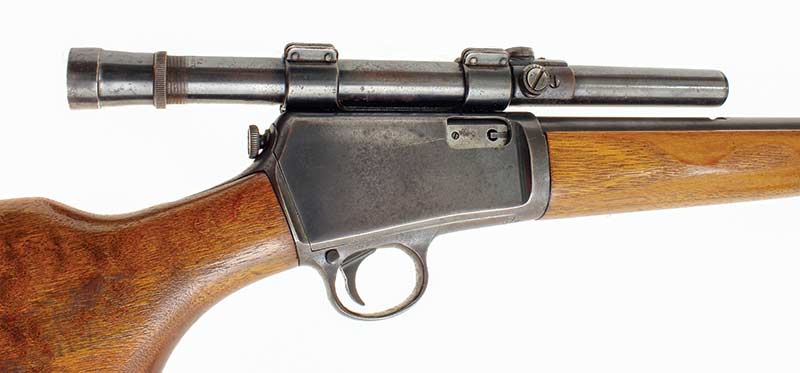
Winchester 63 with a period-correct Weaver low-magnification scope. Light and simple is often best!

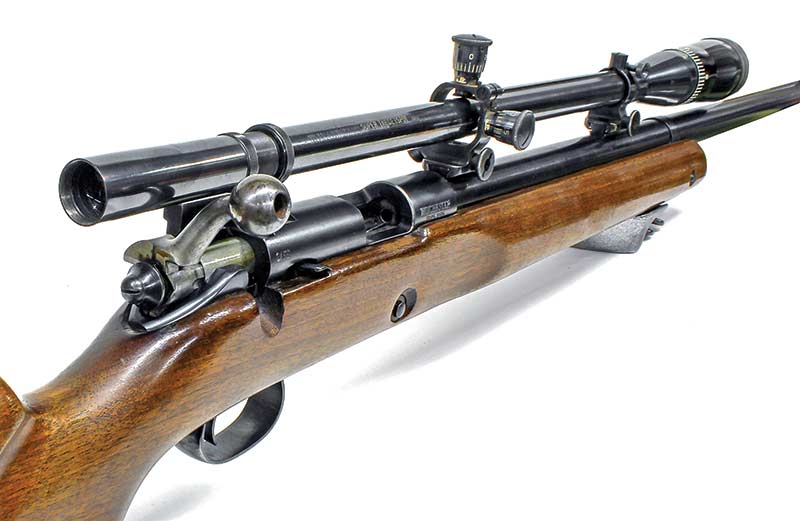
Winchester’s vaunted Model 52 is of the perennial kings of rimfire accuracy and craftsmanship, it’s also a boat anchor!

The Other End

As one moves from “budget” to “premium” in the rimfire rifle category, the upgrades are obvious. At the upper tier of the quality spectrum, buyers can expect to find longer, thicker barrels that aid accuracy. A 26″ tent-pole of a barrel not only offers more runway for the powder of a rimfire cartridge to fully and completely burn, but it gives open sight users more distance to ensure perfect alignment between the front and rear units.

The barrel thickness also ensures it heats and cools in a more uniform manner, which reduces any temperature-based point of impact shifts.

Along with those long, gorgeous barrels and hand-fit actions, you’ll also usually find very generous and beautiful walnut furniture, often with metal fixtures for the buttstock, sling attachments and other accoutrements. One look at these guns and you’ll immediately be transported back to an era where no cost was spared to provide the rimfire shooter with the best accuracy the day’s engineering and experience could allow.

The trade-offs, however, are size and weight. Most of the .22s you’ll find in rimfire competitions tend to be big. Extra mass provides more stability and precision, but makes it a rifle much harder to heft and shoot offhand. It’s not to say one can’t do so but those interested in the attempt normally have specialized shooting jackets dedicated to such a purpose.

The same goes for adding one of the most common and historic tools for improving one’s group: the scope. As my military buddies like to say, “Ounces make pounds.” Where rimfire rifles are concerned, I’ve found a 24-oz. scope moves offhand shooting on a big, wood-stocked rifle from the realm of “challenging” to “impromptu strength training.” Show me a guy who can heft a scoped Winchester 52D and shoot a great group offhand, and I’ll show you a guy who looks like Hulk Hogan.

Above, the Ruger 10/22 is well-represented in America’s gun stores, and for good reason.

The Middle Path

For the rest of us, many of the design specs and equipment choices maximizing mechanical precision come at the expense of practical accuracy. In simpler terms: Bring the scope to eye level, and your arms will almost instantly begin to feel like wet noodles and the reticle will wobble all over the place. To quote the old infomercials: There has to be a better way!

Indeed, there is no shortage of rimfire rifles which got an extra degree of TLC from the maker over the budget model yet weren’t fully optimized for bench work. The Winchester 69 remains perhaps my favorite rifle of all time. Yes, the trigger guard is stamped steel and the trigger pull isn’t astoundingly light, but the gun is like a laser in my hands. Within 75 yards, if I can see it, I can hit it. Of course, beyond that I probably can’t see it!

I also have a tremendous affinity for a number of quality pump-action rifles. Often, models like the Remington 12, Winchester 62 and Browning Trombone exhibit very high quality workmanship, are fast into action, and shucking rounds in and out of these platforms is a joy.

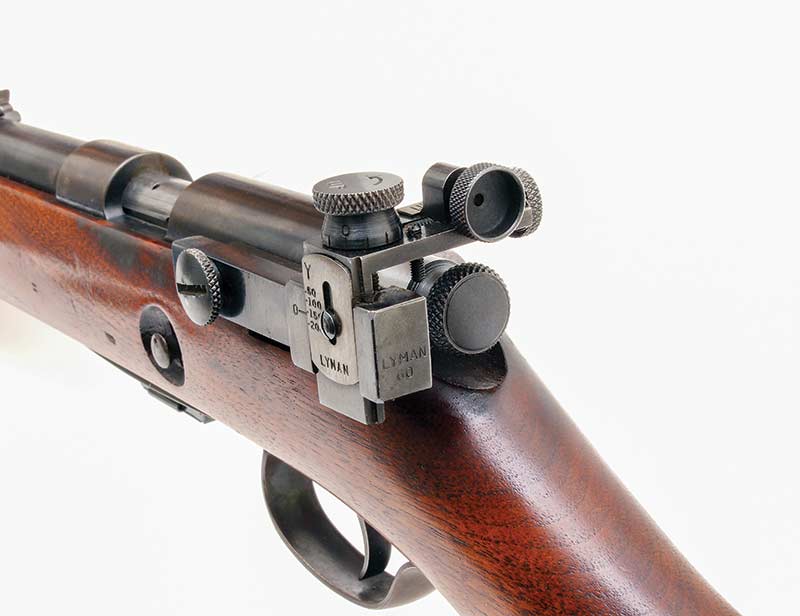
Still, I’m not picky. Just about any mag or tube-fed rifle with a thinner barrel, decent wood and a good set of aperture sights has my eye. To this latter point, I find “peep” sights allow for tremendous practical accuracy without the weight of a scope and mounts, yet they also eschew the alignment imprecision that often goes hand-in-hand with buckhorns or folded steel sights.

One key to finding a great offhand plinker is to look for the phrase “sporter.” Through the generations, the term has defined guns designed to be used afield — i.e., picked up and shot. Winchester made its storied 52 in a “sporter” configuration (a gun perpetually on my “one day” list), and Browning still makes its excellent T-bolt rifle as a sporter.

The wood-stocked version of Springfield’s new 2020 Waypoint rimfire rifle also comes with an accuracy guarantee and a stated weight of 6 lbs., 3 oz. Truly, a “best of both worlds” deal.

Elsewhere, composite materials help to keep the weight down. I purchased my Bergara BMR not only because of the Spanish gunmaker’s well-established reputation but because it was light enough for me to heft even with a scope included.

With a user-adjustable trigger — currently set at 2.5 lbs. exactly — and capable of eye-popping groups from the bench, I don’t feel like I’m giving up much to the walnut-stocked, bull-barreled monsters of yore.

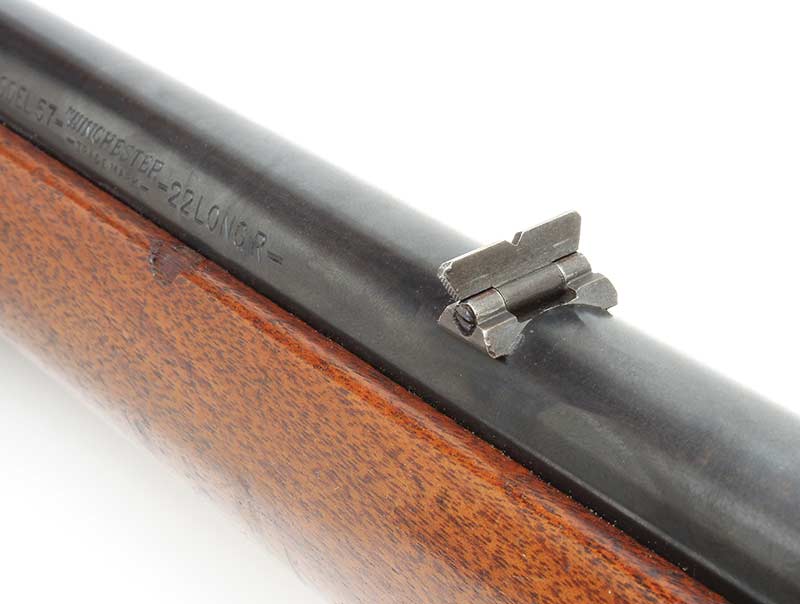
Many sporter-weight rimfire rifles feature simple sights often challenging to aging eyes, but (right) the aperture sight is a godsend on a small-caliber rifle, enabling high precision with hardly any additional weight.

Freedom of Choice

Our own Massad Ayoob recently wrote he didn’t like the finger grooves on the third-generation GLOCKs because he didn’t like a gun telling him how he needed to shoot it. The same goes for me with the weight of many .22 rifles — a gun telling me it needs to live on the bench isn’t usually one that’s fun for me to work with.

Sure, the long guns I’ve gravitated to might very well give up some accuracy at the 50-yard line and beyond. I don’t know how many dudes are winning rimfire matches with clapped out “department store” rifle. Regardless, there have been countless golf balls, shotgun shells, playing cards and wood chips obliterated by my ugly, dinged-up .22 and the slight impact shift between a hot and cold barrel doesn’t normally matter on targets I don’t need magnification to see.

Ironically, the older I get, the more time I seem to spend with designs historically positioned as youth rifles. That is, they’re lithe, simple and inexpensive. To me, the feats of marksmanship putting a smile on my face are those coming as a result of me using my own two eyes and hands to zap something just at the threshold of my vision. Almost always, I’m going to reach for a .22 rifle to scratch the itch.

If it’s been some time since you’ve gotten away from the bench rest, or if you’re the kind of shooter who has regarded any sort of .22 as a novelty, here’s your invitation — buy a svelte, light rimfire rifle. It probably won’t cost you very much and I bet you’ll immediately rediscover just how fun offhand shooting can be.

Categories
All About Guns

YouTube Woes

Categories
All About Guns

A Ithaca Hammerless 12GA Double Number 1 Frame Damascus Custom 12 GA

Categories
All About Guns

Winchester 94 break down for cleaning.

Categories
All About Guns

Wieger 942: East Germany Makes a 5.56mm AK

Categories
All About Guns

Firearms Hall of Fame: Remington Model 721 Bolt Action Rifle | MidwayUSA

Categories
All About Guns Ammo

Hitler’s Super Armor Piercing Ammo vs modern day body armor and steel!

Categories
All About Guns The Green Machine

Hegseth Memo Shifts Military Base Carry Policy Toward Armed Self-Defense by Dean Weingarten

Secretary Pete Hegseth says commanders should presume approval when service members request to carry privately owned firearms for personal protection on U.S. military installations. iStock-2196791813

On April 2, 2026, Secretary of War Pete Hegseth issued a memo directing installation commanders to respect the Second Amendment rights of our service members on United States Military installations.  Hegseth noted the Constitution is there to protect the rights of all Americans, including the rights of service members, which are protected by the Second Amendment.

The current policies in place in the United States military made it virtually impossible for service members to be able to carry arms for their own protection unless they were military police or in some training exercises.

Installation commanders have had the authority to determine who may carry weapons on their installations. Secretary Hegseth directed installation commanders to start with the presumption that a request by a service member to carry a personal weapon for personal protection is valid.


“The memo I am signing today directs installation commanders to allow a request for personal protection to carry a privately owned firearm with the presumption that it is necessary for personal protection.” 

Hegseth continued, “If a request is for some reason denied, the reason for that denial will be in writing and will explain in detail the basis for that direction.”

Military bases have been, in effect, gun free zones, where only a very few people, mostly military police, were allowed to be armed. Secretary Hegseth noted recent mass public shooting attacks on military bases at Fort Stewart, Holloman Air Force Base, and Pensacola Naval Air Station.

Online commentary from declared veterans on X was often positive, with comments such as “best Secretary of War ever” and “this should have been done long ago”. Detractors claim there will be a wave of accidental shootings, murders, and suicides as the policy is implemented.

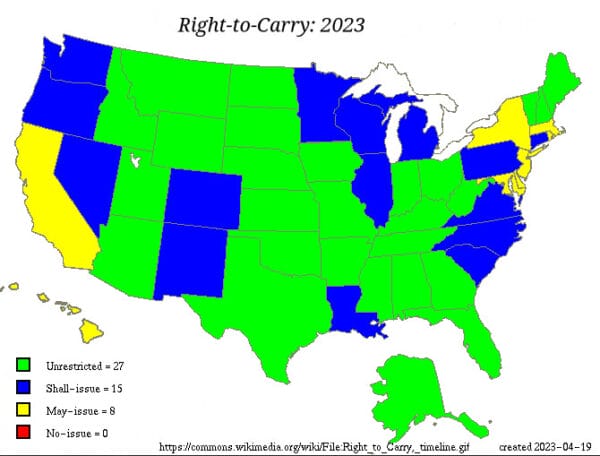
War fighters will be required to follow the laws of the states where they are stationed. 29 states do not currently require a permit to carry handguns, concealed or openly. 21 states require a permit to do so.

At present, only a few states allow concealed carry by persons under the age of 21. The memo applies to service members “…in their nonofficial duty capacity on DOW property within the United States.”  The question of Second Amendment rights for 18, 19, and 20-year-olds is being adjudicated in the courts.

Louisiana, shown as shall issue (blue) on the Gulf of Mexico, had its Constitutional Carry law go into effect on July 4, 2024. South Carolina joined the Constitutional Carry Club on March 7, 2024, bringing the total to 29 states. The “may issue” states are gradually becoming reluctant “shall issue” states, as required by the Supreme Court.

In 2015, Donald Trump promised a similar policy. In 2018, this correspondent explained how the policy was neutered by the military bureaucracy in an article entitled Defiance through Compliance.

The complex mechanisms set up in the military bureaucracy made it virtually impossible for the vast majority of service members to carry arms for the defense of self and others, except in an active war zone. All of the incentives were biased against commanders allowing their service members to be armed.

As Secretary of War Hegseth noted, our military bases in the United States can be targeted in asymmetric warfare. Casualties at a United States military base inside the United States could be higher than the minimal casualties that have occurred in operation Epic Fury abroad.

People who have obtained concealed carry permits have proved to be more law-abiding than police officers in the same jurisdictions. Military personnel who are willing to submit a request to their commanding officer in order to be able to carry personal arms for the defense of themselves and others are likely to exhibit the same level of responsibility.

Most mass public shootings take place where the attacker knows most people are not allowed to carry defensive weapons.

The memo from Secretary of War Hegseth is designed to remove military bases from that category.  The memo directs commanders to assume the need to carry for protection is legitimate. The incentives should become biased toward the protection of the right to bear arms.

Future memos might include retired military members, veterans, or simply those with carry permits among those allowed to carry on military bases. Retired police officers have a mechanism to carry nationwide. An increase in armed defenders increases the odds that one or more will be available to defend against an attack.


About Dean Weingarten:

Dean Weingarten has been a peace officer, a military officer, was on the University of Wisconsin Pistol Team for four years, and was first certified to teach firearms safety in 1973. He taught the Arizona concealed carry course for fifteen years until the goal of Constitutional Carry was attained. He has degrees in meteorology and mining engineering, and retired from the Department of Defense after a 30 year career in Army Research, Development, Testing, and Evaluation.

Dean Weingarten

Categories
All About Guns

The Classic Smith & Wesson Schofield