Category: You have to be kidding, right!?!


A black hole is a celestial body so named because its force of gravity is such that not even light can escape. Science fiction authors have depicted such weird phenomena as portals to strange dimensions or wormholes leading Lord-knows-where. Astronomers recognize such stuff because, when juxtaposed against the inky deadness of space, a black hole is a special kind of dark. Down here on earth, gunshot wounds are a comparably special kind of dark. When studied up close, a gunshot wound can offer a glimpse into a bad man’s soul.
The man walked in to the inner city ER where I toiled with his injured girlfriend in tow. He was distraught, affectionate and hovering. She was shot through the head but conscious.
It never seems to be quite like the movies. In this case, this otherwise-healthy 20-something young woman had been shot in the left temple with a small-caliber handgun. Her left eye protruded grotesquely, but she still walked into the Emergency Department under her own power and remained an engaging conversationalist. I naturally inquired regarding the details.
Her boyfriend carried a gun every day. So do I. Down here in the Deep South, that’s not terribly unusual. She said when he got home from work or whatever it was he did, he removed the weapon and placed it gently on the dresser.
The gun inexplicably went off and accidentally struck her as she stood across the room. He helpfully added that he planned on securing a lawyer once the dust settled to investigate the gun maker’s liability for offering such a defective product. They were both in complete agreement concerning the details.
Gunshot wounds tell stories. Pistols typically punch orderly little holes and often do not produce exit wounds. High velocity rifles can create sufficient overpressure as to precipitate veritably explosive downrange effects.
At close range, a 12-bore charged with most anything will make a thug look like God worked him over with a big honking ice cream scoop. In this case, the area around the entrance wound was neither clean nor tidy. The edges were torn, and the surrounding skin was stippled with flecks of unburned gunpowder.
The story this wound told was unambiguous. The happy couple had gotten sideways over something. Then our hero pushed his gat up against this young lady’s head and squeezed the trigger. Nothing else makes a wound like that.
We separated the two under some pretense, and I explained my observations to the injured woman. I assured her that I could keep her safe, but that she needed to tell me the truth.
She would hear none of it. He loved her and would never intentionally harm her. The cops had a similar conversation with the poor lass as well and got the same answer. Without a witness willing to testify, their hands were tied.
The 95-grain FMJ bullet had transected the woman’s left optic nerve, rendering her irrevocably blind on that side. It then transited her sinuses and ended up lodged behind her right rearmost upper molar. We consulted the maxillofacial surgeon who numbed everything up and popped the slug out without further drama. Easy peazy.
The woman spent but a single night in the hospital. The following day the battered couple left in each other’s arms with a prescription for some antibiotics and a little pain medication. I never saw either of them again. It seems the bonds of love really are as strong as the poets opine.

As much as 4% of the sand on Normandy’s Omaha Beach is broken-down shrapnel. |
World History |
 |
|
|
| On a quieter day 44 years later, geologists Earle McBride and Dane Picard scooped a sample of sand from the high-tide point of Omaha Beach for closer examination. Among their findings, which were published in the September 2011 edition of The Sedimentary Record and the January 5, 2012, edition of Earth magazine, were a significant number of “angular opaque grains that were magnetic.” They eventually realized that these grains, ranging in size from .06 to 1.0 millimeters, were shrapnel shards that had been broken down into tiny pieces. They concluded that the shards made up 4% of the total sample. Additionally, they found 30 slightly larger iron and glass beads, believed to be the result of high-temperature munitions explosions in the sand and air. | |
| The geologists pointed out, however, that the 4% figure doesn’t represent the entirety of Omaha Beach, as wave breaks and currents can disrupt grain distribution on a daily basis. What’s more, because of the corrosion accelerated by rust and waves, there was already a drop in the concentration of beach shrapnel in the years between when the sample was collected and when the results were published. Which means that while beachgoers today still walk among these fleeting remnants of one of history’s most important military engagements, nature will sweep them away for good within the next century or so. |
You’re out on the street or in a parking lot, minding your own business, maybe heading to dinner with a family member, picking something up from the store or meeting someone for a first date, when suddenly an armed group of thugs walk up to rob or attack you. You’re scared. This is not what you planned and it’s a situation, even the most badass among us don’t want to find themselves in. But there’s nowhere to run. You have no choice but to defend yourself. You are legally carrying your own firearm.
So, even with a gun pointed at you and shots being fired your direction, you may have even been hit, you manage to get your own gun out and return fire. Thankfully, your shots find their mark. The shooter crumples as the other attackers flee.
Now another onslaught occurs. Police and prosecutors come at you with questions. What happened? Why did you have a gun? Why did you feel you had to use it? Did you instigate the situation? Did you need to shoot? Why didn’t you just call police?
Even with the physical threat removed, you now face a very real legal threat, one that can land you in jail if you were wrong in your actions or have a bad lawyer. Even if you avoid jail, it’s a situation that can potentially leave you financially crushed trying to defend yourself.
But then the district attorney announces, after thorough investigation, there will be no charges. What is most likely the most traumatizing situation you will hopefully ever experience is behind you now. Or is it? You forget civil court. And in the United States, it seems no matter what the case, no matter who is really right or wrong, someone always sues.
And that’s exactly what is happening in New Mexico in the self-defense case of New Mexico State University basketball player Mike Peake, who shot and killed Brandon Travis after Travis and two other men attacked Peake in a University of New Mexico parking lot in 2022.
No charges were filed against Peake after a lengthy investigation by police, but Travis’s family want someone to pay. Even though their son instigated the matter as an act of revenge against Peake, which was proven in court and by video of the event, they feel they’ve been wronged.
But in an odd twist, they aren’t coming after Peake. He is or was, after all, just another broke college student. No, they are going after a place that has money, and who dollars to donuts, their attorney is sure will ultimately agree to a settlement that will get everyone paid. They are going after New Mexico State University and Peake’s former basketball coaches, Greg Heiar and Dominique Taylor.
“The Travis family seeks to hold NMSU accountable for its institutional failures, including the toxic, violent culture condoned by its administrators, that led to Brandon’s preventable and tragic passing,” one of the family’s attorneys told KOAT, a local ABC affiliate in Albuquerque, New Mexico.
The Shooting
The deadly encounter between Mike Peake and Brandon Travis was the culmination of escalating tensions that had been brewing for weeks according to a detailed report by Las Cruces Sun News. The following details of what played out come largely from that report. The animosity between the two groups began on October 15, 2022, during a brawl at the NMSU-UNM football game. This altercation, which involved Peake and other NMSU basketball players beating on Brandon Travis, set the stage for the later confrontation, and ultimately, the filing of the civil lawsuit against the university and coaches.
On the night of November 18, 2022, the NMSU basketball team was in Albuquerque for a game against the University of New Mexico. Peake was lured away from his team’s hotel by 17-year-old Mya Hill, who had been in contact with him under the guise of a romantic rendezvous. Unbeknownst to Peake, Hill was part of a setup orchestrated by Brandon Travis and two other UNM students, Jonathan Smith and Eli’sha Upshaw.
Around 3:14 a.m. on November 19, Peake met Hill outside the Coronado Complex on the UNM campus. As they walked together, Travis, Smith, and Upshaw approached from behind. Travis, armed with a gun, pointed it at Peake’s face, while another assailant struck Peake in the leg with a baseball bat. Despite being injured and outnumbered, Peake managed to draw his own firearm and return fire. He shot Travis four times, killing him. The other two attackers fled the scene. Peake was also shot in the leg.
The Investigation
In the immediate aftermath of the shooting, law enforcement launched a comprehensive investigation into the incident. Surveillance footage, witness statements and physical evidence were all meticulously reviewed. Peake was taken to the hospital, and his actions were scrutinized to determine whether his use of deadly force was justified.
The investigation revealed that Peake had acted in self-defense. The Bernalillo District Attorney’s Office conducted a thorough review of the case and, on May 22, 2023, announced that no charges would be filed against Peake. The decision was based on the evidence that clearly showed Peake was the victim of an unprovoked attack and had responded to protect his own life.
The Lawsuit
While Peake may have been cleared of criminal charges, the legal battle is are far from over. The family of Brandon Travis has filed a civil lawsuit, not against Peake, but against New Mexico State University and its former basketball coaches, Greg Heiar and Dominique Taylor. According to reports by KOAT, the lawsuit alleges that NMSU and its administrators fostered a “toxic, violent culture” that contributed to Travis’s death.
The Travis family is seeking monetary damages, arguing that the university’s environment played a significant role in the tragic events. Their attorney has claimed that NMSU’s failure to address and control the behavior of its athletes created the conditions that led to the confrontation.
KOAT’s legal expert John Day highlighted the challenges the Travis family faces in proving their case.
“They’ve got to establish in a court of law that New Mexico State was somehow responsible for this situation,” Day noted. The lawsuit underscores the complexities of self-defense cases in the United States, where even a justified shooting can lead to prolonged legal battles in civil court.
This ongoing lawsuit serves as a stark reminder that in the aftermath of a defensive shooting, the fight isn’t over once the criminal charges are dropped and can even reach further than those directly involved. The civil courts present another battleground not often discussed in self-defense cases where the stakes are still high, and the financial and emotional toll can be just as severe as the initial confrontation.
KTSM Video
We stepped inside Beretta’s living headquarters in Gardone Val Trompia to see 3,000 historic firearms, cutting-edge Industry 4.0 lines, and a subterranean range that dives two hundred meters into the mountain.

Table of contents
- Beretta’s Living History In Gardone Val Trompia
- A Museum That Rebuilds The Firearms Story
- Fine Guns Taken Seriously
- Military Cabinets And Modern Icons
- An Industrial Ecosystem With Range
- Competition Guns And The Olympic Legacy
- The Factory Floor Blends Old Skill With New Systems
- History Under The Mountain
- A Living Legacy With Family At The Helm
- Beretta Factory Tour Fast Facts
- Pros And Cons Of The Beretta Factory Experience
- Related Reads From GunsAmerica Digest
Beretta’s Living History In Gardone Val Trompia
By any reasonable metric, Fabbrica d’Armi Pietro Beretta occupies rare ground in the firearms world. Founded in 1526, Beretta is the oldest continuously operating gunmaker on earth, and after touring the company’s Italian headquarters and manufacturing facilities in Gardone Val Trompia, it is clear that history here is not something preserved behind glass alone. It is something still very much alive on the factory floor.
A Museum That Rebuilds The Firearms Story
The tour begins upstairs in Beretta’s private historical collection, a room housing roughly 3,000 pieces. This is not simply a gallery of old guns. Alongside complete commercial and military firearms are prototypes, experimental designs, and examples from other manufacturers. The goal is ambitious: to reconstruct the broader history of firearms development, not just Beretta’s.
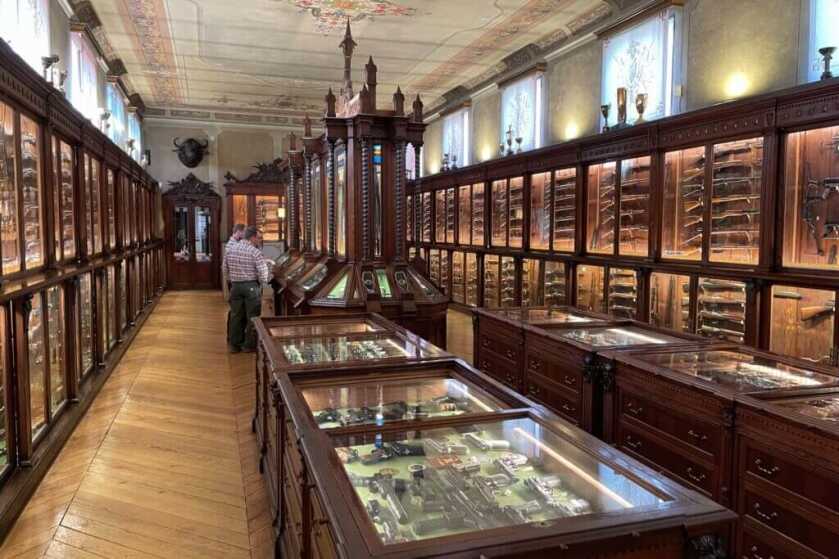
The collection is carefully divided. One side focuses on sporting and hunting arms, the other on military and service weapons. Contents of the collection range from simple, utilitarian designs to some of the most ornate firearms ever produced. Early matchlock and flintlock examples showcase black powder ignition systems, while experimental multi-barrel guns and unconventional firing systems demonstrate the significant trial and error that went into early firearm development.

One recurring theme is Beretta’s reputation for barrel making. Historically, Beretta barrels, alongside Belgian examples, were considered among the safest and most reliable in Europe. The traditional Damascus spiral method, requiring only iron, wood, water, and an immense amount of skill, relied on twisting, hammering, and forge-welding layered steel into barrels strong enough to withstand early black powder pressures. Several examples of single, double, triple, and even four-barrelled firearms illustrate the experimentation that defined the era.
Fine Guns Taken Seriously
One cabinet stands apart, showcasing what Beretta refers to as “intensified arms,” high-end firearms that exist far beyond industrial or military production. A matched pair of 12-gauge shotguns gifted to Cavalier Ugo Gussalli Beretta on his seventieth birthday exemplifies this philosophy.

Both guns are stocked from the same walnut blank, engraved by a British artist, and inlaid with five different types of gold: white, yellow, blue, green, and brown. The engraving reflects the owner’s tastes: one receiver depicts the Beretta Gallery of New York and American waterfowl scenes, while the other features portraits of his favorite dogs and a personal likeness.

Containing these shotguns is an equally remarkable gun case, built from rosewood and walnut by a craftsman connected to the British royal family. It includes hidden drawers, integrated cleaning tools, and craftsmanship that rivals the firearms it was built to house.
Not every piece in the collection is practical. One exhibition gun, adorned with diamonds, was intended to showcase the skill of Beretta engravers and jewelers. It was fired briefly until diamonds began popping out of their mounts. The gun now remains purely an object of art, insured for roughly €270,000.

Military Cabinets And Modern Icons
The collection transitions naturally into military history. Mausers, Enfields, Mosin-Nagants, and some of the first fully automatic designs line the cabinets. Among them are pistols made for foreign dignitaries, including gold-plated examples destined for Middle Eastern royalty, later redesigned when it became clear that gold’s softness and heat conductivity compromised functionality.
One cabinet houses Lugers and their accessories, while others highlight Beretta pistols that many American shooters know well, including early predecessors to the Model 92 and M9 platforms. A particularly telling example comes from a Swedish shooting school, which returned a functional Beretta pistol after 500,000 rounds.
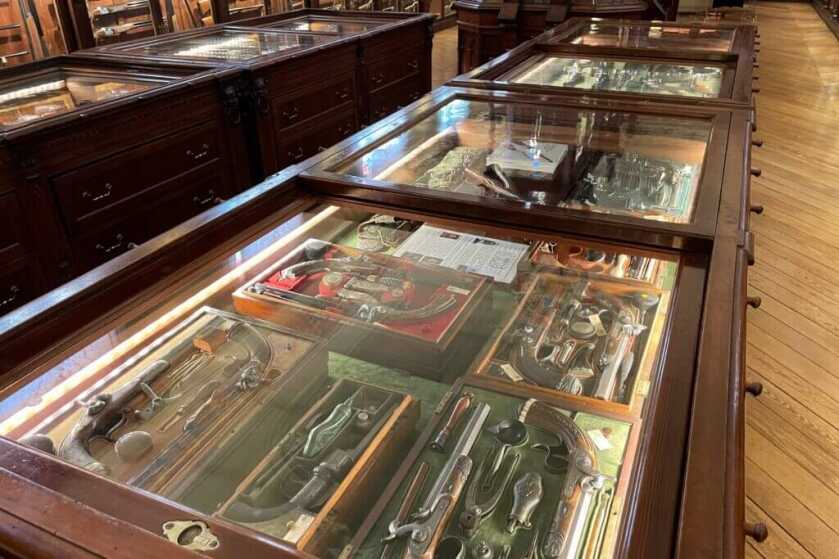
There are also cultural touchstones, film props, Olympic competition guns, and rare markings that trace Beretta’s evolving logos. The famous three-arrow emblem, still in use today, was adopted in the mid 20th century with the blessing of Italian poet and nationalist Gabriele D’Annunzio. The symbol, originally a naval motif, represents disabling a ship’s controls, breaching the hull, and ultimately sinking it, an image D’Annunzio felt fitting for a firearms manufacturer.
An Industrial Ecosystem With Range
Beretta’s history is not limited to firearms. Displays include motorcycles produced in the mid 20th century, small aircraft engines, experimental watercraft, and advertising artifacts spanning decades. These ventures underscore the company’s broader engineering curiosity and willingness to innovate outside its core business.

That same mindset defines modern Beretta Holding. Today, the company operates as an integrated ecosystem encompassing firearms, optics, ammunition, and accessories. Brands like Tikka, Sako, Steiner, Norma, RWS, and others allow Beretta to offer complete end-to-end solutions, particularly attractive for military and law enforcement contracts.
The scale of the Gardone facility reflects this. The interconnected campus spans over one million square feet, with machining, assembly, warehousing, and administrative spaces linked by tunnels, bridges, and corridors. Firearms move from one stage to the next without ever leaving company property.
Tucked away in one of these corridors was an early ’90s American car, a Chevy Beretta. While Beretta did not intentionally partner with Chevy, it worked out that way in the end. Apparently, GM had brought the Beretta to market without ever consulting with Beretta Italy, which owned the naming rights. After learning of the American automobile, the Beretta family reached out to General Motors, and a deal was made for the use of the name. This deal included the delivery of one Chevy Beretta to Gardone Val Trompia, Italy, and a $150,000 donation to cancer research.

Competition Guns And The Olympic Legacy
Beretta’s dominance in competitive shooting is impossible to ignore. A wall of medals traces Olympic success back decades. From platforms like the 680 and 682 to modern icons like the DT11, Beretta competition guns have accumulated more Olympic medals than any other brand.
The development process is deliberate. Features refined with elite athletes eventually filter down into production models. Balance systems, adjustable stocks, and recoil management technologies all evolve through this feedback loop before reaching civilian shooters.
The Factory Floor Blends Old Skill With New Systems
Inside the manufacturing buildings, the contrast between tradition and technology is striking. Beretta operates an Industry 4.0 environment, with predictive maintenance systems monitoring oil levels, machine wear, and production status in real time. Screens track performance continuously, allowing issues to be addressed before they disrupt production.

At the same time, many critical steps remain firmly human. Barrel production alone involves drilling, honing, polishing, brazing, and burnishing, much of it requiring trained eyes and hands. While machines can create straight barrels, aligning and brazing over and under sets still depends on skilled workers visually checking alignment.
Beretta treats environmental and worker safety with equal seriousness. Air quality sensors monitor chromium levels, on-site medical staff conduct regular health checks, and Beretta proactively reports issues to local authorities. It is a level of self-regulation that reflects both modern standards and long-term investment in the surrounding community.

One of the most surprising features of the production floor had nothing to do with manufacturing. It was actually the sheer number of trees and plants within the facility. The idea is that if the factory is healthy for a tree, the factory is healthy for an employee.
History Under The Mountain
Perhaps the most striking moment of the tour comes as we near the mountainside. During World War II, Beretta moved key machinery into tunnels carved directly into the rock to protect operations from bombing. Workers continued production underground while the valley above was under attack.

Those tunnels still exist today, repurposed for ammunition storage and ballistic testing. The range we used plunged two hundred meters straight into the mountain. There, we fired a variety of Beretta’s new production hunting rifles and competition pistols, as well as a full-auto Beretta PMX, which recently won a contract with the Italian Military.

A Living Legacy With Family At The Helm
Today, Beretta remains a family-led company, with multiple generations actively involved in leadership and operations. The continuity is not symbolic; it is structural. Decisions made centuries ago about craftsmanship, self-sufficiency, and long-term thinking still shape how the company operates.
Walking through Beretta’s Italian headquarters is not just a factory tour. It is a reminder that while materials, machines, and markets change, the core principles behind a well-made firearm, precision, durability, and respect for the craft, remain timeless.

For shooters accustomed to seeing the Beretta logo on a slide or receiver, this visit puts everything into context. The guns we handle today are not isolated products. They are the latest chapter in a story still being written, one forged, quite literally, over five centuries.
Be sure to check out Beretta’s Website for more information on the company’s history or to browse their extensive catalog of firearms.
Beretta Factory Tour Fast Facts
| Founded | 1526 |
|---|---|
| Museum Collection | About 3000 pieces |
| Factory Size | Over one million square feet |
| Diamond Exhibition Gun | 1193 diamonds, 90 carats, insured at €270,000 |
| Swedish School Test | Beretta pistol returned functional after 500,000 rounds |
| Tunnel Range | Two hundred meters into the mountain |
| Chevy Beretta Deal | $150,000 donation to cancer research and one car delivered |
Pros And Cons Of The Beretta Factory Experience
- Pros: Deep, hands-on look at 500 years of craft; rare access to competition and military icons; Industry 4.0 insights; unforgettable tunnel range.
- Cons: Overwhelming volume of artifacts in one visit; some exhibition pieces are art only; access is limited and scheduled.
