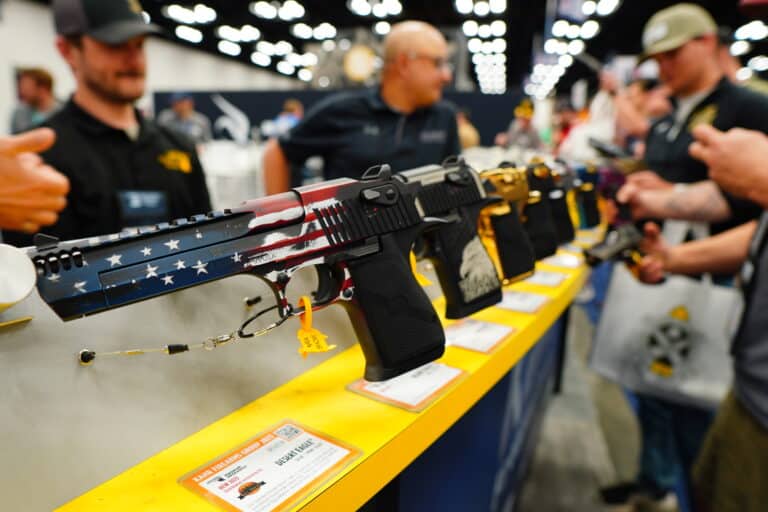
When the Supreme Court’s Bruen decision was issued, even I was pleasantly surprised at the breadth of Justice Thomas’ opinion and its probable implications. By focusing strictly on whether particular limits on Second Amendment rights were historically recognized (and invalidating those that are not), the table was set for potential wholesale invalidations of many gun control laws.
In the short time that Bruen has been the law of the land, it is already bearing tangible results. Courts have struck down bans on the carrying of guns by 18 to 21-year-olds and local laws on the possession of firearms. More recently, New York’s petulant legislative response to losing in Bruen is being eviscerated.
Now another shoe has dropped. In United States v. Price, a district court in West Virginia considered whether bans on firearm possession by felons and possession of firearms with obliterated serial numbers were constitutional. While finding that the law barring convicted felons from possessing guns was justified under Bruen, the court found that the laws against removing the serial number on a firearm, or possessing a firearm with an obliterated serial number were not.
Firearms with no serial number are just as “bearable” as the same firearm with a serial number, and there is no “common use” issue here as the presence or lack of a serial number makes no difference with respect to whether the type of weapon is commonly used. Finally, I can find no authority for the idea that a firearm without a serial number would meet the historical definition of a dangerous or unusual firearm.
The opinion applies Bruen in a straightforward manner. Noting that serial numbers on firearms were essentially unknown until the era of mass production, and laws requiring them and prohibiting their removal dated only to the 1968 Gun Control Act, the court ruled that 18 U.S.C. § 922(k) unconstitutionally infringes on Second Amendment rights.
While not before the court, the court seems to indicate that requiring a manufacturer to serialize the guns it puts into commerce was acceptable, as such did not infringe any right to keep or bear arms.
The court gave the following examples:
Assume, for example, that a law-abiding citizen purchases a firearm from a sporting goods store. At the time of the sale, that firearm complies with the commercial regulation that it bear a serial number. The law-abiding citizen takes the firearm home and removes the serial number. He has no ill intent and never takes any otherwise unlawful action with the firearm. Contrary to the Government’s argument that Section 922(k) does not amount to an “infringement” on the lawabiding citizen’s Second Amendment right, the practical application is that while the law-abiding citizen’s possession of the firearm was originally legal, it became illegal only because the serial number was removed. He could be prosecuted federally for his possession of it. That is the definition of an infringement on one’s right to possess a firearm.
Now, assume that the law-abiding citizen dies and leaves his gun collection to his law-abiding daughter. The daughter takes the firearms, the one with the removed serial number among them, to her home and displays them in her father’s memory. As it stands, Section 922(k) also makes her possession of the firearm illegal, despite the fact that it was legally purchased by her father and despite the fact that she was not the person who removed the serial number. These scenarios make clear that Section 922(k) is far more than the mere commercial regulation the Government claims it to be. Rather, it is a blatant prohibition on possession. The conduct prohibited by Section 922(k) falls squarely within the Second Amendment’s plain text.
Before you break out your Dremel tool and start de-identifying your gats, remember that this case isn’t over. While the decision may (and should) be upheld, until it is final and the feds formally acknowledge that Section 922(k) is kaput, you must recognize that it might not be – and once you’ve removed a serial number, you can’t put it back on.
Similarly, there are various state laws that prohibit removal of serial numbers or possession of unserialized guns. While these should eventually be struck down for the same reason, until they are, you would be playing with fire.
I read the court’s opinion as potentially blessing laws enhancing the criminal penalties for committing a crime with a firearm that has had its serial number removed . . . which would give a zealous prosecutor additional ammunition were you to use such a firearm in a Zimmerman or Rittenhouse type self-defense situation.
What are the implications of this ruling? If its logic and reasoning are followed by other courts – again, they should be, as it’s a straightforward application of Bruen – then “ghost gun” bans, serialization requirements for homemade firearms, microstamping requirements, “smart gun” laws, and other recent ideas from the Shannon Wattses of the worlds should be toast.
So too should be things like magazine capacity limits and just about everything the California politicians have come up with in the past couple of decades.
Look Ma, no serial numbers! (JWT for TTAG)
Could it similarly be used to invalidate NFA regulations on suppressors, SBR’s, and SBS’s? Perhaps, although the argument will be made that the NFA is just a tax. The NFA was structured that way because FDR’s DOJ was concerned that straightforward bans on those items would violate the Second Amendment. That issue should be addressed soon by Judge Pittman in the test case on the “Made in Texas” suppressor law.
Could the West Virginia ruling be used to attack the Hughes Amendment? Most definitely.
In the mean time, pass the popcorn. The Bruen show is still just getting started.
Disclaimer: While I am a lawyer, I’m not your lawyer. This essay is journalistic, and neither I, my firm, or TTAG is providing legal advice. Consult your own attorney if you have specific questions.
With the benefit of hindsight, Terrion Pouncy should have just paid for his hot dog.
One of the best vacations my family and I ever took was to Chicago. We did the museums, wandered about taking in the sights, and ate some great food. Unfortunately, several decades of left-wing governance have taken their inevitable toll. As anyone who has watched the news will tell you, Chicago has a bit of a violence problem these days.
Despite some fairly restrictive gun control laws an awful lot of people are still getting shot in Chicago.
It’s pretty tough to buy a legal gun in Chicago, though the illegal sort apparently litter the place. Until recent times, the Windy City had no gun shops. There are a few now, but you still have to have special cards, government permission, and similar stuff to obtain a weapon legally. Despite all that, in 2020 there were 780 murders in Chicago. Over the July 4th weekend in 2021 more than 100 people were shot. Tragically, eighteen perished.
Jackson, Mississippi, where I went to med school, is one of the most violent cities in America.
Per capita, Chicago is far from the worst. In 2020 they had about 25 murders per 100,000 people. I’m disappointed to report that the reigning champion that year was actually Jackson, Mississippi, with a murder rate of roughly twice that. Our sordid tale this day takes us through both places.
My Credentials
Most small towns in the Deep South are delightfully safe and pleasant. Mine certainly is.
I live in a small town in the Deep South today. A great many folks are armed, and, with blessed few exceptions, everybody is friendly. Crimes of violence are quite unusual. Property crime happens from time to time, but thankfully that’s rare, too.
Jackson, Mississippi, was a great place to go to med school.
I learned to be a doctor in Jackson, Mississippi, apparently per capita one of the most violent places in the country. I would assert that this was also the best place on the planet to learn medicine. The facility and faculty were indeed both top flight, but that wasn’t the secret to a stellar medical education. Jackson was a great place to learn medicine because of the patients.
This guy is from Mexico. Being really big brings a whole host of medical challenges.
That part of Mississippi is one of the most morbidly obese places on planet earth. It is a uniquely modern phenomenon that our poor people are fat. With such profoundly poor diets and a dearth of exercise come scads of metabolic maladies. Diabetes and hypertension were ubiquitous, and there was a thin scattering of venereal disease sprinkled over the top as well.
Amidst a simply breathtaking pantheon of stupid things human beings have done, smoking has got to be the stupidest. Sucking these ghastly rascals is a great way to die horribly.
My patients routinely neglected to do what I asked of them. We often discussed stuff like diet and exercise, but that was clearly more for my benefit than theirs. Oftentimes some enormous Jacksonian endured my spiel about the many-splendored dangers of fast food, cigarettes, and a sedentary lifestyle before departing my clinic determined not to change a blessed thing.
The patient population in the ER in Jackson was shockingly violent.
Lastly, in their free time my patients not infrequently shot each other. I never did a shift in the ER at the Level 1 trauma center where I trained without at least one gunshot wound. My personal record was seven. However, those sordid attributes also made it a great place to learn. Once I hung out my shingle in a normal place with moms, dads, and patients who heeded my advice, being an effective doctor seemed relatively breezy.
Profiling
This is Terrion Pouncy. Terrion made some poor life choices.
Terrion Pouncy was a thug. While I have not had the pleasure of meeting Terrion myself, I have indeed met many like him. At risk of being labeled whatever it is you get labeled with these days for simply describing the world as it is, here’s what these guys are like up close.
Of course, modern-day gangs have an online presence. It’s amazing what Google will find for you when you go looking.
These are the gladiators. They’re often exceptionally fit and typically covered in gang tats. They are invariably combative and belligerent when they present to the emergency department acutely shot. I mean, who wouldn’t be? However, once you save their lives and get them out of that environment they’re most commonly quite friendly. I have had some of the most delightful conversations with these guys as they recuperated after surgery.
Behold the rap group Bone Thugs-N-Harmony. This is what passes for role models among poor inner city kids these days. Is it any wonder so many of them turn out poorly?
None of them had dads, and their moms often stayed in the rooms with them. These long-suffering ladies did the best they could considering, but there aren’t a whole lot of positive role models in that world. These guys gravitate toward crime, drugs, and violence in an effort at escaping their dreadful circumstances.
Occupational Hazards
This is the hot dog shop where Terrion Pouncy had his date with destiny.
At 6 am on a chilly November day in 2017, Terrion Pouncy approached a 24-hour hotdog stand at 11656 South Halsted Street in the West Pullman neighborhood in Chicago. The stand was manned by a pair of unidentified guys aged 39 and 45. Terrion was dressed in a dark hooded sweatshirt pulled up over his head. He had a similarly dark scarf that concealed his face.
In the covid era, modern criminals seem to be exceptionally responsible about wearing face coverings. This gentleman’s stripped-down polymer-framed AR pistol is curiously devoid of sights.
These were the days before covid, so facial coverings were not quite as commonplace as is the case today. Surveillance videos posted on YouTube demonstrate that modern criminals are exceptionally conscientious about mask-wearing. Regardless, it was cold and dark, so Terrion likely got pretty close before the hot dog guys grew suspicious.
Terrion’s .38-caliber pistol likely looked something like this.
Pouncy approached the two men, produced a .38-caliber handgun, and demanded the money in the cash register. The younger of the two victims readily complied. However, this man was also holding a bucket of hot grease at the time. As he fumbled for the cash in the register he accidentally dropped the bucket, spilling hot grease liberally across the floor.
This is Arlando Henderson. Arlando stole $88,000 in cash from the bank where he worked and then posted pictures of himself flashing the money on social media. I’m sure the FBI appreciated the help.
Terrion lustily grabbed the cash, most of it in ones, and started shoving it into his pants. Before departing, Terrion availed himself of the man’s wallet and cell phone as well. All this was captured on surveillance video.
It’s easy to suffer from task overload during an armed robbery. To keep from shooting yourself through the penis it is best to slow down and do it right.
As Pouncy turned to jog away he stuffed his handgun back into his waistband and slipped on the spilled grease. Unfortunately, his hands were full, and he was in a rush. The trigger caught on something, and the gun went off. This is where Terrion’s morning took an unexpectedly dark turn.
Maxwell Street Express seems pretty nice. When Terrion Pouncy tried to rob the place things did not end well for him.
Pouncy ran down the street to an abandoned car wash now bleeding vigorously. There he was seen throwing something, presumably his weapon, over a fence. He then called 911 and reported that he had been shot.
The geometry of gunshot wounds is often quite surprising.
First responders found Pouncy with a through-and-through gunshot wound to his penis and another to his thigh. Both injuries were clearly from the same round. The cops later found his discarded hoodie and weapon. The younger of the two robbery victims discovered his wallet near the spot where the ambulance retrieved the freshly neutered criminal.
Terrion did not do his future any favors when he tried to rob a local hot dog joint.
Pouncy was taken to Advocate Christ Medical Center in Oak Lawn and admitted. While there he missed his initial hearing, so Judge Stephanie Miller ordered him held without bond. I bet hers is a simply fascinating job. Despite an aggressive Google search, I never could find out what became of poor Terrion. Even if they just let him go, the argument could be made that he has already been punished adequately.
Closer to Home
The ER in Jackson, Mississippi, was a thrill a minute.
I myself had a similar encounter while working in the ER in Jackson. A young unlicensed pharmacist got sideways with a competitor, and they both slapped leather. This guy’s Hi-Point 9mm went off on the draw stroke, centerpunching his male member mid-shaft but fortuitously missing everything else. His opponent apparently felt that justice had been adequately served and abandoned him bleeding on the sidewalk.
Ambulance crews play a critical role in keeping people alive long enough to get to the hospital.
This guy was justifiably unsettled when we met, but the paramedics had gotten much of the bleeding staunched enroute. We packaged him up for the Urology residents who were thrilled to get an interesting surgical case. When your world orbits around bladder cancer and inflamed prostate glands a good old-fashioned gunshot wound to the shlong is a reliable crowd-pleaser.
Some folks’ lifestyle choices make them frequent customers in the ER.
I actually saw that guy for something else some months later and he offered to let me take a peek at his offended member. It had indeed healed nicely, no doubt a tribute to the rarefied skill of our resident Urologists. It did, however, cock off at a jaunty angle around mid-shaft. Our hero was thrilled to report that it still functioned as intended. He explained that his injury might have even made him more popular with the local ladies based solely upon the novelty of the thing. Thank goodness he could still reproduce.
The Gun
Despite its modest price, the Hi-Point C9 is quite a serviceable weapon.
I write for the gun press, and I proudly own a Hi-Point pistol. Those who denigrate the performance of these inexpensive guns have clearly not logged a great deal of trigger time on one. My Hi-Point shoots quite well.
Hi-Point carbines are mechanically similar to their C9 handguns.
Originally launched in 1992, Hi-Point produces inexpensive, reliable firearms. Their catalog includes both pistols and carbines in a variety of calibers. All of their weapons are based upon the straight blowback operating system. This design mandates an unusually heavy slide.
The big bulky slide on the Hi-Point C9 is necessary to counteract recoil given its blowback method of operation.
Hi-Point slides are die cast from an inexpensive zinc alloy called Zamak-3. The frames are steel-reinforced polymer. Ancillary bits demanding gun-grade strength are cut from steel as well. The aesthetic result looks like a blow dryer had a baby with an electric toaster.
In the wrong hands, the Hi-Point C9 remains quite effective.
The single action trigger on the Hi-Point is a bit mushy but quite serviceable. The gun’s single-stack magazines are relatively easy to swap, and the safety is intuitive. One of the red dots on my rear sight fell out, but Hi-Point pistols shoot plenty straight. Mine has also been unflinchingly reliable. The bulk of the slide makes concealment a chore, but that doesn’t mean that literally countless young thugs haven’t successfully pulled it off. My Hi-Point C9 set me back $46 without a magazine from a Law Enforcement auction.
Ruminations
Prison looks like fun and all, but it’s still better to just work hard and obey the law than to make one’s way via a life of crime.
So if you were pondering a life of petty crime let me encourage you to seek out a career elsewhere. The money can be good, and the tax burden is admittedly minimal. However, Terrion Pouncy can no doubt attest that the occupational hazards far outweigh the potential rewards. Nobody wants to be shot in the Johnson no matter how much easy cash rides on the enterprise.
SPRINGFIELD, VA-(Ammoland.com)- When the Bureau of Alcohol, Tobacco, Firearms and Explosives (ATF) told Representative Michael Cloud’s (R-TX) office that it held nearly one billion out of business records, Gun Owners of America (GOA) called it an illegal gun registry. The legacy media newspaper, USA Today, issued a “fact check” stating that the claim was false. Now thanks to a Freedom of Information Act (FOIA) request filed by GOA and Gun Owners Foundation (GOF), we know how much of a role the ATF played in determining the rating.
Last January, the ATF answered an inquire by Rep Cloud’s office stating that it held nearly one billion records in its Out of Business Office in Martinsburg, West Virginia. The vast majority of the records were digitized, and the ATF’s Firearms Trace Center had access to the documents. Although the ATF claims the records are not searchable by anything other than the former federal firearms licensee (FFL) name, by just selecting a few options in the software, those records could be usable by using optical character recognition (OCR).
A new FOIA request by GOA and GOF shows the communication between the USA Today fact checker, ATF’s former Chief of the Public Affairs Division, April Langwell, and former ATF Associate Deputy Director Thomas Chittum. Mr. Chittum has left the ATF to work for ShotSpotter. Ms. Langwell also recently left the ATF to work as the Director of Communications for the United States Marine Corp (USMC).
In the exchange, the unnamed fact-checker asked about the alleged registry. Ms. Langwell and Mr. Chittum denied the existence of the gun registry. Mr. Chittum replied that there was no firearms registry and handed off the conversation to Ms. Langwell. Ms. Langwell repeated the claim that the database is only searchable by FFL name. She stated that the ATF doesn’t consider the digitally scanned records to be a gun registry. The fact checker did not follow up on how easy it would be to turn on optical character recognition. The fact checker seemed to accept Ms. Langwell’s claims at face value.
The issue the fact checker overlooked is that according to the email exchange, the records are stored in PDF format. The PDF file format is the product of Adobe. Adobe Acrobat is needed to read the documents in the file format. The ability to OCR documents is built into Adobe Acrobat and can be applied to a PDF in as little as two clicks.
The ATF also told USA Today that all records had been digitized as of 2017. This claim contradicts what the ATF told Congressman Michael Cloud (R-TX). The fact checker did ask Ms. Langwell about the discrepancy. The ATF repeated the claim to the fact checker that the ATF completed the move to a digital format in 2017. The fact checker never followed up on why the ATF told USA Today something different than what the Bureau told Congress. Someone received the wrong information from the ATF, and it is unclear who has the incorrect information.
GOF and GOA were deeply troubled by USA Today’s “fact checking” methods. They point out that the paper discounted the mountains of evidence and the ATF’s own statements on the matter.
“ATF openly admitted to USA Today that ‘scanning out of business records began in 2005’ and now ATF ‘processes an average of 5.5 million’ records containing private gun and owner information into its database per month,” said Aidan Johnston, Director of Federal Affairs, Gun Owners of America. “We are disappointed that this ‘journalist’ simply reported ATF’s denial of an illegal gun registry as truth, without any critical thinking whatsoever.”
USA Today did not respond to AmmoLand’s request for comment.
About John Crump
John is a NRA instructor and a constitutional activist. John has written about firearms, interviewed people of all walks of life, and on the Constitution. John lives in Northern Virginia with his wife and sons and can be followed on Twitter at @crumpyss, or at www.crumpy.com.
Man exchanges 3D printed guns for $21,000 at New York gun buyback program
At an event held in Utica, NY in August, one man allegedly gamed the system, walking away with thousands of dollars after turning in over 100 guns he made using his 3D printer.
Since 2019, New York Attorney General Letitia James has been encouraging residents of her state to participate in her office’s gun buyback program, wherein the government offers money for firearms, “no questions asked.”
At an event held in Utica, NY in August, one man allegedly gamed the system, walking away with thousands of dollars after turning in over 100 guns he made using his 3D printer.
According to WKTV, the man, known only as “Kem,” had seen posts online about people pulling off such stunts, and decided to try it for himself.
Using his $200 3D printer, Kem quickly birthed a battery of plastic firearms, and drove six hours from his home to Utica, where the buyback program was holding an event.
“I 3D-printed a bunch of lower receivers and frames for different kinds of firearms,” said Kem.
Kem explained that upon arriving in Utica, he was asked how many guns he wished to turn in, to which he replied, “110.”
After spending the rest of the day negotiating with staff, Kem was presented with 42 gift cards, each worth $500, making the total payout $21,000.
“I’m sure handing over $21,000 in gift cards to some punk kid after getting a bunch of plastic junk was a rousing success,” Kem told WKTV, adding that, “gun buybacks are a fantastic way of showing, number one, that your policies don’t work, and, number two, you’re creating perverse demand.”
He argued that programs such as James’ “don’t actually reduce crime whatsoever.”
According to James’ office, the August 27 buyback event “resulted in the collection of 296 guns, including 177 ghost guns, 42 long guns, 41 handguns, 33 non-working guns, and 3 assault rifles.”
Ghost guns are firearms that are unregistered and unregulated, often built by users themselves. Kem’s 3D-printed weapons would fit into this category.
Since 2019, James’ program has resulted in the buyback of 3,500 guns, and she has no intention of stopping any time soon.
In a statement to KWTV, her office slammed Kem for his actions, and explained that they have “adjusted [their] policies to ensure that no one can exploit this program again for personal gain.”
Buying a gun in California isn’t a simple or fast process thanks to the numerous gun control measures that anti-gun politicians have put in place over the past few decades, but thankfully the state’s draconian restrictions on the right to keep and bear arms didn’t interfere with one woman’s ability to use a firearm to defend herself and her husband from a stranger who tried to come inside their home.
According to authorities, the woman in question had just picked up her pistol the day before, after waiting the 10 days required under California law between the time of purchase and when gun owners can actually take possession of their newly-bought firearm. Little did she realize that she would soon end up using the gun to fend off an attack on her husband in their own home.
A Patterson woman who had gotten a handgun just the previous day fatally shot a stranger who was grappling with her husband Saturday night at the door of their home, the Stanislaus County sheriff’s office said.
In a 911 call at 10:20 p.m., a resident of the Wilding Ranch subdivision on the city’s east edge reported that a neighbor had called and said she had just shot an intruder at her house.
When deputies arrived, they found a dead man near the home’s front entry. The residents — a 50-year-old woman and her 45-year-old husband — said that the apparently intoxicated stranger had tried to force his way into their home.
According to the sheriff’s report, as the husband fought with the intruder near the front door, his wife ran to the bedroom to get a revolver, which she said she had brought home on Friday. Returning to the entry, she fired all its rounds into the intruder.
According to authorities, 22-year old Angelo Santana tried to force entry into the home while he was “heavily intoxicated,” leading to him fighting with the 45-year old resident. Police say that, according to interviews with those who knew him, Santana had a history of alcohol abuse and would “regularly show-up unannounced trying to find friends and acquaintances of his in the same neighborhood.”
In a Facebook post, the Stanislaus County Sheriff’s Office announced that a preliminary investigation indicates the shooting was “strictly self-defense,” and while the investigation continues the details that the sheriff has released publicly appear to back up the woman’s claim that she was acting to protect her husband and herself from a combative stranger.
The house belonged to 50-year-old Yuhui Zheng and her husband, 45-year-old Yang Luan. The husband attempted to physically restrain Santana and was involved in a significant fight near the threshold of the front-door.
Luan sustained minimal physical injuries, to include abrasions and scratches to the back, while fighting with Santana and trying to defend his home. Yuhui Zheng retrieved a revolver from the upstairs bedroom, which she had acquired only one-day prior, and in self-defense of her husband, fired all rounds into Angelo Santana.
Santana wasn’t armed, but neither Zheng nor Luan knew that at the time. All they knew for sure is that a strange man was trying to get inside their home and began attacking Luan as he tried to keep the would-be intruder at bay. I’d say that they had a reasonable fear that the stranger was trying to do them harm, but we’ll have to wait and see what the D.A. in Stanislaus County decides to do with the case.
Real superheroes don’t wear spandex. On November 5, 2017, the real superhero was taking a nap.
In November of 2017, Stephen Willeford worked as a plumber at the children’s hospital in San Antonio, Texas. He lived in Sutherland Springs, population 600, about an hour away. The commute was onerous, but Stephen was a small-town sort of guy.
Trained as a plumber, Stephen Willeford was just a regular guy.
Stephen was, like many of us, just a responsible American who enjoyed shooting. He was an NRA certified firearms instructor and member of the nearby Church of Christ. On Sunday morning November 5, 2017, however, he was facing a long week on call at the University Hospital. As a result, he played hooky from his own church to take a nap. He lived with his family across the street from the First Baptist Church of Sutherland Springs.
The Monster Among Us
Something about Devin Kelley just wasn’t wired correctly. Trouble followed him everywhere.
Devin Patrick Kelley was the antithesis of Stephen Willeford. Devin Kelley was a card-carrying professional loser. Raised in New Braunfels some 35 miles away, Kelley was suspended seven times during high school for infractions ranging from insubordination and profanity to drug offenses.
Kelley spent time in an inpatient behavioral health facility due to his persistent criminal and antisocial behavior.
Kelley enlisted in the Air Force in 2009 upon graduation from high school. Three years later he was charged with assaulting his wife and fracturing his toddler stepson’s skull. He threatened the charging officer with physical violence and was admitted to an inpatient behavioral health treatment facility.
Tessa Brennaman, Kelley’s first wife, lived in constant fear of him.
His wife later reported that he had held a loaded handgun to her head and waterboarded her over stuff like speeding tickets. They divorced in short order. In 2014 after a fairly long trek through the military justice system, Kelley was separated from the Air Force with a bad conduct discharge.
Danielle was Devin’s second wife. They married after he returned home from the Air Force. Danielle’s family was a regular part of FBC Sutherland Springs. Devin had a fulminant relationship with his mother-in-law.
Leaving the military did little to improve Kelley’s rancid disposition. He was investigated for assault and rape within months of his arrival back in Texas. In 2014 Kelley married a high school friend whose family attended the First Baptist Church of Sutherland Springs.
Arming the Animal
Kelley was not legally authorized to own firearms, yet he easily acquired them due to the systemic failure of a variety of flawed gun control mechanisms.
The nature of Kelley’s discharge from the military and his domestic violence history should have prevented his passing the background check required to buy a gun, but this information was not entered into the NICS system. As a result, Kelley lied on a variety of official forms and bought weapons through legal channels. He even landed a job as a security guard.
Kelley bought an EAA revolver (like this one) legally at Holloman Air Force Base.
Kelley bought a SIG SAUER P250 and European American Armory Windicator .38 revolver at the Base Exchange at Holloman Air Force Base. In April of 2016, he falsified his 4473 at an Academy Sports store in San Antonio and purchased a Ruger AR-556 rifle. Along the way, he also accumulated a Glock 19 9mm, a Ruger SR22 pistol, and a Ruger GP100 .357 Magnum revolver.
The Massacre
At some point, darkness took complete control of this man. Family members said later it was as though he was possessed.
At 11:20 am Kelley exited his Ford Explorer outside FBC Sutherland Springs wearing black fatigues and body armor as well as a facemask adorned with a skull. He shot two parishioners outside the church before pushing his way into the sanctuary. Over the next 11 minutes, Kelley expended about 700 rounds. Police later found fifteen empty rifle magazines.
Stephen Willeford’s daughter, Stephanie, alerted her father to the noise across the street.
Stephen Willeford’s oldest daughter, Stephanie, woke him up to tell him she thought she heard gunshots. Stephen’s first thought was that somebody was tapping on his bedroom window. When he went into the living room he recognized the sound.
Like many of us, Stephen did not keep loaded magazines for his weapons. He had to snap a few rounds into a mag on the fly.
Rushing to his gun safe, Willeford thumbed a few cartridges into a magazine and grabbed his favorite AR15, a homebuilt parts gun he had customized himself. Stephen ran out of the house and headed for the church, the sounds of gunfire growing louder. He directed his daughter to go back and load magazines. He admitted later that this was just to keep her out of danger. Stephen Willeford was barefoot.
Stephen’s wife, Pam, begged him not to go to the church.
As Stephen crossed the 150 yards to the church he called his wife. She was on the other side of town helping another daughter drywall their house. He told them to stay put and avoid the church. As he hung up the phone his wife was shouting, “Don’t go over there!”
The Firefight
Stephen Willeford wasn’t a cop or a soldier. He asserts that God guided his actions that fateful day.
As he approached the church Stephen heard the carnage inside. He involuntarily screamed, “Hey!” as loud as he could, violating every tactical dictum about what to do when approaching a violent crime in progress. He tells people now that, “It was the Holy Spirit calling the demon out of the church.” This was the precise moment the slaughter inside FBC Sutherland Springs stopped.
Willeford responded as he had trained, shooting Kelley twice in the chest with his customized AR15 rifle.
Devin Kelley somehow heard Willeford’s shout and left the church to investigate. Upon seeing Stephen with a gun he fired three rounds, striking a Dodge Challenger, a nearby house, and the Dodge Ram Willeford was using for cover. Stephen steadied his holographic reticle on the man’s chest and stroked the trigger twice. Kelley dropped his rifle but was not otherwise inconvenienced.
Willeford realized that he was going to have to shoot around Kelley’s plates.
On a certain primal level, Stephen now recognized that Kelley was wearing body armor. As the shooter made for his vehicle, Willeford got his angle and shot the monster once underneath his arm and again in the thigh. As Kelley roared away in his Explorer, Willeford estimated where his head should be and blew out the vehicle’s windows.
The Chase
Johnnie Langendorff was at the right place at the right time to help bring Devin Kelley’s rampage to an end.
27-year-old Johnnie Langendorff had driven down from Seguin, 30 minutes away, to visit his girlfriend. Willeford, a stranger to him, ran up to his truck carrying a rifle and said, “That guy just shot up the church. We need to stop him.” Langendorff unlocked his doors.
Willeford and Langendorff had never met before they joined forces to run Devin Kelley down.
The two men chased Kelley for about six miles, passing several cars and topping 90 miles per hour. They kept the 911 dispatcher on the phone updating their location. Willeford had two rounds remaining.
Willeford and Langendorff’s pursuit drove Kelley away from inhabited areas and into a farmer’s field where he ultimately took his own wretched miserable life.
Kelley stopped his truck and Willeford moved to exit the vehicle. Kelley then sped off again, this time swerving erratically from blood loss before tearing through a fence and coming to a stop in a nearby field. The cops arrived soon thereafter. Devin Kelley called his parents expressing extreme remorse and then shot himself in the head.
The Guns
The Ruger AR-556 is a rack grade direct gas AR rifle.
The Ruger AR-556 is an entry-level direct gas impingement version of Gene Stoner’s classic black rifle introduced in 2014. The AR-556 followed on the heels of Ruger’s previous piston-driven SR-556. The SR-556 was an exceptional firearm, but it cost nearly $2000.
Kelley had customized his AR-556 with Magpul furniture and a red dot sight.
The AR-556 is a no-frills AR designed to compete with similar weapons such as the S&W M&P15 Sport.
Devin Kelley bought his Glock 19 through commercial sources after lying on his Form 4473. To presuppose that criminals will obey the administrative rules concerning gun ownership borders upon insanity.
The Glock 19 is a mid-size 9mm combat pistol that has seen widespread distribution. Sporting the familiar Glock Safe Action striker-fired trigger system and a 15-round magazine, the G19 is employed by the military, civilian, and Law Enforcement users pretty much anyplace folks wield guns. The G19 offers a chassis that is small enough to conceal yet large enough to control.
The Ruger GP100 revolver was introduced in 1985.
The Ruger GP100 is a rugged double-action magnum revolver. Available in a variety of chamberings with barrels between three and six inches long, the GP100 employs a transfer bar ignition system.
I presume this is the rifle Willeford used to stop Devin Kelley’s murderous rampage.
I couldn’t ascertain any definitive specifics about Stephen’s gun. The most probable photograph I could find showed a direct gas impingement AR sporting Magpul furniture, an EOTech Holosight, and a tactical light along with a magwell adaptor. As the AR15 is the most modular firearm ever created it lends itself to customization.
Ruminations
To imagine that some law or rule was going to miraculously transform this genuine piece of work into a model citizen represents magical thinking.
Much hay has been made over the fact that Devin Kelley was able to buy his guns through commercial sources. Really? Does any rational person actually believe that his failing a NICS check could have somehow stopped this perennial loser psychopath from shooting up that church?
The Sutherland Springs massacre was the fifth deadliest mass shooting in American history. It all appeared to be Devin Kelley’s failed attempt to get back at his mother-in-law. She was not at the church at the time and was otherwise physically unharmed.
It appeared that Kelley’s sole motivation was to settle a squabble with his wife’s family. Among the 26 dead were 9 children, one of whom was unborn. Another 20 worshippers were wounded. Sutherland Springs was the worst church shooting in American history.
Pastor Frank Pomeroy was not present that Sunday but tragically lost his daughter in the attack. He announced as I was putting this article together that he was running for the Texas State Senate.
The pastor at FBC Sutherland Springs was Frank Pomeroy. Frank typically carried a firearm during services. However, he was away with his wife on November 7th. His 14-year-old daughter was among the victims. Visiting pastor Bryan Holcombe died along with eight of his family members.
True heroism is ordinary people doing extraordinary things. These guys were thrown together by fate to thwart a madman.
Stephen Willeford and Johnnie Langendorff are archetypal American heroes. Quiet, humble, and selfless, these guys did whatever it took to stop a monster rampaging through their little Texas town. Willeford had no military or LEO experience yet said he had trained all his life for that moment.
It’s not hard to perceive spiritual forces behind the horrible events at FBC Sutherland Springs. Willeford sees himself as God’s instrument to stop the carnage.
A committed Christian, Stephen attributes his success to God’s Providence. Given the inevitable state of Devin Kelley’s ears after firing 700 rounds inside an enclosed building, it does make one wonder how he could have otherwise heard Willeford’s shout outside the church.
Out of tragedy pours grace. The man who stopped the massacre and the killer’s widow both worship together among the body of believers so traumatized by Devin Kelley’s actions.
Stephen Willeford moved his church membership to FBC Sutherland Springs. Danielle Kelley, Devin Kelley’s widow, worships with them as well. This ravaged church has welcomed her with open arms.
Stephen Willeford put his years of experience on the range to use when he stopped a psychopath. This sordid tale is fraught with lessons to be learned by responsible American gun owners.
When I finished typing this piece I went downstairs and stuffed two PMAGs with sixty rounds of M855 62-grain ammo. Those two magazines will still work long after I don’t. I also stashed a spare pair of shoes nearby.
Stephen Willeford is an American gun enthusiast who risked everything to save his friends and neighbors.Law Enforcement investigators seized Willeford’s rifle for a time during the subsequent investigation. A prominent black rifle manufacturer gave him this one as a replacement.