Category: A Victory!
Categories
Made my day that’s for sure!
The Spartan kick pic.twitter.com/rolELKpLa3
— Washingtons ghost (@washghost1) December 9, 2025


I took this photo myself. Those Alaskan brown bears can become absolutely enormous.
I spent my last three years in the Army stationed at Fort Wainwright, Alaska. For a substantial portion of that time, I was the operations officer for a CH-47 Chinook helicopter unit.
I picked flight crews and assigned mission responsibilities. That also meant I got to do some really cool flying all across the last frontier. If you were paying taxes back in the 1990s, sincerely and from my heart, thank you for that.
Megafauna
When you encounter moose while flying out over the vast Alaskan muskeg, they typically either ignore you or run. These things are as big as Clydesdales and quite deadly up close, but they’re herbivorous ungulates. They don’t hunt people for food. Alaskan brown bears, by contrast, will gladly make a meal of you.
One fine day, I was piloting a Chinook helicopter north to south just east of the Salcha River on the far side of Eielson Air Force Base. We were flying nap-of-the-earth right above the trees at maybe 160 knots (about 185 mph). In this configuration, I serendipitously happened upon an absolutely enormous cinnamon grizzly bear.
I wasn’t trying to molest the wildlife. He just happened to be right in my flight path. I popped the cyclic back and cleared him by scant feet.
A CH-47 tops out at 50,000 pounds, and it makes the devil’s own racket. Most animals are rightly terrified of it. In this case, my flight engineer reported that, as we passed over this big gentleman’s head, he stood up on his hind legs and swatted at us. Human beings are not the apex predators in this space.
The Monster
In 1923, along the Unuk River near Cripple Creek north of Ketchikan, Alaska, a young fur trapper named Jess Sethington struck out to make his fortune. He packed a .38-caliber revolver and a .33-caliber rifle for personal protection and subsistence. He was never heard from again.
For years afterwards, trappers reported a particularly large bear in the area that regularly stalked them and molested their camps. The bear was unique for the strange groaning sound it seemed to make. Locals named the beast “Old Groaner.”
Old Groaner operated mostly at night and showed little fear of man. Several prospectors and trappers had fired at him, but none had connected in the dark. With all this in mind, in November 1935, two grizzled prospectors struck out into Old Groaner’s territory to stake a claim, accompanied by their dog.

The Attack
One of the miners ventured out alone with the dog and his rifle to post signage establishing his claim. Setting his rifle aside to erect the sign, he was surprised when his dog rushed past him barking furiously.
Grabbing his weapon, he saw a massive grizzly swat the dog away effortlessly and charge. With no time to shoulder the weapon, he fired from the hip instinctively. The muzzle was mere inches from the animal at the time.
The impact threw the man backwards, but his shot had connected. As the bear struggled to rise, the prospector gauged his angles and shot the enormous beast two more times. Old Groaner was done.
The Aftermath
The massive bear’s paws were more than ten inches across. However, that wasn’t what made the animal memorable. Once they got the big bruin dressed out, they found its jaw and skull to be grossly deformed. This accounted for the weird groaning sounds.
The two miners dug three .38-caliber pistol bullets out of the animal’s jaw along with a pair of .33-caliber rifle rounds. It seems that Jess Sethington had connected five times before the monster bear killed him. That was the sole physical evidence of Sethington’s gory demise that was ever discovered.

This was my bear gun while I was stationed in Alaska. It took a BATF Form 1 to build it legally, but when stoked with sabot slugs it was easy to carry while offering some proper downrange thump.
Ruminations
Alaska plays home to some 140,000 bears of all sorts. That’s an estimated 100,000 black bears, 30,000 brown/grizzly bears, and a further 4,700 polar bears. However, Alaska is a really big place. If you split Alaska in half, Texas would be the third-largest state.
Despite the space over which these animals are distributed, they are hardly rare. Attacks on humans are quite unusual, but I met two men during my time there who had been mauled while out hunting.
I never left the confines of the Army post without a serious gun. More often than not, that was a registered short-barreled 12-bore stoked with sabot slugs. I still felt underequipped at times.
An adult male brown bear can reach 10 feet long and weigh 900 pounds in the summer. What purportedly determines whether you survive a violent encounter with one of these creatures is the relative size of your head to his jaws. If he can get his teeth around your skull, he will pop it like a grape. If not, you only get scalped.
There is an amazing series of books that were required reading for those of us planning to spend any time in the bush, titled simply, “Alaskan Bear Tales.”
There are three volumes, and you can find them on Amazon. Be forewarned, these stories can be pretty gruesome. However, they serve as a reminder that there are some places where man is not always at the top of the food chain.

One of LA’s most important benefactors also spent time in San Quentin
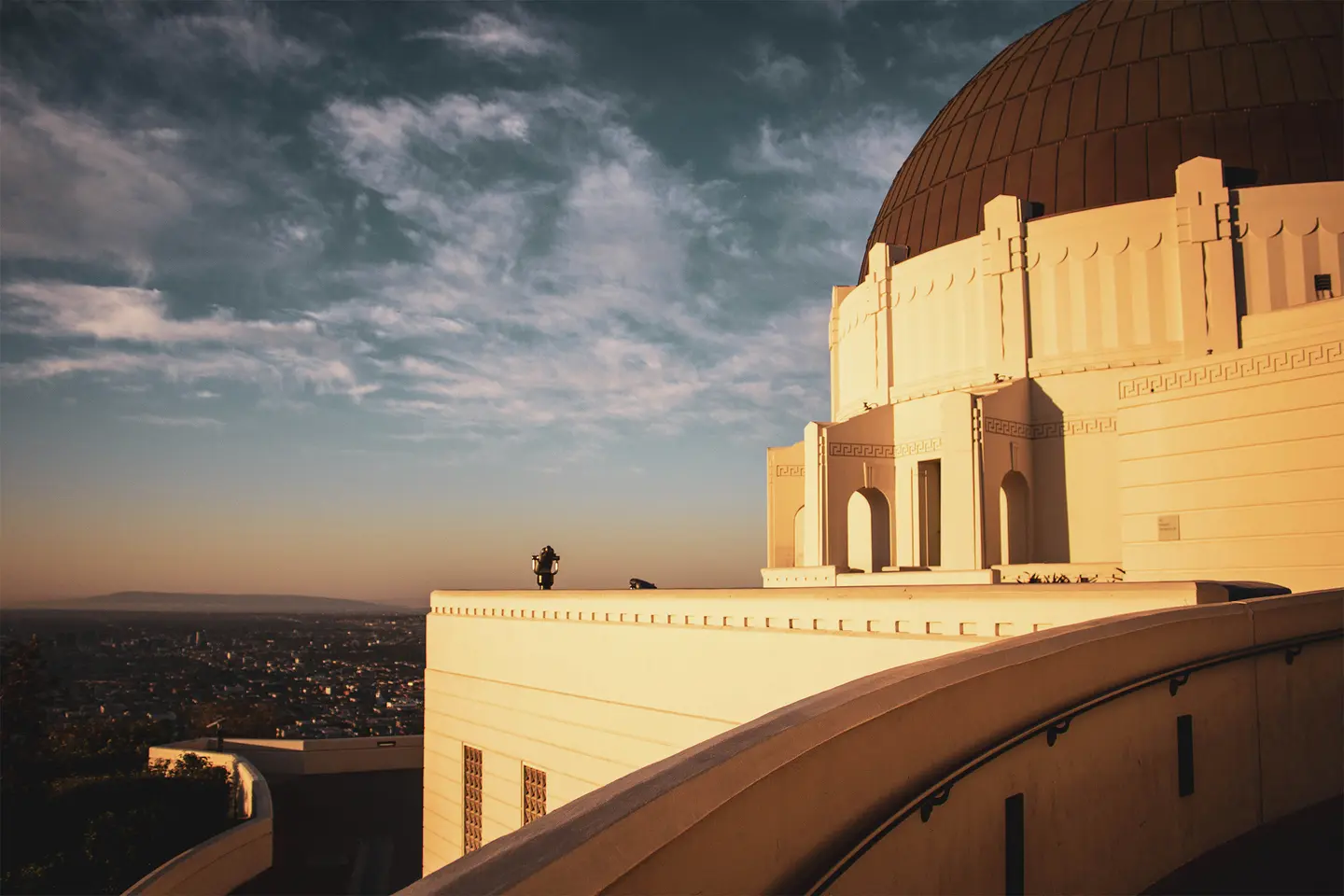
East side of Griffith Observatory in the city of Los Angeles.
Lena Wagner/Getty Images
By ,
To get a sense of what Griffith J. Griffith achieved for Los Angeles, all you have to do is hike up to the summit of Mount Hollywood, the second-highest point in the 4,210-acre urban wilderness park that bears his name.
“I find it a miracle that you look out over the basin and then you turn around and you look over the San Fernando Valley, and there is all of this urban and suburban sprawl, and some way, somehow, in the middle of it, there is this 4,000 acres for all of us,” said Mike Eberts, a professor of mass communications at Glendale Community College and author of a 1996 history book on Griffith Park published for the park’s centennial. “And Col. Griffith made that happen.”
“If there’s a list of people who’ve really made Los Angeles a great place to live, Griffith would be very high on that list,” Eberts, a board member of the Griffith Charitable Trust, continued.
In 1896, Griffith donated a massive piece of land to the city to be used as a public park, which today remains both a key city landmark and one of the largest municipal parks with urban wilderness in the United States. (For context, it is more than four times the size of San Francisco’s Golden Gate Park.)
The park likely wouldn’t exist today if it weren’t for Griffith’s foresight to set aside the land as green space in the city’s booming early days; he declared it “a place of recreation and rest for the plain people.” But while Griffith’s name is now emblazoned on the park, an observatory and a major boulevard, his legacy is complicated.

Construction of Griffith Observatory in Los Angeles, 1934.
Corbis/Getty Images

General view of the Hollywood Sign above Lake Hollywood on April 4, 2025, in Hollywood, Calif.
AaronP/Bauer-Griffin/Getty Images
In 1903, Griffith shot his wife in the face in a jealous rage and spent two years at San Quentin.
“He was a flawed man,” Eberts said, adding, “I like to think of him as someone who rose above his flaws.”
Col. Griffith J. Griffith was born in Wales in 1850 and moved to the United States as a teenager, later starting a career as a journalist covering mining in California.
He started working for mining companies as a side gig while still reporting on them (if you’re unfamiliar with journalism, that’s what’s called a conflict of interest) and eventually dropped the writing gig to manage mines full time.
In 1882, he moved to Los Angeles and purchased Rancho Los Feliz, 4,071 acres of a former land grant, all while dabbling in real estate and ranching and generally moving up into the city’s more elite circles.
Col. Griffith J. Griffith was also, notably, not a colonel. While he’d served as a major of riflery practice in the California National Guard, the colonel title was “apparently self-bestowed,” according to Eberts.

Portrait of Griffith J. Griffith circa 1910.
Calisphere/Los Angeles Public Library
In 1887, then-36-year-old Griffith married 23-year-old Mary Agnes Christina (“Tina”) Mesmer, daughter of an elite and wealthy Los Angeles family; “Union of Two Very Wealthy Los Angeles Families,” a headline proclaimed at the time.
Their relationship had developed while Tina was set to receive a large inheritance, something Griffith would have been aware of when the two first met, according to “Enlightened Egomaniac: The Life, Times & Crime of Griffith Jenkins Griffith,” a book by Miguel Llanos.
Griffith donated most of his rancho to the city in December 1896 (the press dubbed it a Christmas gift to Los Angeles) with much pomp and circumstance.
“Recognizing the duty which one who has acquired some little wealth owes to the community in which he has prospered … I am impelled to make an offer, the acceptance of which by yourselves, acting for the people, I believe will be a source of enjoyment and pride to my fellows and add a charm to our beloved city,” Griffith wrote in a letter to the mayor and city council.
At the time, the land “wasn’t really recognized as anything significant,” because it was so far away from downtown Los Angeles, according to Marian Dodge, board member at Friends of Griffith Park. To sweeten the deal, Griffith threw in land along the Los Angeles River, including the water rights.
Back then and in the years since, allegations and rumors have swirled that Griffith had other motives when making his generous donation — perhaps because previous business ventures at the rancho hadn’t panned out as planned, or to stop paying taxes on a huge piece of undevelopable property.
But regardless of motives, the giant parkland was set aside for generations of Angelenos, a slice of wilderness that dwarfs New York City’s Central Park several times over, set right in the middle of what became the nation’s second-largest city.
That massive swath of protected land means a chunk of the Santa Monica Mountains has been left undeveloped for over a century, while in other parts of the mountain range, conservation groups have had to fight to protect small pieces of habitat bit by bit, Dodge said.
“Griffith spoke of ‘taking time by the forelock, err it be too late,’ and so he really did see that this kind of frontier town, which we were when he donated the land in 1896, he envisioned it growing into a great city all around this park,” Eberts said.

Hotel Arcadia in Santa Monica, Calif., 1891.
Calisphere/Huntington Library
Then, amid his peak of local celebrity and reverie, Griffith committed a violent crime. Griffith and Tina were staying at a hotel in Santa Monica with their teenage son when an inebriated Griffith became paranoid and suspicious of Tina, accusing her of infidelity and asking if she was poisoning him (accusations she denied).
As the fight escalated, Griffith asked Tina to kneel, place a hand on a prayer book and answer his questions.
“His (last) question was: ‘Have you always been faithful to your marriage vows?’ I said: ‘As God is my judge, I have.’ As I answered the last question, he shot me,” according to a 1903 statement from Tina.
Tina survived but lost an eye and was disfigured by her injuries. She swiftly moved to divorce Griffith, and the judge granted the divorce in less than five minutes.
The day after the shooting, Griffith went right back to business around Los Angeles, including stops at his downtown office and a luncheon at the Jonathan Club.
When confronted by reporters about his wife’s injuries less than 24 hours prior, Griffith said that “the whole thing was purely accidental” and that Tina’s injuries were more from a fall out of the window than from the shot (Tina had jumped out of the hotel window to escape Griffith after he shot her).

Mug shots of Griffith J. Griffith, April 5, 1905.
California Department of Corrections and Rehabilitation
Griffith was ultimately found guilty of assault with a deadly weapon and sentenced to two years in San Quentin. When he emerged, he became an outspoken advocate for prison reform. Griffith J. Griffith “tells horrors of prison life” and “wages humanitarian crusade throughout country,” proclaimed one Los Angeles Herald headline in 1908 after Griffith’s release.
He also doubled down on securing his legacy as a wealthy yet generous member of the Los Angeles elite by offering $100,000 to the city to build a new observatory in Griffith Park.
Some city officials balked at taking more money from a man convicted of such a crime, and the efforts were slowed by litigation and debate for years. “The city still wanted his land, they still wanted his money, but they’re keeping him a little at arm’s length,” Eberts said.
Ultimately, Griffith left money to the city in his will for the construction of what became the Griffith Observatory and the nearby Greek Theatre, both of which opened in the 1930s, over a decade after Griffith’s death.

Helicopter point of view of Griffith Park Observatory in Los Angeles.
Getty Images/iStockphoto

Hiking path leading up to Griffith Observatory, with several hikers in the distance and trees on the edge of the path.
Lena Wagner/Getty Images
Griffith’s large donations appear to have memorialized him as a generous benefactor for the city, mostly overshadowing his violent crime.
In 1996, as part of Griffith Park’s centennial anniversary celebrations, a 14-foot bronze statue of Griffith was erected near the park entrance at the corner of Los Feliz Boulevard and Crystal Springs Drive.
The statue came after members of the Griffith Charitable Trust realized that “there was no dedication to the man who’d given the city this extraordinary gift,” according to nonprofit Friends of Griffith Park.
So the controversial figure now looms large over a busy intersection just outside the park, with a quote from Griffith that reads, “Public parks are a safety valve of great cities and should be made accessible and attractive where neither race, creed nor color could be excluded.”

The quote is attributed to Colonel Griffith, permanently cementing Griffith’s long con in stone.
———————————————————
As you see from this California & especially LA has always been a weird, violent and fun place to live.