Category: A Victory!

Obviously, I liked the guns.
Perhaps my favorite, based purely on aesthetics, was the pepperbox revolver. If you’re unfamiliar with it, think of a Gatling gun in your hand and you’ve got a good idea of what it looked like, though the operation was very, very different.
The guns aren’t really a thing in this day and age, yet apparently, you can still get arrested for having one in California.
Just after 8 p.m. on Tuesday night, officials with the Redding Police Department said their officers were called to the Burger King off of Eureka Way for a report of a man seen walking around with a handgun on his bag. Officers said they responded to the area and contacted the suspect, identified as Ryan Battles.
After searching Battles’s bag, police said they found an antique black-powdered pepperbox revolver, black powder and iron pellets.
Of course, the media called it a “musket-style pistol,” which makes little sense.
Battles was arrested for carrying a concealed weapon without a permit.
Now, with all that said, yes, there is more to the story. For one thing, police believe Battles stole the gun in the first place. Apparently, he’s not much of a history buff or something. Either way, if the gun is in fact stolen, I’m all for putting Battles under the jail, metaphorically, of course.
I cannot abide a thief, but especially not a gun thief.
Yet I can’t help but chuckle about someone ultimately being arrested for carrying an 18th-century revolver, something not that different from what anti-gunners routinely tell us the Second Amendment is really protecting.
Again, Battles isn’t actually charged with having a stolen gun. They just think it’s stolen. While they’re probably right, they still arrested a man for carrying an antique, muzzle-loaded revolver that apparently wasn’t even loaded.
Only in California.
OK, not just in California, of course, but you know what I mean.
Still, if they believe it to be legitimately stolen, they need evidence that it wasn’t his gun. I don’t know that they have that, which also means it’s possible that Battles is innocent of that accusation.
Either way, though, this looks like it could be a surprisingly interesting case. I clicked on it because the headline looked weird and I’m a fan of pepperbox pistols, so seeing the picture made it obvious that I’d talk about this one.
But there are a lot of layers to this one that hasn’t really been uncovered as of this writing. I’d say it’ll be interesting to see how all of this shakes out, but it’s California. Even if the gun belonged to Battles lawfully, he’s still getting prosecuted for not having a carry permit at a minimum. As such, we know how it will ultimately shake out. It should still be pretty fascinating to watch in that trainwreck kind of way.
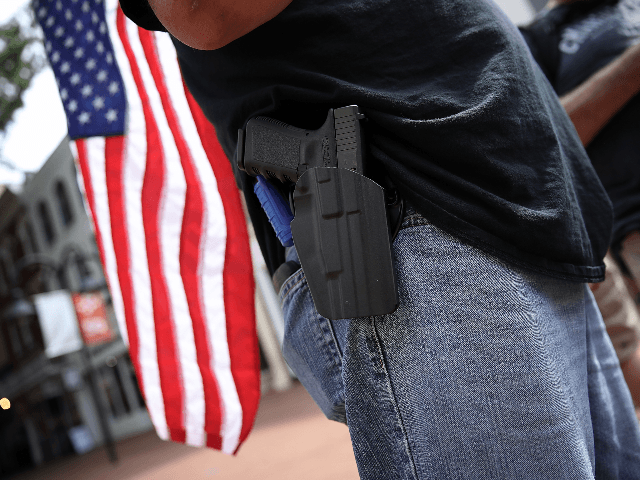
South Carolina’s Senate Judiciary subcommittee advanced constitutional carry legislation Wednesday, keeping the state on track to become the 27th constitutional carry state in the Union.
On February 2, 2023, Breitbart News reported that South Carolina State Rep. Bobby Cox (R-Greenville) put forward H.3594 to secure constitutional carry in the state.
On February 23, 2023, NRA-ILA noted that the South Carolina House passed Cox’s legislation.
Now constitutional carry is moving through the South Carolina Senate. The Post and Courier observed that it passed out of the Senate Judiciary subcommittee by a 3-2 vote on April 5, 2023, and now goes to the full Judiciary Committee.
Breitbart News spoke with Cox about the constitutional carry legislation on April 6, 2023, and he said, “The Senate should not delay in passing H. 3954. The House version was a collaborative effort between 2A groups and law enforcement to restore our constitutional freedom and keep guns out of the hands of criminals.”
Currently, the Union has 26 constitutional carry states: Alabama, Alaska, Arizona, Arkansas, Florida, Georgia, Idaho, Indiana, Iowa, Kansas, Kentucky, Maine, Mississippi, Missouri, Montana, New Hampshire, North Dakota, Ohio, Oklahoma, South Dakota, Tennessee, Texas, Utah, Vermont, West Virginia, and Wyoming. (Florida’s constitutional carry law takes effect July 1, 2023.)

Are helicopter pilots highly regarded in the US Army especially since most are warrant officers? How are they viewed by others in the army or by pilots in say the Air Force or the Navy who are all commissioned?
Army helicopter pilots are very highly regarded, regardless of rank. They bring firepower, food, ammunition and mail. They evacuate the wounded and remove the tired from the battlefield. They are braver than lions, fiercer than tigers, gentle as lambs. They have nerves of steel, the eyes of eagles, the cunning of a snake and can drink like its the end of the world. And on top of all that, we are ever so humble and modest.
Finally! An accurate description of an Army helicopter pilot, as seen by the people in his life:
As seen by himself:
An incredibly intelligent, tall, handsome, innovative, and highly trained professional killer, idol to countless females, and Gentleman Adventurer, who wears a star sapphire ring, carries a hair-trigger .45 automatic in a specially designed, hand-made quick draw holster along with his trusty survival knife, who is always on time thanks to his ability to obtain immediate transportation and the reliability of his Rolex watch.
As seen by his wife:
A disreputable member of the family who comes home once a year all bruised up, driving a stolen jeep up to the back door carrying a B-4 bag full of dirty laundry, wearing a stained flight suit, smelling of stale booze and JP-4, wearing a huge watch, a fake ring, and that damn ugly beat-up pistol in that stupid holster, who will three months later go out the front door, thankfully for another year.
As seen by his commander:
A fine specimen of a drunken, brawling, jeep stealing, woman corrupting liar, with a star sapphire ring, fantastically accurate Rolex watch, an unauthorized .45 in a non-regulation shoulder holster, and trusty survival knife.
As seen by Division Headquarters:
The embodiment of a drunken, brawling, jeep stealing, woman corrupting, lying, zipper-suited Sun God, with a ring, a proscribed 1911A1 .45 in a non-regulation shoulder holster, a Rolex watch, who for some reason carries a survival knife.
As seen by the DoD:
An overpaid, rule-ignoring, over-ranked tax burden, who is unfortunately totally indispensable simply because he has volunteered to go anywhere, and do anything, at any time, only so long as he can booze it up, brawl, steal jeeps, corrupt women, lie, and wear a star sapphire ring, Rolex watch, and carry an obsolete hand gun and a survival knife.
As seen by the enemy:
The implacable inescapable face of death!
Florida residents will be allowed to carry concealed firearms without a permit after Republican Gov. Ron DeSantis signed a Constitutional Carry bill into law on Monday. The move is viewed as another legislative victory for the governor, who is preparing for a presidential campaign.
The bill was signed in a private ceremony in DeSantis’ office, with his only public comment being “Constitutional Carry is in the books,” in a three-paragraph news release.
The new law will allow anyone who can legally own a gun in Florida to carry one without a permit starting on July 1. Background checks and training will not be required for carrying concealed guns in public.
The debate surrounding the legislation was split along political lines, with Republicans arguing that law-abiding citizens have the right to carry guns for self-protection. Republicans believe that most people will still want to obtain permits to carry concealed weapons in states with reciprocal agreements and to buy guns without a waiting period.
However, Democrats and gun control advocates argue that the new law will only make the state more dangerous, pointing to past mass shootings in Florida such as the 2016 Pulse nightclub massacre in Orlando and the 2018 shooting at Marjory Stoneman Douglas High School in Parkland.
“I am pissed,” said Fred Guttenberg, whose 14-year-old daughter Jaime was killed at Marjory Stoneman Douglas High School in Parkland, during an online news conference. “I will chase him down across the state as well as possibly across the country…because Ron DeSantis today put his signature to a bill that guarantees there will be more Jaimes.”
Guttenberg added that he believes DeSantis is a coward for signing the bill behind closed doors.
“Somebody in Florida may die … because of this legislation. That will be because of you, Ron DeSantis,” Guttenberg said. “I understand why you hid today … You are a weak, pathetic, small-minded individual.”
Almost 3 million Floridians have a concealed weapons permit. Although background checks and a three-day waiting period will still be required to buy guns from licensed dealers, they are not mandatory for private transactions or weapons exchanges.
DeSantis has indicated that he thinks Florida should go further and allow people to openly carry guns. However, while some lawmakers have advocated for open carry, it is unlikely that such legislation will pass during this session.
The bill signing comes five years after former Republican Gov. Rick Scott signed a bill imposing gun restrictions following the deaths of 17 students and faculty at Marjory Stoneman Douglas. Under DeSantis, the momentum has shifted towards expanding gun rights rather than limiting them, earning him praise from gun-rights advocates.
“Government will not get in the way of law-abiding Americans who want to defend themselves and their families,” said Republican Senator Jay Collins, who sponsored the bill, in a news release.
John Velleco, the Executive Vice President for Gun Owners of America, celebrated the new bill.
“It was a pleasure to attend the signing ceremony with Governor DeSantis today in Tallahassee, and we commend him for pushing lawmakers to right this discriminatory wrong from the state’s past,” Velleco said.
The bill was signed one week after six people were killed in a Nashville school shooting, which was highlighted by President Joe Biden’s administration.
“It is shameful that so soon after another tragic school shooting, Florida Governor Ron DeSantis signed into law a permitless concealed carry bill behind closed doors,” said White House Press Secretary Karine Jean-Pierre. “This is the opposite of common-sense gun safety.”
As GunsAmerica previously reported, there is no evidence that crime rates increase in the wake of the passage of permitless carry laws. Fears and concerns over “blood in the streets” are totally unfounded. If Constitutional Carry was a threat to public safety, there’d be ample data to substantiate that claim as half the country has these laws on the books. And not one state has turned into the wild wild west.