Categories
All About Guns You have to be kidding, right!?!

The Tiny Pocket-Sized North American Arms Zebra Killer by WILL DABBS

This nutjob is crazy as a fruit bat. However, his exploits captivated America through long months of social isolation.

Joe Exotic is all the rage these days. His Netflix biopic Tiger King apparently got the entire planet through its recent COVID-driven isolation. I watched a bit of it. That guy was the chemical formula for crazy.

These guys aren’t staples at your local neighborhood PetSmart, but a fair number of Americans do maintain animals, some of them unusual, just for the heck of it.

Collecting and maintaining exotic animals isn’t as rare as you might think, particularly in locales with a little space. It’s not like every other home on the cul-de-sac has a rhinoceros in the backyard, but a surprising number of folks blessed with the room do maintain a modest menagerie just for the heck of it.

These guys look pretty, but they sound like you ran over the horn section of your local marching band with a dump truck.

Peacocks were once a sign of means. They are undeniably attractive birds, but have you ever heard one squawk?  I’d make it a week before I put that thing on the dinner table. However, in my travels I have seen wallabies, camels, and a smattering of African hoofed stock traipsing about rural American pastures. A great friend I met in my medical clinic recently related a most fascinating tale from several decades ago.

Failure to Play Well with Others Always Carries Consequences

Zebras are undeniably beautiful animals.

My buddy grew up on a rural farm out West, and his father maintained an expansive pasture liberally populated with weird exotic animals. The man just enjoyed the novelty of cultivating his own miniature African savannah. His mini zoo included gazelles, kangaroos, some odd African deer, and a smattering of zebras.

Some of God’s creatures just have a sour attitude. A friend’s big male zebra fell into that category.

These creatures were ungulates all, so it wasn’t like they would eat each other. However, creation is indeed an undeniably fallen thing. That meant that the larger, more capable beasts tended to pick on the smaller sort. Among none of these disparate residents was this a greater problem than with a certain newcomer, a big buck zebra. He had a chip on his shoulder and the bulk to make it stick.

Collecting zebras is almost as expensive as collecting transferable machineguns. Figuring in ammo costs makes maintaining each likely comparably spendy.

Google tells me that an adult plains zebra will cost between $3000 and $7000 nowadays. Other species are endangered and therefore illegal to own. My buddy tells me his dad’s big buck zebra set him back several grand even back in the day.

This one big buck zebra was an inveterate grouch.

One fine afternoon my buddy and his dad were sitting in rocking chairs on their front porch enjoying a proper chat. Their weird animals cavorted in the front pasture providing a pastoral backdrop to a proper visit. Suddenly and unprovoked the big zebra tipped up to one of his dad’s odd African deer and bit him on the head, dropping the poor little guy like a sack of cement.

The North American Arms .22 Short micro-revolver is just adorable. Not much bigger than my thumb, this is the gun you can always have on you.

Nobody likes a bully, and my buddy’s dad immediately lost his patience. Leaping to his feet and fishing about in his front right pocket the man produced a North American Arms micro revolver chambered in .22 Short. These adorable little stainless steel pistols look like they were scaled for your kids’ action figures. However, their compact dimensions mean that these tiny little wheelguns are the firearms that you can always have available. If you’re wearing clothes and own an NAA pistol you have no excuse for not being armed.

The big zebra’s antisocial behavior prompted a warning shot above the pasture.

The man shouted at the offending creature and loosed a single diminutive .22 Short round over the top of the pasture to get his attention. The zebra indeed leapt back from the now terminally injured deer and wandered off to pick on something else small and helpless. My friend’s dad grumbled a bit, ensured his gun was safe and replaced it in his pocket. The rest of the conversation was dominated by what a jerk the new zebra was.

A short while later the bullying zebra just dropped dead.

A couple of days later the zebra fell over dead. My pal says he had seemed in no particular distress until the moment he shuffled off his mortal coil. One minute he was standing in the pasture peacefully behaving in the manner of a typical zebra. The next moment he was demised. A cursory examination revealed nothing amiss, so the local veterinarian was summoned.

Don’t let the diminutive dimensions fool you, this tiny little wheelgun remains quite lethal.

A necropsy by the animal sawbones revealed a single small-caliber bullet wound to the creature’s flank. Apparently, amidst his fit of justifiable anger, the wizened farmer had inadvertently popped the beast in the belly with his tiny little pistol at a surprisingly long range. Seventy-two hours later the zebra was no more.

Here we see any number of popular cartridges arrayed alongside the diminutive .22 Short on the far left. Feel free to name them all in the comments. Extra credit if you can specify the particular loads.

Many folks might inquire as to the practical utility of such an underpowered and anemic little defensive gun. There are indeed literally countless other options that are more reliable man stoppers. However, I have it on reliable information that, in the right hands and aggressively wielded, one can successfully hunt African big game with these tiny little rascals.

The Gun

North American Arms built its business on these cool little stainless steel single action revolvers.

The North American Arms company evolved out of North American Manufacturing. North American Manufacturing had itself been Rocky Mountain Arms back when it was founded in 1972.

The .22 Short NAA revolver is ridiculously small. It is shown here alongside a Magnum Research .44 Magnum Desert Eagle.

Today’s North American Arms is a most personable mob. Sandy Chisolm is the CEO and a regular feature at his company’s booth at the SHOT show. Sandy and his crew are invariably good for some spirited conversation.

The trim little North American Arms Guardian semiautomatic pistol is designed for deep concealed carry.

The current NAA lineup includes an array for stainless steel pocket autoloaders called the Guardian series. These trim little concealed carry guns come chambered in .32ACP as well as .380ACP along with a couple of odd little wildcat rounds.

These little proprietary necked-down cartridges are just cute as a button.

The .25NAA is a .25ACP bullet mounted atop a necked-down .32ACP case. The .32NAA is a .32-caliber projectile pushed from a modified .380ACP case. These two adorable little loadings are nothing if not unique. NAA’s real forte, however, is their expansive line of single action .22-caliber revolvers.

North American Arms produces their little revolvers in a bewildering array of configurations. This version uses interchangeable cylinders to run either .22LR or .22 Win Mag.

NAA produces versions of their classic guns with swing-out cylinders and tip-up barrels. However, most of their guns utilize a five-shot removable cylinder. All of their pistols are cut from high-grade stainless steel.

To load these guns you remove the cylinder pivot pin, disassemble the gun, and fill or empty the cylinder. This procedure is not hard but it will not be done in haste.

A typical NAA revolver features a removable cylinder pin that can also be used to punch out empty cases once it is separated from the gun. Loading and unloading will not be done in a rush, but this is not the gun you will use to win an IPSC match. NAA revolvers are the weapons you use when your more serious iron is either empty, broken, or left behind in the gun box back home. Under those rarefied circumstances, an NAA miniature wheelgun could be the final line of defense between you and some Very Bad Things.

Believe it or not, both of these guns are pistols in the eyes of the government. The SIG Rattler in .300AAC dwarfs this NAA micro revolver.

The manual of arms is completely straightforward. Modern NAA guns include safety notches between each chamber, so the gun can be safely carried with a full cylinder even loose in a pocket. To run the gun simply point it at something you dislike, thumb back the hammer, and squeeze. These guns technically have fixed sights, but you’ll likely never use them for real.

These guns have sights, but you probably won’t use them. This .22 Short version is shown alongside a 7.62mm tracer bullet.

My .22 Short version is as cute as a beagle puppy and about as useful. I own one simply for the novelty of the thing. The larger brother in .22 Magnum, however, is a serious social tool.

My .22 Win Mag NAA revolver includes a pivoting pistol grip that folds forward to shield the trigger when in carry mode.

My gun has a pivoting grip that folds up to cover the trigger when stowed. Deploying the gun for action takes mere moments and is intuitive. Once unfolded the grip gives you ample purchase to run the gun safely and well.

Deploying the gun for action can be easily managed quickly and one-handed. Winchester PDX-1 loads make the .22 Win Mag particularly nasty.

I keep mine loaded with Winchester PDX-1 .22 Magnum loads. These high-tech expanding hollowpoint rounds produce some of the most hideous-looking star-shaped projectiles in ballistic gel. Five of these rascals might not drop my buddy’s zebra amidst a proper charge, but it would certainly give an evil-doer pause were he to face one with malicious intent.

There is a veritable cornucopia of cool-guy stuff designed for these little guns. The .22 Win Mag version on the bottom has a laser sight built into the grip.

Scads of options, accessories, and sundry widgets make these good guns great. There is even a version that fires balls using black powder and percussion caps that ships straight to your door without the hassle of an FFL. I have wandered about where the Wild Things roam with my trusty .22 Win Mag mini-revolver in my front right pocket and never felt like a victim.

Your Constant Companion

A bad dog can be an intimidating opponent at close quarters.

Our hero a different day at the clinic was a house painter and a regular patient. He had been working on a local gentleman’s front porch when around the corner charged the homeowner’s hound in a state of remarkable agitation. Dogs are by their nature territorial, and this one was mightily perturbed at the presence of someone not of his tribe. The canine took hold of the painter’s hand and shook it with great vigor.

An enthusiastic dog can do a serious job on a human hand in a shockingly short period of time. That’s going to need some attention.

Before things got totally out of control the homeowner appeared and restrained the beast. My buddy’s hand, however, was by that time in dire need of attention. An hour later the man sat reclined in the treatment room at my clinic as I prepared to restore his appendage to working order. As I got down to business he related the tale of the afternoon’s excitement.

The NAA revolver is absolutely tiny and all but weightless. It can be your backup or the backup to your backup. So long as you are wearing clothes you can tote this gun painlessly. This folding grip also includes a built-in pocket clip.

He fished about in his front pocket with his good hand and retrieved a shopworn NAA .22 revolver. He showed me the gun and explained that he had been mere moments away from using it on the excessively-territorial canine. Fortunately the dog’s owner defused the situation in time. Thank goodness the malevolent creature was not a zebra.

We don’t typically imagine the zebra to be a particularly aggressive dangerous animal. However, when properly tooled up they can indeed be formidable.
Categories
You have to be kidding, right!?!

When the Russian navy was popular here in the US of A

COURTESY NAVAL RECORDS AND LIBRARY, NAVY DEPARTMENT

The Visit of Russian Squadrons       in 1863

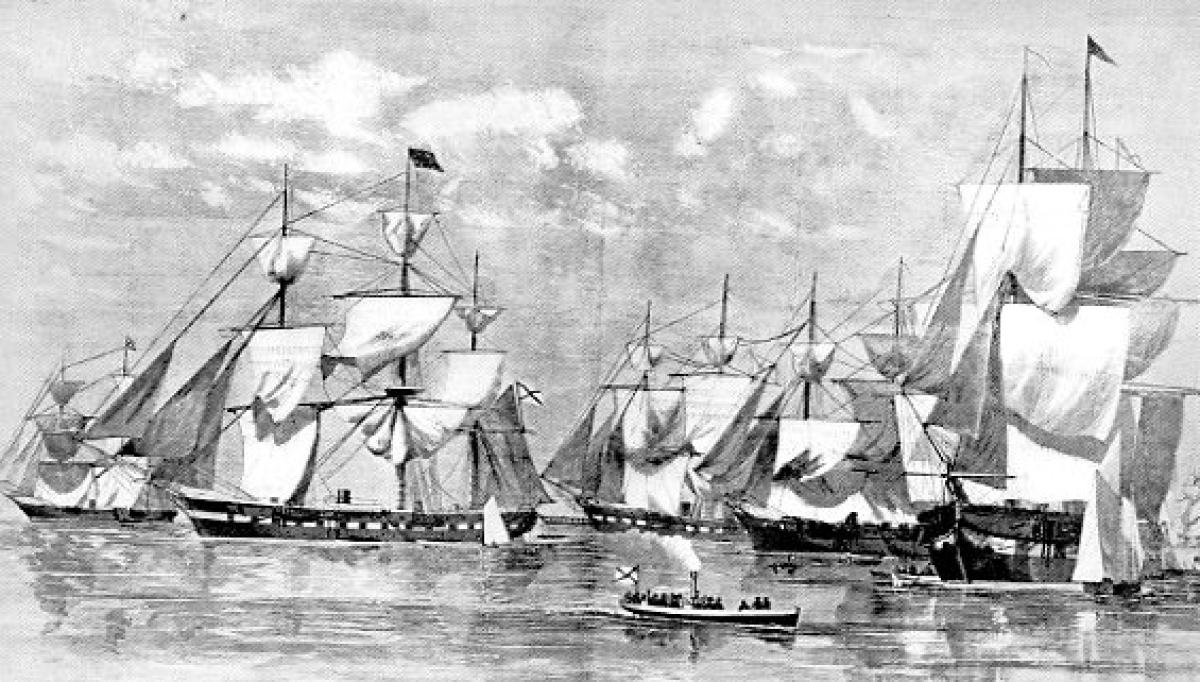
One late September day in 1863 the Russian frigate Osliabia under the command of Captain Bourtakoff steamed into New York Harbor. The city authorities gave it the customary cordial welcome accorded to a man-of-war of a friendly nation paying a visit.

A few days later a Russian cruiser squadron commanded by Real Admiral Lessofsky and consisting of the frigates Alexander Nevsky (flagship), Peresvet, the corvets Variag and Vitiaz and the clipper Almaz cast anchor in New York Bay. This was a signal for the City Fathers to give the Russians a rousing reception. To quote the New York Daily Tribune of October 2, 1863, we hear that:

The “Joint Committee” went out to welcome the Russian visitors. The band of the North Carolina performed the beautiful Russian National Air, “God Save the Czar,” as it passed the vessels, while the Russian seamen mounted the riggings to acknowledge the compliment by loud and hearty cheers. The band of the flagship Alexander Nevsky struck up “Yankee Doodle” in return. A dozen of the ships’ boats were awaiting the arrival of the committee and the invited guests were transferred to the deck of the Russian flagship…The officers of the Russian fleet were standing on the starboard side in full-dress uniform with Admiral Lessofsky at the head. The seamen were drawn up in line on the port side and forward on the starboard side. The officers present numbered nearly threescore and were of the grades known in the Russian Navy as admiral, post captain, lieutenant, sub-lieutenant and midshipman. The uniforms of the Russian Navy are very attractive, being tastefully decorated with gold lace and embroidery about the collar and cuffs.

Great excitement prevailed in New York City. A grand parade was tendered to the Russian visitors. According to the newspapers:

one thousand metropolitan police marched in the parade, as well as units of the Seventh Regiment (the Daily Tribune did not fail to comment upon the excellent marching of the “Old Seventh”). The procession started at the foot of 23rd Street and went all the way down to 14th Street. Spectators lined the streets in great masses and everybody was waving flags and handkerchiefs from windows and housetops. It was estimated that over 30,000 people attended the parade. The Russian admiral and officers were feted by the city authorities and toasts were drunk “in good wine” both to the health of the President of the United States and the Czar of Russia.

Another surprise awaited the American people. A few days later the telegraph flashed news from San Francisco that a squadron of Russian cruisers had passed the Golden Gate and was riding at anchor in San Francisco Bay. This unit was commanded by Rear Admiral Popoff and was made up of the following ships: The corvets Rynda, Kalevala, Bogatyr, and Novyk, and the clippers Abrek and Gaydamak.

All this happened, as stated before, in the year 1863. Northern shipping at that time was being severely ravaged by the commerce raiders of the Confederacy. The exploits of these raiders equaled, if not surpassed, both in adroitness and damages inflicted upon the Northern merchant marine of the United States, the activities of the well-known German raider Emden and her sister-ships during the World War. It has been recorded that by November, 1864, more than 1,300 vessels flying the Union flag had been sunk by Southern raiders, the net proceeds arising from the sale of condemned prize property amounting to over 13 million dollars.

If we keep in mind that the Northern merchant fleet on the high seas had been reduced during the Civil War from about 2½ million tons to a little over 1½ million tons and was being continuously harassed by successful attacks of the Alabama,Florida, and other Confederate ships, the arrival in New York and San Francisco of cruiser units belonging to a friendly nation was naturally an event of great importance.

As far as the Union was concerned the political situation presented itself as follows: England was supporting the South more or less openly by allowing British shipyards to build ironclads and cruisers for the Confederacy, half-heartedly interfering with the delivery of these ships only upon the most strenuous though tactful remonstrances from the United States Ambassador, Charles Francis Adams, whose protests, however, were not always successful.

Let us now examine more closely the motives that prompted Czar Alexander II to dispatch his fleets to New York and San Francisco.

In January, 1863, the latest Polish revolt had broken out openly. Due to the intensive propaganda carried on for some time by the numerous Polish émigrés in various European capitals, the rebellion quickly gained the support of public opinion throughout Europe. In France especially the Polish patriots were in high hopes. The adventurer-emperor Napoleon III was favorably inclined toward their cause. His Minister of State at that time was Count Walewski, a son of the Emperor’s august uncle, Napoleon I and the Polish Countess Walewska, who was naturally pro-Polish. Moreover it was a political tradition of the second empire to further Polish national aspirations in reverence to the memory of the Great Corsican who created the independent Grand Duchy of Warsaw.

Napoleon III succeeded in persuading Great Britain and Austria to join him in a diplomatic demonstration against Russia on the Polish question. Both of his allies deemed the moment opportune to exact some advantages from the Czar while the latter was preoccupied by the disturbances on his western frontier. Prussia refused to become a party of the coalition and Bismarck, in defiance of the German Parliament and public opinion, even offered the Czar military assistance to quell the Polish insurrection. The Allies, France, Austria, and England, entered into a lengthy exchange of notes with the Russian government and the political situation became alarmingly tense. Czar Alexander II, with open rebellion in his Polish and Lithuanian provinces, had also to reckon with the possibility that Finland and the Caucasus would rise in revolt at the first opportunity. Such an opportunity would easily present itself with the arrival of joint Anglo-French fleets and landing detachments both in the Baltic and Black Seas.

The demands of the Allies became increasingly aggressive. Finally Napoleon III dispatched a sharp note to Russia demanding immediate recognition of Poland as an independent country. This the Russian government could not grant but it realized at the same time that a refusal of the French demand meant only one thing—war. The crisis approached rapidly. Russia faced a desperate situation. Her Navy, recently reorganized, was absolutely insignificant in comparison with the fleets of the two largest naval powers of Europe. In case of war the seacoasts of her far-flung Empire, in the Baltic and Black Seas and the Far East, were entirely defenseless and exposed to blockade, bombardment, and landing of troops by her enemies. Her only chance lay in having England quit, as in such an event the French fleet alone would not be sufficiently large to bother Russia on all her maritime frontiers. Thus Russia would not be forced to scatter her Army in order to defend her various seaboard provinces. Besides, Austria would think twice before attacking the innumerable host of “Holy Russia” concentrated to repulse any invasion, especially as Emperor Francis Joseph knew that Prussia would not hesitate to come to the assistance of the Czar.

Russia’s problem reduced itself to the means of keeping Great Britain out of an alliance with France and Austria. A simple and at the same time brilliant solution was found by Admiral N. K. Krabbe, at that time in command of the Russian Navy.

The dashing exploits of the Alabama and other Confederate raiders had conclusively demonstrated that a comparatively small number of well-armed and equipped cruisers could cause havoc among the merchant marine of their enemy, even if their adversary had a much superior naval force. As more than 75 per cent of the British merchant fleet at the time of the Civil War consisted of sailing vessels, the sudden appearance of about a dozen Russian steam-propelled cruisers both in the Atlantic and Pacific would greatly alarm England. These cruisers, which were able to sail under canvas when things were slow and get up steam and easily overhaul any prize they sighted, could still evade on the huge expanse of the two oceans any possible dragnet of the British Navy. They had a great advantage over the German raiders of the World War inasmuch as they were not dependent to such an extent on coaling stations, but could cruise under sail for practically an unlimited amount of time if necessary.

The vision of a dozen of such cruiser raiders ravaging British merchantmen on all the Seven Seas was enough to strike fear to the heart of even the staunchest Tory, because, after all, “Britannia rules the waves” only for her commerce, and the balance sheet of an English merchant is almost as important to him as the Magna Charta.

Fully realizing all this, Admiral Krabbe submitted to Czar Alexander II his daring plan.

The Russian Navy at that time commanded only about twelve vessels which were up to date and fit for cruiser duty. He proposed that two cruiser squadrons of approximately equal strength should be formed and dispatched to Union ports, one from St. Petersburg and the other from Vladivostok, with orders to arrive simultaneously in New York and San Francisco, respectively. The success of the whole plan depended entirely upon its being carried out both swiftly and secretly. Both fleets were outfitted for the crossing and subsequent cruiser duty on the high seas in less than a month. The entire personnel of the expedition was selected from unmarried men.

The squadron that left St. Petersburg for New York was the most important one and it was, therefore, especially necessary for this unit not to divulge its movements as, in view of the straitened relations of Russia with England and France, these two powers would undoubtedly prevent the squadron from leaving the Baltic Sea. Orders were, therefore, issued to Admiral Lessofsky, commanding this squadron, to have his ships leave Kronstadt (the naval base of St. Petersburg) singly, as if to relieve ships on patrol duty off the coast of Courland. Near the island of Bornholm, two colliers awaited them and the squadron replenished its bunkers. In order to hide his movements Admiral Lessofsky then proceeded through the seldom used passage of the Little Belt, avoiding the main trade route of the Big Belt where he would have been in danger of encountering British scouting vessels. Once out of the Baltic Sea he set his course straight north and leaving the British Isles far south turned westward for New York.

In the meantime Admiral Popoff, in command of the other squadron, had left Vladivostok.

The successful synchronization of the movements of the two squadrons starting from points a continent apart and with the distance to their respective ports of destination varying many thousands of miles was a remarkable achievement for those days, especially if we realize that at that time there were no telegraph or railroad communications between St. Petersburg and Vladivostok and the order to Admiral Popoff had to be dispatched by special courier who traveled many weeks in order to deliver it. The order to Popoff contained among others the instruction to place his ships at the disposal of the Federal admiral should the English or French fleet attack the city of San Francisco but to remain neutral as long as the bombardment was concentrated on the military fortifications only.

A surprised Europe learned one day from arriving American newspapers that a Russian cruiser squadron had cast anchor in the harbor of New York and that a few days later another Russian fleet had passed the Golden Gate. These newspapers also brought accounts of the enthusiastic reception of the Russians by the American people.

The impression created by these events on the governments and public opinion of the three Allies was tremendous. It now appeared that while the two mightiest naval powers of the time were threatening the coasts of the Russian Empire, the Czar had turned the tables on them and his fleet was menacing England and France from the rear. Having evaded their watchfulness, the Russian squadrons now occupied, especially with regard to England, such a commanding and invulnerable position that the Allies were forced to change their policy abruptly. All speculations as to advantages of actions against Russia’s unprotected coasts momentarily faded before the possibility of the colossal losses which the Russians could inflict upon the sea trade and colonies of England and France. Russia’s game was won.

The first power of the coalition to sense the unsteadiness of the situation—the possibility of England withdrawing from the Alliance—was Austria. She not only hastened to compromise with Russia but expressed her willingness to co-operate in the quelling of the Polish revolution. A sharp note which England already had dispatched to St. Petersburg was hurriedly stopped in Berlin and soon England abstained completely from further interfering with Russian affairs. Left alone, Napoleon III tried to “save his face” by suggesting a congress to discuss the Polish question but this proposal found no response either in Austria or England. A few weeks later Alexander II issued an Imperial Rescript regarding foreign interference in the Polish situation couched in such phrases that had it been published before the arrival of the Russian fleet in America, it would have meant immediate war with the Allies. Nothing happened now, however.

Both Russian squadrons stayed in America for almost a year and were recalled only after the Polish rebellion had been definitely crushed and when the ultimate success of the North was clearly visible and any danger of England’s intervention in the Civil War had vanished.

After the end of the Civil War, the American government, learning of the attempt on the life of Czar Alexander II sent to St. Petersburg a special naval detachment consisting of the monitor Miantonomoh and steamer Augusta with a delegation to congratulate the Emperor on his deliverance from danger and to express to Russia the appreciation of the United States for the help Russia rendered to preserve the unity of the American people by sending her Beet to America.

The question, whether England’s entry into the war on the side of the Confederacy at this critical moment of the struggle would have been crucial to the North is a matter of speculation for authorities on military operations. It is undisputable, however, that it would have created a most precarious situation for the Union Government and seriously jeopardized its chances for victory.

It was, of course, for various reasons that England decided to remain neutral, but the presence of Russian cruisers both in the Atlantic and Pacific played undoubtedly a major part in influencing British statesmen to adopt that policy.

As we have seen, Russia launched this naval expedition primarily in her own interest, to avoid a threatening war in which she would have to face a superior enemy while her western provinces were in open rebellion and other borderlands ready to revolt at the first opportune moment. We must keep in mind, however, that the United States and Russia were traditionally on friendly terms. As America alone had stood by Russia in 1854 during the Crimean War, nine years later Russia was the only great power siding with the Federal Government and quite openly expressing its friendship, although Prussia and a few smaller European countries were also sympathetic with the North.

The services Russia thus rendered the United States undoubtedly influenced Congress in 1867 to agree to the purchase of Alaska upon request from Czar Alexander II. Alaska at that time was considered a barren wasteland.

Categories
Darwin would of approved of this! You have to be kidding, right!?!

HOW NOT TO KILL A SNAKE PRO TIP: IT AIN’T SUPPOSED TO BE A FAIR FIGHT WRITTEN BY JEREMY CLOUGH

Jeremy will leave it to Dr. Dabbs to tease out the finer points of copperhead bites.
Suffice it to say, they’re venomous, aggressive and you do not want to tangle with them.

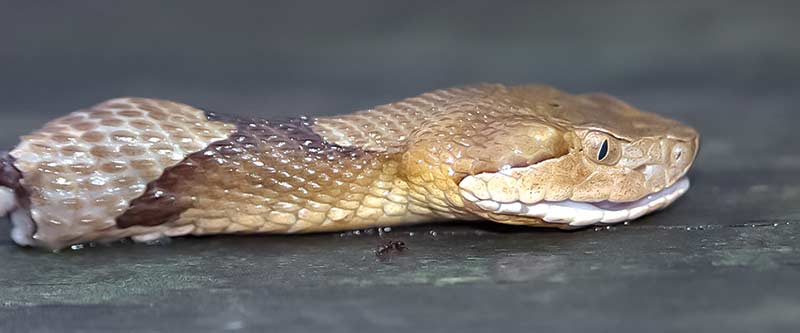
“It” was about 2′ long or so, big for its breed, and facing away from me where I couldn’t see the sinister smile concealing its fangs. I’d seen plenty of copperheads before and knew one this close to the house had pretty much signed its own death warrant. I’d seen him — though not until I was waaay too close, but I might not the next time.

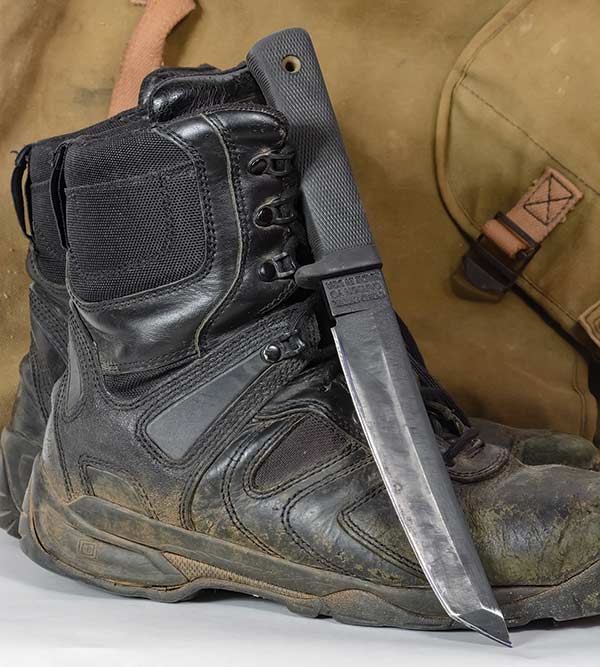
This Cold Steel Recon Tanto split Jeremy’s kindling for five years without
being sharpened. It also eased a couple serpents into their slithery afterlife,
something we can’t in good conscience recommend.

Multitasking Geometry

Still carrying on my business call, I pondered my options. To this point, I had only ever killed copperheads with a knife. A dangerous business, but geometrically logical: Intersecting a line (the snake) with another line (the blade of my Cold Steel Tanto) was easier than intersecting a line (the snake) with a point (read: bullet). To be fair, I hadn’t actually graphed all this out the first time I did it.

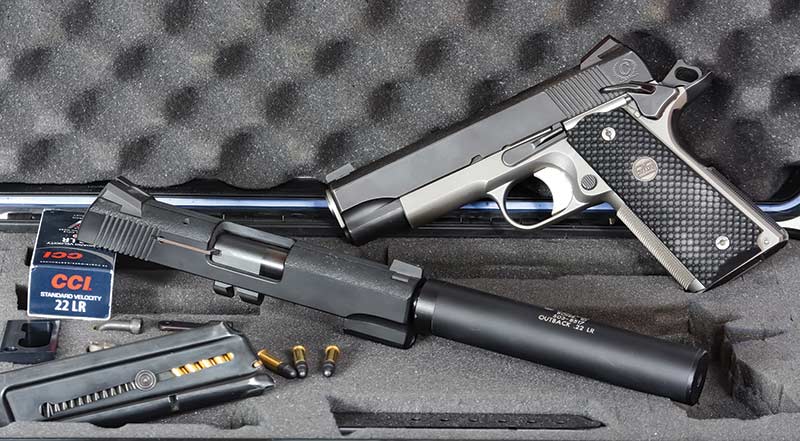
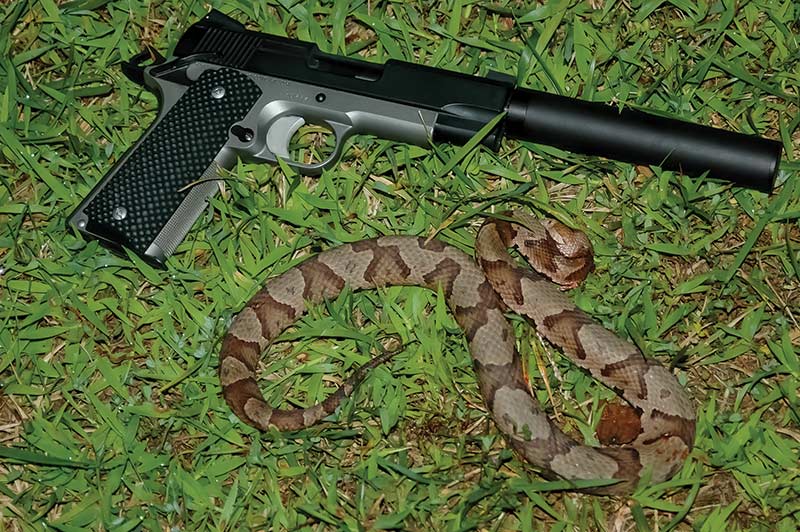
This titanium Commander Jeremy built on a long trip to Novak’s was state
of the art for the time with its matching .22 conversion, G10 grips and Answer
one-piece backstrap. Unfortunately, he didn’t drive it well going mano a mano
with a pit viper while on the phone.

Slither At Me, Bro

I was walking back to the car one night in the national forest after showing off my camp cooking skills to a girl when a particularly aggressive copperhead showed up in the halo of my Coleman lantern and headed my way. I snatched the Cold Steel out of its scabbard and decapitated the serpent with a swipe before I realized I had just gotten into a knife fight with a venomous snake. I won, but was a bit shaky about it. Then I justified it by the angles, and the feeling turned to “slither at me, bro.”

I’d done it again, also in the dark, when my friend I was following down a trail nearly stepped on one. This snake took two hits to kill, but kill him I did.

This time, though, with a hand holding the phone to my ear, I knew I didn’t have the range of motion to make it work with a blade, and trying meant I would almost certainly get bitten. Inexplicably, I completely ignored the shed in front of me, with its hoes, rakes and shovels, as well as an entire barn next to me filled with all the implements previously used to work the land. Instead, I fixated on something entirely new: My .22 suppressor.

I’d seen him — though not until I was waaay too close, but I might not the next time.

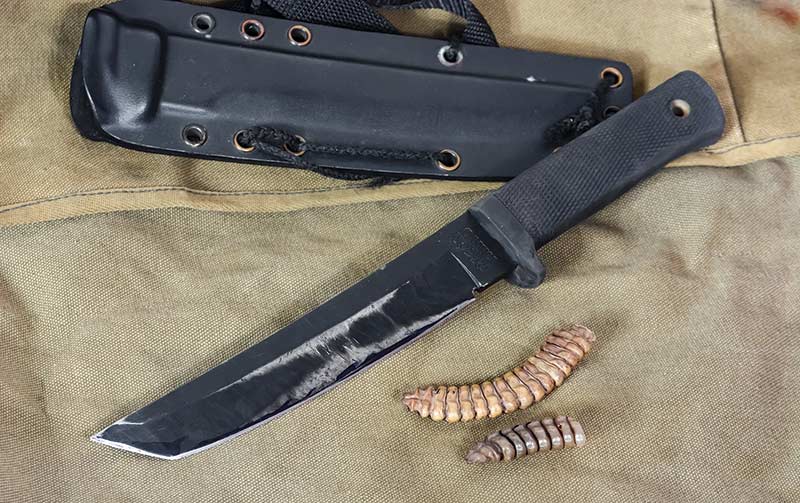
There’s more than one wrong way to kill a snake, and using a knife
is one of them. Don’t let the two copperheads this one killed fool you;
it’s a bad idea with anything. Try it with a rattler and you’re likely to
attain immortality in the Darwin Awards.

SBD

The paperwork had just cleared for my first silencer. Even better, I had a new titanium-framed 1911 freshly built on a recent trip to Novak’s, along with its matching .22 conversion. My plan was simple: Walk into the house, carrying on the conversation with el presidente, assemble the conversion onto my new pistol, screw on the can, walk outside — doing my best 007 impression — and pop, Bond’s your uncle.

With the low report of the suppressed shot, it wouldn’t be heard through the phone and there would be no interruption to the call, which was important. As I said, I didn’t really know this man, and I wanted to impress him.

All went well until first contact; I walked up behind the snake, lined him up over those Novak LoMounts and pressed the trigger. The pistol made a gentle “pop,” and the earth exploded beneath the copperhead as the bullet nicked him. He warped around at the speed of heat, immediately striking and striking again while I desperately crab-walked backward, one-handing shots at him while he, equally fervent, continued trying to kill me. Pop. Pop. PopPopPop. Pop.

The photo Jeremy sent that night. This whole thing really wasn’t the best idea.

End Times

The end of the mag was near, and my options with it, when I finally anchored him with a solid head shot. By now, the president had long since gone silent.

“I’m sorry,” I said. “I’m sure you’re wondering what that was.”

“It sounded like a .22 rifle,” he responded drily.

“Close. It was a suppressed pistol. I, uh, had to kill a pit viper.”

I’ll never really know whether he believed me in that moment or not; I only know he asked for a photo of me, the snake and the gun.
Which I sent. He and I are friends to this day, and I like to think that near-lethal phone call cemented the relationship. Of course, I may just like to think that.

Categories
A Victory! Manly Stuff Our Great Kids Real men Soldiering Stand & Deliver This great Nation & Its People War

I’d buy that man a beer anyday!

Categories
All About Guns Anti Civil Rights ideas & "Friends" You have to be kidding, right!?!

Special Report: Biden Weaponizing IRS Into a Well-Armed Paramilitary Force by Lee Williams

Special Report: Biden Weaponizing IRS Into a Well-Armed Paramilitary Force, iStock-1203186874

U.S.A. — Iowa Senator Joni Ernst introduced a bill last week titled “Why does the IRS Have Guns Act,” which would prohibit the IRS from buying or storing guns and ammunition, transfer all IRS firearms to the General Services Administration so they could be auctioned off to licensed gun dealers to reduce the national debt, and move the agency’s Criminal Investigation Division to the control of the Justice Department.

“The taxman is fully loaded at the expense of the taxpayer,” Ernst said in a statement. “As the Biden administration has worked to expand the size of the IRS, any further weaponization of this federal agency against hardworking Americans and small businesses is a grave concern. I’m working to disarm the IRS and return these dollars to address reckless spending in Washington.”

While the outcome of Ernst’s legislation is not promising – Joe Biden will likely veto her bill, should it ever reach his desk – the Senator’s efforts have drawn much-needed attention to the massive arsenal that the IRS has amassed – is amassing.

The IRS is preparing for battle. Some of the weapons and tactical equipment currently in their inventory are used by elite military commandos, not American law enforcement officers. To be clear, none of this extreme militarization occurred until after Biden took office.

“Who are they preparing to battle?” asked Adam Andrzejewski, CEO and Founder of OpenTheBooks.com, the largest private repository of U.S. public-sector spending. Andrzejewski’s watchdog efforts have led to federal legislation, grand jury indictments, congressional hearings, subpoenas and convictions, as well as audits by the Government Accountability Office and Congressional Research Service reports.

“It looks like it’s for domestic tax and law enforcement objectives, but the IRS has blurred the lines between civil and administrative agencies, civil and administrative duties and federal law enforcement capability. After grabbing legal power, the IRS is amassing firepower. It’s time to scale back the federal arsenal,” Andrzejewski told the Second Amendment Foundation’s Investigative Journalism Project Wednesday.

In one recent report, Andrzejewski found that IRS has spent $35.2 million taxpayer dollars on guns, ammunition and tactical gear since 2006, but the agency’s purchasing increased dramatically under Biden.

“The years 2020 and 2021 were peak years at the IRS for purchasing weaponry and gear. Just since the pandemic started, the IRS has purchased $10 million in weaponry and gear,” the report states.

The purchases included:

  • $2.5 million on ballistic shields and various other gear for criminal investigation agents
  • $1.3 million for tactical lights, tactical gear bags, ballistic helmets and body armor
  • Nearly $1 million on Smith & Wesson M&P15s and Beretta tactical shotguns
  • 3,000 tactical holsters for handguns with optical sights and weapon lights (As of this week, the IRS only has 2,100 armed agents.)

Trigger-pullers wanted

The IRS is recruiting people who won’t hesitate to put another American behind their front-sight post.

In a recent job posting, the agency says special agent candidates, “must be willing to use force up to and including the use of deadly force.”

Those who qualify will receive the best guns and gear taxpayer dollars can buy.

Here is a partial list of some of the agency’s recent purchases.

Night Vision Rifle Scopes

American law enforcement – even the IRS – does not operate with Rules of Engagement like the military when it encounters armed resistance. The last time law enforcement used ROE rather than the law, things went very wrong. Whatever the tactical situation, police are subject to criminal laws and deadly force policies, which are predicated upon the sanctity of human life.

Force – up to and including deadly force – must be reasonable. An American law enforcement officer must use the minimum amount of force necessary and can use deadly force in defense of their life or the life of another. Verbal warnings and other de-escalation attempts are always considered after deadly force is used to determine whether the force was justified.

That said, it’s difficult to understand why the IRS is equipping its agents with night vision rifle scopes, which are capable of hitting man-sized targets at distance in total darkness.

How does shooting a suspect who is hundreds of yards away and unaware of an agent’s presence – at night, without warning – comply with use-of-force statutes and policies? How is this not murder? What tactical problem are the night vision rifle scopes intended to resolve?

Ballistic Shields

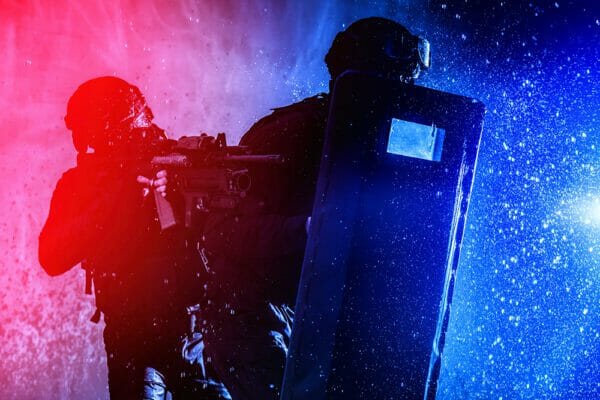
When the threat level is extreme, such as a report of an active shooter, SWAT teams will deploy a ballistic shield, which is designed to complement their personal body armor and further reduce the threat.

Ballistic shields come in all shapes and sizes and are rated by bullet resistance. A Level II shield will stop 9mm and other handgun rounds. A level IV shield will stop .30 caliber armor-piercing ammunition. The greater the bullet resistance, the heavier the shield. Operators must train constantly to carry the shield and shoot a pistol one-handed. It’s awkward and requires a lot of practice.

The Los Angeles Police Department has guidelines concerning the use of ballistic shields. Officers must first pass a Ballistic Shield Operator course before they can carry one into harm’s way. The course specifies the type of tactical situations where a ballistic shield should be deployed. They include but are not limited to the following:

  • Breaching (doors and windows)
  • High-risk vehicle stops
  • High-risk handcuffing
  • Door entries
  • Room clearing
  • Hallway movement
  • Rescuing wounded officers under fire

These types of tactical situations are the purview of SWAT teams and military special forces, not the IRS.

What’s in the IRS’s Gun Safe

The IRS issues Smith & Wesson M&P15 rifles to most of its special agents. It’s a good, serviceable patrol carbine – more than adequate for most needs. However, the agency issues HK416s to select agents. The difference between an M&P15 and an HK416 is staggering. Smith & Wesson designed their carbine for civilian end users. Heckler & Koch designed the 416 for special operations forces. It is currently the weapon of choice for the most elite units in the world, including Tier One JSOC teams. IRS even issues Heckler & Koch magazines with the rifles, which are much more reliable, but cost as much as 10-times more than traditional AR magazines.

Why do IRS agents need the same rifle carried by Navy SEALs or members of the Army’s most elite special missions unit?

While the IRS issues .40 cal. Glock handguns to its agents, documents show the agency has purchased a limited number of 5.7x28mm handguns and ammunition, although the type of ammunition has not been specified.

The Bureau of Alcohol, Tobacco, Firearms and Explosives classifies the 5.7x28mm SS190 duty round, which has a steel penetrator, as armor-piercing handgun ammunition. The manufacturer restricts the ammunition to military and law enforcement customers.

The 5.7x28mm weapon system gives IRS agents the capability of defeating most civilian body armor with a handgun.

IRS Responds

The Second Amendment Foundation’s Investigative Journalism Project asked the IRS to explain why they need ballistic shields, HK416s, night vision rifle scopes and other highly specialized equipment.

Here is their response:

“IRS-CI special agents are sworn federal law enforcement officers who conduct criminal investigations into tax violations, money laundering, cybercrimes, as well as organized crime involving drugs and gangs.


The agency’s approximately 2,100 IRS-CI special agents regularly execute and serve search, arrest, and seizure warrants; conduct covert operations; and interact with the public in law enforcement settings.


They must participate in annual firearms training, briefings, and practical exercises to demonstrate they are proficient to carry firearms. Firearms and related tactical gear are – and have been – necessary equipment for CI special agents for more than 100 years,” said Carissa Cutrell, a member of the IRS Criminal Investigation division.

Takeaways

It’s clear the IRS geared up so they could start raiding.

Last week a joint IRS/ATF team raided Highwood Creek Outfitters in Great Falls, Montana. ATF agents were prohibited from seizing the gun shop’s 4473s, but the IRS agents weren’t. They seized hundreds of the forms.

Montana Attorney General Austin Knudsen expressed concern over the seizure, asking, “What the hell does the IRS need with 4473s?” By now, I’m sure he realizes they were all handed over to the ATF.

History has shown us that whatever a federal agency buys, it will eventually use. The only question is who will IRS point their HK416s and night vision rifle scopes at now that the raids have begun.

Most Americans are sick of watching Biden weaponize federal agencies to further his partisan political objectives. The ATF was weaponized first, and they’re going door-to-door right now, conducting unconstitutional knock-and-talks under the guise of firearm inspections.

If Joe Biden is allowed to fully weaponize the IRS like he did the ATF, he will be able to exert his executive authority whenever he wants without congressional oversight. Anyone who objects or complains could be shot without warning, at distance, at night, without ever seeing who fired the fatal round.

As Senator Ernst noted, this is a grave concern.


About Lee Williams

Lee Williams, who is also known as “The Gun Writer,” is the chief editor of the Second Amendment Foundation’s Investigative Journalism Project. Until recently, he was also an editor for a daily newspaper in Florida. Before becoming an editor, Lee was an investigative reporter at newspapers in three states and a U.S. Territory. Before becoming a journalist, he worked as a police officer. Before becoming a cop, Lee served in the Army. He’s earned more than a dozen national journalism awards as a reporter, and three medals of valor as a cop. Lee is an avid tactical shooter.

———————————————————————————–  WOW A “a grave concern” , what no hope & prayers? Like that will really help a lot in this fight! All I can say is until we start throwing some of these ass clowns in a cell with Bubba fo a LONG TIME.* Nothing is going to change for the better for this country. Grumpy

*

Categories
A Victory! All About Guns Manly Stuff Our Great Kids Real men

Good Guy With a Gun Stops Man Shooting Up Las Vegas Building Lobby by Julio Rosas

AP Photo/Rich Pedroncelli
A building employee of Las Vegas’ Turnberry Towers is being hailed as a hero by residents for shooting a man who was firing upon the building’s front desk on Friday.

KTNV reports a man wearing a helmet had an AR-15 and other weapons when he entered the towers Friday afternoon. The gunman then fired at the front desk, shattering glass but not hitting anyone.

That is when the resident said the building employee fired at the gunman, hitting him and causing him to try to flee the area while still be shot at by the employee.

Security video shows the moment when the shooter was exiting the building after being shot. He survived

Resident Benjamin Teal told KLAS the employee was warning people about the gunman before going back to engage the shooter.

“My valet comes out waving his arms saying, ‘There is a guy with a gun, turn around and go the other way,’ and so we go down to the basement the first level where the valet parking is and then we heard about six to seven or eight gunshots,” Teal said. “It was pretty distinguishable to be a gunshot.”

A social media user claimed the gunman was a resident and the shooting was “unprovoked, never had issues with anyone here, just went to his car, grabbed an [AR] and came back in and shot the front lobby up. Homberto, who works in receiving, is a hero. He shot the armed man and saved so many lives. Nobody was injured other than the shooter.”

Categories
A Victory! All About Guns

Would be Mass Public Shooter Stopped by an Employee with a Concealed Handgun Permit

On Friday, June 23rd, 2023, an employee at Turnberry Towers near Karen and Paradise shot a gunman who walked in and fired shots at the front desk. Fortunately, the employee had a concealed handgun permit and was able to quickly stop the attack before anyone else was hurt. More similar cases where people are legally carrying guns are available here.

. . . Channel 13 spoke with the resident to get their story. Law enforcement has not confirmed the following details.

According to the resident, a man wearing a helmet had an AR-15 and other weapons when he entered the towers Friday afternoon.

This is when the resident tells us the man fired shots in the area of the front desk, shattering glass which is shown in pictures they have provided to us.

The resident says it was an employee of the towers who stopped the attack, and thinks they are a hero who deserves recognition for stepping in. . . .

KTNV Staff, “Man called ‘hero’ for stopping shooter at Turnberry Towers Friday,” KTNV Channel 13 ABC (Las Vegas), June 24, 2023.

It was a resident. Unprovoked, never had issues with anyone here,just went to his car, grabbed an AK and came back in and shot the front lobby up. Homberto, who works in receiving is a hero. He shot the armed man and saved so many lives. Nobody was injured other than the shooter.

Brianna Dymond, a resident of the apartment building, June 24, 2023.

Categories
All About Guns Cops You have to be kidding, right!?!

Another potential ENEMY OF THE PEOPLE, Candiate Tulsa Police Chief: Might be Time to Trade Some Freedom for Gun Control by AWR HAWKINS

TULSA, OK - June 02: Tulsa Police Chief Wendell Franklin discusses the shooting at Saint Francis Hospital that left five dead, during a press conference on June 2, 2022 in Tulsa, Oklahoma. The shooter had purchased the AR15 rifle only hours before the shooting (Photo by Pat Carter/Getty Images

Tulsa Police Chief Wendell Franklin is calling for a 9/11 style response to gun violence and suggesting people may have to give up some of their freedom in exchange for gun control.

NPR posted an interview with Franklin on Sunday, noting he is critical of constitutional carry, wants more regulations on firearms that Democrats describe as “ghost guns,” and is open to a waiting period for the purchase of AR-15s and similar firearms.

Franklin said, “Law enforcement – we are the experts. We’re the subject matter experts at protecting America – right? – protecting our cities. And, you know, we should be utilizing that in that manner. So I am charged with protecting this community. And if there are better ways of protecting it, I think we should be looking at those better ways to protect it.”

Public Radio Tulsa quoted Franklin saying:

Ultimately, I’m a Second Amendment guy…But I’m okay giving up some of that freedom, right? We had to give up some of that freedom after 9/11. I’m okay with waiting three days, five days, or whatever to get my firearm if I go out and purchase another firearm.


So I’m okay with a pause to allow for weapons to be purchased and allow the government and the gun companies to look at the background and do a thorough check before that gun goes to someone.

Franklin compared giving up some freedom in exchange for gun control to the process people went through in adapting to seatbelt laws when they were first enacted.

He said, “You know, we put seatbelt laws in place, I’m not exactly sure when, probably the 1980s, I think. And we mandated that everyone starts wearing a seatbelt, and it took some time for people to grab hold of that. But if you look today it is an automatic thing that people put on their seatbelt when they get into a vehicle. You feel uncomfortable not wearing that seatbelt. I think again, we give something up to get safety for, for something safe. I think that’s where we are today. We are going to have to give up some things. And I think there are some things that we can give up for a safer community.”

Franklin became Tulsa’s 40th police chief on February 1, 2020.

U.S. News & World Report lists Tulsa as No. 8 in a list of the “Top 25 Most Dangerous Places in the U.S.”

Categories
All About Guns You have to be kidding, right!?!

Someone cut down a Russia Mosin Nagant

Categories
Well I thought it was funny! You have to be kidding, right!?!

Some of my so called humor