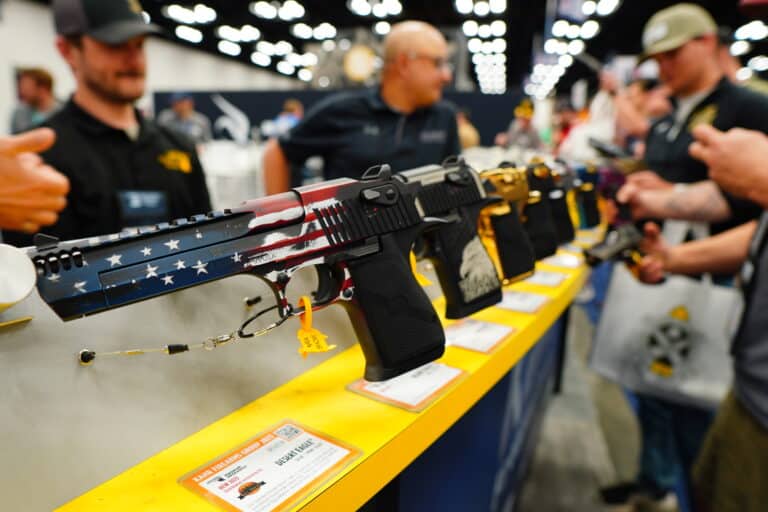
So we can have war with bith Russia & China at the same time!?! Sheer insanity is all I can say about this Grumpy
Category: A Victory!

The New York Post is reporting that nearly two dozen struggling homeless veterans have been booted from upstate hotels to make room for migrants, at least according to a nonprofit group that works with the vets.
Conservatives hail Daniel Penny as ‘hero’ after killing man on subway
A video posted to Twitter this week by Mr.GunsNGear shows government agents making the rounds to confiscate forced reset triggers.
One of the individuals who was targeted recorded his interaction with the agents. It wasn’t immediately clear when the video was taken.
“So, the reason why we’re here is, as I’m sure you’re aware, the ATF recently classified FRTs — the forced reset triggers — as machineguns,” says the female agent.
“We are aware that you may have purchased some of these FRTs,” she continues. “So now basically the whole agency is reaching out to these purchasers and we have to pick ’em up. You know they’re evil.”
The citizen responds by saying he won’t be answering any questions regarding their inquiry nor will he be turning anything over.
“Are you refusing to give us the triggers,” asks the male agent.
“I’m not refusing anything and I won’t be answering any questions,” the citizen says.
“Again, we are aware that you did purchase FRTs,” says the female agent. “You wouldn’t be in trouble if you gave those up to us. Or, if you sold them, you can tell me you sold them.”
The citizen holds firm in his stance. He tells them that if he’s not being detained or if he’s not being placed under arrest he is going to leave.
“Just to be clear, so that now you know, that if you were to be in possession of these FRTs then you would be basically breaking the law,” she says.
In the United States, the possession of an unregistered machine gun is a federal offense under the National Firearms Act (NFA) of 1934 and the Gun Control Act of 1968. Penalties for violating these laws are no joke.
For possession of an unregistered machine gun, the potential penalties include:
- Imprisonment: Convicted individuals can face up to 10 years in federal prison.
- Fines: Fines for possessing an unregistered machine gun can be substantial, with amounts up to $250,000 for individuals and $500,000 for organizations.
- Forfeiture: Any machine guns and other firearms involved in the offense, as well as any property used to commit the crime or traceable to the crime, may be subject to seizure and forfeiture.
- Loss of gun rights: Convicted individuals may lose their right to own or possess firearms in the future.
Remember, not only are FRTs considered “machineguns,” but bump stocks fall under that classification as well.
It appears that Biden’s ATF is playing hardball. Sending agents door-to-door to confiscate forced reset triggers from law-abiding citizens is tantamount to declaring war on 2A advocates, not to mention a terrible use of limited government resources.
Seriously, there are hardened criminals terrorizing communities all across the country. Yet, the president believes the best use of ATF’s personnel is to send them out to seize aftermarket triggers from responsible gun owners and enthusiasts.
It’s insanity. Or, maybe, Mr.GunsNGear is right. It’s tyranny.
Update 5/10/22 — ATF Responds
GunsAmerica reached out to ATF to ask the following questions:
Is the ATF still actively doing this? How did it obtain the list of purchasers of FRTs? Also, does it plan to take a similar approach with respect to bump stocks, pistol braces, and/or unserialized frames and receivers?
Erik Longnecker, ATF’s Deputy Chief of the Public Affairs Division responded in the following manner:
We would direct you to this Open Letter in reference to certain unregistered machineguns: https://www.atf.gov/firearms/docs/open-letter/all-ffls-mar-2022-open-letter-forced-reset-triggers-frts/download.
Additional information about bump stocks, short barreled rifles and firearm frames and receivers can be found on our website at: https://www.atf.gov/rules-and-regulations/rulings.
The Mossberg 940 series is Mossberg’s attempt to fix some of the flaws with the 930 series. It’s their latest line of semi-auto shotguns. The 940 series started with 3-Gun in mind but has moved to the hunting and now the tactical world. The 940 Pro Tactical shotgun has hit the market and is aiming at the premium market of defensive shotguns. The Pro Tactical takes aim at guns like the Beretta 1301 and the Benelli M4. with an MSRP of $1,154.

Like the original 930 series, the gun is a gas-operated gun. The main improvements over the 930 included better ergonomics and a gas system that’s a lot less finicky. It doesn’t need to be cleaned nearly as often as the 930 series. The maintenance-heavy 930s required cleaning quite often for them to run reliably.
With tactical in the name, it’s easy to assume that the 940 Pro Tactical is aimed at the duty and home defense market. It’s a tactical shotgun with a lot of whizbangs and doo-dads. Unlike most of its competition, the 940 Pro Tactical is American-made and doesn’t have to deal with 922R and import restrictions which gives it an edge over the standard imported shotgun.
Features and Specs
Unlike the Italian selections of shotguns, the 940 Pro Tactical comes ready with a seven-round magazine tube. It’s ready to go and loaded for bear. The barrel tops out at 18.5 inches, and the gun weighs 7.5 pounds. The overall length is 37.5 inches. Mossberg wisely implemented a stock design that allows the user to adjust the length of pull.

Shooters can use inserts and spacers to take the shotgun’s length of pull from 12.5 to 14.25 inches. Included with the gun are two butt pads that give you either a recoil pad or a short flat plastic option. Shooters can swap chokes if they so choose, and the gun comes with a cylinder bore choke.

On top of the gun sits a high-visibility fiber optic sight. It sits low, but the barrel is much thicker at the end and provides a bit of a higher bead for ensuring the point of aim & point of impact. One of my favorite features is the optic cut. From the factory, it comes ready for you to attach a Shield footprint optic. The optics attaches directly to the receiver and sits low enough to co-witness with the bead.
The 940 Pro Tactical is a well-put-together gun that comes with a number of features worth mentioning.
Ergonomics
“Make it bigger” seemed to be the mantra behind the ergonomics of the 940. Outside of the safety, everything is bigger. The 940 uses the same tang-style safety we all know and love. It’s easy to access and ambidextrous to use. Our charging handles and bolt release are massive. They are much bigger than a standard bolt release and outperform the competition.

They are massive, easy to grab, and easy to engage. On top of that, the loading port is large and easy to shove a round into, and so is the ejection port. You can easily reload the weapon on the fly, and that’s a smart feature for a weapon that only holds seven rounds.

The length of pull adjustments is a godsend for shotguns. Most shotguns come with some crazy long length of pull set in excess of 14 inches. It’s absurd, and while it works for wing shooting, it doesn’t work well with most shooters in a squared-up shooting position. The spacers and adjustments make it easy to fit the gun to you. A lot of times, shooters have to purchase special stocks like the Magpul SGA to get this feature.

At the front of the gun sits a magazine clamp that has two M-LOK slots. This allows you to run a light fairly easily with a pressure switch to the handguard.
At the Range
I really liked the Mossberg 940 Pro Tactical at first glance, but taking it to the range is what made me fall in love with the gun. At the range, the gun performed extremely well with a wide variety of rounds. The majority of my ammo is the cheap Federal birdshot you can get anywhere and everywhere for a good price. It ate through 300 rounds of that stuff without a single malfunction.

Birdshot worked fine, and so did the cheapest buckshot in my armory. My cheapest buckshot is the Monarch brand from Academy. It has high brass but can be finicky when it comes to feeding. A 100 rounds of Monarch didn’t provide the 940 Pro Tactical or me with any issues. Neither did a little Rio, Federal, or Hornady. The gun cycles low recoil tactical loads, including my favorite Federal Flitecontrol loads.

All in all, I hit 200 rounds of problem-free buckshot. It’s a gas-operated semi-auto, so it doesn’t cycle mini shells because I know someone will ask in the comments section. It will cycle the 2.5-inch shells, at least the Nobel Sport buckshot cycles. The 1.75 and 2-inch stuff is a no-go.
Rocking and Rolling
Gas operation bites some of the recoil down and makes the gun increasingly controllable. The 940 Pro Tactical handles well, especially when you get the right LOP and can really engage the push/pull into your shooting. The gun barely bucks when proper recoil mitigation is in effect. Seeing that red dot barely move between shots from a shotgun is quite nice.
Speaking of red dots, the front sight works great, but tossing a red dot on the gun makes it even better. The red dot sits nice and tight on the gun and low enough to co-witness with the fiber optic. A red dot makes it easier and faster to shoot and aids in accuracy when it comes to slug use.

With the soft controls and fast use red dot, my split times decreased consistently when compared to other semi-auto shotguns. The time to hit a target with multiple shots or multiple targets with multiple shots took a nose dive with the 940 Pro Tactical.
A nice crisp trigger greets your hands, and for slug use at longer ranges, it’s great. It won’t win an award, but it’s adequate and consistent. With slugs, I could ping a metal IPSC target at 100 yards easily with just the red dot and a decent shooting position.

The gun patterns are like any other standard shotgun. If you have a 590A1, it likely patterns well, but this is more akin to a standard 500. A cheap load patterns loosely, but a good load stays tight. A standard round of military Olin company buckshot will pattern at 8.5 inches at 12 yards. Flitecontrol looks like a slug out until you get beyond 15 yards.
The New Standard
The 940 Pro Tactical doesn’t have the reputation or user count like other competing shotguns, so I can’t say it’s the holy grail. In a few years and with a few thousand users, then we might be able to make that call. However, I can say it’s a dang fine gun. It’s ergonomic and features some real modern flair. Typically when I purchase a shotgun, I begin to look at what needs to be changed.
When I got my hands on the 940 Pro Tactical, the only thing I wanted to add was a red dot. That says a lot to me. Mossberg has knocked one out of the park with the 940 series.
—————————————————————————————-WTF would anybody outside of an active war zone want or need one of these!?!
Now I know that there are a lot of folks out there who are earnestly waiting for the end of the world, Race War or the start of the 2nd American Civil War or what ever to start. Plus let us not forget the Rambo / Fake Veterans wantabe’s. Who, I have some real issues with but thats for another day.
But lets get real folks!!!
Now if I was a cop and saw one of these outside of your house. If I had not SHOT you yet. I WOULD give you a REALLY intensive Field Interview that you would not forget real soon. Especially when one of your Karen type / Gun Fearing wussies neighbors turned you in during my lunch break.
Also if you took it hunting. I also would be willing to bet that the local Game Warden would also want to talk to you about it. ESPECIALLY if he or she could load it with more than 3 rounds. Can we say a huge ticket and maybe jail time depending where you are.
Bottom line – Guns like this are just fodder to our “Friends” on the other side who want to abolish the 2nd Amendment. Grumpy

Nearly two years ago, an errant spark inside a mill caused an explosion so big it destroyed all the building’s equipment and blew a corrugated fiberglass wall 100 feet, this incident was suddenly mentioned by the Wall Street Journal on April, 27.
It also shut down the sole domestic source of an explosive the Department of Defense relies on to produce bullets, mortar shells, artillery rounds and Tomahawk missiles.
The ramshackle facility makes the original form of gunpowder, known today as black powder, a highly combustible material with hundreds of military applications. The product, for which there is no substitute, is used in small quantities in munitions to ignite more powerful explosives.
No one was hurt in the June 2021 blast. But the factory remains offline, unable to deliver its single vital component to either commercial or Pentagon customers.
Military suppliers consolidated at the Cold War’s end, under pressure to reduce defense costs and streamline the nation’s industrial base.
Over the past three decades, the number of fixed wing aircraft suppliers in the U.S. has declined from eight to three. During the same period, major surface ship producers fell from eight to two, and today, only three American companies supply over 90% of the Pentagon’s missile stockpile.
Lower-tier defense firms are often the sole maker of vital parts — such as black powder — and a single crisis can bring production to a standstill.
“Can you imagine what would happen to these supply chains if the U.S. were in an actual state of active war, or NATO was?” said Jeff Rhoads, executive director of the Purdue Institute for National Security, a defense-research institute at Purdue University. “They could be in trouble very quickly.”
The “incident,” as the Minden explosion has become known, is a pointed example of the risks facing America’s military. The blast that wrecked a World War II era building in a remote compound 30 miles from Shreveport has extinguished all production of black powder in North America.
For a millennium, black powder was a crucial material for both military and commercial uses. Today, it is a specialty commodity with few commercial applications — mostly for rocket hobbyists — but it’s still used in more than 300 munitions, from cruise missiles, to bullets for M16 rifles, to the vital 155 mm shells.
Sales volume is limited and that means profits can be too thin to support more than a single production facility. This type of vulnerability is so common, the Pentagon describes it as the “single source” problem. Only one foundry in the U.S. makes the titanium castings used in howitzers, and only one company makes the rocket motor used in the Javelin antitank weapon widely used in Ukraine.
Part of the problem is that the Pentagon can be a fickle customer. Orders can surge or plummet depending on inventory levels, the state of U.S. military engagements or budget priorities. This posed a challenge for the operators of the black powder mill, who also faced costly regulations.
The roots of the current crisis can be traced back three decades, to a 1993 dinner at the Pentagon often referred to as the “last supper,” when Secretary of Defense Les Aspin invited the CEOs of the top 15 defense companies and warned that the Pentagon couldn’t sustain them all. They would need to consolidate.
The number of major arms suppliers for the Pentagon went from dozens in the 1990s, down to just five, known as primes, who typically bid for major weapons programs today. A similar contraction took place among lower-tier suppliers.
Overall, the defense industrial base shrank to 55,000 vendors in 2021, down from 69,000 in 2016. Despite consolidation, the networks of companies remain large. The average American aerospace company relies on hundreds of first-tier subcontractors, according to Defense Department statistics, and thousands in the second and third tiers below that.
That scope presents its own problems. The network is so vast, the military has limited visibility, according to a Pentagon report, and “does not track these vulnerabilities as they impact weapons programs.” A failure down the supply chain can go unnoticed for months by prime contractors such as Boeing Co. or Lockheed Martin Corp., let alone the Pentagon.
Late last year, the Defense Department identified 27 critical chemicals that have no U.S. production and are sourced from places, including Russia and China, considered adversaries of the U.S. The Pentagon expects to spend more than $207 million to bring production of materials back to the U.S. as soon as possible, WSJ concludes.

The sales of firearms, especially AR-15-style rifles, unexpectedly turned up last month, apparently driven by efforts in several states to impose gun bans.
Industry officials reviewing the latest FBI background check information said that states planning gun bans or moving to change the rules governing firearms purchases saw massive jumps in April sales.
In Washington state, where the governor just signed a law banning the sale or transfer of AR-style rifles, background checks for April sales surged to 71,272 compared to 49,641 in April 2022, a 43.6% increase, said Mark Oliva, the spokesman for the National Shooting Sports Foundation.
The industry trade group found a surge in Illinois, where it recently won a federal court decision to block a ban on modern sporting rifles. There, Oliva said, sales background checks increased 11.7% in April.

Ditto in Oregon, he said: “Oregon, a state with a legislature and governor’s office hostile to lawful firearm ownership, totaled 43,574 adjusted background checks in April 2023, compared to 27,921 a year ago, representing a 56.1% increase.”
Even states that moved to change the rules to buy guns saw a big sales uptick before any new regulations began to take effect.
“Notably, North Carolina’s legislature overrode Gov. Roy Cooper’s veto of a bill that repealed the state’s antiquated Jim Crow-era permit-to-purchase a handgun scheme which immediately reverted the state to using the FBI NICS system to verify all handgun sales,” Oliva said. “North Carolina came in with 68,181 background checks in April 2023, compared to 18,967 in April 2022, a 238.4% increase.”
In recent months, concerns about safety drove sales highs, and that is continuing to add to the records. But Oliva said the difference in April was the threats from the government to take away gun rights.
SEE THE LATEST POLITICAL NEWS AND BUZZ FROM WASHINGTON SECRETS
“April’s uptick of 1,369,296 FBI National Instant Criminal Background Check System (NICS) verifications shows that there continues to be a steady appetite for lawful firearm ownership even as certain state governors and legislators are taking radical measures to infringe on the Second Amendment rights of law-abiding citizens to possess firearms, especially the Modern Sporting Rifle,” Oliva said in a reference to AR- and AK-style rifles.
“These figures show that when Americans are concerned that government authorities will deny them the full spectrum of their Second Amendment rights, they will respond by exercising those rights. It also shows that when barriers to lawful firearm ownership are torn down, law-abiding citizens will exercise their right to lawfully purchase firearms,” he said.