
Category: A Victory!
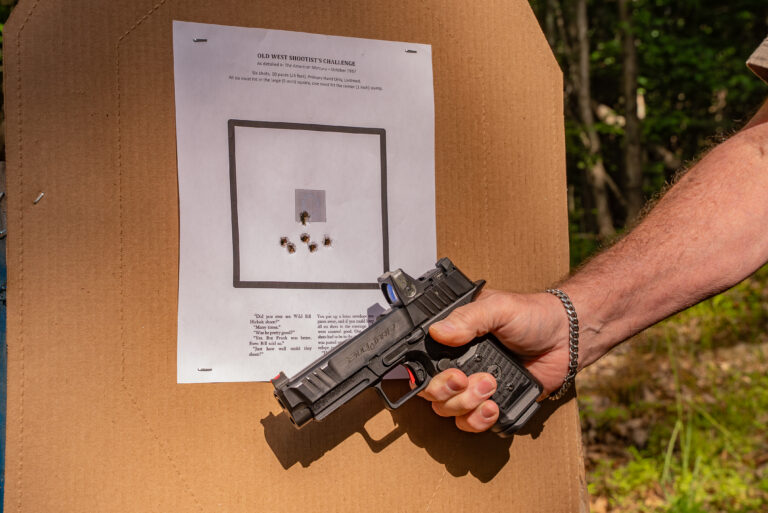
If you could go back and duel Wild Bill Hickock, are your handgun skills good enough that you would walk away alive?
Legend has it that Wild Bill Hickock was a “very good” pistol shot, but what does that mean, exactly? I don’t think we will ever know, but legend also tells us that during a gunfight with Davis Tutt in Springfield, Missouri, in 1865, Wild Bill shot Tutt through the heart at 75 yards with either a 0.36-caliber Navy Colt or a 0.44-caliber Colt’s Dragoon. The gun he used is not that important, but most anyone would agree hitting a target smaller than a soft ball at that distance with a cap and ball revolver would require some fine marksmanship. Of course, we have no idea what Wild Bill was aiming at (maybe he was aiming at Tutt’s head?).
We of course lack evidence—provenanced evidence—but we do have a story from the October 1937 issue of the American Mercury magazine. The following quote is from the article, “The Myth of the Two-Gun Man,” written by Charles B. Roth:
“The best Marksman of the Old West was a mild little soldier you have probably never met in your readings for the good reason he doesn’t appear there. He was too busy with his job to talk to newspaper correspondents. But the annals of Nebraska history write him large.
Major Frank North was his name, and he was commanding officer of the Pawnee Scouts, a body of Indian soldiers that served during the Indian campaigns. His brother, Luther North, was associated with him. Often I have queried Luther North about frontier marksmanship.”
“Did you ever see Wild Bill Hickock shoot?”
“Many times.”
“Was he pretty good?”
“Yes. But Frank [Frank North] was better. Even Bill said so.”
“Just how well could they shoot?”
“About as well as anyone, with the guns they had. They both could live up to the test of good marksmanship. Frank better than Bill. You put an envelope 10 paces away, and if you could keep all six shots in the envelope you were counted good. One of the shots had to be in the stamp, which was pasted on the back of the envelope in the center.”
“How big were the envelopes?”
“Five inches square. And the stamp an inch square.”
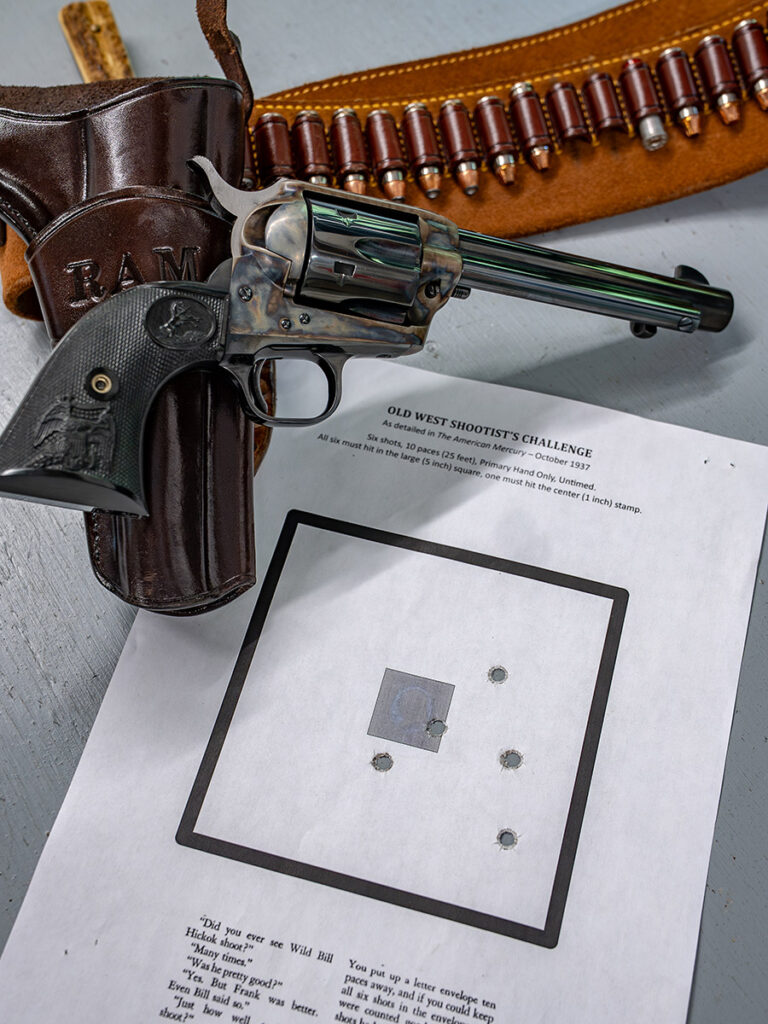
The article goes on to say that Luther never witnessed Frank fail to out-shoot Hickock, who always took the losses good-naturedly. But according to Luther, Wild Bill once said, “Frank, you can sure beat me when it comes to shootin’ at these little black dots, but I can beat you when it comes to hitting men.” The author goes on to theorize that it was nerve more than marksmanship that kept men like Hickock, Jesse James and Bat Masterson alive.
Measuring Handgun Marksmanship
The reason I share this article is that the practice of shooting a 5-inch square with a 1-inch hidden square on the middle of the backside of the target has evolved into what is known as the Old West’s Shootist’s Challenge. You place that target at 25 feet and shoot with your strong hand only with no time limit. The goal is to get all six shots inside the 5-inch square, and one must hit the 1-inch square—stamp—on the back side.
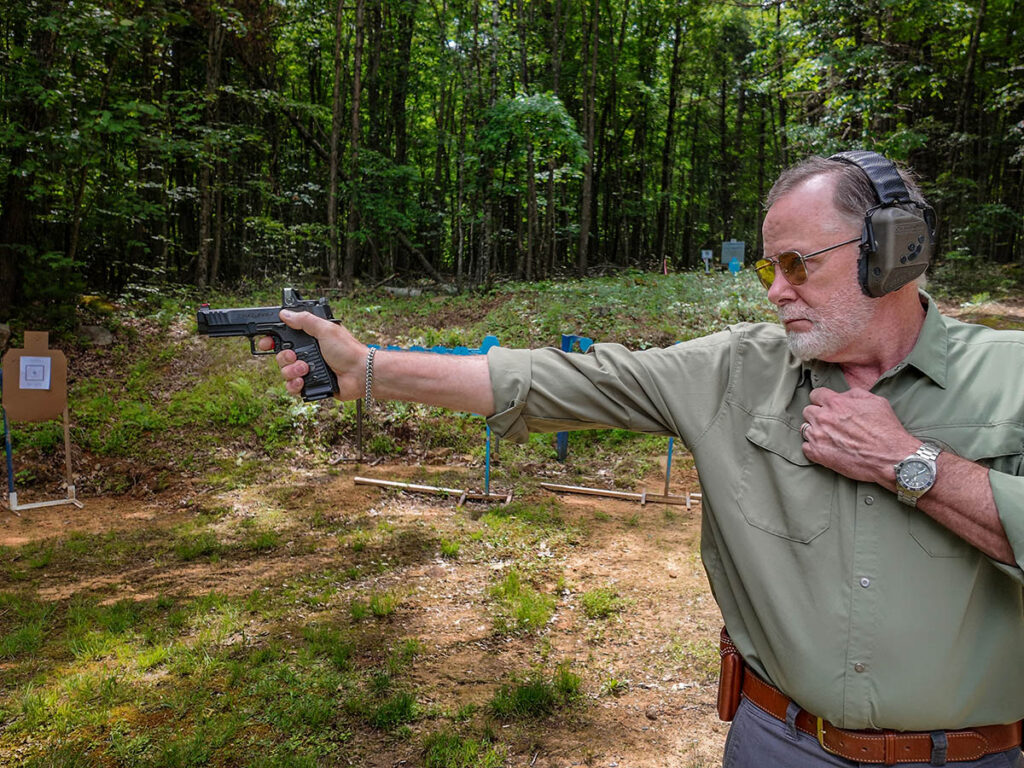
This is not a terribly difficult test, and it’s a drill I do on occasion to make me focus on accuracy more than speed. After all, you cannot miss fast enough to win a gunfight. I emailed the challenge to another Bill—Bill Wilson of Wilson Combat—and less than 30 minutes later he sent me back a photo of his target shot with one of his 4-inch 1911 compact pistols. All six shots were in the 5-inch square—envelope—and four hit the 1-inch square. Of course, Hickock never saw a Wilson Combat 1911, and Wilson is a fantastic pistol shot. A little humbled, I didn’t bother to send Wilson a photo of the target I shot with my Single Action Army revolver with all five shots in the square but only one in the stamp.
In another blast from the past, I have in my archives a photograph of a playing card shot in 1894 by William G. Baldwin, who was the founder of the Baldwin Felts Detective Agency. It shows 10 hits from 52 feet—17.3 yards—with a S&W revolver, and the note says, “When I was a shootist.”
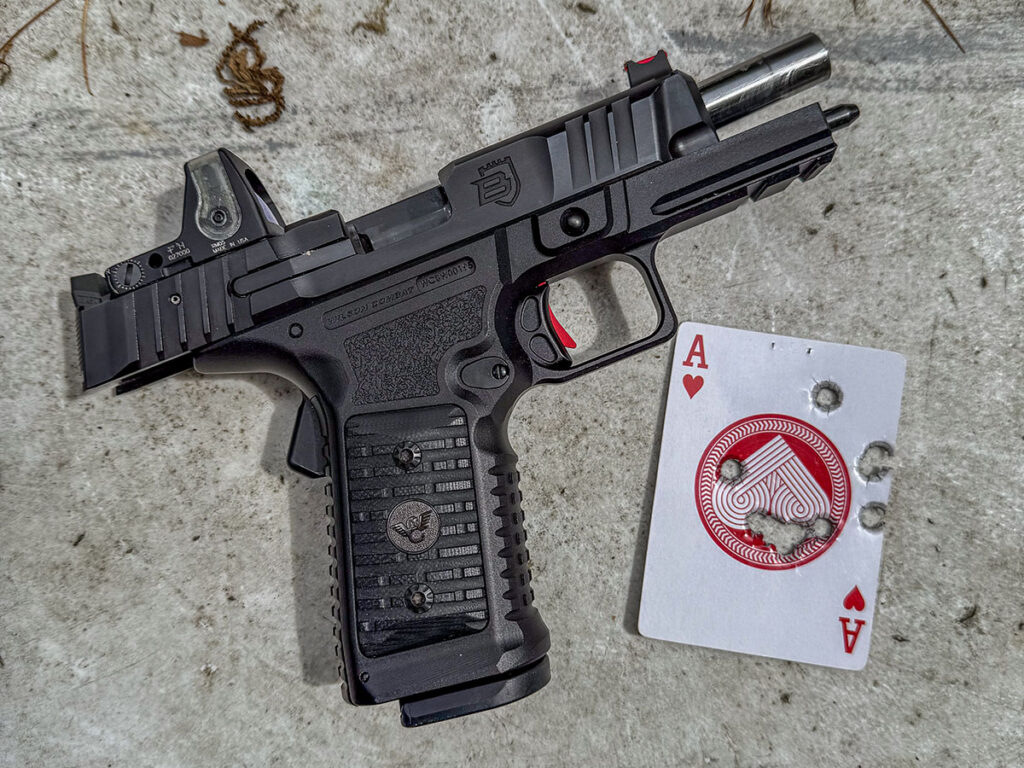
Baldwin survived multiple gunfights during his career, put numerous bad guys in the ground, and died of old age in 1936. However, we have no way of knowing the conditions in which he fired those 10 shots. At that time, shooting with the strong hand only was common practice, but did Baldwin use one hand or two?
Either way, it was good shooting; try it.
We will never know the factual truth regarding the marksmanship abilities of those legendary gunfighters, but maybe the most poignant evidence of their skill is that they survived the gunfights they were in. Well, mostly. Wild Bill was playing poker in Deadwood on August 2, 1876, when Jack McCall shot him in the back of the head with a Colt Single Action Army chambered in .45 Long Colt. I suppose McCall lacked the courage, or, just as likely, he had enough sense not to face Wild Bill and try to kill him. Regardless, situational awareness might be as much if not more important than marksmanship skill. I imagine if we could dig him up from his South Dakota grave and ask him, Wild Bill would probably agree.

 Canada’s government is forcing licensed and law-abiding firearm owners to surrender, export or permanently “deactivate” thousands of prohibited firearm models. Meanwhile, a criminal investigation involving former Member of Parliament (MP) Inky Mark shows Canadian authorities already possess extensive laws to pursue actual firearm trafficking and other illegal criminal conduct.
The Royal Canadian Mounted Police (RCMP) arrested former MP Mark, 79, after executing search warrants on July 7, 2026, at his Dauphin, Manitoba, residence. Investigators reported seizing 439 firearms, ammunition, an antique cannon and more than C$300,000 in cash, which Mark claims is from the sale of Manitoba properties. Former MP Mark faces 12 Criminal Code charges, including firearm trafficking and possession of property obtained by crime.
He has been released from custody. Mark denies the charges but did tell the Canadian Broadcast Corporation that “he did something stupid” and admitted he transferred firearms to an individual he has known for 30 years.
Mark, also the former mayor of Dauphin, is outspoken and critical against Canada’s Liberal Party, which dominates politics north of the border. Mark wasn’t in Canada’s Parliament when the gun confiscation bill was voted upon.
Criminal Conduct Is Already Illegal
RCMP officials said investigators believe at least three of the seized firearms were illegally trafficked and one had an altered serial number. The investigation reportedly began after another Dauphin resident was charged with firearm offenses in the United States.
Those allegations are serious. But they do not expose some previously unknown gap in Canada’s gun laws.
Firearm trafficking, altering serial numbers, unauthorized possession and violating secure storage laws are already criminal offenses. RCMP officials acknowledged that Canadians may lawfully possess large firearm collections. The legal line is crossed by criminal conduct, not by the number of firearms a licensed citizen owns.
That distinction should guide public policy.
Confiscation Moves Forward
In the meantime, Canadian Prime Minister Mark Carney’s government is pressing ahead with the so-called “Assault-Style Firearms Compensation Program” covering more than 2,500 makes and models prohibited since May 2020. The entire scheme, begun under former Prime Minister Justin Trudeau, has been a fiasco from the get-go.
The declaration period for law-abiding gun owners ended March 31. Collection, destruction, deactivation and compensation are already underway and are expected to continue through early fall. As of June 8, owners had declared just 68,717 firearms, including 2,520 in Manitoba.
Participation in the compensation program was technically voluntary. But compliance with the prohibitions is not. Owners who decline compensation must ultimately surrender their affected firearms without payment, export them or pay to have them permanently deactivated.
Facing measly compliance rates, the Canadian government extended its amnesty orders after the Supreme Court of Canada agreed to hear a challenge to the 2020 prohibitions. The amnesty will now expire 90 days after the court issues its decision, expected in 2027. The confiscation program, however, continues.
Target Criminals, Not Lawful Owners
Nothing alleged against former MP Mark suggests Canada needed to prohibit thousands of additional firearm models or confiscate lawfully acquired property to investigate him.
Police used existing laws directed at trafficking, unauthorized possession and altered serial numbers. That is precisely where enforcement belongs.
The courts will determine whether former MP Mark committed the offenses alleged against him.
The United States had their own brush with a state lawmaker convicted of trafficking firearms. California Democratic state Sen. Leland Yee was a “known champion of open government and gun control” according to an NPR report. The Brady Campaign named him to its Gun Violence Prevention Honor Roll for his bill to require unworkable microstamping. He was also part of the effort to require California’s “bullet button.”
Except he was an illegal firearm trafficker. Yee accepted over $42,000 from undercover FBI agents to provide up to $2.5 million in firearms from Muslim terrorists in The Philippines and smuggle them into the United States.
The disgraced state senator was convicted of felony racketeering charges for money laundering, political corruption, arms trafficking and bribery. He spent five years in prison.
Canada’s Mark faces his own day in court but policymakers there should nevertheless recognize the larger lesson already staring them in the face.
Public safety is not advanced by disarming hunters, recreational shooters and other licensed citizens who obey the law. It is advanced by identifying criminal conduct, prosecuting those responsible and leaving lawful firearm owners alone.

Steven Spielberg’s 1998 film Saving Private Ryan is pure Hollywood fiction, but it was inspired by the true — and all too tragic — story of the five Sullivan brothers. The siblings enlisted/re-enlisted in the U.S. Navy following the Japanese attack on Pearl Harbor in December 1941 and insisted they serve together on the same warship.
All were killed less than a year later when the Altanta-class light cruiser USS Juneau (CL-52) was sunk at the Naval Battle of Guadalcanal on November 13, 1942.

In total, 687 officers and sailors lost their lives as a result of the ship’s sinking, with only 10 survivors rescued after eight days in the water.
Their story was the subject of a 1944 film, while two warships have been named for brothers, and last year, New York Governor Kathy Houchul announced that the Empire State would help fund the restoration of the first of those vessels, which is now preserved as a floating museum outside Buffalo.
The Fighting Sullivans
The Sullivan brothers became national heroes, with President Franklin Roosevelt sending a letter of condolence to their parents, while Pope Pius XII sent a rosary with his message of regret.
Their story was told in the film “The Fighting Sullivans.” The semi-fictionalized account of brothers George, Frank, Joe, Matt, and Al saw them from their upbringing in Waterloo, Iowa, to their enlisting in the Navy after learning of the death of their friend Bill Ball — also boyfriend of their sister Genevive — while aboard USS Arizona (BB-39) during the Pearl Harbor attack.

The film didn’t get all the details right, but that didn’t matter. Their sacrifice was no less great.
As noted by the U.S. Naval History and Heritage Command, George and Francis (Frank) had previously enlisted in the U.S. Navy in 1937 and served on the destroyer USS Hovey (DD-208) but were discharged before the attack on Pearl Harbor. The Sullivans were also not the only brothers serving on the same ship, and according to The Medal of Honor Hall of Fame there may have been as many as 30 groups of siblings on the USS Juneau.
“The Fighting Sullivans” (spoilers) erroneously suggested that the brothers died together, likely for dramatic effect — although the film leaves the details vague. According to the survivors, Frank, Joe, and Matt were killed instantly when the USS Juneau was struck by a torpedo fired by the Imperial Japanese Navy destroyer Amatsukaze. The torpedo is believed to have hit the thinly armored light cruiser near its ammunition magazine, which caused the ship to blow in half and quickly sink.

Around 100 of the U.S. warship’s crew survived the explosion and were even spotted by a U.S. Army Air Force’s Boeing B-17 Flying Fortress. The aircraft was under strict orders not to break radio silence, and it wasn’t able to report the location of the survivors until after it landed several hours later.
Even worse, due to a mix-up with paperwork, a rescue operation was delayed by several days. Had the message been relayed earlier, it is possible that brother Al, the only one to be married and with a child, and brother George may have been saved.
Instead, Al drowned a day after the warship sank.
George Sullivan is reported to have survived for four or five days in the water, until he likely suffered from delirium from hypernatremia, and jumped out of a life raft and was never seen again. It has been suggested that he may have been “driven insane with grief” after the loss of his brothers and possibly the guilt of being the only one left.

Due to wartime security, the U.S. Navy did not reveal the loss of USS Juneau — or other ships, for that matter so as not to provide information to the enemy. After several weeks of not hearing from them, in January 1943, Alleta Sullivan (mother of the five brothers) wrote to the Bureau of Naval Personnel. Soon after, on January 12, the family was told of their fate.
Three men in uniform went to the family house, and the naval officer told Tom Sullivan, “I have some news for you about your boys.”
“Which one,” Tom Sullivan asked.
“I’m sorry,” was the response. “All five.”
“We Stick Together”
Following the deaths of the five Sullivan brothers, the United States Navy announced it would honor their memory by naming a Fletcher-class destroyer in their honor. Originally laid down as Putnam just a month before the sinking of USS Juneau, the ship’s name was initially changed to Sullivan. At the behest of President Roosevelt, the name was changed to honor all five brothers.

USS The Sullivans (DD-537) became the first vessel commissioned by the United States Navy to honor more than one person. Alleta Sullivan was the ship’s sponsor, and the destroyer was given the most fitting of mottos: “We Stick Together.”
DD-537 was commissioned in September 1943 and, following a shakedown and training operations, joined Battleship Division (BatDiv) 9 in early 1944, where she was part of the U.S. Navy’s protective screen for the aircraft carriers USS Essex (CV-9), USS Intrepid (CV-11), and USS Cabot (CVL-22) as the flattops launched nearly continuous raids on the Japanese-held Kwajalein Atoll.
The warship went on to see action in the Battle of the Philippine Sea, engaging Japanese aircraft, and later supported the Leyte landings. The destroyer took part in the U.S. Navy’s invasion of Okinawa while then serving as an escort for USS Enterprise (CV-6).
Her last combat operations of World War II occurred in May 1945, after which USS The Sullivans returned to Mare Island, California, for an overhaul — missing the final combat activity of the war.
Sent to the Pacific Reserve Fleet after the end of World War II, USS The Sullivans was recalled to duty during the Korean War, serving in the screen of fast carriers that supported United Nations (UN) ground forces. As part of the U.S. Navy’s Cold War fleet, the destroyer took part in the U.S. naval blockade of Cuba in October 1962 and was among the vessels that played a role in the investigation following the loss of the nuclear-powered submarine USS Thresher (SSN-593) off the coast of Boston in April 1963.
USS The Sullivans was decommissioned on January 7, 1965 — but remained in the reserve fleet until she was stricken from the Naval Vessel Register in December 1974. The destroyer named for the five brothers who made the ultimate sacrifice for their country received nine battle stars for World War II service and two more for Korean service.
Among the U.S. Navy sailors to serve on USS The Sullivans was James Sullivan, son of youngest brother Al.
Saved as a Museum Ship
In 1977, the retired destroyer — along with the cruiser USS Little Rock (CG-4) were sent to the city of Buffalo, New York, to serve as a floating museum. Today, USS The Sullivans is one of just four surviving Fletcher-class destroyers, along with USS Kidd (DD-661), which is now in Baton Rouge, Louisiana; USS Cassin Young (DD-793), in Boston; and the Greek Navy’s Velos (D16), the former USS Charrette (DD-581), in Palaio Faliro, Greece.

However, the nearly five decades in the water, along with Buffalo’s harsh winters and hot summers, had taken their toll on the historic vessel. In April 2022, the situation became so bad that USS The Sullivans partially sank at her mooring at the Buffalo & Erie County Naval and Military Park. Though the destroyer was eventually refloated and multiple holes in her hull were patched, it was clear more needed to be done.
At issue was the cost.
Last fall, Governor Hochul announced the Empire State would provide $10 million, helping the military park reach the estimated $21 million needed to send the ship and its Gato-class submarine USS Croaker (SS-246) to dry-dock for much-needed repairs.
Current plans call for the vessels to head to a repair facility in the fall of 2025, with the work expected to be completed by the spring of 2026. The efforts will ensure USS The Sullivans continues to pay homage to the brothers, as well as the other sailors who served in the U.S. Navy during World War II, Korea, and the Cold War.
The Second USS The Sullivans
Though USS The Sullivans was the first U.S. warship to be named for more than a single person, it wasn’t the last — and a second vessel honoring the brothers is now in service.

The Arleigh Burke-class Aegis guided-missile destroyer (DDG-68) was built by Bath Iron Works in Bath, Maine, and launched in 1995 with Kelly Ann Sullivan, granddaughter of Al Sullivan, as the ship’s sponsor. The vessel was among the escorts of the Royal Navy’s flagship, HMS Queen Elizabeth, during her 2021 deployment to the Indo-Pacific. USS The Sullivans (DDG-68) has been among the U.S. Navy warships sent to the Middle East to bolster the deterrence posture in the region.

As with the now-retired destroyer, the motto of the current USS The Sullivans remains “We Stick Together.”