 Transcript of an actual conversation I overheard among some Army buddies whilst waiting in an airport to fly off to someplace horrible many years ago:
“‘Batman versus the Terminator.”
“With or without his utility belt?”
“With, of course. Don’t be an idiot. Without his utility belt, Batman is just a dude.”
Three hours later, all the nearby women had wandered off to commit ritual seppuku. The men were still going strong, debating the finer points of batarangs against the Terminator’s armored endoskeleton.
Any place two or more guys are gathered there will invariably result spirited discourse about such weighty issues as superheroes and cinematic monsters. Where there is little disagreement, however, is regarding the greatest gun movie of all time. This film is, obviously, Michael Mann’s 1995 ballistic opus
“Heat.”
Origins of a Masterpiece
It’s hard to believe that “Heat” is 30 years old this year. Michael Mann, the directorial wunderkind behind this amazing film, is a freaking beast of a movie maker. His filmography spans a dozen theatrical movies, 14 TV series, and four made-for-TV features.
Among those 12 big budget films you will find such seminal epics as “The Keep,” “The Last of the Mohicans,” “Collateral,” “Miami Vice,” and “Public Enemies.” Though these films span many eras and genres, the common denominator is some simply amazing gun work.
Incidentally, “The Keep” was his second directorial effort, and it was amazing. Check it out if you haven’t already. You’ll thank me later. “Heat,” however, eclipsed them all.
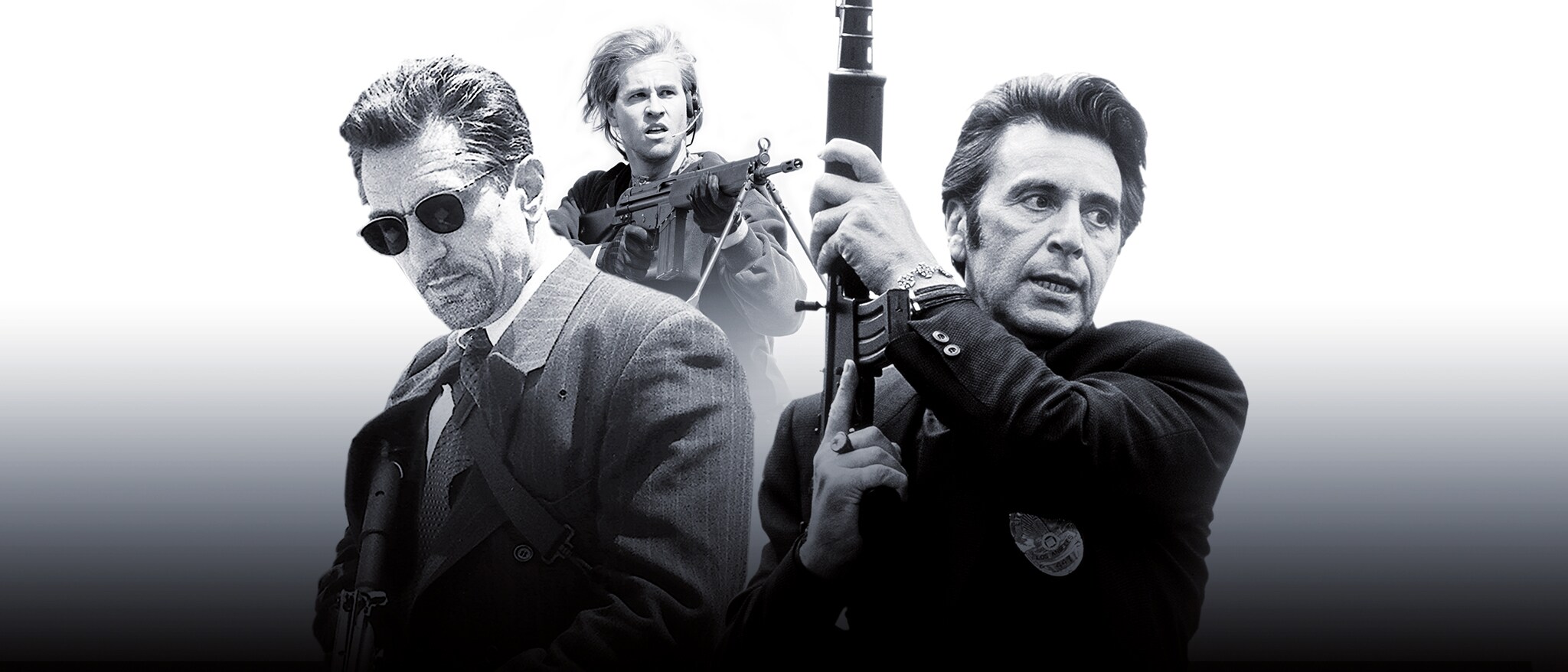
“Heat” had a gripping story, a killer score, and the best acting talent in the industry. Al Pacino stars as Los Angeles police Lieutenant Vincent Hanna. Robert DeNiro is his opposite number, the leader of a murderous armed robbery crew named Neil McCauley. Val Kilmer, Jon Voight, Tom Sizemore, Wes Studi, Ashley Judd, Natalie Portman, Danny Trejo and others add some proper depth.
Curiously, one of the reasons Mann did such a bang-up job on “Heat” is that it wasn’t his first time to tell the story. The script for “Heat” began as a 1989 TV pilot called “LA Takedown.” “LA Takedown” used many of the same characters along with an abbreviated version of the narrative that Mann later utilized for “Heat.” Mann filmed this project in a mere 19 days. The movie ran on TV in August of 1989 and was intended to become a series before being canceled.
Both films were based upon an actual incident that occurred back in 1964. The real-life thief was really named Neil McCauley, an ex-Alcatraz inmate who began plotting fresh crimes as soon as he got out of prison. Unbeknownst to McCauley, an LA detective named Chuck Adamson was following at a distance.
McCauley and his crew robbed an armored car as it made a drop at the National Tea grocery store. While inside the store, the cops closed off the escape routes and a massive shootout ensued. McCauley was gunned down by the cops in the front yard of a nearby home.
DeNiro’s McCauley character begins the film with an HK USP before switching to a SIG P220. Pacino’s Hanna packs a Colt M1991A1 Series 80 Officer’s ACP in a cross-draw holster. Pacino press checks his 1911 prior to confronting one of the bad guys, which is a cool touch.
Val Kilmer’s character is shown with a Beretta 84FS. The LAPD officers pack standard Beretta 92FS pistols, which should be period correct. LAPD SWAT carry 1911’s, which is also spot-on.
SWAT officers are carrying what appear to be HK MP5A3 submachine guns. However, the astute gun nerd will note that they are actually converted HK94 9mm rifles. You can tell by the absence of tri-lug suppressor mounts on the barrels and the lack of flapper magazine releases. Normal people don’t care, but guys like me certainly do.
Factory-correct HK MP5 clones are both reasonably-priced and ubiquitous nowadays. However, back in the 1990’s, converting a real-deal German HK94 was the only way to get into an MP5 analog. These same guns were used in lots of movies made during this time period, “Die Hard” standing out among them.
Tom Sizemore’s character wields an FN FAL battle rifle in the opening armored car scene. When terminating a captive security guard he employs the classic Mozambique Drill of two to the chest and one to the head. We see the same thing on glorious display by Tom Cruise in the subsequent Michael Mann film “Collateral.”
Val Kilmer’s character uses an HK91 rifle without an optic from an overwatch position during the shootout at the abandoned drive-in. In his skilled hands, this full-power .308 battle rifle is appropriately effective against targets inside a pickup truck. He fires the weapon off of its folding bipod to excellent effect.
DeNiro and Kilmer are packing full-auto Colt Model 733 carbines. These stubby 5.56mm assault rifles sport 11.5-inch barrels and round handguards, this being the era before ubiquitous rails. Curiously, the M16A1 upper receivers sport A1 rear sights but include the A2-style brass deflectors.
Tom Sizemore wields a Galil ARM in 5.56mm. Wes Studi’s cop character carries an M16A1 outfitted with M16A2-style round handguards. The rest of the street cops carry a variety of shotguns.
Pacino’s character comes packing a short-barreled FN FNC carbine. The gun used in the film was selective fire and cut down from a long-barreled original.
However, Mann had Pacino use the gun in semi-auto-only as he was portraying a police officer. It was rightfully assumed that a cop would not be spraying rounds all over the countryside.
DeNiro and Kilmer were not so inhibited. They run their 733’s in appropriately precise bursts, covering each other using solid fire and maneuver tactics. Kilmer’s character in particular executes magazine changes under fire like a freaking Delta Force operator.
In fact, it has long been rumored that the Marine Corps uses an excerpt from this scene to introduce their CQB training. I’ve never personally eaten crayons myself, so I am not qualified to comment on the veracity of that tale.
Details
These were the days before the widespread use of digital effects, so the star-shaped muzzle flashes were real. The way the actors reacted to the live weapons made the gun scenes all the more compelling. What really cemented the movie in its position as greatest gun film ever, however, was the noise.
Mann was not satisfied with simply having the Foley guys patch in artificial gunfire sounds over his film. As a result, the sounds of gunfire were recorded live in the city during primary filming.
Listen closely, and you can hear the reverb of gunshots bouncing back and forth off of the buildings in downtown LA. I saw the movie in the theater when it came out, and this effect was mind-blowing.
I wasn’t the only guy who found “Heat” inspiring. Two years after the movie came out, Larry Phillips Jr. and Emil Mătăsăreanu famously robbed the North Hollywood branch of the Bank of America packing real-deal automatic weapons.
The two criminals perished in a fusillade of full-auto gunfire, while 11 cops and seven civilians were injured. Investigating officers found a VHS copy of “Heat” in Phillips’ VCR when they later searched his home.
Given Alec Baldwin’s unfortunate on-set faux pas, movie makers are increasingly relying upon airsoft guns and digital effects to replicate on-screen gunfire. That’s cheaper and undoubtedly safer than using live blank-adapted guns for shoot-em-up scenes. However, when you get a master like Michael Mann who clearly has a passion for firearms behind the camera, the results speak for themselves. “Heat” is the greatest gun movie of all time.