Categories
Author: Grumpy
Categories
The Thompson/Center is Back!
Categories
The words just fail me!
.JPG)

Categories
Gunga Din
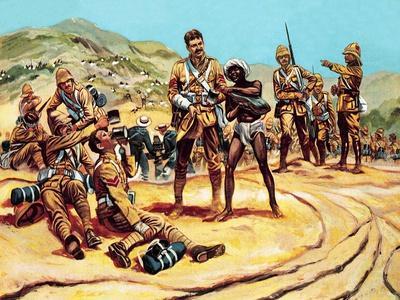 Gunga Din
You may talk o’ gin and beer
When you’re quartered safe out ’ere,
An’ you’re sent to penny-fights an’ Aldershot it;
But when it comes to slaughter
You will do your work on water,
An’ you’ll lick the bloomin’ boots of ’im that’s got it.
Now in Injia’s sunny clime,
Where I used to spend my time
A-servin’ of ’Er Majesty the Queen,
Of all them blackfaced crew
The finest man I knew
Was our regimental bhisti, Gunga Din,
He was ‘Din! Din! Din!
‘You limpin’ lump o’ brick-dust, Gunga Din!
‘Hi! Slippy hitherao
‘Water, get it! Panee lao,
‘You squidgy-nosed old idol, Gunga Din.’
The uniform ’e wore
Was nothin’ much before,
An’ rather less than ’arf o’ that be’ind,
For a piece o’ twisty rag
An’ a goatskin water-bag
Was all the field-equipment ’e could find.
When the sweatin’ troop-train lay
In a sidin’ through the day,
Where the ’eat would make your bloomin’ eyebrows crawl,
We shouted ‘Harry By!’
Till our throats were bricky-dry,
Then we wopped ’im ’cause ’e couldn’t serve us all.
It was ‘Din! Din! Din!
‘You ’eathen, where the mischief ’ave you been?
‘You put some juldee in it
‘Or I’ll marrow you this minute
‘If you don’t fill up my helmet, Gunga Din!’
’E would dot an’ carry one
Till the longest day was done;
An’ ’e didn’t seem to know the use o’ fear.
If we charged or broke or cut,
You could bet your bloomin’ nut,
’E’d be waitin’ fifty paces right flank rear.
With ’is mussick on ’is back,
’E would skip with our attack,
An’ watch us till the bugles made ‘Retire,’
An’ for all ’is dirty ’ide
’E was white, clear white, inside
When ’e went to tend the wounded under fire!
It was ‘Din! Din! Din!’
With the bullets kickin’ dust-spots on the green.
When the cartridges ran out,
You could hear the front-ranks shout,
‘Hi! ammunition-mules an’ Gunga Din!’
I shan’t forgit the night
When I dropped be’ind the fight
With a bullet where my belt-plate should ’a’ been.
I was chokin’ mad with thirst,
An’ the man that spied me first
Was our good old grinnin’, gruntin’ Gunga Din.
’E lifted up my ’ead,
An’ he plugged me where I bled,
An’ ’e guv me ’arf-a-pint o’ water green.
It was crawlin’ and it stunk,
But of all the drinks I’ve drunk,
I’m gratefullest to one from Gunga Din.
It was ‘Din! Din! Din!
‘’Ere’s a beggar with a bullet through ’is spleen;
‘’E’s chawin’ up the ground,
‘An’ ’e’s kickin’ all around:
‘For Gawd’s sake git the water, Gunga Din!’
’E carried me away
To where a dooli lay,
An’ a bullet come an’ drilled the beggar clean.
’E put me safe inside,
An’ just before ’e died,
‘I ’ope you liked your drink,’ sez Gunga Din.
So I’ll meet ’im later on
At the place where ’e is gone—
Where it’s always double drill and no canteen.
’E’ll be squattin’ on the coals
Givin’ drink to poor damned souls,
An’ I’ll get a swig in hell from Gunga Din!
Yes, Din! Din! Din!
You Lazarushian-leather Gunga Din!
Though I’ve belted you and flayed you,
By the livin’ Gawd that made you,
You’re a better man than I am, Gunga Din!
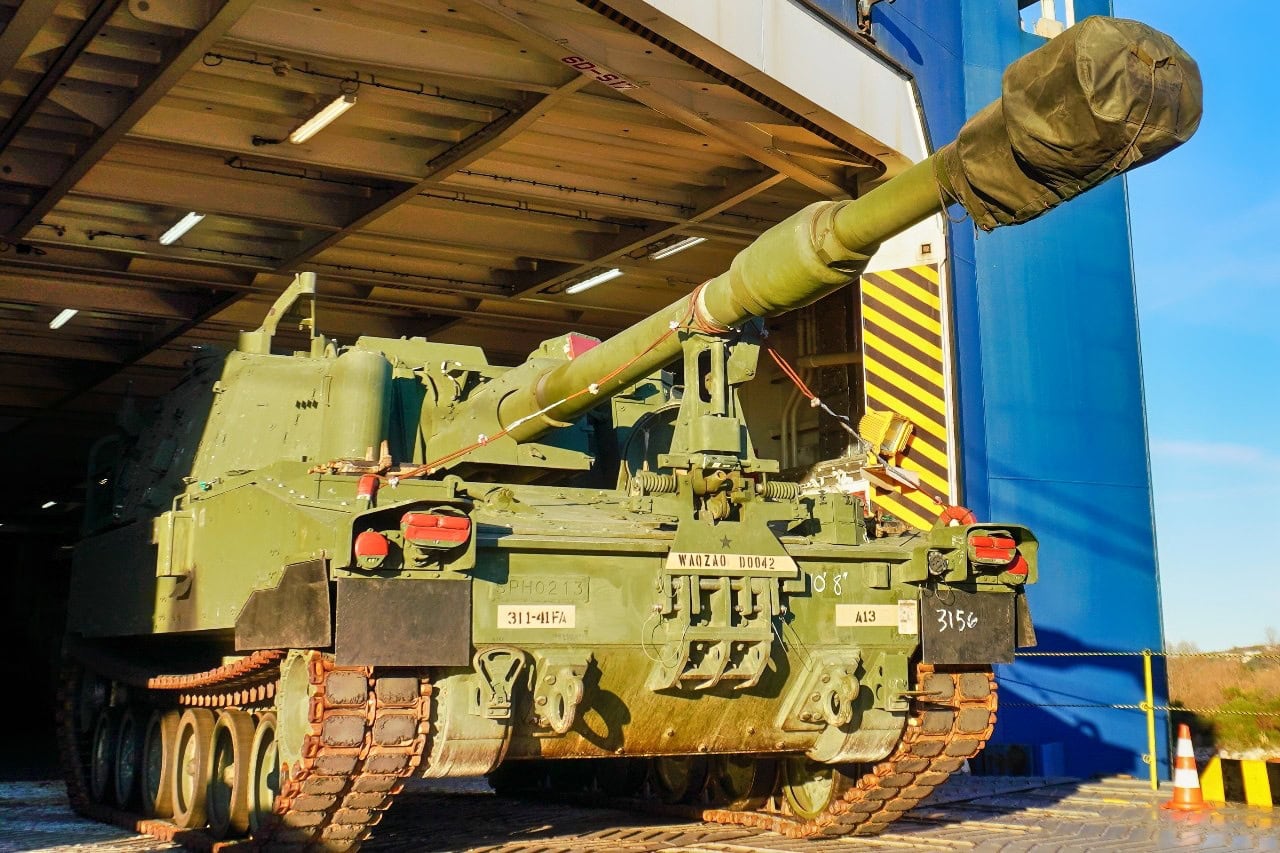 A U.S. M109 Paladin howitzer drives off the vessel Liberty Peace during offloading operations at the port of Koper, Slovenia on December 28, 2024. This Reception, Staging, and Onward Movement (RSOM) operation in the port of Koper is bringing in 1-3ID, the next Regionally Aligned Force (RAF), into the European Theater. These forces will be then transported by the 21st Theater Sustainment Command to their forward operating sites across NATO where they will conduct interoperability training with Allies and partners. The intent of these RAFs is to assure our allies and deter all adversaries.
NATO’s June summit in The Hague will present a critical opportunity for America’s allies to reaffirm their commitment to collective security. The worsening security environment in both Europe and the Indo-Pacific can only be met by increased burden-sharing from all NATO members.
NATO: An Alliance Ripe for Change
Longstanding imbalances in defense expenditures and strategic responsibilities within the alliance have culminated in a vital need to undertake four reforms.
Reinforce Article 3: Commitment to Self-Defense
Article 3 of the North Atlantic Treaty requires NATO members to “maintain and develop their individual and collective capacity to resist armed attack.” There are legitimate concerns that many nations may not be fully capable of defending themselves, let alone aiding the collective capacity to support one another in conflict.
According to a recent analysis by the Heritage Foundation, America’s NATO allies have collectively underfunded their defense commitments by more than $827 billion. Notable shortfalls include Germany ($249 billion), Italy ($150 billion), and Spain ($150 billion). These shortfalls represent a decade of underinvestment in capabilities and maintenance. The end result is less-capable militaries
During this period, the U.S. averaged defense spending equivalent to 3.42 percent of GDP, while the average NATO member spent 1.59 percent—less than half as much as the U.S. spent and well below NATO’s 2 percent benchmark first articulated in 2006 and reaffirmed by all members at the 2014 Wales Summit.
Russia’s annexation of Crimea in 2014 and its invasion of Ukraine in 2022 exposed the consequences of decades of underinvestment. European nations have struggled to deliver on promised military support to Ukraine, with depleted stockpiles and limited industrial capacity—especially in munitions—undermining their ability to take the lead on military aid to Ukraine.
The 2 percent minimum has become a political bellwether in Washington, and fulfilling these obligations will strengthen transatlantic relations.
Raise NATO Spending Targets to at Least 3 percent
NATO’s current defense-spending target of 2 percent has proven insufficient to deter aggression. There are now growing calls for a 3 percent threshold—not as a new obligation, but as a necessary correction for more than a decade of underinvestment. In fact, most countries that have a deficit in spending will likely take until 2030 to 2035 just to reach the original 2-percent minimum target agreed upon in 2014.
This higher minimum threshold would accelerate rearmament in munitions production, military mobility infrastructure, and training. It would signal strategic resolve.
Reform the 20 Percent Equipment and R&D Requirement
The 2014 Wales Summit also set a target for NATO members to allocate at least 20 percent of their defense budgets “on major equipment, including related Research & Development.” However, many nations only met this metric by spending below the 2 percent minimum target, undercutting the policy’s intent.
For example, Spain has consistently met the 20 percent equipment requirement, but only spent 1 percent of overall GDP on defense. When looking only at the equipment expenditure target, Spain could claim to have overspent the minimum target by $1.3 billion since 2014. However, when considering that the target is to spend 0.4 percent of GDP on equipment—20 percent of 2 percent of GDP—Spain is down $28.4 billion on equipment since 2014.
Therefore, NATO could explore reforming its guideline by setting a floor on equipment spending that uses GDP as a reference. For example, a new standard could be to spend 0.6 percent of GDP for equipment—20 percent of a revised 3 percent GDP minimum. Given Europe’s travails in delivering military equipment to Ukraine on promised timelines, these conversations are both timely and germane. Further, implementing such a policy is prudent for any individual nation, whether or not it is formally codified in a declaration.
Address the Fiscal Realities of the United States
After decades of overspending, the United States is approaching its fiscal limits. Interest payments on U.S. national debt are set to exceed annual defense spending. Washington cannot afford to subsidize allies while bearing an outsized share of global security burdens. As China adopts an increasingly bellicose posture toward Taiwan, deepens ties with Iran, and provides support for Russia’s actions in Ukraine, NATO must grapple with global instability and embrace genuine burden-sharing . The most significant thing European NATO members can do to help America deter China is to provide the bulk of conventional deterrence in Europe so that U.S. forces can shift to the Indo-Pacific.
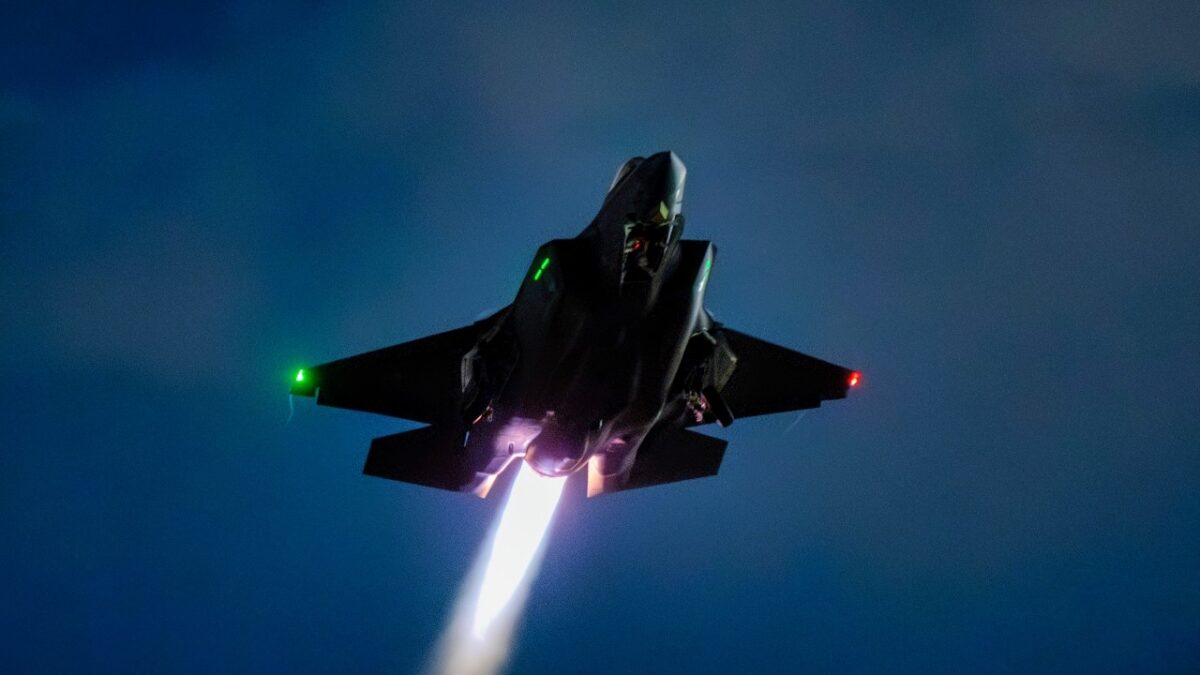
An F-35A Lighting II takes off for a Red Flag-Nellis 24-2 night mission at Nellis Air Force Base, Nevada, March 18, 2024. The presence of the F-35s offers the U.S., Allies, and partners a versatile and highly capable system, enhancing collective defense measures while reinforcing the NATO Alliance’s commitment to leveraging top-tier military capabilities for regional security and deterrence. (U.S. Air Force photo by 1st Lt. Jimmy Cummings)
NATO must use the Hague summit to recommit to Article 3; adopt a robust 3-percent-of-GDP defense-spending target; consider setting equipment-spending standards to 0.6 percent of GDP; and recognize the fiscal limitations facing the United States.
Failure to act now, individually and collectively, will increase the likelihood of future conflict. Decisive reform, however, will ensure NATO remains a credible force for peace and deterrence well into the 21st century.
About the Authors:
Miles Pollard is an economic policy analyst at the Heritage Foundation’s Center for Data Analysis. Kyle Mendelson was a member of Heritage’s Young Leaders Program.