|
The Frommer Stop Pistol
by Ed Buffaloe
Rudolf Frommer was born in Budapest, Hungary on 4 August 1868. Contrary to what many sources indicate, Frommer did not study engineering.
He studied business administration at the Kereskedelmi Akadémiát (College of Commerce) in Budapest. In 1896, at the age of 28, he was employed at the Higelbank (Credit Bank) in Budapest.
At this time the Hungarian state Small Arms and Machine Factory, Fegyver és Gépgyár (FEG), was in a state of financial crisis and the company’s stock was taken over by the bank, which promptly transferred Frommer to the factory to reorganize their finances. Frommer secured a line of credit to allow FEG to manufacture Mannlicher rifles, and was instrumental in putting the company on a sound financial footing.
Frommer became involved in firearms design, and his position in the company enabled him to promulgate his own inventions.
More than 100 patents were issued to him between 1900 and 1934, mostly related to firearms or machine tools for various products manufactured by FEG.
In 1904 he was made Director of Trade, and in 1914 he was made CEO of the company. He was awarded an honorary degree in mechanical engineering, was elevated to the nobility, and became a lifetime member of the Hungarian Senate. F
rommer retired on 1 November 1935 and died in Budapest on 1 September 1936 at the age of 78. He is buried in the Jewish graveyard next to the Farkasréti cemetery in Buda.
Between 1900 and 1914 Rudolf Frommer, almost certainly in collaboration with his co-workers Karl Krnka and Georg Roth, developed a number of weapons that utilized a “straight pull” long-recoil locked breech design, wherein the barrel and locking bolt both recoil together for slightly more than the length of the cartridge.
whereupon the breech unlocks as the barrel returns to its forward position, the empty cartridge case is ejected, and the bolt closes and relocks. These weapon designs included several pistols, a rifle, and a machine gun.
Early Long-Recoil Patents
Possibly the earliest long recoil action design was that of Hugh Gabbett Fairfax.
who filed various patents in Great Britain in 1895, 1897 and 1900 for a design for which a number of prototypes were manufactured under the name Mars pistol by Webley & Scott in the period between 1900 and 1902.
The gun met with very limited success and was never produced for sale.
Another early design for an automatic weapon using a long recoil action, and the earliest I have found which utilizes a rotary bolt like the Frommer, is found in John M. Browning’s U.S. patent 659786, which he applied for on 6 June 1900 and which was issued on 16 October of that same year.
Guns produced under this patent include the Remington Model 11 automatic shotgun, manufactured from 1905 through 1948, and the Remington Model 8 semi-automatic rifle, manufactured from 1906 through 1936.
The design has both a barrel spring, to return the barrel to its home position, and an “action spring” to return the bolt to its home position, and features a breech block with a rotating, telescoping locking bolt.
In the patent the mechanism is described as follows (leaving out references to the various drawings):
The bolt…has locking-lugs…, which engage with spiral or circumferential grooves…in the rear extension…of the barrel….
[The] automatic locking and unlocking of the bolt in its position relatively to the carrier insures the proper engagement of the bolt with the barrel.
Now suppose a cartridge to be inserted in the barrel of the gun and the bolt closed thereon by a forward movement of the bolt-carrier.
At this instant the bolt-lock…is released, and the forward movement of the bolt-carrier…causes the bolt to rotate to locked position, the bolt carrier closing over the bolt into close contact with the barrel….
If the cartridge is now fired, the recoil carries the barrel and bolt -carrier directly backward…compressing both springs…
The latch…is pressed up by a spring…to engage a shoulder…on the bolt- carrier, thus retaining the carrier in its rearmost position. The barrel…moves forward under the impulse of [the] spring…, and, pulling the bolt with it by means of the locking engagement described, causes the bolt…to partially rotate until it is unlocked, when the barrel continues to move forward….
The extractor.. .engages the cartridge flange or groove as usual, and when the barrel has moved forward far enough the spring -ejector…throws out the shell through the opening…in the receiver in [the] usual manner.
As soon as the latch…is rocked far enough to be released from the bolt-carrier…said carrier jumps forward under the impulse of the action-spring…, carrying a cartridge with it, if one be present, and closing and locking the breech….
Frommer’s Early Guns
Rudolf Frommer applied for a British patent for an “Automatic Firearm with Sliding Barrel” on 11 October 1901, which was granted on 13 March 1902 as patent number 20362-1901.
Although Frommer’s implementation differs from Browning’s, like Browning’s, Frommer’s design features separate springs for the bolt and the barrel, as well as a rotating locking breech block.
Frommer’s patent illustrations show how the design could be adapted to either a hammer-fired pistol or a striker- fired rifle.
The method of operation is described as follows (omitting references to the various drawings):
At the moment of firing, the barrel…, the breech frame…and the whole breech mechanism are thrown back by the recoil…
whereby the barrel spring, the [bolt] spring…, the hammer…and consequently the [hammer] driving spring.. .are set.
The tumbler…thereby comes into engagement with the notch…of the bolt and fixes the bolt in its rearward position.
The force of the recoil then immediately ceases so that the barrel…and the breech frame…are again driven forward by means of the barrel spring….
As the barrel…and breech frame…are now driven forwards by the barrel spring…the empty cartridge case firmly held by the cartridge extractor is thrown out by the ejector… …
the breech bolt remains fixed in its rearward position… …the driving spring…can then come into operation and drive forward the breech bolt which pushes into the chamber the fresh cartridge…,
whereby the studs…of the breech block which passed into the hollows…in the annular groove…turn in the said groove and become firmly locked with the breech frame….
The arm is now ready for firing, that is cocked, rigidly closed and charged and can again be fired off by pulling the trigger….
The design described in the above 1901 patent was manufactured by FEG in 1903, designated the Model 1901 Frommer, and chambered for an 8mm cartridge which is said to have been later used in the Roth-Steyr pistol of 1908.
This cartridge would have been known as the 8mm Frommer had the pistol been more successful, but instead is known today as the 8mm Roth-Steyr.
Both pistols probably evolved from an 1895 Roth-Krnka prototype pistol.
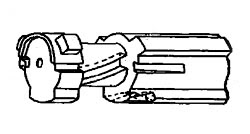
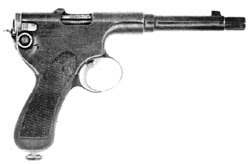
The Model 1901 Frommer is remarkably compact, given its mechanical complexity. It consists of the receiver, barrel and barrel extension (referred to as the breech frame in the patent), and the bolt, containing the rotating breech block with locking lug which telescopes in and out of the bolt.
At the rear of the bolt is a lug with serrations for gripping. The gun has an external spur hammer and a single-action trigger.
There is a knob on the right side, just beneath the end of the bolt, which secures the bolt retaining piece beneath the bolt and is used in field stripping.
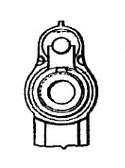
The receiver is topped by a barrel housing which completely surrounds the barrel and barrel extension, with only 25mm of the barrel protruding from the front of the housing.
The 1901 Frommer has an integral ten-round magazine in the grip which is charged through the open breech using a cartridge clip.
The barrel recoil spring fits concentrically around the barrel, beneath the housing, while the bolt recoil spring is likewise wrapped around the firing pin, inside the breech block.
The spring-loaded ejector is embedded in the left side of the barrel extension; the extractor is on the right side of the breech block.
The gun has a manual safety in the form of a square button on the left side of the frame which locks the barrel, bolt, sear, trigger, and hammer.
The bolt locks open when the last round has been fired, and may be closed by a round button on the left side of the frame, just above the top of the left grip.
The grip features a rounded butt with a large lanyard ring. The rear sight sits just behind the ejection port.
The Model 1901 may have been manufactured for two or three years, but the quantities made must have been quite small as the gun is very scarce today.
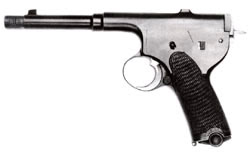
The Model 1906 Frommer was an updated form of the Model 1901.
A number of parts were redesigned so that they could be manufactured more quickly and therefore more cheaply.
The gun was chambered for the 7 .65mm Frommer cartridge, which was externally identical to the 7.65mm Roth-Sauer cartridge of 1905,
but was loaded to a higher pressure to operate the long-recoil action of the Frommer.
The cartridge case length was .510 inches (compared to the 7.65mm Browning’s case length of .655 to .685 inches).
The early Model 1906 retained the integral butt-well magazine, but the later model was provided with a removable magazine and a magazine release button to the rear of the trigger guard on the left side of the frame–easily accessible to the thumb of a right-handed shooter.
A small lanyard ring is integral with the grip frame, just in front of the magazine well.
Ezell gives a barrel length of 159mm (6.25 inches) and an overall length of 275mm (10.8 inches) for the Model 1906.
The gun weighed 640 grams (22.6 ounces). According to Hogg and Weeks, this pistol was manufactured in small quantities for approximately four years.
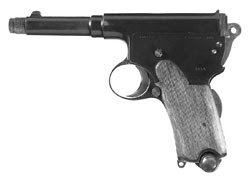
The final version of the early Frommer pistol was the Model 1910.
Hogg and Weeks, Ezell, and Matthews all state that this gun was chambered for the 7.65mm Browning cartridge.
However, an online article by Merv Broten states that the pistol was “chambered for the 7.65mm Frommer cartridge, never the .32 ACP – the magazine well is much too short.”
I have had correspondence from an owner of a 1910, he states categorically that the .32 ACP is too long to fit in the magazine or the chamber.
With the addition of a grip safety, the manual safety of the earlier models was eliminated. There is still a button on the left side of the frame, just above the top of the grip, to close the breech.
The hammer has a ring instead of a spur. The rear sight has been moved to the rearmost position on top of the receiver, just in front of the bolt lug.
The barrel and overall length of the gun have been shortened.
According to Hogg and Weeks, this pistol was manufactured in small quantities right up to the beginning of World War I in 1914.
Broten states that the early pistols “…were probably serial numbered in the same block of numbers. M1910’s are found in the 7000 to 10000 range.” However,
all the 1910 Frommers I have documented seem to be in the 2000-3000 range.
The Frommer Stop
Probably when the redesign for the Model 1910 was completed Frommer had already begun work on a completely new design. The patent was applied for in Germany on 5 September 1911, and patent number 252983 was granted on 31 October 1912. In 1912 Frommer was granted British patent number 10566-1912 and Swiss patent number 60337 for “Improvements in Self-loading Pistols of the kind having Sliding Barrels.” The nature of the patent is described succinctly as follows:This invention relates to self-loading pistols of the kind in which the barrel slides backwards under the effect of the recoil and in which the breech block interlocks with the barrel. In weapons of the kind referred to it is necessary to provide springs for returning the barrel and breech-block respectively into the firing position after the recoil due to each discharge. It is generally desirable to make such weapons as short and light as possible, and in the construction of the same heretofore employed a difficulty was experienced in combining these desirable features with springs of sufficient length for effecting the self loading in an absolutely reliable man- ner. The object of the invention is to provide a construction which enables this difficulty to be overcome.
With this object in view, according to this invention, the two springs which return the barrel and the breech-block respectively into the firing position are arranged above the barrel concentrically to one another. The advantage of this arrangement is that each of the two springs can have a considerable length relatively to that of the weapon, so that with a comparatively short weapon the springs can be made sufficiently long to fulfil their functions in a reliable manner.
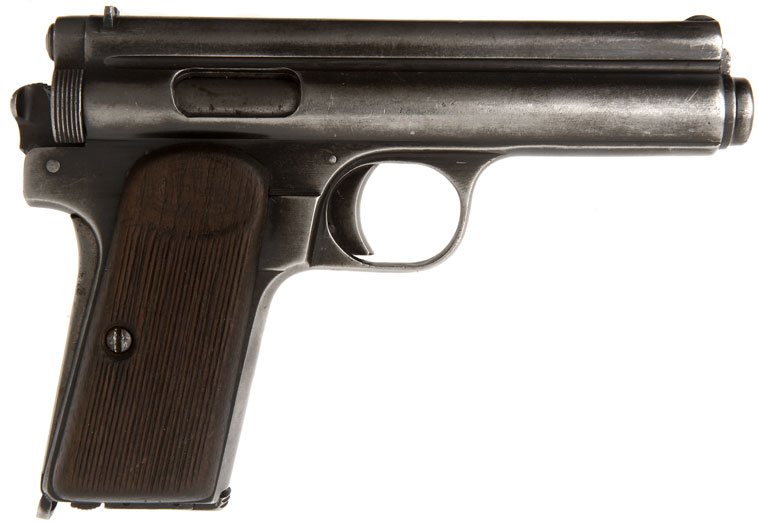
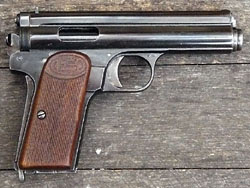
Production of the Frommer Stop began in 1912. It was chambered for the 7.65mm Browning cartridge (.32 ACP). After the beginning of the First World War the Frommer Stop was also chambered for the 9mm Browning Short (.380 ACP).
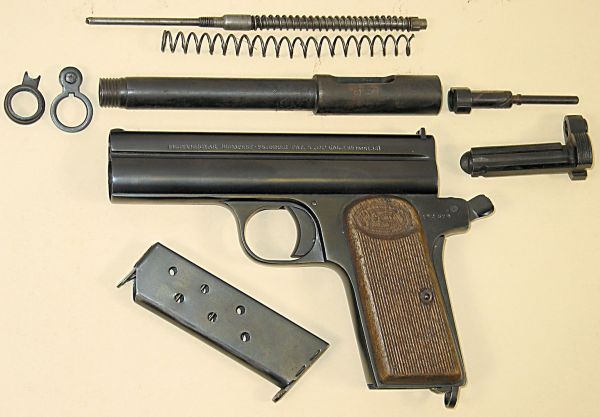
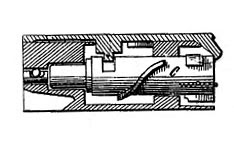
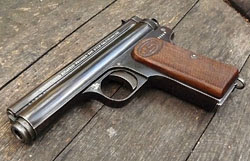
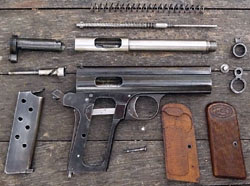
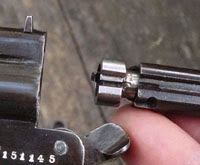
Like its predecessors, the Frommer Stop has three main components: the barrel, bolt, and receiver. The receiver has a metal housing on top in the form of two horizontal cylinders. The top cylinder is about half the diameter of the bottom cylinder. The top cylinder houses the dual return springs for the barrel and bolt, and a guide rod for both springs. The lower cylinder houses the barrel. The barrel has an extension on its rear to accept the bolt. A spring-loaded ejector is built into the inside wall of the barrel extension. The bolt has a rotating breech block that fits inside it. The firing pin runs through the middle of the breech block, and the extractor runs along one side of it. The breech block telescopes in helical grooves inside the bolt and has two lugs, one that serves as a guide and one that rotates into a recess inside the barrel extension to lock the breech when the bolt is all the way forward. The bolt is flattened on the bottom into a sort of full-length lug that fits into the cutaway bottom of the barrel extension, so the bolt is able to reciprocate inside the barrel extension, but cannot rotate.The connector bar runs inside the frame on the right side of the gun connecting the trigger with the tail of the sear. Just above the sear is the bolt catch, which engages the bolt at full recoil. The sear and the bolt catch are both tensioned by a vertical coil spring which sits between them. The grip safety locks the connector bar, and hence the trigger, but not the sear or any other part of the mechanism.
The sequence of operation is exactly like that described in Frommer’s first patent. To reiterate, for clarity’s sake, when the cartridge is fired, the barrel and bolt recoil together for a distance greater than the length of the cartridge. At its rearmost extension under recoil the bolt catch engages the bolt, locking it back. The barrel recoil spring, having been compressed by the recoil, forces the barrel forward. As the barrel moves forward the helical groove in the barrel extension rotates the locking lug of the breech block. The breech block telescopes forward about 8mm in the bolt and unlocks the breech. The barrel continues forward, while the empty cartridge is held by the extractor, and when the barrel moves forward enough the spring-loaded ejector in the barrel extension springs out and ejects the cartridge. When the barrel reaches its forwardmost position the bolt catch is disengaged and releases the bolt, and if there is a cartridge in the magazine the magazine spring forces it upward to be driven into the chamber by the returning bolt.
This is certainly one of the most complex mechanisms ever invented for a pistol. The breech remains positively locked until the bullet exits the barrel. However, because of the mechanical complexity of the weapon and the mass of the barrel, barrel extension, and bolt, a cartridge with a weak charge will not cycle the action. Donald Simmons points out that the bolt is installed from the rear and is retained by two lugs at the end of the recoil spring guide rod which “…are the only deterrents to the bolt continuing straight back, right off the frame of the pistol” and into the shooter’s face. I have never heard of this happening, but a more worrisome problem is detailed by R.K. Wilson. “The metal of the receiver is so thin and light that it is easily damaged by knocks and blows, a very slight one of which will produce binding against the barrel and totally incapacitate the weapon.”Early grips are of checkered hard rubber with an ‘FS’ monogram in an oval at the top. Later grips are of wood with vertical serrations and an ‘FS’ monogram in an oval at the top. All markings are on the left side of the gun. The serial number is stamped on the left grip tang. On military pistols there is an acceptance mark on the left bow of the trigger guard–this invariably starts with BP (for Budapest) followed by an Austrian or Austro-Hungarian seal, followed by the last two digits of the year of acceptance. Commercial proofs consist of a crown over BP in a circle. The guns are marked on the left side of the spring housing in capital serif letters as follows:
FEGYVERGYAR-BUDAPEST·FROMMER-PAT. STOP CAL.7.65mm (.32)
or
FEGYVERGYAR-BUDAPEST·FROMMER-PAT. STOP CAL.9mm (.380)
Magazines have holes drilled in both sides for viewing the cartridges, and are marked on the bottom of the thick baseplate either 7.65 FROMMER or FROMMER 7.65MM. I believe these markings have often led people to believe that the cartridge was something other than the 7.65mm Browning, and there is no doubt that the Hungarian cartridges were loaded to a higher pressure than most U.S. .32 ACP cartridges, but this is also true of many of the European-made Browning cartridges. The .32 Stop magazine holds 8 cartridges, while the .380 Stop magazine holds 7.
The Frommer Stop pistol was manufactured through 1929, after which it was superceded by the Frommer Model 1929, which was a .380 caliber pistol with a simple blowback mechanism. It had far fewer moving parts than the Stop, was cheaper to manufacture, and was probably more robust and reliable.
The Frommer Baby
The Frommer Baby pistol is a downsized version of the Frommer Stop. The two guns appear to have begun production at more or less the same time, and in the early serial number ranges more Baby Pistols were produced than Stop pistols. The patent drawings appear to show a Baby rather than the larger Stop. Parts in the Baby which did not require downsizing, such as the trigger, connector, sear, bolt catch, hammer, barrel nut, barrel guide, and various pins will interchange with the Stop.
Grips on the Baby are similar to those on the Stop, except the monogram in the oval at the top is ‘FB’ instead of ‘FS’. The inscription on the left side of the spring housing is as follows:
FEGYVERGYAR-BUDAPEST·FROMMER-PAT. BABY CAL.7.65mm (.32)
or
FEGYVERGYAR-BUDAPEST·FROMMER-PAT. BABY CAL.9mm (.380)
The .32 Baby magazine holds 6 cartridges, while the .380 version holds 5.
Range Report for the Frommer Stop
The friend I bought the Frommer from had reported that the action didn’t always cycle properly. I disassembled and reassembled the pistol, making sure everything was in working order and properly lubricated. Then I bought the hottest 7.65mm hardball ammo I know of–Sellier & Bellot–to test with. I shot about 35 rounds in the Frommer and had three cases catch in the ejection port–they were extracted but not properly ejected. Otherwise the gun functioned quite well.
At 25 feet my shooting companion and I were able to hold groups to about an inch-and-one-half with the Frommer. For comparison purposes I shot the same ammunition in an MAB Model D pistol, which has the same length barrel as the Frommer but is blowback operated. The MAB’s trigger is atrocious–heavy, creepy and uneven–and the best groups I could get were 2 to 3 inches. The trigger on the Frommer is not light, but it is crisp and has the same feel with every shot –far superior to that of the MAB. I thought sure the Frommer would give higher velocities out of its locked breech, but testing proved me wrong. I chronographed ten rounds from each gun and averaged the muzzle velocities–the Stop bullets averaged 944 feet per second, whereas the MAB bullets averaged 996 feet per second. The barrels on both guns are in excellent shape, with crisp rifling and no pitting.
Writing in the 1940’s, R.K. Wilson said of the Frommer Stop, “[t]he pistol is a curious one to fire, as the long recoil of the heavy barrel tends to upset the aim and throw the muzzle upwards. It also gives the impression of being violent in its action. This is chiefly due to the light weight of the weapon.” I didn’t find this to be the case. I couldn’t tell any real difference in the recoil of the Frommer and the MAB. However, I agree with Wilson’s comments on the ergonomics of the Frommer: “The grip is not quite square to the barrel, but is not sufficiently sloping for natural pointing; moreover, there is too much weight above the hand.”
While the Frommer Stop illustrates a very interesting chapter in the evolution of self-loading handguns, it is too complex to be an acceptable military or self-defense weapon. If all its complexity actually resulted in a measurable increase in muzzle velocity and knockdown power, we might forgive its other drawbacks. But it offers no advantage over simpler designs, is fragile, unreliable, and difficult to maintain. It is a fascinating gun, but not one I would want to stake my life on.
| Field Stripping
the Frommer
Stop or Baby
- Remove the magazine and make sure the chamber is empty.
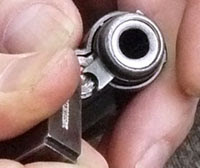
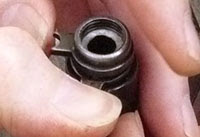
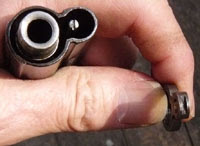
- Using the toe of the magazine, depress the barrel nut retainer and unscrew the barrel nut. (I find this is much easier if I use a brass punch instead of the magazine.)
- Carefully ease the spring-loaded barrel nut and barrel guide off the front of the gun.
- Remove the recoil spring from its housing.
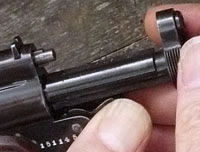
- The top of the barrel guide has a slot to use as a tool to turn the recoil spring guide. I find, however, that a small screwdriver works much better. Depress the recoil spring guide and rotate it a quarter-turn. It will spring out a little way.
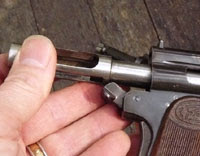
- Cock the hammer and remove the bolt from the rear of the receiver.
- Turn the recoil spring guide another quarter-turn and remove it from the front of the spring housing.
- Push the barrel out the rear of the receiver.
Reassemble in reverse. The breech block must be turned so its lugs align with those on the bolt–it will extend out from the bolt for several millimeters when the lugs are aligned. |
|
|
|
|