Categories
Uncategorized

THE PPSH SUBMACHINE GUN: RUSSIA’S SAVIOR? By Will Dabbs, MD

Private Pavel Ivanovich Andreyev was terrified. In his 18 short years on this planet, he had never imagined things could be so bad. He sat perched atop a growling T34 as it rumbled forward in the plains near the Soviet city of Kursk.

It was August of 1943. The sky was blue, and the sun beat down like a furnace. Littering the countryside around him were the hulks of hundreds of derelict armored vehicles.

The stench of rotten death penetrated the foul diesel exhaust bellowing from the T34. The ghastly smell seemed to soak into his flesh. Pavel wanted desperately to go home.

German reenactor with Russian PPSh SMG
The PPSh submachine gun was popular with troops on both sides on the Eastern Front.

Private Andreyev held his PPSh submachine gun in a death rictus. Andreyev and his comrades called the simple little bullet hose the “Papasha” or “Daddy.” Simplistic to the point of crudity, the PPSh nonetheless offered a simply breathtaking volume of close-range fire. Some Soviet formations sported entire companies armed solely with these fast-firing monsters.

The PPSh could be fed via either 71-round drums or 35-round stick magazines. Andreyev’s gun carried a drum. He had another drum magazine hanging from his belt in a canvas pouch. He felt the massive T34 slow down slightly before the very sky itself split asunder.

Soldiers and tanks in the Battle of Kursk
Kursk was the largest tank battle in human history. It was carnage on a scale the modern mind struggles to grasp. Image: Russian Federation Mil.ru

It was a German antitank gun, likely a feared Flak 88, and it pitched the Russian tank like some kind of toad. The shock threw Private Andreyev and the rest of his rifle squad viciously to the ground. Andreyev regained his wits moments later and rolled over. Andreyev realized he had to move or he was going to die.

The Soviet tank was now brewing up, its ammunition cooking off like the sulfuric effluvium of hell itself. In desperation Private Andreyev rolled into a nearby trench.

Miraculously, his Papasha was still slung around his neck. The young Russian fell heavily to the soft earth and willed himself not to panic. As he stood unsteadily to his feet four German Landsers came tearing around the corner on top of him. All five young soldiers were comparably surprised.

PPSh magazine and drum
The PPSh could be fed via either 71-round drums or 35-round box magazines.

The Germans carried bolt-action Kar98k rifles, and they all four raised them up as one spontaneously orienting in Andreyev’s direction. For his part, Private Andreyev did not think. He simply angled his Papasha from the hip and torqued down on the trigger. The PPSh spewed death within the tight confines of the trench at fifteen rounds per second. All four Germans went down.

Five seconds later Andreyev’s subgun fell silent, steam and smoke rising from its hot barrel. Without conscious thought Private Andreyev removed the empty drum and had a fresh one in place. He carefully stowed the expended drum in his ammo pouch for reloading. Andreyev got his wits about him, jacked the bolt on his SMG to the rear, and headed down the trench in search of trouble.

Tactical Details

The short-range, high-volume capabilities of the PPSh changed the way the Soviets prosecuted infantry engagements. Where previously rifle marksmanship was assumed to be the lynchpin to successful infantry actions, now the typical Soviet grunt thusly equipped was simply a bullet hose. One angry PPSh was impressive. One hundred at once was an irresistible force.

PPSh stood for “Pistolet-Pulemyot Shpagina” or literally “Shpagin’s Machine Pistol” after its designer Georgy Shpagin. An evolutionary development of the previous Soviet PPD, the PPSh was intended from the outset to be optimized for mass production. The PPSh first saw action in 1941.

Russian PPSh SMG
The Russian PPSh was inexpensive, effective, and available. It helped win the war for the Soviets.

The Papasha was comprised predominantly of relatively crude steel stampings. The receiver and perforated barrel jacket were pressed out as a single component. The flip-adjustable sights were basic and unadorned, while the sundry details were rough and rugged. The muzzle end of the gun terminated in a brilliant pressed steel muzzle brake that tended to help minimize muzzle rise. The barrel jacket featured a series of cooling slots.

The magazine release was a pivoting thumb lever located on the midline. When not in use this appendage could be folded up and stowed against the bottom of the weapon. There was a sliding switch located inside the triggerguard that toggled between semi- and full-auto fire. The gun’s sole safety was a sliding component of the charging handle that could be snapped in toward the receiver to lock the bolt in either the open or closed positions.

Pivoting magazine on the PPSh
The pivoting magazine release could be folded up against the receiver when not needed.

The bolt was chrome plated as was the bore, and there was a synthetic buffer in the back of the gun that looked like a screwdriver handle. Two PPSh barrels could be formed from a single Mosin-Nagant tube by cutting the rifle barrel in half and chambering both ends. The buttstock was simple and unadorned. Two drums were hand-fitted to each gun at the factory. The use of other drums ran the risk of a loose fit or poor reliability.

Muzzle brake on the Russian PPSh SMG
The gun’s angled steel muzzle brake was one of its most innovative and effective features.

There were 87 parts comprising a PPSh, and the gun required 5.6 hours’ worth of machine time to produce. By comparison, the previous PPD consumed 13.7 hours. Only a few hundred weapons were in service by November of 1941. Another 155,000 rolled off the lines in the next five months. In 1942 Soviet industry had produced 1.5 million Papashas. By the end of the gun’s vigorous production run some six million copies had been built.

Practical Tactical

A great many experienced soldiers swore by the PPSh for its exceptional reliability and breathtaking close-range firepower. I myself do not care much for the gun. That might have something to do with the fact that the first burst I ever fired through a PPSh dropped a pair of hot empty cases down the back of my collar. The PPSh ejects straight up and with some vigor. When moving tactically that’s not a big deal. When stationary on the range, however, it’s like sitting under a shower of hot brass.

7.62x25 PPSh round vs. 9mm Parabellum
The zippy little 7.62x25mm round (right) fired by the PPSh is shown here on the right alongside the 9mm Parabellum.

There’s not really a good place to put your support hand when running a drum-equipped PPSh. The weak hand can cup the stock behind the drum or just grab onto the side of the drum itself, but these are suboptimal solutions. Holding the barrel shroud risks burning your hands, and the angles are all wrong trying to reach around that fat drum. The curved 35-round stick magazine provides a much more comfortable purchase.

The 1,000-rpm rate of fire is a bit spunky for my tastes as well. The gun’s fully-loaded 12-pound weight when rocking a drum and its superlative design render it exceptionally controllable, but it still burns through ammo at a prodigious rate. A good gun will run in the face of the most egregious abuse with minimal maintenance.

Sincerest Form of Flattery

It became obvious in action that the PPSh was a game-changer on the battlefield. The zippy little 7.62x25mm round it fired offered ample penetration and minimal recoil, while the 71-round drum produced unprecedented firepower. This meant that German Landsers frequently used captured PPSh submachine guns in action against the Russians.

Man dressed as soldier from German army using of PPSh
German use of the Russian PPSh was so widespread that the Wehrmacht type-classified the weapon.

The Wehrmacht even undertook a program to convert captured PPSh’s to fire 9mm Parabellum. Conversion kits included a drop-in 9mm barrel and a magwell adaptor that allowed the Russian guns to feed from German MP40 magazines. These converted guns were designated the MP41(r) in German service. The same guns in their stock configuration were referred to as the MP717(r) and were fed dimensionally similar German 7.63x25mm ammunition.

The Russians also experimented with the PPSh as an airborne weapon. Multiple PPSh SMGs were fitted to fuselage racks affixed to the Tupolev-2 bomber. In this configuration, these ground attack planes produced a simply breathtaking volume of very short-range automatic fire. However, as the guns fired pistol cartridges the rounds lost energy quickly.

Angled view of the PPSh submachine gun
While some say the gun would never win a beauty contest, the PPSh was an incredible performer in the field.

The PPSh was eventually supplanted by the yet simpler PPS-43. However, the communists shipped their surplus PPSh guns to puppet states and terrorist groups all around the globe. The PPSh saw widespread use during the Korean War in the hands of both North Korean and Chinese soldiers. The PPSh is still encountered in some of your less well-funded war zones even today.

The PPSh will never win any beauty pageants. However, when introduced it was effective, reliable, and available in quantity. These factors alone made the PPSh a legitimately war-winning weapon. In the sweaty hands of young conscript soldiers like Pavel Ivanovich Andreyev the PPSh helped beat back the fascist hordes. From the barren approaches to Moscow to the ghastly hell that was Stalingrad to the verdant fields surrounding Kursk, the PPSh could be found grappling with the Nazi juggernaut.

Special thanks to worldwarsupply.com for the reproduction gear used in our photographs.

Categories
All About Guns

A Winchester Model 70 XTR Sporter Varmint in caliber .223 (My Buddy Bill had one of these and Brother did it shoot well!)


Categories
All About Guns

“Portable Hotchkiss”

"Portable Hotchkiss"
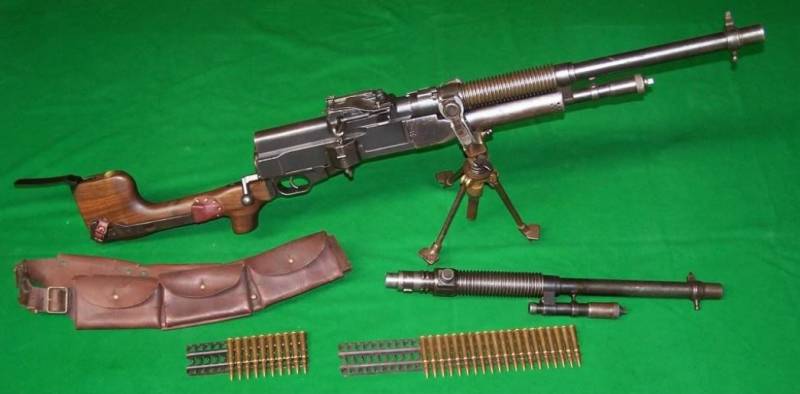
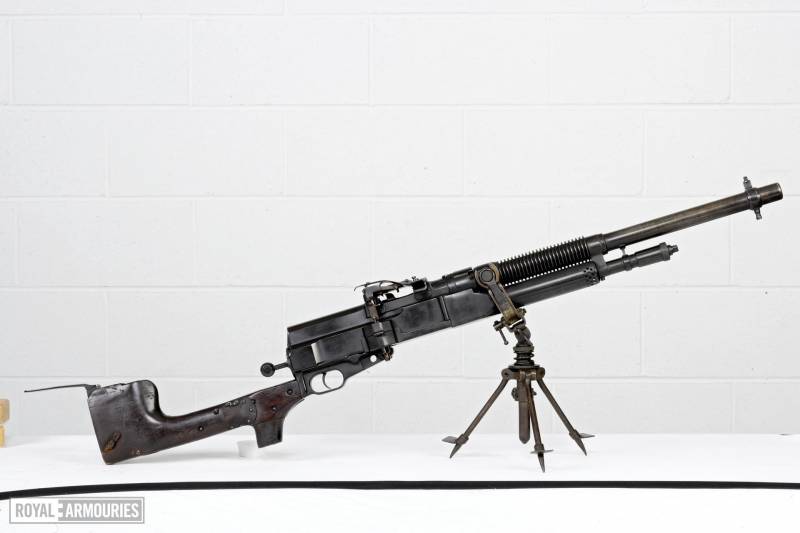
Machine gun “Hotchkiss” M1909 Infantry model. Next to it is a barrel with trunnions for a tripod, leather ammunition for cartridge cassettes and the cassettes themselves for 14 and 30 rounds
“During the Russo-Japanese War, an English military observer, future general, Ian Hamilton said: “The only thing the cavalry is capable of in the face of machine-gun nests is to cook rice for the foot soldiers.”
Barbara Tuckman, The Guns of August

stories about weapons. Creation of an air-cooled machine gun arr. 1900 was a great achievement for both the Hotchkiss company and the French military, who were able to understand that in addition to Maxim machine guns, other systems have the right to exist, and they are in many ways no worse. However, having received this heavy machine gun on a tripod, they immediately realized something else, namely, that they would absolutely need another machine gun – lighter and more convenient for use in cavalry and infantry for fire support in conditions where heavy machine guns are used will be impossible. This is how the idea of ​​a “gun-machine gun” arose, which, however, has already found its embodiment in the Madsen light machine gun. But the French army could not take it into service due to the need to unify weapons.


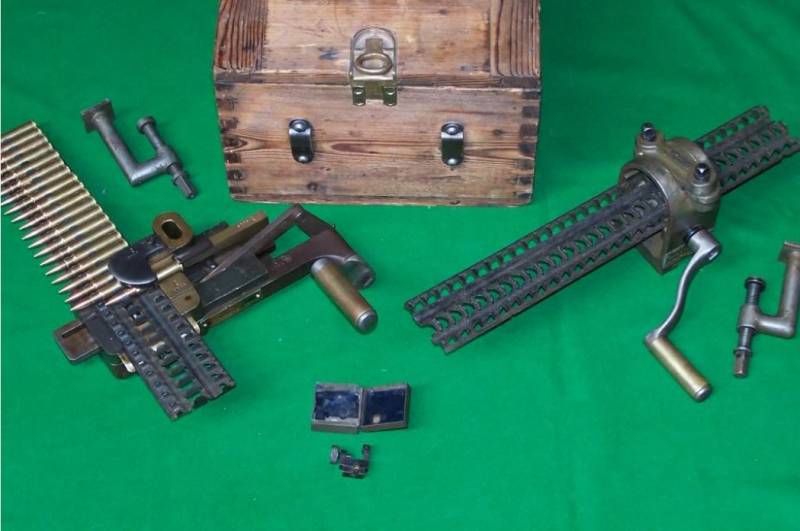
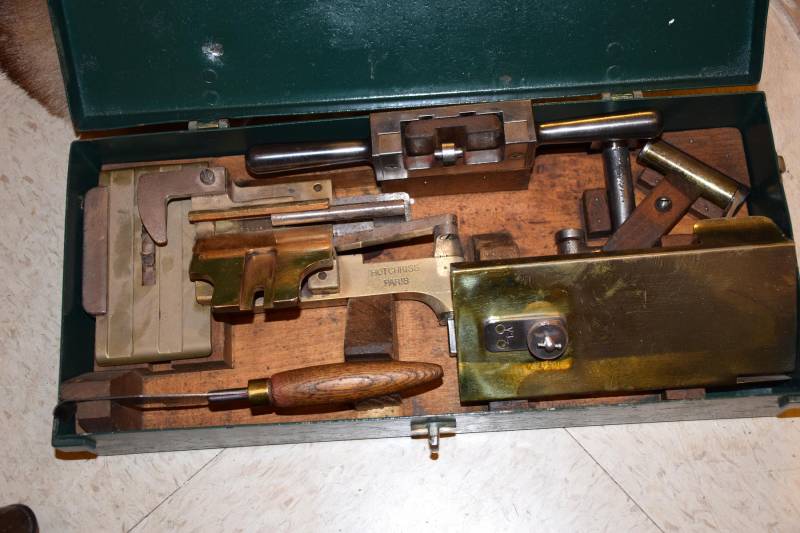
On the left is a machine for stuffing cartridges into a cassette, on the right – for correcting bent cassettes

That is, the new machine gun had to copy the old one, but at the same time be lighter, more transportable and have the same cartridge supply system with the easel machine gun. To solve this problem was entrusted to the same designers of the Hotchkiss company – the American Lawrence Bennett (or, as he was called in the French manner – Benet) and his French assistant Henri Mercier. And they successfully coped with their task. So a machine gun was born with three names at once: “Hotchkiss” Mk I, “Hotchkiss portable” and the Bene-Mercier M1909 machine gun. In general, Adolf Odkolek could only rejoice, because it was his idea that was also embodied in this machine gun, which, by the way, was mentioned in all British instructions for firing from this machine gun.


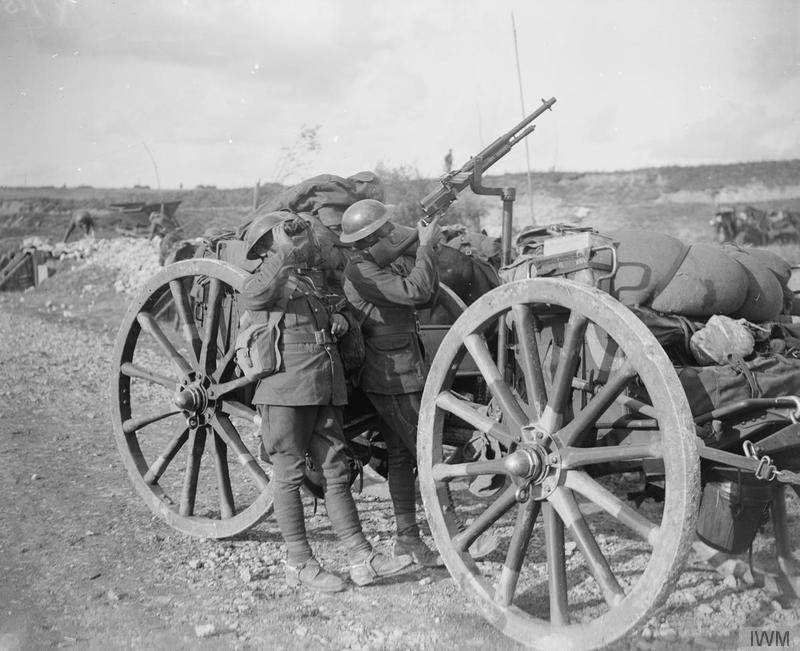
The Hundred Day Offensive, August-November 1918. Soldiers of the Royal Horse Artillery, attached to the 1st Cavalry Division, fire at a German aircraft from a Hotchkiss M1909 machine gun mounted on the limber. Transport convoys were favorite targets for German pilots and were provided with such anti-aircraft protection. October 8, 1918 Photo archive. Imperial War Museum

The production of the machine gun began at the Hotchkiss factory in Saint-Denis in Paris in 1909, but in 1914, due to the threat of the capture of the city by the German army, it was transferred to Lyon along with the factory. The next year, the British government decided to produce this machine gun under license at a factory in Coventry. By the end of the war, more than 40 M000s had already been manufactured there.


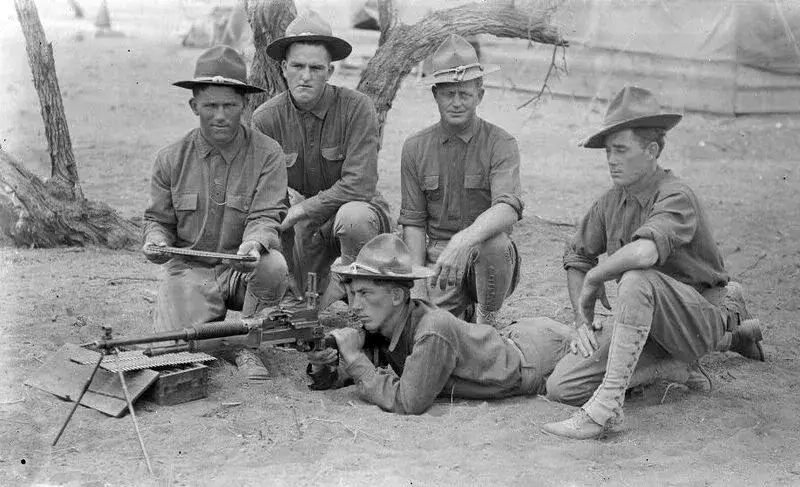
US Army machine gun platoon

At the same time, the production of a machine gun was launched in the United States at the enterprises of the Springfield Arsenal and at the Colt company. However, total production in the United States was only 670 units. It may not seem like much, but for the US Army of that time it was a significant batch. Here it was named “Bene-Mercier machine gun, caliber .30, model USA 1909”. The American model differed from the British machine guns by the presence of a bipod on the barrel and an emphasis on the butt, as well as an optical sight. Well, he also had his own caliber, American. Also, for Colt machine guns, from the gas valve to the front sight, the barrel had an unusual very small faceted cut, reminiscent of the wall decoration at our Kremlin Chamber of Facets!

TTX English and American machine guns “Hotchkiss” М1909:
Hotchkiss Mk.I and Bennet-Mercier M1909

Caliber: .303 British (7.7x57R); .30-06 (7.62×63)
Weight: 12,8 kg; 15 kg
Length: 1190 mm; 1244 mm
Barrel length: 565 mm; 610 mm
Feed: 9, 14, or 30-round rigid cassette tapes or 50-round semi-rigid tapes; hard cassettes for 30 rounds
Rate of fire: 500 rounds per minute; 550 rounds per minute


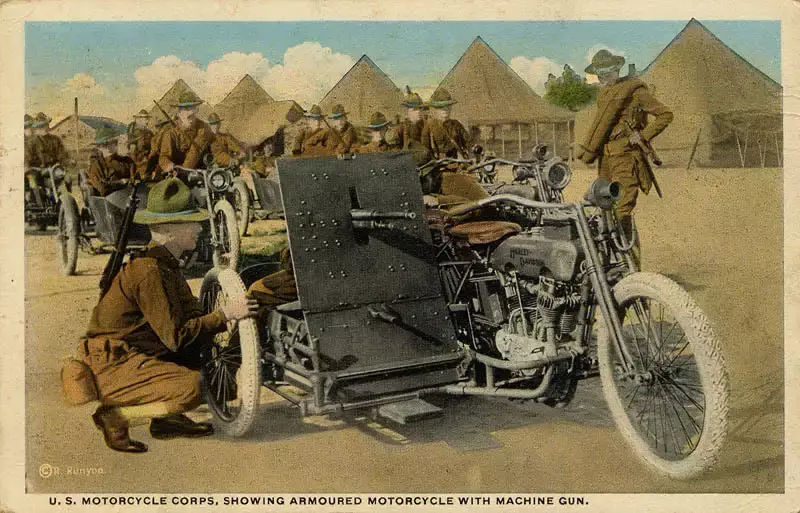
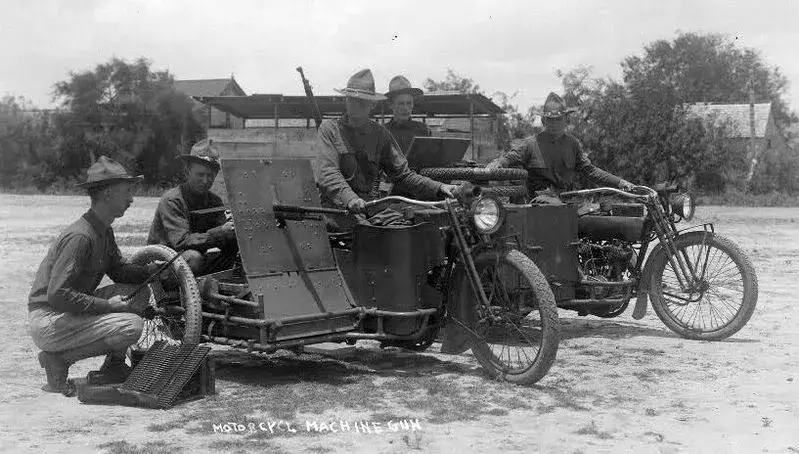
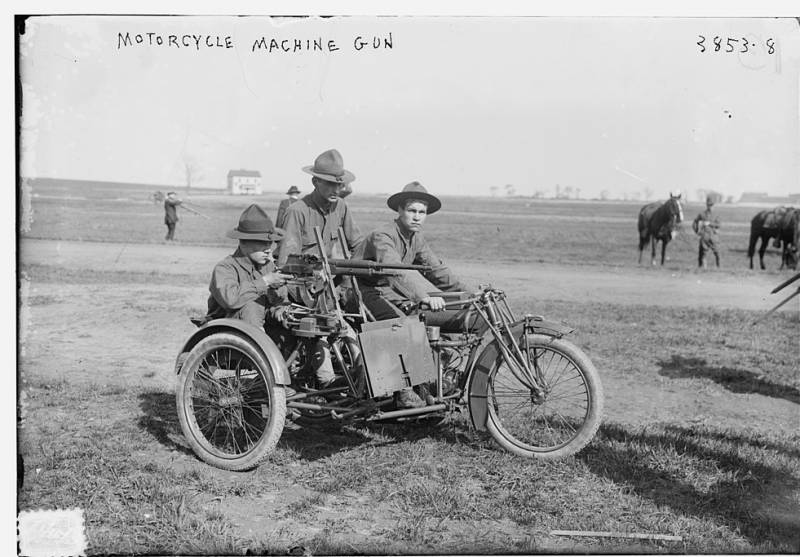
During the First World War, it became fashionable in the American army to mount M1919 machine guns on motorcycles.

It is interesting that the Hotchkiss, adopted by the French military in 1909, for some reason, was not first used as an infantry weapon. 700 copies of the machine gun were handed over to the fortresses of Verdun, and after the start of the war they were used on some aircraft, and then … in tanks Mk V* purchased from the UK.


Machine gunners on motorcycles. US Army, 1916

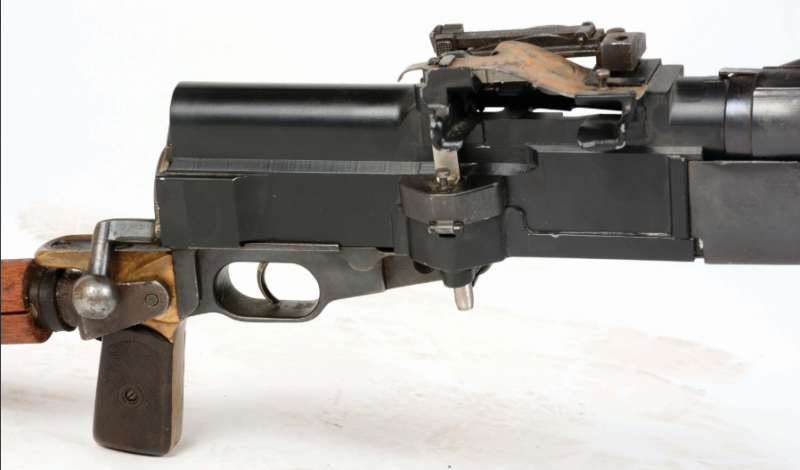
The British .303 Hotchkiss Mk I variant produced in the UK at the Coventry factory was issued to some cavalry regiments, while the Mk I*, with its wooden stock replaced by a pistol grip, was widely used on British tanks.


And in this photo the armor plate is removed

It was also used in the armies of Belgium, Sweden and Mexico. And in the armed forces of France and Great Britain, the M1909 machine gun was used not only during the First, but also during the Second World War. They armed the Australian Light Horse, the New Zealand Mounted Rifle Brigade, the Camel Corps and parts of the Duke of Lancaster’s Yeomanry. In 1915-1917. it was used in the Sinai and Palestine campaigns. And in the same 1916, the American army unsuccessfully tried to use four M1909 machine guns against Pancho Villa’s Mexican rebels during the latter’s raid on the city of Columbus, New Mexico. Initially, the press said that they refused to work due to design flaws, but later it turned out that the machine gun crews simply were not trained to handle them.


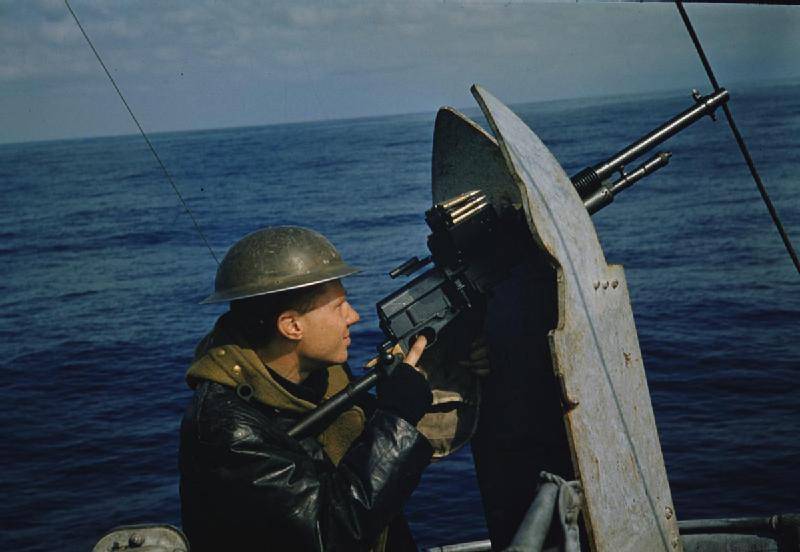
British Royal Navy in 1942. A machine gunner on an escort vessel is on watch during the passage of a British convoy across the Atlantic. Ammunition machine gun “Hotchkiss” M1909 from the drum shop. Photo archive. Imperial War Museum

So, American machine guns often broke drummers and extractors. Due to the difficulty of replacing broken parts at night, the press began derisively calling the M1909 “daylight weapons”, because in the dark, soldiers often inserted one important detail upside down. Major Julian Hatcher was assigned to study the problem, and he found that almost all cases of delays in firing and machine gun failures were caused by … human error, that is, poor training of machine gunners.


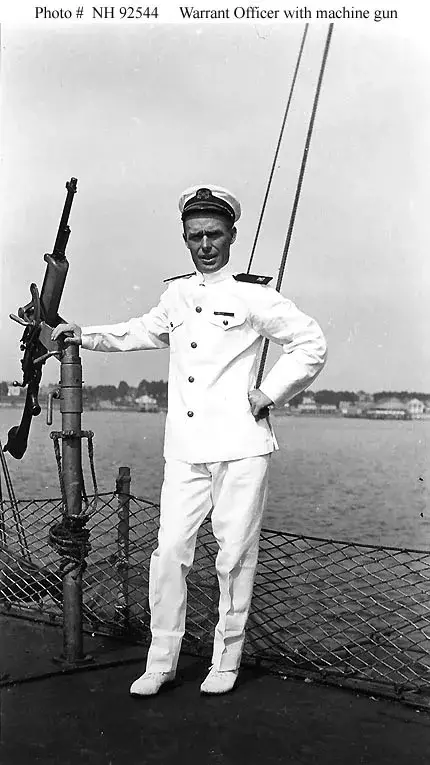
A warrant officer at a Hotchkiss machine gun on a USS. US Library of Congress

After the soldiers learned a little, the M1909 began to be considered a completely effective weapon. That’s just the production of this machine gun in the United States was discontinued before the First World War. Only a small part of them ended up in the army, because of which, after entering the war, their release had to be urgently resumed.


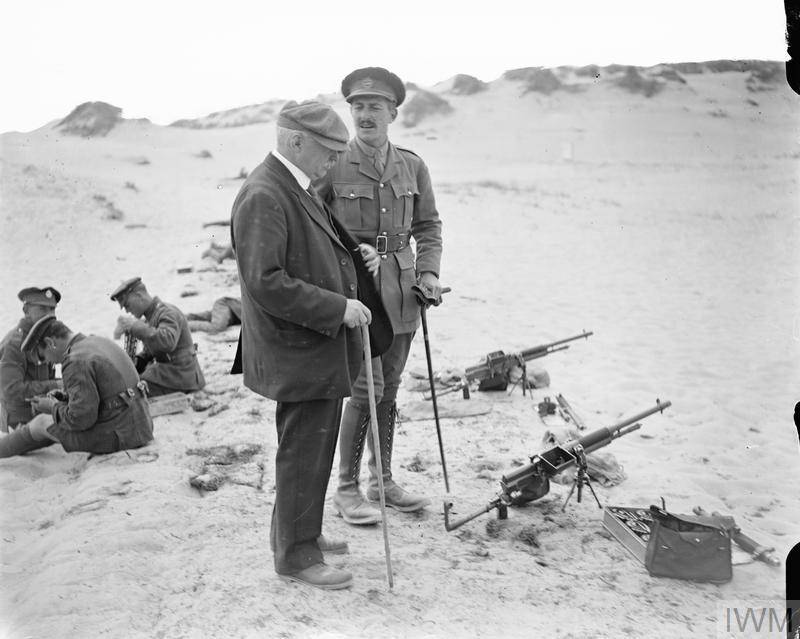
Sir Edward Patrick Morris, Prime Minister of Newfoundland, visits the Panzer Corps Ordnance School at Merlimont, July 2, 1918. Photo archive. Imperial War Museum

Experts note that, although, in general, Hotchkiss portable machine guns during the war years were in the shadow of other, more commercially successful systems (for example, the Lewis machine gun), they themselves were simple in design and fairly reliable samples. An important advantage of these machine guns was massive barrels, which allowed (in case of emergency) to conduct effective continuous fire up to 1000 shots without changing the barrel or cooling down (and usually the shooters were recommended to pause in firing after 200-300 shots).


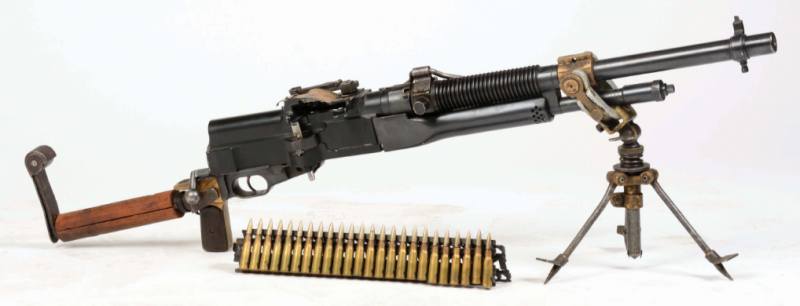
Machine gun “Hotchkiss” M1909 with an L-shaped butt, cartridge cassette and tripod support, which is fixed not on the pins of the barrel, but on the barrel itself. Used by the British Army. Photo morphyauctions.com

What were the design features of this machine gun, which, in fact, became a reduced copy of the Hotchkiss machine gun, but at the same time retained its high fire performance?


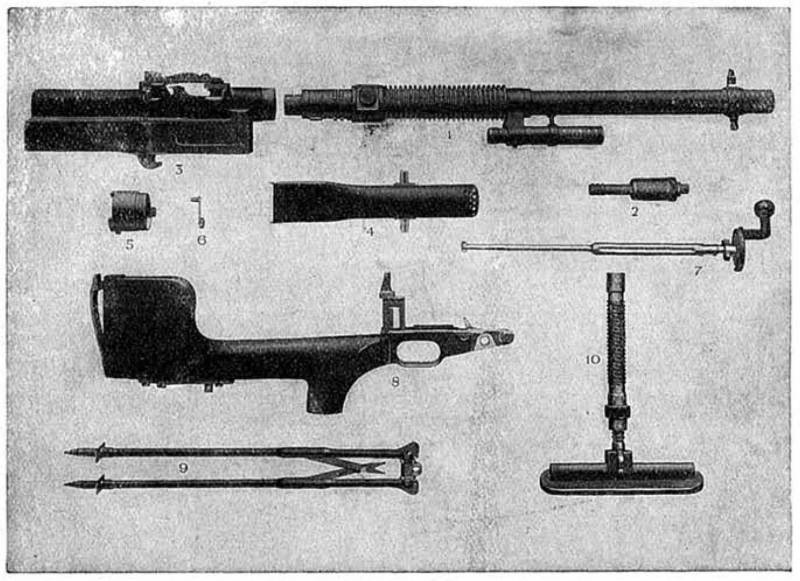
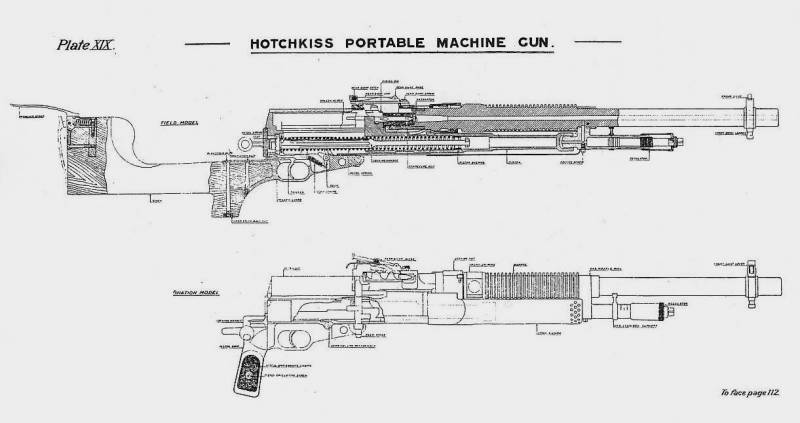
The machine gun consisted of the following main parts: (1) a barrel with a gas tube; (2) a gas regulator that screwed into the gas tube from the front; (3) bolt box; (4) forearm, which is the casing of the gas piston; (5) gate nut; (6) handles for fastening the bolt box to the butt; (7) cocking handles; (8) trigger stock; (9) bipods (on American machine guns); (10) stock supports

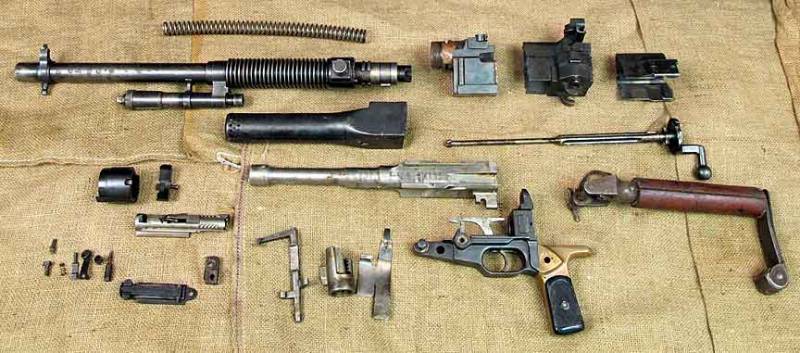
Machine gun completely disassembled. Noteworthy is the exceptionally massive gas piston, which passes into the bolt carrier. Their diameter made it possible to place a return spring inside. And although the piston was hollow, the significant weight of this part helped to significantly reduce the recoil and thereby increase the accuracy of fire, which was especially emphasized in the manuals for using the machine gun. Lightweight stock used by the British Army

Scheme of the Hotchkiss M1909 machine gun (below in the version of the tank machine gun)

The machine gun had a fairly short, but at the same time, a massive barrel with fins up to the gas chamber, which consisted of twenty-five flanges that created a large cooling surface. Under the barrel was a T-shaped gas valve with two holes: front and rear. Through the rear hole, the powder gases from the barrel after the shot pressed on the cup-shaped piston head and threw it back, but the front one served to divert part of the gases into the regulator chamber. It was available with graduated positions of the piston screwed into the chamber, and the rule was this: more space inside, less gas pressure force; the enclosed space is smaller, the gas pressure force is greater.


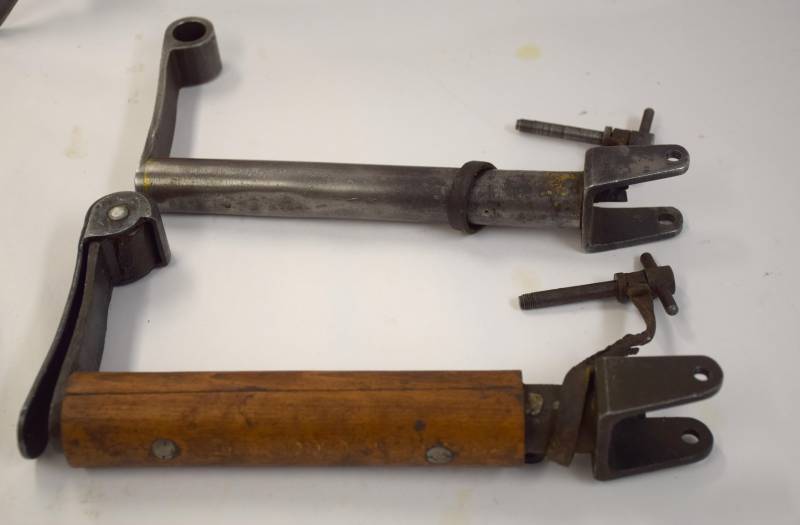
Variants of stocks for a machine gun. Photo morphyauctions.com

A barrel lock nut attaches to the front end of the receiver and screws onto the barrel to lock the barrel to the receiver. An external spring steel lug provided with undercuts or teeth that fit into the teeth or teeth on the receiver and prevent accidental rotation when fired. Front two recesses for dismantling key for disassembly and assembly. To the left of the indentations, you will find the arm guard that hooks onto the right shoulder of the arm guard and holds the arm guard in position. The barrel stop restricts the movement of the barrel in the lock nut. Inside the lock nut are three sets of interrupted flanges; they fit into matching flanges on the breech, and the deep threads on the inside fit into matching threads on the receiver.


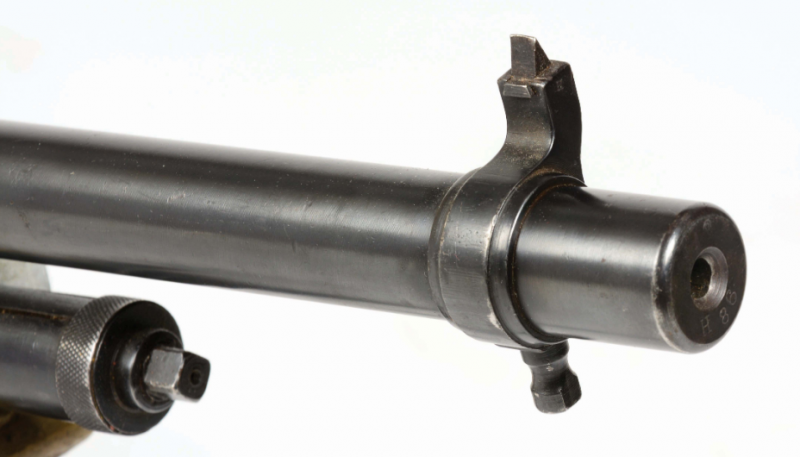
Muzzle, front sight and head of the piston-regulator. Photo morphyauctions.com

The barrel was locked by a rotating clutch, which was put on the breech of the barrel and could turn on it. On its inner surface there were three strips of intermittent threads, and exactly the same threaded strips were in front of the shutter. When the shutter moved, the protrusion on the coupling moved in the figured groove of the gas piston rod. At the same time, the clutch turned and, depending on the direction of movement of the piston and the bolt back and forth, either locked the barrel with the bolt or unlocked it. In the latter case, the barrel moved back, extracted the empty cartridge case and at the same time pulled out the next cartridge from the cassette for the next shot.


A set of tools for servicing a machine gun. Photo morphyauctions.com

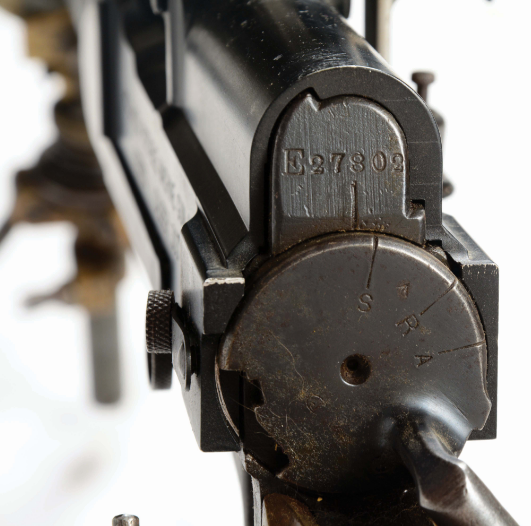
Shooting was carried out, like many other machine guns of that time, from an open bolt, single shots or bursts. The choice of fire mode is carried out in an unusual way: by turning the L-shaped cocking handle around its axis. At the same time, when shooting, she remained motionless, which, of course, was convenient.


Three positions of the shutter handle: “A” – fire bursts; “R” – single shots; “S” – on the fuse. On the left, a lever with a threaded head is clearly visible. By unscrewing it, you can easily separate the stock from the receiver

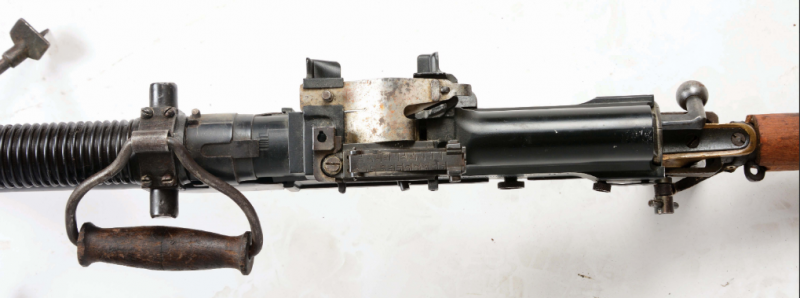
Sight shifted to the left and feed mechanism cover. Due to the presence of a handle, an overheated barrel could be replaced relatively easily. The machine gun sight was also shifted to the left and graduated in yards, from 100 to 2000 yards – even numbers were on the right, odd numbers on the left. The normal firing range was 900 meters. Photo morphyauctions.com

On the right side of the receiver is the housing of the cassette feeding mechanism with cartridges, which is closed from above with a lid on spring hinges; a flat spring keeps it closed. Its main detail was an L-shaped vertical rod with a “tooth” at the end and two V-shaped cams placed on it, which fit into the cutouts on the body and at the same time fall into the corresponding grooves of the bolt frame.


Cartridge feeding mechanism. Photo morphyauctions.com

Due to this, when the frame moved back and forth, the vertically standing lever made movements perpendicular to the axis of the barrel and with its “tooth” (at the same time it fell into the cutout on the cassette with cartridges) shifted it in the direction from right to left. The lever is spring loaded. Therefore, in order to insert the cassette into the receiver, it was necessary to lift it by pressing on the protruding end from below so that it itself rose up. The cassette was inserted on the right. In this case, the cartridges should have been under the cassette.


Machine gun “Hotchkiss” M1909 British production. Export version 1934. Total length: 1010 mm. Total weight: 12,5 kg. Barrel length: 597 mm. Caliber 7,92 mm. Royal Arsenal, Leeds

TTX machine gun “Hotchkiss” Mk I
Weight: 12 kg
Length: 1,23 m
Barrel length: 64 cm
Ammunition: .303 British (British), 8mm Lebel (French), .30-06 Springfield (USA), 7×57mm Mauser (Brazil and Spain)
Calibers: .303 (7,7mm), 8mm, .30 (7,62mm), 7mm
Firing Rate: 400-600 shots per minute
Maximum range: 3800 m
Power type: 30-shot cassette

PS This machine gun is more difficult to see in the cinema than the same “Lewis”, but there are still films where it is present. These are the following films: “La Bandera” (1935), “All is calm on the Western Front” (1979), “The Seventh Satellite” (1968), “Dauria” (1972), “My Destiny” (1974).

Author:
Vyacheslav Shpakovsky
Categories
Interesting stuff

Concentration is one of the keys to markmanship

Categories
A Victory! Our Great Kids The Green Machine This great Nation & Its People War

Sgt. Leigh Ann Hester – My kind of Soldier (One that gets the job done!)

Sgt. Leigh Ann Hester fought her way through an enemy ambush south of Baghdad, killing three insurgents with her M-4 rifle to save fellow soldiers’ lives — and became the first woman since World War II to win the Silver Star medal for valor in combat. 
The then-23-year-old from Bowling Green, Ky., won the award for skillfully leading her team of military police soldiers in a counterattack after about 50 insurgents ambushed a supply convoy they were guarding near Salman Pak. 
The medal, rare for any soldier, underscores the growing role in combat of U.S. female troops in Iraq’s guerrilla war, where tens of thousands of American women have served.
Categories
All About Guns

Sporterized Mausers: Doing it Right

Categories
Well I thought it was neat!

Well I thought it was funny!

Categories
All About Guns Fieldcraft

What Really Happens When You Fire a Gun Underwater?

Categories
All About Guns

What a pity that they ruined this!

Categories
All About Guns Allies California

There’s Nothing New about California Republicans ‘Snubbing’ Gun Owners by David Codrea

California Republican Ronald Reagan, claimed by some to be “pro-gun,” had all the grabber buzzwords, right down to calling the Stockton schoolyard maniac’s semiauto a “machinegun.” (Barack Obama/Facebook)

U.S.A. – -(Ammoland.com)- “According to their official platform, the California Republican Party believes the United States Constitution guarantees the right of its citizenry to keep and bear arms and that the state’s gun control laws only serve to disarm law-abiding citizens, not criminals,” Gun Owners of California notes in a blog post decrying the state GOP’s deliberate indifference to acting on its pledges. “They are on the record as opposing any further gun control legislation and support the right of all California citizens to own and bear guns and ammunition for any lawful purpose.”

“If this is the case, then why would the California Republican Party continue to snub the hundreds of thousands of gun owners in the state?” GOC asks. “Why does the political party – the one that supposedly is the champion of the Constitution – treat California’s gun owners like annoying flies to be swatted away?”

Probably because equivocal platitudes Golden State Republicans offer to establish their 2A bona fides with those who don’t look deeper than rah-rah sloganeering are just that. The late RNC Chair Lee Atwater is reputed to have asked “Who else are gun owners going to vote for?” when informed performance didn’t live up to the promise. Being allowed to continually get away with that by “lesser of two evils” gun voters means there’s no incentive to change and to walk the talk.

Those in it for personal and political advancement will say whatever it takes to win. When they perceive that no longer works to their advantage, they guiltlessly reverse polarity and do what they think will serve them best, and the hell with those who brought them to the dance in the first place. Besides, who else are gun owners going to vote for, right?

None of this is news to California’s activist gun owners, of which I was one when I lived there. And in many cases, the misinformation being fed to them comes from groups they look to for leadership.

Case in point, the myth of Ronald Reagan being a great friend to gun owners, “substantiated” with anecdotes and citations to make that case, is directly contradicted by his actions.

20 years ago, I created a poll asking gun owners what they thought of a certain politician, listing some of the anti-gun actions he’s taken when in power, but not identifying who he was.

The results:

“[N]early 80%…who voted based solely on his actions deemed them ‘traitorous,’ and the vast majority of the balance deemed them ‘misguided.’”

It was, of course, Reagan. And he hosed us on immigration, too, leading to the seismic demographic shift in California that has anti-gun “progressives” gloating (and “gun rights” groups hiding behind a hollow “single issue” excuse), and encourages remaining Republicans to act more and more like Democrats if they want to have any skin in the game at all.

So why should California Republicans (and those from other states where they think they can get away with it) do anything more than give lip service to gun owners, assuming they even need to do that? After all, they’ve been getting away with serial betrayals for years.

Remember Gov. Pete Wilson?

“Pete Wilson has been strong and reliable on gun laws,” said Bob Walker, president of Handgun Control Inc. in Washington. “I think Gov. Wilson has always had a reputation for moderation. We think this is a very moderate and sensible approach to the problem.”

How about Attorney General Dan Lundgren?

“Many owners of the named firearms did not comply with the law, so Attorney General Dan Lundgren allowed persons to register them after the deadline. Fearing criminal penalties for possessing an illegal firearm, many owners reported their firearms under Lundren’s ‘amnesty’ program. In August 1998, however, a California appellate court held the Attorney General could not legally allow the gun owners to register their weapons after the March 1992 deadline. That ruling came after many owners had already identified themselves by registering late. The Attorney General had led the law-fearing lambs into a trap: citizens had voluntarily informed the state that they were felons.”

Then there was Gov. George Deukmejian:

“We’re coming up on the 24th anniversary of Iron Duke’s outdrawing the gun lobby to enact the nation’s first assault weapons ban — an action hardly anyone could have predicted, given his political past. Deukmejian owed his gubernatorial election in 1982, in large part, to gun owners.”

And don’t forget Arnold Schwarzenegger with his predictable results. He was someone a handful of us warned California gun owners against before he was selected to represent the GOP, only to see our warnings ignored or overwhelmed by misdirecting “gun group” voices.

So, with Republicans like these, who needs Democrats? (Sorry, GOC, if you’re going to insist there are “many freedom-loving Democrats,” it’s on you to show us their votes don’t enable the tyranny-loving kind. If owning a gun was all it took, we’d have no better pals than Lon Horiuchi and David Chipman.

And before you say “Libertarians,” consider their amnesty/invite-all platform and then show your research on why you’re right on demographics and every top Democrat since 1965 has been wrong.

Meanwhile, the rest of us are left with the existential question “What do we do?”

The same thing every human being faced with a demand to surrender or resist has always had to do: Make an existential choice.

Anyone who tells you we need to empower a known betrayer or “we’ll lose our guns” is really only saying that when push comes to shove, they’ll lose theirs.


About David Codrea:

David Codrea is the winner of multiple journalist awards for investigating/defending the RKBA and a long-time gun owner rights advocate who defiantly challenges the folly of citizen disarmament. He blogs at “The War on Guns: Notes from the Resistance,” is a regularly featured contributor to Firearms News, and posts on Twitter: @dcodrea and Facebook.

David Codrea