Author: Grumpy


We’ve seen FightLite’s AR pistol before, but at first, it had only a pirate raider grip. Now with a solid “sawed-off” (for lack of a better phrase) style grip, you can get two hands on the Bandito and hold it firmly. The buttstock is not a brace, so this will not be affected by the ATF’s SBR rules.
The Bandito mounts to standard AR-15 uppers, but the lower is significantly different. It’s a modern take on the mare’s leg shotgun shape and the whole gun is just 21.25″ long.


The Bandito’s barrel is just 7.25″ long, so the RipBrake is essential for keeping recoil under control and directing the fireball to the sides so you can still see your target.
The forend has a flare to help keep your hand behind the blast. It’s available in both 5.56 NATO and 300 Blackout, and the barrel is threaded appropriately for each caliber so suppressor use will be easy.
The buffer tube is not like standard ARs. It is modified and travels downward into the grip, rather than straight back into an AR stock.


FightLite Industries’ SCR Bandito pistol is available now in both 5.56 NATO and 300 BLK. MSRP: 1,199.99
Specs
- CALIBER: 5.56x45mm NATO, or 300 BLK
- WEIGHT: 4.2 Lbs.
- OVERALL LENGTH: 21.25″
- BARREL LENGTH: 7.25”
- HEIGHT: 5”
- WIDTH: 2.25” (Widest Points)
- BOLT: MIL-Spec, 8-Lug Rotating Bolt
- BARREL EXTENSION: MIL-Spec 8620
- BARREL: 4150 Vanadium, Gas-Ferritic Nitrocarburized
- 5.56 NATO (1/7 RHT with ½-28 tpi Muzzle Threads)
- 300 BLK (1/8 RHT with 5/8-24 tpi Muzzle Threads)
- RECEIVERS: Multi-Caliber with Captive Push-pin Takedown
- Aerospace Grade 7075-T6 Forgings
- GRIP: High-Impact Synthetic Polymer (model shown)
- HANDGUARD: Aluminum alloy, Magpul M-Lok®
- ALUMINUM FINISH: MIL-A-8625F Black Hardcoat Anodize
- STEEL FINISH: MIL-Spec Manganese Phosphate
- MAGAZINE: 10 rd. Detachable (Can accept any AR15/M16 Magazine)
- ORIGIN: 100% Made in the U.S.A.
Connecticut Gov. Ned Lamont announced a series of proposals aimed at curbing gun violence in the state during a press conference in Waterbury on Monday.
The proposals, which will be introduced during the 2023 legislative session include:
- Banning open carry of firearms in public
- Allowing concealed carry with a permit except in certain locations
- Limiting handgun purchases to one per month
- Updating the state’s ban on unregistered “ghost guns.”
These proposals will be part of the governor’s package of priorities for the 2023 legislative session, which he plans to present to the Connecticut General Assembly in February.
Gov. Lamont’s plans were also introduced in a press release via his official site.
Even though Lamont acknowledged that Connecticut is one of the safest states in the country, he claims the reforms are “commonsense” and even necessary due to rising rates of gun violence around the country.
“It’s our responsibility to implement policies that keep our homes and our neighborhoods safe, and we have to take every opportunity to keep our residents protected,” Lamont said. “These commonsense reforms will protect our neighborhoods and the people who live in them.”
State Sen. Gary Winfield and State Rep. Steven Stafstrom, co-chairs of the Judiciary Committee, praised the governor’s proposals.
“I have seen the success of our state-supported community violence intervention programs up close and personal,” Winfield said. “They are critical to addressing and preventing gun violence in our communities, where strict gun laws fail to stop gun-related crime. We have the ability to address the root causes of gun violence and get to the individuals at risk of committing these offenses.”
Stafstrom agreed with Winfield.
“These critical reforms attack gun violence in our neighborhoods from every angle,” Stafstrom said. “I’ve supported some of these proposals in the past, and I look forward to working with the committee and the governor to get a commonsense gun violence package accomplished this session.”
According to Fox News, Republicans in the Democratic-controlled legislature took issue with the governor’s proposals, criticizing him for putting law-abiding citizens at risk while not placing enough emphasis on criminals.
“Today the Governor and Democrats pitched a familiar path to an ‘everybody problem’ by offering proposals that will again have law-abiding gun owners carrying most of the freight,” said House Republican Leader Vincent Candelora. “Missing from their news conference was any talk about focusing on the people who are squarely responsible for causing mayhem in our communities.”
The Governor’s proposal also includes allocating an additional $2.5 million for the community gun violence intervention and prevention program, which will continue funding for the staff at the Department of Public Health who oversee this program and also provide grants for community-based violence intervention organizations.
During Lamont’s time in office, he’s made gun control one of his primary goals. Starting in 2019, he made so-called “ghost guns” illegal unless the purchaser receives an official serial number from the state. In that same month, he banned gun owners from leaving their firearms unsecured in vehicles and homes. Part of that legislation was called “Ethan’s Law” in honor of 15-year-old Ethan Song, who was accidentally shot and killed while handling a .357 Magnum at his neighbor’s house.
This press conference took place less than a year after Lamont announced a $64 million dollar proposal for gun control which he claimed was supposed to address rising crime rates in the state.
“You’re not tough on crime if you’re weak on guns,” Lamont told reporters at the state Capitol in Hartford. ”We’re going to continue to stay tough on guns.”
Categories
MP18 – Maschinenpistole 18/I
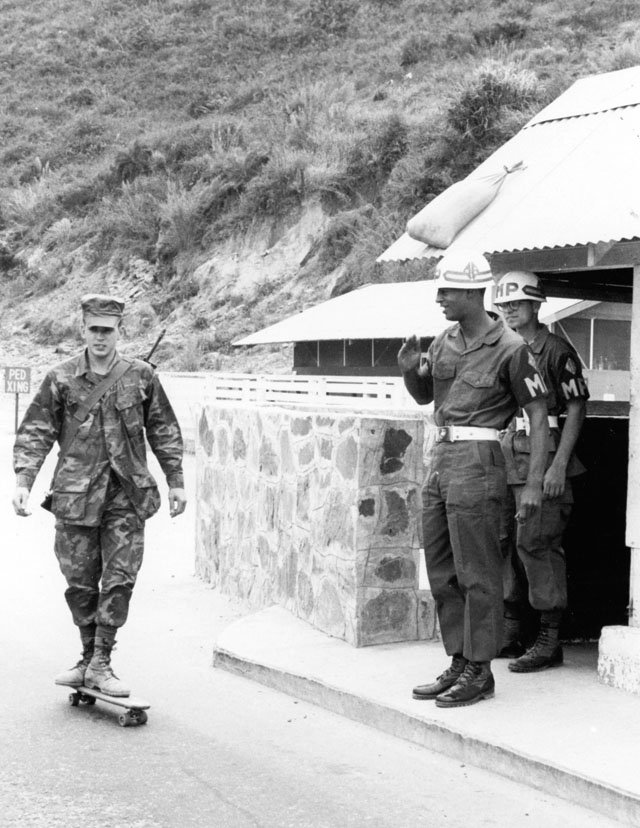
Thanks to movies like Platoon, Americans today think of the typical U.S. soldier in Vietnam as an infantryman on jungle patrol facing death and terror daily. But the reality was somewhat different. (U.S. Army)
IN AUGUST 1970, the Army Reporter newspaper profiled some fun-loving clerks of the 25th Infantry Division in Vietnam. Working far from the fighting, these men would never earn a medal for valor, so they created their own: the Silver Paper Clip. In a ceremony brimming with irony, they bestowed the honor on one of their brethren, along with this citation:
Specialist Howard distinguished himself with conspicuous gallantry and intrepidity at the risk of his life when he single-handedly answered over 200 telephone calls and processed in fifteen new men, exposing himself to a hail of questions. He moved from the relative safety of his desk to the P.X. where he repeatedly bought cases of soda. He organized and led his section as they swept out their hootch. Ignoring the personnel NCO, he cleaned his typewriter, picked up the mail, petted four dogs, ran off three stencils and took his malaria pill.
THANKS TO MOVIES like Platoon, Americans today think of the typical U.S. soldier in Vietnam as an infantryman on jungle patrol facing death and terror daily. But the reality is that most troops were more like Specialist Howard than Oliver Stone’s Chris Taylor. The high-tech nature of America’s war in Southeast Asia and its sophisticated logistics effort meant that some 75 percent of the 2.5 million soldiers who served there worked in supporting roles, out of danger and in relative comfort.
‘Basically there are two different wars here in Vietnam. While we are out in the field living like animals, the guy in the rear’s biggest problem is that he can receive only one television station’
Modern armies have always required mammoth support operations. But Vietnam was different. For the first time, the U.S. military turned its rearward bases into replicas of home, with many of the luxuries and consumer goods that post–World War II prosperity had lavished on America. The abundance had an unintended side effect: The uneven distribution of discomfort and danger stoked combat soldiers’ resentment of support troops, who were derided as “rear echelon motherfuckers.” REMFs and grunts may have served on the same side, but they did not serve in the same war.
AS FIGHTING in Vietnam intensified in the mid-1960s, the American war machine required enormous resources not only to subdue the enemy but also to sustain its fighting men. A legion of butchers, bakers, and ice cream makers fed the troops. Librarians shelved books in base libraries, entertainment specialists planned morale-boosting field trips and talent shows, craft-shop attendants minded the kilns and darkrooms, and lifeguards kept watch at the pools. Military-run retail outlets and bars employed even more personnel to stock the shelves, pour the drinks, book the bands, and count the slugs in the slot machines. On rear bases, an army of plumbers, electricians, and refrigerator repairmen kept the water running, the lights on, and the drinks ice cold.
Identifying REMFs on base was easy. Infantrymen returning from the field were lean and grizzled, their uniforms and boots bleached white from scuffs and sun. REMFs, meanwhile, wore fatigues that were often green and crisp with boots that retained a shine. Rich mess-hall fare and sedentary duty meant that more than a few uniforms stretched tight over paunches. Some newly arrived soldiers felt so self-conscious that they tried to distress their uniforms, especially the boots.
Most support troops worked on rear bases, many of which resembled big American cities. The largest was Long Binh Post, about 20 miles north of Saigon. Built over time for more than $130 million, Long Binh eventually had 3,500 buildings and 180 miles of road covering an area bigger than Cleveland. One colonel joked, “If we ever really got attacked, the V.C. would have to use the scheduled bus service to get around the base.”
Home to the army’s Vietnam headquarters, Long Binh was, in the words of one resident soldier, “a virtual REMF citadel.” The shooting war was far away, and soldiers stationed at the post had plenty of time on their hands. To keep them busy, military authorities provided a full slate of recreational opportunities. As of July 1971, the post boasted 81 basketball courts, 64 volleyball courts, 12 swimming pools, 8 multipurpose courts, 8 softball fields, 6 tennis courts, 5 craft shops, 3 football fields, 3 weight rooms, 3 libraries, 3 service clubs, 2 miniature golf courses, 2 handball-court complexes, a running track, an archery range, a golf driving range, a skeet range, a party area, and an amphitheater for movies and live shows.
By 1972, Long Binh Post even had a go-cart track, complete with a starting stand, a public-address system, and a pit for on-the-spot repairs.
Open mess clubs, which served food and alcohol and often featured live entertainment, abounded throughout South Vietnam. At its peak in 1969, Long Binh’s club system had 40 bars with a net worth of $1.2 million, including $270,000 in cash on hand. If soldiers didn’t like club life, Long Binh’s retail stores stocked food and alcohol to host private parties at the pools, barracks, or barbecue pits. An unofficial brothel, a “male beauty bar” with salon services, and outdoor movies rounded out Long Binh’s offerings.
Construction of new recreational facilities on Long Binh Post continued until the end of the war. As late as 1970, more than a year into troop withdrawals from Vietnam, the U.S. Army was still planning to build two 474-seat movie theaters, additional handball courts, two in-ground swimming pools with bathhouses, and a recreational lake. The military scrapped the more expensive construction projects in response to public outrage, but the post’s amenities were still expanding right through the summer of 1971.
Long Binh and other posts had retail stores that would have rivaled today’s big box outlets for their selection, if not their size. Just one of Long Binh’s P.X.s was ringing up more than $800,000 in monthly sales in late 1971, and it was not even the largest in Vietnam. These stores offered a selection of products that, in pre-Walmart days, was unlike anything most Americans had ever seen. As a reporter for a division newspaper raved about the P.X. at Camp Radcliff in the Central Highlands of Vietnam: “There are a lot of shopping centers—in fact, whole towns—back in the world where you couldn’t find snuff, anchovies, baby oil, dice, flash bulbs, radios, and steak sauce in the same store, or even in the same general area. But at Camp Radcliff you can buy almost anything you want.”
SUCH ABUNDANCE combined with the relative safety of duty in the rear to make the war itself seem like a distant concern. Writing about Da Nang Air Base in his memoir, Vietnam: The Other War, military policeman Charles Anderson reflects on this sense of isolation: “All of these comforts and services made the world of the rear a warm, insulated, womb-capsule into which the sweaty, grimy, screaming, bleeding, writhing-in-the-hot-dust thing that was the war rarely intruded.” William Upton, who served near the R&R center at Vung Tàu, told his mother upon returning home, “Most of the time you didn’t know you were in a war.”
Combat troops frequently passed through rear bases on their way to and from the States, R&R, or the hospital. These encounters left them bewildered by commanders who gave the most to those who risked the least, and resentful of noncombat troops who enjoyed relative comfort and safety.
Though U.S. Army officials denied friction between combat and support troops, front-line soldiers bristled at how their peers lived. In his memoir Nam Sense: Surviving Vietnam with the 101st Airborne, Arthur Wiknik Jr.—an infantry squad leader and veteran of the bloody assault on Hamburger Hill—seethes: “As near as I could tell, the only danger a REMF faced was from catching gonorrhea or being run down by a drunken truck driver. And the biggest hardship a REMF contended with was when a generator broke down and [his] beer got warm or there was no movie that night.”
In April 1969, 30 members of a combat infantry unit aired their grievances publicly. Writing to President Richard M. Nixon, they argued that “basically there are two different wars here in Vietnam. While we are out in the field living like animals, putting our lives on the line twenty-four hours a day, seven days a week, the guy in the rear’s biggest problem is that he can receive only one television station. There is no comparison between the two….The man in the rear doesn’t know what it is like to burn a leech off his body with a cigarette; to go unbathed for months at a time…or to wake up to the sound of incoming mortar rounds and the cry of your buddy screaming, ‘Medic!’”
A year later, retired officer John H. Funston wrote to the New York Times arguing that the army should reward riflemen with extra pay for the hazards they face in the field. The idea of combat pay, he argued, had been trivialized because every soldier received it, “regardless of his rank or whether he is a rifleman being shot at or a lifeguard at a rest area swimming pool.”
SOLDIERS IN THE REAR, meanwhile, regarded combat troops with deep admiration. On his way to an overseas R&R, clerk-typist Dean Muehlberg encountered a company of infantrymen on stand-down at the out-processing center at Da Nang. “We were in awe of the Marines,” he gushed. “We didn’t speak to them or get in their way. We didn’t know their language. You sensed that after the constant threat of death, of terrible harm, nothing else scared them.”
Muehlberg wrote a memoir, REMF “War Stories,” in which he pokes fun at himself, the boring work, and the very idea that he was fighting a war. The quotation marks in the title are deliberate; his 1969 tour was so far removed from combat that his rifle actually grew mold while it sat in its rack.
Muehlberg worked in the Awards and Decorations section, where he processed recommendations for medals and decided what commendation was appropriate. “For the first month it seemed a dirty job,” he writes. “I did not feel worthy! I was sitting in relative security reading grisly, awe-inspiring accounts of the courage of my not so fortunate brothers who were out in the thick of it. And then sitting in judgment on the ‘degree’ of their courage, their deed.”
After the war, enmity between grunts and REMFs persisted in personal memoirs and, later, websites. But in some cases, grunts’ bitterness lost its edge as veterans closed ranks to face a common enemy upon returning home: public and government indifference. Those who joined protests as part of the G.I. movement to end the war and claim federal veterans benefits buried their bad feelings in order to increase their numbers and present a unified front. Thousands of REMFs marched alongside combat veterans. Antiwar veteran groups scarcely acknowledged that the divisions ever existed. To the public, all the returning soldiers were simply “Vietnam veterans.” Only the vets knew that they had served on the same side in different wars.
Adapted from Armed With Abundance: Consumerism and Soldiering in the Vietnam War, by Meredith H. Lair, assistant professor of history at George Mason University in Virginia. © 2011 by The University of North Carolina Press.
This is my rifle. There are many like it, but this one is mine.
My rifle is my best friend. It is my life. I must master it as I must master my life.
Without me, my rifle is useless. Without my rifle, I am useless. I must fire my rifle true. I must shoot straighter than my enemy who is trying to kill me. I must shoot him before he shoots me. I will …
My rifle and I know that what counts in war is not the rounds we fire, the noise of our burst, nor the smoke we make. We know that it is the hits that count. We will hit …
My rifle is human, even as I [am human], because it is my life. Thus, I will learn it as a brother. I will learn its weaknesses, its strength, its parts, its accessories, its sights and its barrel. I will keep my rifle clean and ready, even as I am clean and ready. We will become part of each other. We will …
Before God, I swear this creed. My rifle and I are the defenders of my country. We are the masters of our enemy. We are the saviors of my life.
So be it, until victory is America’s and there is no enemy, but peace!