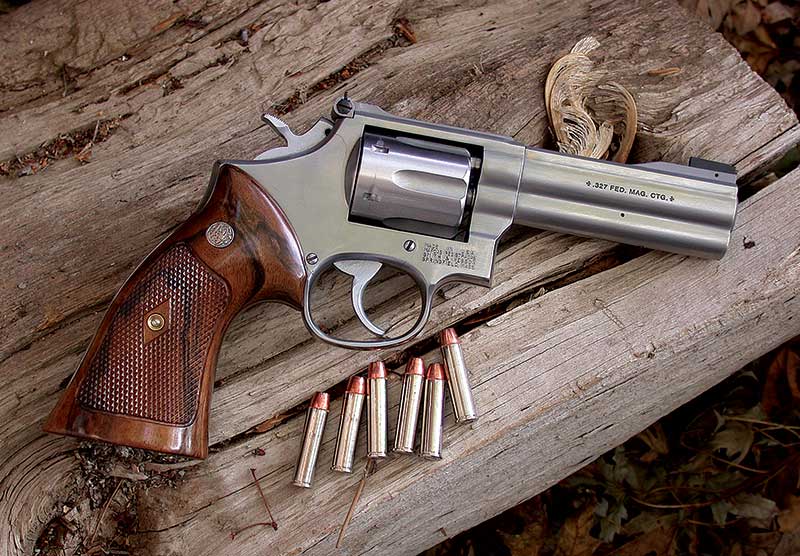
Starting with a Smith & Wesson Model 66 Bowen builds this
exquisite double action .327 Federal Magnum.
All of the dedicated sixgunners in my acquaintance have several things in common. Certainly not the least of which is having spent much time during their younger years staring at pictures of custom sixguns in Elmer Keith’s book Sixguns. Many of us have searched out his old articles from the 1920s and 1930s found in the American Rifleman. Early in our marriage, Dot and I had some tough times. I was attending college full time and working full time to provide for Dot and our three little kids. One of the many things which helped to keep me going was to be able to look at those pictures and dream of someday. Someday – when I would actually have such sixguns I could call my own.
All of the men and establishments connected with Elmer Keith and his custom sixguns, such as Harold Croft, E.F. Sedgley, J.D. O’Meara, Neal Houchins, King Gunsight Co. and the Gun Re-Blue Co., were long gone before us I could ever afford anything close to the work they provided. That’s the downside. The wonderful upside is the fact we have a dozen or more custom sixgunsmiths plying their trade today who are every bit as good, and probably even better.
At the top of this list is a southern gentleman, a man I am proud to have as a friend and fellow Shootist, Hamilton Bowen. Hamilton is not only a superb sixgunsmith he is also one of the most articulate fellows one is likely to encounter, and both of these skills are evident in his book The Custom Revolver. Add in the fact that he also has a superb sense of humor and has a book not only highly informative but oh so wonderfully readable. Education, which is enjoyable and painless seems, to last much longer.
Hamilton’s formal education consists of majoring in history and English in college, then graduating from Trinidad Gunsmithing School, and in recent years, actually graduating from law school. All of these combined affect his outlook on life as well as his custom gunsmithing, and he is especially driven by his love of history, which is reflected in some of his custom sixguns inspired by the old classics. Who else but Hamilton would use a Ruger Redhawk to build a modern version of the S&W 1917 double action revolver of World War I?
Obviously Hamilton has also been captivated by those old custom sixguns of Elmer Keith and Harold Croft. He has carried out many of Croft’s lightweight sixgun ideas on single actions such as hollowed out recoil shields and loading gates; also stepped down shapes on frames all of which reduce weight.
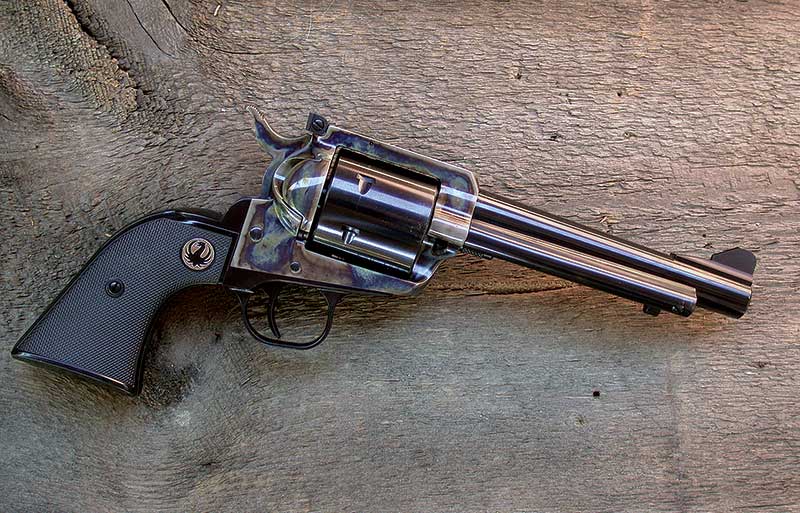
Hamiton Bowen uses the Ruger 50th Anniversary Model .357 Blackhawk as
the platform for this exquisite .327 Federal conversion.
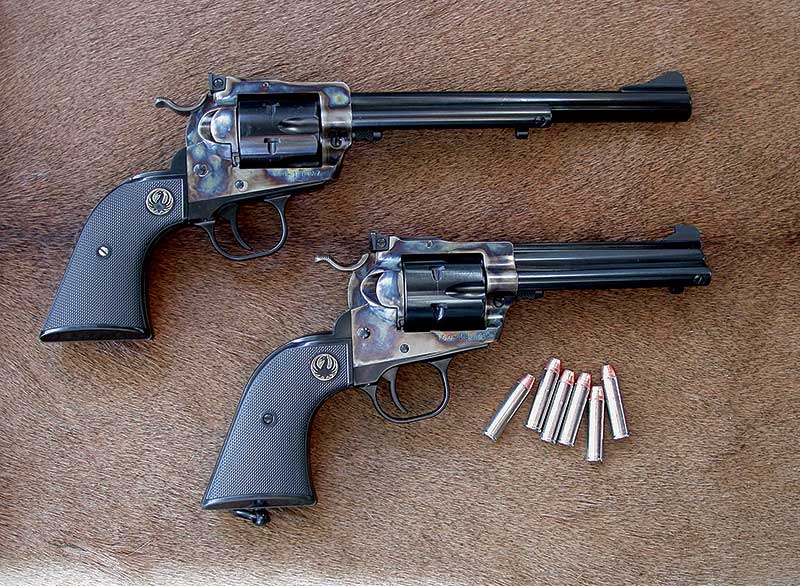
Both of these Bowen .327 Federal Magnum conversions started life
as Ruger .32 Magnum Single-Sixes.
The New Guy
I first met Hamilton in the mid-1980s when he was just getting started. At a Shootist Holiday I experienced two of his first custom sixguns. They were not only a first for me, I would bet they were the first examples built by anyone.
One was a .500 Linebaugh on a Ruger Redhawk while the other was a .44 Special on a Ruger Security-Six or GP100, can’t remember which at this late date. Hamilton was also the first, at least as far as I know, to match up Dan Wesson Heavyweight barrels with Ruger Redhawks.
In recent years Ruger has finally offered a 4″ Redhawk chambered in either a .45 Colt or .44 Magnum. Many years ago Hamilton, seeing the value of a Redhawk as a Perfect Packin’ Pistol, began offering the Alpine Redhawk with a 4″ barrel, round butt and special sights.
Innovation is a key word at Bowen Classic Arms. When something desirable isn’t available, Hamilton simply builds it himself. An example of this is his adjustable rear sight for Ruger sixguns. These are offered in both a Heavy-Duty Field sight as well as a version with finer click adjustments. Testimonial to how good these sights are is the fact several other sixgunsmiths are offering them with their custom work.
In addition to these sights Hamilton also offers high visibility sights for S&W J-frames. I also believe Hamilton was the first sixgunsmith in modern times to start putting lanyard rings on revolvers. There exists many a sad tale of sixguns lost by those on horseback, hiking in rough country, even canoeing. Something as simple as a lanyard ring and cord used properly can prevent the loss of a valuable sixgun.
One of the most practical custom sixguns is a Ruger Three-Screw .357 Blackhawk converted to .44 Special. By starting with either a Flap-Top Ruger as produced from 1955 to 1962 or the Old Model of 1963 to 1972, one winds up with a Colt Single Action-sized .44 Special with adjustable sights and a virtually indestructible action. Hamilton has done several of these for me, including a matched pair of 45/8″ blued versions stag-stocked, and a matte blue finished heavy-duty hard country, packin’ pistol. My Long Range Bowen .44 Special wears a 71/2″ barrel. These are certainly some of the finest .44 Specials in existence.
One of the best investments I ever made was to provide two Colt Single Actions for Hamilton to use as the first examples of the greatest of the classic single action sixguns for him to experiment with. I provided the guns; he provided the work. At the onset of this project he warned me things may not turn out right, but I had seen enough of his work to know I was in good hands.
Those two Colt Single Actions are now fitted with custom barrels and unfluted custom cylinders. One is a 51/2″ .41 Special with standard sights, and it was only the first of my Bowen .41s. He has since converted a 4″ S&W Model 586 to a double action only .41 and has also used a Ruger Flat-Top .357 to build an exquisite 45/8″ .41 Special complete with case colored frame and set off with mouthwatering fancy walnut stocks by my friend Tedd Adamovich of BluMagnum. Sixguns do not come any better looking, or shooting, than this one.
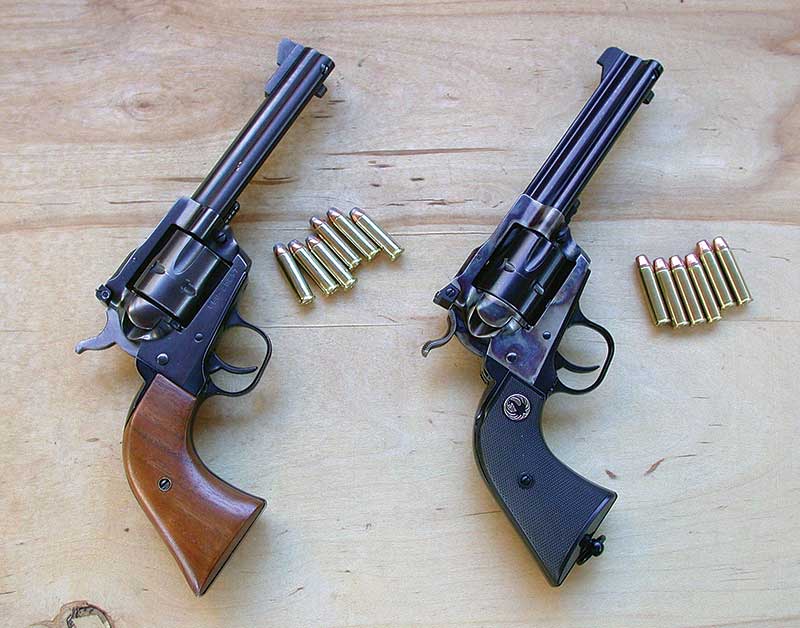
Ruger’s 45/8″ .32 Magnum Single-Six compared to Hamilton Bowen’s .327 Federal conversion.
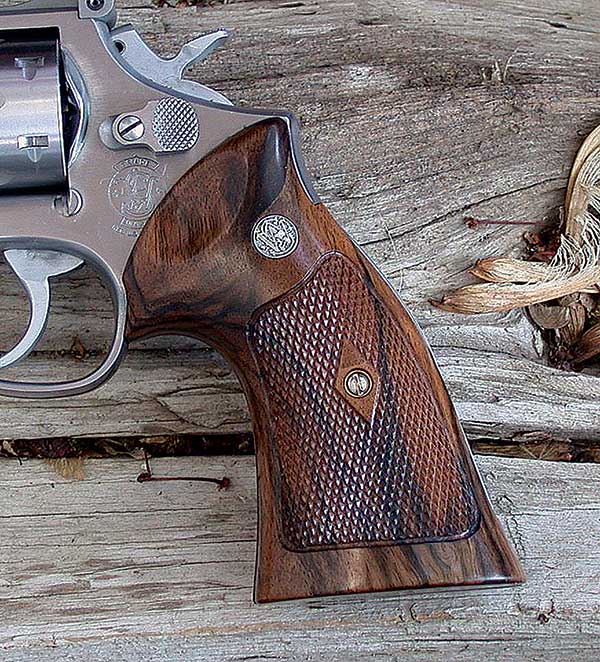
Keith Brown duplicates the Combat Magnum stocks of the 1950s in fancy walnut.
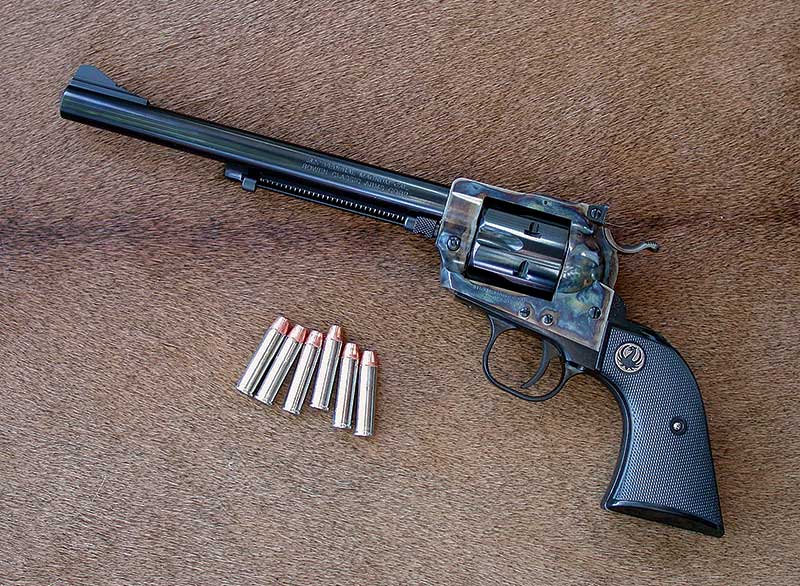
Hamilton Bowen’s 71/2″ .327 Federal on a Ruger Single-Six; note the Bowen
rear sight, Bisley hammer, and Turnbull case coloring
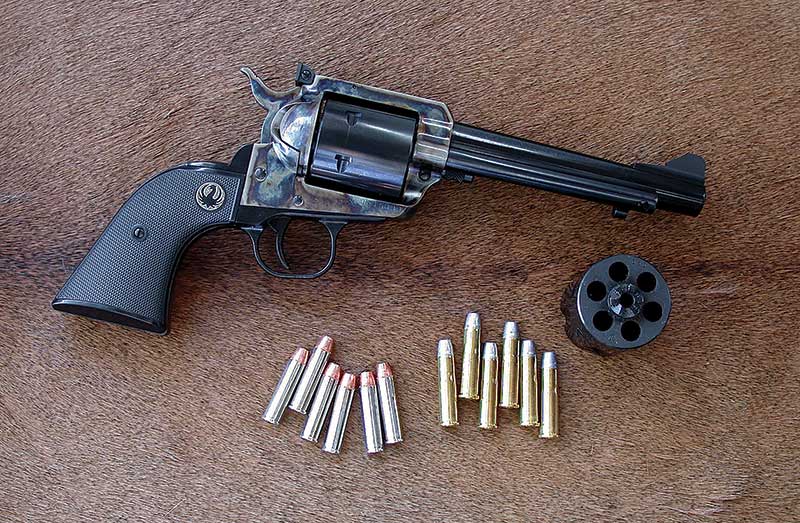
Ruger’s 50th Anniversary Model .357 is large enough to allow a conversion
using both .327 Federal and .32-20 cylinders.
The .327 Magnum
With the advent of the .327 Federal Magnum, Hamilton has what can be considered a modernized .32-20 to work with to build some very beautiful and practical single action sixguns. This new cartridge is just enough shorter than the .32-20 so the New Model Ruger Single-Six can be used as the basic platform for building a 21st century version of the 19th century varmint sixgun; the .327 Federal can do everything the .32-20 can do and does it with stronger brass.
It has been my good pleasure for the past month to work with a pair of Bowen Custom Arms Single-Sixes. Hamilton starts with a Ruger Single-Six in .32 Magnum which he says “are in my view, the natural home for the .327 in a single-action. The cylinder diameter is adequate for six-shots and only has to be longer. No receiver modifications are necessary. Factory ammo will work fine as well as most suitable cast bullets.”
The two are basically the same except for the barrels. Hamilton and I both like 71/2″ barrels on classic-style single-actions. For me 71/2″ single actions balance the best and are the easiest to shoot. The 71/2″ .327 Single-Six conversion features a line-bored cylinder, which is both fluted and black powder chamfered; the latter is one example of Hamilton’s appreciation for history as this is the way the early Colt Single Actions had their cylinders radiused on the front edge.
Of course, the action is totally tuned, trigger pull set at just a hair over three pounds, a Bisley hammer is fitted, the frame is color cased by Turnbull, a steel ejector rod housing is installed, an oversized locking base pin fitted, and a BCA heavy-duty rear field sight is matched up with a serrated front ramp sight. A final touch, and one which makes this an all steel sixgun, is the fitting of an XR3 grip frame and Black Eagle grips from a Ruger 50th Anniversary Model. This latest rendition of the XR3 feels exceptionally comfortable in my hands and works well for .44 Special and .45 Colt loads also.
Hamilton’s second .327 Single-Six is virtually the same except for the barrel. Hamilton’s use of Dan Wesson barrels on Redhawks was mentioned earlier; this time he uses a Smith & Wesson barrel to give this little Single-Six a totally different look and feel. Starting with a ribbed K22 barrel, Hamilton machines off the underlug, re-bores it to .327, cuts it to 45/8″, and installs it along with a steel ejector rod housing. Custom sixgunsmiths in the period between the two world wars often fitted ribbed barrel to Colt Single Actions; this one matches up beautifully with the Single-Six frame. On this little .327 the front sight is an undercut post and a really nice touch is the installation of a lanyard ring.
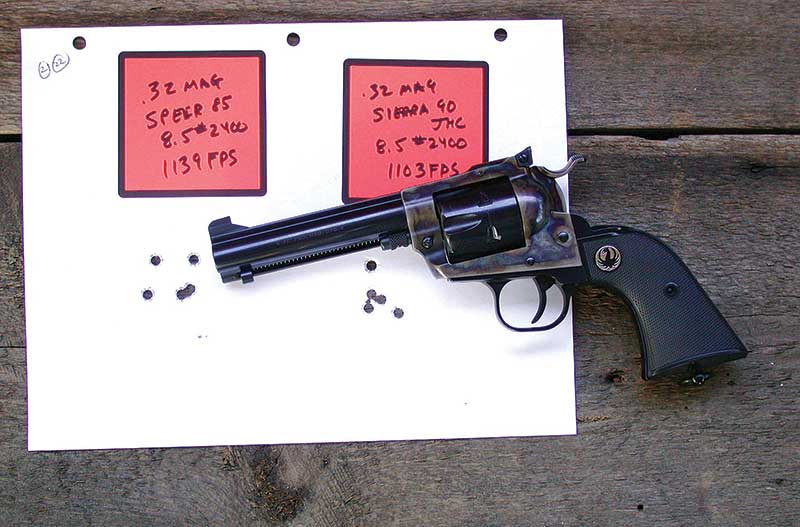
Above & Below: Targets shot using .32 Magnum ammo in Bowen’s 45/8″ .327
Federal Single-Six exhibits the versatiltiy of this little sixgun.
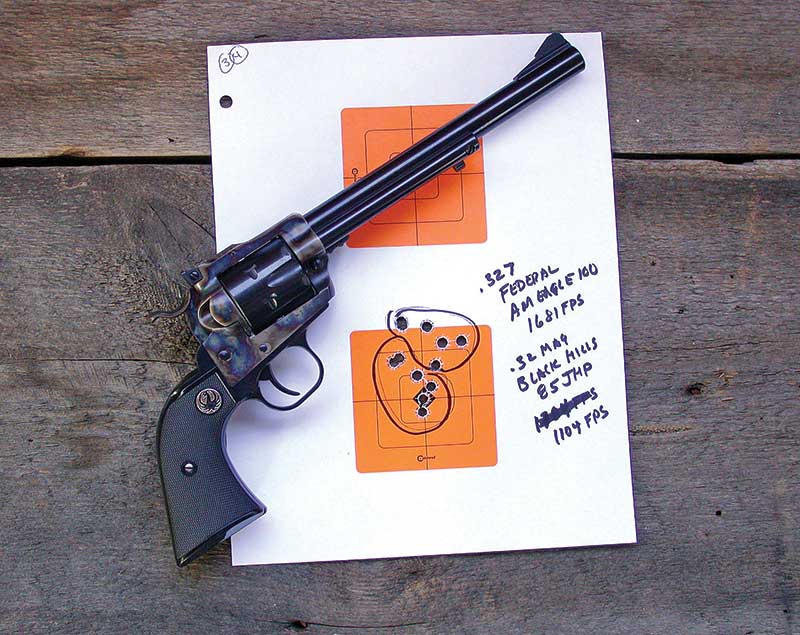
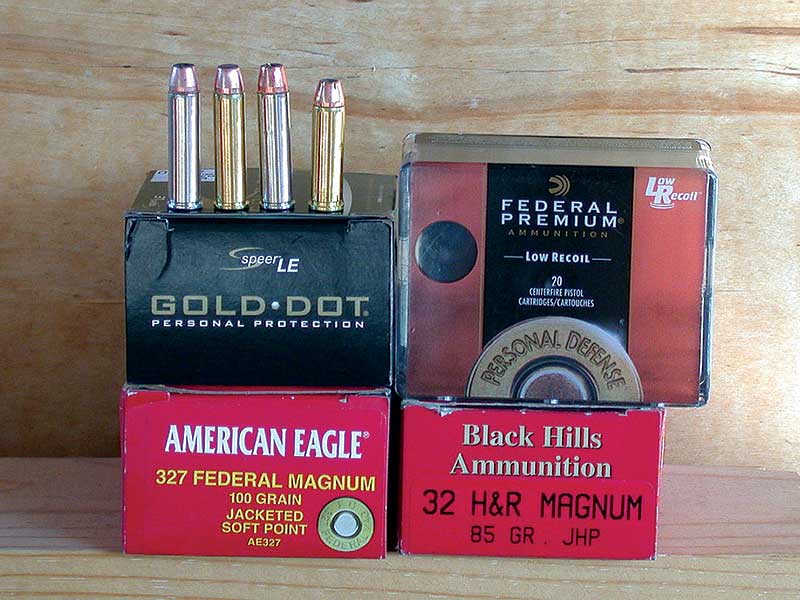
Factory ammo tested in the Bowen sixguns included Speer 115 GD, American Eagle 100 FP, and Federal 85 JHP in .327 Federal and Black Hills .32 Magnum 85 JHP.
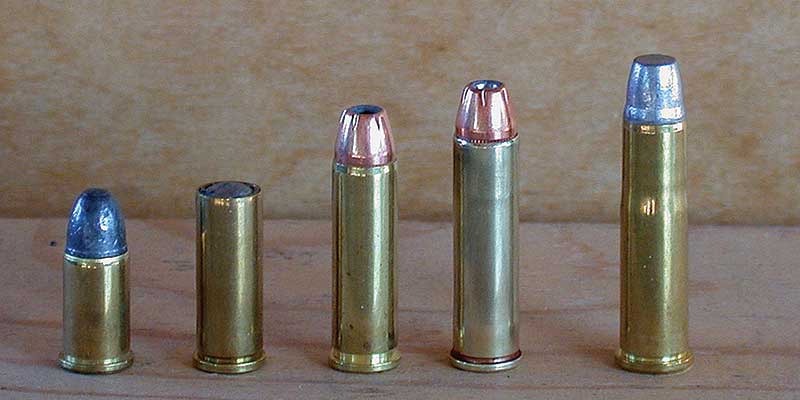
Bowen’s .327 conversions will handle .32 S&W, .32 S&W Long, .32 H&R Magnum, and .327 Federal, and with an extra cylinder, .32-20.
Two More
Along with the two Single-Sixes, I received two other .327 conversions destined to go to two of Hamilton’s customers. One of the best sixguns to come along in this still relatively new century has been Ruger’s 50th Anniversary .357 Magnum Blackhawk. It is the same size as the original Ruger .357 Blackhawk, uses the original sized XR3 grip frame, and is all steel. Hamilton uses this platform for a dual cylindered .32-20 and .327 Federal.
To easily distinguish between the two chamberings the .32-20 is fluted while the .327 cylinder is not; both are expertly fitted to the frame, which has a 51/2″ Douglas barrel. The front sight is a tapered post on a ramp and is matched up with one of Hamilton’s heavy-duty field rear sights. The hammer and frame are case colored by Turnbull, a locking large knurled head base pin is fitted, the action is tightened and tuned, and the trigger pull set at 21/2 pounds.
Finally we come to Hamilton’s double action .327 Federal. This conversion starts with a 4″ Model 617 .22 barrel which is re-bored and the full under-lugged barrel is fitted to a Model 66-2 frame which then receives a Model 617 cylinder chambered to .327 Federal Magnum. Everything is tightened and tuned, the single action trigger pull set at three pounds, and an undercut front post of the proper height fitted to the ramp on the Model 617 barrel. There was a time when Smith & Wesson produced usable target stocks and especially so for the K-Frames; those days are long gone. However, this .327 conversion wears a pair of exquisite “diamond” Smith & Wesson Target stocks not by Smith & Wesson but rather are perfect recreations of original S&W .357 Combat Magnum stocks carried out in fancy walnut by stockmaker Keith Brown, who not only duplicates early Smith & Wesson Target and Magna stocks but classic Roper and Kearsarge pre-War stocks as well. A great sixgun deserves great stocks and Keith Brown simply makes great stocks! That’s why Hamilton uses them.
For more info: Bowen Classic Arms, (865) 984-3583, www.bowenclassicarms.com; Federal Cartridge Co., www.federalcartridge.com; Keith Brown