
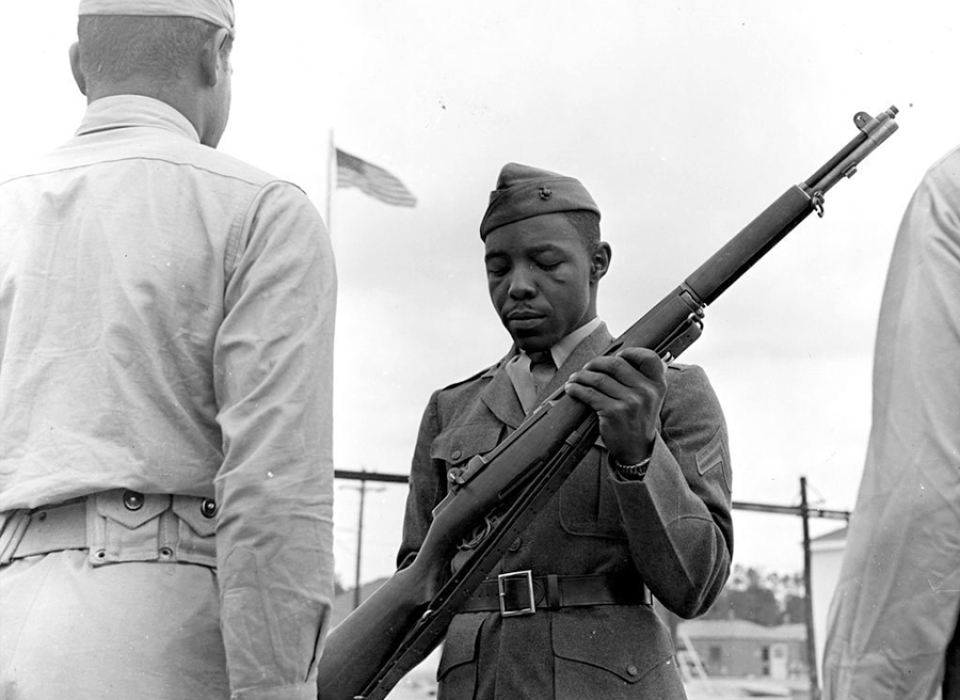
Top Photo: US Marine Corps Corporal Edgar R. Huff inspects a weapon at Montford Point Camp, Camp Lejeune, North Carolina. He enlisted in the Marine Corps in June 1942. Huff became a legend among the Marines who were trained there by earning the rank of First Sergeant in less than two years. He retired in 1972 as a Sergeant Major. Photo: National Archives
On January 23, 1942, the 17th Commandant of the Marine Corps, Major General Thomas Holcomb, testified to the General Board of the United States Navy:
There would be a definite loss of efficiency in the Marine Corps if we have to take Negroes. [The] Negro race has every opportunity now to satisfy its aspirations for combat, in the Army—a very much larger organization than the Navy or Marine Corps—and their desire to enter the naval service is largely, I think, to break into a club that doesn’t want them.
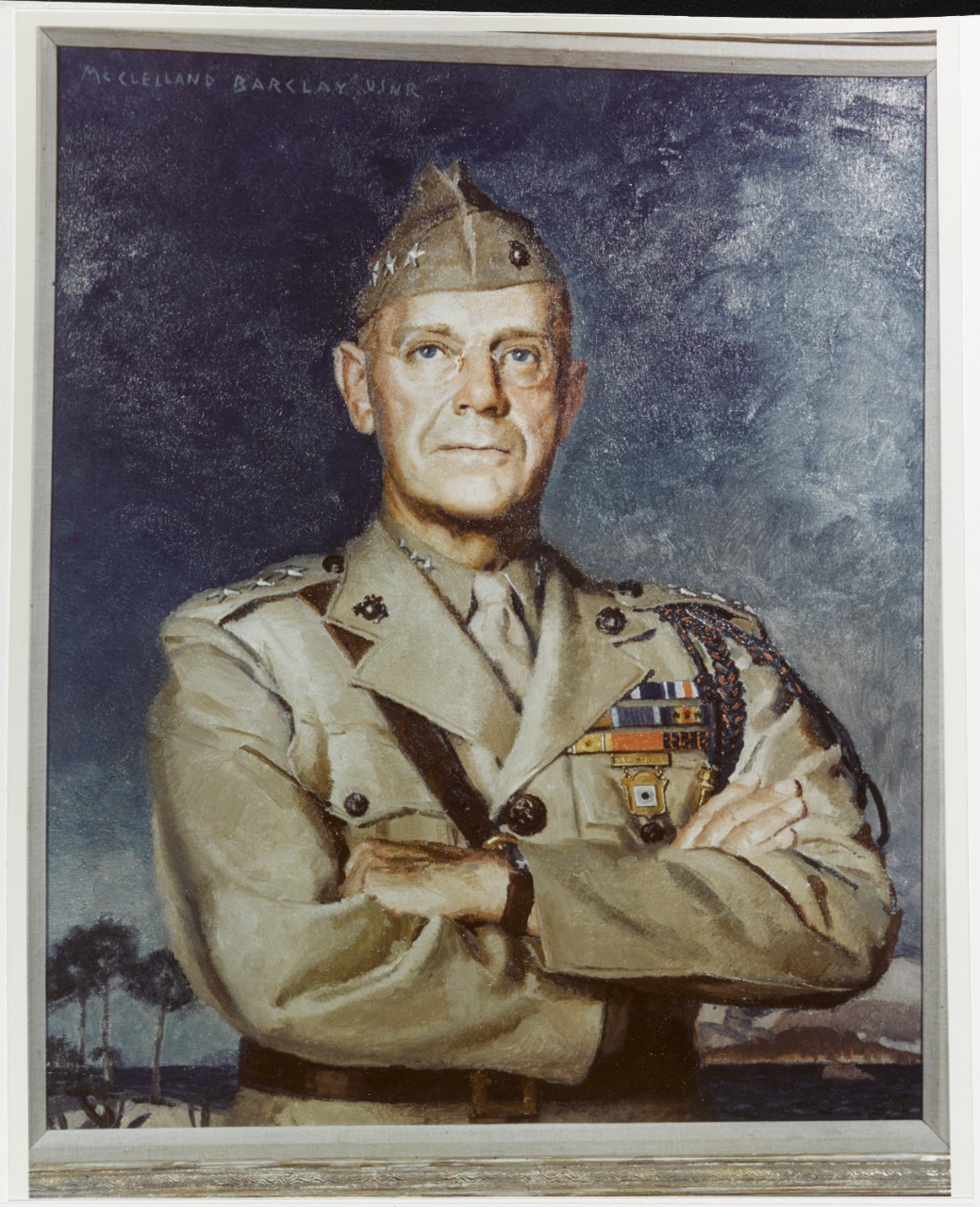
Unwilling to step beyond the significant fact of having Black men in fighting units, the US Army and Marine Corps took the position that their respective organizations should not be laboratories for “social experimentation.” The common belief among senior military officials in both services was that integration would be detrimental to unit effectiveness, combat efficiency, and preparedness and create unnecessary racial friction. This reassertion of white supremacy corresponded to a broader ideological campaign to preserve whiteness and exclusivity.
After he made this statement, Holcomb soon had to adjust his notions: Four months later, Howard P. Perry became the first Black man officially listed on a duty roster at Camp Montford Point and recorded as “Montford Point Recruit #1.” After more than 80 years of tracing the significance of the Marines of Montford Point as military pioneers of courage and bravery, these men of legend remain largely unknown.
In the fall of 1944, during the Battle of Peleliu, in one of the most bitter battles of World War II for the Marines, a platoon of African American Marines fought their way to capture an airstrip and save a company of embattled white Marines. This company of white Marines knew that their time on the small coral island would be painful and short without the support of reinforcements.
Despite being saved by a platoon of Black Marines, leaders of the company of white Marines refused to recognize these Montford Pointers for saving their lives: It would have been an embarrassment if word had gotten back to the company’s senior officers of this incident. This level of prejudice and discrimination had a crippling ripple effect on the combat service of Black Marines for the rest of the war.
After Peleliu, no one heard about the African American unit’s heroic deeds. Like in so many other wars, these Black heroes received no medals, no front-page news stories covering the events on the tiny coral island; there weren’t even any rumors or tales of their actions.
After World War II, these men returned to the United States only to have the merits of their wartime achievements vigorously questioned. Unlike white Marines, these men were suspects. To many, the audacity these men had in donning the Marine Corps uniform and emblems was a direct affront to the sacredness of those who earned the title “Marine” in a bygone era.
Moments like the Battle of Peleliu and the institutional and social opposition these men experienced were rampant. Consequently, Black Marines’ humanity, manhood, and rights to full citizenship were always under intense scrutiny by white commanders. The efforts of senior military officials to undermine their service compromised their right to be counted among the elite, sidelining their story to the fringes of Marine Corps and American history.
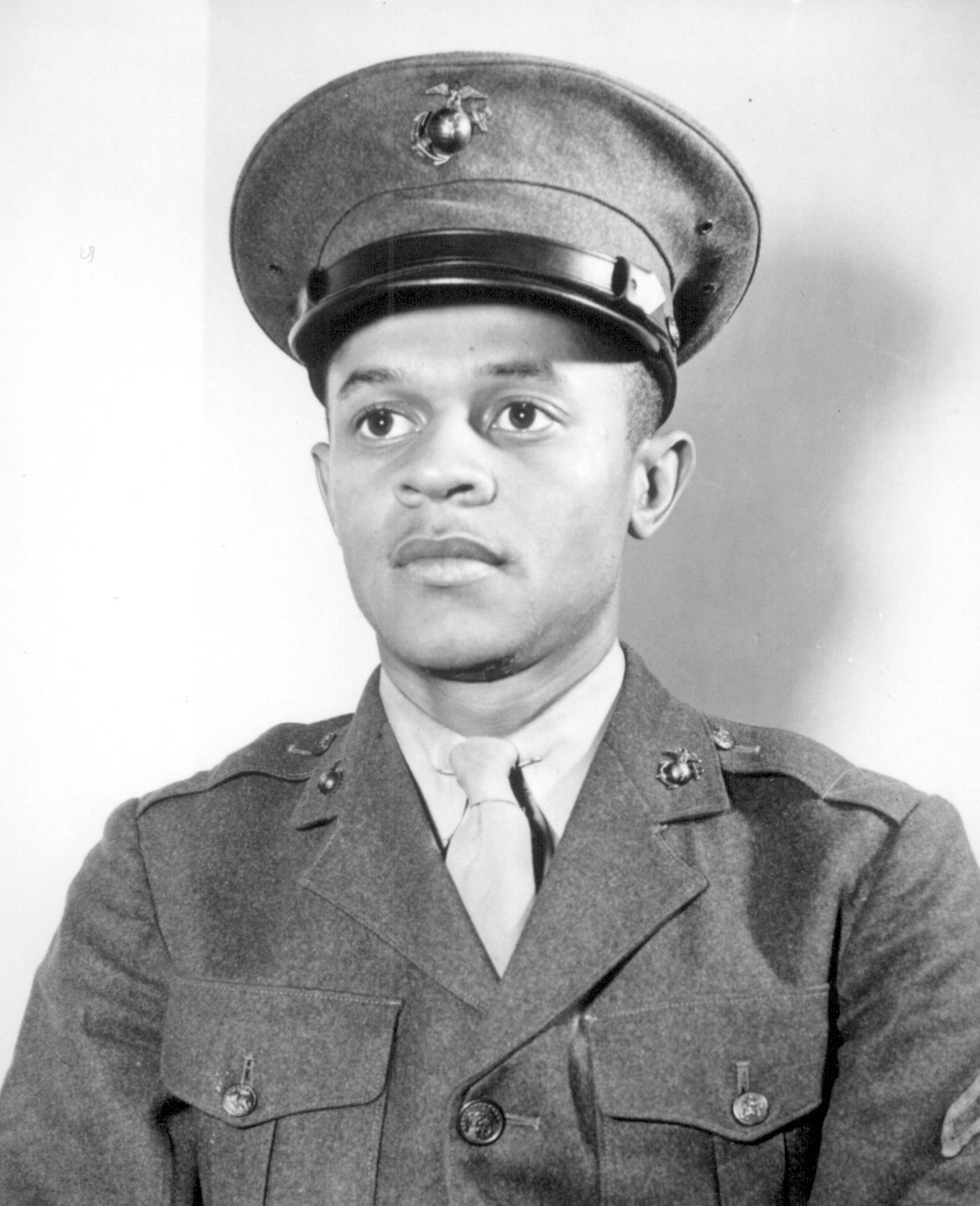
Howard P. Perry. Photo: Roger Smith
The opportunity for Black Marines to rightfully cement their legacy as decorated American heroes and icons of the Pacific war like John Basilone and Lewis “Chesty” Puller was such an embarrassment to the Marine Corps that its high character leaders quickly compromised their integrity to protect a false image of unified bravery and combat valor.
Firsthand accounts of the Battle of Peleliu disproved white racist assumptions about Black servicemembers’ tactical abilities in the crucible of war. However, the lack of genuine and unbiased leadership subjected Black valor to historical scrutiny and subsequent erasure.
Hence, the dearth of accurate accounts such as these only served to reinforce popular notions and biased studies that Black men were unable to withstand the rigors of intense warfare. In a sense, this made it implausible for war planners and government officials to believe in the prospect of Black bravery during combat. As a result, the figure and image of the Black Marine remained in the shadows.
Despite their commendable service during World War II, the Marines of Montford Point would regularly contend with societal forces that vehemently resisted all measures taken toward racial integration.
Hence, their legacy and contributions to a country that would not accept them as equals remained in question, minimizing their public profile. As a result, the harshest eyes scrutinized their combat service with agendas based on dubious science, arguing that Black men were innate cowards.
What their legacy means today is still difficult to appreciate because it is mixed with distinct emotions, motivations, and poignant reactions. For activists, their legacy has not received enough attention; for some senior Marine officials, the reaction typically manifests in the question: “What else are we supposed to do?” The history of the first Black Marines walks a painful path to validation and legitimacy.
Before Congress had to intervene in recognizing the Marines of Montford Point, did the Marine Corps miss an opportunity? Did the Marine Corps genuinely want to herald a group of young Black men who could have left a legacy defined by immense courage, discipline, and bravery? Maybe.
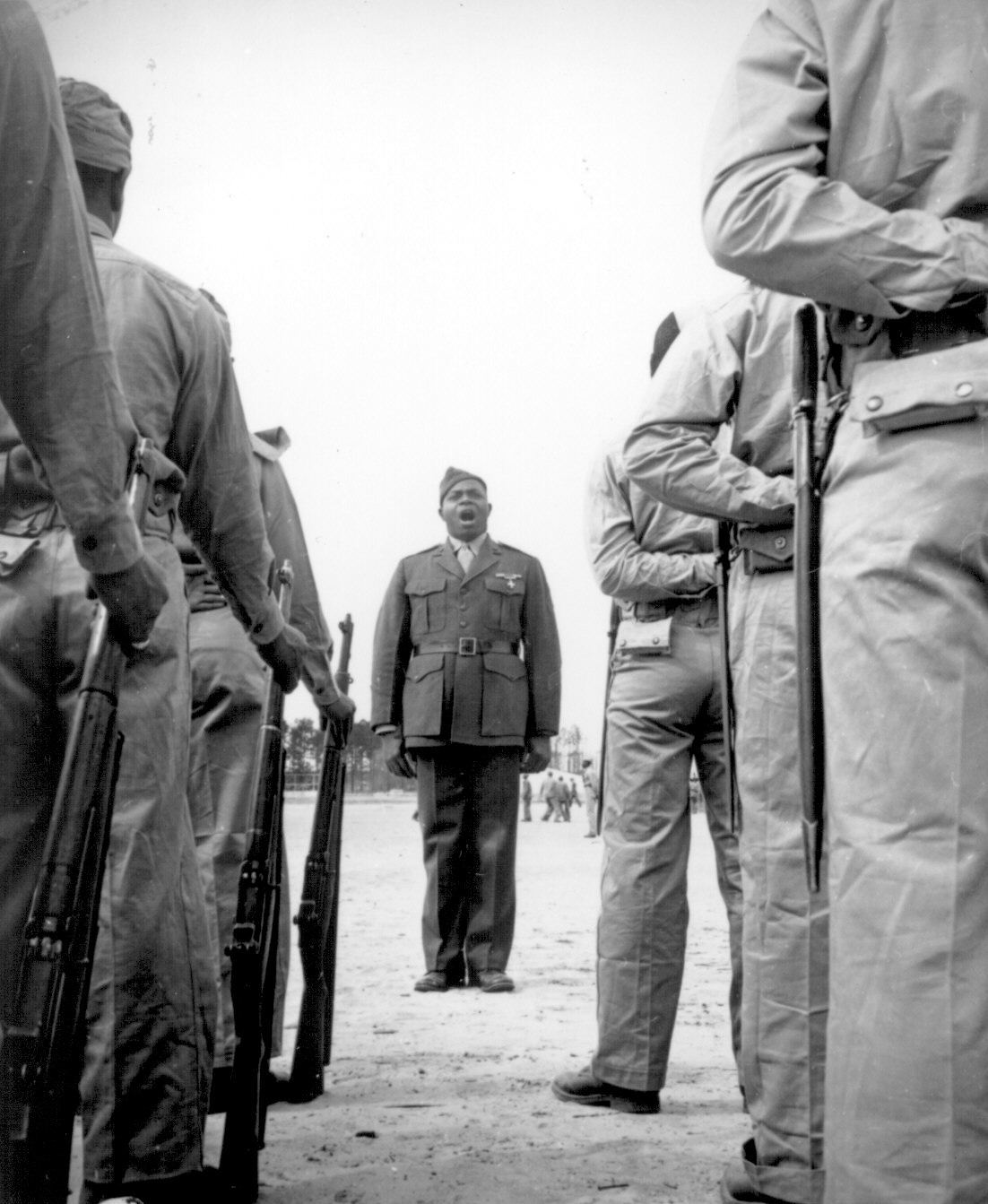
Unfortunately, the measures civilian and Marine officials took to restore organizational integrity based on a foundation of white supremacy harmed the Marine Corps across two more wars. Because of institutionalized racism, the Marines of Montford Point would be subject to comments like, “I did not realize that a war was going on until I returned to the States. [But when] I saw you people wearing our uniform, [the] globe and anchor, [I knew we were in trouble].”
Incredulous of the sight of Black Marines in uniform, Brigadier General Henry L. Larsen continued: “[I’ve now] seen dog Marines, women Marines, and you people [as a result of the war].” This remark by Larsen at Camp Montford Point in the summer of 1943 was not only insulting and insensitive, but it made Montford Pointers question their very existence in an institution that took pride in being the first to fight.
The legacy of the Marines of Montford Point is tremendous. These men are finally viewed as royalty, heroes, icons, and trailblazers of the highest class. Their military achievements are recognized as groundbreaking and a testament to their long suffering during an era of extraordinary racial and social tension.
After Congress passed legislation in 2011 for them to receive the Congressional Gold Medal, America’s first Black Marines were awarded the nation’s highest civilian honor during the summer of 2012. The Congressional Gold Medal is only awarded to persons “who have performed an achievement that has an impact on American history and culture that is likely to be recognized as a major achievement in the recipient’s field long after the achievement.”
For the men of Montford Point, flags waved, bands played, and their status was VIP at every event. This long overdue recognition has led Marine Corps officials to begin reevaluating earlier military decorations awarded to African American Marines, which prejudiced eyes may have colored.
For their outstanding perseverance and courage that inspired change in the Marine Corps, an accompanying cover story for USA Today read: “At last, honors for the first black Marines: Montford Point Marines to become part of Corps’ story.” Since June 1, 1942, Black Marines had officially been part of the Marine Corps story—69 years later, they had moved from footnote to front page.
Despite this appalling historical oversight, the Senate had now recognized them as “liberators of the people of the Pacific,” proclaiming them members of the inner circle of America’s Greatest Generation.
This belated validation, however, has done little to compensate for the Marine Corps’ past behaviors, during which the organization—a branch that believed in its own initiative and pioneering spirit—missed opportunity after opportunity to lead by example in validating these pathbreakers for the world to see.
The legacy of these men of legend brings up hard feelings primarily because the Marine Corps recognizes how its historical treatment of the Marines of Montford Point has had residual effects on the 21st-century Marine Corps. Many Black Marines, especially those serving as Marine officers, point to Frederick C. Branch, the Marine Corps’ first Black officer, commissioned on November 10, 1945, as a benchmark for a lack of progress in the officer ranks. Instead, the Marine Corps successfully denied its Black trailblazers multiple opportunities to be recognized as members of America’s publicly acclaimed Greatest Generation when it mattered most.
Despite this flagrant negligence, no longer would the past be contested for the first Black Marines. Quite the opposite is occurring as institutional doors open to more significant opportunities to recognize the legacy of the Marines of Montford. And while the intense sting of bigotry may be fading, and their numbers dwindling in their ultimate post-military life, many Montford Pointers have never felt the “mission was accomplished.” Their battle continues today.
On August 6, 2022, however, General David H. Berger, the 38th Commandant of the Marine Corps, promoted Michael Langley, who became the Marine Corps’ first Black four-star general in the military service’s 246-year history.
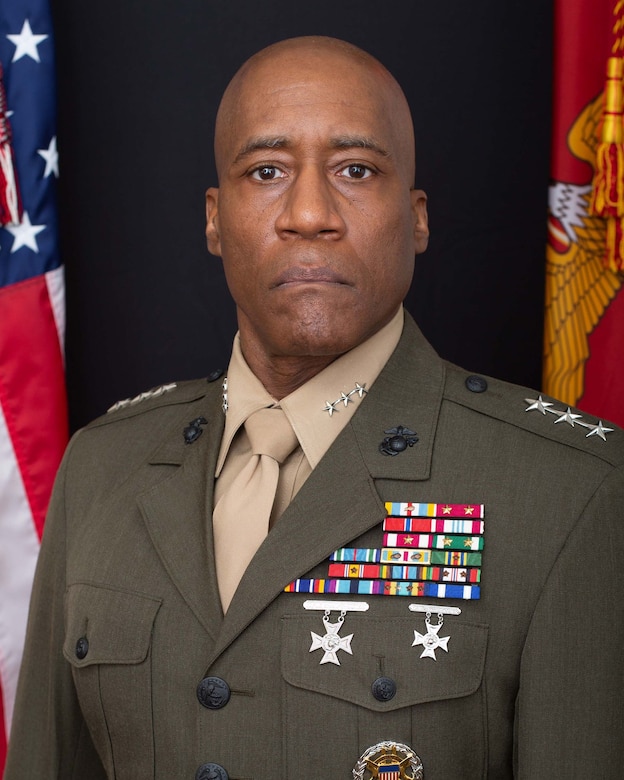 Langley paid homage to the men of Montford Point and Frederick C. Branch, adding that this “milestone and what it means to the Corps is quite essential. Not just because [of] the mark in history, but what it will affect going forward, especially for those younger across society that want to aspire and look to the Marine Corps as an opportunity.”
During the promotion ceremony at the Marine Corps Barracks Washington, Berger made a powerful statement in honoring the late Lieutenant General Frank E. Peterson—the first Black Marine three-star general and aviator—while recognizing Langley’s historic accomplishment: “43 years we go from our first African American general to now our first—I think leading to many more—four-star African American generals.” Langley’s achievement of four stars is monumental, but it is a stark reminder of the astonishingly slow evolution of Marine Corps leader’s management of Black Marines since their inception in 1942.
TheGunBlog.ca — Canada’s Liberal Party-led administration said today that gun owners targeted by its mass confiscation fantasy will soon be able to register the goods they want seized and destroyed, possibly without compensation.
Unworkable, Unenforceable
The Liberals published a statement and hosted a “technical briefing” for media including TheGunBlog.ca. They were unable to provide any specifics on their failing confiscation effort.
- They couldn’t say how they will enforce the seizures, given that they don’t know who owns most of the rifles and shotguns they want to confiscate. (The so-called “Non-Restricted” models.)
- They couldn’t say how they will enforce seizures that owners oppose.
- They couldn’t say how they will execute a program that most provinces oppose.
- They couldn’t say how they will execute a program that most police oppose.
- They couldn’t say if confiscation agents will visit homes, or if/when police will be involved.
- They reiterated their idea of “mobile-collection units,” without more details.
- They couldn’t provide a timeline for payment in case anyone does actually get paid.
Confiscation Without Compensation
The Liberals did confirm that you might be denied compensation, even if you register your firearms for confiscation and destruction by the new deadline of March 31.
“Please note that submitting a declaration does not guarantee you will receive compensation,” they say on several of the new webpages for the crackdown. The bold text is in the original.
Last year, the Liberals broke their promise to offer payment to everyone who participated. They expect a maximum of 136,000 gun owners to opt-in, far below industry estimates of the number of affected owners.
Most Provinces Oppose Confiscation
- Quebec is the only province that publicly supports the attacks unleashed by the Liberals in May 2020.
- Winnipeg, Halifax, and Cape Breton are the only municipalities that have said they support the seizures against government-licensed firearm owners.
- Alberta, Manitoba, New Brunswick, Nova Scotia, Ontario, Saskatchewan, and Yukon have said they won’t participate, or are actively working to block the crackdown.
No Surrender
TheGunBlog.ca isn’t aware of any individual who intends to surrender their gear, and is aware of many who intend to keep their gear.
It doesn’t matter at this point, because thankfully, the confiscation program is still only a confiscation fantasy.
So I see that America does not have a corner on having some real idiots in their Ruling Class! But I REALLY feel sorry for the average Canadian. As I seen myself, they are a really decent bunch of folks and some GREAT Allies! Grumpy

Categories
Astra Regent .22lr revolver 60fps
Categories
One on the way!
Fighter pilots are invariably obnoxious extroverts. I’ve known a few. The profession selects for those particular character traits. They honestly earn that.
When your job is to climb all by your lonesome into a machine filled with kerosene that will propel you faster than some bullets so you can go fight to the death with some comparably capable dude in another similar craft, well, you have my respect. However, those guys are notorious for wanting to publicize their accomplishments.

Military flying is invariably edgy. That’s one of the reasons I loved it so. You learn the limits of your machine and then go out and explore them. That’s also one of the reasons most military aviators are fairly young. Old guys have accumulated way too much sense. However, when you hit that sweet, crazy spot, magic happens…
Table of contents
The Guy
Elmer Royce Williams was born in April of 1925. He went by Royce. Royce and his brother aspired to be pilots from a young age. When the Japanese bombed Pearl Harbor and dragged the United States into World War 2, the boys were just too young. However, as soon as the military would have them, Royce and his brother enlisted and trained as Aviators.

Royce Williams pinned on his Naval Aviator wings in Pensacola in August of 1945, around the same time that the two atomic bombs ended the war. It looked like he had missed it. However, he soon qualified as a fighter pilot in F9F Panther jets. With things heating up across the Korean peninsula, Royce deployed aboard the USS Oriskany to do his bit.
The Plane
I always thought the Grumman F9F Panther to be an objectively beautiful airplane. Developed in the closing months of WW2, the Panther was a single-engine day fighter that was armed with four 20mm cannon in addition to an assortment of air-to-ground munitions. Most production variants were powered by a Pratt and Whitney J48-P-2 turbojet engine.

The Panther was cleared for carrier operations in September of 1949. Panthers were deployed to Korea from the very outset of the war. The F9F was the first US Navy fighter aircraft to see air-to-air combat in that theater.
The Situation
Things were still pretty weird over and around Korea in November of 1952. It had only been seven years since the United States and the Soviet Union stood side-by-side to defeat the Nazis. Now the two nations reviled each other. This clash of cultures came to a head across the 38th Parallel.
The Korean War ran for three years from June 1950 through the summer of 1953. The communist North battled the free South for dominance of ideologies. Once it began looking like the South might be gaining the upper hand, Red China came pouring across the border with tens of thousands of fresh combat troops. In the winter of 1952, Korea was all frozen chaos and blood.

On 18 November 1952, Lieutenant Royce Williams was serving in VF-781 “The Pacemakers” as part of Task Force 77 supporting ground operations in Korea. His first mission of the day was unremarkable.
After landing on the Oriskany for gas, Williams and three of his comrades launched again, this time to conduct a combat air patrol over the fleet off the coast in the Sea of Japan near Hoeryong, North Korea. The objective of the CAP was to identify enemy aircraft that might threaten the Task Force and kill them.
The Encounter
Williams spotted a flight of seven MiG-15s flying at about 50,000 feet high above the four-ship flight of Panthers. These primitive jet fighters were all fairly finicky machines. One of the four American aircraft experienced a mechanical failure and had to return to the carrier. That pilot’s wingman went back with him per protocol.

LT Williams and his wingman, LT (jg) Dave Rolands, climbed to intercept. It was now seven to two. In moments, Williams and Rolands were in the midst of a veritable swarm of hostile communist fighter planes.

The MiG-15 was a legend. Tiny, heavily-armed, fast, and eminently maneuverable, the MiG-15 was arguably the premier fighter aircraft in the world at the time. The F86 Sabre jet could give the nimble little warplane a run for its money, but only just. I’ve pawed over a MiG-15 before, and that thing seems like a toy. It is unnaturally small. In the skies above Korea, however, these vicious little monsters were killers.
The Fight
It’s tough to capture in print just how fast things can go pear-shaped in jet air combat. During head-on engagements, the combined closure rate was over 1,000 knots.
The MiG-15 packed 23mm and 37mm cannons, both of which fired deadly high-explosive shells. All it took was one in the wrong spot. Of that initial engagement, Williams said, “The four that had turned to the right came at us in a finger-four formation and started firing. All of them were shooting.” Now it was game on.

LT Williams had a total of 720 rounds for his 20mm guns. With MiG-15s swarming everywhere, he knew he would have to make every round count. Wrenching his nimble Grumman fighter around, he found himself on the tail of one of the MiGs.
MiG-15
His first solid burst chewed that MiG-15 to pieces. One down. LT (jg) Rolands dove after that first crippled enemy plane and was out of the fight. Outnumbered six-to-one, LT Williams faced the remaining enemy aircraft alone.

Williams lacked the time to keep track of how he was doing. He just traded fire with the nimble little MiGs as the opportunity allowed.
In short order, a second MiG went down in flames, followed by a third and then a fourth. In his words, “I did not have the liberty of following them down. I had more of them shooting at me. I would aim, hit, do some damage, then maneuver defensively…Two of the kills were head-on, and the others were from the rear. They went past too fast to permit deflection shots, so I concentrated on getting on their tail.”
Struck!
Along the way, the communist MiGs were also shooting Williams’ plane to bits. One 37mm round struck his aircraft amidships. This explosive shell took out his hydraulic system and trashed his flight controls. Williams described the situation this way: “The 37 hit the accessory section of the engine and did a super amount of damage. I only had elevator control; fortunately, the landing gear extended from gravity.”
Now out of ammo and running on fumes in a fighter plane shot absolutely to pieces, LT Williams limped back to the Oriskany.
One MiG followed him back, but Rolands caught up before it could engage. Rolands’ guns had jammed, but he was nonetheless able to persuade this last communist fighter to head for home.
Coming Home

With no flaps, Williams’ Panther approached the carrier at a blistering 170 knots. That’s around 200 mph. The Oriskany’s flight deck was only 911 feet long. Williams should have ditched his plane or ejected. However, this was winter in the Sea of Japan. Given the frigid nature of the water, there was no guarantee he could have survived.
As a pilot myself, I simply cannot imagine trying to land a shot-up airplane on a 911-foot runway at 170 knots. However, LT Williams caught the third wire and walked away without a scratch. Ground crewmen counted 263 holes in the mangled Panther before pushing it over the side.
The Aftermath
The entire dogfight went on for 35 minutes. That made this aerial engagement the longest in US Navy history. It was one of the longest single dogfights ever documented.
However, there was more to it than LT Williams realized. American intelligence officers had intercepted and translated the enemy pilots’ radio traffic. These were not communist Chinese warplanes. These seven MiGs were flown by seasoned Russian combat pilots. Everybody in the American chain of command took note of that.

Little was known about the MiG-15 at the time, and the fact that Williams had killed Russians was legitimately explosive.
LT Williams was exhaustively debriefed by intelligence officers onboard the Oriskany and then by a variety of Navy Admirals. He then had a sit-down with the Secretary of Defense.
A few weeks later, Williams was called upon to relate his story directly to President Eisenhower during his visit to the war zone. Then they all decided, as the Soviet Union was not a formal combatant in the war, that the entire engagement should be classified and covered up.
Details of the fight were removed from US Navy and National Security Agency records. LT Williams was sworn to secrecy. He took that oath seriously.
Nowadays, it seems like every Navy SEAL at Coronado is given some kind of podcast contract as soon as he completes Hell Week. By contrast, LT Williams never told anybody. Not his wife. Not his military pilot brother. He kept his secret sacred until 2002, when the records were finally declassified.
The Rest of the Story
At the time, LT Royce Williams was the top-scoring carrier-based Naval Aviator of the Korean War, but nobody knew about it. He was eventually credited with four kills that day.
However, once the Iron Curtain came down and Soviet records were examined, it was discovered that only one of those seven Russian jets made it back to base intact.

The stealth ace reference in the title may be a bit of an exaggeration. However, it also might not. Williams was the only one to mix it up with those Russian jets, and six of them were ultimately lost.
Royce Williams went on to fly a further 100 missions in A4 Skyhawks and F4 Phantoms over Vietnam. He served as skipper of the USS Eldorado from 1969 through 1971 and retired from the Navy as a Captain in 1980. He is 100 years old and lives in Escondido, California, today, the very personification of the humble hero.
Addendum: I wrote this piece a good while back. There has been an ongoing effort to get Captain Williams the Medal of Honor for his extraordinary actions that fateful day in the skies over Korea.
In December of 2022, US Secretary of the Navy Carlos Del Toro awarded Williams the Navy Cross, that service’s second-highest award for valor in combat. The US House of Representatives approved specific legislation to waive the statute of limitations requirement so Williams could receive the MOH he so richly deserved.
Some pogues in the Senate subsequently removed the reference in conference. If my opinion counts for anything, it is past time to resurrect that initiative. That great old hero ain’t getting any younger.