Between the moment a system begins to crack and the moment people realize something has broken beyond repair exists a window of delusion. You notice the signs but interpret them as temporary anomalies.
The supermarket shelves that sit empty for a day, two, then refill with different products, packaging you don’t recognize. The electricity bill that jumps from two hundred to four hundred dollars in one July. That news story about a California city running dry for three days, quickly replaced by a political scandal or a championship game. Collapse doesn’t scream. It whispers.
When we speak of the end of the world as we know it, we usually imagine spectacular explosions: nuclear bombs, killer pandemics, cyber attacks that extinguish the lights in an instant.
But history teaches us that civilizations more often die in whispers, through gradual erosion, through the accumulation of micro-failures that, on a certain morning, transform into catastrophic system failure.
The supply chain that has delivered your breakfast cereal every Tuesday for twenty years simply stops. The water treatment plant that has purified your tap water since 1967 shuts down because a replacement part that used to take three days to arrive is now back-ordered for eighteen months. The pension check that has arrived reliably for fifteen years bounces.
If—when—these systems begin to cascade into mutual failure, your coordinates will matter more than your preparations, more than your supplies, more than your intentions. Geography becomes destiny in ways that no amount of individual resilience can overcome.
The United States contains approximately 3.8 million square miles of territory, yet the majority of its population clusters in regions that share common vulnerabilities: dependence on distant supply chains, exposure to extreme weather events, limited local food production, and infrastructure maintained on budgets that have been deferred since the 1970s.
What follows examines five such regions where the convergence of these factors could create conditions that overwhelm individual and community capacity to adapt. The selection criteria include population density metrics, infrastructure fragility assessments, supply chain dependency ratios, and environmental risk factors.
However, the analysis also incorporates something less quantifiable: the quality of constraint. Some places trap their inhabitants through geography, others through economics, still others through the sheer inertia of accumulated human settlement that cannot be unwound quickly.
These are not prophecies. They are inventories of possibility, weighted by current data and expert projections. The scenarios described represent what could happen, what experts warn might happen, if the systems we take for granted begin to falter in earnest. The observations come from extensive travel through these regions, conversations with residents, engineers, emergency managers, and the growing number of people who sense that the ground is shifting beneath their feet.
So where does that leave us? Five places stand out—places where, if the wrong domino falls, getting out may be harder than anyone expects:
Approximately fifty million Americans occupy the corridor stretching from Washington D.C. to Boston, packed into a settlement pattern that represents less than two percent of the nation’s landmass. Drive this route on an ordinary Tuesday and you will encounter something cartographers rarely emphasize: the absence of empty space.
One metropolitan area bleeds into the next with only the thinnest membrane of suburbia separating them. Baltimore becomes Philadelphia becomes Trenton becomes Newark becomes the Bronx, and somewhere around Stamford you realize that you have not seen uninterrupted horizon for hours.
This density creates a particular vulnerability that rural preppers rarely grasp. When the systems that feed this organism hiccup, the hiccup becomes strangulation. Consider the Port of New York and New Jersey, which processes roughly thirty-two percent of the East Coast’s container traffic.
In 2026, this facility operates on infrastructure that engineers have assessed as “functionally obsolete” at rates exceeding forty percent in some corridors. The phrase sounds technical, almost reassuring. What it means is that the roads, bridges, and rails were built for a different era—lighter trucks, less traffic, more forgiving maintenance schedules—and have been kept in service through patches and emergency repairs that accumulate technical debt.
A transportation planner I interviewed in New Haven explained the mathematics that keep her awake. The just-in-time delivery networks that keep supermarket shelves stocked now operate with margins so thin that a three-day delay triggers cascading shortages. “We used to have warehouses full of backup,” she noted, gesturing toward the stacked containers visible from her office window. “Now we have algorithms. Algorithms don’t eat, but they also don’t care if you do.”
One scenario that emergency management officials have modeled involves a moderate hurricane—Category 2 or 3—making landfall near Sandy Hook and tracking northward. Such storms have occurred historically and will occur again. The difference now lies in the margin of error.
Previous decades maintained redundancy that could absorb localized damage. Today, according to a 2025 report from the American Society of Civil Engineers, the Northeast’s infrastructure operates with minimal redundancy and maximal interdependence.
Damage to particular bridges, specific switching yards, certain pumping stations could propagate failure across networks that residents assume are separate but are in fact intimately connected.
The electrical grid presents similar fragility. The Northeast operates as an integrated system managed by regional transmission organizations. In theory, this allows power to flow from surplus areas to deficit areas.
In practice, according to power systems researchers, the grid has become increasingly brittle. The addition of renewable sources has introduced variability that aging infrastructure struggles to balance.
Transformers that step voltage up for transmission and down for distribution have average ages exceeding forty years. Replacement parts for some models are no longer manufactured and must be scavenged from decommissioned facilities or fabricated to order, extending outage durations from days to weeks.
If such an outage occurred during winter—and climate scientists suggest that extreme cold events may become more frequent as Arctic warming disrupts the jet stream—the consequences could exceed emergency response capacity.
During the 2024 cold snap affecting Buffalo and Rochester, approximately two hundred thousand residents lost power. Most were restored within seventy-two hours. But edge cases revealed systemic fragility: elderly residents in high-rise buildings unable to descend stairs to reach warming centers, individuals dependent on electrically powered medical equipment, apartment complexes where frozen pipes burst and rendered buildings uninhabitable even after power returned.
Multiply these edge cases across fifty million residents, and you begin to see why experts warn that sustained outage could trigger population movements overwhelming remaining infrastructure.
The highways serving as evacuation routes—primarily I-95 and tributaries—operate at capacity during normal traffic. During the 2021 evacuation ahead of Hurricane Ida, portions of I-95 experienced stationary traffic for fourteen hours. If such conditions persisted for days, with vehicles running out of fuel and occupants unable to reach shelter, humanitarian implications become severe.
Water infrastructure presents equally concerning vulnerabilities. New York City’s aqueduct system includes the Delaware Aqueduct, completed in 1944, which has been leaking approximately thirty-five million gallons daily since at least the 1990s.
Engineers have proposed a bypass tunnel, but construction has faced delays due to geological challenges and funding constraints.
If the original tunnel were to fail before bypass completion—a scenario that the city’s Department of Environmental Protection acknowledges as possible—the city would have approximately sixty to seventy-two hours of stored water before distribution would need rationing or suspension.
The social dimensions prove harder to model but equally important. The Northeast Corridor contains extreme wealth alongside concentrated poverty. Manhattan’s Upper East Side and the Bronx’s South Bronx exist within the same administrative boundaries but experience radically different service levels.
If municipal capacity degraded, social control would likely degrade unevenly, with private security and wealth concentration providing insulation for some while others faced increasing precarity. Historical precedents from other urban crises suggest that social order can deteriorate rapidly when expectations of response are violated.
Gun laws throughout this region vary but tend toward restriction. Connecticut, New York, New Jersey, Massachusetts, and Maryland maintain licensing requirements, magazine capacity limits, and assault weapon bans that would complicate armed self-defense for residents who had not navigated these requirements in advance.
If law enforcement capacity degraded alongside other systems, residents would face security dilemmas with constrained options.
For those considering relocation from this region, geography itself presents challenges. The Appalachian Mountains form a barrier to the west that funnels movement into limited corridors. The coastal plain to the east offers no escape from sea-level rise and storm surge. The corridor’s residents are committed to infrastructure that supports them, dependent on its continued functioning in ways that preclude easy exit.
The view from the airplane window reveals the contradiction immediately. Descending into Los Angeles, you see brown mountains giving way to dense urbanization stretching to the horizon, a carpet of development that seems to deny the aridity beneath it.
Then you notice the emerald golf courses, the shimmering swimming pools, the imported vegetation requiring constant irrigation to maintain the illusion of garden climate. This civilization was built on the premise that water can be made to flow uphill, toward money, indefinitely.
Three weeks in the Central Valley during spring 2026 revealed the reality behind the mirage. Towns that coastal Californians never visit—Mendota, Firebaugh, Dos Palos—sit surrounded by some of the most productive agricultural land in the world.
Or rather, they used to. Unemployment rates in these towns exceed thirty percent, not because residents lack work ethic, but because the work has evaporated. Water allotments that made the region’s agriculture possible have been cut, then cut again, as the Colorado River entered its third decade of drought and Sierra Nevada snowpack declined to fractions of historical averages.
A third-generation farmer in Mendota showed photographs on his phone of his family’s former orchards. The almond trees had been removed in 2024, shredded and buried because no water existed to support them and no market for the wood.
The land now lies fallow, blowing dust that coats windows and lungs alike. “We used to feed the country,” he said, though the phrase seemed as much ritual as statement of fact. Now the region imports food from Mexico and Central America, the irony apparently lost on policymakers who spent decades restricting the immigration that made the agricultural economy possible.
The Central Valley produces approximately one-third of the nation’s vegetables and two-thirds of its fruits and nuts. This output has been made possible by the largest water engineering project in human history—dams, aqueducts, and pumps that move water from the wet north to the dry south, from the Colorado River eastward across desert, from underground aquifers being pumped faster than natural recharge can replace.
Aquifer depletion has caused land subsidence—the ground literally sinking—as voids left by extracted water collapse. In some areas, land has dropped more than two feet in a single year. This subsidence damages the very infrastructure—canals, roads, pipelines—that makes water movement possible, creating feedback loops of degradation.
If water deliveries were significantly disrupted—and multiple scenarios could produce such disruption, from earthquake damage to aqueducts to political conflict over Colorado River allocations to electrical grid failures disabling pumps—the agricultural economy would collapse within a single growing season.
The implications extend far beyond the Central Valley. The nation’s food system has become concentrated to a degree unrecognizable to previous generations. Four companies control approximately eighty percent of beef processing. Three companies dominate grain exports. The lettuce appearing in Maine in January comes from this valley, transported by logistics assuming continuous fuel availability and functioning refrigeration.
Los Angeles and San Diego present different but related vulnerabilities. These cities exist in permanent water deficit, maintained only by imports traveling hundreds of miles. The Metropolitan Water District of Southern California has warned that if imports from the Colorado River and Sacramento-San Joaquin Delta were simultaneously reduced—a scenario climate models suggest becomes more likely as warming progresses—the region would face shortages that local supplies and conservation cannot address.
Desalination plants have been proposed and partially constructed, but these facilities require enormous energy inputs and cannot scale quickly enough to replace lost imports.
The wildfire situation has evolved beyond catastrophic into chronic. The 2025 fire season burned approximately 4.5 million acres in California alone, and smoke from these events created air quality hazards extending across state lines.
Insurance companies have begun withdrawing from high-risk areas, making homeownership impossible without state-backed coverage that may itself prove unsustainable.
If a fire season coincided with water shortages and grid instability—if, for example, a major transmission line were disabled by fire, cutting power to pumping stations that could not be restored because of ongoing fire danger—the confluence could overwhelm emergency response capacity.
The San Andreas fault system presents seismic risks extensively studied and inadequately addressed. The USGS estimates approximately seventy percent probability of a magnitude 6.7 or greater earthquake in the San Francisco Bay Area before 2045, with similar probabilities for Southern California.
Such an event would damage not merely buildings but the infrastructure making urban life possible. Aqueducts crossing the fault zone would likely rupture. Ports handling forty percent of the nation’s imports would face liquefaction damage. Buildings constructed before modern seismic codes—numbering in the hundreds of thousands—would experience failure rates rendering hundreds of thousands homeless simultaneously.
Social fabric has been strained by housing costs that have driven the middle class inland or out of state entirely. Coastal cities have become increasingly bifurcated, with technology wealth concentrated in specific neighborhoods and poverty spreading in others.
The homeless population in Los Angeles County exceeded seventy-five thousand in the 2025 count, many living in encampments that have become semi-permanent settlements. If municipal services degraded, these populations would face immediate survival crises, and geographic constraints of the coastal plain would limit options for dispersal.
Gun laws in California are among the most restrictive in the nation, with assault weapon bans, magazine capacity limits, and waiting periods complicating armed self-defense for residents who had not navigated these requirements in advance. If law enforcement were overwhelmed by crisis conditions, residents would face security challenges with constrained options.
For those considering exit from this region, geography presents the barrier of the Sierra Nevada to the east and the Mojave Desert to the southeast. Routes out—Interstate 5 northward, Interstate 15 eastward—would likely become congested quickly in any mass movement scenario. The assumption that one can simply drive to safety may not hold when millions attempt the same journey simultaneously.
The real estate listing described the property as “waterfront” without specifying that water now laps at the foundation during high tides. This particular house in Miami Beach’s Sunset Harbour neighborhood had begun flooding on sunny days with increasing regularity.
The asking price was $2.3 million, down from $3.1 million two years prior, though the seller’s agent preferred emphasizing “opportunity” rather than trend. The garage had been converted to living space after flooding made parking impossible, and the ground floor sat empty, tiled and waterproofed against the inevitable.
Florida’s vulnerability begins with geology. The peninsula sits atop porous limestone, karst topography resembling Swiss cheese more than solid rock.
This porosity means sea level rise does not simply advance across land like a wave; it percolates upward through bedrock, contaminating freshwater aquifers from below.
The Biscayne Aquifer, providing drinking water to approximately six million South Florida residents, has experienced saltwater intrusion as far as fifteen miles inland in some areas. The boundary between fresh and salt water moves inland at rates varying with rainfall and pumping, but the trend is unambiguous.
A hydrogeologist at the University of Miami explained that standard responses to saltwater intrusion—building desalination plants—face insurmountable energy constraints. Reverse osmosis requires approximately ten megawatt-hours per million gallons produced. At scale, this would require power generation capacity that does not exist and cannot be built quickly enough to address accelerating intrusion.
“We are not facing a technological problem,” she noted. “We are facing a thermodynamic problem. The energy required to maintain this population in this location exceeds available supply.”
Hurricane risk is well understood but inadequately prepared for. The 2024 season demonstrated that even moderate storms can produce cascading failures when intersecting with aging infrastructure. Hurricane Helene, a Category 4 storm, caused approximately $85 billion in damage and left portions of the state without power for weeks.
The 2026 hurricane season, according to NOAA’s forecast, is expected to be “extremely active,” with eight to ten major hurricanes predicted. Warm water temperatures in the Gulf of Mexico and Atlantic—reaching ninety degrees Fahrenheit in some measurements—provide fuel for storms that could exceed historical intensity records.
If a major hurricane made direct landfall on Miami or Tampa, storm surge could reach heights overwhelming existing seawalls and surge barriers. Evacuation routes—primarily Interstate 75 north and Interstate 95 north—would face immediate congestion.
Unlike other regions, Florida’s peninsula geography offers no lateral escape. Residents cannot drive west to avoid a storm approaching from the east; the peninsula is only a few hundred miles wide at its broadest point. The Keys are connected by a single highway that becomes impassable with moderate surge, trapping residents who did not evacuate early.
The insurance market has already begun retreating from Florida. Most major carriers have stopped writing new policies in Miami-Dade, Broward, and Palm Beach counties.
State-backed Citizens Property Insurance has become the insurer of last resort for hundreds of thousands of properties, creating risk concentration that could bankrupt the state if a major storm season occurs. If the insurance market collapsed entirely, property values would plummet, destroying wealth residents have accumulated and potentially triggering financial crisis extending beyond the state.
Heat and humidity create dangers often underestimated by those who have not experienced them without air conditioning.
Wet-bulb temperature—a measure combining heat and humidity to indicate the body’s ability to cool through sweating—has approached dangerous thresholds in South Florida during recent summers. If the electrical grid failed during a heat wave, elderly and vulnerable populations would face immediate health risks.
The 1995 Chicago heat wave killed approximately seven hundred people; Florida’s larger vulnerable population and higher baseline temperatures suggest that a similar event could produce casualties in the thousands.
Social dynamics include a large elderly population that retired to the state for climate and tax advantages. This population is particularly vulnerable to service disruptions, dependent on electricity for medical equipment, air conditioning, and mobility.
Gun laws are relatively permissive compared to the Northeast, but concentration of population in coastal areas would complicate any attempt at self-sufficiency through hunting or fishing, as game populations would be quickly exhausted by millions attempting to subsist.
For those considering exit from Florida, geography presents barriers of the Gulf of Mexico to the west and Atlantic to the east. Evacuation must occur northward, through Georgia and Alabama, which would face their own challenges absorbing millions of refugees. The assumption that one can wait for FEMA to arrive may not hold when disaster affects the entire peninsula simultaneously.
The swimming pool had evaporated to a greenish puddle at the deep end, surrounded by cracked concrete suggesting abandonment rather than disuse.
This particular house in a Phoenix suburb had seen foreclosure rates spike in 2025 and continue climbing through 2026. The “For Sale” sign had bleached in the sun, the phone number faded to illegibility. The realtor had stopped returning calls months ago. The house represented a bet on permanent abundance that had been lost.
Phoenix exists in violation of thermodynamic common sense. The metropolitan area has grown from approximately 100,000 residents in 1950 to nearly five million today, all living in a valley receiving less than eight inches of rainfall annually and experiencing summer temperatures reaching 120 degrees Fahrenheit.
This existence has been made possible by the Central Arizona Project, a 336-mile canal system pumping Colorado River water uphill across desert, and by air conditioning systems consuming electricity generated primarily by plants requiring water for cooling.
Lake Mead, the reservoir storing water for the Lower Colorado River Basin, reached “dead pool” status in May 2026. This term does not mean the lake is empty; it means the water level has dropped below intake valves feeding the Las Vegas Valley and Central Arizona Project.
The Southern Nevada Water Authority has been extending “straws” deeper into the reservoir, but they are now approaching bedrock. When water can no longer be pumped—and this could occur within years if current trends continue—cities of the desert Southwest will face a reckoning that no technology can postpone.
A week in Phoenix in July 2026 revealed the reality behind the air conditioning. Staying in a motel where cooling functioned only intermittently, when it failed the room temperature rose to 95 degrees within an hour.
Outside, pavement radiated heat making walking impossible after 9 AM. The heat was not merely uncomfortable; it was hostile, an active force pressing against skin, making breathing laborious, transforming every task into an ordeal of endurance. And this was with a functioning grid. When power fails in Phoenix—and it does, with increasing frequency as demand outstrips capacity—the city becomes lethal within hours.
Important below:
You might be living in one of America’s deathzones and not have a clue about it
What if that were you? What would YOU do?
In the next few minutes, I’m going to show you the U.S. Nuclear Target map, where you’ll find out if you’re living in one of America’s Deathzones.
The human body cannot survive temperatures above approximately 95 degrees Fahrenheit for extended periods without cooling mechanisms.
In dry heat, evaporation provides cooling as long as water is available to replace sweat. Phoenix combines dry heat with extreme intensity, creating conditions where shade provides only partial relief. The elderly, the very young, and those with cardiovascular conditions face immediate risk. Hospitals fill with heatstroke victims. Morgues require additional refrigeration capacity.
Water situation compounds thermal danger. Phoenix has approximately three days of water in local reservoirs if Colorado River imports cease.
Groundwater has been pumped so aggressively that land is subsiding, cracking infrastructure carrying water and power. When taps run dry, there is no alternative source. The desert offers no streams to drink from, no springs to tap. Water that exists is deep underground, requiring energy to pump that will not exist when the grid fails.
Evacuation routes from Phoenix lead through desert that kills the unprepared. I-10 east toward Tucson, I-17 north toward Flagstaff, US-60 toward Globe—all pass through terrain where a broken-down vehicle becomes a death sentence in summer. When collapse comes, and fuel deliveries stop, and vehicles break down, roads out of Phoenix will become dotted with the stranded and the dead. The desert does not forgive miscalculation.
Social fabric has been strained by housing boom and bust cycles, by influx of retirees seeking affordable living, by concentration of poverty in areas with least tree cover and highest heat exposure. Gun laws are relatively permissive, but the environment itself provides the most severe constraints. One cannot hunt what does not exist; desert game populations are sparse and would be quickly exhausted by residents attempting to subsist.
For those considering exit from this region, timing presents the crucial variable. Leaving in October, when temperatures moderate, is feasible. Leaving in July, when heat makes outdoor exposure lethal within hours, may be impossible. The desert creates a window of opportunity that closes with the rising sun.
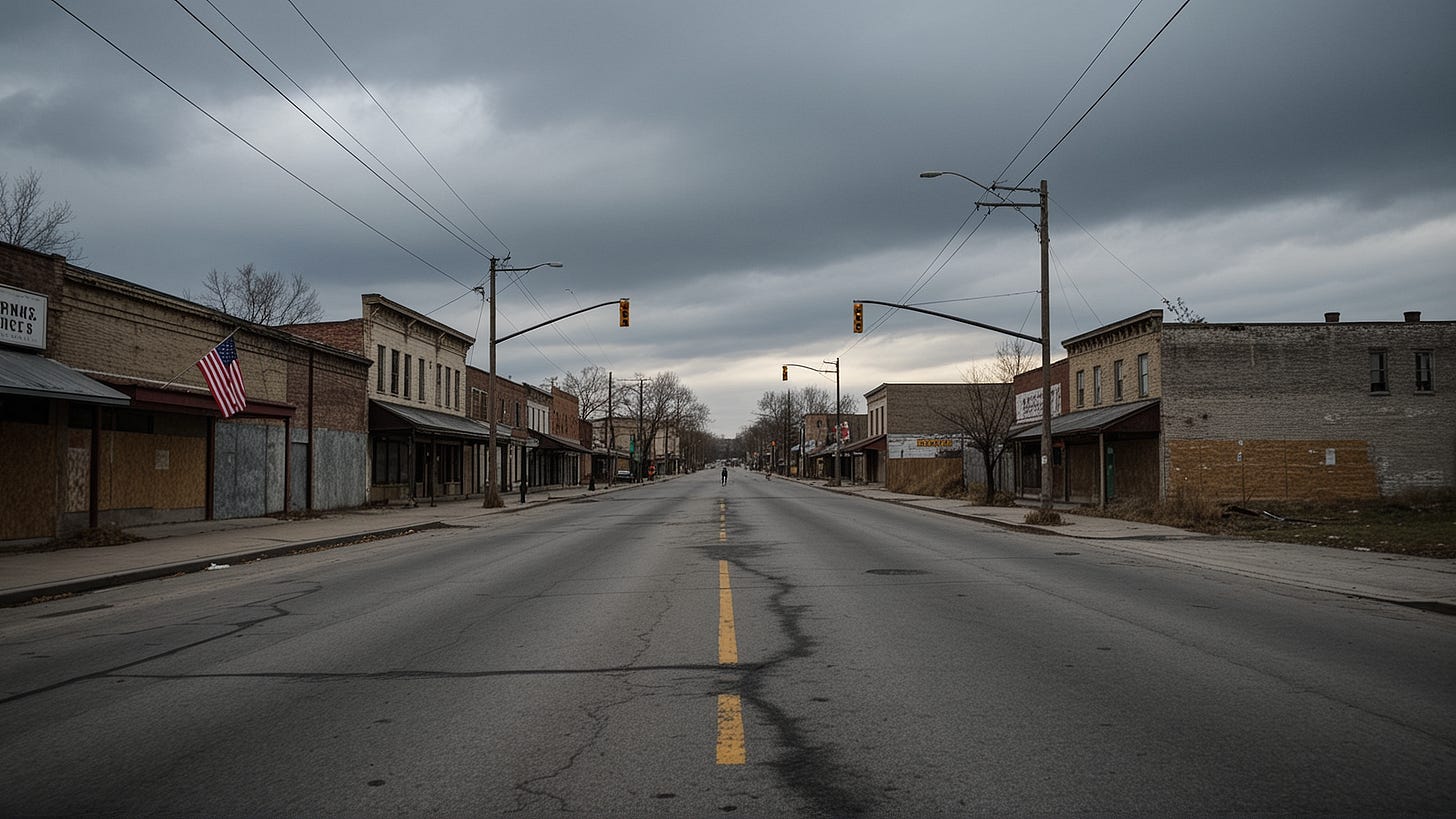
Snow fell on streets where streetlights had not worked for months, transforming the urban landscape into something resembling a nineteenth-century lithograph rather than a twenty-first-century city.
Walking through this South Side Chicago neighborhood in February 2026 revealed vacant lots stretching for blocks, former residential areas now returned to prairie, buildings demolished for code violations and never replaced. Remaining structures were fortresses, barred and boarded, occupants huddled against cold seeping through walls no matter how high thermostats were set.
Chicago’s crisis is financial before environmental, though environment compounds difficulties. The state of Illinois owes approximately $140 billion to retired public workers and has roughly $25 billion in assets to cover these obligations.
The city of Chicago owes another $47 billion. In 2026, the Illinois Supreme Court ruled that pension benefits cannot be reduced constitutionally, effectively guaranteeing municipal bankruptcy within two years. When Chicago declares bankruptcy—and most municipal finance experts agree this is inevitable—it will become the largest municipal failure in American history.
Implications extend beyond abstract realms of bond ratings and credit defaults. Police and fire departments will face cuts rendering them unable to respond to routine emergencies, let alone systemic shocks.
Snow removal keeping streets passable in winter will become unreliable. Water infrastructure, already ancient and leaking, will face deferred maintenance accelerating failure. Schools, already struggling, will close or operate on reduced schedules. Social services maintaining safety nets for vulnerable populations will fray.
A firefighter with twenty-three years of service described equipment shortages already beginning: engines that cannot be repaired because parts are no longer manufactured, protective gear exceeding rated lifespan, training curtailed for budgetary reasons.
“We are one bad fire away from catastrophe,” he said, immediately qualifying: “Actually, the disaster is already here. People just don’t see it yet.”
Winter weather of the Midwest presents dangers coastal residents often underestimate. The polar vortex collapse of February 2026 brought temperatures of minus thirty-two degrees Fahrenheit to Chicago, with wind chills of minus sixty-five.
The electrical grid failed for eighteen hours in some areas. Two hundred forty-seven people froze to death in their homes, most elderly, many discovered only when neighbors noticed mail accumulating. This event was not an anomaly. Climate models suggest Arctic warming may destabilize the jet stream, causing more frequent intrusions of polar air into mid-latitude regions.
If such cold events coincided with infrastructure failures—if natural gas pipelines supplying heating fuel failed, or the electrical grid collapsed under demand—death tolls could reach thousands.
Emergency warming centers have capacity for thousands, not tens of thousands. Hotels that might serve as backup require functioning infrastructure and payment mechanisms. Social networks allowing neighbors to shelter each other have been attenuated by decades of population loss and neighborhood abandonment.
Detroit presents an even starker vision of municipal failure. The city has lost approximately sixty percent of its population since 1970, leaving a sprawling urban area with infrastructure sized for nearly two million residents serving fewer than seven hundred thousand.
The water department has shut off service to entire neighborhoods where maintenance costs exceeded revenue from ratepayers. Streetlights do not function in many areas. Police response time in some districts exceeds an hour.
When collapse accelerates, Detroit will not have a riot problem; it will have a “feral city” problem, where entire districts operate under autonomous control and remaining infrastructure is stripped for scrap by organized crews.
The Great Lakes, which seem like advantages, have become liabilities. PFAS “forever chemicals” have rendered most fish inedible, and algae blooms in Lake Erie now cover approximately forty percent of the lake’s surface annually.
The “fresh water” advantage is illusory when filtration technology requires energy and replacement parts that will not exist after supply chains break. Water is present but poisoned, accessible but undrinkable without treatment infrastructure that may not survive systemic shock.
Gun laws in Illinois are restrictive compared to national averages, with licensing requirements and waiting periods complicating armed self-defense for residents who had not navigated these requirements in advance.
Social dynamics include deep segregation, concentrated poverty, and history of industrial abandonment leaving many residents with skills mismatched to available economy.
For those considering exit from this region, geography presents the barrier of winter. Leaving in January requires functioning vehicles, clear roads, and destinations with heating capacity.
The assumption that one can simply drive south ignores the reality that millions may attempt the same journey simultaneously, overwhelming infrastructure of receiving regions.
The five regions examined share characteristics making them particularly vulnerable to systemic collapse: high population density, infrastructure dependency, environmental stress, and limited exit options. They are not the only vulnerable regions in the United States, but they represent concentrations of risk exceeding national averages by significant margins.
For those finding themselves in these regions, questions become ones of timing and preparation. Relocation is optimal strategy, but it requires resources, flexibility, and willingness to abandon social networks and economic opportunities that may have taken decades to build.
For those who cannot relocate, preparation takes form of redundancy: water storage, food reserves, alternative heating or cooling, communication plans, and community networks providing mutual aid when formal systems fail.
But beyond the practicalities of preparation lies a deeper recognition that we have built our civilization on assumptions of permanence that geology and physics do not guarantee.
The Northeast Corridor assumes that water can be moved hundreds of miles indefinitely. California assumes that desert can be made to bloom through engineering will. Florida assumes that the ocean can be held back by pumps and walls. Phoenix assumes that heat can be air-conditioned into submission. The Industrial Midwest assumes that pension promises can be kept through financial alchemy.
These assumptions have persisted because, for decades, they have worked well enough. The water has flowed, the crops have grown, the cities have functioned, the checks have cleared.
But systems operating at the edge of their capacity have no margin for disruption. They are, in the terminology of engineers, “brittle”—strong under normal conditions but prone to catastrophic failure when stressed beyond design parameters.
What the next decade may bring is unclear. Perhaps the infrastructure investments that have been promised for generations will finally materialize.
Perhaps the climate models are too pessimistic, and the jet stream will stabilize, and the rains will return, and the aquifers will recharge. Perhaps the financial wizards will discover some mechanism for making the mathematics of pension obligations work. Perhaps.
But perhaps not. And if the systems do begin to cascade into mutual failure—if the water stops flowing, and the power goes dark, and the trucks no longer arrive, and the temperature does things that human bodies cannot survive—then your location will determine whether you are among those who adapt or among those who become statistics in a catastrophe that future historians will struggle to explain.
The choice, for now, remains yours. The window, according to those who watch these systems most carefully, may be narrower than we wish to believe. The ground is shifting. The question is whether we will feel it in time to move our feet.
The Mathematical Warning That Refused to Fade
When the shelves empty and the streets change, stockpiles may not be enough!!!
(What you’re about to see reveals just how quickly the world we know can unravel.)
Affiliate Disclosure: This post contains affiliate links. If you make a purchase through these links, I may earn a small commission at no additional cost to you. Thank you for your support!
Follow for more market & economic analysis:
📌 Pinterest — Charts, market insights & economic analysis.
📰 Flipboard — Follow my curated market & macro coverage.



 When I Take my M1 Garand to the range. A lot of times there will be some guys who say how heavy they are and worry about the kick.