
Categories
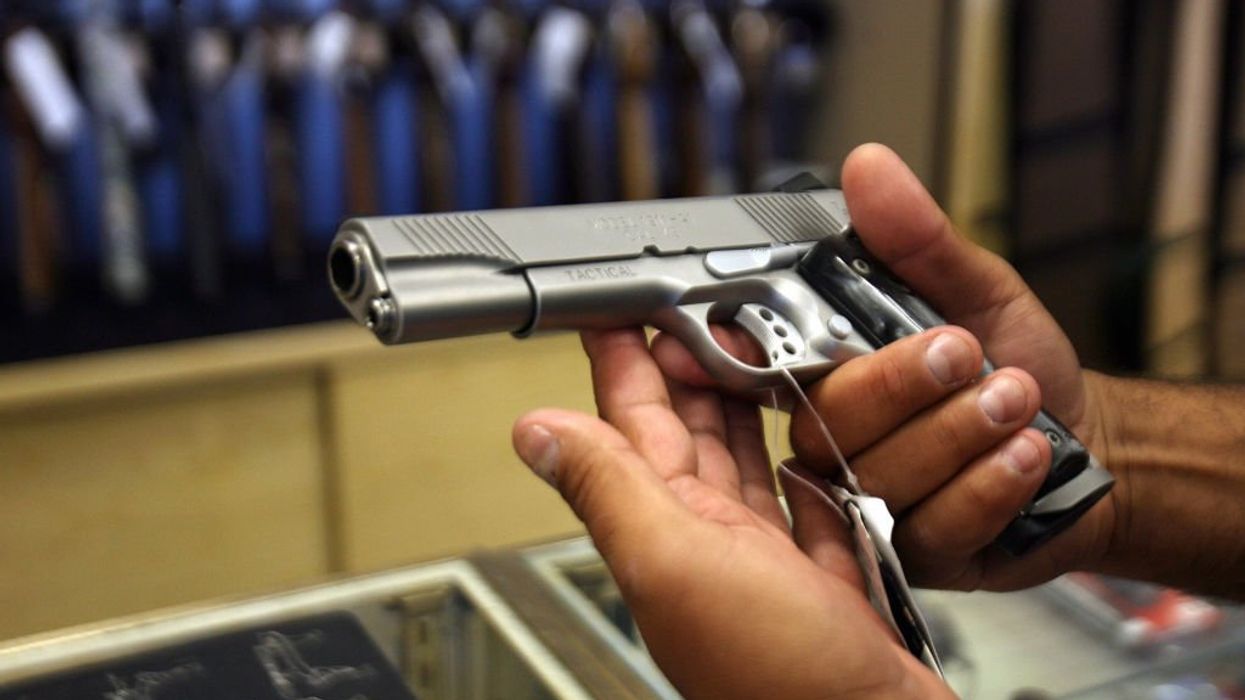
Several major credit card companies have decided to move forward with a plan to track purchases made at gun retailers in California, CBS News reported Monday.
American Express, Visa, and Mastercard will implement a new merchant code for firearm and ammunition retailers, allowing banks to track “suspicious” purchases to comply with a new California law. Adopting the code will not provide information about the specific items purchased at the retailer, as credit card companies do not record data at an SKU level.
Retailers are assigned merchant category codes based on the types of items they sell. According to Mastercard’s quick reference booklet, gun stores are currently assigned the “miscellaneous” or “durable goods” merchant category code. Other businesses listed under those codes include gas lighting fixtures, musical instruments, fireworks, fire extinguishers, grave markers, luggage, and wood chips.
In 2022, the International Organization for Standardization approved a unique code for firearm retailers. California then passed a law requiring retailers to adopt the ISO’s new code by May 2025.
The three major credit card companies previously agreed to assign the new code to gun retailers to allow banks to track firearm purchases more easily. In September 2022, 24 Republican state attorneys general wrote a letter to the companies, urging them to reconsider, Blaze News previously reported. According to the AGs, implementing a unique code could violate citizens’ rights.
“Categorizing the constitutionally protected right to purchase firearms unfairly singles out law-abiding merchants and consumers alike,” the letter argued.
Supporters of the law believe that the implementation of a unique code could prevent mass shooting incidents. Conservatives argue that the move will infringe on Second Amendment rights and potentially cause banks to flag and report so-called suspicious purchase patterns that target law-abiding Americans.
In March 2023, the companies agreed to halt their plans to implement the new code, citing pressure from Republican politicians, Blaze News previously reported.
On Monday, CBS News stated that American Express, Visa, and Mastercard have since reversed course and once again plan to adopt the new code to comply with California’s law.
The news outlet reported that the credit card companies told congressional Democrats last month that the new code would be available and ready for use in California by May 2025.
Mastercard executive Tucker Foote wrote to lawmakers, “The applicable standalone merchants in California primarily engaged in the sale of firearms will be required to utilize the code.”
Visa senior vice president Robert B. Thomson III’s comments to lawmakers seemed to indicate that the company will continue to pause the adoption of the code at least until California’s new law goes into effect in 2025. CBS News reported that Thomson assured Democrats that Visa would endeavor to comply with the state’s rule.
Thomson wrote, “With respect to the [firearm merchant code], there continues to be a tremendous amount of regulatory and legislative uncertainty.”
“Given the conflicting state laws on this topic and the likelihood that other states will enact legislation to either restrict or mandate the code, our implementation pause remains in effect,” Thomson added.

Everytown for Gun Safety, the billionaire-backed gun prohibition lobbying group, was making headlines over the weekend because a state-by-state new scorecard named California as “first in the nation” for having the most restrictive gun control laws.
In a report published by the Sacramento Bee, Everytown—often mischaracterized by the establishment media as a “gun safety” organization—and its subsidiary, Moms Demand Action, were taking credit for tough gun laws. A volunteer with the California Moms chapter was quoted boasting, “For over a decade, our grassroots army has worked in lockstep with our gun safety champions to keep California families safe from senseless acts of gun violence — this ranking showcases how far we’ve come and the road ahead.”
During 2022, the website notes, 2,197 Californians were murdered, a fact about which the gun control crowd has so far remained quiet.
As reported elsewhere by Ammoland News, the latest restrictive gun law known as SB2 is being challenged in federal court, and based on a ruling by a federal court panel Saturday which restored a preliminary injunction granted by District Judge Cormack J. Carney in December, the law could be in big trouble. The case is known as May v. Bonta, filed by the Second Amendment Foundation and the California Rifle & Pistol Association.
Everytown made headlines a few days ago when CNN reported the group’s prediction that some 298,000 lives “could be saved from the nation’s wave of gun violence” if only all states would adopt restrictive gun control laws like California.
Trailing California in the top spots are New York (762 slayings in 2022, according to Statista), Illinois (881 slayings, most of them in Chicago), Connecticut (136 murders), Hawaii (28 slayings; tiny state), Massachusetts (148 killings), New Jersey (254 murders reported), and Maryland (511 slayings).
Contrast those states with places such as Montana, identified by Ammo.com as the state with the highest percentage of gun ownership (66.3%) and a 2022 body count of just 49, yet with the low ranking of 47 on Everytown’s list of 50, and the gun control group’s credibility suffers. Neighboring Wyoming has the most guns per capita, the Ammo.com report noted, with 245.8 guns for every 1,000 residents. Wyoming is 44th on Everytown’s list, even though with all those people owning guns, the state produced only 14 murders in 2022.
Two more important points were listed by the Ammo.com report:
Rounding out the Top 5 states for gun ownership are Alaska, Idaho, and West Virginia. Everytown’s scorecard places them at 41st, 48th, and 27th, respectively.
This tale of irony is being overshadowed by the opening of the civil trial against the National Rifle Association and three of its senior leaders in recent years—Wayne LaPierre, Wilson “Woody” Phillips and John Frazer—unfolds in a New York courtroom. The civil lawsuit was brought by New York Attorney General Letitia James, who has leveled allegations of financial misconduct, according to UPI. The 74-year-old LaPierre last Friday announced his resignation from the position as executive vice president, which he has held for more than three decades. The resignation is effective Jan. 31.
By no small coincidence, Everytown for Gun Safety is headquartered in New York, same as the NRA, though the latter has been around since 1871.
The Citizens Committee for the Right to Keep and Bear Arms was quick to criticize the Everytown scorecard.
“One of the signals this is bogus research is the way Everytown graded Washington State, where the Citizens Committee is headquartered,” said CCRKBA Chairman Alan Gottlieb in a statement to the media. “Washington is position ninth on the list, and is described avs ‘making progress.’
The state has adopted increasingly restrictive gun laws in recent years, and the number of homicides has more than doubled since 2014, according to FBI data and statistics from the Washington Association of Sheriffs and Police Chiefs. Seattle just set a new homicide record in 2023. If that’s what Everytown calls ‘making progress,’ we would be better off going back to living in caves.”
About Dave Workman
Dave Workman is a senior editor at TheGunMag.com and Liberty Park Press, author of multiple books on the Right to Keep & Bear Arms, and formerly an NRA-certified firearms instructor.
Federal law enforcement officials have launched a new initiative to inform the public of what they say is a growing problem that involves the illegal modification of semi-automatic firearms into fully automatic weapons.
Officials from the United States Attorney’s Office for the Central District of California and the Bureau of Alcohol, Tobacco, Firearms and Explosives launched a series of public service announcements designed to raise awareness on the dangers of these machine gun conversion devices, which are often referred to as “switches,” “chips” or “auto sears.”
The devices can be 3D-printed at home, but are often sold online, sometimes under misleading names to avoid detection by law enforcement, and billed as being legal to possess.
But despite their seeming harmlessness on their own, simply owning one of the conversion devices carries the same legal penalty as carrying an illegal machine gun, even if you don’t even have a weapon to modify.
The public service announcements feature U.S. Attorney Martin Estrada and leadership from the ATF Los Angeles, highlighting the dangers of the illegal conversion devices and the stiff legal penalties for those found in possession of them.
“These devices are not gun accessories. They are illegal and considered machine guns under federal law,” says ATF LA Field Division Special Agent in Charge Christopher Bombardiere.
He adds that the ATF has recovered more than 31,000 of the devices in the last five years and compared the problem to the rise of ghost guns — untraceable firearms that are assembled using spare or 3D-printed parts and which have no serial number.
Law enforcement officials say the devices can switch a semi-automatic pistol or rifle into fully automatic in as little as 60 seconds. “One pull of the trigger can release all the ammunition in the magazine,” they said.
Estrada said simply possessing one of these “switches” can carry a sentence of up to 10 years in prison and federal law enforcement officials are being extra diligent to keep the devices off the streets.
If you know of anyone who may be purchasing, making or stockpiling these devices, you are urged to contact your local ATF office. They can also be safely turned over at a local office.
A machine gun is described under the National Firearms Act as follows:
To view one of the public service announcements published by the ATF, click here.


| Late Saturday night, the United States Court of Appeals for the Ninth Circuit issued an order dissolving a prior order and reinstating a preliminary injunction that prevented the state of California from enforcing the expanded so-called sensitive places designated under SB 2, which were set to go into effect January 1.
This means the injunction that was granted in late December preventing the state from enforcing the expanded sensitive places under SB 2 is back in effect, pending further court orders. This is a huge win for gun owners as this litigation proceeds. |

“A California appeals court [Fourth Appellate District, Division One Court of Appeal of California] ruled Friday that the state may continue sharing the personal information of gun owners with ‘gun violence’ researchers,” The Western Journal reports. “California’s Department of Justice had been permitted to share ‘identifying information of more than 4 million gun owners’ collected by the state during the background check process for firearms purchases with ‘qualified research institutions,’ ostensibly to aid in the study of gun-related accidents, suicides and violence.”
Per the bill that “authorized” this massive privacy intrusion against citizens for claiming their rights (Assembly Bill No. 173), those include “a database of gun violence restraining orders, and a database of firearm precursor parts purchases.” In other words, that will include people who have never been charged with or tried for a crime, let alone convicted, and will identify people who bought parts that may later be declared verboten.
And more, but you have to go to the court opinion to see how much:
“The DROS [Dealer Record of Sale] system and the associated AFS [Automated Firearms System] and APRF [Ammunition Purchase Records File] databases create a unique data set regarding gun and ammunition ownership not available anywhere else. Researchers in California have used this data to conduct empirical research regarding firearm-related violence for some time.”
“The court’s decision is a victory in our ongoing efforts to prevent gun violence,” Attorney General Rob Bonta Bonta crowed in a media release. “AB 173’s information-sharing serves the important goal of enabling research that supports informed policymaking aimed at reducing and preventing firearm violence. Research and data are vital in our efforts to prevent gun violence in California and provide a clear path to help us save lives.”
“California’s Department of Justice mistakenly posted the names, addresses and birthdays of nearly 200,000 gun owners on the internet because officials didn’t follow policies or understand how to operate their website,” the Associated Press reported last December. California Rifle and Pistol Association President Chuck Michel “noted the leaked data likely included information from people in sensitive positions — including judges, law enforcement personnel and domestic violence victims — who had sought gun permits.”
As for who the “researcher” is privy to the data, per AB 173:
“This bill would name the center for research into firearm-related violence the California Firearm Violence Research Center at UC Davis. The bill would generally require that the information above be made available to the center and researchers affiliated with the center, and, at the department’s discretion, to any other nonprofit bona fide research institution accredited by the United States Department of Education or the Council for Higher Education Accreditation, as specified, for the study of the prevention of violence.”
That pretty much guarantees whose yard they’ll be playing in, and that suits someone who is no stranger to this correspondent just fine.
“The court’s decision is an important victory for science,” University of California’s Davis California Firearm Violence Research Center Chair Garen Wintemute declared. It’s more like an “important victory” for “agenda science”…
Back in 2007, I warned gun show attendees that Wintemute was surreptitiously eavesdropping on and recording gun show transactions to report them to authorities and justify banning private sales. I saw this as a violation of gun show rules and recommended notifying security if anyone saw it happen. He told Slate it was a “Wanted poster” and tied that in with threats against his life and that “federal law enforcement agents recommended that I wear a ballistic vest.” There was also the false accusation that I had “outed” him. The end result was the science journal Nature felt compelled to publish a (incomplete) retraction.
While acknowledging that “the law also insists that ‘Material identifying individuals shall only be provided for research or statistical activities and shall not be transferred, revealed, or used for purposes other than research or statistical activities, and reports or publications derived therefrom shall not identify specific individuals,’” they made another important observation:
“[A] gun owner might understandably not be thrilled that people in the business of coming up with reasons why no one should be allowed to own guns (largely true of people in the ‘gun violence research’ field) can easily know their name, address, and all the weapons, parts, and ammo they bought legally. What’s more, nothing in the law as written applies any stern level of oversight or punishment over misuse of the information.”
That “misuse” can be deliberate by activists gone wild or due to lax/incompetent security protocols. And it’s not like sensitive and supposedly secure government systems at the highest levels can’t be breached and hacked by anyone, from cyber criminals to foreign enemies. It’s not like names, addresses, and lists don’t have real-world street value, and it would be just like the prohibitionists to have their efforts actually increase violence and its incentives.
It also looks like it might be a good way for someone with list access and an agenda to call in an anonymous tip and give police “probable cause” for sending out militarized confiscation teams. It’s not like law enforcement won’t do so with information targeting owners of previously registered but now prohibited items.
A truism about “gun control” laws is that criminals don’t obey them, and they end up infringing on those who have. A case in point is 1968’s Haynes v. U.S., in which the Supreme Court (correctly, if you think about it) decided that forcing a convicted felon to register an NFA weapons he was prohibited by law from possessing violated his Fifth Amendment-recognized right against self-incrimination. So, oath-breaker Bonta’s vaunted database, relied on by the Davis gun show mole and his gaggle of anti-gun eggheads, by design, does not include the very reprobates initiating the lion’s share of the “gun violence” they’re purporting to “study”—California’s armed-to-the-teeth criminals who get their guns the old-fashioned way, by breaking the law.
There’s another break afforded exclusively to criminal suspects, the reading of their “Miranda rights.” Noting another well-documented prohibitionist tactic, declaring what was once legal to now be banned, gun owners buying what could be prohibited later should be advised that whatever they admit to on a required registration form can and will be used against them in a court of law if the Democrats get their way.
