Category: California

California has passed AB 2047, the California Firearm Printing Prevention Act, and the bill is now on Governor Gavin Newsom’s desk.
The measure, authored by Assembly Member Rebecca Bauer-Kahan, would eventually require consumer 3D printers sold or transferred in the state to include “firearm blocking technology” intended to identify and stop print jobs for firearms and certain illegal parts, including machine-gun conversion devices. After weeks of amendments, the Legislature sent the enrolled bill to the governor in the closing hours of the 2026 session. Newsom has until the end of September to sign or veto it.
The version that reached his desk is far narrower than the bill that first cleared the Assembly in May. The Senate stripped several of the most aggressive enforcement tools after lawmakers and industry groups argued they were technologically infeasible or overbroad. Gone are the original criminal misdemeanor for disabling the software, the $25,000-per-violation civil penalties, the mandatory manufacturer self-attestation process, and a public roster of “compliant” models.
The final text keeps an exemption for printers used exclusively to make entertainment-industry props and lets the California Department of Justice create additional exceptions by regulation. It also shields people who share digital firearm files solely to test or develop blocking software.
What remains is a delayed, contingent mandate. Beginning no later than July 1, 2027, the DOJ must check quarterly whether ASTM International has published industry standards for firearm-blocking technology on 3D printers. If ASTM issues qualifying standards, the department then has 24 months to publish its own written guidance or regulations describing minimum performance requirements. One year after those state standards appear, it would become unlawful to sell, offer for sale, or transfer a 3D printer in California that lacks compliant blocking technology. If ASTM has not published standards by July 1, 2029, the department is relieved of further duties under the act, and the sales restriction may never take effect.
The bill does not operate in a vacuum. California already prohibits unlicensed people from using a 3D printer or CNC mill to manufacture a firearm under Penal Code § 29185. Separate statutes restrict machines whose “sole or primary function” is to make guns and create civil liability for distributing “digital firearm manufacturing code” to unlicensed persons. AB 1263 and related 2025–26 measures further expanded definitions of firearm manufacturing machines and accessories effective January 1, 2026. AB 2047 tries to move one step upstream by making the printer itself refuse certain files.
California is not the first state down this path. New York enacted a similar blocking-technology law earlier this year. Sacramento modeled AB 2047 on that approach, then made the California version more conditional after the Senate rewrite.
Critics say the concept still fails on both technology and law. 3D-printing companies, the ACLU of California, Hollywood prop shops, the Electronic Frontier Foundation, and gun-rights groups argue that detection algorithms are easy to evade with slightly modified files, offline machines, older printers already in circulation, or out-of-state purchases. They also raise First Amendment concerns about treating design files as something the state can force hardware makers to censor, and they warn that unreliable software would burden schools, small businesses, and hobbyists. Several analyses noted that the Senate rewrite left the actual sales ban hanging on a private standards body that may never act.
Supporters, including Everytown for Gun Safety and the bill’s author, frame AB 2047 as a response to recovered 3D-printed guns and unfinished frames. They describe it as a way to cut off a pipeline for untraceable weapons before a file becomes a firearm.
Even if Newsom signs the bill, nothing changes at the store counter tomorrow. The mandate is years away, if it arrives at all. The practical fight now is whether ASTM writes a standard the state can adopt—and whether software that must inspect every print job can ever work well enough to survive both evasion and a courtroom.
Categories
Venice California

Back in 1930, California was producing nearly one quarter of the entire world’s oil output. These oil wells in Venice, California, were still operational on the beach in 1952.
The image shows a dense forest of wooden oil derricks crowding the shoreline and beach area during the Southern California oil boom in the early 20th century.
Large-scale petroleum discoveries in the 1920s and 1930s turned parts of the Los Angeles coastline, including Venice and Playa del Rey, into packed industrial drilling zones right up against the ocean. Beachgoers, homes, and seaside areas sat shoulder-to-shoulder with active rigs and storage tanks before regulations and tourism eventually shifted the coastline’s purpose.
Venice, California experienced a massive, fast-moving oil boom after the Ohio Oil Company struck oil on December 18, 1929, near the Grand Canal and Washington Street. Within two years, more than 400 towering metal derricks crowded the beachfront and residential lots, transforming the resort town into a noisy, sludge-filled industrial zone before production quickly declined.
The first wildcat well yielded 3,000 barrels per day from a depth of nearly 6,200 feet, sparking intense “oil fever” during the Great Depression. By July 1931, over 340 to 450 active wells crowded the Venice peninsula south of Washington Street, making it one of the top-producing fields in California.
Drilling waste, thick sludge, and foul odors polluted the historic canals, forced local school closures, and ruined the beach. Production dropped drastically by 1932, though low-level pumping continued for decades.
By the 1970s and 1990s, all remaining wells were completely capped and removed, leaving behind the modern residential and recreational neighborhood. Plus a very nasty Gang too!
.jpg)
 California still wants to regulate 3D printers because people can use them to make firearms without the state’s blessing. Its vehicle is AB 2047, a bill originally designed to force printer makers to build in technology capable of detecting and blocking gun files.
But after a round of amendments, the bill has been substantially watered down. What started as a mandate is now more of a regulatory tripwire — one that may never actually be triggered.
From Mandate to Maybe
Introduced in February by Assemblymember Rebecca Bauer-Kahan (D-Orinda), AB 2047 originally would have required 3D printers sold or transferred in California to include state-approved “firearm blocking technology” — hardware or software designed to prevent the machine from printing files identified as firearms or firearm components.
The amended version doesn’t actually establish that standard.
Instead, beginning no later than July 1, 2027, the California Department of Justice would check quarterly to see whether ASTM International — the private standards organization involved in additive manufacturing, the industry’s term for 3D printing — has published standards for firearm-blocking technology.
If ASTM does, DOJ gets 24 months to develop guidance or regulations based on those standards. Per the bill, those rules would establish “minimum performance standards” necessary to safely, fairly and effectively implement the technology statewide.
And if ASTM hasn’t published anything by July 1, 2029?
The bill says DOJ “shall not be required to make any further determinations under this section.”
In other words, no ASTM standards, no California regulations under AB 2047.
At least for now.
Passing the Buck
The amended bill flips the original structure on its head.
Instead of California lawmakers deciding what firearm-blocking technology must do, they wait for an outside standards organization to establish the technical foundation. If that happens, DOJ gets to turn it into regulations.
Politically, that’s convenient.
Lawmakers get to vote for “doing something about ghost guns” without having to explain how the technology is actually supposed to work. If the eventual regulations are expensive, ineffective or technologically impossible, DOJ owns the details.
The legislators simply created the machine and walked away.
Legislating by handing the hard decisions to unelected regulators is an interesting move for a political class that spends so much time warning everyone about threats to democracy.
There’s Another Problem: Does This Technology Even Work?
That’s the bigger question hanging over AB 2047.
The blocking software envisioned by proposals like this would somehow have to recognize firearm-related geometry while allowing the countless ordinary objects that contain identical or similar shapes.
A printer doesn’t inherently know whether a particular hole, tube, spring, cavity or other geometry is destined to become part of a firearm, a household object, a prototype or something else entirely.
Even the federal Justice Department has gone looking to the 3D-printing industry for help with the problem.
Then there’s the First Amendment.
The California Senate’s own committee analysis raised questions about restricting what a printer can produce and the unsettled issue of whether computer code constitutes protected speech. California is already fighting on similar ground in its lawsuit involving websites that distribute 3D gun files.
The Electronic Frontier Foundation has also blasted the proposal, arguing that it would effectively build censorship into the printer itself.
That’s what makes AB 2047 more interesting than another California “ghost gun” bill. The state isn’t merely trying to regulate what someone manufactures. It’s attempting to regulate what a general-purpose machine is allowed to process.
The Clock Is Running
AB 2047 cleared the Assembly in May and has since moved through the Senate Judiciary and Public Safety committees.
It now faces the Senate floor — and a deadline.
The Legislature has until August 31 to pass bills this session. If the Senate approves AB 2047 without further amendments, it heads to Gov. Gavin Newsom. If senators change it again, it goes back to the Assembly for concurrence.
That doesn’t leave much time.
Then again, this is California and we’re talking about gun control. Finding time has rarely been the problem.
The Bottom Line
On its face, the amendments look like a win for 3D-printer manufacturers, hobbyists and anyone else who doesn’t particularly like the idea of government-approved software deciding what their machine is allowed to print.
But this isn’t a clean escape.
California hasn’t abandoned firearm-blocking technology. It has outsourced the trigger.
If ASTM never produces the standards, AB 2047 could amount to little more than bureaucratic homework. If ASTM does, however, California DOJ already has the legislative framework it needs to start turning those standards into rules.
The bill deserves to die, teeth filed down or not. A law that outsources its technical trigger to a private standards organization and leaves the actual requirements to regulators is questionable lawmaking before we even get to whether the underlying technology works.
But this is California, in the closing days of the legislative session, with a super majority that rarely lets a gun-control bill expire quietly.
The smart bet isn’t that AB 2047 dies.
It’s that California passes the framework now and waits for someone else to pull the trigger.
Fresno mulls letting prosecutors carry concealed firearms after stabbing rocks California
Fresno County officials are pushing to let prosecutors carry concealed firearms after a shocking daylight stabbing of a senior deputy district attorney last week.
Supervisor Garry Bredefeld is working with Sheriff John Zanoni and DA Lisa Smittcamp on an ordinance allowing them to be armed on county property, according to Your Central Valley.


The proposal is expected to go before the Fresno County Board of Supervisors in the coming weeks.
“All of our law enforcement — whether they’re prosecutors, the sheriffs or the police officers — get up and work to make this community safe,” Bredefeld said. “The least we can do is make sure they have the means to protect themselves.”
The push comes after a senior deputy district attorney was stabbed three times in the back Thursday while outside Courthouse Park in Downtown Fresno.
Smittcamp questioned the county’s current restrictions Friday, noting that she is prohibited from carrying a firearm on county property despite her position.


“I am the chief law enforcement official in the county of Fresno … if I want to carry a weapon on county property I can’t under a current ordinance,” Smittcamp said. “Kind of ridiculous … people like Mr. Crawford are empowered by the weakness of the criminal justice system.”
Supervisors Nathan Magsig and Luis Chavez also backed the proposed change, according to the outlet, with Chavez calling it “long overdue.”

“I know for a fact that prosecutors have received death threats,” Chavez said. “We need to start recognizing our prosecutors as part of our public safety family.”
Magsig said the change would require the county to work with state officials. Bredefeld said he was not optimistic the attack would change lawmakers’ attitudes in Sacramento.

Dustin Crawford, 42, allegedly approached the prosecutor and others while they were outside Courthouse Park shooting a campaign commercial.
Crawford allegedly recognized the group before singling out the prosecutor and stabbing him three times in the back.

We reported last month that several anti-gun measures that were still under consideration as California’s legislative session closed remained on track to be considered when lawmakers reconvened on August 3.
Five bad bills clear appropriations — now on to the floor
Now, five of those measures have, indeed, been passed in committee and are eligible for floor votes in the state Senate and Assembly.
According to a legislative update by the National Rifle Association’s Institute for Legislative Action, three bad Assembly bills were passed by the Senate Appropriations Committee and are now eligible for a vote on the Senate floor.
AB 1743 expands the database that leaked CCW holder data in 2022
Assembly Bill 1743 expands the state’s firearm owner data-sharing framework by increasing access to information maintained in California’s Automated Firearms System and related databases.
“Expanding this system raises significant concerns given California’s track record of protecting firearm owner data,” NRA-ILA explained. “In 2022, the California Department of Justice exposed the personal information of thousands of firearm owners and concealed carry permit holders in a widely reported data breach.”
AB 1753 expands red flag laws under the guise of “clarification”
AB 1753 “clarifies” California’s Gun Violence Restraining Order (GVRO) violation framework by explicitly subjecting ammunition possession to the same hearing and enforcement procedures currently applied to firearms.
“Red flag laws have repeatedly stripped law-abiding citizens of their Second Amendment rights while undermining basic due process protections,” NRA-ILA wrote. “Existing red flag laws in California should not be expanded under the guise of ‘clarification,’ but repealed.”
AB 2047 goes after 3D printers — the same play as New York’s Hochul law
Finally, AB 2047 targets 3-dimensional printers by restricting their sale or transfer unless equipped with so-called “firearm blueprint detection algorithms.”
“The bill represents a broad attack on lawful technology and raises concerns about free speech, innovation and the rights of law-abiding Californians,” NRA-ILA reported. “These concerns are not just realized by firearm owners, but tens of thousands of STEM educators and technology professionals.”
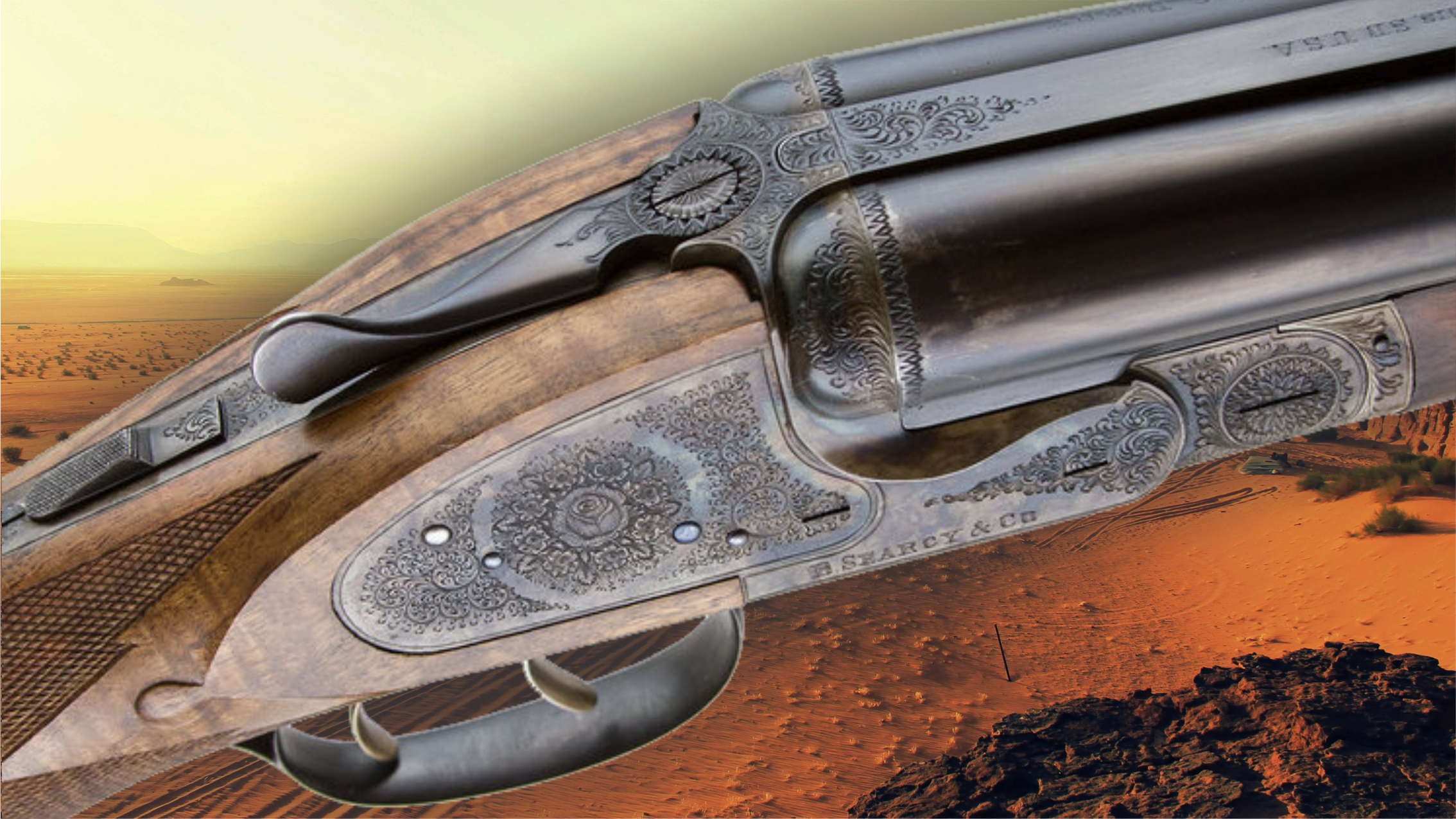
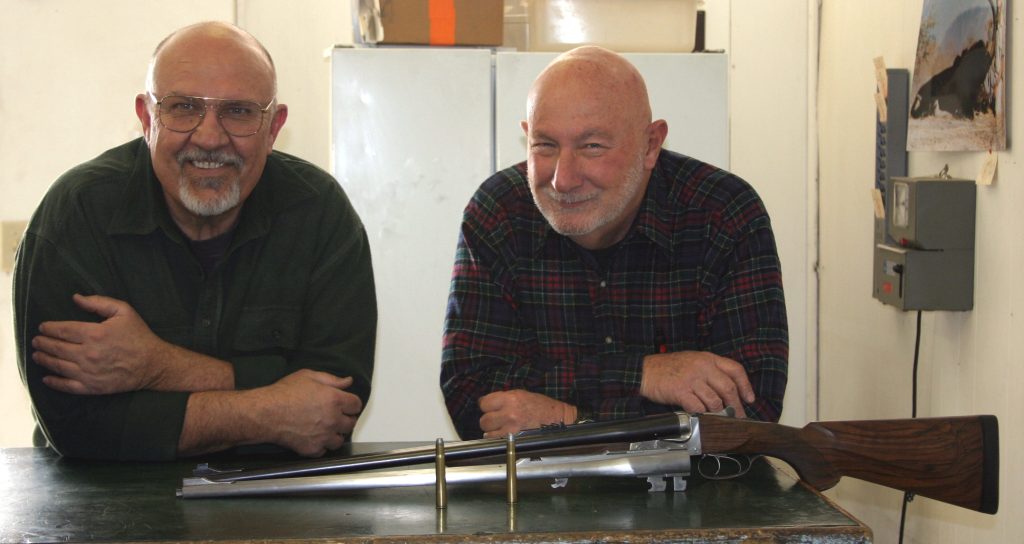
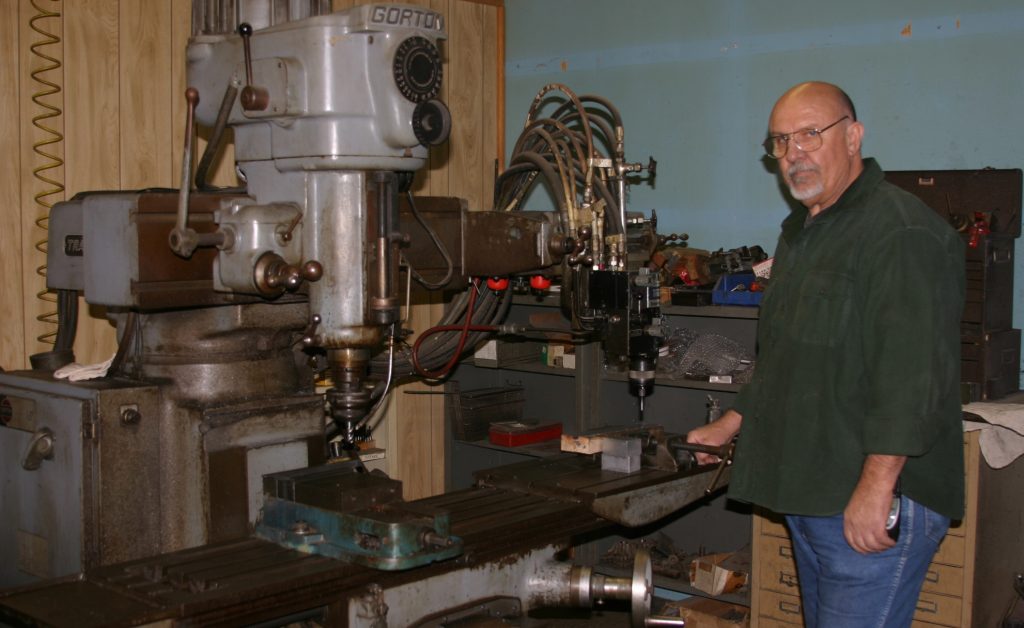
 B. Searcy Company is headquartered in the small desert community of Boron, California, about 100 miles northeast of Los Angeles. Located in an old WWII Quonset building, just across the road from Edward’s Air Force Base, Searcy is ready to kit-up and custom fit a double enthusiast with a custom double barreled rifle in any caliber they are willing to pay for.
Butch offers six grades of double rifles: four boxlock designs and two sidelock designs. The Field Grade is the entry-level boxlock, which as of January 1, 2010, will have a base price of $11,500.
The next step up is the Classic boxlock at $18,000, then the Deluxe boxlock at $21,500, and the Sidelock at $22,000. Finally, there are the ultimate stoppers; a .577 Nitro Express double that you can have as a Boxlock or a Sidelock for $22,000 and $35,000 respectively (larger calibers available).
All these rifles have multiple options and feature choices, the details of which can be best viewed at Searcy’s website.
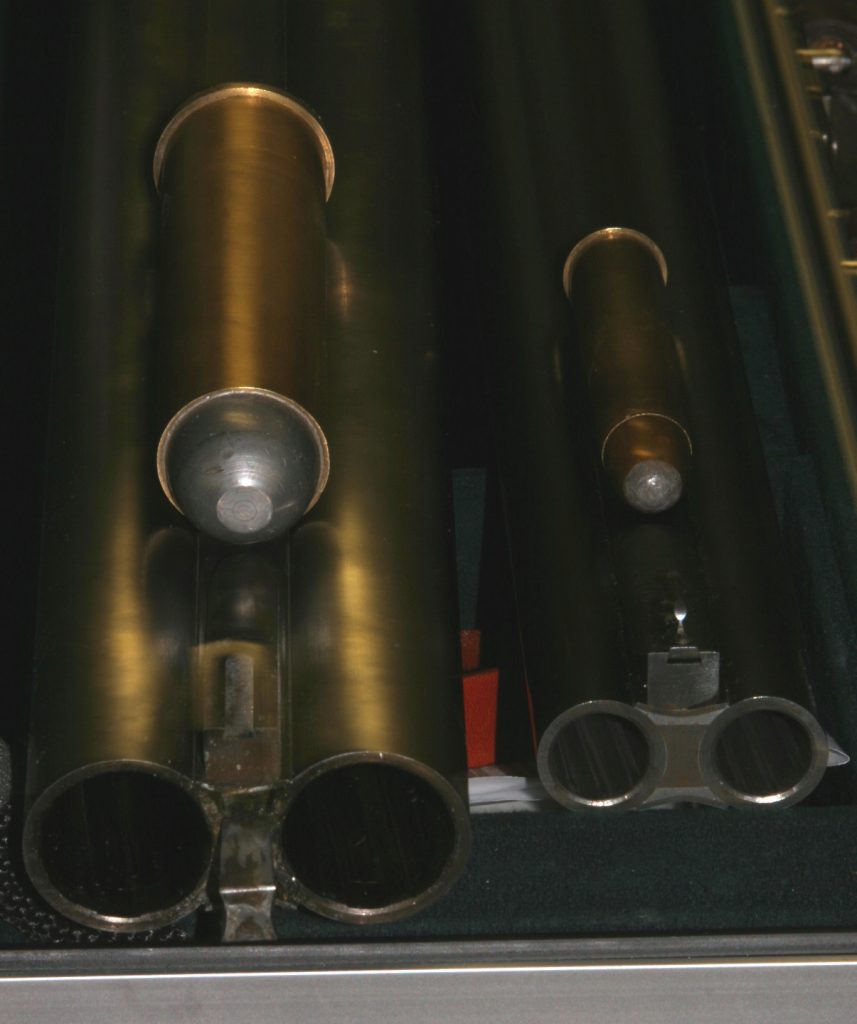
Standard calibers offered are the .375 H&H Flanged Magnum, the .450-400-3” (.411”), the .450 3¼” Nitro Express, the .450 Nitro Express, the .470 Nitro Express, the .500 Nitro Express (3” and 3 ¼”), the .577 Nitro Express, the .600 Nitro Express, the .700 Nitro Express, and the incredible 4-Bore. The 4-Bore double rifle starts at $85,000. Other calibers are available on request for an additional charge.
Only the Searcy double rifle can be described as an ‘All American’. Although other available doubles may be assembled in the United States, they are built on German or Italian actions. The Searcy rifles are machined right here in the States and have Anson and Deeley style receivers, with double Purdey bolting and top extension, and are CNC machined out of 4130 chromoly and 416 stainless steel bar stock into boxlock or sidelock configurations.
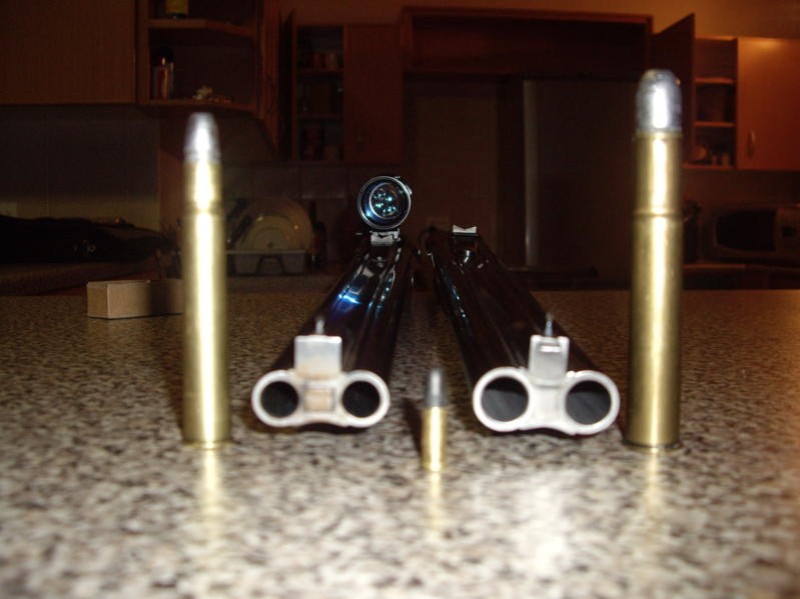
Searcy’s doubles come fitted with monobloc constructed PAC-NOR barrels, and are topped with iron sights from New England Custom Guns. A second set of double rifle barrels in a different caliber will set you back a cool $10,000, while a set of 12 gauge shotgun barrels can be fitted for a mere $4500.
Final barrel options include the choice of installing ejectors ($1000) or extractors (including rimless).
All Searcy rifles come standard with a quarter-rib, which includes one fixed rear sight and a caterpillar front sight. However, rear sights with folding leafs are available options at the rate of: one fixed + one folding leaf $400, one fixed sight + two folding leafs $500, and one fixed sight + three folding leafs $600. The final iron sight option is a front ‘night sight’ for $225.
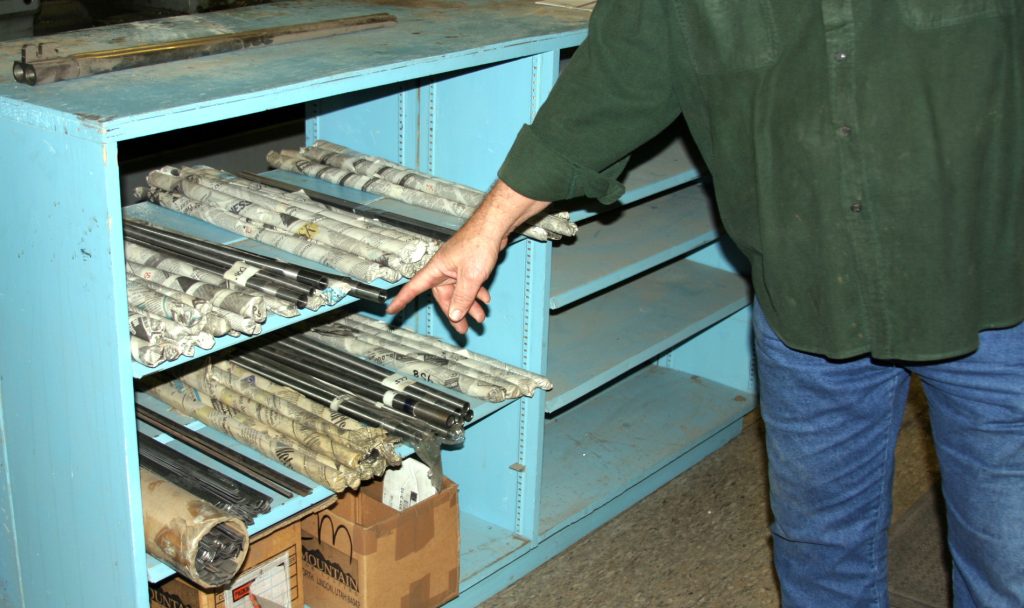
Although not usually recommended for the larger ‘stopping’ caliber rifles, scope mounts are a popular option for the large medium bore caliber rifles, where a good quality riflescope can be very useful for long distance shots at plains game. Two styles of mounts are available; the renowned Talley rings and bases for $595 or the European style claw mounts for $2900.
To most traditionalists, red dot sights on double rifles are inconceivable. However, to a growing number of riflemen, they are a welcome addition to their sighting options. If you have vision issues that make the use of regular iron sights difficult, a lightweight red dot style sight is just the ticket for close shots where quick handling and accurate bullet placement is more important than traditional good looks.
Any level of engraving and fancy metal work can be had on request. The depth of a shooter’s pocketbook is the only limit to the amount of decoration and embellishment available. To give the engravers additional working area, $1000 false side plates are offered for the boxlock rifles.
All of these doubles come with custom-fitted stocks in various grades of English walnut from Jim Preslick.
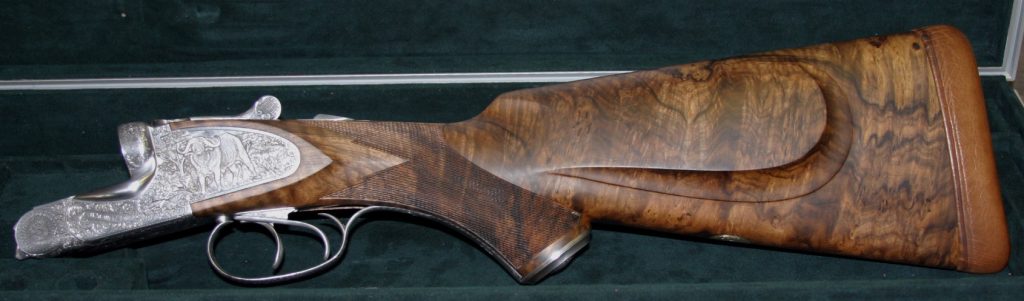
Besides fitting (length, bend or drop, and cast-on or cast-off), other options on stocks include; long tangs ($1500), long trigger guard ($800), trap grip cap ($550), stock medallion ($400), teardrop medallion ($500), and leather covered recoil pad ($400. And finally, for $1500, all rifles can be had in an oak & leather display case.
When you consider the entry-level Holland & Holland .470 double rifle at almost $80,000 and a Westley Richards sidelock at just over $96,000, a Searcy sidelock at $22,000 certainly does look like one of the best deals on this planet for a custom double.
However, there will soon be a new higher dollar rifle rolling out from Searcy’s shop. Built on the expensive to manufacture, but robust action that John Rigby and Thomas Bissell patented in 1879; the Sidelock Bissell Rising Third Bite action’s initial price will be $40,000.
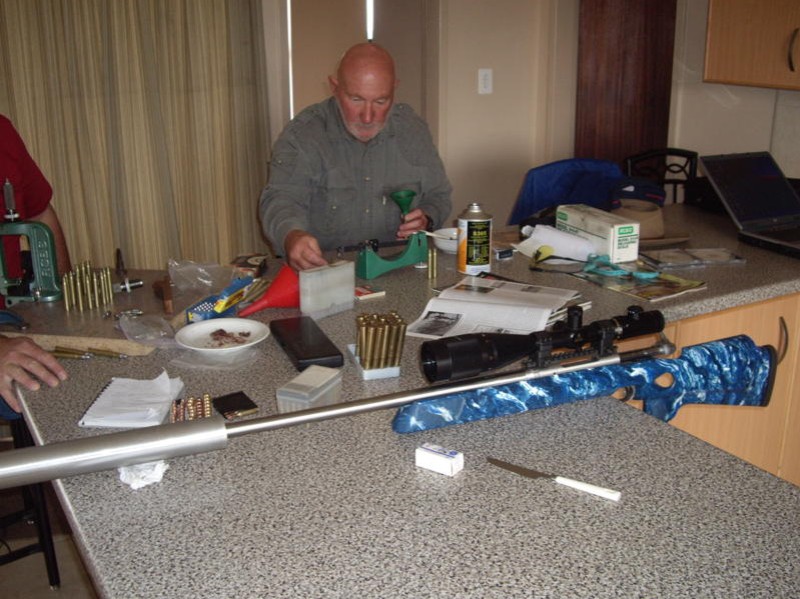
A couple of years ago, I had the good fortune to make my own pilgrimage to Butch’s legendary Quonset hut on 20 Mule Team Road in the company of .470 reloading guru, Leo Grizzaffi. As an old friend and customer of the B. Searcy Company, Leo had been asked by Butch to help him wring out a (then) new project, which consisted of fitting an extra set of 375 Flanged barrels to his well worn and well broken-in .470 Nitro Express.
This barrel combination has proven popular for many safari hunters who already own a double rifle in one of the heavy ‘stopping calibers’, i.e., a .45 caliber or larger. However, there are always other factors to consider when deciding on the caliber of your add-on barrel set. At that time, .375 Flanged brass was easier to find than .450/400 brass, but with Hornady’s recently introduced 3-inch and 3½-inch .450/400 brass now in production, getting .450/400 brass may no longer be a problem.
When I questioned Butch and Leo on the desirability of a .375 Flanged barrels vs. a set of barrels in .450/400, we got into the other issues which had led them into choosing the .375 Flanged. The deciding factors were; there is a large variety (and ample supply) of .375 caliber bullets available for handloading, and with its longer range and somewhat flatter trajectory, the .375 Flanged is more versatile in the field than the .450/400.
However, the final reason for going with the .375 Flanged was that the .450/400 simply was not a big enough step DOWN in power. With its significant reduction in recoil, the average person will find the .375 Flanged not only more pleasant to shoot, but more manageable than the .450/400. Even for someone like Leo, who has put over 5000 rounds through his .470, and over 2000 rounds through the .375 Flanged barrels, tailoring the amount of recoil down to more manageable levels was a major point. On a practical level, if the rifle is pleasant to shoot, more practice is done on a regular basis. That way, the shooter develops familiarity with the weapon, muscle memory is enhanced, and when it comes time for serious use, fear of recoil becomes a non-issue, with handling and reloading the rifle become second nature.
On the other end of the spectrum are the extreme big bore double rifles that Searcy makes, which start with the .577 Nitro Express and include the .600 Nitro Express, the .700 Nitro Express, and the massive 4-Bore. If you are not completely insensitive to recoil, the best thing you can do is stay on the porch, because recoil is where these big dogs run.
As a bonus for traditionalists, Butch also offers the dynamic duo of stopping calibers: the .450 Nitro Express and the .450 3¼” Nitro Express. These cartridges give the handloader the ability to use relatively cheap, and easily available .458 bullets to make premium ‘full-house’ hunting rounds, as well as use cast lead .458 bullets for ‘reduced load’ practice rounds.
It is not a problem if you own a modern rifle like a Searcy, but if you are going to handload full-house loads for any of the old original .450 Nitro Expresses, you should have a good gunsmith check the rifles out thoroughly, and remember to keep the pressures low. Inexpensive bullets and low recoil practice are an attractive combination of features in favor of choosing these calibers.
The 450 Nitro Express calibers were the first of their kind, and when it came out, it was viewed by many experts as the best in its class for hunting the most dangerous game. Guess what? It still is.
Having a custom double rifle maker like Searcy working right here in our back yard is a boon to the American customers who are in the market for a brand new double, and want something better than an ‘out of the box’ factory rifle.
Not only are his prices competitive with the factory doubles from Germany and France, but you are dealing with an honest US gun maker who is not only easily available, but willing to back up his product, and in most cases offer quicker delivery times.
If price is no option, and sending your rifle back to England for repairs is not inconvenient, then it is hard to argue with anyone who wants to buy a Holland and Holland or Westley Richard. However, in my opinion there is a lot of value for the first time double rifle owner to get into the game at roughly 25% of the big name English rifle makers entry level prices for doubles.
 But at the end of the day, it is up to the individual buyer to weigh their own needs and opinions against what is available on the market today, and to decide for themselves what rifle brand best fits their budget, investment strategy, and expectations.
We are lucky to have the choice of a wide range of styles in double rifle design and cosmetics available in the in the 21st Century marketplace.
It wasn’t that long age when all the firearms pundits were convinced the double rifle had seen its last safari, but in a relatively short period of time, and despite the recent downturn in the US economy, double rifle sales have rebounded from their ‘death’ in the 1960’s, and looking at their sales in the long term, we are in the strongest market for double rifles since World War II.
Leo Grizzaffi is a lifelong hunter and veteran of many African safaris. Author and reloading expert, his specialty is the care and feeding of big bore double rifles, however he also dabbles with the little calibers. Leo resides in California, where being a lawyer and judge in the City of Los Angeles sometimes interferes with his busy hunting and reloading schedule.