
In October 1983, the USA invaded the small island nation of Grenada, which at the time was being supported and reinforced by Cuba. Most of the weapons the American troops encountered were of post-WWII, Cold War vintage; namely a staggering quantity of AK-47s, but there were some WWII weapons discovered as well.


(Top: An A-7 Corsair II strike jet off USS Independence (CV-62) over Point Salines Airport, one of the focal points of the 1983 operation. Bottom: A WWII-vintage Enfield No.4 Mk.I rifle as used by the Grenadian military during the brief fighting.)
Background
Grenada is an island at the southern end of the Grenadines chain in the Caribbean Sea, just northeast of Venezuela. The whole country is only 133 miles² and at the time of the invasion had a total population under 99,000.
Long a British colony, Grenada had zero strategic value and WWII passed the island by. The country became independent on 7 February 1974. The first leader was Eric Gairy, an erratic and ineffective premier who was unpopular with Grenadians.
At independence, Grenada had no enemies and faced no military threats, so the country’s tiny army was equipped with WWII-era equipment, mainly ex-British Enfield rifles and Bren machine guns, plus some American-made M3 Grease Gun submachine guns.
Gairy was overthrown by a coup in March 1979, led by a marxist group called the New Jewel Movement under Maurice Bishop. Bishop established ties with the USSR, North Korea, Vietnam, Cuba, and East Germany; and thus incurred the wrath of the USA. All political parties except New Jewel were abolished, and promised elections were never held.
At the same time, Bishop signed military pacts with the USSR, Cuba, and North Korea, bringing in a massive influx of small arms and anti-aircraft guns, plus a gargantuan quantity of ammunition. A contingent of Cuban troops was based in Grenada.
 (A Soviet-made history book captured by American troops in 1983. Grenada was a curious case regarding military and political literature, as it was an extremely rare instance of an English-speaking communist country and it was out of the ordinary to see Soviet publications like this in English as the original language.)
Using Soviet funds, a new “international airport”, Port Salines IAP, was built by British and Canadian companies with Cuban assistance. With a wide, hardened 10,000′ runway; the new airport was claimed by the Grenadians to allow Boeing 747 jumbo airliners to fly tourists direct to the island. The runway was certainly long enough for a 747 but it was also capable of handling Soviet Tu-16 bombers and fully-loaded Il-76 heavy transports, and the incoming administration of Ronald Reagan was concerned that it would be used by the USSR for meddling in Central America.
 (An American reconnaissance photo of the airfield, which was under construction at the time. POL means petroleum, oil, & lubricants.) (official US Defense Department image)
By 1982, Bishop changed his outlook somewhat and sought a course similar to Yugoslavia, a socialist/capitalist hybrid which would be aligned with the Soviets but none the less amicable to the west. Companies from Europe were invited to invest in Grenada. Bishop’s plans did not work out, as the USA was still relatively cold towards him and meanwhile, other leaders in the New Jewel party wanted to make Grenada a full-blown communist nation. On 19 October 1983, a coup by New Jewel hardline communists placed Bishop under house arrest. The country’s small military and police force was of divided loyalty and that afternoon, he was allowed to return to his office. The hardliners simply murdered him later that day, dissolved the government, put the military in charge, and declared martial law. A nationwide curfew was announced and it was warned that anybody, Grenadian or foreigner, would be shot on sight.
A number of American medical students were studying in the country and their safety was a concern, moreover Reagan feared development of a hostage situation like the one in Iran three years before. Finally, he wanted to simply end communism in the country before the nearly-complete airfield opened. Six days later, on 25 October 1983, the United States invaded the country, in Operation “Urgent Fury”.
 WWII equipment
Machine guns
All of the machine guns provided by the Soviets were of postwar design, however the Grenadians still had some Brens in service.
 (A pair of WWII-veteran Bren Mk.III machine guns captured by American troops in 1983.)
The Bren light machine gun was the standard British weapon of it’s class during WWII. It weighed 25 lbs with a full magazine, and was full-auto with a 500rpm rate of fire. It used the .303 British cartridge from a 30-round top-mounted box magazine, and had a range of about 1,800 yards maximum. It was normally fired prone from it’s folding bipod.
 (An American soldier in Grenada with a captured WWII Bren. The bazooka-type weapon is a post-WWII RPG-2, the forerunner of the famous RPG-7.)
Grenada used both the Bren Mk.I and later-production Bren Mk.III. Neither was in notable use any longer by 1983, but none the less some were encountered in battle, and/or captured intact.
Rifles
The Enfield family was the main weapon of the small Grenadian army at the time of independence, and Enfields remained in use after the switch to communism. Grenada’s Enfields were a mix of submodels, but the most common was the Enfield No.4 Mk.I and the SMLE Mk.III.
 (WWII-veteran SMLE Mk.III as used by Grenada in 1983.)
All of the Enfields were bolt-action rifles, firing the .303 Mk.VII cartridge with a muzzle velocity of 2,441fps and an accurate range between 505-1,000 yards depending on the model. All had an internal ten-round magazine which was loaded by five-round stripper clips.
 (The focus of this spread of captured Grenadian/Cuban weapons is the Cold War-era PKM machine gun, but the third rifle from the right in the background is a WWII-era SMLE, alongside a WWII Mosin-Nagant to it’s left.)
Like the Bren, the aging Enfields were no longer standard issue to the Grenadians, having been replaced by the AK-47 as the main battle rifle. None the less, they were encountered.
The other WWII-era rifle used by the Grenadians was the Mosin-Nagant. Both the Mosin-Nagant 91/30 and Mosin-Nagant M1944 versions were captured by the Americans in 1983, but the M1944 (the short carbine version) was much more common.
 (Part of the Soviet-Grenadian Military Cooperation Pact treaty – the original English-language signed copy of which was captured by American troops – detailing 2,000 Mosin-Nagant M1944s to be delivered from Soviet storage in two batches, alongside an equal number of AK-47s.)

(The Mosin-Nagant M1944.)

(US Marines pose with captured posters of Ho Chi Minh and Lenin during the 1983 invasion. At their feet in the pile of equipment is a Mosin-Nagant M1944 along with an old police shotgun.)
The Mosin-Nagant 91/30 was the main Soviet rifle throughout WWII, with the M1944 version being introduced later in the war. Both versions of this bolt-action rifle weighed about 9 lbs and fired the 7.62x54mm(R) cartridge from a stripper-loaded five-round magazine. Muzzle velocity was 2,700fps depending on the specific cartridge model and rifle version, and the weapon was accurate out to 550 yards. In other armies, much longer ranges were accurately possible however the time between the first delivery of Mosin-Nagants and the American invasion was only about 2 ½ years so proficiency was poor with the Grenadians. The Cubans did not use these rifles, being fully equipped with either SKSs or AK-47s.
 (American soldiers push a cart of captured Cuban and Grenadian rifles and machine guns. Most are Cold War-era weapons, but the buttstock of at least one Mosin-Nagant is visible.)
 (A shipping crate of Mosin-Nagant M1944 carbines and AK-47 assault rifles captured by American troops. Grenada was literally an island of firearms in 1983, with many more warehoused guns than trained soldiers to shoot them.)
Both the Enfields and Mosin-Nagants were hopelessly obsolete by the 1980s and from a different time compared to the more common AK-47s or the M16s which the Americans used.
Submachine guns
Cuba shipped 180 ex-Soviet WWII-veteran PPS-43 submachine guns to Grenada between 1980-1982.
 This full-auto submachine gun fired the 7.62mm Tokarev cartridge from a 35-round magazine. Designed for cheap and fast manufacture during WWII, the PPS-43s which were sent to Grenada in the 1980s were probably well-worn and their role was already filled by more modern AK-47s. They were not frequently encountered during the American invasion.
Amazingly, a few of the Sten submachine guns used by the British garrison on the island during WWII, and then inherited by the new Grenadian army at independence, were still in service.
 The variant found was the Sten Mk.II, which was the most common of all Sten versions. Of WWII manufacture, this basic submachine gun fired the 9mm Parabellum cartridge from a 32-round horizontal magazine. It was accurate only to about 100 yards and definitely was a close-quarters combat weapon. Grenada was in an unusual situation regarding this gun; one of the few times in history that the 9mm Parabellum round was not common; as neither the other WWII British nor WWII Soviet weapons could use it; likewise it was incompatible with the post-WWII communist-bloc firearms and the few old American-made weapons.
One of the most surprising captures was a tiny quantity of M3A1 “Grease Gun” submachine guns, of American WWII fame.
 (A WWII-vintage M3A1 submachine gun, with the conical flash suppressor, is at the upper left of the tarp. Other WWII weapons include a Mosin-Nagant M1944 underneath the RPG-2, and a Bren Mk.I machine gun, second from the right inbetween two postwar guns, a FN-MAG and one of several PKMs. The other “old-looking” gun inbetween the Mosin-Nagant and M3 magazines is a Czechoslovak-made vz.52 rifle, which despite it’s appearance was a post-WWII weapon.) (official US Defense Department image)
The Grease Gun was 2’6″ long and weighed 8 lbs without a magazine. It fired the .45 ACP cartridge from a 30-round box magazine (three of which can be seen below the gun in the above photo). The M3A1 was the WWII American contemporary of the Soviet PPS-43 and British Sten (both of which Grenada used), in that they were cheap, easy-to-build, close quarters battle weapons. As Grenada became independent long after the M3 was generally gone from American use, the origins of the weapons captured there in 1983 are uncertain. It’s possible they were Lend-Lease leftovers from the British during WWII, or (more likely) that they came from Cuba. Still another possibility is that Grenada itself purchased some on the world arms black market using it’s own tiny military budget.
Handguns
Few WWII-era handguns were encountered or captured, as both the Grenadians and Cubans had standardized on the Makarov.
 (Some weapons captured in Grenada being inventoried back in the United States later in 1983. There are folding- and fixed-stock AK variants and a 9mm Makarov; all Cold War-era weapons, along with a WWII German P08. How the P08 ended up in Grenada is a mystery. It may have been from a shipment of ex-Wehrmacht weapons the Soviets delivered to Castro in the early 1960s, or, may have been privately purchased by a Grenadian officer as a personal sidearm.)
Hand Grenades
Some WWII-vintage Soviet F1 grenades were captured by American troops.
 (Captured by American troops in Grenada were these three WWII-era F1 grenades with the red safety plugs in, along with their UZRGM fuzes on the ammo can. The ammo can indicates it holds 440 rounds of T-46 series tracer 7.62x54mm(R) rifle ammunition. The two cyrillic letters after 46 indicate the rounds are what the Soviets called “gliding metal”, a partial jacket over steelcore bullets. Next to the “C” (actually s in Russian) is the powder date, unfortunately it’s hard to tell if it says 60 or 80 (1960 or 1980). The paint strip was often added by the Soviets for the benefit of allies which didn’t use the cyrillic alphabet, green in this instance indicating tracer. The T-46 tracers do not activate until about 100-200 yards out, to prevent the enemy from “following back” the rounds.)
The Soviet F1 hand grenade of WWII weighed 1.3 lbs and had a 3 ½ second delay. A contemporary of the USA’s WWII Mk2 pineapple grenade, the F1 still remained an effective weapon in the 1980s. Initially it was thought that Grenada received all of it’s F1 grenades via Cuba, however some may have come from North Korea.
Mortars
Most of the mortars used by the Cubans and Grenadians were of Cold War-vintage, however some 82-PM-41 mortars of WWII vintage were encountered as well.
 (This mortar, captured in Grenada by American troops in 1983, is actually the slightly improved Mod43 version of the 82-PM-41.)
The 82-PM-41 was a muzzle-drop 82mm mortar of the Soviet army during WWII. During that war, it was issued at the battalion level. The Soviet army used it until the 1960s, then passing off much of it’s stockpile abroad, including Cuba. The Cubans and Grenadians probably had no set issuance doctrine. The 82-PM-41 weighed 126 lbs and had a range of about 3,000 yards.
Artillery
Cuba donated four WWII-veteran ZiS-3 towed anti-tank guns to the Grenadian army shortly before the American invasion. These four guns were, in fact, the only artillery pieces Grenada has ever used.
 The Soviet ZiS-3 was a 76mm gun that weighed 1 ¼ tons. It fired BR-350 (armor-piercing) or OF-350 (HE) 76.2x385mm(R) shells. In the direct-fire role, range against tanks was about 2 miles. In the indirect bombardment role, 12 miles was theoretically possible but 8 ¼ miles more realistic. These four old WWII guns had no impact on the fighting in 1983. The USA had complete air superiority, plus the benefit of offshore US Navy ships for gunfire support, and it was impossible for the Grenadians to reposition towed artillery.
The AA weapons encountered were all Cold War-vintage, namely ZU-23-2 and ZPU-series towed guns. However there was one very interesting type captured by American troops, the Czechoslovak M-53.
 (An American solder inspects a cart of captured Grenadian weapons (including one WWII Bren); behind is a captured M-53 towed AA gun. The red airfield service truck in the background is an East German-made IFA W50 military truck. East German vehicles were certainly never common in the Caribbean, and were a surprise to the Americans. Nobody knew it at the time of the invasion of course, but East Germany itself only had six more years to exist.)
The M-53 is hard to classify as either a WWII or post-WWII weapon. They were designed and physically manufactured in Czechoslovakia at the start of the 1950s, but their actual firing components were the Soviet WWII-era Degtyarov DK drum-fed 12.7mm machine gun. The M-53 was never really common during the Cold War, as it filled the same niche as the USSR’s ZPU-4 which dominated the export market in the communist world. The origin of the weapons in Grenada was no mystery. They had been provided to Cuba at the start of the 1960s, this is for certain as American reconnaissance planes during the 1962 Cuban Missile Crisis were engaged by M-53s over Cuba. Apparently Castro had donated some of these old weapons to his Grenadian allies. It is thought (but not known for certain) that a M-53 was responsible or partially responsible for shooting down a UH-60 Black Hawk helicopter on 25 October 1983; the first UH-60 ever shot down in combat.
On the American side
None of the vehicles, aircraft, artillery, or warships used during Operation “Urgent Fury” were of WWII-vintage. On the other hand, the operation saw the combat debut of some new systems: the UH-60 Black Hawk helicopter, Spruance class destroyer, and Pegasus class hydrofoil (the first and last combat use of that type). To American civilians, the most notable debut was the PASGT helmet.
 (A soldier of the 82nd Airborne Division unlocks the door of a Mercedes-Benz luxury automobile operated by the USSR’s ambassador to Grenada. He is wearing the then-new PASGT helmet which replaced the WWII-designed M1 steel pot.)
During the Gerald Ford administration, the US Army began studies on replacing the M1 steel pot helmet, a design which had been in constant service since WWII. The Army instructed would-be designers to make a new helmet with optimal performance characteristics, irrespective of it’s appearance. The winning design was nearly identical in shape to the WWII German M42 stahlhelm and the Army quietly requested some minor cosmetic changes, but the kevlar PASGT still shared a resemblance to the steel German helmet. During the Grenada invasion, some – but not all – of the American troops had new PASGTs, and it was the first time many startled American civilians had ever seen American troops in anything but M1 pots. The PASGT was briefly nicknamed “the Fritz” before the similarity was forgotten and the nickname faded.
 (A US Army Ranger in Grenada wearing a mix of gear; the WWII-design M1 helmet, Vietnam War-era fatigues, and a modern M16 assault rifle. A US Air Force C-141 Starlifter is landing reinforcements in the background.)
 (The soldier on the far right has a PASGT kevlar helmet but the others have M1 steel pots. The 1983 Grenada invasion was the last time American troops wore M1s into combat. By 1985 most of the military had converted to kevlar; the last units in Alaska switching in 1988. The soldier on the far left has a M1911 .45 sidearm. Grenada was the last conflict where the legendary M1911 was the exclusive American pistol; during the Panama (1989) and Desert Storm (1991) conflicts the M1911 served alongside the 9mm Beretta M9, and thereafter was replaced by it. The AA gun is a captured Cuban Soviet-made ZU-23-2 of the Cold War era.)
To give at least a token nod to multilateral diplomacy, Reagan included very tiny contingents from other small Caribbean nations. Only 350 men strong, this force did not participate in the initial attack and with the possible exception of the Jamaican troops, American commanders considered them useless. Some of the Caribbean troops themselves had WWII equipment.
 (A team of MPs from Barbados arrives in Grenada, armed with WWII-vintage Enfield No.4 Mk.I rifles.)
Fate of captured weapons and postscript
Intelligence gathering
President Reagan was always adamant about gathering captured documents and Grenada was no exception.
 (The intelligence captured in Grenada during the 1983 operation was downgraded by President Clinton in 1999 and released by President Bush in 2001.)
The original copy of the Soviet-Grenadian treaty, which outlined the first two tranches of military aid, was captured intact. The quantities of weapons were in excess of the treaty, apparently showing that the USSR shipped more as a matter of logistical convenience, or, that there was an unwritten understanding that additional guns and ammunition would be provided.


(An excerpt from the Soviet treaty, outlining the delivery of 1.8 million rounds of 7.62mm rifle ammunition.)
For certain, none of the WWII-vintage systems had any intelligence value by the 1980s and most of the postwar-design systems were also obsolete.
 (Not a WWII vehicle but still interesting, this Soviet-made 1960s-vintage BRDM-2 armored car was captured in combat by US Marines and pressed into service during the fighting. The Marines had a negative opinion of the BRDM-2.)
 (Of greater value was this BTR-60PB armored personnel carrier, shown here being loaded onto the cargo ship Dolly Turman about a month after the invasion. This design was in frontline Warsaw Pact use during the 1980s. Three BTR-60PBs were captured, this one in perfect condition and with manuals. It was examined and tested in the USA.)
One of the more surprising finds was an arms agreement between Grenada and North Korea. North Korean involvement in the Caribbean had previously thought to have been minor. Twenty-four North Koreans were captured in Grenada, they claimed to be diplomatic advisers and Reagan released them to go home without further comment.


(This machine gun is a North Korean-manufactured clone of the Soviet PKT. It is a solenoid-fired gun that has to be hardmounted in a vehicle or aircraft, and was apparently intended to be a replacement for the worn-out PKTs on Grenada’s BRDM-2s.)
The vast bulk of the small arms, and staggering quantities of ammunition found, came from Cuba. The Castro regime went to great lengths to hide it’s all-but-obvious involvement in Grenada.
 (This crate was marked as ingots of ammonite rock from the Maprinter export concern in Cuba, but contained ammunition.)
 (Marked as “Cuban Economic Office”, this crate contained small arms ammunition.)
Disposition of captured weapons in late 1983
The US military divided captured items into two categories, “contemporary” and “legacy”, with 1973 being the cut-off with the exception of AK-variant rifles as it was too time-consuming to date them on the spot. For the legacy weapons, no differentiation was made between WWII and post-1945 weapons.
Captured WWII weapons inventoried by the United States included: ♦the four ZiS-3 artillery pieces ♦ten 82-PM-41 mortars ♦all 180 of the PPS-43 submachine guns ♦three Bren machine guns ♦one P08 handgun ♦a total 2,432 Mosin-Nagants of all versions ♦a total 61 Enfields of all versions ♦seventeen Sten submachine guns ♦a total 32 M3 Grease Gun submachine guns of all versions.(Grenades were lumped into one grand 1,800 round total so the exact number of F1s is unknown.)
Some effort was made to trace the arms. Some Mosin-Nagants had Hungarian proof stampings, but it’s not thought that Hungary directly supplied Grenada; rather that these guns had been shipped to Castro in Cuba decades earlier.
The most astonishing find was the huge stockpile of ammunition – 5.5 million rounds of 7.62mm rifle ammunition, smaller quantities of British and Parabellum rounds, and 8,900 mortar and artillery rounds. A US Army officer estimated that the captured quantity would suffice an entire NATO division for a month of high-intensity combat, and could seemingly equip the little Grenadian army until the end of time.
 (A warehouse of captured ammunition in Grenada after the 1983 operation.)
The vast stockpile of ammunition, crated for quick shipment, might lend credence to the theory that the USSR’s interest in the Point Salines airfield was not to benefit Grenada’s tourism industry.
Battle trophies
Grenada was the last time American servicemen were allowed to bring back battlefield capture weapons. The US Marine Corps organized a lottery of suitable captured weapons. Excluded were grenades, rockets, machine guns, and full-auto firearms. The most prized Grenada trophy wasn’t any of the WWII weapons, but rather the Czechoslovak-made vz.52 rifles. Nobody thought that the Cold War would be over at the end of the decade, and these were viewed as an ultra-rare opportunity for an American to own a rifle from behind the Iron Curtain. Political pressure afterwards ended the military’s war trophy program, and Grenada was the end of an American military tradition that stretched back to George Washington’s army.
Legacy
Grenada returned to being a quiet and forgotten-about Caribbean island. The airstrip which served as the focal point of the invasion eventually opened for tourist flights. It remains a point of debate today, regarding it’s intentions in 1983.
Operation “Urgent Fury” was massively popular with the American public, and enjoyed heavy congressional support from both Republicans and Democrats. Conversely it was almost universally condemned elsewhere, including American allies Great Britain and Canada (which had been helping build the airstrip). Obviously it was strongly condemned in the communist world. For the American military, the completely successful operation ended a bad streak which had started with the humiliating 1975 evacuation of the Saigon embassy, through the bungled Iran hostage rescue attempt, and the Beirut barracks bombing earlier in 1983.
The biggest loser was Cuba. During the late 1970s and early 1980s, Castro had dispatched thousands of Cuban troops from Angola to Libya, and was trying to portray himself as a major player. The complete inability of the Cuban military to reinforce the Grenada garrison during the fighting exposed it as a house of cards built on Soviet funding and support.
Amazingly, some WWII weapons are still in use in Grenada today in 2015. Some of the captured Enfields were released back to the country after it’s government was reformed following the invasion.
 (Wardens of Grenada’s national prison service march with Enfield rifles in 2015.)
Categories
I Have This Old Gun: Afghan Jezail

Any gun nerd worthy of his GLOCK has at least a passing knowledge of the history of automatic firearms. Seminal names like Maxim, Browning, Lewis and Thompson shaped the landscape. We all know that true machine guns were introduced in the late 19th century only to find their legs later during the hemoclysm that was World War I.
The English Vickers and American BAR were legendary, while the French Chauchaut was an abomination. However, what is not so well known is that there was a relatively obscure Danish design debuted in 1902 that was actually the world’s first true light machine gun. Offered in a dozen calibers and formally adopted by 34 nations, the Madsen LMG (light machine gun) was decades ahead of its time. Incredibly, it soldiers on to this very day.
In the Beginning
Designed by Theodor Schouboe and Julius Rasmussen, the Madsen LMG was first proposed by Colonel Vilhelm Herman Olaf Madsen, the Danish Minister of War. As Colonel Madsen was the driving force behind this radically advanced gun, he got to hang his name onto it. At a time when most machine guns were water-cooled, belt-fed and as big as a chest freezer, the Madsen fed from a top-mounted magazine and was light enough to be utilized by a single operator. It would take the rest of the world years to catch up.
Colonel Madsen started a company, Compagnie Madsen A/S, to produce this extraordinary automatic rifle. That company remains in operation today as DISA. Through the decades they produced a wide variety of military guns to include the 9mm M50 SMG. Nowadays, DISA is an industry leader in industrial casting and molding equipment.
Mechanical Details
The Madsen LMG began as the M1888 Self-Loading Rifle first imagined by then-Captain of Artillery VHO Madsen in 1883. The formal name for the M.1888 was the Madsen M1888 Forsøgsrekylgevær. You have no idea how tough it was convincing Microsoft Word to produce that term.
The M1888 was a novel recoil-operated shoulder arm chambered in the 8x58mm Rimmed cartridge. Curiously, the M1888 was gravity-fed via an integral folding stripper clip. The clip remained with the rifle and would pivot to seal the action when not in use. While inspired, the M1888’s gravity-fed action was mechanically doomed. Despite being as complicated as a sewing machine, the basic action nonetheless held great promise.
These rifles were designed just as cartridge-firing guns were transitioning from black powder to smokeless nitrocellulose-based propellants. The first prototype Madsen machine guns were finicky and prone to fouling with the early black powder rounds. However, once the gun was chambered for the then-state-of-the-art 6.5mm smokeless cartridge, it ran quite well.
The Madsen operated via a hybrid recoil-driven action inspired by the lever-action Martini-Henry rifle. It fired from the open bolt to aid in cooling. Where the Martini-Henry was manually operated, the Madsen used the recoil impulse from a fired round to move the bolt, barrel and barrel extension to the rear. When the moment was right, the bolt cammed upward, while the barrel and barrel extension cycled separately. A combination extractor/ejector lever discarded the empty case through the bottom of the receiver. As the action returned forward, it stripped a new round and shoved it into the chamber.
The movement of all this mass helped mitigate recoil forces. It also resulted in a positively impressive rate of fire of around 450 rpm. This is about the same as that of the American M3 Grease Gun.
Major Players of the Madsen LMG
The Madsen LMG was expensive and laborious to produce, but all machine guns made during this time were expensive and laborious to produce. Regardless, when stoked with smokeless rounds, the Madsen was lightweight and portable in an era when automatic guns typically were not. These attributes made it quite popular. The Madsen became a common fixture on battlefields.
Both sides used the Madsen during the Mexican Revolution. In fact, in 1905 the British Rexer Arms Company began producing an unauthorized copy that they sold to anyone with cash. The Russians bought a pile of the guns for use with both horse cavalry and aboard the crude warplanes of the day.
The open-bolt nature of the design confounded efforts to create a synchronization gear to allow the gun to fire through the propellor arc safely on early Morane-Saulnier aircraft. Some versions of the plane even employed an armored propellor to deflect the rounds as needed. This probably didn’t inspire confidence among its pilots.
The German infantry used Madsen LMGs chambered in 7.92x57mm during WWI. The relatively-lightweight Madsens were popular among the soldiers who needed a mobile base of automatic fire for trench-clearing operations. Considering the alternative was the MG08/15 Maxim that weighed a whopping 40 pounds empty, the Madsen offered markedly improved mobility.
The Chinese were cursed with internecine warfare among sundry warlords throughout the first half of the 20th century. They bought a small number of Madsens and then began local production at the Guandong Arsenal in 1909. As a result of such widespread distribution, the Madsen eventually found its way around the globe.
You Can’t Keep a Good Gun Down
In the years following World War I, it really did seem that everybody was using the Madsen, albeit in small numbers. The Czechs employed the gun to fight the Bolsheviks during the Russian Civil War. China bought another 300 in the 1930s and put them to use. Paraguay and Bolivia both bought Madsens to use against each other. Brazil and Argentina stocked their arms rooms with Madsens as well.
After World War II broke out, the world just could not get enough guns. Thousands went to the Chinese, while Norway used the Madsen LMG as a Squad Automatic Weapon chambered in 6.5×55 Krag. However, of all the calibers the Madsen ran, this was one of the least reliable.
The Madsen was originally a Dutch design, and the Dutch used the gun in a hopeless effort at maintaining their Pacific colonies prior to their capitulation to the Japanese. As the Imperial Japanese Army was forever short of firearms, they press-ganged these liberated Madsens into use against the Allies. A few were captured by U.S. forces at Guadalcanal.
Onward To the Present
While the Great War might have ended, other wars and battles picked up around the world. The Madsen saw significant post-war service in Brazil. Chambered in 7.62x51mm NATO, these guns were still in use by Brazilian police as recently as 2018. The Portuguese used Madsens through the 1970s and 80s as they tried to gracefully extricate themselves from their chaotic African holdings.
In July of 1969, Honduras and El Salvador actually went to war over a soccer game. Four days later, some 3,600 people were dead…because of a soccer game. There were other issues of mass migration and cultural incompatibility as well, but it was the soccer game that conflagrated everything in the first place. Naturally, the Madsen LMG figured prominently.
If properly maintained, firearms will last pretty much forever. In fact, during the Russian invasion of Ukraine in 2022, the Ukrainians threw absolutely everything they had into defense of their country. News footage showed members of the Ukrainian youth group Prava Molod going into action against Russian forces packing WWI-vintage Madsens.
Despite being more complicated than the U.S. tax code and looking like the illegitimate love child between a boat paddle and a fishing rod, the Madsen LMG has had an outsized impact on the course of modern war.
.jpg)
When the M1 Carbine (officially the United States Carbine, Caliber .30, M1) began to reach American combat units in late 1942, the handy little rifle quickly gained a reputation as the “soldier’s pet”.
And why not? The little M1 Carbine weighed just 5.8 pounds (loaded with a 15-round magazine) and was only 35.6” long. By 1942 standards, it was a semi-automatic sweetheart.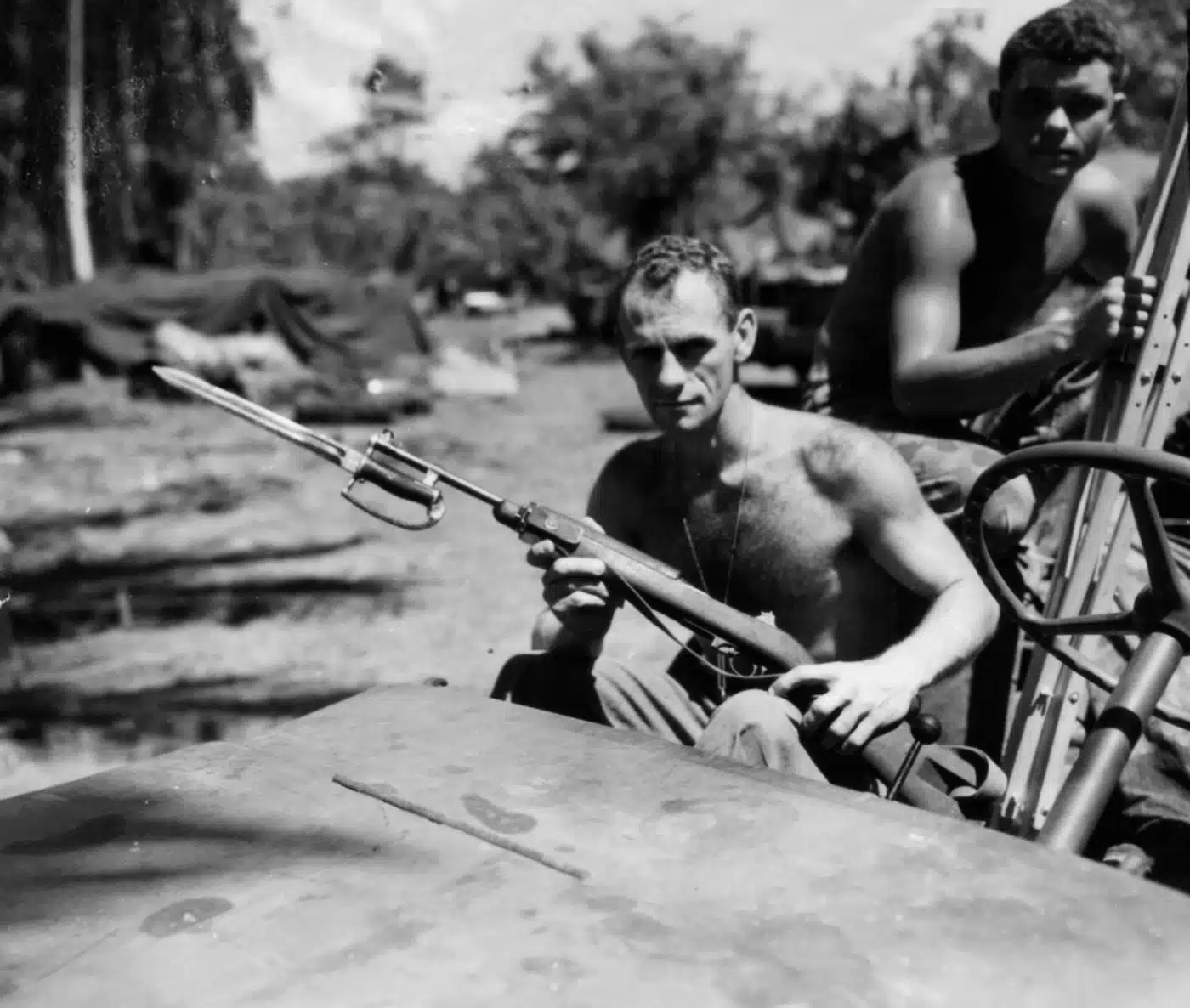
Consequently, as the Carbine quickly made its way from its intended role as a weapon for officers and specialist troops (like artillerymen, tankers, and paratroops) into the hands of the long-suffering infantrymen, the G.I.’s penchant for customization created some interesting field modifications for their new favorite rifle.
They had plenty of opportunities — there were 6.1 million carbines made during World War II, and they were issued in every combat theatre.
Bayonets
M1 Carbines equipped with a bayonet lug did not appear until the final weeks of the war, but that doesn’t mean that American troops weren’t creating their own bayonets for the Carbine in the field.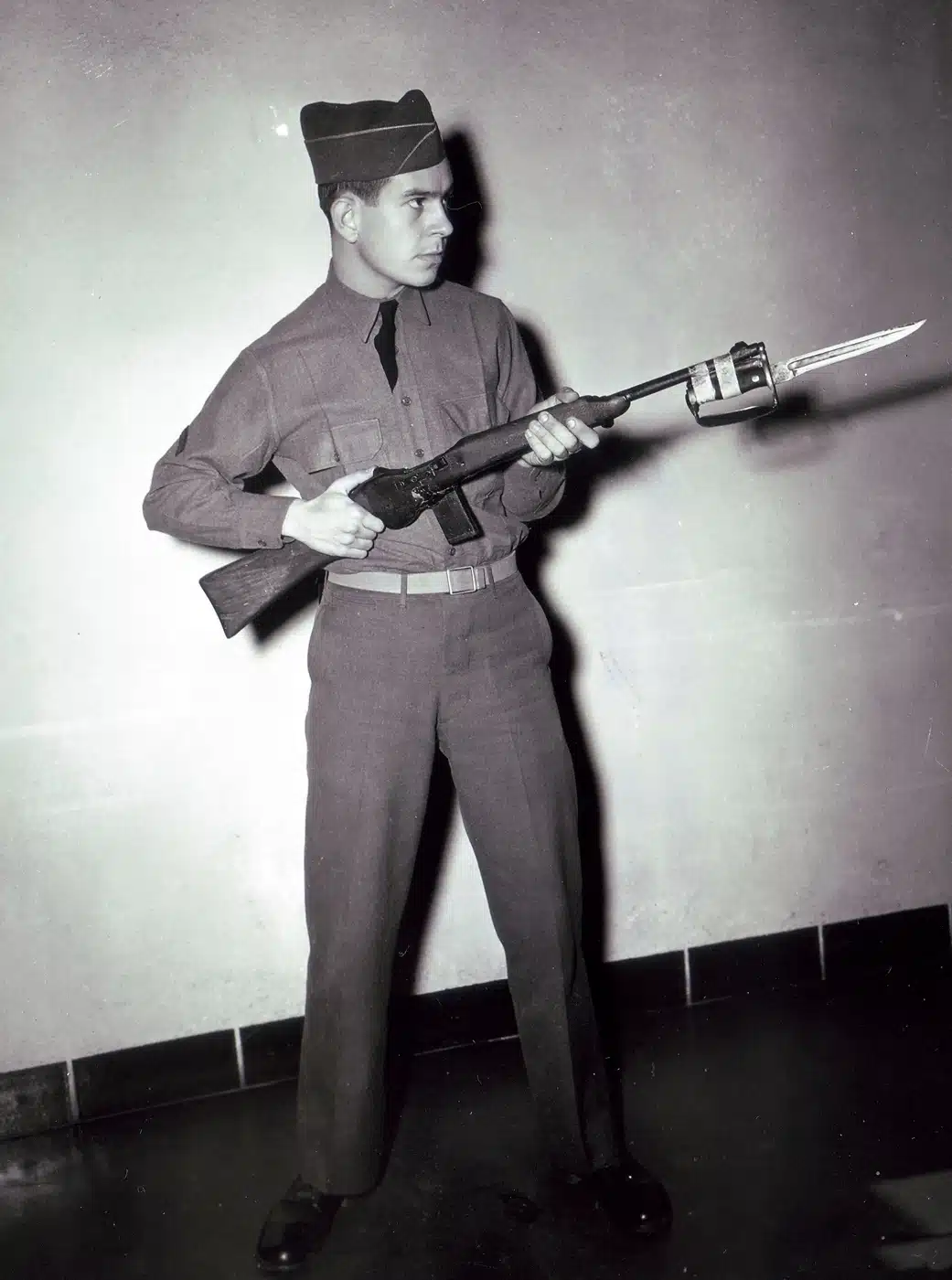
Ultimately, the M3 fighting knife was transformed into the M4 bayonet for use on the M1 Carbine. The official design appears to follow along with improvised bayonets created in the field.
Flash Hiders
During the war, the T23 (later designated M3) flash hider was developed for use with the M3 Carbine and its infrared sniperscope. Only a handful of the M3 Carbines saw service by the war’s end, and consequently few of the M3 flash hiders were in use until the Korean War.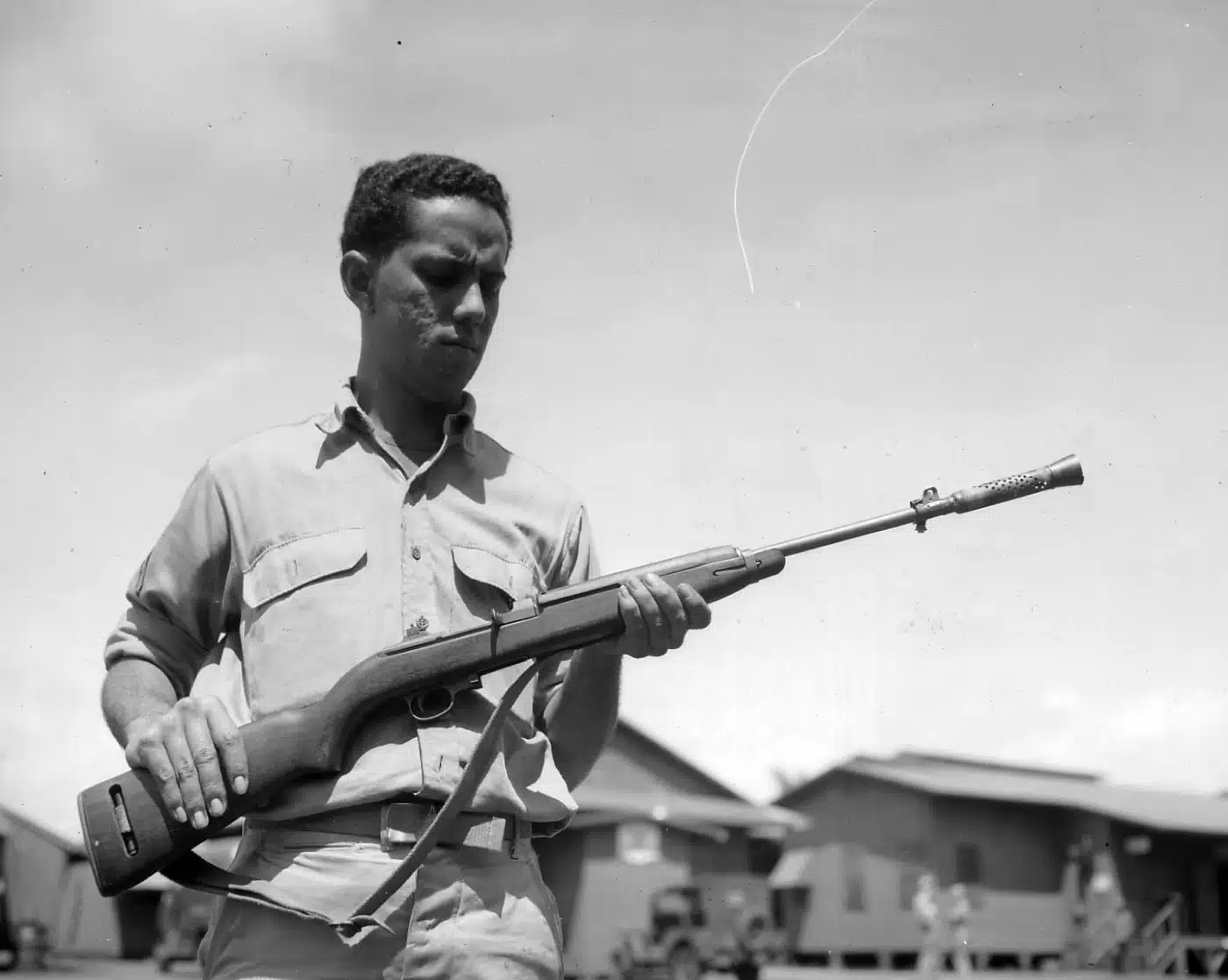
Even so, I managed to find a pair of photos of a field-made flash hider from an Army unit in the Philippines. Different units experimented with flash hider/compensator combinations for their carbines, the flash hider for use in close-quarters night fighting, and the compensator for Carbines field-modified for fully automatic fire.
The Clip Carrier
By late 1944, the twin-magazine “stock pouch” was fitted to many carbines — giving troops quick access to three 15-round magazines without using an ammunition belt. In the spring of 1945, a semi-official “clip carrier” was introduced in small numbers in Germany.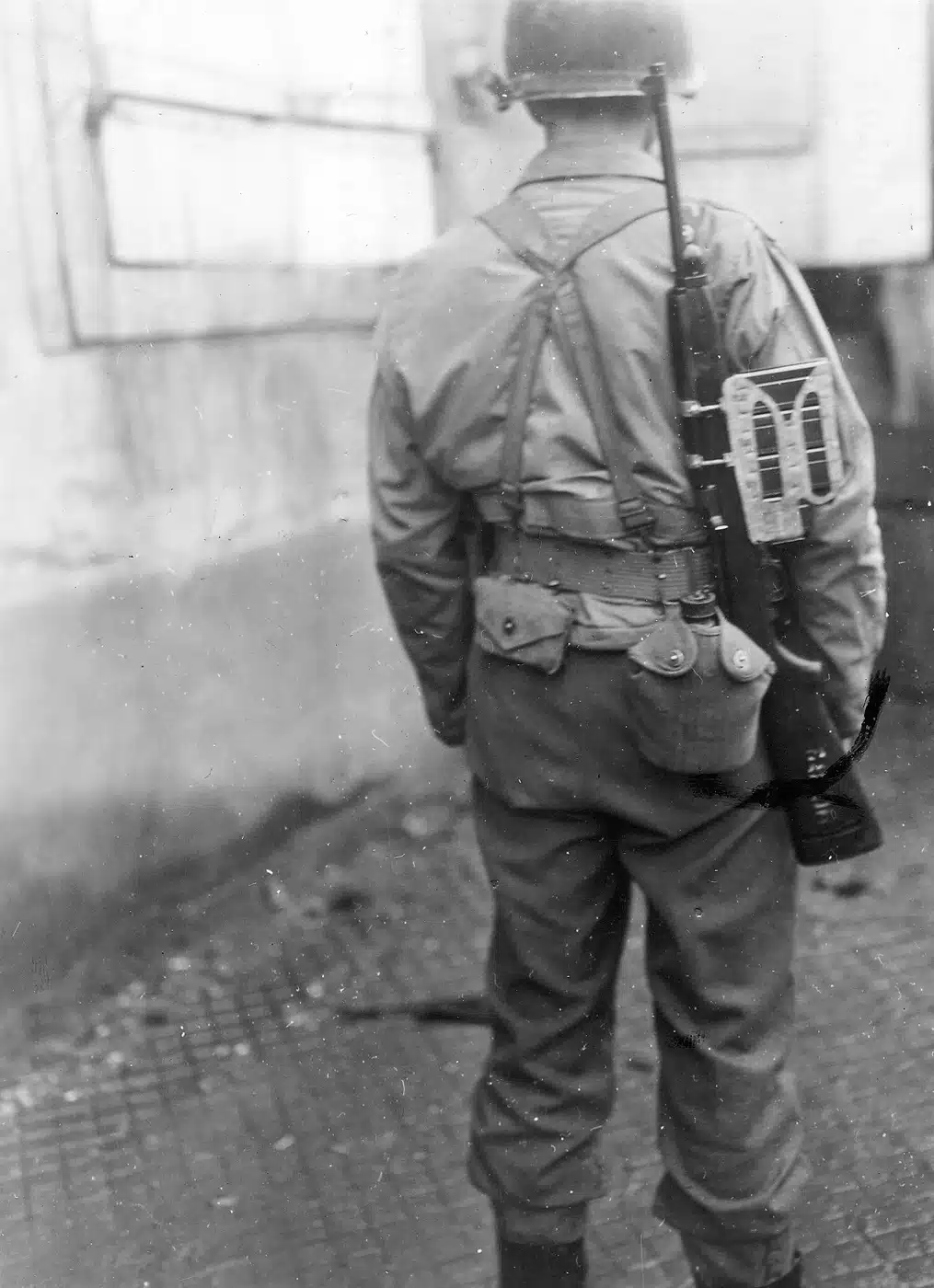
The unusual ammunition clip carrier allowed three additional 15-round magazines to be carried forward of the normal 15-round magazine in the mag-well (60 rounds total).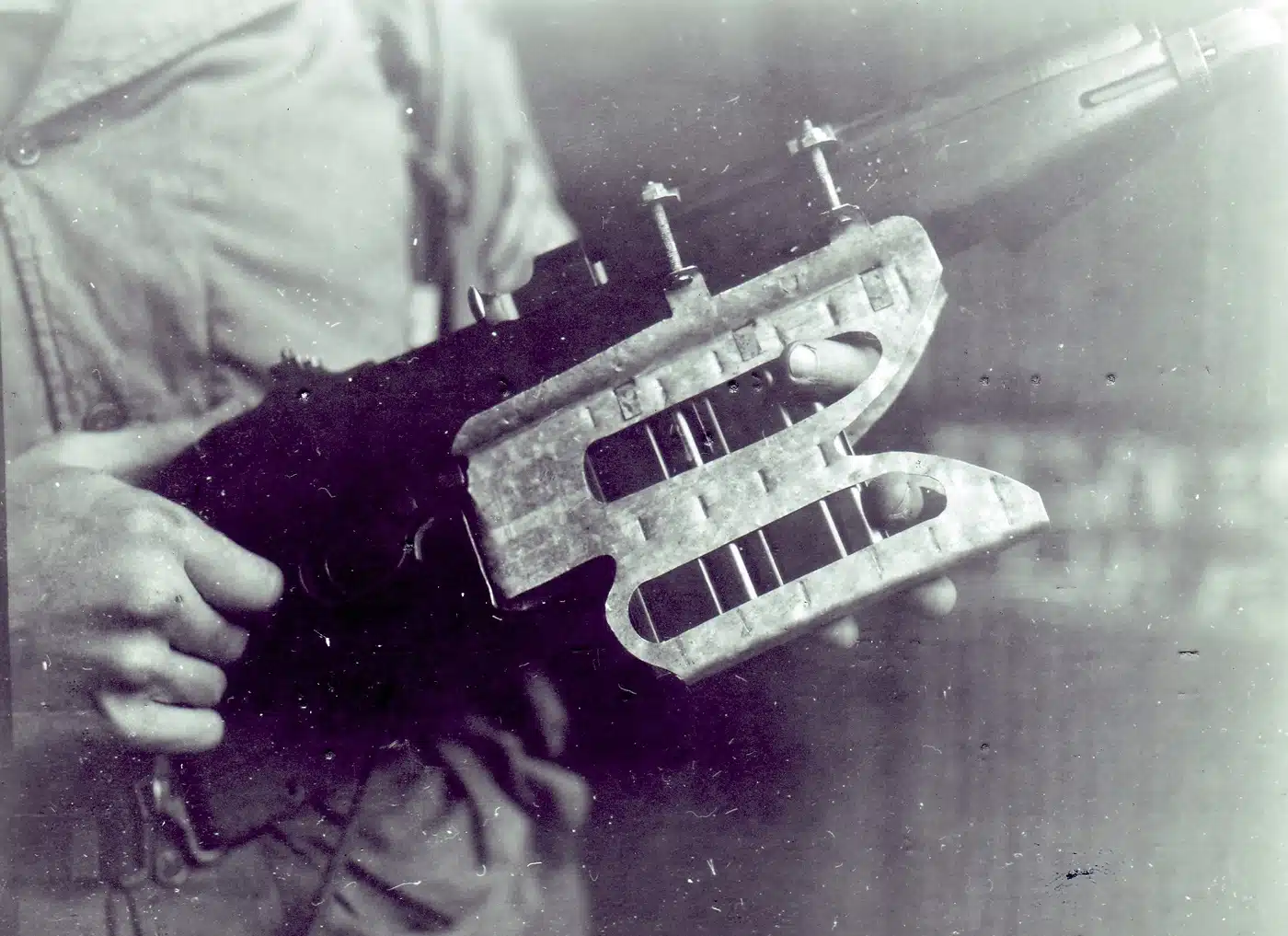
he U.S. War Department’s “Combat Lessons No. 8” describes the device:
This ammunition clip carrier was designed by T/4 Pierce S. Priest, for use with the .30 caliber carbine M1. When the carrier is fully loaded, the exhausted clip is removed in the usual manner and a fresh clip placed in position for insertion by pressure exerted with fingers of the left hand at the front of the carrier. When the carrier is partially loaded, operation is the same except that the fingers of the left hand are inserted at the side of the carrier.
Cut-Down Carbine
Units with access to tools often experimented with converting an M1 Carbine to full-auto fire. Likewise, the already small carbine was sometimes cut down even further to create an oversized pistol, or machine-pistol.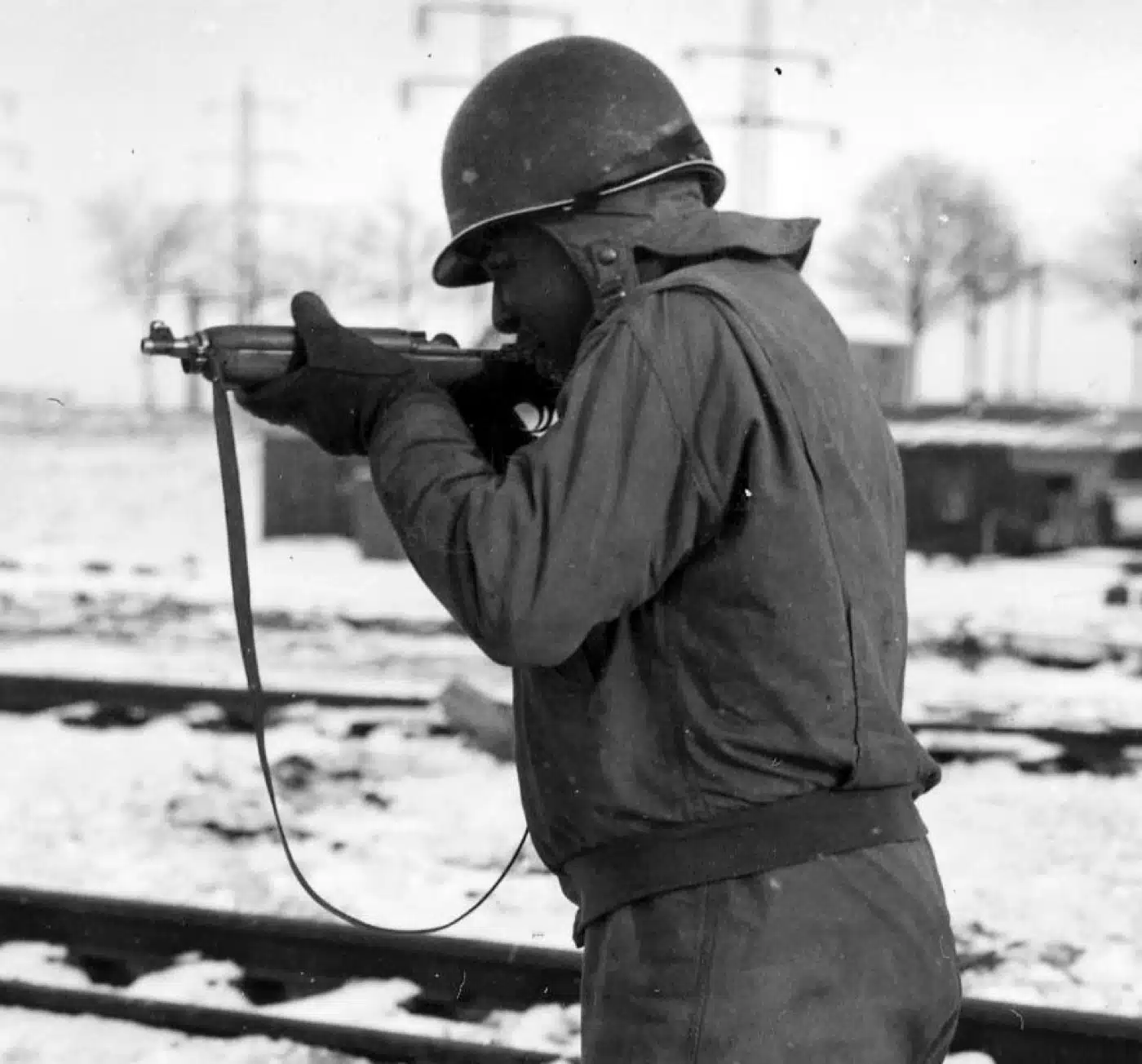
During the 1960s, both Iver Johnson and Universal created commercial variants of the M1 Carbine cut down to pistol length for sale in the USA. It seems likely that the G.I. field modifications were popular enough for postwar manufacturers to “productize” them.
Bandolier-Sling
As a photo researcher, I can tell you that I often find interesting images of firearms modifications or adaptations that ask more questions than they answer. Back in 2006, I published a photo study of the M1 Carbine in action. In that book, I included a couple of photos that showed Marines on Okinawa with a unique sling that doubled as a bandolier for their Carbines. I didn’t say much about it in the captions, as I had no reference to describe specifically what it was.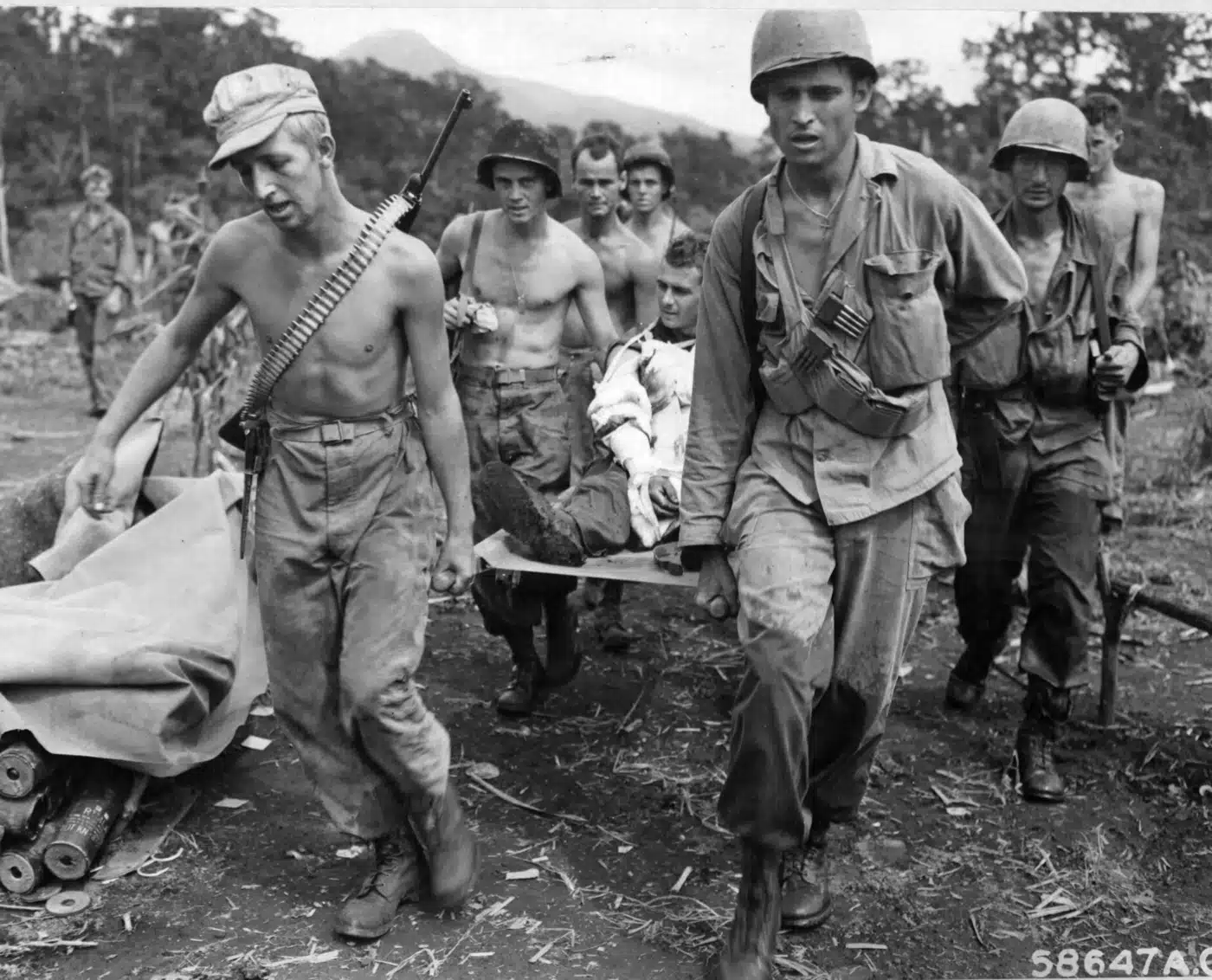
In the summer of that year, I sat down with renowned gun researcher Dolf Goldsmith. Dolf looked at those images, and quickly asked that a box of .30 Carbine cartridges along with the web ammunition belt for a Browning M1917 .30 caliber machine gun be brought to him. With both of those in hand and an M1 Carbine on the table, Dolf broke down the “mystery sling”.
The Marines had used a web ammo belt (for the .30 cal M1917 machine gun), and the .30 Carbine rounds held in there perfectly. The newly made sling did the same job as the standard type, while providing the user with about 30 rounds of loose ammunition. All of the materials were readily available, and the conversion was relatively simple to complete.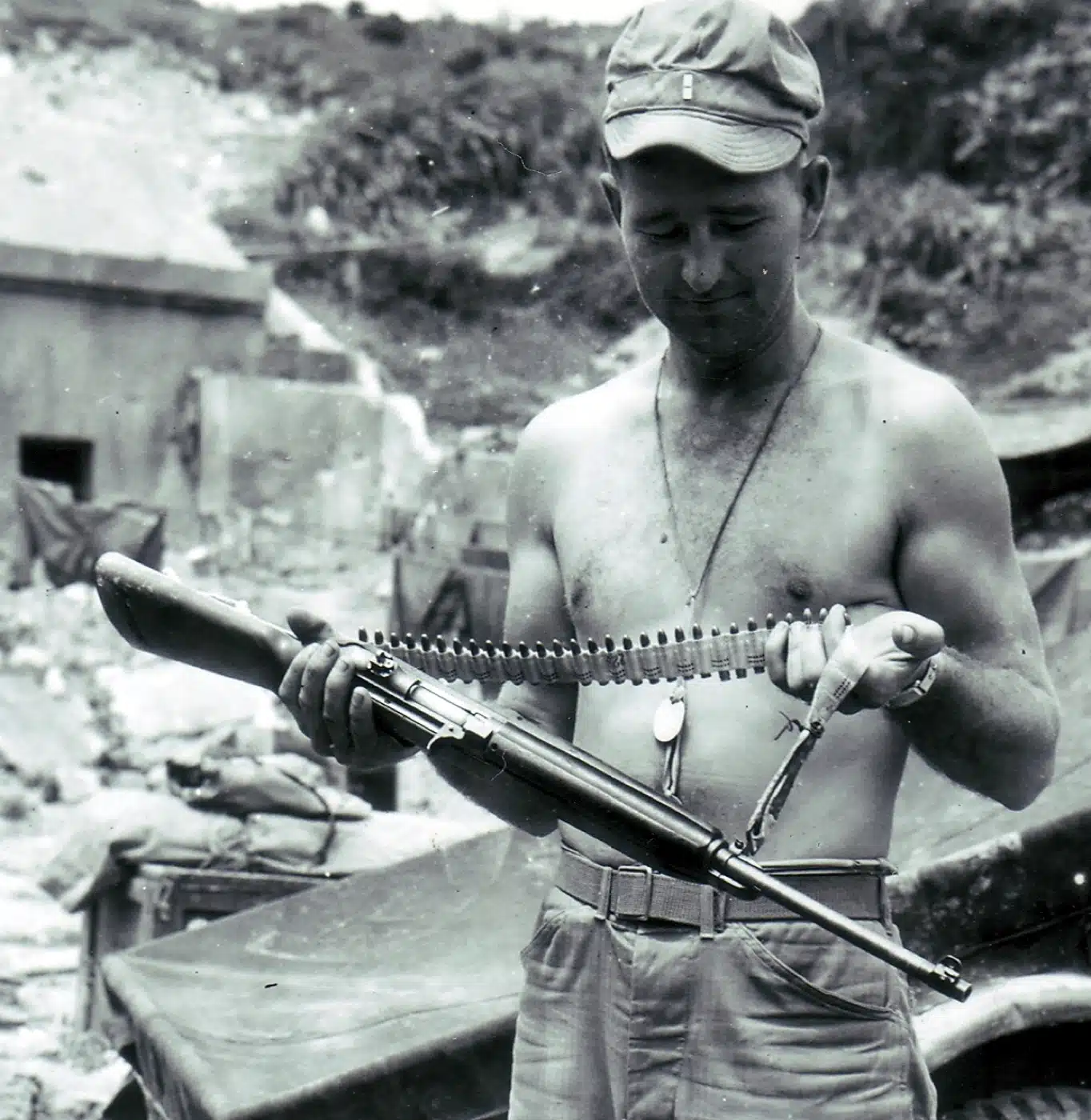
The next expert I talked to took in all the available information, and then shot back some questions that I could not answer. I reviewed the bandolier-sling photos with the leading M1 Carbine expert, the late Larry Ruth. After a little thought, Larry had this to say: “I think you and Dolf have figured out what it is and how it was made. That makes perfect sense. But I wonder why it exists at all?”
Solving the Mystery
Apparently, the bandolier-sling concept intersected with some research that Larry was conducting on M1 Carbine magazines. Then he hit me with another question: “In all your photo research and collecting, have you found any images that show empty carbine magazines laying discarded on the battlefield?” I thought about it a bit and concluded that I had not.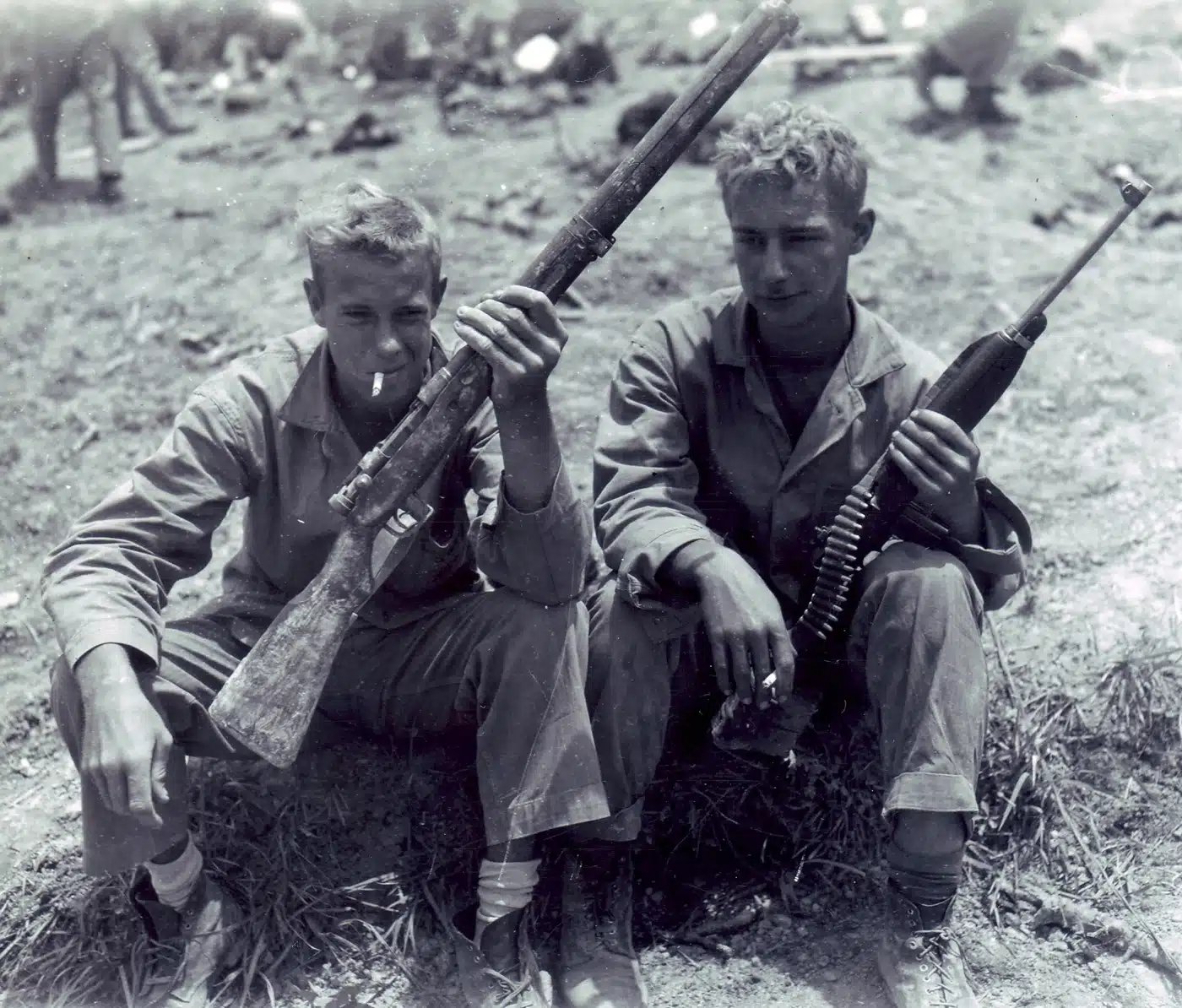
Larry went on to explain that although there were millions of spare magazines made for the Carbine during the war — enough that individual magazines should have been expendable. Even today, you can find examples of 15-round magazines that are still unopened in their factory wraps. Larry went on to say that he had not seen images that showed discarded carbines mags, and furthermore, he had no anecdotal evidence of empty Carbine magazines treated as disposable by Marines, or G.I.s, or anyone. I asked several WWII combat veterans that used the M1 Carbine, and all that any of them could remember was that when a carbine magazine was empty, they put it in their pocket to eventually reload and use it again.
It was the mathematics of production and distribution of M1 Carbine magazines that wasn’t adding up for Larry. The fact that U.S. combat troops went to the time and trouble to create a sling that doubled as an ammunition bandolier (particularly late in the war when production was at its peak) appeared to be a symptom of a U.S. Ordnance problem with distribution.
The concept of a bandolier-sling would never have come up if American combat troops had enough Carbine magazines that they could confidently discard the empties in a firefight. It seems like a minor point, but it was next-level thinking on Larry’s part, and it also showed that American troops could invent tactical-level solutions for strategic-level problems. Also — spoiler alert — we won the war, so it is unlikely that anyone bothered to investigate it after August of 1945.
In the years after, I have found more images of the carbine bandolier-sling, and while all of them are shown on rifles in the Pacific Theater of the war, not all of them were taken by Marines. Army units used the same modification. This modification may have been used in the ETO or MTO, but I have no photographs to prove it.
Conclusion
So there you have it, a round-up of some of the more interesting adaptations applied to the M1 Carbine by troops in the field. Necessity is truly the mother of invention, and Americans have always acquitted themselves well when it comes to creativity in times of need.