Categories
This great Nation & Its People Well I thought it was neat! You have to be kidding, right!?!

Lawn Chair Larry the Amateur Aeronaut By Will Dabbs, MD

As preposterous as this story sounds, every word of it is true.
Lawrence Richard “Larry” Walters had always dreamt of becoming a pilot. He tried to enter flight training with the U.S. Air Force but was thwarted by crappy eyesight.

Larry eventually ended up serving as a cook during the Vietnam War. After his discharge, he took a job as a truck driver. Throughout it all, however, Larry Walters still really wanted to fly.

A Dream Fulfilled

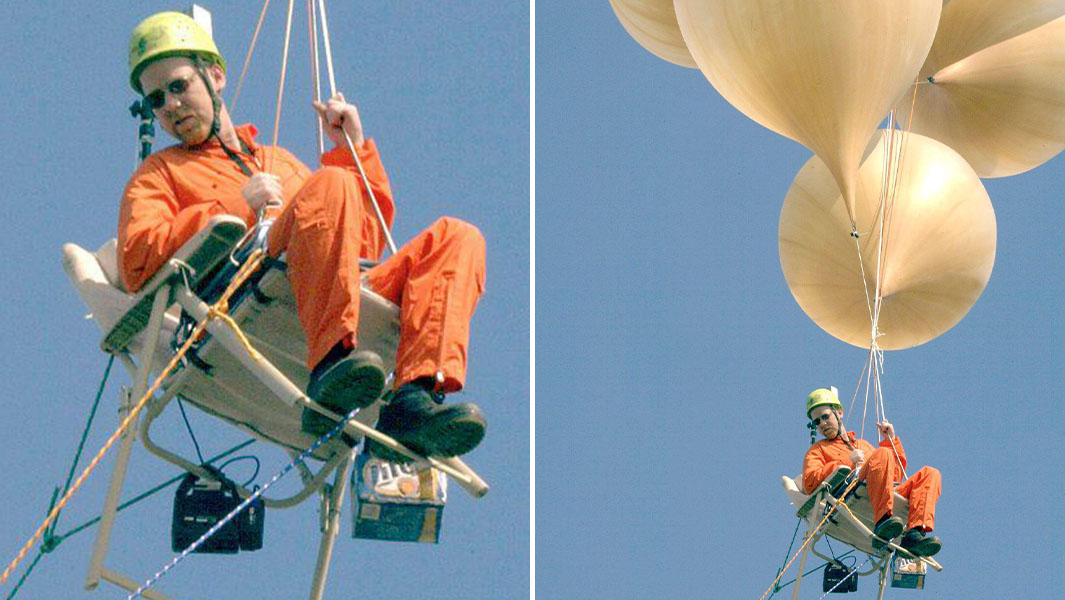
At age 33, Larry purchased 45 weather balloons from a local military surplus store. With the able assistance of his girlfriend, Carol Van Deusen, he lashed 42 of these to a lawn chair and filled them with helium. They assembled this improvised flying machine in Carol’s mother’s backyard. Carol’s mom was obviously away on business or some such.

They had thoroughly schemed out the details. Larry packed a CB radio, two liters of Coca-Cola, a camera, sandwiches, a pellet rifle, and a six-pack of beer. His plan, such as it was, involved using the pellet gun to deflate balloons as needed when it was time to descend. On July 2, 1982, Larry donned a parachute and climbed aboard.

They had secured the rig to the bumper of Larry’s Jeep. However, the lashing unexpectedly broke, and the machine rocketed upward like prunes through a toddler. For good or for ill, Larry Walters was now flying.

Breaker, Breaker…

Realizing things were going pear-shaped fast, Larry fired up his CB radio and contacted REACT (Radio Emergency Associated Communication Teams). This was the monitored CB emergency channel 9 set up to assist motorists in extremis. REACT exchanges were recorded.

REACT: What information do you wish me to tell [the airport] at this time as to your location and your difficulty?

Larry: Ah, the difficulty is, ah, this was an unauthorized balloon launch, and, uh, I know I’m in a federal airspace, and, uh, I’m sure my ground crew has alerted the proper authority. But, uh, just call them and tell them I’m okay.

In a shockingly brief period of time, Larry found himself clinging to a lawn chair 16,000 feet above the ground.

16,000 feet is a heck of a long way up. It’s actually tough to breathe at that altitude. Anything above 10,000 feet is also positively-controlled airspace. Larry eventually drifted past LAX and was spotted by two passing airliners. I can only imagine how that Air Traffic Control conversation went.

Larry Walters' lawn chair.

It’s Time to Do Some of That Pilot Stuff, Mav…

After 45 minutes of this, Larry wisely felt it was time to call it a day. He burst several of the balloons with his pellet gun, taking care not to unbalance things unduly. However, in all the excitement, he also accidentally dropped his pellet rifle. There was just so much he could do to influence his situation with a couple of sandwiches and some beer. Tragically, Larry forgot all about his camera.

Larry’s contraption did eventually descend. He settled across a set of power lines in Long Beach after traversing about 14 miles. His ignominious landing knocked out power to the entire neighborhood for about 20 minutes. Larry, for his part, was miraculously unscathed.

Decisions Have Consequences

The Long Beach Police Department arrested poor Larry as soon as he climbed out of his lawn chair. FAA inspector Neal Savoy stated, “We know he broke some part of the Federal Aviation Act, and as soon as we decide which part it is, some type of charge will be filed. If he had a pilot’s license, we’d suspend that, but he doesn’t.”

Larry was fined $4,000 but appealed. His fine was subsequently reduced to $1,500. I wasn’t there, but I strongly suspect that the judge quietly thought Larry was awesome.

Ten days later, Larry Walters appeared on “Late Night with David Letterman.” He quit his job as a truck driver and began touring as a motivational speaker. However, there wasn’t a great deal of money in that.

The Rest of the Story

I wish our tale ended there, but it doesn’t. Larry eventually broke up with Carol and occupied himself doing volunteer work for the U.S. Forest Service.

He made ends meet as a part-time security guard. On October 6, 1993, Larry Walters tragically took his own life. He was 44 years old. I suppose that, after riding a lawn chair suspended underneath a bunch of weather balloons to an altitude of 16,000 feet, the world had very little left to offer him.

Larry Walters was a stud of the highest order. What stones that must have taken. His battered, electrocuted lawn chair now resides in the National Air and Space Museum in Washington, DC. I hate to admit it, but that guy is my hero.

Categories
All About Guns Allies

Update On My Health

Categories
All About Guns

I Have This Old Gun: Star Model B

Categories
All About Guns You have to be kidding, right!?!

I Have This Old Gun: Woodward .500 Express Double Rifle by American Rifleman Staff

Categories
All About Guns

Gun Of The Week: Heritage Manufacturing 92 by American Rifleman Staff

Categories
Uncategorized

Some wicked ladies for my Grand Readers! NSFW

Categories
You have to be kidding, right!?!

Something to really piss me off!

Categories
All About Guns

An IWA 2018] Tavor Styled Shotgun

Categories
All About Guns War

STORY OF THE RPK-74 By Will Dabbs, MD

The 5.45x39mm RPK-74 was an evolutionary development of Mikhail Kalashnikov’s original 1940’s-vintage AK-47. The earliest AK (Avtomat Kalashnikova) rifle fired the then radically new M43 7.62x39mm round and was built around a stamped steel receiver. This 35″, 7.7-lb. infantry rifle legitimately changed the world.

Belarusian special operations soldier with an RPK-74 participates in Slavic Brotherhood 2018 training located in Russia. The RPK-74 is fitted with a blank firing adaptor. Image: Andrey Rusov/Mil.ru

Alas, those early stamped receivers weren’t quite ready for prime time, so the rifle was redesigned around a heavy and expensive milled version cut from a big chunk of forged steel. This basic rifle soldiered on until 1959 when the stamped steel receiver was finally perfected. This optimized weapon was christened the AKM (Avtomat Kalashnikova Modernizirovanny). Most of what we call AK-47s on this side of the pond today are actually AKMs. (To learn more, read the differences between the AK-47 and the AKM.)

The author’s RPK-74, shown here, is a semi-automatic rifle built from a demilled parts kit and a domestically manufactured receiver.

In 1961, the Soviets debuted the RPK (Ruchnoy Pulemyot Kalashnikova). The RPK fired the same 7.62x39mm round, but it was built around a heavier, more robust stamped receiver. It also sported a longer, beefier barrel, an integral folding bipod, and a curious clubfoot stock. The RPK could use standard 30-round AKM magazines. However, it also accepted longer 40-round versions as well as two different varieties of 75-round drum.

5.45x39mm — Downsizing the RPK

By the 1970s the US military had fully transitioned to the lightweight, high-velocity 5.56x45mm round fired through the M16 rifle, and the Soviets were growing jealous. (Be sure to read about the evolution of the M16.) They tasked Comrade Kalashnikov to build them a new family of weapons around the weirdly adorable 5.45x39mm round.

This Ukrainian soldier engages in live fire training with his RPK-74 prior to deployment in eastern Ukraine. The photo was taken before the Russian invasion. Image: Ukraine Ministry of Defense/CC BY-SA 2.0

The 5.45mm round featured an unnaturally long, skinny bullet and was much lighter and faster than the previous 7.62x39mm M43. By skillfully crafting the FMJ bullets with a small air space under the jacket in the tip, they also created a round that reliably tumbled on impact. This resulted in some truly ghastly effects. Speaking solely for myself, the soft-shooting 5.45x39mm round is a personal fave.

From left to right: the German 7.92x33mm Kurz, the M43 7.62x39mm, the 5.45x39mm, and the American 5.56x45mm.

The end result was the AK-74. This firearm was built around a stamped steel receiver and was specifically designed for the new lighter cartridge. At a glance, the AK-74 can be differentiated from the previous AKM by the less-pronounced curve of the polymer magazine and the curiously complicated, yet effective muzzle brake. The muzzle brake works by redirecting some of the muzzle blast to the sides, and it will reliably clear your sinuses on the range.

Shown here is an RPK-pattern, semi-auto rifle chambered in 7.62x39mm from the author’s personal collection.

Simultaneously with the AK-74, Kalashnikov’s team developed the RPK-74. Like the RPK that preceded it, the RPK-74 was longer and heavier than the parent infantry rifle. It retained the clubfoot stock and folding bipod but dispensed with the complex muzzle brake in favor of a simple birdcage flash suppressor. Though prototypes were produced, there never was a general-issue drum created for the RPK-74.

A member of Ukraine’s military trains with an RPK-74 during Storm 2018. The exercise was combined arms training for repelling an amphibious attack. Image: Ukraine Ministry of Defense/CC BY-SA 2.0

Over time, the wooden furniture was replaced with polymer, but the basic action remained the same. The latest versions of both the AK-74 and the RPK-74 feature side-folding polymer buttstocks. The end result is a mature and effective combat weapon.

Custom RPK-74 Semi-Automatic Rifle

Obtaining a semi-auto RPK-74 of your own requires diligence, persistence, a little mechanical aptitude, and no small amount of cash. A negligible number of factory guns were imported back in the Dark Ages before the various import bans took effect, but they are insanely expensive. As a result, I built mine up from a demilled parts kit.

Though longer, heavier, and bulkier than the AK-74 rifle that inspired it, the RPK-74 is an efficient SAW (Squad Automatic Weapon). The author’s semi-auto version is shown here.

Accumulating all the necessary parts for such an exotic rifle is still a Gordian chore. I bought most of mine from a guy who had been trying to build up an RPK-74 and gave up. The original barrel dates to before the 2005 import ban, as do most of the parts. That makes them expensive. The stripped semi-auto receiver and fire control components were domestically produced as were a handful of other bits needed to keep the build legal. The few small parts that were missing, I had a machinist buddy make for me.

Ukrainian Territorial Defense Forces train with American soldiers in 2016. A reservist in the foreground is armed with an RPK-74. A BMP-2 provides support in the background. Image: Capt. Scott Kuhn/U.S. Army

Building up an AK from parts isn’t plug-and-play as might be the same chore for an AR. You have to be able to run a drill press, set rivets, and gauge headspace. I have built a couple of AKs myself at home by hand. However, given what these RPK-74 parts cost, I got an experienced buddy to build this one for me.

With the right tools, you can bodge together a Kalashnikov like this one in an afternoon. In this case, the real challenge was really sourcing the parts. If you’re interested, just haunt GunBroker and expect to pay a decent price for the stuff you need. The end result, while certainly not cheap, will reliably set you apart at the range.

In this 2017 photograph, a Russian soldier of the 29th Guards Rocket Vitebsk Division aims his RPK-74. Image: Svetlana Dzhabbarova/Mil.ru

The big honking 45-round box magazine is undeniably awkward, but it lasts a while. It is also interchangeable with the standard 30-round rifle mag. Feeding the rifle involves hooking the front lip of the magazine and then rocking it in place. This chore is indeed a bit slower than the same task on your favorite M4, but it does make it easier to seat a full mag with the bolt closed. As the bolt on the RPK-74 does not lock to the rear on the last round fired, this is a potentially big deal.

Members of the U.S. Army 3rd Infantry Division train with Ukrainian soldiers near Yavorik, Ukraine in 2016. This soldier has an RPK-74. Image: Capt. Scott Kuhn/U.S. Army

The trigger is long and creepy, but all AK triggers are long and creepy. Unlike the sights on the standard rifle, the rear sight on the RPK-74 is easily adjustable for both windage and elevation without tools. There is also a Combloc-standard optics rail riveted to the left side of the receiver.

In the hands of the author, you can see that the RPK-74 is equipped with a folding bipod and is longer than an AK-74 rifle. The RPK-74 can use standard AK-74 magazines.

The combination of the heavy rifle and the lightweight cartridge makes the overall system almost unnaturally stable and controllable. The 5.45x39mm round does not fare well at extreme ranges, particular in wind. However, when launched in quantity from a stable platform like the RPK-74, recent history has shown it to be plenty powerful to do the deed.

Is the RPK-74 the Best Squad Automatic Weapon?

The original 1961-vintage RPK was developed to replace the RPD LMG, a superb belt-fed machine gun developed during WWII. The RPD has much to commend it. On the surface at least, this seems a step backwards. However, I have a lot of trigger time on both, and the RPK is the better SAW (Squad Automatic Weapon).

Here, a Russian soldier is seen with a RPK-74. The photo was taken in July 2023 at an unknown location. Image: Mil.ru

Quicker to load, more tolerant of dirt, and generally easier to maintain, the RPK is the more efficient battlefield tool. The RPK doesn’t have an interchangeable barrel, but neither does the RPD. The RPK-74 is everything the previous RPK is, only half a pound lighter and more readily managed. The RPK-74 is indeed a shockingly solid SAW in my opinion.

Categories
All About Guns

WYOMING EYE CANDY – 1885 Winchester