

Month: December 2025
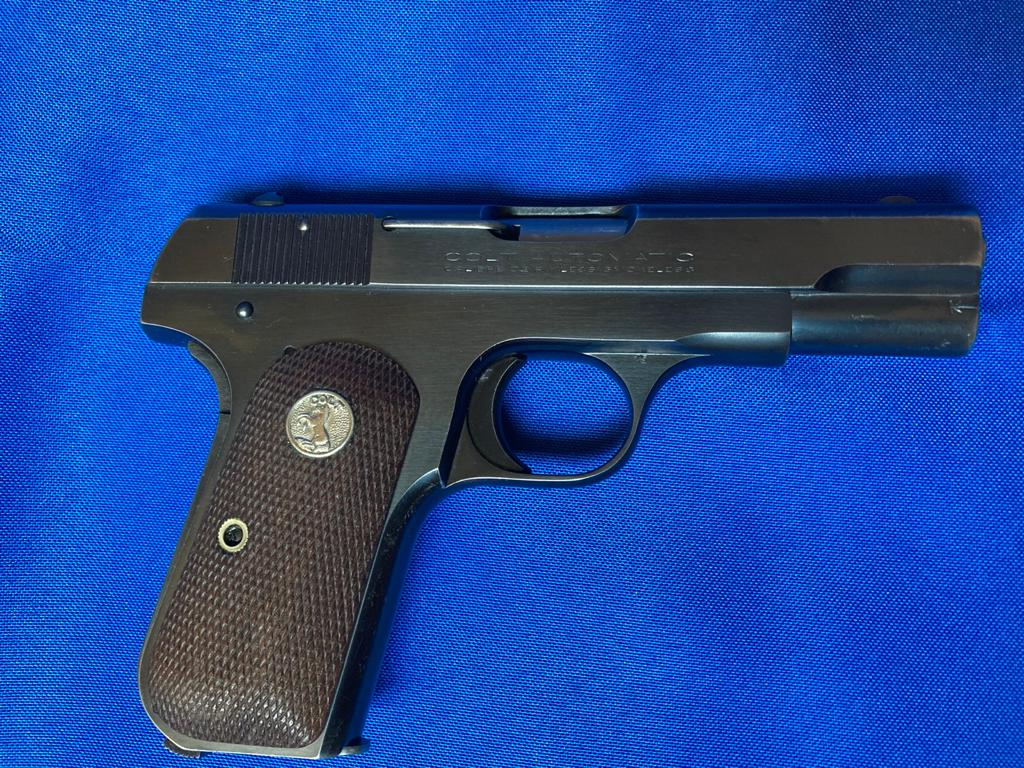
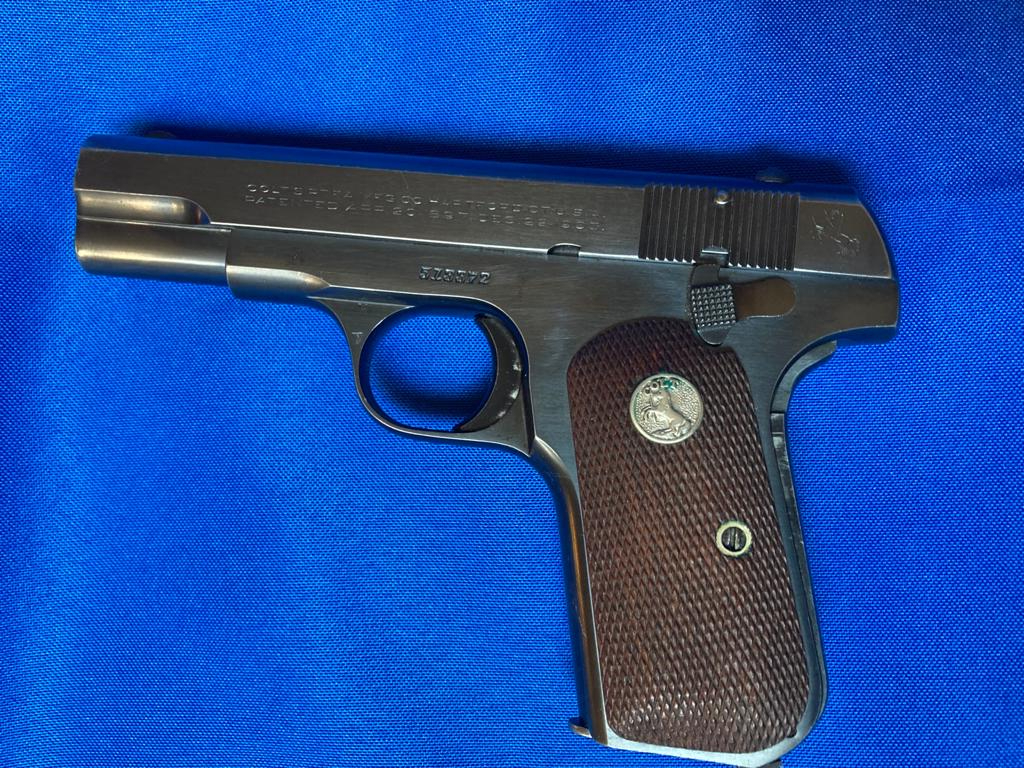
Its a Colt Model 1903 Pocket Hammerless in caliber 32 ACP Pistol / .32 Auto (7.65 Browning)

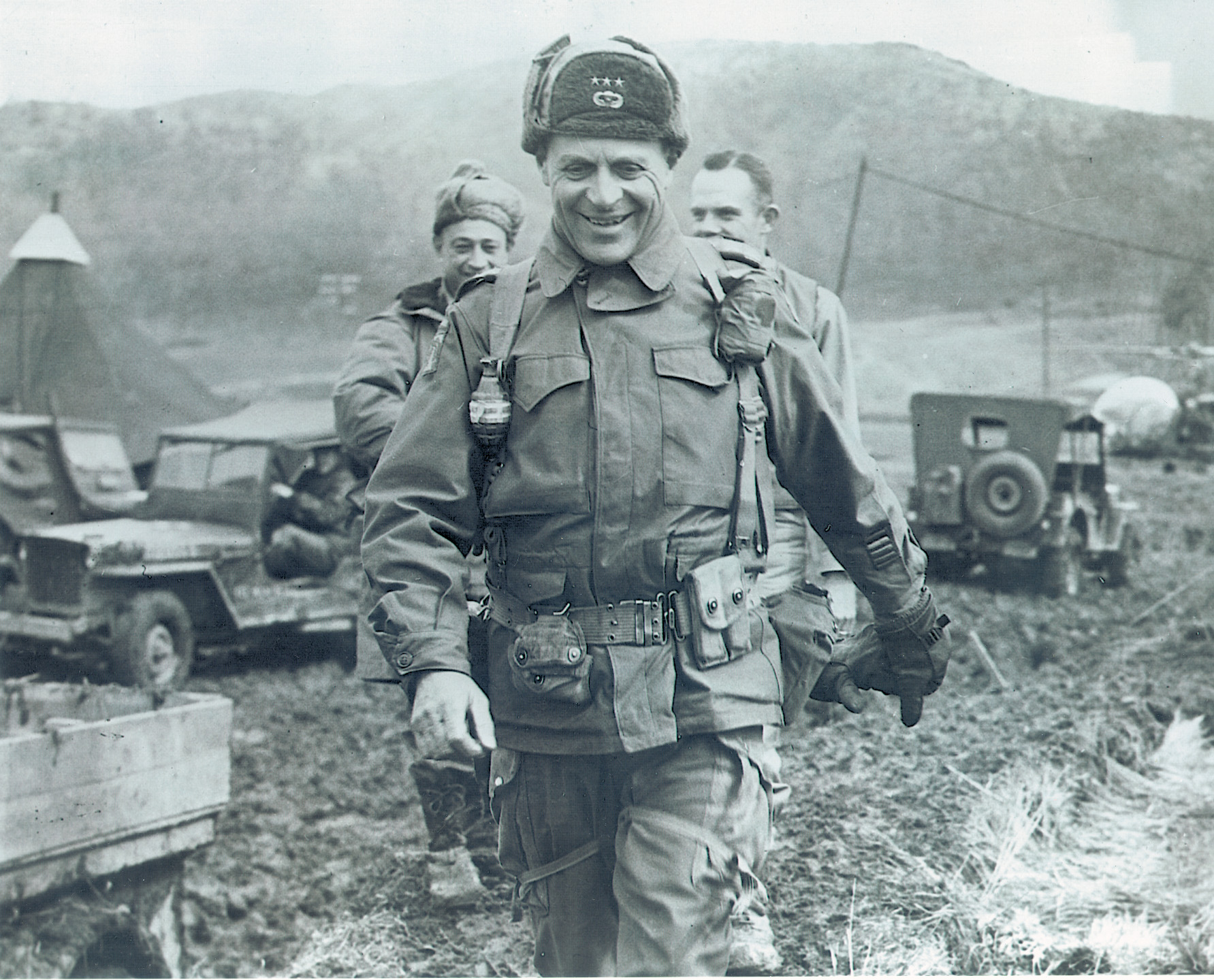 Matthew B. Ridgway stepped into a freezing Korean command bunker in January 1951, looked at a wall map covered in retreat arrows, and made a decision that stunned every officer in the room. The United Nations forces were outnumbered, outmaneuvered, and collapsing, yet Ridgway calmly said the collapse would end tonight. Then he clipped a grenade to his chest harness and walked toward the front.
When he took command of the Eighth Army, morale was broken and casualties were rising.
Officers whispered that the war was already lost.
Ridgway refused to accept it.
He visited wounded soldiers at field stations and asked what went wrong.
They told him leadership had vanished from the battlefield.
He promised to fix it.And he did it the only way he believed in: by showing up under fire.
Ridgeway traveled to front line foxholes where temperatures dropped below zero and Chinese forces attacked at night with overwhelming numbers.
He carried no illusions.He carried grenades, a Bible, and the belief that soldiers follow example, not slogans.
Men said the sound of his boots in the snow changed entire units.If Ridgway appeared at dawn, it meant the line would hold.
He reorganized divisions, replaced timid commanders, and restored the offensive mindset.
When the Chinese launched their Fourth Phase Offensive in early 1951, Ridgway countered with precision.
He ordered tactical withdrawals to stretch enemy supply lines, then struck with concentrated artillery and air power.
His decisions stabilized the front and forced Chinese forces back north, reversing weeks of panic.
President Harry Truman took notice.When General Douglas MacArthur openly challenged civilian authority, Truman relieved him and appointed Ridgway to command United Nations forces.Ridgway accepted without theatrics.
He viewed the job as duty, not spotlight.
Under his leadership, defensive collapse turned into a balanced stalemate that prevented a wider war and saved thousands of lives.
He refused pressure to escalate into China because he understood the cost.
He believed in victory, but never in reckless victory.
After Korea, Ridgway became Army Chief of Staff in 1953, where he argued against expanding conflicts without clear purpose.
He kept a framed note in his office.It read: “No soldier’s life is expendable. No mission justifies waste.”
Matthew B. Ridgway never chased headlines.He chased responsibility.
He took broken armies, broken plans, and broken morale and rebuilt them with presence, clarity, and courage.
Some generals win battles with strategy.
Ridgway won them by showing up where a commander was least expected and most needed.

At least 33 countries produced AK rifles, but none of them had an origin history as strange as Yugoslavian AKs. Some say that Zastava is the best license-produced Kalashnikovs ever, but the truth is – Yugo AKs were not “license-produced”. Those guns had their own unique path that we will explore in this series of articles.
AK History @ TFB:
- AKs from Finland. Part 4: RK 95, The Last of the Clan
- Egyptian AKs (Misr, Maadi). Part 2: Quality, Problems and Modernization Projects
- East Germany AKs – The Best In The World? Part 3: Less Known Variants
- Hungarian AKs (Part 4): From Wonderfully Weird to Plain and Reliable
After the WW2, Yugoslavia found itself in a very peculiar political situation. Technically, it was a socialist country, but the leader, Iosif Broz Tito was too smart to follow in the footsteps of the Soviet Union and outsource all major political decisions to Moscow.
Stalin did not tolerate this kind of independent thinking, and the “brotherly” relationship turned into burning hatred between the two political regimes. The Soviet press called Tito the “bloody dog”, and all Soviet advisors left Yugoslavia. Stalin demanded that Tito must repent for his deadly sin of insubordination.
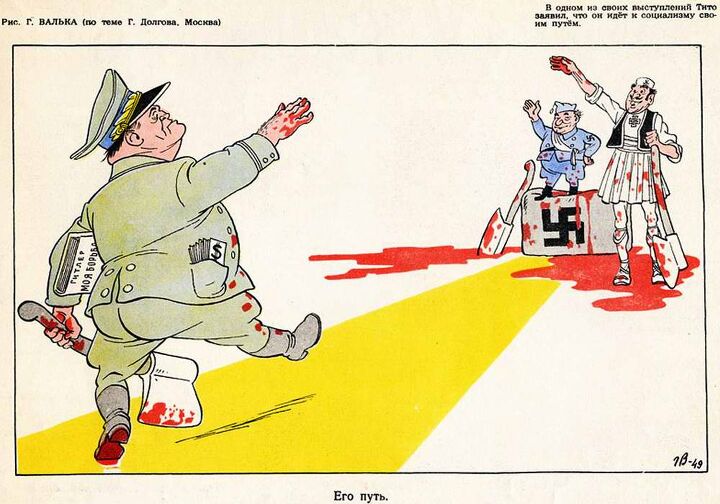 Soviet propaganda depicted Tito as a bloody fascist. The caption reads “His way”.
In 1944, Red Army helped Yugoslav partisans to liberate their country from Nazi invaders, and in 1948, just four years later, the same Soviet generals were drafting up plans for the Soviet invasion of Yugoslavia.
In this situation, Yugoslavia could not possibly expect to receive a transfer of technology for weapon manufacturing from the USSR. At the same time, it remained to be a socialist country, so Western powers weren’t eager to help it with the creation of manufacturing capabilities. Yugoslavia was preparing to repel invasion from both NATO and the Soviet Union and had to build its own defense industry with minimal reliance on outside help.
Right after the war, Yugoslavia factories still produced bolt-action Mauser 98 rifles, but Yugoslavian weapons design engineers understood that the times had changed. In the early 50s, they analyzed the German STG 44 and began research to develop their own intermediate-caliber assault rifle.
 Two main service rifles of the Yugoslavian Army before AK: Mauser 98 and locally made SKS
In 1959, two Albanian border guards escaped to Yugoslavia. They had two newly issued Soviet-made AK rifles, which ended up at the Zastava factory in Kraguevac, the city in Central Serbia with the oldest and most well-known Serbian weapon factory.
Engineers analyzed the Soviet rifles and came up with the ambitious concept called FAZ (Familija Automatika Zastava) – the family of automatic weapons from Zastava. Coincidentally, Mihail Kalashnikov was working on the same idea at the same time, just 2000 miles away.
The development of the FAZ concept was a team effort: Božidar Blagojević (later on he developed a pistol called CZ99), major Miloš Ostojić, Miodrag Lukovac, Milutin Milivojević, Milan Ćirić, Stevan Tomašević, Predrag Mirčić, and Mika Mudrić.
 First Yugoslavian AKs – early M64 prototypes. Credit: Oleg Valetsky
Initially, they studied the system and copied some parts using sulfur castings. However, the two guns did not give the factory enough information about the tolerances of every part. They needed more AKs, and the solution came from an unexpected source.
Iosif Broz Tito was visiting one of the African countries and made a deal with local statesmen. Yugoslavia secretly bought 2000 AK rifles from the batch of guns sent as military aid by the Soviet Union to this particular African state.
The first Zastava AK – M64
 Zastava M64. Credit: Oleg Valetsky
The first prototype the factory created was designated M64. The letter “A” was used for guns with fixed wooden stock and the letter “B” for guns with a folding stock. Later on, the naming system changed. Early prototypes had rear sight on the receiver cover, but later on, engineers decided that conventional AK rear sight would do well enough.
Even at this very early stage, engineers wanted to use as many existing parts as possible, so M64 had a hollow cylindrical charging handle taken from the M59, the Yugoslavian version of SKS. The folding stock version called M64B uses mass-produced under folding stock from the M56 submachine gun.
From the beginning, Yugoslavian AKs were designed to be used with rifle grenades and had grenade sights and shut-off mechanisms for the gas system.
Zastava engineers also developed an M65A light machine gun with a quick-detach barrel that never went into mass production.
 Zastava M65A LMG prototypes. Credit: Oleg Valetsky
The guns were ready, but the Yugoslav generals were not. Some brass still thought that giving every soldier an automatic weapon was excessive. They changed their mind after 1968, when during the invasion of Czechoslovakia every Soviet soldier wielded an AK of some sort.
Yugoslavian Ministry of Defense began a discussion about the procurement of AKs for special forces from the Soviet Union since the relations became much better in the 60s. Zastava engineers were not happy. They developed an innovative rifle with additional capabilities and generals wanted to import guns from a recent geopolitical rival.
Common sense prevailed, and the Military-Technical Institute of Belgrade prepared technical documentation for the production of new rifles. However, the first mass-produced Yugoslavian AKs were different from the M64 prototypes. We will talk about it in part 2 of this article.


Dieudonné Saive is best known for finishing John Moses Browning’s High Power pistol and the famed FAL rifle. He piggy-backed on the Browning M1905 and created his own smaller version, shaving off 4 ounces and a half an inch in length.

The Browning-designed Colt 1908 Vest Pocket and FN 1906 were designed to fit in a man’s vest pocket, allowing shop owners and well-dressed people to conceal a gun without adding bulk. Browning designed the pistol for the .25 ACP round, which gained popularity worldwide as one of the first automatic cartridges.
While FN produced the M1905 under license, Saive further refined the pistol after Browning’s death in 1926 to make the design smaller and lighter. He eliminated the grip safety (ahead of his time, some would say) and extended the safety lever so that it could be actuated more easily by right-handed shooters.

He also lengthened the dust cover to match the barrel and slide, performed a slight undercut for the trigger guard, and kept the magazine disconnect safety that was present on the M1905. The updated pistol was officially released in 1931.
The Baby Browning
With the redesign and smaller stature, the gun took on the moniker of “Baby Browning,” with FN logos on the hardened plastic grips and “Baby” encircled logos under the raised portion of the grips. After 1960, the grips were polymer and simply said “Browning” at the top. This model is from the Guns.com Certified Used section and was made sometime after 1960.


While FN produced about 550,000 of these tiny pocket rockets, other versions also exist. FN-licensed versions were made in Canada initially and transitioned to the States after. Clones exist across the world and some are still made today by Precision Small Arms.
Today’s world is all about capacity and slimness for carry, but the early part of the 1900s focused more on tiny, snag-free concealable options.
Features
These guns are quite unlike guns made today, though many features are still in use. As with the Colt 1903, there is no slide lock, which helps with concealability and less parts breakage. The trigger is objectively heavy at 5.1 pounds after some take-up, which is not uncommon for a pocket pistol. There’s a safety lever on the left side of the gun, just behind the trigger. If you forget that, the next safety is the trigger heft.


The gun features rather crude, small, fixed sights that are more like nubs. The point of this gun was self-defense and extremely close use, so I don’t imagine many people have ever shot these at distance or used precision aiming in an actual fight.

The rear of the slide includes tactile, good-looking diagonal serrations in line with the grip angle. The slide is somewhat heavy and can be finicky when trying to rack it. There is no slide lock, so cleaning and clearing can be a little difficult. I was surprised at how far the slide travels versus the size of the round. I watched some videos on this and noticed the slide cycles incredibly fast. Most of its snappiness is due to not being able to grip it perfectly.

The most problematic feature for me is the mag release. It is the same mechanism as the 1903 and 1908 pistols, but due to its small size, I found it hard to actuate. There’s no spring release, either, so once you move the small, serrated button to the rear, you need to hold it there while the magazine is pulled out.
Specs
The 90-year-old Baby Browning was surprisingly modern for its time. Despite its small stature, the design is still used in many arms today. The gun is a semi-automatic, striker-fired, blowback design. It has a cocked striker indicator and a magazine safety. Stop me if you’ve heard this before, but what were major innovations back then tend to be points of consternation today. Still, you must appreciate the utility, especially for the use case of this pistol.

These guns are beautifully machined, as was the case for most manufacturing of the day. This model is especially smooth and reminds me of the finish on my 1936 Walther PPK and 1931 Colt Pocket Hammerless.
While both of those guns are highly concealable, you can see in the photos just how small the Baby Browning is. It’s able to fit in a pocket without creating much bulge. The roll marks are deep and clean. Overall, this tiny pistol is plain, yet quite elegant.

What I love about this pistol (and many old firearms) is the lines. It is a nice mix of straight lines and graceful curves, with rounded edges perfect for concealment. One thing I’ve always appreciated is the lack of any sharp corners. It’s a classy gun.


The ergonomics, however, are not great. I can’t overstate this, but the gun is tiny. It looks proportional in my 5-year-old’s hands, but smaller than most toys in mine. I can get a decent grip on it in theory, but the webbing of my hand and the top of my thumb would seem to impede the slide travel.
At best, I’d expect some major slide bite. The gun is typically fired one-handed, and I doubt many did any training with it before throwing it in their pocket just to have “something” to fight back with when necessary.

Here’s a quick list of basic specs:
- Weight: 9.7 ounces
- Height: 2.75 inches
- Overall Length: 4 inches
- Barrel Length: 2.75 inches
- Width: .75 inches
- Trigger Pull: 5+ pounds
- Action: Single action
- Finish: Blued steel with plastic grips
Cool points
Some special operators in the early days of the Vietnam War were known to carry these little pistols in a wallet holster as a last-resort weapon. It could be suppressed as well. The .25 ACP does not pack much of a punch, though it does have decent velocity and it’s still a bullet.

Rather than adding another large sidearm to the kit, it was tucked away within these unassuming holsters. Coincidentally, these recon soldiers preferred another Browning/Saive creation: the Hi Power, due to its 9mm round and capacity of 13 rounds.

Another fun note is that the Baby Browning was no longer imported due to it being “too small,” much like the Walther PPK. FN did not make it bigger the way that Walther created the PPK/S. So, if you do find pre-68 models, they typically won’t have the gaudy import markings. This leaves the steel much more sterile and beautiful, in my opinion.
In Closing

The Baby Browning was a sign of its times. It’s a beautifully designed and purpose-built firearm. It may be out of place in the modern age, but historical firearms are always interesting. The design and finish is a marvel to behold. If you need an excuse, I know many people have a mailbox gun, and this could almost completely fit in your coffee mug.
Categories