Month: November 2025
Categories
I miss mine!
.jpg)
I never thought something like this would happen to me. This was truly my nightmare, even though I thought I was prepared for something like this. Even as reddish flames were visible from my bathroom window, it still seemed absurd to think that my house would burn down.
There’s something particularly ghoulish about a house fire that makes it almost too large to fully process: it’s the immediate elimination of so many memories, the loss of so many physical artifacts that come to define our identity and those of our family members, the erasure of location where we feel safest and most at ease, and an invalidation of decades of hard work to provide for ourselves and others. It’s something so horrible it almost seems like it could happen only to the most unlucky of us.

On the morning of January 8th, I would awake to learn that my home, and everything I owned that did not get packed into a few go bags, would be totally consumed by flames. As readers of this website may surmise, that included several new and vintage firearms, along with the tools, cleaning supplies, and various pieces of equipment dedicated to keeping them fed and running.
Surprisingly, there have been many things to be thankful for in the aftermath of this tragedy. That list is too numerous to detail here, but for the purposes of this article, I’ll reveal one in particular: I did have an insurance policy that covered my firearms, knives, and accessories. As a result, I’m equipped to share some real information with you guys from someone who has navigated the process and learned some lessons along the way.
Step 1: Have a Policy
I’d written previously for The Armory Life that while investing in firearms in the strictest sense of the word might be a questionable proposition, I do strongly believe that guns are an excellent store of value. As that value increases, it begins to make very good sense to protect those assets.

Even if you have a homeowner’s or renter’s insurance policy, there may be a ceiling on the maximum payout of the loss of your firearms (or any esoteric rare collection, like comic books or baseball cards). If you think you’re covered under an existing policy, now is an excellent time to read the fine print carefully to understand what would be covered and what isn’t. You may want a secondary policy that purely covers your firearms and gun accessories.
When in doubt — either as pertains to your current policy or one you’re considering — ask questions. Sending an email to the company or agent is a great way to not only get an answer, but get an answer on record. Are your books, manuals, and holsters covered? Are optics? Is there additional documentation or appraisal required for especially high-value items?

Additionally, set (or adjust) your policy limits a little higher than you think you need. I guarantee you that once you really start adding up how much it would cost to replace absolutely everything you own, you’re going to be fairly alarmed by the number. It’s tempting to set your policy limits at a point where premiums are cheaper, but — and speaking from experience — nobody thinks they’re going to file a claim until they do. And on that day, you’ll definitely be kicking yourself if you’re under-insured.
Step 2: Document What You Own
When my appraiser asked if I had photographs of my collection, I could hardly stop myself from responding with glee. “I would be shocked if you’ve ever received a higher quality collection of photos from another policy holder,” I told her. Being a gunwriter these days means being a gun photographer to boot.
The reality is that every insurance provider has the right to put the full onus on you to prove that you actually owned what you’re claiming is destroyed.

I’m not saying that everyone needs to purchase a DSLR and learn the process of producing print-ready photographs, but I imagine mine did a very good job of communicating the relative condition of my guns and to prove my ownership of them.
At the very least, I recommend taking three pictures of every gun. A shot of the left and right side, in profile, along with a close-up shot of the serial number as legibly as you can take it. Having a bright light source helps, as does a tripod, so that any blur-inducing shake or wobble is minimized. Make sure your photos “read” to communicate the condition and clear stamping of the serial.
These tips helped me document all of my firearms, but in retrospect, I should have done more, and I should have had a better system.

To document all of your other “stuff,” the main risk is that we’re bound to forget quite a lot of what we own if we simply go off memory. Do you know how many bottles of cleaning solution you have, and of what type? Do you know how many rounds of ammo you have? Can you remember what reloading or disassembly manuals were on the shelf?
Here, opening drawers and getting out the cell phone is a great way to go. Take a video, and pan very slowly over what you own, moving objects aside so that every thing being filmed is visible — including the stuff at the bottom of buckets, or at the very back of cabinets. Use a flashlight to illuminate if you have to, but make sure the light source doesn’t blow out the details of labels and boxes.
Step 3: Consider Where Documentation Lives
When the flames are nearly at your doorstep and you’re making decisions about what to save, you will most likely not grab the cardboard box filled with crumpled receipts. For that reason, anything you can digitize is your friend.
For reasons that should be obvious at this point, any physical device this information is stored on is subject to the same environmental factors as any other object that might reside in a burning, flooded, or otherwise destroyed house. A USB stick or hard drive with all of those photos and videos you took is useless if the data is unrecoverable. For that reason, online data storage and backup is a great option. Unless you have a mammoth collection and gobs of video, a lot of it can honestly be saved to a zip file and stored via your email or other storage service.
Here, I realize that some people are leery of storing sensitive information in “the cloud.” While I think the upsides outweigh the drawbacks — some of which can be mitigated by password protection or encryption — others will disagree.
If you do decide to save your documentation solely on physical media, make sure it exists in duplicate and in separate physical sites: have a USB stick live with a trusted relative.
Also keep your data fresh. All digital media degrades over time: ancient floppy disks, CDs, hard drives and even SSD drives can fail over time. Consider periodically updating your storage media to mitigate this risk.

Speaking of digital receipts: I am very much in favor of supporting our local brick-and-mortar shops and retailers. However, I will say that in the same breath, I am very thankful that I also did a good amount of my “gun stuff” and “knife stuff” shopping on sites like Midway USA, Graf and Sons, Dillon Precision, Blade HQ, and Natchez, where it was easy to log into my account and view my purchase history going back several years.
However, even if you normally make a lot of cash purchases for ammo, accessories, and other gear, you may find it useful to utilize an app that stores receipts for you. This will also save the hassle of having to go through “the receipt drawer” to find one entry in particular.
Step 4: Making Spreadsheets
After my house burned down, I battled a spreadsheet for a good six days, off and on, documenting not only the destruction of my serialized firearms, but also the bulk of everything that counted as a “firearm accessory” or “edged weapon” as defined through my insurance policy.

At a minimum, your spreadsheet should contain the item lost, a description of the condition, whether a receipt (digital or print) is available, and a cost estimate. There are a lot of ways to go about this, but the best advice I can give is to stay organized and think systematically. Some may catalog the price paid at time of purchase; others may opt to provide a “replacement cost” along with a link to a retailer selling the item.
With respect to the above, multiple categories of goods and multiple pages are your friends. It’s likely easiest to start with firearms; then take an inventory of optics, then bulky categories of items like safes or reloading equipment. Then, you might get into accessories and spare parts like scope rings, recoil springs, gunsmithing tools, and the like.

Once again, this will require quite a bit of cross-referencing with old credit card statements, online shopping orders, and your own photographs and video. However, remember that the diligence you spend here is time well spent. Additionally, thinking like an insurance adjuster reduces the odds that you two will be on completely different wavelengths, which could delay or reduce the amount of a payout. The clearer you can make things for them, the happier you’ll be with the resolution process.
In Closing
In cases like these, hindsight is 20/20: I should have had a higher limit to my policy, and I should have spent more time documenting what I owned. Still, I can confidently say I wasn’t caught completely flat-footed, and what care I did take in my recordkeeping and photography (deliberately or accidentally) proved to be tremendously beneficial.
Naturally, all of my suggestions above won’t do anything for the heartache of losing your place of comfort and solitude, your numerous heirlooms and memories, and the tethers to a community you may love. They will, however, take a little of the sting out of the administrative headaches that follow a total loss. While I don’t have the ability to rewind the clock and do things over, I certainly do hope some of the above provides at least one of our readers with a spark and an action plan.
100-Year-Old Veteran on Live TV: We Fought WW II for Nothing, Britain Less Free Than in 1945
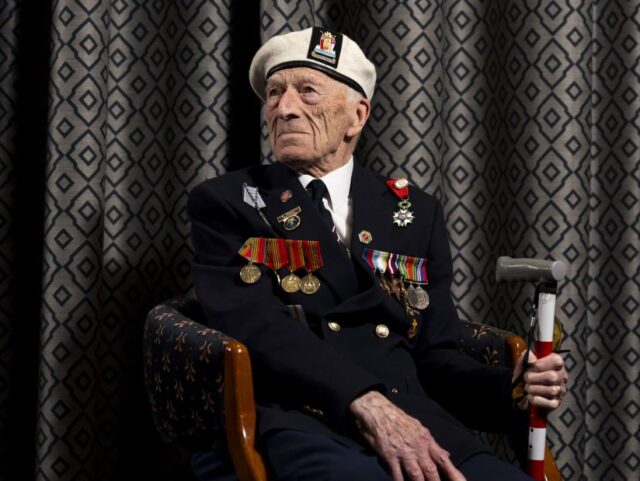
A centenarian Royal Navy veteran took full advantage of an appearance on live television to express his sorrow at the state of modern Britain, saying he and his comrades fought for freedom that has been frittered away, eliciting what critics called a “patronising” response by show hosts.
Royal Navy and Arctic Convoy veteran Alec Penstone told Britain’s ITV breakfast show “the sacrifice wasn’t worth” what the country has since become, mourning the loss of freedom he and his friends fought and died for.
Appearing on Good Morning Britain on Friday for a segment on the upcoming Remembrance Sunday and Armistice Day on November 11th, Penstone was asked what the events commemorating fallen troops from the two World Wars meant, and what his message to the country now is.
Far from the feel-good sentiments the piece had evidently been set up for, 100-year-old Penstone remarked: “I can see in my mind’s eye those rows and rows of white stones.
“All the hundreds of my friends, everybody else, who gave their lives. For what? The country of today. No, I’m sorry, the sacrifice wasn’t worth the result that it is now.”
Comedian Adil Ray, best known for creating Citizen Khan, a BBC comedy about a “British Pakistani” family living in “the capital of British Pakistan” — Birmingham, England — quickly interjected to ask of the veteran: “what do you mean by that, though?”.
Penstone continued: “what we fought for was our freedom. We find that even now, it’s a darn sight worse than what it was when I fought for it”.
Ray’s co-host Kate Garraway, a former journalist and news presenter, placed her hand on Penstone’s shoulder and reassured him that people of her generation did appreciate the sacrifice of the veteran and his friends, before announcing that he was to be presented with a compact-disc of Second World War-era popular music in thanks.
British academic Professor David Betz was among those responding to the turn of events, calling Penstone’s remarks “heartbreaking” and the response from the television hosts “patronising” and “simply infuriating”.
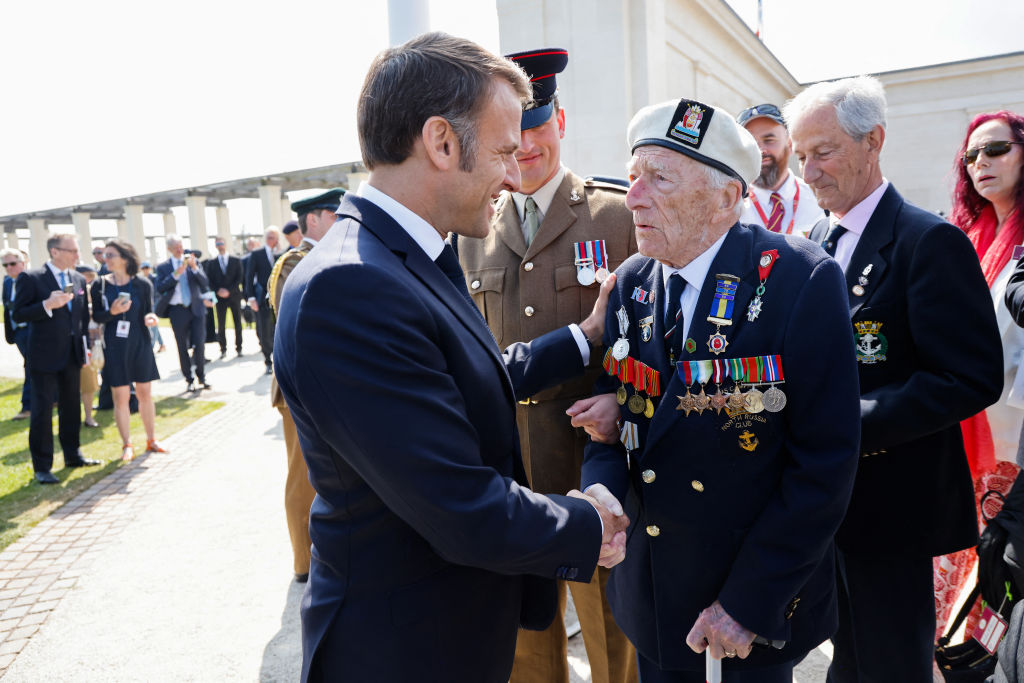
France’s President Emmanuel Macron (L) greets 98-year-old British D-Day veteran Alec Penstone during the UK Ministry of Defence and the Royal British Legion’s commemorative ceremony marking the 80th anniversary of the World War II “D-Day” Allied landings in Normandy France, on June 6, 2024. (Photo by LUDOVIC MARIN/POOL/AFP via Getty Images)
According to a profile by the Royal British Legion, a prominent veterans organisation, Penstone was a young man when the Second World War broke out and initially volunteered as a messenger for the Air Raid Precautions organisation in London during the height of the Blitz.
He said of his time in London during some of the worst bombing of the war: “The moments at 15 years of age, pulling bodies out of bombed buildings you grow up very quickly.”
His father, a veteran of the Great War, made Penstone vow not to serve in an infantry role due to the horrors he’d witnessed in the trenches in the Great War. So he joined the Royal Navy as a submarine-detector, and ended up in one of the most deadly assignments of the Second World War, on the Arctic Convoys. He also served in mine sweeping to clear the sea ready for the D-Day landings, and in the far east, fighting Japan.
The Imperial War Museum states of the Arctic Convoys delivering materiel to the Soviet Union to help them fight Nazi Germany:
Conditions were among the worst faced by any Allied sailors. As well as the Germans, they faced extreme cold, gales and pack ice. The loss rate for ships was higher than any other Allied convoy route.
Over four million tons of supplies were delivered to the Russians. As well as tanks and aircraft, these included less sensational but still vital items like trucks, tractors, telephone wire, railway engines and boots.
While appearing on television today, Mr Penstone was seen wearing the distinctive white beret and badge of the Arctic Convoy Club, a veterans organisation for survivors which disbanded in 2005, given it had so few surviving members.
On his left breast he wore a rack of British medals from his war service including the 1939-45 Star, the Atlantic Star, the Arctic Star, the Pacific Star for service in Burma, and Defence Medal for his service in the ARP.
Separately on a red ribbon, Penstone wore the insignia for a Knight of the Légion d’honneur for role in liberation of France. In 2024, Penstone was personally greeted by French President Emmanuel Macron and thanked for his service.
On his right breast, Penstone wore several Russian Medals including Medal of Ushakov for convoys, and USSR-era convoy medals.
While these are not authorised for wear by Britons in uniform, it is normal practice for British veterans of the Arctic Convoys to wear them on the right breast in this way.
Categories
Smokey and the Bandit
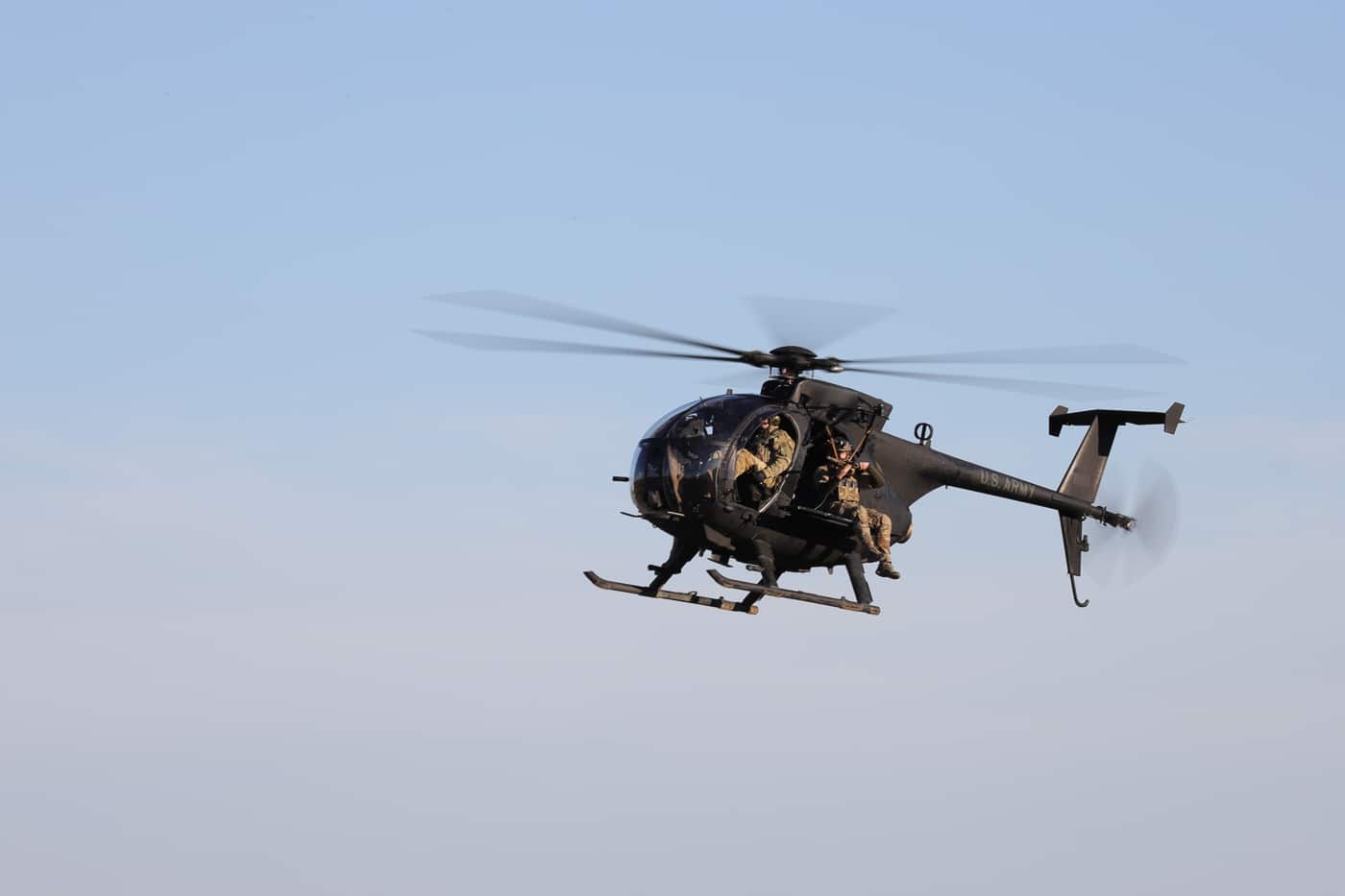
The Night Stalkers, officially known as the 160th Special Operations Aviation Regiment (Airborne), were created in April 1980, out of the ashes of the disaster at Desert One, the failed attempt to rescue American hostages held in Tehran after the Shah of Iran was overthrown.
President Carter ordered Chief of Naval Operations Admiral James Holloway to devise a plan for a successful second attempt at rescue.

Holloway looked to the U.S. Army for pilots and personnel to be trained in short-notice Special Operations Missions. The Army looked to the 101st Aviation group of the 101st Airborne Division Air Assault at Fort Campbell, Kentucky, since they had the most experience in helicopter operations. Personnel from several 101st battalions were selected, but since the majority came from the 158th Aviation Battalion, the new unit was dubbed Task Force 158. Training began for the unit, with CH-47s and UH-60 Blackhawks. The OH-6 Cayuse from the days of Vietnam was resurrected and conducted training in a secluded part of the base.

After the first class completed their training in the fall of 1980, a second rescue operation, dubbed “Honey Badger,” was scheduled for early 1981, but was called off at the last minute when the Iranians released the hostages on the morning of President Ronald Reagan’s inauguration.

Task Force 158 was recognized as the premier Army Aviation unit, and their special training was not going to be wasted. On October 16, 1981, the Task Force was transferred into a separate unit from the 101st and was redesignated as the 160th Aviation Battalion. The original class of Night Stalkers called it “The Day the Eagles Came Off.”

There were several unit name changes over the years, and in May 1990, the unit was redesignated the 160th Special Operations Aviation Regiment (Airborne).
Recruitment & Training for 160th SOAR
Recruitment for the 160th comes from volunteers throughout the Army, as well as selections made by the U.S. Army Human Resources Command based on the unit’s required MOS’s. There are positions available for Enlisted, Warrant, and Officers in certain MOSs.

The training to become a member of the 160th is intense, to put it mildly. A recruit arrives and is assigned to the Green Platoon, where they receive intensive training in areas such as first responder, teamwork, combatives, land navigation, and weapons. Weapons training includes thousands of rounds of practice with the M4 rifle, M9 9mm, M17 9mm, and the Kalashnikov AK-47 & AK-74.

The Green Platoon is used to weed out any substandard soldiers who do not have what it takes to be a Night Stalker. Any soldier who passes this course proceeds to the Basic Night Stalker Course.

Pilots arrive as Basic Mission Qualified. After passing a series of skills tests on leadership, experience, and oral review boards, a process that can take up to three years, the pilot is designated fully mission-qualified.

A Night Stalker flight medic can be qualified as a special operations combat medic after completing a 36-week combat medic course at Ft Bragg, North Carolina.
The Night Stalkers Creed
“I pledge to maintain my body, mind, and equipment in a constant state of readiness, for I am a member of the fastest deployable task force in the world, ready to move at a moment’s notice anytime, anywhere, arriving time on target plus or minus 30 seconds.”

“Night Stalkers Don’t Quit”
The 160th became known as the “Night Stalkers” because they pioneered the Army’s nighttime flying techniques, giving it the capability to strike undetected in the darkness. They continue to develop new technology and tactics for the battlefield. In every major combat operation since Grenada, the 160th has demonstrated that they live by their motto, “Night Stalkers Don’t Quit.”
Aircraft
Boeing MH-47G Chinook: This ain’t your father’s Chinook. The CH-47 Chinook, which took its first flight in 1961, has been involved with every conflict since then. It’s a tandem rotor heavy lift helicopter designed initially for troop and cargo transport. It has been heavily modified over the years for the 160th SOAR.

Sikorsky MH-60L/M: The L model is a Direct Action Penetrator version of the Black Hawk that’s been configured as a helicopter gunship and used exclusively by the 160th SOAR. Most are equipped with twin M-134D Miniguns.

McDonnell Douglas MH-6: This helicopter dates back to the OH-6 Cayuse, which was used during the Vietnam War. Now highly modified for the Night Stalker Mission
General Atomics MQ-1C Surveillance Drone: This drone is the Eyes of the Night Stalkers, providing pre-operation intelligence as well as real-time surveillance.
SOAR Locations
The Night Stalkers are based in three different locations.
- 1st Battalion: Fort Campbell, Kentucky
- 2nd Battalion: Fort Campbell, Kentucky
- 3rd battalion: Hunter Army Airfield, Ga
- 4th Battalion: Joint Base Lewis-McChord, Washington
Publicly Known Night Stalker Operations
The 160th has participated in numerous operations from its inception. Here are just a few of them.
Operation Just Cause: 1989 marked the debut of the Night Stalkers, who spearheaded the operation to remove Dictator Manuel Noriega from Panama.

Desert Storm, Desert Shield, and the Global War on Terror: Beginning in 1991, the Night Stalkers have participated in hundreds of missions throughout the Middle East. In 2003, they took part in the rescue of PFC Jessica Lynch, who was taken prisoner during the Battle of Nasiriyah. Also in 2003, Saddam Hussein, who was captured in Operation Red Dawn, was exfiltrated to Baghdad International Airport by a SOAR MH-6 Little Bird and placed into custody.

The Battle of Mogadishu: In October 1993, the 160th was tasked, along with U.S. Army Rangers and Delta Force operators, to participate in Operation Gothic Serpent.
The result was the Battle of Mogadishu, which was the subject of a book and movie entitled Black Hawk Down. The Night Stalkers were stationed in Somalia, as part of Task Force Ranger, alongside a multinational group tasked with capturing Mohamed Farah Aidid, a local warlord who had declared himself President of Somalia.
On this day, the 160th was on a mission to capture two of Aidid’s top men. The Delta operators successfully captured Aidid’s henchman while air units were taking heavy fire.
A Black Hawk, call sign Super Six-One, was hit by an RPG round and crashed. A ground-based rescue operation began. During the rescue mission, a second Black Hawk, Super Six-Four, was shot down a few blocks away.

With resources stretched, D-Boys Randy Shughart and Gary Gordon volunteered to be inserted and provide security for the site, knowing the outcome was unlikely to be good.
The pair arrived and found the pilot still alive. Despite their heroic efforts, the site was overrun, and they were killed. As the Night Stalkers leave the area due to fuel and ammunition shortages, they assured their brothers that they will return, and used their loudspeakers to repeat the motto, “Night Stalkers Don’t Quit.”

Of the 18 soldiers killed in the operation, five of them were from the 160th. Delta operators Shughart and Gordon were awarded the Medal of Honor posthumously, the first MOH recipients since the Vietnam War.

Operation Neptune Spear — The Hunt for Bin Laden: In May 2011, the 160th took part in a raid on the compound of Usama bin Laden. The Night Stalkers used a pair of specially modified stealth Black Hawk helicopters to insert Navy Seals on the target.
Upon insertion, the tail rotor on one of the Black Hawks struck a compound wall and crashed. The SOAR crew was able to extract themselves from the wreckage and provide cover for the SEAL team. All personnel were able to exfiltrate in the second Black Hawk, making the mission a success despite the loss of the Black Hawk.

While not confirmed, it is rumored that the stealth model Black Hawk is challenging to fly due to the added technology, as helicopters are not stealthy to begin with.
Legacy of the Night Stalkers
From Grenada to the present, Night Stalkers have been involved in countless operations. Over the years, their constant push to improve has led to advancements in technology, enabling them to perform their mission more safely and efficiently. This technology carries over to regular units of all military branches and has undoubtedly saved many lives.

The Night Stalker Memorial Wall, located at Fort Campbell, Kentucky, lists the names of 94 Night Stalkers who have “Borne the Battle.” It serves as a poignant reminder of the high cost paid by these soldiers and their families in service to their country.