Month: June 2025
Categories
You have to be kidding, right!?!
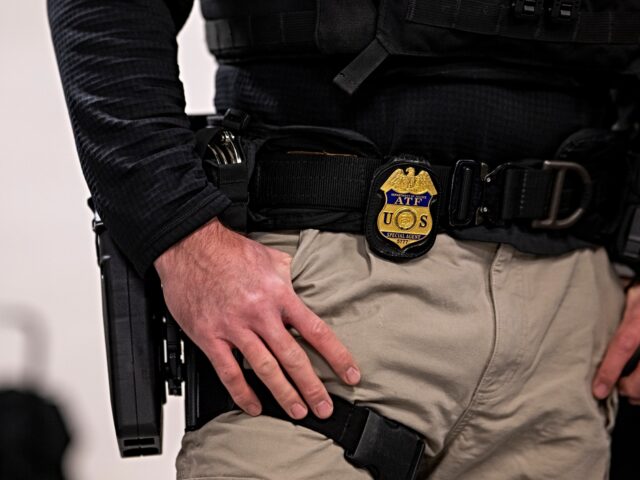
A report from the New York Times indicated President Donald Trump’s Department of Justice is limiting the ATF’s ability to harass Federal Firearm License holders (FFLs) by cutting the number of ATF inspectors by two-thirds.
According to the NYT, “The department plans to eliminate 541 of the estimated 800 investigators.”
ATF inspectors are the ones who visited FFLs under the Biden Administration’s zero tolerance policy and shut down numerous gun stores over clerical errors.
On April 7, 2025, Breitbart News pointed to a report by Gun Owners of America which noted that Gun Owners of America that, under Trump, the DOJ and ATF repealed the zero tolerance policy that was weaponized under Biden. Moreover, on May 27, 2025, Breitbart News noted that automatic FFL revocations by the ATF were gone as well.
Such revocations were a trait of Biden’s ATF, as inspectors immediately revoked FFLs due to simple mistakes on gun forms.
Trump’s ATF announced that the approach of automatic revocation would be replaced with one that considers “intent, compliance history and public-safety risks.” The announcement also made clear there would be a new posture among ATF personnel involved in gun store/FFL inspections, a posture that included a focus on “content-driven enforcement” and “support for lawful industry engagement.”
AWR Hawkins is an award-winning Second Amendment columnist for Breitbart News and the writer/curator of Down Range with AWR Hawkins, a weekly newsletter focused on all things Second Amendment, also for Breitbart News. He is the political analyst for Armed American Radio, a member of Gun Owners of America, a Pulsar Night Vision pro-staffer, and the director of global marketing for Lone Star Hunts. He was a Visiting Fellow at the Russell Kirk Center for Cultural Renewal in 2010 and has a Ph.D. in Military History. Follow him on Instagram: @awr_hawkins. You can sign up to get Down Range at breitbart.com/downrange. Reach him directly: awrhawkins@breitbart.com.
Categories
All Types of Gunpowder Explained

Let’s get this out of the way first. No, the Constitution wasn’t officially suspended in 1933. But it was gagged, blindfolded, and tied to a chair while the federal government handed itself sweeping emergency powers and redefined “freedom” into a kind of bureaucratic improv comedy routine. They didn’t declare martial law on paper because that would have looked bad. Instead, they declared it in practice and gave it a haircut, a press pass, and a desk job. Most Americans never noticed. Most still don’t.
The story begins with a “banking emergency.” On March 6, 1933, President Franklin Delano Roosevelt signed Executive Order 2039, effectively closing the banks. This wasn’t a request—it was a national lockdown of the financial system.
Within days, Congress passed the Emergency Banking Relief Act, which amended the Trading With the Enemy Act of 1917 to allow the president to seize private property and control commerce even in peacetime. You read that right. The original act was intended for use against foreign enemies during wartime.
Roosevelt’s administration simply redefined the term “enemy” to include American citizens. That’s not a conspiracy theory. That’s a matter of historical record. You can read it here and here. This wasn’t martial law with tanks in the streets. It was something more insidious: the silent transfer of authority from constitutional governance to executive fiat, wrapped in the language of patriotic crisis management.
Then came House Joint Resolution 192 in June of that same year. This little piece of legal sorcery declared that debts could no longer be paid in gold. Instead, all gold was to be surrendered to the Federal Reserve, and the American public would now transact in fiat currency—Federal Reserve Notes.
In one move, Roosevelt erased the gold standard domestically, outlawed the most stable form of lawful money, and replaced it with an I.O.U. The people didn’t protest. They complied. It was all for the good of the nation, they were told. Never mind that their savings were now denominated in debt-backed paper. Never mind that the Constitution says only gold and silver shall be legal tender. Never mind that the American people’s wealth was effectively nationalized with the stroke of a pen.
By 1938, the Supreme Court put the nail in the coffin. Erie Railroad Co. v. Tompkins may sound like a mundane case about trains and trespass, but the decision fundamentally altered the legal landscape of America.
Prior to Erie, federal courts operated under general common law principles—those ancient foundations rooted in natural law and the rights of man.
After Erie, federal courts were now confined to statutory law. In other words, judges would interpret the rules written by bureaucrats and legislatures, not derive justice from first principles. The Constitution didn’t vanish overnight. It just became irrelevant in practice. What mattered now was what the statute said.
If Congress wrote a law giving an agency the right to inspect your property, seize your earnings, or regulate your behavior, the courts would uphold it, even if it made a mockery of the Bill of Rights.
So no, martial law was never formally declared. But we’ve been living under a continuous state of emergency ever since. Roosevelt’s national emergency was never truly repealed. Instead, it became the precedent for every president that followed.
As of this writing, there are at least 41 ongoing national emergencies in effect, some of them decades old. You can find the full list here. The 9/11 emergency is still active. The COVID emergency was extended multiple times before it was quietly phased out.
New emergencies are declared regularly over foreign sanctions, trade disruptions, and cyber threats. Each declaration unlocks a set of executive powers that bypass the normal constitutional process. Congress almost never intervenes to end them.
The public barely registers their existence. The result is a legal environment in which emergency governance is the norm, not the exception.
Why does this work? The answer lies in psychology. When people feel threatened, they surrender liberty for safety. The fight-or-flight part of the brain takes over. Critical thinking shuts down. This is not speculation. It’s basic neuroscience.
Governments have long known that fear makes citizens more compliant. Tell them the banks are collapsing, the virus is coming, the terrorists are plotting, or the climate is boiling, and they’ll accept almost anything in the name of protection.
Even the erosion of their most sacred rights. Once that pattern is set, it becomes permanent. Americans have been conditioned to believe that constitutional protections are optional—valid only when convenient and subject to immediate cancellation when the sirens start blaring.
Now let’s talk about the legal sleight of hand. Most Americans assume they live under the jurisdiction of the Constitution. But the courts increasingly operate under a hybrid system of statutory and administrative law, often enforced through what is functionally maritime law.
Don’t believe me? Take a look at the gold-fringed flag in most courtrooms. That’s not just decoration. It’s a symbol of admiralty jurisdiction, meaning you’re not in a constitutional court. You’re in a corporate tribunal. And speaking of corporations, the United States is defined in 28 U.S. Code § 3002(15)(A) as a federal corporation. You are not a sovereign individual under natural law. You are a legal entity—an asset tracked by a Social Security number and collateralized against the national debt.
From Roosevelt to Biden, every president has expanded these powers. Truman declared emergency powers during the Korean War. Reagan authorized secret continuity of government plans. Bush signed the Patriot Act. Obama embedded indefinite detention into the NDAA. Trump launched Operation Warp Speed and accelerated the surveillance state through Palantir and FISA. Biden renewed and expanded nearly every emergency he inherited. The mechanisms of control don’t change. Only the branding does.
And here we are. The Constitution is still there, printed in pocket-sized booklets and waved around at rallies. But in most courtrooms, classrooms, and government buildings, it has all the force of a museum artifact.
They didn’t suspend it. They just bypassed it. They didn’t tear it up. They just buried it under 90,000 pages of federal regulations. And when someone like you or me points this out, we’re called extremists, radicals, or conspiracy theorists. That’s fine. History is full of people who were slandered for telling the truth too early.
But the Constitution doesn’t give you rights. It recognizes the rights you already have. The paper is not the source. You are. And no act of Congress, no executive order, no foreign or domestic emergency can erase what God has written into your being. They can only convince you to forget it.
Until you remember.
Categories
Huh!
The USNS CARD was an old aircraft carrier commissioned way back in 1942, but well, it was an aircraft carrier nonetheless.
In mid-1963, Vietcong secret intelligence inside the port of Saigon informed their commanders that two aircraft carriers named USNS Core and USNS Card frequently moored in the port. Both ships carried huge numbers of helicopters, fighter jets, armored vehicles, artillery, etc. Every time these ships arrived, security around the port was tripled. A full-strength paratrooper battalion blocked the nearby streets, patrol boats sealed off the waterway, secret police searched and arrested any suspects on the flimsiest of evidence, …
However, both ships were to become targets of Vietcong’s 65th Special Operations Group.
On the 29th of December 1963, the USNS Core arrived in Saigon port. After having carefully studied the terrain, one single Vietcong commando named Lam Son Nao made his way into the port by going through 300m of a secret sewer tunnel full of highly toxic machine oil, carrying a time bomb made of 80kg of TNT with him.
He placed the bomb on the hull of the ship then got out via the same tunnel. Unfortunately for the Vietcong (and fortunately for the U.S.), the bomb malfunctioned.
Noticing that there was no explosion at the pre-determined time, the commando went back to the USNS Core, removed the bomb from the ship and brought it back to base. (Why didn’t he simply carry another bomb with him to replace the malfunctioned one? Because the Vietcong did not have limitless supply of explosives). Despite the failure, the whole bombing plot was still a secret.
Then on the 1st of May 1964, the USNS Card arrived in the port. This time, two Vietcong commandos Lam Son Nao and Nguyen Phu Hung, traveled by boat to the secret tunnel, carrying 80kg of TNT and 8kg of C4. But before entering the tunnel, they were detected by South Vietnamese police patrol boats. The commandos confessed that they were smugglers and paid a huge bribery to the ranking police officer who, upon receiving the money, immediately let them go!
The two commandos divided the explosives into 2 parts and attached them just above the waterline near the bilge and the engine compartment on the ship’s starboard side. When they finished, it was 2 AM on the 2nd of May 1964.
One hour later, 2 massive explosions erupted and the USNS Card – an escort carrier that saw distinguished service as a submarine-hunter in the North Atlantic and survived several U-boat attacks during World War II – gradually sank to the bottom of the river, 5 crewmen and 23 aircraft on board were lost. It was the last aircraft carrier in U.S. military history to date sunk by enemy action.
This fact was largely unknown because the USNS Card was sunk in a river and not out in the ocean, therefore it could be re-floated, repaired and 6 months later put back to military service. But it was sunk alright.
The USNS Core – the ship that was almost sunk by Vietcong – in Saigon Port.

(In WWII she sank 11 Uboats in the Atlantic. Grumpy)