Month: March 2025
I LOVED my Jungle Boots and wore them as much as I could while in the Green Machine!!! Grumpy
 Four years ago, when the country was still reeling in the aftermath of the 2020 election and the Capitol protest of Jan. 6, 2021, every loudmouth liberal — politicians, editorial writers, opinion columnists and barstool boors — was mouthing the same thing about people on the losing side: They were all branded “election deniers.”
It was nothing new, really. Back in 2017 and for the next couple of years, Hillary Clinton was travelling around the country and even around the world, blaming everyone and everything other than herself for losing in November 2016. She simply couldn’t acknowledge she was a lousy candidate and her campaign people weren’t very good at counting Electoral College votes.
Same Old Same
And so it goes with gun prohibitionists. Whether they are federal court judges, state-level politicians, members of Congress or members of the media, there are legions of people who stubbornly refuse to recognize U.S. Supreme Court rulings in 2008 (Heller), 2010 (McDonald) and 2022 (Bruen), all of which affirmed the Second Amendment of the U.S. Constitution protects a fundamental, individual right to keep and bear arms. The definition of this problem is DENIAL.
Even today, with all of the evidence and settled law running against them, gun control zealots continue insisting the high court was wrong. They claim the bearing of arms applies only to members of the militia, whom they define as members of the National Guard. If they get tripped up on that argument, they zero in on the term “well-regulated,” insisting it refers to strict gun control, which it certainly does not.
Long story short, the gun prohibition movement — a label which they will vehemently reject — is fresh out of rational arguments and truth left them in the dust a long time ago.
Some months ago, I had an exchange of emails with a liberal newspaper columnist who didn’t think people should be upset about having to jump through bureaucratic hoops in order to purchase a firearm. It became obvious this fellow wasn’t concerned about infringing on someone else’s rights, especially rights with which he did not agree. Background check? No big deal. Waiting period? No great inconvenience. It wasn’t his ox getting gored, and besides, I was reminded, guns can be used to kill people.
Yeah, and so can knives, scissors, golf clubs, baseball bats, tire irons, claw hammers, hatchets, axes, bricks, rocks, screwdrivers, shovels, jack handles, ropes, table lamps, skateboards and a host of other objects which all have one thing in common: None of these things require a background check at time and point of purchase. There are no waiting periods. You don’t have to provide identification, proof of citizenship or anything but cash or a credit card.
The right to keep and bear arms, which is protected by the Second Amendment, is the only constitutionally enumerated right subjected to this degree of prior restraint. No other tenet in the Bill of Rights is so encumbered with prerequisites as the Second Amendment.
“But guns need to be regulated,” is the stock argument from the gun ban crowd.
Our answer should be, “We’re not talking about guns; we’re talking about rights!”
Talking point — What other right do anti-gunners think should require getting a permit from police before exercising it?
Talking point — Nobody would tolerate having to wait three, seven or 10 days to speak with an attorney if they were arrested and charged with a crime.
Talking point — “Mandatory buyback” is gun confiscation with compensation, and is tantamount to committing sexual assault but then tossing $20 to the victim.
Talking point — Saying nobody is coming after anyone’s guns in one breath, and then immediately saying so-called “assault weapons” should be banned is absolutely contradictory. Banning an entire class of firearms translates to taking someone’s gun(s). Insisting otherwise is delusional.
The Next Big Thing
If the Supreme Court hasn’t already done so by the time you read this, sometime this spring the nine justices will hand down a ruling in the case known as Garland v. VanDerStok which will either affirm or reject the ability of the government (the Bureau of Alcohol, Tobacco, Firearms and Explosives) to regulate so-called “ghost guns.” These are firearms built by home gunsmiths using parts kits that are not serialized.
If the Court says unserialized guns are protected by the Second Amendment, listen for shrieks of agony and predictions of the downfall of modern civilization from the same people who insist there really is no individual right to keep and bear arms. This, too, would be an exhibition of denial from a crowd who believes constitutional protections only apply to rights they favor.
On the other hand, if the Court says homemade firearms must have serial numbers, it may not alter the social/political landscape all that much unless there is an effort to build a registry of those firearms. Then watch for a flood of litigation based on Second and Fourth Amendment grounds.
Such a scenario would put liberals in a very tough spot because they would be immediately faced with a challenging dilemma: How will this be enforced? Police simply cannot just walk into someone’s home and start searching for unserialized firearms, same as they cannot just walk into someone’s home and search through private papers, or look for other items. Civil rights attorneys will get rich because more than one right would be trampled on, and at that point, we’re talking about constitutionally protected rights liberals do value and will zealously protect.
Which brings us back around to rights, and denial. Rights are special, they are all equal in importance and are therefore entitled to the same ferocious defense. Gun owners are already well aware of this principle, while anti-gunners are behind the learning curve.
So long as we keep in perspective this conflict is not about guns, but about rights, the Second Amendment community will continue to hold the high ground. We cannot afford to give it up without a fight.

Categories
Pity that there is no 10mm!

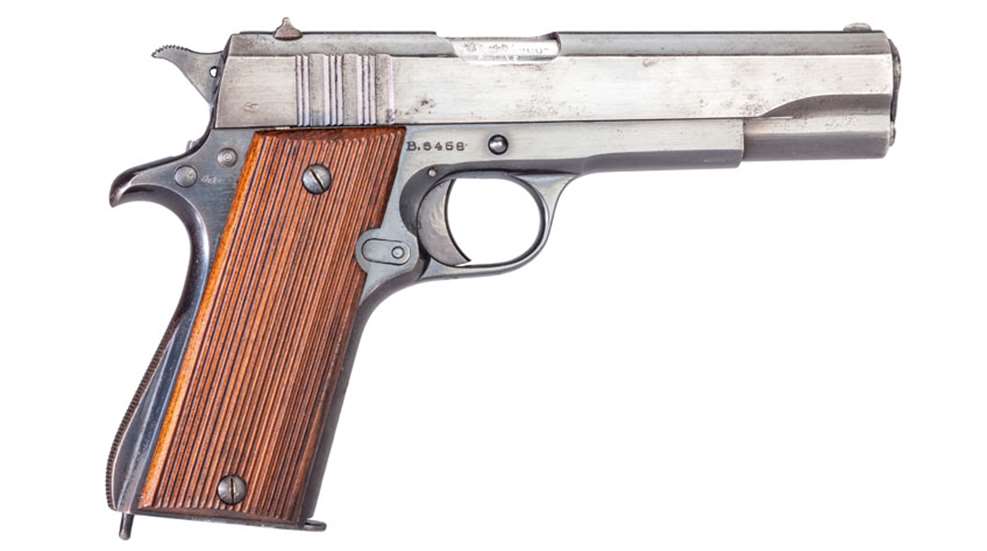
When Argentina decided to adopt a self-loading pistol for its military, it chose wisely. At first, the country purchased .45 ACP 1911 variants directly from Colt in Hartford, but then eventually commenced domestic production of the M1911A1 design as the 11.25 mm Sistema Colt 27. Argentina’s Dirección General de Fabricaciones Militares (the General Directorate of Military Manufacturing, or “DGFM”) made these pistols at the Fábrica Militar de Armas Portátiles (Military Small Arms Factory, or “FMAP”) in Rosario, 200 miles upriver from Buenos Aires.
Although the Sistema 27s provided reliable service, they were costly to make and, even after a decade of production, there still weren’t enough of them. So, work started on what would become the Ballester-Molina pistol.
Dr. Arturo Ballester Janer and Eugenio Molina—two Spanish entrepreneurs who established the firm Hispano Argentina Fábrica de Automóviles S.A.—also known as HAFDASA, gave the Ballester-Molina pistol its name.
Through the efforts of the company’s chief engineer, Rorice Rigaud, HAFDASA developed a pistol combining elements of Browning’s 1911 series with elements of the Spanish Star Model P. Noticeably, the 1911’s grip safety was replaced with a solid backstrap.
In addition to that, the new HAFDASA .45-caliber semi-automatic featured a pair of vertically grooved wooden grips, a hammer-blocking thumb safety, and an inertial firing pin that made it possible to safely lower the hammer on a loaded chamber.
(l.) The familiar “Ballester-Molina” rollmark is the first sign this isn’t a standard pistol. (ctr.)Barrels, which wear the same caliber designation, are interchangeable with 1911-style pistols. (r.) Trigger geometry also differentiates the Ballester-Molina from the M1911.
Although these features set it apart from Browning’s 1911, HAFDASA’s new pistol was almost identical in size, shape, caliber and operating principle. In fact, it was even designed to use the same seven-round detachable-box magazine, barrel and recoil springs. Nevertheless, the new HAFDASA .45 ACP was not a total copy of the Colt .45 ACP—the slides from the two pistols do not interchange.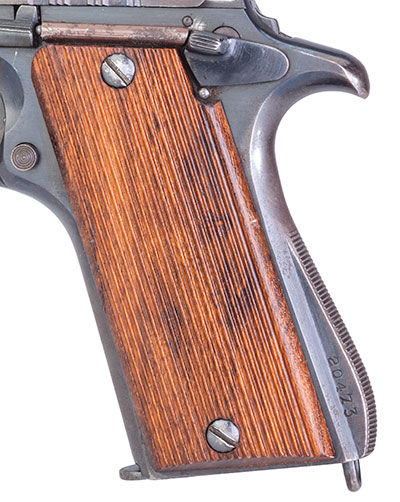
During the first three years of production, the gun was roll-marked with the name “Ballester-Rigaud” but then in 1940 it was given the name that is more familiar to modern shooters and collectors—”Ballester-Molina.”
Initially, the Argentine government was the only user of the Ballester-Molina pistol, issuing the pistol to its military, federal police and customs service, but that changed soon after the Dunkirk evacuation in 1940. The U.K. had to contend with a shortage of pistols after Dunkirk, and ordering Ballester-Molina pistols from HAFDASA helped relieve that situation.
Since Colt M1911A1 pistols were in widespread use in the King’s service and Colt could not keep up with demand, purchasing the Ballester-Molina pistol represented a sensible choice. It used the same holsters, magazines and ammunition as the Colt .45, so issuing the HAFDASA .45 would not introduce new accessories to the logistical chain.
By war’s end, the U.K. had purchased over 10,000 guns—many of which ended up being used by the Special Operations Executive (SOE) for clandestine operations. These British contract Ballester-Molinas carry serial numbers that begin with a ‘B’ prefix and fall below 21,000.
In the aftermath of World War II, the Ballester-Molina remained in production and in service. Then, in 1953 HAFDASA went out of business after having manufactured 113,000 guns. Although the assembly line had stopped running, pistols could still be found in military and police inventory even as Argentina transitioned to the Browning Hi Power 9 mm. Some Ballester-Molina pistols even armed Argentine troops during the invasion and occupation of the Falkland Islands in 1982.
But, after nearly 50 years of federal service, the pistol was finally retired. Even before that point, though, HAFDASA’s robust .45 semi-auto was already being imported into the U.S. as military surplus beginning the 1960s. Although it offers a more-affordable alternative to the military-surplus 1911, the Ballester-Molina pistol is nevertheless an outstanding design in its own right.