Categories
All About Guns This great Nation & Its People War

EVOLUTION OF THE M1 GARAND GAS CYLINDER

The M1 Garand that served the U.S. military from 1936 through 1958 is made up of 57 parts. While every one of those parts is critical to the operation of the rifle, some are more important than others, like the barrel, bolt and receiver.

M1 Garand gas cylinder
The M1 Garand’s gas system evolved over the course of its development. Shown above is the “Model Shop” T1E2/M1 Garand S/N 25. Image: Institute for Military Technology

The gas cylinder is central to the M1’s semi-automatic operation and, of all the parts on the rifle, it is the one that experienced the greatest amount of change over the Garand’s development and production history. In fact, when John Garand began developing a gas-operated semi-automatic rifle in June 1926, he went with a basic gas cylinder design that would eventually evolve through a series of changes – some significant and some not – that singularly and uniquely narrate the entire M1 story from development to mass production.

Through the evolution of that one part, it is possible to see the many ways that a brilliant engineer overcame technical and production challenges that would have thwarted a lesser mind.

Foundation of Success

After abandoning primer actuation, the first thing that John Garand did was design a gas operated rifle in .30-caliber, and that rifle received the designation T1. The Army examined the T1 in December 1927, but expressed more interest in the design than the caliber. John Pedersen’s .276 cartridge was at the time thought to be a better candidate for a semi-automatic service rifle than the more powerful .30-caliber cartridge, so Garand was asked to create a version of his gas-operated design in that caliber. He then modified the existing design for the .276 cartridge. The result was designated T3 in 1929.

Gas cylinder comparison
A comparison between the front end of the .276 caliber T3E1 Garand and the front end of .276 caliber T3E2 S/N 15.

At this critical stage of development, John Garand’s gas cylinder went through some interesting, although primarily cosmetic changes. All of the rifles were “gas trap” type rifles that used gas pressure at the muzzle to the operate the action. Since that aspect of the design did not change, the basic anatomy of the rifle’s gas cylinder did not undergo fundamental modification the way that the M1’s gas cylinder ultimately would in 1940 (more on that below).

A noticeable change to the appearance of the gas cylinder between the T3E1 and the T3E2 did however take place. The rear end of the T3E1 gas cylinder also served as the forward stock ferrule, but Garand simplified that when he transitioned to the T3E2 by separating the components from one another. He further simplified the E2’s gas cylinder by eliminating machining cuts in the area of the gas trap, and by making the front sight base a curved structure.

Bigger Might Be Better

In 1929, the military showed a renewed interest in a .30-caliber Garand rifle, and that paved the way for the short-lived T1E1. But when that rifle’s bolt developed a crack during testing, it was subsequently withdrawn from trials on October 9, 1931. Four months later, U.S. Army Chief of Staff General Douglas MacArthur halted further development of the T3E2 Garand and the .276 cartridge, and ordered all resources dedicated to correcting the problems with the .30-caliber T1E1.

276 Caliber T3E2 Garand
Shown is a .276 caliber T3E2 Garand prototype. Image: Institute for Military Technology

By then, John Garand had made a new bolt for the rifle and completed a few other adjustments to its design. This modified version received the designation T1E2 in March 1932, and it was this version of the Garand that was ultimately adopted as the “U.S. RIFLE CAL. 30 M1” on August 3, 1933.

Garand gas cylinder
With drawing number D-35449, the Garand gas cylinder had reached its final form. Image: Institute for Military Technology

But the first batch of 80 M1 rifles was handmade at Springfield Armory’s Model Shop between April and August 1934, and they were built with a gas cylinder resembling the T3E2’s. While both made use of an unprotected front sight blade, the gas cylinder design equipping the 80 pre-production “Model Shop” M1s included a feature that the T3E2’s gas cylinder did not: a removable nose cap that allowed cleaning of the interior of the gas trap’s expansion chamber. So even at this early stage in the life of the M1 Garand, the design of the rifle’s gas cylinder was already going through product improvement.

Mass production of the M1 rifle began in July 1937 with serial number 81, a rifle that introduced a slightly revised gas cylinder. In recognition of the fact that an unprotected front sight blade was just not a desirable feature for a service rifle, the curved front sight base used on the gas cylinder of the “Model Shop” rifles was replaced with a squared-off base. A milled front sight with protective ears fit in that base and gave the “gas trap” M1s something sufficiently rugged for military service. The improved gas cylinder was assigned drawing number D-28289 and it would remain largely unchanged during the next 35 months of production.

Type 3 D-28289 gas cylinder
An excellent example of the Type 3 D-28289 gas cylinder on a “gas trap” M1 Garand rifle. Image: Institute for Military Technology

Nevertheless, three separate variations of that part were made that can be identified based on the presence or absence of the drawing number on the rear barrel ring, and/or a pair of flutes machined just below the rear sight. Production of the “gas trap” M1s proceeded through to mid-1940 when the rifle’s design underwent a major change.

Field Feedback

By 1939, extensive field use of the M1 had revealed a number of shortcomings associated with its gas cylinder. First of all, it was possible for the screw securing the part to the barrel to loosen while firing, and this could cause a misalignment that could cause a bullet strike that would damage the gas system irreparably. In addition to that, it was difficult to clean excessive carbon build-up in the gas cylinder, and that could affect reliability.

M1 Garand found on Peleliu
The D-35449 gas cylinder of an M1 Garand rifle that the author found on Peleliu during a visit to the island on March 28, 2017.

Garand cured the problem by converting the rifle from a gas trap to a gas port operating system. This involved lengthening the rifle’s barrel from 22” to 24”, and then drilling a .078” diameter port in it that lined-up with a corresponding window in a heavily modified gas cylinder. Gas pressure still put the rifle into an operating cycle, but that cycle was now initiated at the gas port instead of in the expansion chamber at the muzzle.

The new gas cylinder was assigned the drawing number D-35449 and it was recommended for adoption on Oct. 26, 1939. At that point, 48,119 “gas trap” M1 rifles had been produced, but from mid-1940 through to the end of production in 1957 every Garand was built as a gas port rifle with a D-35449 gas cylinder.

Although minor variations can be identified, the Garand gas cylinder had reached its final form with D-35449 and its simplicity reveals another noteworthy attribute of the M1 design – the ability to evolve. Just by examining the way that one part changed between 1926 and 1940, it is possible to understand how a good service rifle ultimately became the greatest service rifle of the 20th century.

Categories
All About Guns Ammo

6.8 SPC vs 6.5 Grendel

Categories
All About Guns

Arisaka “Type 38” Trainer:How things change in 100 years.

Categories
Soldiering

Grenadier of the 1st Foot (Royal Scots) as they appeared during the Seven Years War.

                     AKA Pontius Pilate’s Bodyguard

The Royal Scots were raised in 1633 by Sir John Hepburn when he was given a Royal Warrant to raise a Regiment to fight in France.  During their extended service in France, the Royal Scots earned their nickname, ‘Pontius Pilate’s Bodyguards.’  A dispute arose between the Royals and the French Regiment of Picardy, both arguing that they deserved the coveted place on the right of the line.  The French Regiment asserted that they were the senior regiment, having been on guard at the Crucifixion.  The Royals claimed that had they been there too, the body would not have gone missing!  The Royals have proudly maintained the nickname ever since.


Since the seventeenth century, the Royals have fought in almost every British war up to and including the Second Gulf War.  This makes the Royal Scots the oldest British Regiment of Foot serving today.  It is this proud tradition that we seek to capture when we recreate the actions of the Royal Scots in the War of 1812.


In the early nineteenth century, the Royal Scots (or the Royal Regiment as they were known until 1812) had four distinct battalions serving in the West Indies (1st Battalion), Egypt and India (2nd), the Penninsula (3rd) and in Britain (4th).  All four battalions served with distinction, and, by 1812, the Regiment had earned thirteen battle honours.  They would add seven more before peace returned in 1815. When the United States declared war on Great Britian, the first battalion left the West Indies and sailed for Quebec.  Although the battalion was suffering from their service in the disease-ridden West Indies, they welcomed 300 recruits from the depot and arrived in Lower Canada with 1,216 officers and men.  While the battalion was scattered between Quebec and Kingston for much of 1812 and 1813, the Light Company was involved in training the Canadian militia in light infantry tactics. 


The Royals eventually recovered and saw much action in Upper Canada during the war.  They fought at Sacket’s Harbour, Buffalo and Fort Niagara in 1813 and at Longwoods in March of 1814.  Their greatest contribution to the war, however, would come in the summer of 1814.  The Royals fought the battles at Chippewa, Lundy’s Lane and Fort Erie in July and August.  The Royals suffered very high casualties, but remained steady throughout the campaign and were later awarded the battle honour NIAGARA for their service.  

When the Royal Scots sailed from the West Indies, they were still wearing uniforms that would be very unsuitable in the Canadian climate.  They had no greatcoats, unlined uniform coats, light linen trousers and round caps.  When they arrived in Quebec, therefore, they had to be almost completely reoutfitted.  Fortunately, ships from Britain to Quebec were frequent and the Quebec merchants were more than willing to help the government – for a price. 
Categories
All About Guns

Range Report: Ruger LCR Max (.327 Federal Magnum)

Categories
Hard Nosed Folks Both Good & Bad Manly Stuff

Why You Don’t Want to Be a Navy Captain

Command can be fun but that is times that are few and very far apart.

Categories
All About Guns

Pawn Stars: Gun Guy Rob’s Top 4 Firearm Sales (Rifles, Revolvers & More!)

Categories
All About Guns

Kordun 7.62: A Double-Stack Tokarev Pistol from Yugoslavia

Categories
All About Guns

Ruger’s New Marlin 336 Trapper 30-30: Is It the Ultimate Bush Rifle?

Categories
All About Guns

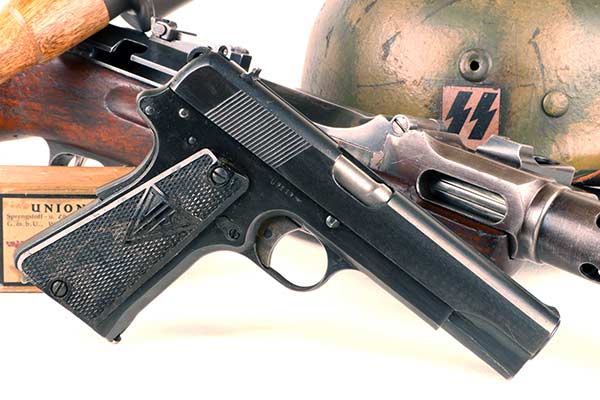
A FORGOTTEN WARRIOR POLAND’S 9MM PISTOLE 35(P) VIS — THE FINEST COMBAT PISTOL YOU’VE LIKELY NEVER HEARD OF BY WILL DABBS, MD

The Polish 9mm Pistole 35(p) Vis is a relatively little known but
superb example of World War II-era handgun technology. Similar
to Browning’s Hi-Power, the Vis was widely used by German
Fallschirmjagers and Waffen SS troops.

Poland has a storied and well-earned reputation for arms making. Their pistolet wz. 35 Vis was one of the most refined and effective combat handguns of World War II. Wz is the Polish abbreviation for wzor (model). Vis is Latin for “force” or “power.” The gun’s salient attributes were so laudable the Nazis maintained production for their elite troops throughout their occupation of the country.

The Vis is typically erroneously referred to as the Radom. Radom is actually the city where the gun was produced, but the Poles disavow the term for the gun. The beating heart of the wz. 35 Vis spawned from the wellspring of firearms brilliance that was John Moses Browning. The short-recoil locked breech action is functionally identical to the P35 Browning Hi-Power. Unlike the P35, the Vis feeds from an 8-round box magazine.

More than 360,000 of these guns were built. Introduced in 1935, the Vis went through several design evolutions during the course of its service life. The Nazis took over production in 1939 and renamed the gun the Pistole 645(p). For reasons lost to history they subsequently shortened the name to P35(p).

The Vis is an excellent pistol with terrific handling
characteristics and reliable performance.

No wonder it was so popular during World War II. The Germans
were so impressed by the pistol they kept it in production under
occupation and armed their troops with it.

Morphology

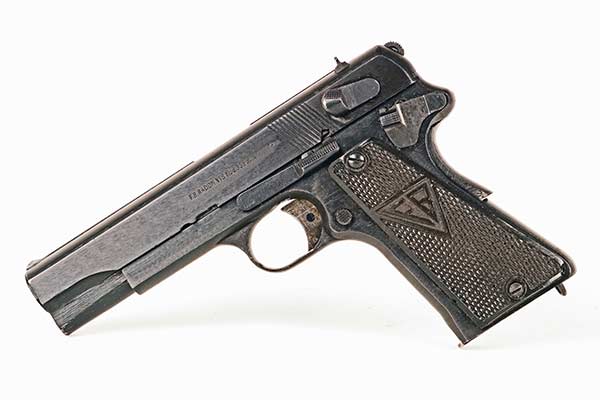
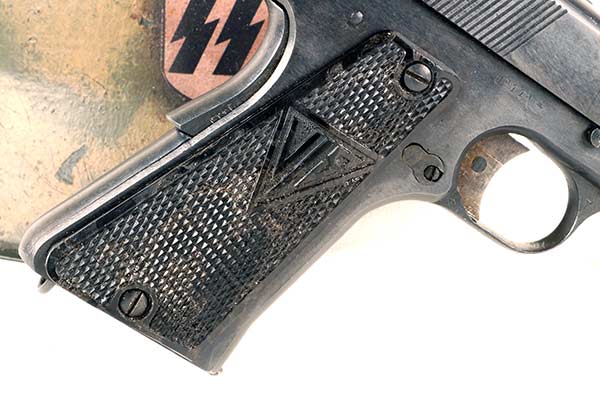
Some of the Polish Vis is familiar, while some is not. The action is classic Browning, and the grip safety looks as though it was lifted bodily from the 1911. The magazine release is in the same spot as the 1911 and the Hi-Power, though the magazine on my copy does not drop cleanly free. Wartime grips were of brown plastic. The left grip was imprinted with FB for Fabryka Broni or “Arms Factory.” The right grip sports VIS in a triangle.

The hammer is partially shrouded by the slide, and the butt includes a lanyard ring. The sights are small, as was typical of the day, and the rear sight is drift adjustable for windage. The top of the slide sports a roughened crosshatched strip to minimize glare. The single-action trigger is equal to the GI 1911’s of the day.

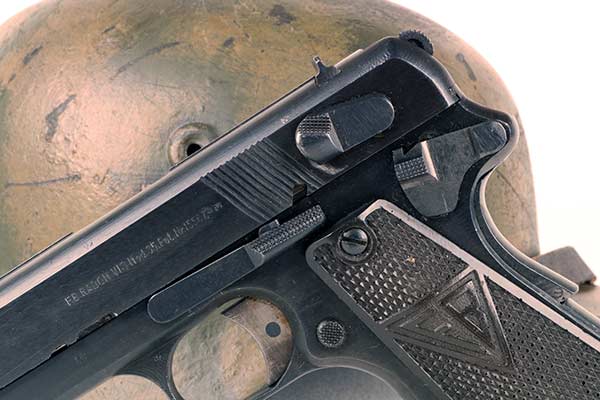
The first thing one notices when initially hefting the Vis is the left side is simply festooned with switches. The slide release operates the same as the 1911, while the slide-mounted lever is a hammer drop safety. Depressing this switch secures the firing pin and drops the hammer safety on a loaded chamber. The gun was designed to be carried in this manner and the hammer would be manually cocked prior to firing.

The switch at the left rear of the frame looking like a 1911 safety is nothing more than a takedown aid. To strip the gun, retract the slide and raise this catch to secure the slide to the rear. The slide release may then be pressed out from the right to the left and the gun stripped in the manner of the Hi-Power. Not unlike the Tokarev TT33, the Vis actually has no manual safety. As the war dragged on and partisan activity made production more challenging, the quality of both fit and finish declined. Ultimately the disassembly catch was dropped. There were a few versions slotted for a shoulder stock, but these stocks are rarer than unicorn horns today.

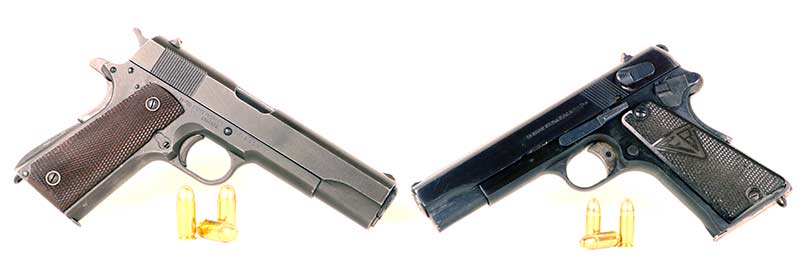
The morphological similarities between the Polish 9mm Pistole
35(p) Vis and the standard 1911A1 .45 ACP service pistol are obvious.

Vis is Latin for “force” or “power,” and it’s molded into the right grip of the Polish 9mm Pistole 35(p).

The single stack 8-round magazine of the Pistole 35(p) Vis sports index holes but does not drop free.

The slide-mounted lever is a hammer-drop safety. The rear lever restrains the slide for disassembly.

Practical Impressions

The 1911-style, grip-to-frame angle makes the gun feel comfortable and familiar to corn-fed Americans with plenty of 1911 trigger time. Index holes indicate rounds remaining in the magazine, though this component must obviously be ejected to facilitate a count. The thin nature of the pistol’s design would facilitate concealed carry were you unfortunate enough to be facing down battalions of soulless Nazis on the wartime streets of Warsaw.

The gun runs great on the range when compared alongside competing designs of the day. The trigger is nicer than that of the P08 and P38, while recoil is more palatable than that of the 1911. I can see why German Fallschirmjagers and SS troopers coveted the gun.