Categories
Month: November 2024
Categories
Origin of the Lance Corporal (USMC)
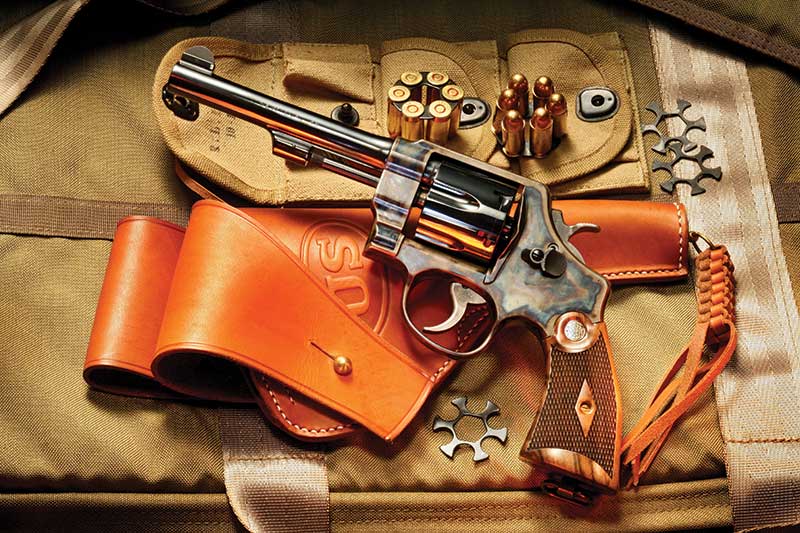
The S&W M1917 is nicely complimented by this repro holster from Pacific Canvas and Leather.
Available in right or left hand it can be marked “US” or “USMC.” Also available is a repro of the
scarce canvas clip pouch holding 18 rounds in half-moon clips.
As a general rule double action revolvers don’t have the historical aura around them, as do ones like the S&W Model No. 3 “Schofield” single action or the Colt Model 1911 autoloader. One exception to the rule is the Smith & Wesson Model 1917.
It was developed during a time of national emergency and made its mark with the US military in two World Wars. Furthermore, it started the trend of chambering revolvers for the .45 ACP (Automatic Colt Pistol) still popular today.
Ninety years ago when the United States entered World War I, the American military found itself unprepared in regards to nearly all military equipment from handguns to aeroplanes.
The US Army’s official handgun was the Model 1911 autoloader made by Colt. Not nearly enough of them were in service to provide for the rapidly expanding military. At the time, both Colt and Smith & Wesson were manufacturing large bore, double-action revolvers.
Some far-thinking engineer at the latter company had already conceived of a manner in which these revolvers could be adapted to fi ring the rimless .45 ACP by snapping the .45 ACP rounds into stamped spring- steel clips, which would then serve as the cartridges’ rims and give the revolver extractors something to push against. Because these little clips held three cartridges in a semi-circular pattern they came to be called “half-moon” clips.
The US Government gave contracts to both Colt and Smith & Wesson for revolvers collectively named “US Model 1917.” These handguns were simply Colt’s standard New Service and Smith & Wesson’s N-frame sixguns. Interestingly Smith & Wesson gave their Model 1917s the same level of polish and blue as their commercial handguns, but Colt put a dull polish on theirs. Grips for both were simple two-piece smooth walnut.
According to US Infantry Weapons Of World War II by Bruce Canfield, Colt sold about 150,000 Model 1917s to the government and Smith & Wesson’s total was slightly greater at about 153,000. These .45 caliber revolvers saw considerable use on the battlefields of World War I. They must have suffered considerable losses because (also according to Canfield’s book) when they were put into storage after the conflict only 96,530 of the Colts and 91,500 of the Smith & Wessons were in government hands.
Into The Breech Again
Now fast forward to 1941 when it was obvious the United States would become involved in World War II. Again there was a shortage of Model 1911 autos, so the trusty Model 1917s were pulled out of storage and issued. According to Canfield, most of these revolvers were retained for use in the continental United States with military police units, prisoner of war camp guards and the like. That said, Canfield also relates just under 21,000 were actually sent overseas for combat duty and existing photographs document their use by combat troop such as US Army soldiers in Europe and Marines on Pacific islands.
On a personal note, my own uncle, the late James Virse of Belfry Kentucky, was an infantryman with the 3rd Marines during the 1944 invasion of Guam. He told me after the island was declared secured there were still numerous Japanese stragglers wandering around. Therefore all Marines were ordered to go armed at all times. He said he scrounged up a Model 1917 .45 (but couldn’t remember if it was a Colt or S&W) and carried it with him in place of his much heavier M1 Garand.
The concept of a revolver firing the big .45 autoloader cartridge caught on with the gun buying public after World War I, so both Colt and Smith & Wesson kept Model 1917 revolvers in their catalogs. Colt only added the cartridge as a chambering in their New Service model but Smith & Wesson actually retained the Model 1917 moniker.
Colt stopped all production of their New Service revolvers about 1944, but Smith & Wesson kept their Model 1917 cataloged until 1949. Then, they introduced a new version called the Model 1950 Military, which turned out to be nothing more than the old Model 1917 with redesigned internals, checkered Magna-style grips, and missing the lanyard ring. In 1957 when they introduced model numbers instead of names, the Model 1950 Military became the Model 22.
When Smith & Wesson discontinued production of many of its large frame double action revolvers in 1966, the Model 1950 Military/Model 22 became one of its least produced standard model revolvers with only 3,976 made. But don’t forget this — in 2005 Smith & Wesson resurrected the Model 22 in a slightly altered form as its second version of a Thunder Ranch Revolver. (Between the US Military, the Brazilian Government and commercial sales, well over 200,000 Model 1917s had been made.)
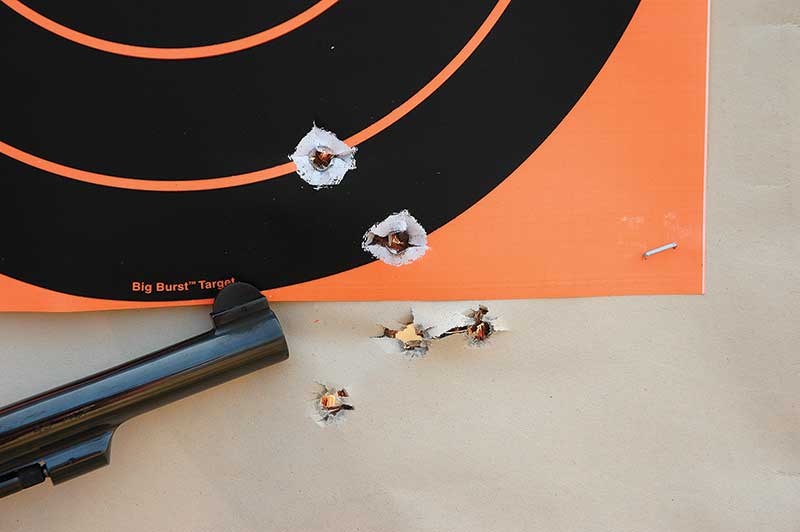
Point of impact with the blued 1917 (above) from handheld shooting at 50′ was on for elevation, but about 2″ right.
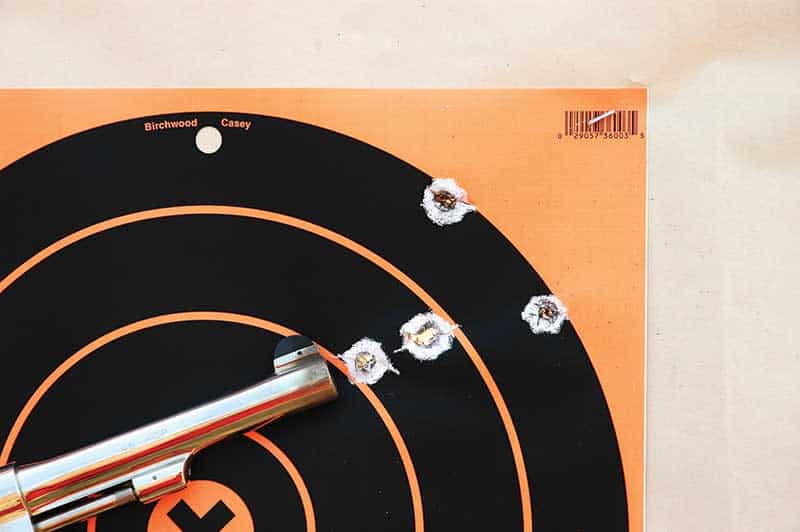
Point of impact with the nickeled 1917 (below) from handheld shooting at 50′ was 3-1/2″ high and 4″ right.
Interest Renewed
That’s the story of the Model 1917 revolvers in a nutshell, and such would be merely a historical footnote except for today’s management at Smith & Wesson. Not only have they developed such startling new things as super lightweight “Scandium” revolvers, but they are able to look backwards, too. That’s what I learned at SHOT Show 2007 when I dropped into their booth. There in a display case were three versions of a new Model 1917 — full blued, full nickel-plated, and a rather odd duck, a Model 1917 with color case hardened frame. I immediately informed our esteemed editor at the time, “Hey, I get to do the new S&W 1917s!”
And they were delivered into my awaiting mitts. The original Smith & Wesson military Model 1917s were all of a type. They were blued with 5-1/2″ barrels, smooth walnut stocks, color case-hardened trigger and hammer and a lanyard ring in the butt.
Sights consisted of Smith & Wesson’s distinctive “half-moon” front with a groove down the revolver’s topstrap for a rear one. After the Model 1917 turned commercial, about the only thing changed was the stocks were checkered and they later evolved into the more hand-filling Magna-style walnut type. In Roy Jinks’ book History Of Smith & Wesson, there is no mention made of commercially sold Model 1917s being nickel-plated, but it is certain the later Model 1950 Military was offered so finished.
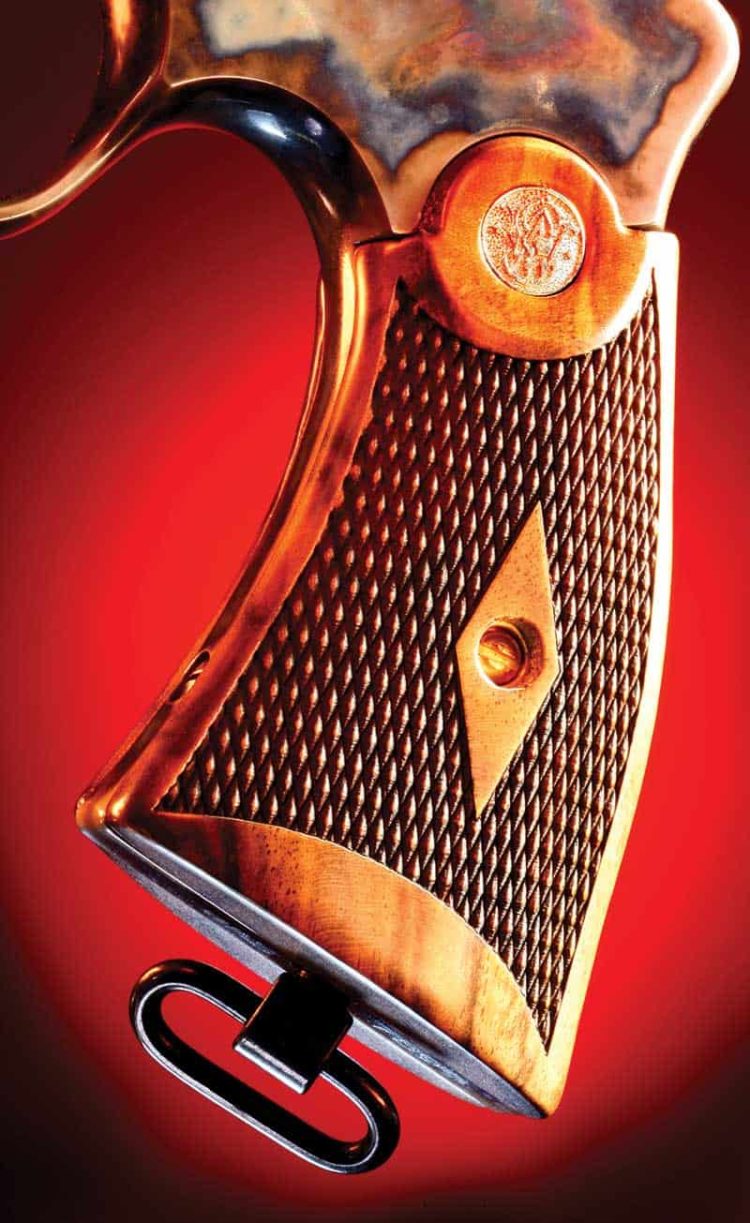
Unlike the original M1917, this one has a frame-mounted firing pin and a lock just above the cylinder release.
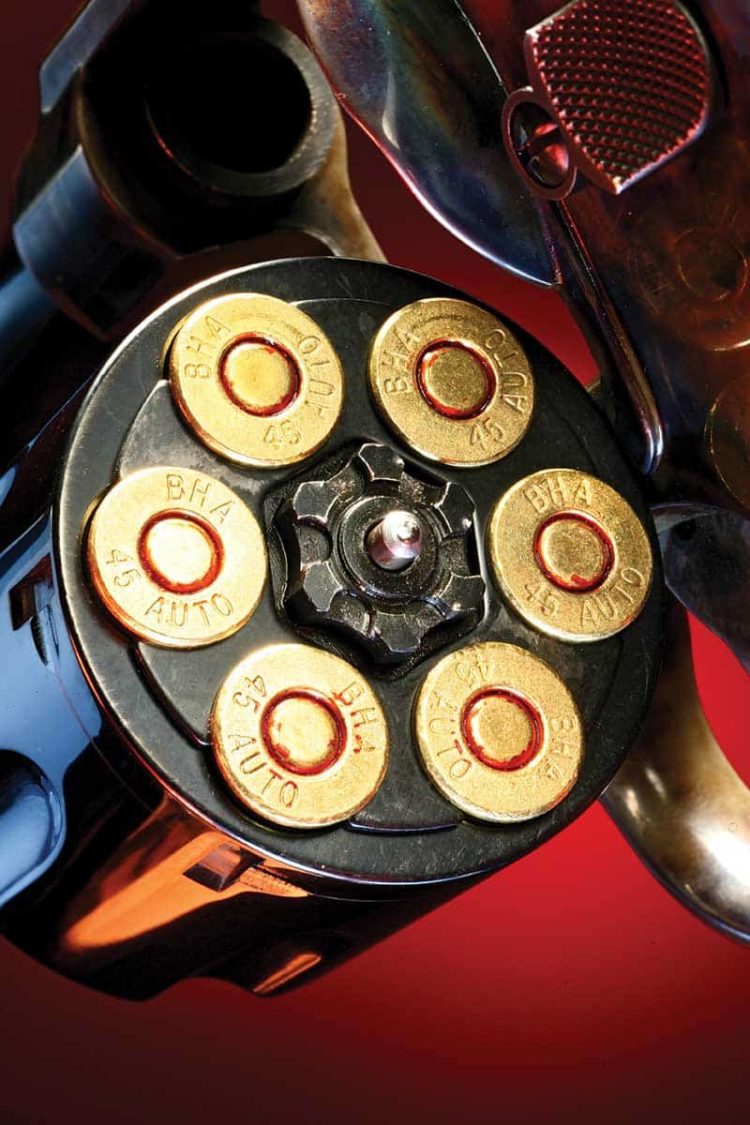
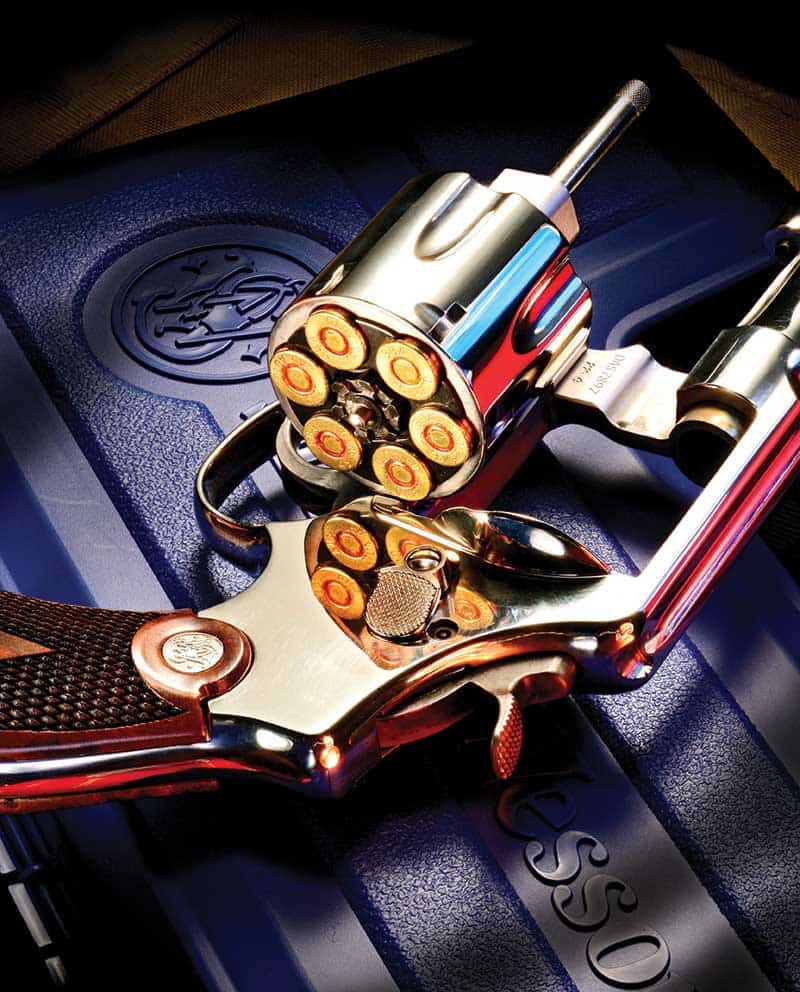
All military models featured lanyard rings (above) and this reintroduction does too. The nicely fitted
grips are by Altamont. Extraction with the rimless .45 ACP rounds is accomplished by using either
full-moon clips (shown below) or half-moon clips.
The Same, But Different
Externally, the new Smith & Wesson Model 1917s are similar, but not dead-ringers for vintage ones. I have a World War I vintage Model 1917 in my collection, so I was able to compare them. The hammer spur on the new 1917s are .400″ wide, while the originals were a narrow .26″. Both types were checkered though. The front sight on the vintage 1917 was forged integral with the barrel. With the new revolver, the sight base is integral with the barrel, but the sight blade itself is pinned in. Both types have the old half-moon shaped front sight with the original being .073″ wide and the new one .125″.
Even the grips on the new gun duplicate those slender checkered-style types found on early commercially sold Model 1917s. And both models have the un-shrouded ejector rod incorporated in N-frame Smith & Wesson revolvers circa 1916. One really surprising item was the fact the new Model 1917s have the fourth screw on the revolver’s sideplate, the one high up, discontinued on N-frames way back in the 1950s.
The biggest difference on the new 1917s a discerning buyer will notice is the new key-lock slot on the left side of the frame just above the cylinder release button. Like just about everyone else on the planet, I don’t like it, but it’s a lawyer-mandated thing and we’re just going to have to live with it. Also, the new Model 1917s don’t have the firing pin mounted on the hammer. Instead, it is frame mounted, but since such a thing isn’t visible when the revolver is being fired, it doesn’t bother me as much.
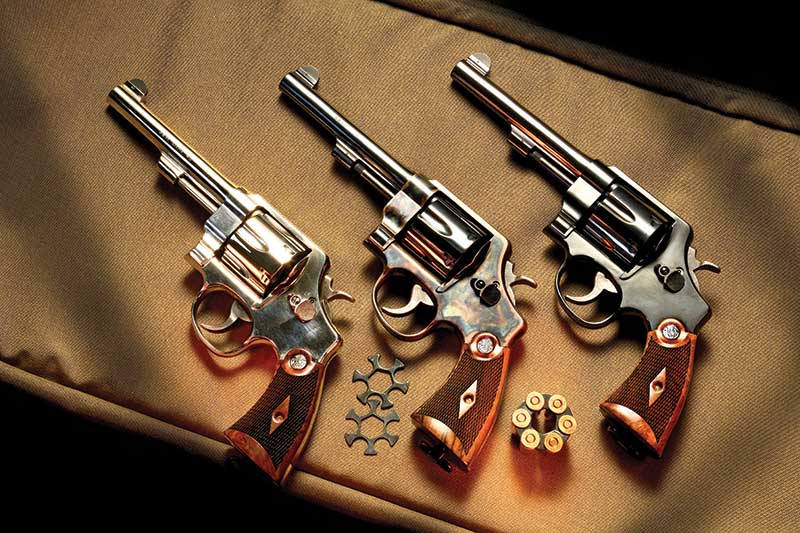
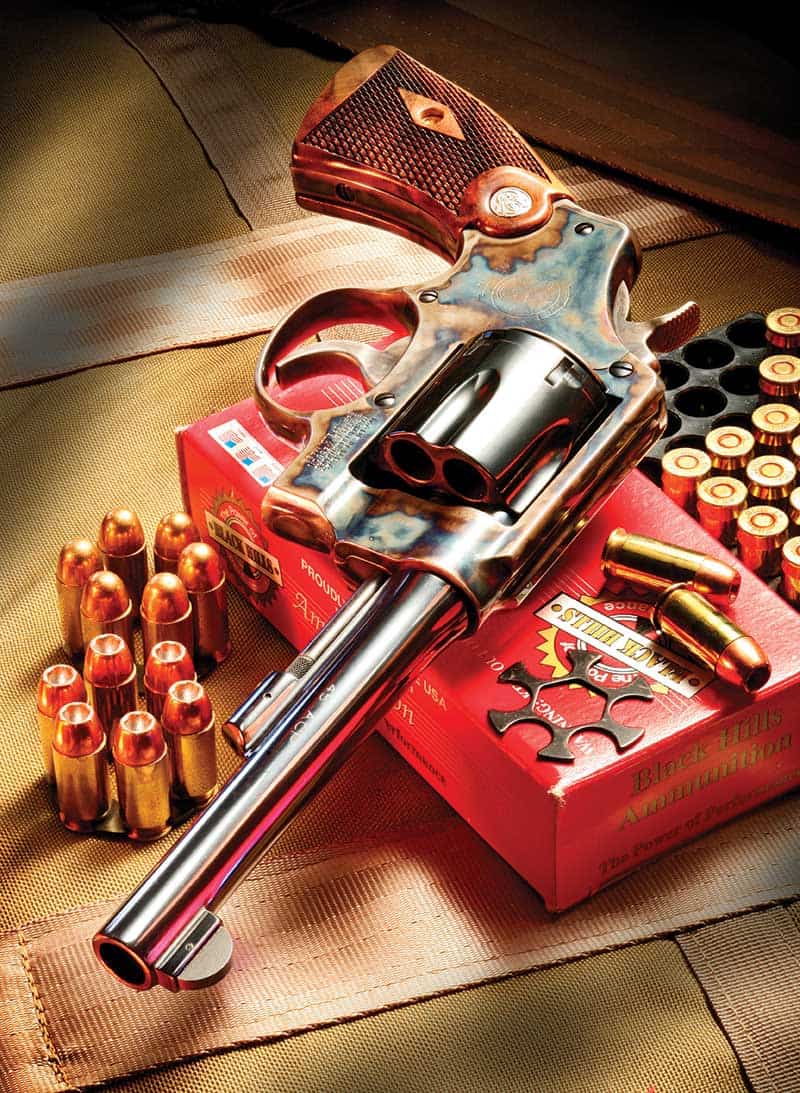
The new M1917 comes finished in either full blue like the military models, nickel
plated or with a case hardened frame and case and blue cylinder barrel.
Tight Fit
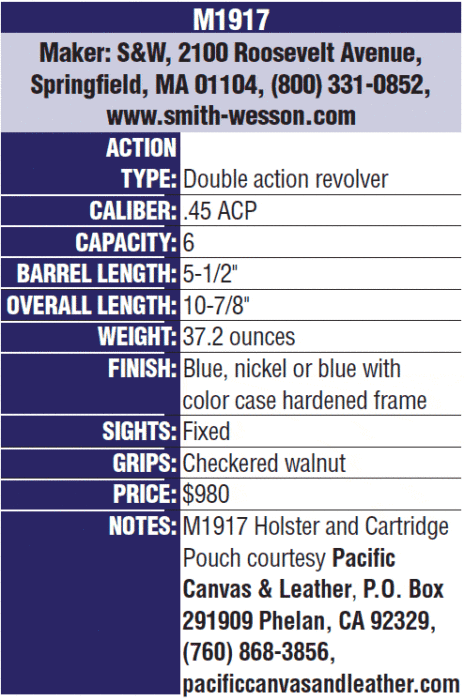
The barrel cylinder gap on the new blued Model 1917 is very tight. It will accept a .003″ feeler gauge but not a .004″ one. By comparison, my 90-year-old original will accept a .011″ gauge, but not a .012″ one. Trigger pull on the new blued Model 1917 is 5-1/2 pounds but crisp. Trigger pull on the new nickeled 1917 is 5-1/4 pounds and I didn’t measure the pull on the color case hardened one for a reason to be pointed out shortly. I can’t measure a trigger pull as heavy as double action ones always are, but these new ones are smooth and not overly heavy. Fit and finish of all three of these new Model 1917s are nice. The edges have not been overly buffed in the polishing process, and the checkered grips fit the grip frames nicely.
I like the blued version much. I like the nickel-plated one almost as much. Being a traditionalist, I don’t personally like the case hardened one, but it’s done well and may appeal to you. Historically, Smith & Wesson never color case-hardened the frames of their revolvers. They were either blued or nickel plated with color case-hardened triggers and hammers. Colt was the manufacturer set on color case hardening revolver frames, but even then mostly just their single actions.
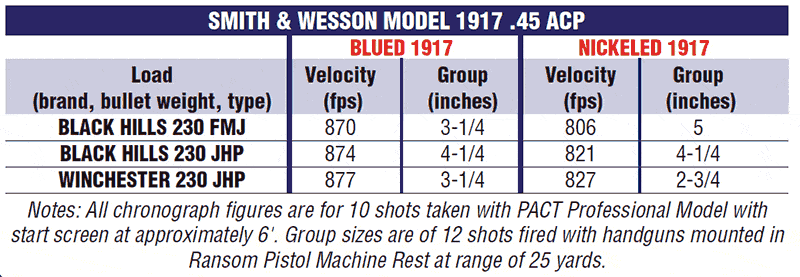
All the firing was done with the blue and nickel-plated versions. In the beginning my intention was to only use 230-grain FMJ factory loads in these guns, as that is the type of ammunition they were designed around back in 1917. But when I looked at my ammo shed, the only load on hand was by Black Hills Ammunition. Therefore I expanded things a bit and included 230-grain JHPs by both Black Hills and Winchester.
First shooting was done with the revolver mounted in a Ransom Pistol Machine Rest to see the basic level of mechanical accuracy of which it was capable. I wish I could report these new Model 1917s were tackdrivers, but alas, they weren’t particularly accurate revolvers. Neither have been the other two or three Smith & Wesson Model 1917s I’ve owned over the last 40 years and my Model 1950 Military/Model 22. Twelve-shot groups at 25 yards were running in the 3″ range with one or two going under that and another one or two going over. Three-inch groups are not horrible, but not spectacularly precise either.
Next, shooting was done at paper targets, steel dueling trees and ordinary chunks of firewood with the new Model 1917 held in my own two mitts. Neither 1917 hit point of aim, but the blued one was closest. Fired from 50′ it was on for elevation but approximately 2″ right for windage. The nickeled one’s point of impact was 3-1/2″ high and a full 4″ right of center. This shooting was with 230-grain FMJ “ball” from Black Hills Ammunition. Fixed sight revolvers can be sighted in; I’ve done many, but it is always nice if they are pretty close right out of the box.
My first S&W 1917 came to me in a gun trade in 1968 and in the nearly 40 years since I’ve owned a few others. They’re not the most practical handgun for most shooting purposes but neither are Colt SAAs, M1 Garands, or just about any other firearm once a military weapon. But, they are historical and always interest a good segment of the shooting community as I’m sure these Smith & Wesson Model 1917s have.
Categories
AC-47 Spooky – In The Movies
Categories
Cimarron Doc Holliday Shotgun
Categories
WKRP Turkey Drop
.gif)
.gif)
.gif)
.gif)


Handgun stopping power is a matter of the speed of incapacitation of a deadly human opponent. The point is to cause a bad guy to cease hostile action, even though he does not not want to. Whether he later dies or eventually recovers is a moot point in this discussion. We usually talk about “one shot stops,” since the cumulative effect of several shots doesn’t tell you much about the real stopping power of a given load.
Empty a 10 shot .22 LR autoloader into an assailant’s lungs and, obviously, a lot more damage will be done than if you only shoot him once. The problem is that you may not have time for 10 aimed shots, or there may be more than one assailant. If you hit a bad guy in the chest with your first shot from a .22 and he returns fire with a .357 Magnum, you could be in trouble! Thus, first shot stopping power is critical, as you may not get a second shot if the first one fails to incapacitate your opponent.
The first somewhat systematic and recorded attempt to test handgun stopping power in the U.S. (at least that I know about) was the Thompson-LeGarde tests of 1904. These were conducted to evaluate a small number of handgun calibers with a view to adoption by the U.S. military. Only round nose lead (RNL) and full metal jacket (FMJ) bullets were used in Thompson-LeGarde, which is an immediate problem, since few use these loads today for personal protection. Such projectiles have been conclusively proven very inferior in terminal performance to jacketed hollow point (JHP) and other modern bullet designs.
The Thompson-LeGarde tests are the underpinning of the Hatcher Relative Stopping Power Formula, Jeff Cooper’s Short Form, the Taylor Short Form and many other attempts at estimating handgun stopping power. Unfortunately, although many still don’t realize it, the Thompson-LeGarde tests were fatally flawed and revealed nothing about handgun stopping power.
The first test protocol involved shooting hung human cadavers and attempting to measure the swing imparted by the impact of a pistol bullet. No rigorous attempt was made to choose corpses of identical size and weight. No examination of the permanent crush cavity caused by the bullet’s impact was made. Nor was there any attempt to determine if this test had any scientific correlation with actual stopping power. (You will probably not be surprised to find that it doesn’t.)
The second test protocol involved shooting live cattle with the same small number of handgun calibers and loads. (I believe this took place at a slaughter house.) No attempt was made to differentiate between the sex of the animals, their size, or their vitality. Nor was their any attempt to standardize the number of shots fired at any one animal. Some were shot once, some twice and some animals were shot three (or possibly more) times. Thus, any comparison of loads was fatally flawed from the outset.
If you actually read the raw Thompson-LeGarde data, you will discover that almost all of the animals were finally put down by a sledgehammer blow, not their pistol wounds. I read the results of the individual steer tests and the only steer I remember being killed outright by a bullet was hit with a high velocity round from a .30 Mauser pistol, which created secondary bone fragments that quickly killed the animal. However, Thompson and LeGarde ignored this favorable result and did not conclude that the U.S. military should adopt the .30 Mauser cartridge.
These unfortunate bovines were vastly bigger and physically very different from human beings, which means that even had the Thompson-LeGarde testing on live steers been a carefully controlled study, which it was not, the results were inherently meaningless if applied to humans. The only valid conclusion based on the Thompson-LeGarde steer shootings is that no handgun caliber tested was effective at “stopping” bovines.
However, Thompson and LeGarde were strong proponents of a .45 caliber service pistol, so they summarized their non-results to make it appear that the .45 was more effective than smaller calibers and this erroneous conclusion, based on these very seriously flawed tests, has been accepted as Gospel ever since by many big bore advocates.
In particular, Colonel Hatcher extrapolated from the Thompson-LeGarde non-results his formula for Relative Stopping Power, to which he added bullet form coefficients based entirely on his personal and subjective opinion about the effect of bullet material (lead or FMJ) and nose shapes (mostly RN and flat point variations) on stopping power. Hatcher completely ignored expanding bullets of any sort in devising his formula. The result was rating the .45 ACP, 230 grain RN/FMJ service load a 95% effective one shot man stopper, which is a huge over estimation of that load’s actual effectiveness. The bottom line is that the Hatcher formula, based as it was on Thompson-LeGarde extrapolated into a mathematical formula, is worthless for comparing the actual stopping power of various handgun calibers and loads.
Jeff Cooper, one of the best and most persuasive gun writers of his generation, shortened the Hatcher Formula for easier calculation. Cooper also ignored the effects of bullet expansion and, in fact, wrote (incorrectly) that reliable bullet expansion was impossible to achieve at handgun impact velocities. His “short form” results were designed to mirror Hatcher results and they do. Unfortunately, that means that Cooper’s Short Form is as worthless as Hatcher’s long form.
Chuck Taylor’s Modified Short Form includes a slight compensation for bullet expansion at high impact velocity. However, it is also designed to mirror the Hatcher Relative Stopping Power formula results and thus fatally flawed.
Thompson-LeGarde, Hatcher’s Relative Stopping Power, Taylor and Cooper’s Short Forms are all based on flawed data and heavily skewed in favor of bullet diameter, especially .45. (All of these fine men were strong proponents of .45 caliber pistols.) They are beloved and widely quoted by big bore advocates, who generally do not understand how limited, biased and invalid these attempts to compare handgun stopping power really are.
I have taken the time to explain these traditional measures of handgun stopping power and their failings, because they are still bandied about today. Far more worthwhile for evaluating handgun stopping power than Thompson-LeGarde, mathematical formulas and emotional appeal are controlled live animal tests using instrumented animals similar in size and lung capacity to human beings (the Strasbourg goat study), autopsy results from actual shootings, debriefing gunshot victims who later recovered, detailed analysis of police shooting records and repeatable tests of bullet terminal performance using calibrated ballistic gelatin (especially those that record/analyze both the temporary stretch cavity and permanent crush cavity). These methods can potentially, given an adequately large data base, produce a much higher correlation with reality and allow meaningful comparisons of various handgun calibers and loads.
The “bigger is better” concept, as applied to handgun caliber, has a strong emotional appeal. However, strong emotional appeal often has little positive correlation with science. Indeed, it may have a negative correlation with reality. Keep this in mind when evaluating handgun stopping power.
Back in the 1960’s, big bore fans asserted that .45 ACP 230 grain ball ammo would achieve 95% one shot stops. Subsequent research has shown that 230grain FMJ .45 ACP loads actually provide about 60-64% one shot stops and several smaller calibers using expanding bullets are more effective stoppers.
The most effective of all self-defense handgun cartridges, as this is written, is the medium bore .357 Magnum shooting a 125 grain JHP bullet, which provides 93-97% stops. These numbers are supported by a huge data base and several different researchers, working independently, have discovered essentially the same thing.
Bullet placement is, by far, the most important factor in stopping power. The assertion that a larger caliber somehow compensates for incorrect bullet placement is a dangerous fallacy, as well as logically flawed. Consider this: if a big bore shooter fails to get his bullet where it needs to go, he will end up just as dead as anyone else who loses a gunfight. What difference does it make whether a big bore pistol fails to achieve a stop and a criminal blows you away, or a smaller caliber fails to achieve a stop with the same result? Either way you didn’t stop the bad guy from hurting you.
Remember that bullet placement, not cartridge and load, is the most important factor in stopping power. Bigger may be a liability, not better, if it degrades the shooter’s ability to achieve the requisite accuracy and rate of fire due to excessive recoil and muzzle blast. These negatively impact the shooter both physically and psychologically. Anyone can shoot better with a cartridge/load that generates less blast and recoil.
Caliber (bullet cross-sectional area) is important, but it is only one factor among many that determine stopping power and that should be considered when choosing a personal protection cartridge and load. Bullet placement tops the list and terminal performance is more important than caliber.
You must also consider the sort of life and death situation you will most likely face. For example, military combat shootings usually involve cover (trenches, hardened structures and the like) and various sorts of barricades, including body armor, that the bullet may have to penetrate before reaching the intended target. By international agreement, military ammo is limited to non-expanding bullets (usually FMJ).
Given those conditions and limitations, the most significant factors in military pistol bullet design become sectional density (for penetration) and cross-sectional area (since expanding bullets are banned). Historical and anecdotal evidence based on military combat results, therefore, have very little relevance when choosing civilian self-defense ammunition.
Police shooting conditions are also liable to be quite different from typical civilian self-defense scenarios. When confronted by police, a violent bad guy involved in a shootout will often not be standing and facing the officer. There is a good chance that he will be moving, crouched, prone, sideways, or returning fire from around the corner of a building, wall, vehicle, tree, or other cover. Police ammunition must be designed to take this into consideration.
The FBI testing protocol developed after the April 1986 gunfight in south Florida has greatly influenced handgun bullet design. It was specifically intended to develop handgun loads optimized for police work. FBI/police spec ammo is now typically designed to shoot through walls, car bodies, wood, sheet metal, fiberglass and tempered glass.
Unfortunately, this much penetration could easily get a civilian into big trouble, both morally and legally, should there be an innocent bystander on the other side of those materials. Over-penetration is a very real problem in populated areas, particularly for apartment, condo, duplex and mobile home dwellers.
Typical civilian defensive ammunition requirements are quite different from police requirements. The bad guy is the aggressor, usually standing in the open and facing his intended victim at relatively short range. Civilian shootings are typically frontal shootings. This requires different bullet performance for optimum results.
Civilian defensive shooting conditions usually call for quick opening bullets that will put down bad guys in frontal shootings without exiting and penetrating the wall behind the bad guy, inadvertently wounding someone in the next room. This is why pre-fragmented loads, such as Glaser Safety Slugs, are often an appropriate and effective ammunition choice for many civilian self-defense situations.
Civilian gun owners should differentiate between ammo for concealed carry and ammo for home defense. The two situations are different and different loads may be required, depending on where you live and what you live in.
A single person living on a farm out in the country has more home defense latitude than the head of a family of eight living in an apartment complex in a big city. These factors should be taken into consideration when choosing carry and home defense handguns and the ammo to feed them. This is why “one size fits all” advice may be bad advice, regardless of what an ammo manufacturer’s advertising claims.
First of all, whatever self-defense ammunition you choose, make sure it functions reliably in your handgun. Ammunition for a concealed carry firearm might need to be more generalized than home defense ammo, since the external environment may vary greatly, unlike the inside of your home. Of course, the same load may serve both purposes, depending on your individual situation.
I generally prefer a JHP bullet designed for rapid expansion from a short barreled handgun for concealed carry, since that is the sort of gun I typically carry. My home defense gun has a standard length barrel, allowing me more latitude when choosing ammunition.
Here are some widely distributed, conventional factory loads (i.e. not specialty loads like Glaser, Powerball and MagSafe) from .22 LR to .45 Colt that have good track records for bullet expansion and comparative stopping power in their respective calibers. The loads are listed alphabetically by manufacturer for each caliber. (Note: this list is not intended to be a comprehensive list of every viable civilian self-defense load!)
- .22 LR – CCI Stinger 32 grain HP, Remington Yellow Jacket 33 grain HP
- .22 WMR – Hornady 45 grain FTX (mini revolvers), Speer 40 grain Gold Dot JHP (short barrel), Winchester Super-X 40 grain JHP (4″ barrel and longer)
- .25 ACP – Hornady 35 grain XTP, Speer 35 grain Gold Dot
- .32 ACP – Cor-Bon 60 grain JHP, Cor-Bon 60 grain DPX, Speer 60 grain Gold Dot, Winchester 60 grain Silvertip
- .32 H&R Magnum – Federal 85 grain JHP, Hornady 80 grain FTX
- .327 Magnum – Federal 85 grain Hydra-Shok, Speer 100 grain Gold Dot, Speer 115 grain Gold Dot
- .380 ACP – Hornady 90 grain FTX, Remington 88 grain JHP, Sig Sauer 90 grain V-Crown, Speer 90 grain Gold Dot, Winchester 85 grain Silvertip, Winchester 95 grain Defend, Winchester 95 grain PDX1
- 9x18mm Makarov – Hornady 95 grain FTX
- 9mm Luger – Cor-Bon 115 grain DPX, Federal 115 grain JHP, Federal 124 grain HST, Federal 147 grain HST, Remington 147 grain Golden Saber, Speer 115 grain Gold Dot, Winchester 147 grain Ranger T-series
- 9mm Luger +P – Barnes 115 grain TAC-XPD, Cor-Bon 115 grain JHP, Federal 124 grain HST, Federal 135 grain Tactical Bonded, Federal 147 grain HST, Federal 150 grain Micro HST, Hornady 135 grain FlexLock, Remington 115 grain JHP, Remington 124 grain Golden Saber
- .38 Special – Federal Nyclad 125 grain HP (snubby revolvers), Hornady 110 grain FTX, Remington 110 grain SJHP, Winchester 110 grain Silvertip, Winchester 130 grain Defend
- .38 Special +P – Cor-Bon 110 grain DPX, Cor-Bon 110 grain JHP, Cor-Bon 125 grain JHP, Federal 158 grain LHP, Remington 158 grain LHP, Sig-Sauer 125 grain V-Crown, Speer 125 grain Gold Dot, Winchester 130 grain Defend, Winchester 158 grain LHP
- .357 Sig – Cor-Bon 115 grain JHP, Cor-Bon 125 grain DPX, Cor-Bon 125 grain JHP, Hornady 135 grain FlexLock, Sig-Sauer 125 grain V-Crown, Speer 125 grain Gold Dot, Winchester 125 grain Defend
- .357 Magnum – Federal/Remington/Winchester 110 grain JHP’s (all), Cor-Bon/Federal/Remington/Sig-Sauer/Speer/Winchester 125 grain JHP’s (all), Federal 130 grain Hydra-Shok JHP, Hornady 125 grain FTX, Hornady 135 grain FlexLock, Speer 135 grain Gold Dot (short barrel), Winchester 145 grain Silvertip
- .40 S&W – Federal/Remington/Speer/Winchester 155 grain JHP’s (all), Barnes 140 grain Tac-XPD, Cor-Bon 135 grain JHP, Cor-Bon 140 grain DPX, Cor-Bon 150 grain JHP, Cor-Bon 165 grain JHP, Federal 135 grain Guard Dog, Federal 180 grain HST, Hornady 165 grain FTX, Remington 165 grain Golden Saber, Remington 180 grain Golden Saber, Remington 180 grain Golden Saber Bonded, Speer 180 grain Gold Dot, Speer 180 grain Gold Dot (short barrel), Winchester 165 grain PDX1, Winchester 180 grain Defend, Winchester 165 grain Ranger, Winchester 165 grain Ranger Bonded, Winchester 180 grain Ranger, Winchester 180 grain Ranger Bonded
- 10mm Auto – Cor-Bon 135 grain JHP, Cor-Bon 150 grain JHP, Cor-Bon 155 grain DPX, Cor-Bon 165 grain JHP, Hornady 155 grain XTP, Hornady 175 grain FlexLock, Sig Sauer 180 grain V-Crown, Winchester 175 grain Silvertip
- .41 Rem. Mag. – Cor-Bon 170 grain JHP, Cor-Bon 180 grain DPX, Federal 210 grain JHP, Winchester 170 grain Silvertip
- .44 Spec. – CCI-Blaser 200 grain Gold Dot, Cor-Bon 165 grain JHP, Cor-Bon 200 grain DPX, Hornady CD 165 grain FTX (short barrel), Sig Sauer 240 grain V-Crown, Speer 200 grain Gold Dot, Winchester 200 grain Silvertip
- .44 Rem. Mag. – Cor-Bon 165 grain JHP, Cor-Bon 225 grain DPX, Sig Sauer 240 grain V-Crown, Speer 200 grain Gold Dot (short barrel), Speer 210 grain Gold Dot, Winchester 210 grain Silvertip
- .45 ACP – Cor-Bon 160 grain DPX, Federal 165 grain Guard Dog, Federal 185 grain JHP, Federal 230 grain HST, Remington 185 grain Golden Saber, Remington 230 grain Golden Saber, Speer 185 grain Gold Dot , Speer 230 grain Gold Dot, Speer 230 grain Gold Dot (short barrel), Winchester 185 grain Silvertip, Winchester 230 grain Ranger
- .45 ACP +P – Cor-Bon 165 grain JHP, Cor-Bon 185 grain JHP, Cor-Bon 185 grain DPX, Cor-Bon 200 grain JHP, Cor-Bon 230 grain JHP, Federal 230 grain HST, Federal 230 grain Tactical Bonded, Hornady 220 grain FlexLock, Remington 185 grain Golden Saber, Speer 200 grain Gold Dot, Winchester 230 grain Ranger
- .45 Colt – Blazer 200 grain JHP, Federal 225 grain LHP, Hornady 185 grain FTX (short barrel), Sig Sauer 230 grain V-Crown, Speer 250 grain Gold Dot, Winchester 225 grain Silvertip, Winchester 225 grain Defender
- .45 Colt +P – Cor-Bon 200 grain JHP, Cor-Bon 225 grain DPX, Cor-Bon 240 grain JHP
The most commonly recommended calibers for concealed carry are .380 ACP, 9mm Luger, .38 Special, .357 Magnum, .40 S&W and .45 ACP. These are also respectable choices for home defense.
Obviously, more powerful calibers are preferable to the rimfire .22’s for personal protection. I included the rimfires on the list above, because they are so common. If a .22 is what you have, a .22 is what you must use and it is certainly better than hoping the police respond to a 911 call in time to save your life. (The odds of that happening are not encouraging in a critical situation.)
I don’t have much use for .25 ACP pistols and I do not own one. .22 Long Rifle hyper velocity HP loads and .22 WMR JHP loads are more effective than the .25 Auto cartridge and most pistols chambered for .25 ACP are also offered in .22 LR. North American Arms mini revolvers are available in both .22 LR and .22 WMR.
A similar situation applies to most .32 ACP pistols, because the same model pistol is usually available in the superior .380 ACP cartridge. (The common .380, 9mm and .38 cartridges actually use .355-.357 caliber bullets.) My advice would be to stick with the .22 WMR and hyper-velocity .22 LR rimfires, or go straight to the .35’s and forget the .25 and .32 autos.
The .32 H&R Magnum and .327 Federal Magnum revolver cartridges are a different matter. The .32 H&R packs about as much power as the .380 ACP or standard velocity .38 Special loads and the .327 packs a lot more. Note than any .327 revolver can also fire .32 H&R ammo.
The .327 Magnum is, in fact, really too powerful for small frame revolvers, such as the Ruger SP101 reviewed by Guns and Shooting Online. In a medium or large frame revolver the .327 is a potent weapon; it looks and performs like a scaled down .357 Magnum.
.327 Magnum factory loads are available with Federal Hydra-Shok and Speer Gold Dot JHP bullets and the cartridge provides plenty of velocity to initiate expansion. The Federal Premium Low Recoil load uses an 85 grain Hydra-Shok bullet at 1400 fps MV and 370 ft. lbs. ME. This outperforms full power .38 Special +P and 9mm Luger loads in velocity and kinetic energy. The full power Speer 100 and 115 grain Gold Dot HP factory loads (500 ft. lbs and 486 ft. lbs. ME, respectively) hit harder than 9mm +P loads and deliver similar energy on target to the .357 SIG and .40 S&W. This is a small bore to be reckoned with!
A top choice for use in .38 Special snub-nose revolvers is the Federal Premium 125 grain Nyclad LHP load. This is optimized for use in 2″ and 3″ barrels. In medium frame revolvers with 4″ or longer barrels one of the recommended +P loads is probably the best choice.
The .357 Magnum remains the most effective personal protection caliber of all. It is proven to be more effective than any of the larger caliber cartridges, including larger caliber magnums. All of the .357 loads listed above provide impressive stopping power. They also provide more muzzle flash and kick harder than standard calibers, so be sure you can deal with this before buying a .357 Magnum handgun.
It is difficult to overstate the importance of bullet placement in stopping power. You cannot miss fast enough to win a gunfight and merely wounding a determined opponent may give him time to kill you. You should be trying to shut him down immediately and that requires getting your first shot where it will do the most good. Have a working knowledge of human anatomy (the heart, for example, is lower and more centrally located than most folks realize), aim, focus on the front sight and squeeze the trigger. Refuse to lose. To paraphrase Bill Jordan, “Speed is wonderful, but accuracy is deadly.”
Any defensive firearm should be simple to operate, 100% reliable and deadly accurate. It should be chambered for a cartridge sufficient for its purpose that you can control.
My current favorite daily concealed carry gun is a .38 Special Ruger LCRx DA revolver (2″ barrel), which is normally loaded with Federal Premium 125 grain Nyclad HP cartridges. My primary home defense handgun is a .357 Magnum Ruger GP100 DA revolver (4″ barrel). The GP100 is loaded with .357 Magnum Winchester Personal Protection 110 grain JHP ammunition. Both of these revolvers are equipped with tritium night sights and a LaserGrip.
I am an experienced revolver guy and think these guns and loads are appropriate for my intended purposes. At home, the GP100 s backed-up by a 12 gauge Mossberg 500 riot shotgun. Naturally, being a gun writer, I have other alternatives and sometimes I employ them, depending on the circumstances. There are lots of viable gun and ammunition choices!