Month: November 2024
Categories
They seem friendly enough to me! NSFW










 A seaworthy replica of the Batavia was built in the 20th century.
Distilled to its essence, capitalism and communism fractionate based upon one overarching worldview. Now, I realize I’m oversimplifying. College professors and political scientists have built entire careers out of these nuances.
Despotic ideologues have slaughtered millions along the way. However, if you were called upon to compare and contrast the foundational differences between these disparate worldviews, I would propose that it is this: Capitalists believe that people are innately bad. Communists believe that people are innately good. Everything else stems from that.
By way of example, communists believe that, if left to their own devices, mankind will come together selflessly and work toward a common goal for the greater good. By contrast, capitalists espouse that humans will forever strive to improve their individual lot. As a card-carrying conservative capitalist myself, I can attest that communists are delusional and that human greed is the most powerful engine in the known universe.
Properly harnessed, however, capitalism has brought us such stuff as Mars robots, smartphones, supersonic airplanes, GPS-guided bombs and silicone breast implants. Now, to illustrate my point …
A 17th-Century Case Study
Launched in 1628, the Batavia was the flagship of the Dutch East India Company. On her maiden voyage, she carried 341 passengers and crew along with a dozen treasure chests full of silver and a load of precious gems. She was bound for Batavia, her namesake, in the Dutch East Indies. The mission was to deposit the passengers, swap the valuables for spices, and return to Europe, making the East India shareholders filthy rich in the process.
Unbeknownst to Capt. Francisco Pelsaert, an East India official named Jeronimus Cornelisz was plotting a mutiny. Cornelisz’s nefarious plan involved stealing the ship and associated swag and using it to embark on a newfound career in piracy. His ultimate life goal was to start a new nation someplace in his own image. Clearly, everyone involved was a devout capitalist.
The rumor was that Cornelisz sabotaged their navigation but legitimately screwed it up in the process. The Batavia subsequently struck Morning Reef near Beacon Island off the western coast of Australia. It took a while for the tides and surf to tear the ship apart. Of the 341 souls on board, 301 survived to reach the nearby island. The remaining 40 drowned. A fair amount of the original treasure that remained in the Batavia wreck has since been recovered. Photo by Guy de la Bedivere.
Things Get Real
These small islands offered no fresh water and little protein, aside from sea lions and birds. The captain and a small contingent struck out in a 30-foot longboat in search of Batavia and help. The rest of the survivors were left under the command of Jeronimus Cornelisz, who turned out to be a psychopath.
Cornelisz, the aspiring pirate, consolidated all weapons and food under his personal control. He then dispatched the soldiers in the group led by a man named Wiebbe Hayes in another small boat to nearby islands, ostensibly to find water. His tacit hope was that these 20 or so guys would just die.
With limited resources and a lot of mouths to feed, Cornelisz then directed his subordinates to start killing the survivors. At first, he contrived legal charges against his victims like theft or hoarding. Eventually, however, they began killing for fun. When the dust settled, Cornelisz and his band of cutthroats had murdered 110 men, women and children. A few of the comelier lasses they kept on as sex slaves.
Much to everyone’s surprise, the Hayes expedition did indeed find food and potable water on nearby West Wallabi Island. They communicated this back to the main group via prearranged smoke signals. Now Cornelisz was in a bit of a spot.
Meanwhile, after an arduous 33 days at sea in their small boat, Cpt. Pelsaert actually arrived at Batavia. The local Governor-General, Jan Peterson Coen, immediately gave him command of the ship Sardam. While his mission was to rescue the shipwreck survivors, the good governor also asked that he perhaps bring back all that treasure while he was at it. It took Pelsaert a further 30 days or so to find the right islands again.
At least one survivor of the massacre on Beacon Island made it over to West Wallabi with the horrific news. Hayes and his men had no weapons. They were, however, trained soldiers, so they set about building a fort and fashioning implements of violence from materials that had washed up from the wreck.
By now, Hayes’ troops were relatively well-fed, while those of Cornelis were quite peckish. Despite only one side having access to muskets, Hayes’ men successfully withstood several amphibious assaults. It was, however, quite the iffy thing. Much blood was spilled and in a most brutal fashion.
Hayes eventually took Cornelisz hostage just as the Sardam arrived. With the assistance of the guns and crew of the Sardam, Cornelisz’s mutineers were subdued. Here’s where the real fun began.
Actions Have Consequences …
Cpt. Pelsaert was none too pleased to hear the sordid details of what Cornelisz and company had been up to in his absence. He held a cursory trial and then remanded Cornelisz and his primary henchmen to nearby Seal Island. There, his sailors chopped off the offenders’ hands and hanged them to a man.
Two of the lesser mutineers, one of whom was a cabin boy named Jan Pelgrom de Bye, were marooned on the Australian mainland and never heard from again. These were actually the first two European criminals to be abandoned on this curious continent. There would eventually be many more.
The remaining mutineers were transported to Batavia for proper trials. Five were hanged. Several others were keelhauled, flogged or dropped from the yardarm. This last punishment involved being suspended from the ship’s superstructure by a rope and dunked repeatedly into the ocean while underway. Think waterboarding on steroids. Cornelisz’s primary lieutenant, Jacop Pietersz, was broken on the wheel. Being broken saw one lashed to a wagon wheel and having your arms and legs crushed and then threaded through the spokes. That would suck.
Ruminations
Of the original complement, only 122 survived to reach Batavia in peace. A subsequent tribunal found Cpt. Pelsaert to have been partially responsible for the chaos. He, therefore, had his financial assets seized. Pleaser succumbed to disease within a year. Wiebbe Hayes was promoted to sergeant and rightfully hailed a hero.
Over the course of four years in the early 1970s, the Batavia was raised and subsequently preserved in the Shipwreck Galleries in Freemantle, Western Australia. Preservationists recovered 20 tons of timber, an anchor, multiple cannons and scads of other ore mundane stuff, including four navigational astrolabes. The sordid story of the Batavia and her crew serves simply to illustrate that, if left to our own devices, human beings are indeed reliably bad.
BORN IN WAR, THIS JEWEL IS OFTEN
OVERSHADOWED BY THE 1ST AND 3RD MODELS

The first N-Frame was the Smith & Wesson Hand Ejector, 1st Model, often called the “Triple Lock” (left)
and this one is a rare target model. It was replaced at the behest of the British during WWI with the Hand Ejector, 2nd Model, which never got a nickname. Both of these are .44 Specials. Photos By Yvonne Venturino
It seems like we older gun’riters are forever fawning over the legendary Smith & Wesson “Triple Lock” which incidentally is called Hand Ejector, 1st Model by collectors. Perhaps it is because besides being the very first of S&W’s N-Frames sixguns, the Triple Lock was also the introductory vehicle for the .44 Smith & Wesson Special.
Then there is the Hand Ejector, 3rd Model also nicknamed Model 1926. Later the Hand Ejector 4th Model was introduced. It was divided into two variations with the names of 1950 Military for the fixed sight version and 1950 Target for ones with adjustable sights.
But what about the Hand Ejector, 2nd Model? It is seldom mentioned, never got a name and was just as good a revolver as the above mentioned ones and actually far more historical.
This particular handgun was introduced 100 years ago during World War I. The Brits got themselves enmeshed in Europe’s continental war, and as usual, were short of weapons. They contracted with S&W to alter the Hand Ejector, 1st Model to accommodate their rather puny .455 Webley ammunition, but wanted changes. They said that battlefield mud and debris would foul its special 3rd lock and the ejector rod’s protective shroud.
Perhaps more importantly S&W felt the Hand Ejector, 1st models were too expensive at $21. By removing the ejector rod’s shroud and the intricately machined 3rd lock on the crane they could reduce retail price to $19.
And so was born the Hand Ejector, 2nd Model. For the American market the primary caliber offered was .44 Special. Also some were made as .38-40, .44-40 and .45 Colt but they numbered only in the hundreds each. According to Roy Jinks’ History of Smith & Wesson, by September 1916 the company had produced 74,755 N-Frame revolvers in .455 caliber for the British. Of those, 69,755 were Hand Ejector, 2nd Models. The other 5,000 were Hand Ejector, 1st Models because the British didn’t want to wait for the changes being made to the 2nd model.
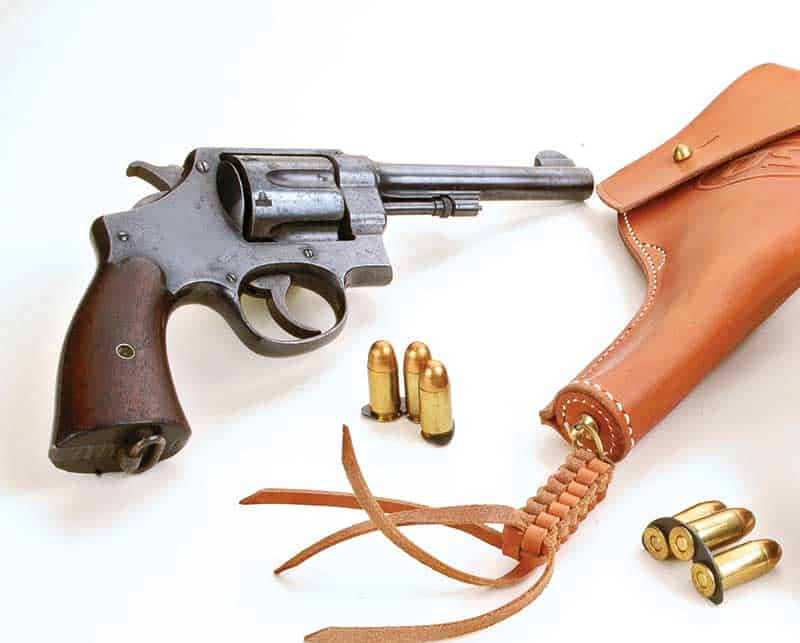
When entering WWI, the United States was desperately short of military handguns so they also
purchased Smith & Wesson’s Hand Ejector, 2nd Model when altered to accept .45 ACP.
All of those had 6-1/2-inch barrels, full blue finish except for the color case hardened trigger and hammer and a lanyard ring on the butt. Grips were checkered walnut and sights were S&W’s trademark “half-moon” front with groove in the frame’s topstrap for a rear. I have a sample in my collection that factory letters to the Canadian Government in 1916.
Even so, the military duty of Hand Ejector, 2nd Models was just beginning. Being almost as bad as the British for declaring war while lacking weapons, the United States entered WWI in April 1917. The US Army was desperate for handguns, so S&W was contracted to provide N-Frame revolvers altered to function with rimless .45 ACP cartridges—this was done by snapping the cases into little 3-round spring-steel clips. The Hand Ejector, 2nd Models were given the military designation of Model 1917. All were fitted with 5-1/2-inch barrels, lanyard rings and smooth walnut grips. Finish and sights were the same as for the Brit’s contract revolvers.
Production of Model 1917’s was enormous. Jinks’ book says 163,476 were made for the US Government in their own serial number range. Those are marked “United States Property” under their barrels as mine is. After WWI ended the company kept this model in their catalog until 1949 and produced about another 50,000. This order included 25,000 sold to the Brazilian Government in the late 1930’s, with many of those returning to the United States for the surplus market in the 1980’s. The commercially made Model 1917’s had checkered walnut grips instead of the military’s plain ones.
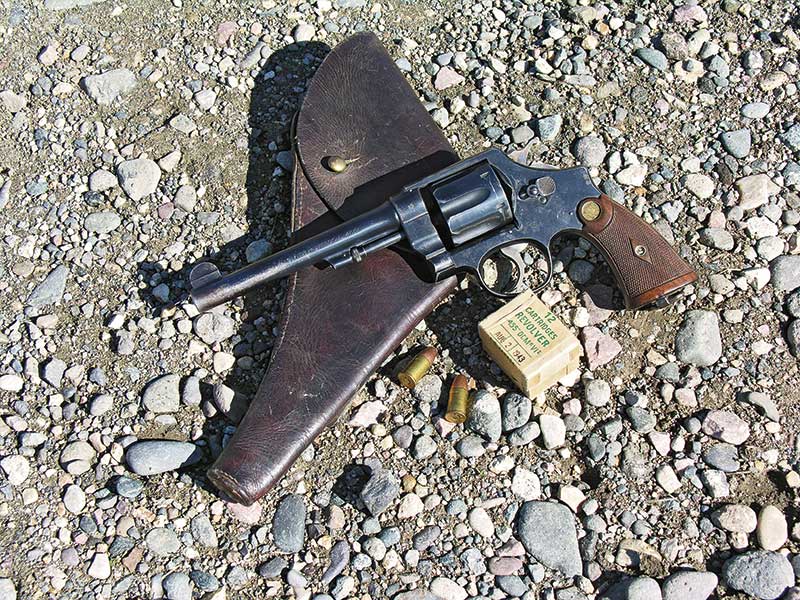
The British persuaded Smith & Wesson to alter their N-Frame design for the .455 Webley and then bought
thousands during WWI. This Hand Ejector, 2nd Model factory letters to the Canadian Government in 1916.
And that brings us back to the Hand Ejector, 2nd Model .44 Special. In nobody’s world could it be called a big selling item. It was dropped from the S&W catalog in 1940, and again referring to Jinks’ authoritative book, only 17,510 were sold in 25 years.
Barrel lengths offered were 4, 5 and 6-1/2 inches with full blue or full nickel for finish. Some were fitted with target sights but the vast majority had sights as described for the .455 variation. Grips were checkered walnut and lanyard rings were not standard. As interested as I have always been in N-Frame S&W handguns, I have never seen a Hand Ejector, 2nd Model in any barrel length but 6-1/2 inches, any finish but blue, any type of sights but fixed or any .38-40, .44-40, or .45 Colt chambering. (Original chambering that is. Many .455’s were rechambered to .45 Colt in bygone years.)
Nigh on 20 years ago I wandered into a nifty little gun store on a trip to Los Angeles. To my utter amazement, in the handgun case was a Hand Ejector, 2nd Model .44 Special, blue finish with 6-1/2-inch barrel. I paid for it and made arrangements for it to be (legally) shipped back to Montana. It took me years to get around to factory lettering it but upon doing so I learned it had been sent to Charleston, W. Va., in 1929. Having been born and raised in that state, the provenance of this revolver dictates I keep it forever.
Besides, it shoots pretty good!
Categories
Number of Deaths in World War 1
Categories
A letter from Michael
Categories
Now that is IMHO call a Gun!
.jpg)
Categories