Month: November 2024
 In a word, I had failed. My presentation to demonstrate a new satellite-based navigation system had been disapproved at the highest level of the Pentagon. The long table in front of my raised platform was populated with more generals, admirals and senior civilians than I had ever addressed. I was a very new colonel and the program director for the U.S. Air Force’s Project 621B.
It was August 1973, and I had just briefed a system design I had inherited, requesting approximately $150 million for a full-scale demonstration. I didn’t have time to contemplate my failure. Malcolm Currie, the undersecretary of the Defense Department controlling the military’s research and development funding, had chaired the meeting. Currie immediately asked me to join him alone in his third-floor Pentagon office.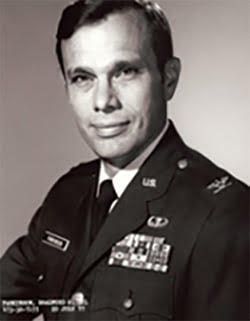
As a U.S. Air Force colonel in 1973, Brad Parkinson inherited Project 621B–a demonstration that led to the creation of the Global Positioning System. Credit: Courtesy of Brad Parkinson
About four months earlier, I had spent 2.5 hr. with him alone in my tiny office at Los Angeles AFB—an astonishing meeting, given the disparity in rank. I explained the tremendous value of a worldwide 3D positioning system. With a Stanford Ph.D. in guidance and control, I understood both the design and technology intimately. The system design could use refinement, but I had felt it would do for a demonstration.
In his office, Currie told me he strongly supported such a system, but he wanted an updated design that would satisfy the needs of all military services, suggesting I use the best technology I could find. He said he felt such a proposal could be approved.
We called that disapproval “Black Thursday,” but in a way, it was Golden Thursday. It led to the Global Positioning System (GPS).
I had been allowed to recruit a superb cadre of young Air Force officer-engineers. All had advanced degrees from outstanding schools. I resolved to call a redesign meeting, far away from potential opponents of change. We held that meeting in the Pentagon over the Labor Day weekend of 1973. The sole attendees were eight of my officer-engineers and two Aerospace Corp. engineers.
Nine years before that, Aerospace Corp. President Ivan Getting had advocated for a new satellite-based navigation system and persuaded the Air Force to fund a classified study of alternatives. This concluded with a description of about a dozen different satellite system designs and capabilities. The most difficult design required four satellites in the user’s view and predicted worldwide 24/7, three-dimensional accuracies of about 10 m (33 ft.). It would use orbiting, hardened atomic clocks. This would become GPS.
A competing Naval Research Lab (NRL) concept, Timation, was also included in the earlier study, six years before the NRL filed for a patent. The patent was finally issued to the Navy in 1974. (Evidently, the NRL was unaware of the earlier secret Air Force study.) That patent described a two-dimensional system that required an atomic clock in each user’s receiver. It was deemed too expensive and inadequate for general use, characteristics that ruled out the NRL concept in our redesign meeting.
Our weekend’s effort was outlined in a decision coordinating paper that summarized the new proposal. Civil use would be enabled by promulgating the details of a “clear” signal. From its inception, we intended to make GPS available for civil use, but with no guarantee on availability.
I then made repeated briefing trips to persuade the decision-makers not to say “no.” By mid-December 1973, I received approval for a $150 million program to demonstrate what we were by then calling GPS.
We went into a wartime development environment and launched the first operational GPS satellite in 44 months. By 1979, all seven types of user equipment had been tested and demonstrated in 11 different vehicles and circumstances. GPS had proven every claim that we had made for accuracy and coverage. It demonstrated bomb delivery and military vehicle location accuracy that far exceeded anything in the military’s inventory.
GPS was clearly a much better “mousetrap,” but the Air Force apparently did not want GPS. The service zeroed out the GPS budget for a series of years in the early 1980s. Fortunately, civilian leadership in the Pentagon and the White House overruled and restored the funding.
Even with the six-satellite test constellation, applications for time transfer to nanoseconds and the Precision Land Survey had begun by 1980. With 24 satellites, GPS was finally declared operational in December 1990. Demonstration of GPS’ value during the wars in Bosnia and Iraq completely reversed the views of the operational military. For the last 30 years, the 2nd Space Operations Sqdn. has been a fully dedicated GPS operator and steward for both civilian and military users worldwide.
Three events greatly accelerated GPS use. In 1983, then-President Ronald Reagan guaranteed GPS to the civilian world. In 2000, then-President Bill Clinton officially abandoned any deliberate degradation of accuracy. During the same period, integrated digital circuits drove down costs and greatly increased capability. Today a $5 GPS receiver can simultaneously receives more than 60 channels of GPS as well as the European, Russian and Chinese versions of global navigation satellite systems (GNSS). Typical accuracies are a few meters.
These three foundations assured civil GPS availability with full accuracy and with both the signals and receivers virtually free. They accelerated GPS adoption. Essentially every element of the U.S. critical infrastructure now depends on GPS. In 1978, I had forecast many applications, but the markets and manufacturers have far exceeded our dreams. The annual economic benefit has been estimated at well over a trillion dollars, without accounting for safety-of-life benefits. The farm tractor market alone is now $2 billion per year, with driverless control accuracies to a few inches.
However, the ubiquitous dependence on GPS has created concerns. A UK study estimated the economic impact to the country of a five-day disruption to GNSS would be £5.2 billion ($6.5 billion).
Perhaps the greatest technical reason for concern is that the received GPS signal power is tiny—just 1/10th of a millionth of a billionth of a watt (10-16 watts). (This signal comes from 45-watt satellite transmitters located 11,000 nm away.) Consequently, the weak GPS signal is vulnerable to deliberate or inadvertent interference. Some users have sought augmentations by using satellites at lower altitudes or ground-based radionavigation systems.
Such efforts are understandable, but the U.S. National Space-Based Positioning Navigation and Timing (PNT) Advisory Board has cautioned: “No current or foreseeable alternative to GNSS [primarily GPS] can deliver equivalent accuracy, integrity and worldwide 24/7 availability.” They advocate protecting the signal and toughening the user’s receivers to mitigate interference.
The single most effective toughening against GPS interference and false signals is the use of multi-element digital antenna arrays (DAA), which create “nulls” in the direction of jammers to greatly reduce their effectiveness. In 1975, I anticipated the jamming issue and enlisted the Air Force’s avionics laboratory to develop a GPS receiver that would demonstrate all the receiver techniques to counter jamming and spoofing. They partnered with Collins Radio, and by 1978 they demonstrated a GPS receiver that could operate while flying directly over a 10-kW jammer.
Unfortunately, State Department International Traffic in Arms Regulations (ITAR) preclude use of DAAs with more than three antenna elements for nonmilitary applications. While well-intentioned, the underlying design and technology of DAAs have been published extensively over the last 50 years, rendering this ITAR restriction ineffective in preventing their proliferation.
For example, Turkish company Tualcom currently offers a 16-element GPS antenna for any application or customer worldwide. Tualcom says it increases jam resistance by a factor of over 100,000. And with the advent of cheap digital components, arrays of up to 91 elements with about 1 m diameter have been considered.
The purpose of the ITAR restrictions—to withhold knowledge and technology from potential enemies—is totally futile, since both theory and implementation are widely available worldwide. By disallowing our use of these technologies, the government simply denies access to them by U.S. civil aviation and other key users. Unlimited DAA use could make these applications nearly immune to hostile or inadvertent interference. The ITAR restrictions certainly do not limit potential enemies. There is some evidence that the Russians are employing DAAs in the drones that are overflying Ukraine.
The world now has three other GPS clones. Civilians can freely use up to 10 signals on four frequencies from the four GPS-like constellations. Fifty or more navigation signals are typically accessible. All these developments would benefit from DAAs. These foreign systems clearly have a goal of surpassing the U.S. GPS.
Despite vulnerabilities, worldwide GPS applications continue to proliferate because of the economic productivity, safety and usefulness they offer. Many billions of cell phones routinely provide users with location to a few meters.
The 50th anniversary of GPS’ initial approval is an occasion for celebration but also a time to prepare for the future. The most important step is for the U.S. government to rescind all restrictions on DAAs. These restrictions are totally ineffective in preventing widespread proliferation of the best technology to toughen GPS against all forms of signal interference. Failure to rescind the restrictions will simply widen the gap, with other countries continuing to advance the well-understood state of the art and condemning U.S. aircraft to susceptibility to GPS jamming.
Perhaps the ultimate tribute to GPS is that knowledge of position is “taken for granted,” and billions of people worldwide use the system each day. Engineers accept anonymity as part of our profession; such widespread use is the cherished payoff for us developers. But “taken for granted’ will be misplaced if the U.S. does not remove the fetters on our receiver industry.
Brad Parkinson is co-director of the Stanford University Center for Position, Navigation and Time
Categories
Beginner’s Guide to Pistol Ammo
Categories
BLACKPOWDER 101 BY JOHN TAFFIN
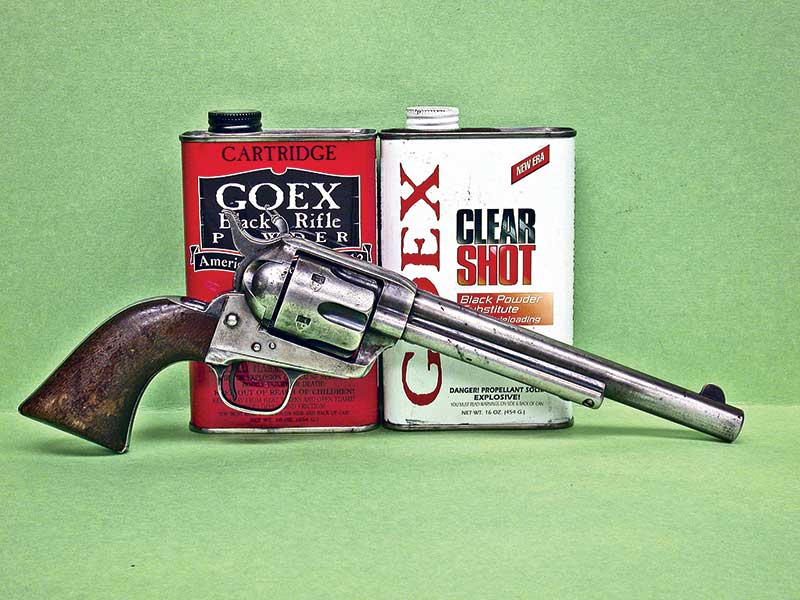
Colt Single Actions manufactured before 1900 should only be used with black powder such
as Goex or their substitute, such as Clear Shot or others.
Ken Wegman, a Handgunner reader, asked about using black powder and substitutes in modern pistols, comparing their characteristics in velocity, energy, accuracy, cleaning etc. along with a historical review of the actual black powder loads used in handgun calibers. Ken also wondered if there are special requirements/cautions when storing black powder and using modern reloading equipment with black powder? Great questions, Ken!
Historically speaking, black powder was the main propellant for firearms until well into the 20th century, with smokeless powder arriving in the 1880’s. Any Colt Single Action made before 1900 should be considered for black powder use only and all Smith & Wesson .44 and .45 Top-Break sixguns were manufactured for the use of black powder; this, of course, also applies to all percussion revolvers. The Smith & Wesson .44 Russian had a well-deserved reputation for accuracy with the records being set using black powder loads in the 1880’s which stood for decades.
When the Army tested the .45 Colt they had strict requirements for accuracy and Elmer Keith wrote of someone with a 71/2″ Cavalry Model being able to keep someone off of him firing at long range with black powder loads. I tested his theory using a 255-grain bullet loaded over 40.0 grains of black powder, again back in the time when I could really shoot, and I found at 50 yards I could keep them all in the head of a standard silhouette target, 100 yards saw them all go into the body and at 200 yards I could definitely keep the target pinned down until someone showed up who could really shoot. Black powder loads can be just as accurate, or more so, than current smokeless powder loads.
Measuring
All black powder loads, whether using actual black powder or substitutes, are measured by volume not by weight. Using a 40-grain volume measure I came up with the following weights: with black powder Goex FFg weighed 39.9 grains; Goex FFFg, 38.0 grains, and Goex Cartridge, 39.2 grains. Switching to the most popular substitute, Pyrodex P with a volume of 40 grains weighed only 29.6 grains while Pyrodex Select came in at only 25.5 grains.
Different loads will print to different points of impact on the target and only experience with one’s sixgun of choice can answer just what this will be. I did find using a 71/2″ .45 Colt with a 250-grain bullet, 35 grains of Goex Gartridge and Pyrodex P both shoot to the same point of aim with muzzle velocities of 873 fps and 929 respectively.
The original loads for both .45 Colt and .44-40 were 40 grains of black powder. Modern brass, with its solid head, will not hold this much powder, more like 35.0 to 37.0 grains is normal. I have tested the full 40.0-grain load in old balloon head brass and I can definitely tell you there was nothing wimpy about those original loads, with the .45 Colt doing about 900 fps and the .44-40 over 1,000 fps using modern black powder and magnum primers.
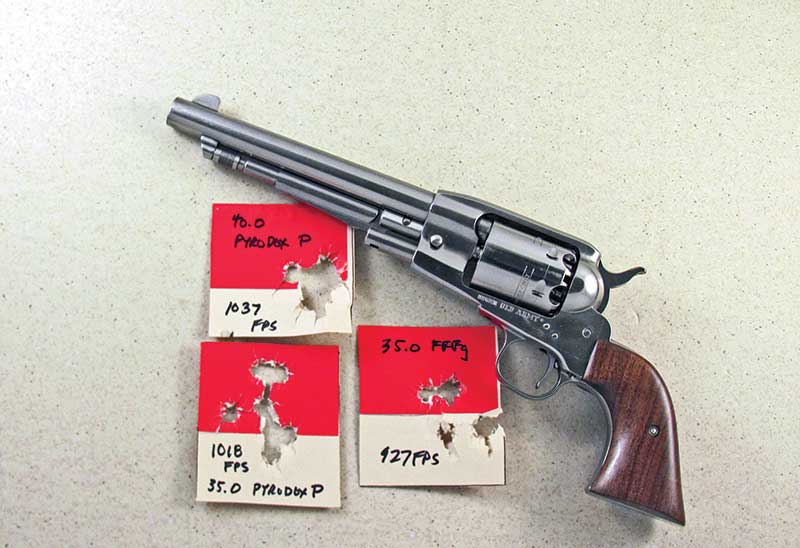 The Ruger Old Army is an exceptionally accurate black powder percussion revolver. Used ones
are still found regularly in gun stores so keep your eye open! John found three in the past year.
Loading/Cleaning
Loading black powder cartridges is not quite the same as loading modern smokeless powder. For best results, bullets chosen should be relatively soft and lubricated with a soft lube specifically designed for black powder use. I’ve found I get the best ignition and cleanest burning results using magnum primers. When shooting black powder loads I usually swab the barrel after each cylinder full.
Over the years I’ve found Windex works as good as anything for this and I simply spray a patch with Windex and run it down the bore. If the cylinder starts to get sluggish in its operation I simply spray Windex at the front and the back without removing the cylinder to clear out some of the fouling. I follow the same procedure when using percussion revolvers. With substitutes, such as Pyrodex, sixguns will normally go through longer strings before they need any attention. With Smith & Wesson replicas or originals fouling is much more pronounced than with a Colt Single Action or replicas.
When I first started shooting black powder there was only one cleaning agent I knew of — hot soapy water. Today there are several excellent black powder cleaning solutions available.
If I’m shooting a particular sixgun on a regular basis I thoroughly clean the cylinder and barrel and wipe down all the other parts after shooting. About every third time, I completely dismantle the sixgun and clean all the interior parts. If I’m going to put the sixgun back away after only one shooting session, I perform the same operation. Substitutes are much easier to clean, however they do require cleaning. My friend Ray and I traveled to Texas for a shooting match several years ago and using loads assembled with Hodgdon’s Triple Seven we found we had forgotten to bring along anything for cleaning. A bottle of Listerine worked just fine.
When shooting percussion revolvers, powder is first dispensed into the hand
powder measure on the left and then loaded into the percussion cylinder.
Cautions
When loading black powder cartridges I do not use a normal powder measure but rather the Lyman Black Powder Measure. People still argue about whether or not a spark is possible with the regular measure, which would ignite the black powder. I prefer to err on the side of caution and use only a powder measure designed for black powder use. When using percussion pistols I never load directly from the flask into the cylinder. The reason being there could be a spark lurking in the dark confines ready to give a very dangerous ka-boom.
Instead, the powder is first poured into a hand powder measure, and then only this one load is placed anywhere near the cylinder. I keep several brass flasks with a measuring spout for a particular amount of powder and then this is easily transferred into a hand powder measure. Or I use an adjustable hand powder measure to come up with the proper charge.
Lyman offers this Black Powder Measure for safely
dispensing black powder into the cartridge cases.
Dies
The same press and dies can be used for loading black powder cartridges as for those with smokeless powder. However, RCBS has special Cowboy Dies for .45 Colt, .45 Schofield, .44-40 and .38-40. These are designed to be used with the soft lead bullets normally used in loading black powder cartridges. Black powder substitutes are “probably” safe to use in a regular powder measure, however, since I already have a black powder measure I use it for substitutes too.
Black powder is classified as an explosive and must be handled as such. Always keep it in the original container, always keep the lid on when not actually transferring powder, and especially stay away from any type of spark. Black powder should be stored in its original container and also away from heat and any possibility of a spark. The back room off my garage is always cool and dry and this is where my powder is stored. Check with any local regulations through the fire department to make sure safety is being observed. I also do not like to have a large amount of black powder on hand, so when sample powders become more than I need for normal use I donate it to the local black powder club.
Many shooters will find black powder is not available in their area. We are fortunate to have a black powder club locally and they maintain a black powder storage facility at the shooting range well away from any activity. They sell black powder to members so I can get what I need at any time. At one time we had a local gun shop which also specialized in black powder and black powder accessories, however they are now gone and the large franchise shops only carry Pyrodex. The reason being black powder substitutes are not classified as an explosive and do not require the special handling reserved for black powder. Recently, ATF talked of classifying all powders as explosives, however, thankfully they did back off from that regulation; at least so far.
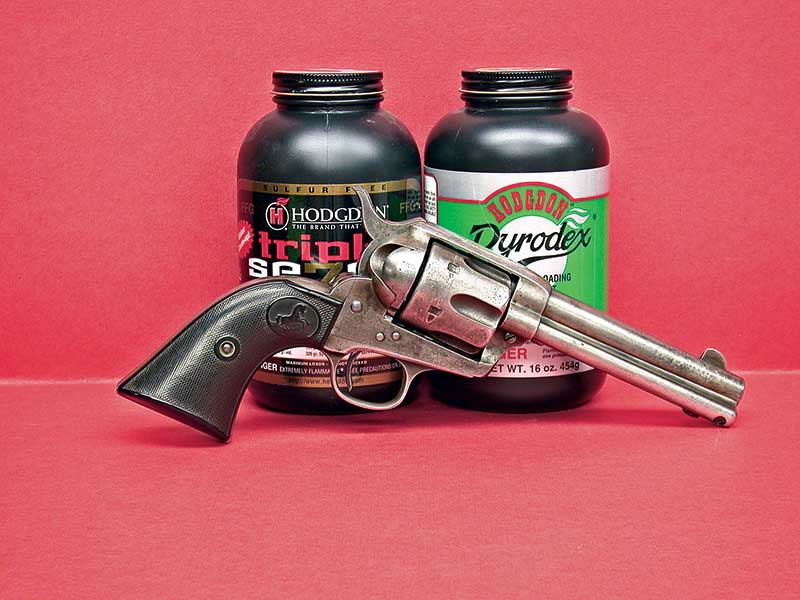 Black Powder substitutes such as Hodgdon’s Triple Seven or Pyrodex are measured and
loaded the same as “real” black powder but are not classified as “explosives.”
Accuracy
I earlier mentioned the accuracy of black powder loads. Ruger has dropped their Old Army percussion sixgun, however these show up from time to time in gun shops. I picked up three in the last year. They are exceptionally accurate revolvers when properly loaded and at the last State & Territorial Muzzle Loading match I attended and took part in, I shot my Old Army bullseye style, standing on my hind legs and shooting one-handed as required, and managed to shoot a 95×100 using a round ball and Pyrodex. The .45 Colt, .44-40 and especially the .38-40 and .44 Russian can be especially accurate using black powder or black powder substitutes.
Photo of a residential subdivision in Dubai, United Arab Emirates.
You can bet the place ain’t called “Levittown-East” however.
