Categories
All About Guns

3 Mausers: Rifles & Rounds Comparison by SAM WEITZNER

Review Leupold RX 1400I Lead

I have spent the majority of my life—since age 11—measuring land and distances as a land surveyor, and always I have tried to correlate things to hunting. Whether it be a bow shot on the longer side of things (when I was an archer as a younger man) or a rifle shot across the hay lots and orchards of the Hudson Valley, my mind always wandering to hunting deer. Our Topcon total station offered accurate measurements down to 1/16-inch but we would always play the “how far do you think that is” game. More often than not, we were grossly in error.

The first—and very crude—handheld rangefinder I ever used relied on differing focal points to establish distances, but it wasn’t very reliable, and while trying to check it, we found it wasn’t very accurate. It was good enough to measure the widths of streams and creeks which were impossible to ford, but which were required to be shown on a boundary map, but it surely wasn’t the kind of thing which I would say could help make a rifle shot at 400 yards.
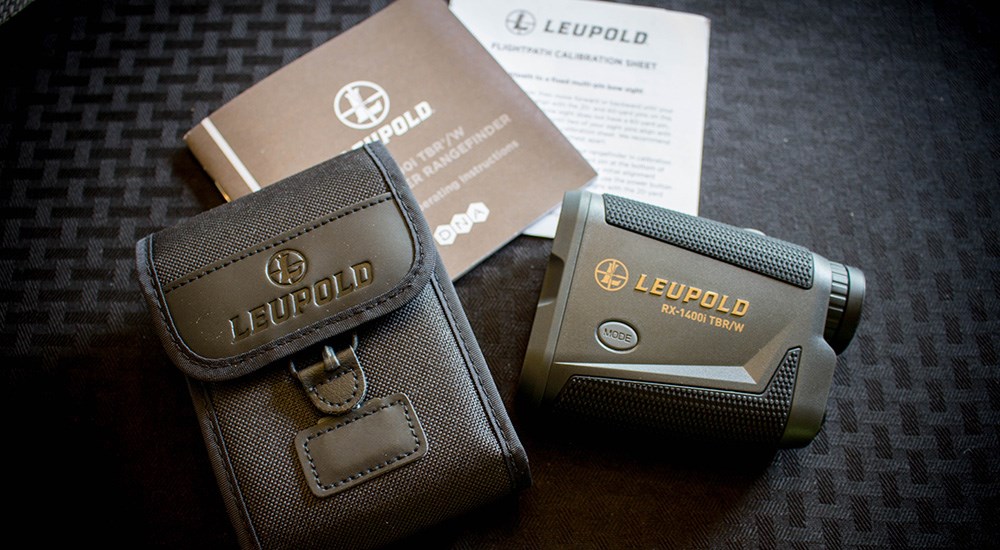
Leupold RX-1400i TBR/W Gen 2 Rangefinder with case and instruction booklet.

As we know, all of that has changed, and modern rangefinders are utterly reliable; while not all rangefinders are created equal, today’s inexpensive models are more accurate and reliable than the top-of-the-line models of thirty years ago. The higher end models are impressive, and if you practice with one, you will be surprised how accurate they are. I’m still a surveyor, and use a rangefinder almost on a nearly basis, whether looking for a property line marker or locating the edge of crop fields. Checking the little handheld units against the precision equipment we use, I find that many are good within a yard or two. Some brands and models are bulkier or heavier than others, and some offer wonderful blend of features and prolonged battery life in a light and compact package. At the head of the latter group, you’ll find the new Leupold RX-1400i TBR/W Gen 2.

For the hunter, the need to know the distance to your quarry is paramount, especially for the bowhunter whose arrow needs to take a more drastically arched path, or for those using the slower cartridges, like the newer developments for the Midwestern states. A 350 Legend or 360 Buckhammer is surely an effective cartridge, but the difference in trajectory between 200 and 225 yards can be more than appreciable. The Leupold RX-1400i TBR/W Gen 2 is a simple, affordable and effective solution to the vast majority of hunting trajectory problems, no matter what you’ve got in hand. Loaded with the TBR/W (True Ballistic Range with Wind) ballistic compensation technology, the RX-1400i offers the same ballistic solutions that the first generation model did, with 25 trajectory curves which will surely match your chosen rifle load. The unit stays off until the top-mounted power button is pressed, and a second press of the button will range your target. It is powered by a single Lithium CR2 battery; which is provided with the unit.
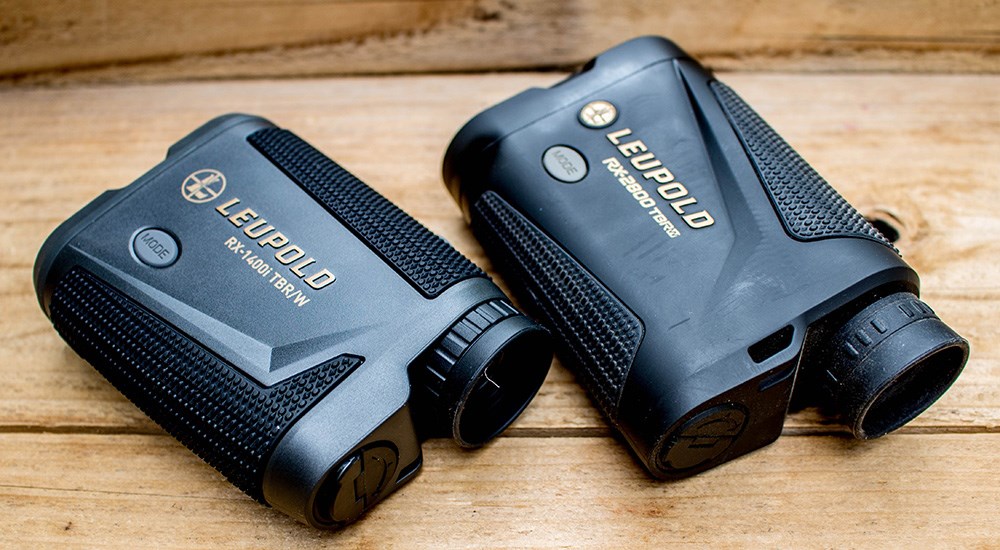
Leupold RX-1400i TBR/W Gen 2 and RX-2800 rangefinders.

While I have been an unabashed devotee of the RX-2800 TBR/W—which is amazing at ranging truly long distances—the RX-1400i is noticeably lighter and smaller, not to mention considerably more affordable. Weighing 5.1 ounces (compared to the RX-2800’s 7.9 ounces), and measuring 4 x 1.4 x 3 inches, the unit fits nicely in a short pocket, and isn’t a burden to carry at all. The archery crowd will be happy to see the bow mode, as it will display a horizontal bar at the arrow’s highest point of trajectory, so the user can quickly get a visual determination of any possible obstruction in the flight path. Handy tool, if you ask me.

Putting the unit into practical application, I took the 1400i into the August woods of Upstate New York, in thick terrain with the beeches, striped maples and other large-leafed trees in full regalia, and used my dear father as my “deer,” with the unit in Last Target mode, using only the last target reflected. We were actually roughly laying out a very old survey from the late 1800s, and I was using the 1400i to keep track of distances. I was extremely impressed how the unit measured to Deer Dad without catching the vegetation; in fact only twice during the course of nearly fifty measurements did I catch a branch or clump of leaves.
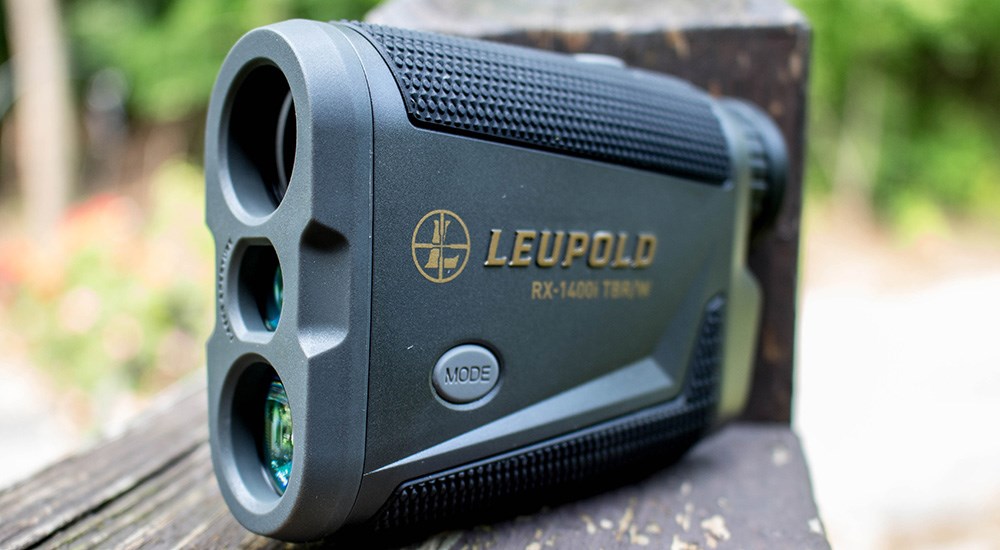
Leupold RX-1400i TBR/W Gen 2 laser rangefinder front view.

Using the side mounted Mode button to scroll through the options, you can easily switch between measuring in yards or meters, change the intensity of the red display (even the low setting was easily visible in bright sunlight), or even choose between one of three crosshairs. You may toggle between bow mode and rifle mode, or choose the innovative Last Target mode, which helps establish a proper reading in rain, snow or foggy conditions. You may choose between Line of Sight mode—measuring in a straight line without compensation for incline or decline—or allow the unit to make the adjustment for uphill/downhill shots. The 5x magnification is enough to ensure you’re ranging what you’re aiming at, yet not so high-powered as to pose an issue finding a deer or bear in thicker vegetation at closer ranges.

The RX-1400i Gen 2 will give accurate readings out to 1,400 yards on highly reflective objects such as road signs or buildings (knowing you’re more than the legal minimum distance from a dwelling is reassuring when hunting in more populated areas). On vegetation, such as trees to hedge rows, it’ll read out to 1,200 yards, and on deer and similar-sized game the unit will give readings out 900 yards, making it an absolutely perfect choice for the hunter. Oh, did I mention the price point of $199.99? For the price of a nice dinner out, you can range your deer in perfect confidence, with a unit packed with features, which is impervious to the elements. Good job, Leupold; you’ve got a winner here.

Categories
All About Guns

The Baby Browning: A .25 ACP Pocket Pistol For Personal Protection by B. GIL HORMAN

horman-babybrowning-1.jpg

Ever since I began my study of defensive handguns, I’ve been fascinated with pocket pistols. These are the smallest of the small semi-automatics designed to be discreetly concealed for up close-and-personal defensive situations. I believe my preoccupation with petite pocketables can be traced back to one gun in particular: the Baby Browning .25 ACP. Not only is it an exceptionally well-made example of the vest pocket size pistols of the mid-20th century, it’s also a little piece of family history as well.

The story begins with John Moses Browning, the famous inventor of the 1911 pistol. He designed the .25 ACP (6.35×16 mm SR) semi-rimmed pistol cartridge for what would become the M1905 Vest Pocket pistol. It was literally designed to fit in a business man’s vest pocket, the one usually reserved for coins. By 1931, Fabrique Nationale d’Armes de Guerre in Herstal, Belgium (FN) launched an even smaller .25 ACP pistol developed by the company’s chief designer, Dieudonné Saive.

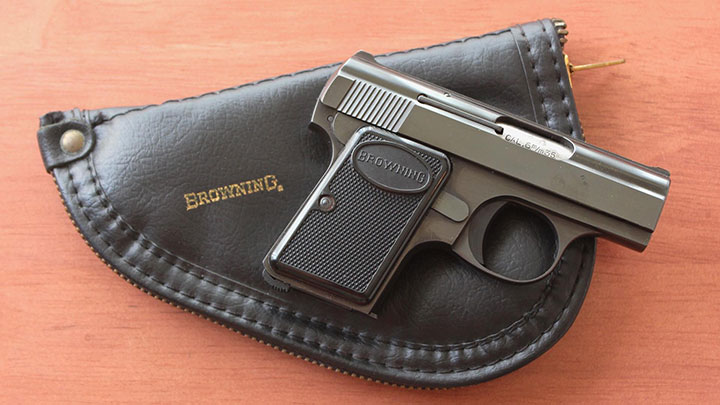
The Baby Browning in .25 ACP.

The Baby Browning in .25 ACP.

It was dubbed the Baby Browning for the market cachet his name offered, even though Mr. Browning had passed away in 1926. It is a simpler and more refined pistol than the 1905 with features that included a magazine safety and a more intuitive external thumb safety lever, which was moved from the slide down behind the trigger guard. The Baby Browning finally made its way into the U.S. market when the Browning Arms Co. decided to carry it in 1954.

It was a popular seller for several years because of its small size, reliability and high quality of manufacture. However, when the Gun Control Act of 1968 kicked into gear, the Baby Browning was among those small defensive handguns banned from importation. FN continued to make it until 1979, including beautifully hand engraved Renaissance models and the Lightweight version with its 6061-T6-aluminum frame.

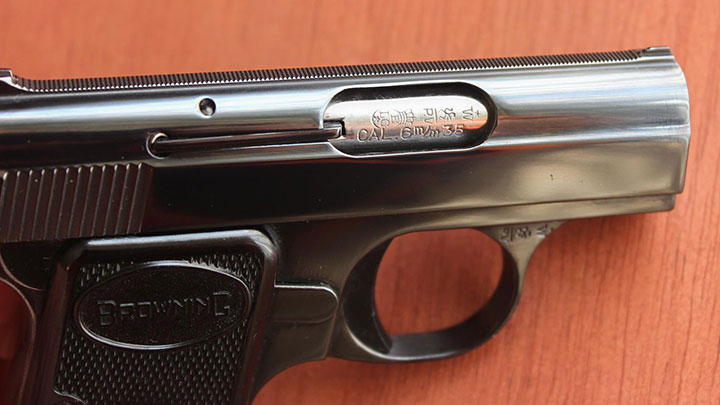
A closer look at the chamber markings on the Baby Browning.

A closer look at the chamber markings on the Baby Browning.

My family’s history with the Belgian Baby Browning began in the fall of 1969 with the purchase of a blued steel model made in 1968, which made it into the country just ahead of the ban. My dad had moved the family to Texas in order to participate in a lucrative construction project. Within a few weeks, he noticed irregularities in the staff, work arrangements and inventory provided by the project’s partners.

Most of the supervisors had no construction background, whole truck loads of building materials mysteriously disappeared from secured work sites and so on. Some additional digging on his part revealed that what seemed like poor management on the partner’s part turned out to be company-wide corruption involving kick-backs, bribery and theft.

A size comparison of the Baby Browning to a hand.

A size comparison of the Baby Browning to a hand.

Since he didn’t have the kind of hard evidence needed to prove the presence of the corruption he had uncovered, he used his authority as the General Superintendent to tackle the problems on his own. But he soon learned that he had kicked a hornet’s nest filled with con-men and fresh-from-prison felons working to establish a foot-hold in Texas for a well-known crime syndicate.

There was an ‘accident’ at a worksite that almost put him in the hospital, a mysterious dent that appeared on his car while driving that was about the same size and shape as a rifle bullet. And then there was a late-night meeting that would have gone quite differently for my dad if not for a few ex-military members of his work crew that tagged along, just in case.

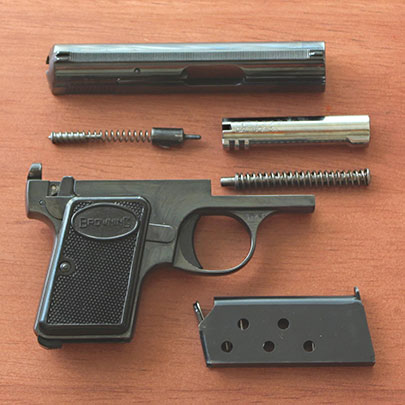
The Baby Browning disassembled.

The Baby Browning disassembled.

After that meeting, Dad decided he wasn’t going to continue with the construction project unless he was armed. Driving to a gun shop on the other side of town, he looked over the pistols they had in stock. A large, powerful handgun capable of medium- or long-range shots would not fit his needs. He wanted something he could always have on-hand in case of an up-close, short-range encounter. A small, lightweight pistol that could ride in the pocket of the sport coats he wore to work and church would have to do.

The pocket pistol options in the shop were limited.  Snub-nosed .38 Spl. revolvers produced a noticeable bulge. A Walther PPK was the right size and thickness for his pocket, but the weight of it caused a tell-tale sag. He kept looking until he found the Belgian Baby Browning . He wanted a quality gun with a name he could trust, and Browning was hard to beat. He paid around $50 for it, or about $350 in today’s dollars.

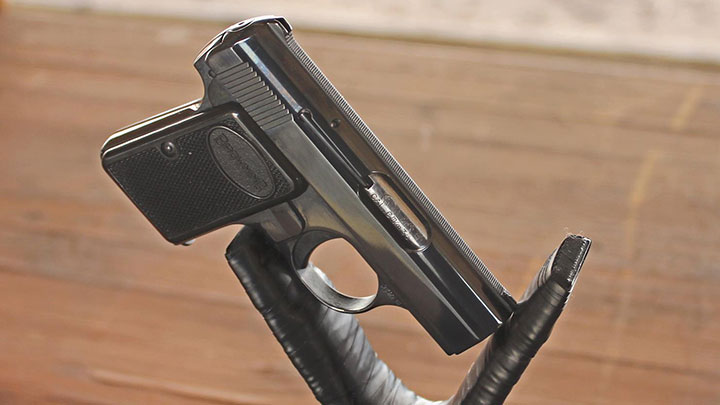
The Baby Browning on a pistol rest at the range.

The Baby Browning on a pistol rest at the range.

The simplicity and features of the Baby Browning are surprisingly satisfying to modern defensive pistol sensibilities for a 90-year-old design. This blow-back operated semi-automatic is striker fired with a single-action trigger, a cocked striker indicator and a magazine safety. The tiny fixed sights are the smallest I’ve ever seen on a handgun but the top strap of the rounded slide is serrated to reduce glare, just in case you want to squint at them.

The trigger exhibits a short, clean trigger pull of 5 lbs., 1 oz. The 1960s-era nylon impregnated black polymer grip plates are checkered with the word “Browning” in a circle at the top. The single-stack magazine holds six rounds of ammunition and is secured by a heel-mounted magazine release.

The pistol’s clean lines are appealing, and it has the precision machining of a Swiss watch. It’s one of the few .25 ACPs that can be counted on to run reliably. However, this is not the easiest pistol to master. The Baby Browning’s slick, thin grip frame only provides enough room for a one-finger grip. Therefore it tends to buck and twist when it recoils.

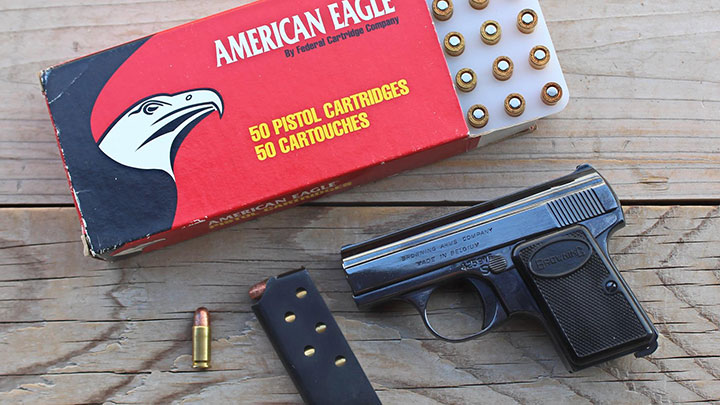
The Baby Browning and Federal American Eagle 50-gr. FMJ ammunition used in the accuracy test.

The Baby Browning and Federal American Eagle 50-gr. FMJ ammunition used in the accuracy test.

The lack of a beaver tail above the grip frame exposes the shooter’s hand to the sharp edges of the recoiling slide. As a result, it will ‘bark the skin’ off the shooting-hand thumb knuckle if the operator is not paying attention (the inside joke in my family is that the Baby’s slide bite is nearly as lethal as the cartridge it fires).

It’s been some time since I shot this pistol, and I had yet to chronograph it. I rustled up a box of Federal American Eagle 50 grain FMJ cartridges and a LabRadar chronograph and headed to the range. This load generated a 10-shot average muzzle velocity of 787 f.p.s. for 69-ft. lbs. of muzzle energy.  With the aid of a pistol rest, I was able to tap out a best single five-shot group of 2.29″ at 7 yards with a five-group average of 2.52″.

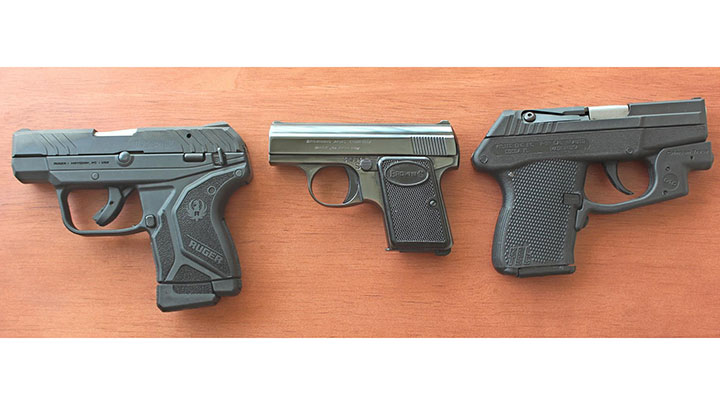
The Baby Browning compared with the Ruger LCP II and Kel-Tec P-32.

The Baby Browning compared with the Ruger LCP II and Kel-Tec P-32.

By today’s pocket-pistol standards, the Baby Browning is too small for a few reasons. Most folks have bigger pockets and more sophisticated holster systems, which allow for larger-caliber pistols to be carried. So the absolute smallest isn’t a requirement these days. The Baby’s slick one-finger grip, the vestigial sights and the very real risk of slide bite makes it a tough gun to work with, and that’s coming from someone who shoots handguns for a living.

Then there’s the .25 ACP cartridge itself. With performance comparable to a .22 LR pistol, small .25 ACPs are easily outclassed by similarly sized .32 ACP and .380 ACP pistols. In speaking with my dad, he agreed that if he had access to the slim, flat, light-weight polymer semi-automatics available today, such as the Kahr Arms CW 380 or Ruger LCP II, he definitely would have chosen a more powerful option. But as it was, the Baby Browning was the best fit for the job.

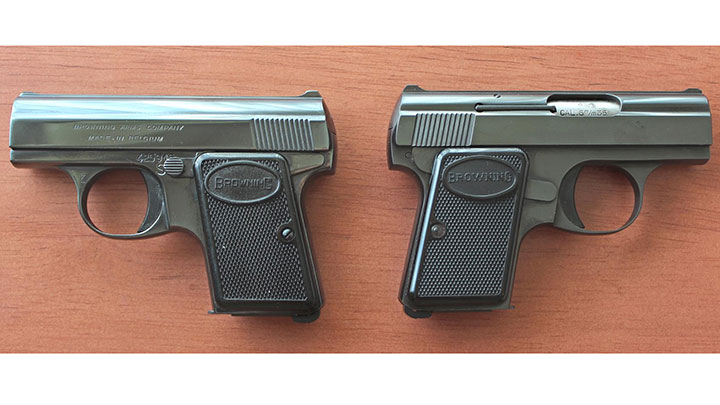
A view of both sides on the Baby Browning.

A view of both sides on the Baby Browning.

Thankfully, my father made it out of that situation without ever having to draw his little .25 ACP. Working with associates in law enforcement (who also watched his back), he gathered the evidence needed to launch an official investigation and then moved his family out of state. Although I’m not in a position to share more of this story here, I can say that I am alive, well and able to write this article today because, half a century ago, good guys with guns kept bad guys with guns from putting an abrupt end to my father’s life.

You see, I wasn’t born until a few years after these events took place. This piece of family history is just one of the reasons I take our 2nd Amendment rights personally. Let’s work together to ensure that, 50 years from now, we’ll have more stories to tell our grandchildren about how we took action to ensure that they, too, would have the means to protect their homes and families.

Specifications:
ManufacturerFabrique Nationale d’Armes de Guerre, 1931 to 1979
Model: Baby Browning
Action Type: blowback-operated, striker-fired, semi-automatic, centerfire pistol
Chambering: .25 ACP (6.35×16 mm SR)
Finish: blued
Stocks: textured black polymer
Sights: fixed
Trigger: single-action, 5-lb., 1-oz. pull
Barrel Length: 2.00″
Overall Length: 4″
Height: 2.75″
Width: 0.75″
Weight:  9.70 ozs.
Magazine: six-round detachable box
Rifle Grooves:  6
Collectors Pricing: $400-$1,200 Depending on Finish and Condition

Categories
All About Guns

Shooting a 50/70 Remington Rolling Block with fixed bayonet

Categories
All About Guns

The Model 1874 Sharps rifle and the 45-120 cartridge – history and shooting

Categories
All About Guns

Hoenig 4-Barrel Vierling Sporting Firearm

Categories
All About Guns

Intro to Double Guns

https://youtu.be/Y6HeLHjcNz8

Categories
All About Guns

Shotguns for £800 – should you buy new or used?

Categories
All About Guns Anti Civil Rights ideas & "Friends" You have to be kidding, right!?!

Chaos’ – MA Gov. Healey Inks ‘Emergency’ Enactment of New Gun Law by Dave Workman

Gov. Maura Healey’s signing of an emergency order implementing the new gun law in Massachusetts has created “chaos,” according to one gun rights leader. IMG Stock-884183940

When Massachusetts Gov. Maura Healey signed an emergency enactment of the state’s new gun control law, she was trying to head off a petition drive that would have derailed the new restrictions at least until  2026, according to a report at Mass.live.

The result, however, according to Jim Wallace, executive director of the Massachusetts Gun Owners Action League (GOAL) has been “chaos.” He accused the governor of “once again silencing the voice of the people” by essentially heading off the petition campaign, mounted by a licensed firearms dealer and conducted by a small army of volunteers, which needed to gather at least 49,716 valid signatures from registered voters to put the new law on hold until it could be placed on the 2026 ballot, according to the Associated Press.

By telephone, Wallace told Ammoland that Healey moved fast when it looked like the petition had gathered far more signatures—perhaps several thousand—than necessary. The Boston Globe reported the petition drive had collected more than 65,000 signatures. Counting was to have begun shortly, with a town-by-town breakdown. The Democrat governor was not about to let that happen.

As explained by the AP story, Healey’s emergency enactment “cracks down on privately made, unserialized ‘ghost guns, criminalizes possession of bump stocks and trigger cranks and requires applicants for a gun license to complete live-fire training.” It also expands the state’s “red flag” law—also known as the extreme risk protective order (ERPO) law—authorizing people other than family members, such as health care professionals, to seek court intervention if someone is deemed to be a threat to themselves or others.

The AP report also acknowledged, “The action by Healey frustrates efforts by gun rights activists who had hoped to gather enough signatures to suspend the law before it took effect.”

GOAL has already filed a federal challenge to the licensing and training mandates. Wallace predicted it will take multiple legal actions, each challenging different sections of the law, to correct what he called an “insane” situation. He also predicted that if the law actually goes on the 2026 ballot, “the other side will spend millions to defeat us.”

Interestingly, the way Mass.Live writer John Micek portrays the fight is a “culture war battle” which many may have thought could not happen in such a politically “deep blue” state. Well, surprise, there are tens of thousands of angry, frustrated gun owners in the Bay State.

Indeed, there is much irony in the fact that the Revolutionary War began in Massachusetts with the Battles of Lexington and Concord in April 1775 over an attempt by the British to seize arms and munitions belonging to the militia.

According to Masslive.com, as of July there were 568,251 active firearms licenses in the Commonwealth, per data compiled by the Firearms Record Bureau. A number that large hints at the potential voter turnout if this measure winds up on a ballot.

In a message posted on the GOAL website, Wallace asserted that Healey, by signing H.4885 into law (Chapter 135 of the Acts of 2024), kept the final language of the bill secret “until the night before the legislature voted on it.” He called it “the worst attack on civil rights in modern U.S. history.”

He is hopeful the federal complaint already filed by GOAL will be taken up “immediately” and will result in an injunction against the law’s enforcement.

How this may play into the November election hasn’t been discussed, but it is clear to GOAL’s Wallace that Massachusetts gun owners are in a prickly mood.

“Massachusetts residents have no idea what to do,” he said. As things stand right now, “nonresidents cannot bring in any gun, period.” That’s not good news as the hunting season is getting underway. The commander of the State Police needs to approve a roster of acceptable firearms, he explained.

On top of everything else, Wallace said ammunition sales must also be recorded.

“It’s insane,” he lamented. “Right now, nonresidents are in danger. If they come into the state with a gun to hunt or compete, they’re a felon.”

If additional lawsuits are filed, it could bog things down if a court decides to issue an injunction against all or parts of the law.

Wallace calls the new law a “tantrum” against the U.S. Supreme Court’s ruling in New York State Rifle & Pistol Association v. Bruen in June 2022. That decision, adopted 6-3 and written by Justice Clarence Thomas, was viewed as a landmark change for the way lower courts and state and local governments must address Second Amendment issues. The ruling will have long-term effects on new and existing gun control laws, many of which are being challenged already by gun rights organizations such as GOAL, the Second Amendment Foundation, National Rifle Association, Gun Owners of America, California Rifle & Pistol Association, Firearms Policy Coalition and others.

About Dave Workman

Categories
Well I thought it was funny!

Oh well, no great loss!

Categories
All About Guns

Mossberg 342k 22lr