Month: September 2024
Categories
John Wayne 1911!!! (Its a BB Gun)
Categories
J.C. Higgins Model 20 (583.53)
An anomaly in the Space Age, the A-1 Skyraider was a prop-powered attack aircraft developed during World War II for naval operations. It’s first flight was in 1945, but it did not see combat until the Korean War. While jets ruled the skies over Vietnam, the A-1 had a unique impact in both attack roles and search and rescue. We take a look at this amazing aircraft that could get low and slow like no others of the time.
All pilots are terrified of fire.
It takes discipline not to think about it unduly. You’re tearing through the sky in a flimsy metal tube filled with an unsettling volume of profoundly flammable aviation gasoline or jet fuel. If something goes wrong, there’s just no place to go.
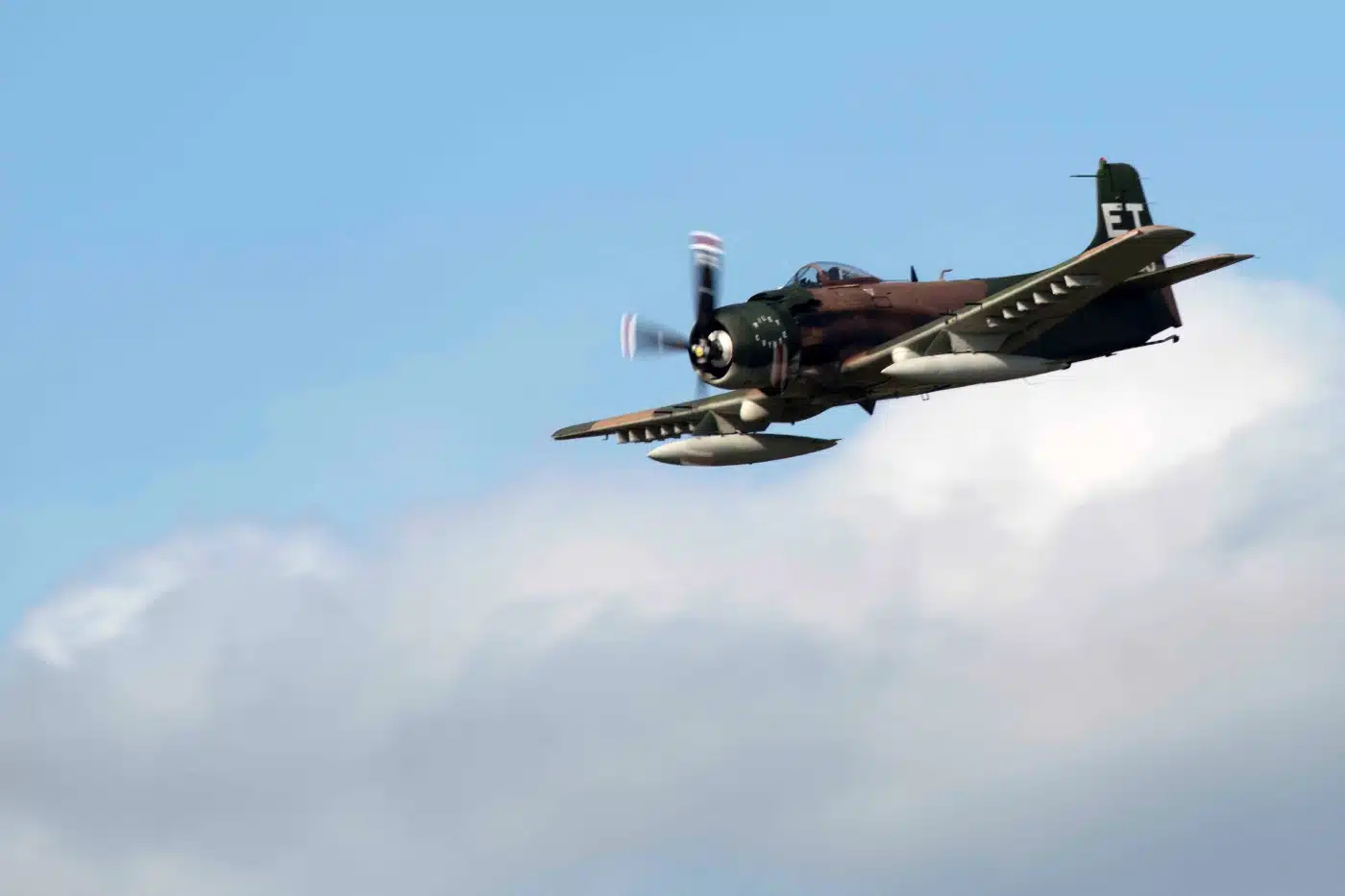
Burning to death in flight is a phobia common to all aviators. On the 1st of September, 1968, Lt. Col. William Atkinson Jones III came face-to-face with that very primal fear. The unnatural way he faced that fear earned him the Medal of Honor.
Behind Enemy Lines
An F-4 Phantom pilot had been brought down 20 miles northwest of Dong Hoi in North Vietnam. Now helpless and alone amidst a rugged karst formation and surrounded by enraged North Vietnamese troops equipped with heavy anti-aircraft systems, this beleaguered U.S. Air Force pilot prepared to die. Then he heard it.

1968 was the middle of the Space Age. The U.S. military operated the most advanced jet combat aircraft in the world. However, this was something different. What this helpless pilot heard was the deep, throaty rumble of a Wright R-3350 Duplex-Cyclone radial engine. That sound would have been right at home in the skies over Europe during World War II.
To that downed American pilot, the growl of that massive piston-driven engine was the sound of angels singing.
That particular big Wright radial was perched on the nose of a Douglas A-1 Skyraider piloted by Lt. Col. Bill Jones. Everyone called the Skyraider the Spad after the famed French fighter of WWI fame. When assigned to combat search and rescue duties, the Skyraider was called Sandy. Sandys would fly cover while a Jolly Green Giant helicopter recovered the downed pilot.

Jones’ Sandy was part of a rescue package deployed to try to snatch this downed American pilot out of the jaws of death. While they had radio contact with the isolated aviator, they did not yet have his exact location. Everything else turned on that piece of information.
Jones dove his heavy strike aircraft down on the deck and began looking for trouble. Suddenly the North Vietnamese defenders opened up with a ZSU-23-2 twin-barrel 23mm antiaircraft gun. AAA (anti-aircraft artillery) was the alpha killer of airplanes on low-level strike missions. Several rounds struck Jones’ Skyraider, and the cockpit filled with smoke.

This is where most normal pilots, even the steely-eyed sort, would have passed the reins off to a wingman and returned to base. However, Lt. Col. Jones knew what was riding on this. Minutes counted. If the NVA got to this downed aviator before the Jolly Green Giant rescue helicopter did, the Phantom driver would spend the rest of the war in a prison camp…or worse.
With his plane damaged and smoke filling the cockpit, Lt. Col. Jones wheeled the big plane around and made another pass.
This time he zeroed the pilot as well as the nearby ZSU that had shot up his airplane. Arming his weapons, Jones made two runs against the AAA position, slathering it with 20mm cannon and rocket fire.

On his second pass, nearby NVA guns pounded his big airplane mercilessly. One round detonated the Yankee Extraction System rocket located behind his headrest. This rocket-assisted ejection device subsequently burned inside the cockpit, filling the space with searing flames. Jones blew the canopy off of his airplane, which made the fire briefly worse. However, his ejection system was spent. Now there was no way for the badly burned pilot to egress his aircraft.
Jones had not been able to notify the rest of his team of the downed pilot’s location. The battle damage had destroyed his radios. Now desperately burned, Jones wracked his stricken plane over and firewalled the throttle. He successfully landed his big airplane and was rushed to surgery.
Before he would allow the surgical team to put him under, Lt. Col. Jones insisted on relating a detailed description of the downed pilot’s location from the operating table. This information was radioed back to the rescue package that was working the area. The downed pilot was successfully recovered later that day.
Anatomy of the Skyraider
The Douglas A-1 Skyraider first flew on March 18, 1945, but it was not operational by the end of WWII. The Skyraider was designed to be a carrier-based, single-seat, long-range, high-endurance torpedo/dive bomber. Prior to entering active service with the U.S. Navy, Japan formally surrendered and ended the Second World War. While the Skyraider never faced off against Japanese aircraft carriers, these attributes turned out to be ideal for close air support in the skies above Vietnam.

In 1946, the Skyraider’s designation was changed to AD-1. During the course of development, engineers stripped the airframe of every piece of unnecessary equipment in a successful effort to give it a long loiter time. In the process, they faired over the bomb bay but mounted a total of 14 external hard points on the wings along with one on the centerline. This gave the Douglas aircraft the capability of carrying a breathtaking array of ordnance.
In addition to being powerful, the Wright engine was rugged. The big 18-cylinder air-cooled radial engine proved exceptionally resistant to battle damage.

Douglas eventually produced versions of the Skyraider that carried two, three or four aircrew members. Variants were capable of night attack operations and electronic warfare missions.
The entire production run of 3,180 aircraft progressed through seven major variants. The U.S. Navy and U.S. Marines used the Skyraider during the Korean War. As the United States entered the Vietnam War, the Navy employed the Skyraider as a medium attack aircraft while the Douglas A-3 Skywarrior held the role of carrier-based strategic bomber.

As the new jet-powered A-6 Intruder was delivered, the US Navy phased out the rugged old Skyraider. Many of the Navy’s Skyraiders were transferred to the Republic of Vietnam. The South Vietnamese Air Force used the Skyraiders extensively in ground attack roles.
The United States Air Force also adopted the plane during the Vietnam War. The U.S.A.F. frequently used the A-1 in the Sandy role to recover lost pilots.
The last Skyraiders were phased out of the active U.S. inventory in 1973. However, their legacy lives on.
AD-6/A-1H Skyraider Technical Specifications
| Length | 38′ 10″ |
| Wingspan | 50′ |
| Powerplant | Wright R-3350-26WA Duplex-Cyclone 18-cylinder radial engine |
| Maximum Speed | 280 knots/322 mph |
| Range | 1,316 miles |
| Armament | 4xAN/M3 20mm cannon with 200 rounds per gun |
| Ordnance | 15 external hardpoints with a total capacity of 8,000 pounds |
A-1 Skyraiders at War
The pilots who flew the Skyraider adored the plane for its rugged construction and forgiving flight characteristics. The grunts and downed aviators who were supported by it veritably worshipped the machine. In a world of fast-moving attack jets, it was the lumbering Skyraider that most reliably brought the pain.

Throughout the Korean War, Marine and Navy Skyraiders were workhorses in ground attack roles. While newer jet aircraft were the darlings of many, it was the Skyraider that was able to fly long missions, loiter extended periods over the battlefield and deliver large quantities of ordnance. While the aircraft were rugged, the pilots paid a heavy price to support their countrymen and allies on the ground. More than 100 Skyraiders were lost in combat.
On July 26, 1954, a pair of Skyraiders splashed two Chinese Lavochkin La-11 “Fang” fighters during an international incident near Hainan Island, China. Chicom fighters launched an unprovoked attack against a DC-4 Skymaster civilian airliner operated by Cathay Pacific Airways. During a search for survivors, Skyraiders shot down the La-11 fighters.

While the ground attack capabilities of the Skyraider were frequently demonstrated in Vietnam, they also picked up air-to-air kills. A pair of North Vietnamese MiG-17 fighters were downed on June 20, 1965, by Lt. Clint Johnson and Lt. Charles Hartman. These were the first gun kills of the war.
On August 5, 1964, Lt. Richard Sather was shot down while flying as part of Operation Pierce Arrow. He was the first Navy pilot lost during the war. In October 1965, to commemorate the 6 millionth pound of ordnance dropped over Vietnam, Cmdr. Clarence Stoddard of VA-25 dropped a Navy surplus toilet along with the rest of his standard combat load.
Legacy of the A-1 Skyraider
Entering the Vietnam War, the U.S. Navy already had the A-6 in development. The Air Force, however, did not have a clear upgrade path.

While the Skyraider performed well during the conflict, losses were heavy — many due to ground fire. Taking the hard-won lessons to heart, the Air Force began the process of developing dedicated close air support aircraft. The initial proposal indicated a need for increased survivability and additional ordnance delivery. By 1970, the Air Force requirements were updated to include all weather and anti-tank capabilities. The result was the Fairchild A-10 Thunderbolt II.
During Vietnam, more than 250 of the A-1 planes — and too many pilots — were lost. However, the number of downed pilots, soldiers and Marines saved by the Skyraider is so great as to be uncountable.

Lt. Col. Jones was promoted to Colonel and awarded the Medal of Honor. Sadly, he died in a Virginia aircraft accident before the MoH presentation. His widow accepted the Medal of Honor from President Richard Nixon at the White House on August 6, 1970.
Lt. Col. William Jones’ complete disregard for his personal safety at the controls of his A-1 exemplifies the American warrior ethos — and the capabilities of the humble Skyraider.
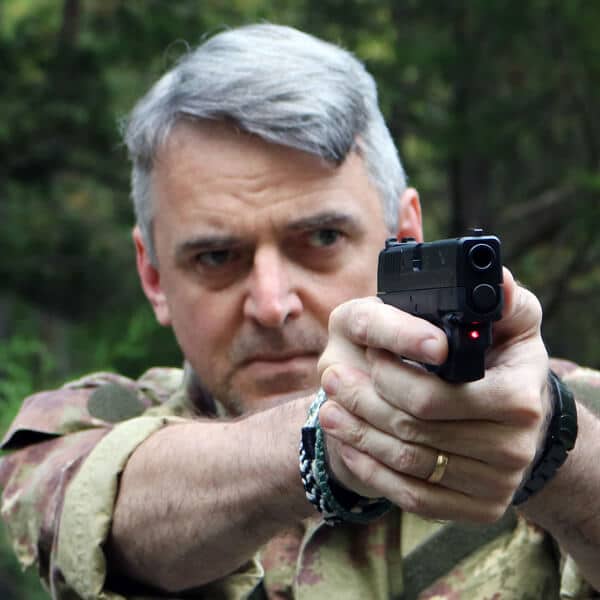
WILL DABBS, MD
Will was raised in the Mississippi Delta and has a degree in Mechanical Engineering. After eight years flying Army helicopters, he left the military as a Major to attend medical school. Will operates an Urgent Care clinic in his small Southern town and works as the plant physician for the local Winchester ammunition plant. He is married to his high school sweetheart, has three adult children, and has written for the gun press for a quarter century.
Categories
BEST Over-Under Shotguns of 2023
Nothing beats the quality craftsmanship and smell of fresh, fine, natural leather. While Nylon and Kydex retain a uniform shape and are easy to maintain, any honest gunslinger will tell you: the look and feel just isn’t the same. Leather holsters are generally much more comfortable and quieter than synthetic holsters. A premium-quality leather holster should last a lifetime, as long as it is well-maintained.
For more than four generations, 1791 Gunleather artisans have been handcrafting fine holsters that positively and reliably hold your firearm in leather you’ll be proud to own. You may notice your holster feels stiff and tight out of the box. It may be difficult to holster or draw your handgun initially. If drawing and holstering the firearm a few times doesn’t do the trick, then you’ll need to break the holster in to find a perfected fit.
How To Break-In A Leather Holster
Use a blocking technique to stretch the leather just enough to get a smooth draw. Place your firearm in a thick plastic bag. You can use a shopping bag or a Ziploc freezer bag. Some people use two sheets of wax paper (with the waxed side toward the leather). Wedge the firearm down into the holster, and let it sit for at least 24 hours. Remove the bag and test the draw, wearing the holster as you would for your intended use, without the plastic bag.
What NOT To Do:
We do NOT recommend using a lubricant like spray silicone or Leather Lightning to grease up the inside of your holster. You don’t want a gun slippery as it may slide out of the holster unintentionally. Beyond that, you don’t want to tarnish the finish of your firearm. The interiors of our holsters are hand-finished to protect your pistol’s bluing.
Want A Leather Holster That’ll Last A Lifetime?
1791 Gunleather holsters are made to last forever. A little care can go a long way in preserving the quality.
Leather Holster Care Do’s:
- Use warm water and glycerin soap or Leather Lotion to remove impurities with a smooth finish.
- Most leather holsters should only be cleaned with soap once every three to four months.
- You may clean your holster with Bick 4 Conditioner or Fiebing’s Foaming Saddle Soap very sparingly.
- Wipe off sweat, dust, dirt, or blood with a soft towel.
- Stubborn dirt or stains can be gently scrubbed with a soft-bristled brush.
- Maintain a layer of clothing between you and the holster to minimize perspiration.
- If the leather has dampened, place the holster in a dry place to allow for natural air-drying.
- Store your leather holster in a cool, dry location, wrapped in a soft cotton cloth or in the original box.
- Minor cosmetic scratches will come off by rubbing olive, baby, or saddle oil into the scratch with a Q-tip.
- Apply rubbing alcohol in a circular motion to minimize the appearance of deeper scratches.
Leather Holster Care Don’ts:
- Do not leave your holster on the car dash or expose it to direct sunlight for extended periods of time.
- Do not store your holster in the trunk of the car, an outdoor shed, the garage, or an attic.
- Do not submerge your holster in water or any other liquid.
- Do not use mink oil, Neat’s oil, or leather conditioner, which will soften and distort the molding.
- Do not dry your holster with a hair dryer, radiator, oven, or laundry machine.
- Do not store your holster within reach of your dog who may mistake it for a rawhide chew.