In this week’s episode of American Rifleman TV, we take a look at the history of the early Colt revolvers and the exploits of the company’s founder, Samuel Colt. Reviewed this week is the Springfield Armory Waypoint 2020, a rifle incorporating carbon fiber to both the stock and the barrel as well as being the company’s first bolt-action hunting rifle.
In the 1855, the Calisher and Terry carbine breech loading rifle was patented in Britain by William Terry and shortly thereafter adopted into military service. The Terry carbine was not only involved in the U.S. Civil War, but was also one of the earliest bolt-action firearms.
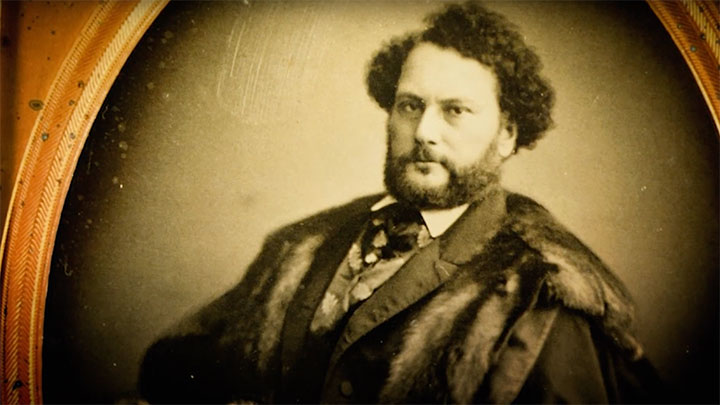
The founder of Colt, and initially failed businessman, Samuel Colt.
Prior to his revolver designs catching on in 1836, Samuel Colt was an interesting individual who had several schemes as a failed business man. Some of these ventures included a failed attempt to design an underwater mine and selling exhibitions of nitrous oxide or “laughing gas” as it was nicknamed. Using the money that he accumulated from his nitrous business, Colt paid Baltimore, Md., gunsmiths to craft some of the firearms designs that he had worked out in his head. Colt never partook in the actual crafting of his design ideas, and simply thought up the designs.
Shooting the lightweight Springfield Armory Waypoint 2020.
Springfield Armory released its first ever purpose-built bolt-action hunting rifle platform this past year, the Waypoint 2020. The Waypoint 2020 features a carbon-fiber stock made by AG Composites that weighs in at only 2 lbs. This contributes to the overall reduced weight of the platform, which is under 7 lbs. Two versions of the stock are available, with either a fixed or adjustable cheek piece. The Waypoint 2020’s barrel is made by BSF and features a carbon-fiber liner along most of its length to save weight and help dissipate heat. A nut at the front of the barrel provides tension against the carbon-fiber liner and keep it in place.
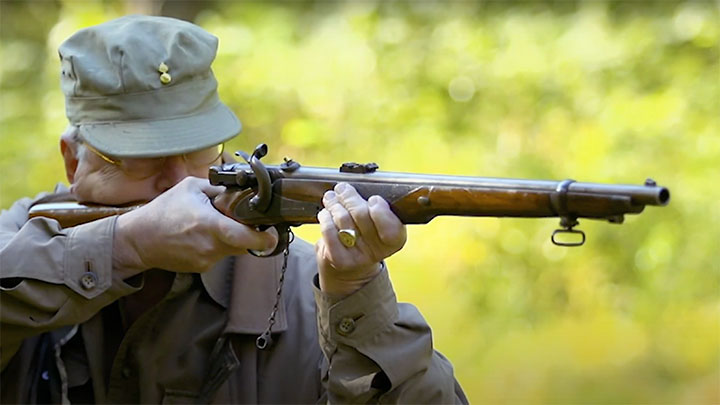
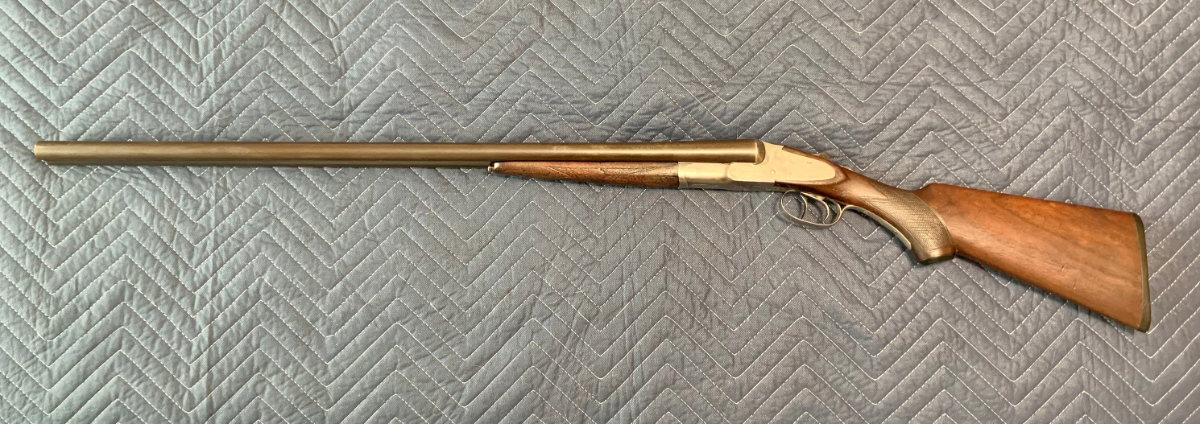
Shooting the Calisher and Terry breech-loading carbine.
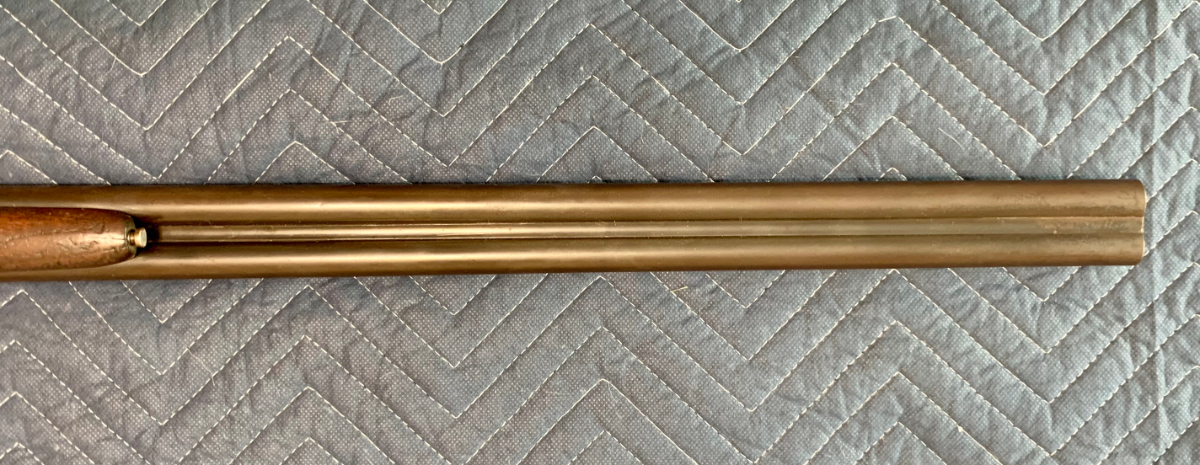
In the mid 1800s, there were a number of early breech-loading rifle and musket designs that were developed in Britain. One of those designs was the Calisher and Terry carbine, patented in 1855 by its inventory William Terry. The design is unique in that it is also arguably one of the earliest bolt-action rifle designs to be accepted into military service. The Terry carbine, as it is popularly known, uses a lever to uncover the breech area, unlock and to pull back a bolt like block, which seals the chamber when fired. The Terry carbine still used an external hammer and percussion cap to fire, but also incorporated a forward thinking feature of pre-loaded nitrided paper cartridges that would be loaded into the breech.
There’s nothing like casting your own bullets for a sense of freedom and satisfaction.
If you’ve been around for a while, you know I love casting my own bullets! Casting bullets provides a sense of freedom and self-sufficiency akin to what our forefathers did out of necessity for their muzzleloader. I also love all things in .45 caliber. And lastly, I love inexpensive bullet molds.
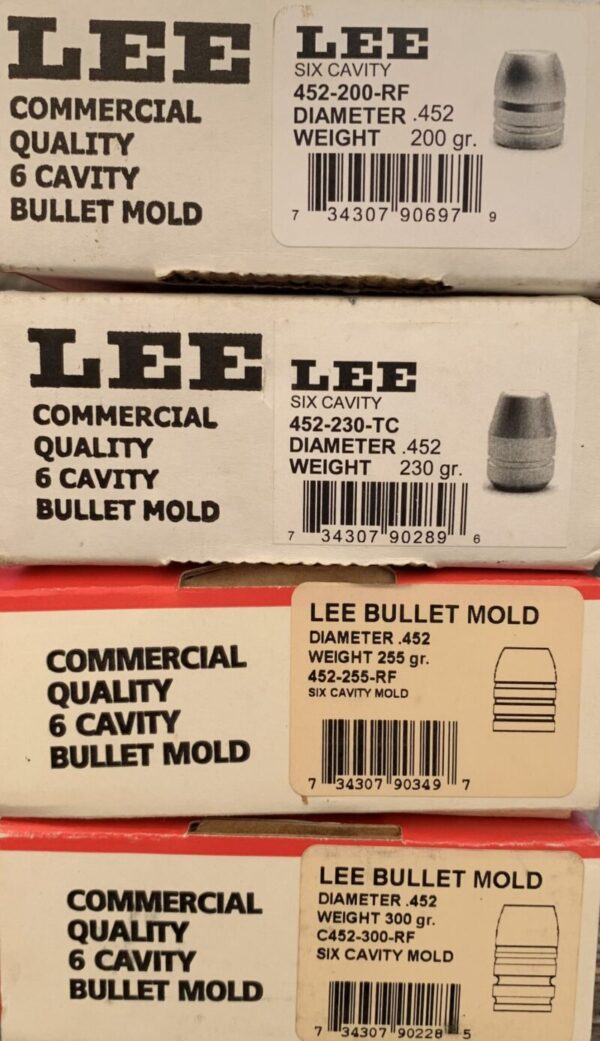
When it comes to affordable bullet molds, Lee Precision is king! Their 6-cavity molds are the best bargain around. Casting a pile of bullets takes no time at all with the 6-banger molds. While I love custom molds, Lee Precision proves affordable molds can have good designs, allowing you to load excellent custom handloads. I’ve done it for years.
By now, you know I have an affinity for the .45 Colt. Despite “Duke” saying it sucks, I’m quite fond of our original brass cased .45 caliber. However, I do agree with “Duke” on the greatness of the .45 ACP and Auto Rim (AR). Their versatility cannot be denied despite shortcomings of overall length.
While their compactness is great for light and medium loads, they’re lacking for what the .45 Colt excels at; Turbo Charged loads capable of propelling heavy 300-plus grain bullets in excess of 1,200 fps. These loads are more powerful than the coveted .44 Magnum. Hell, in large-framed shooters with five-shot cylinders, the .45 Colt comes damn near .454 Casull velocities.
Here’s Tank’s well-used stack of Lee .45 caliber molds.
Some are over 30 years old and still dropping slugs as good as when they were new.
The Molds
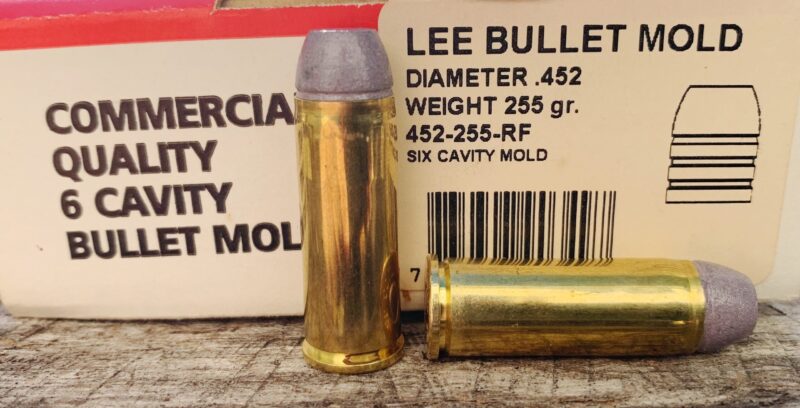
One of the first Lee molds I obtained was their .45 255-grain radiused flat-nose bullet. It is very close in profile to the Lyman 454190 slug. Loaded over 8 grains of 231 in my large-framed Rugers, it gives me just over 900 fps and is one of the most accurate handgun slugs I’ve ever shot. It also can be used in the .45 ACP/AR cases. Loaded over 7 grains of Unique, it closes in on 900 fps.
These purple powder coated poppers are perfect for .45 Colt, ACP/AR.
Big Boy
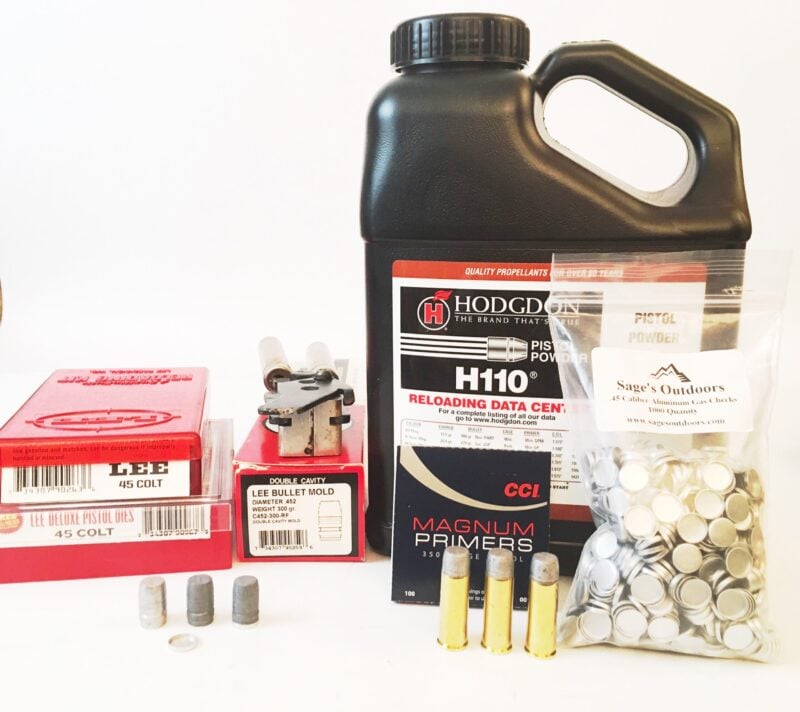
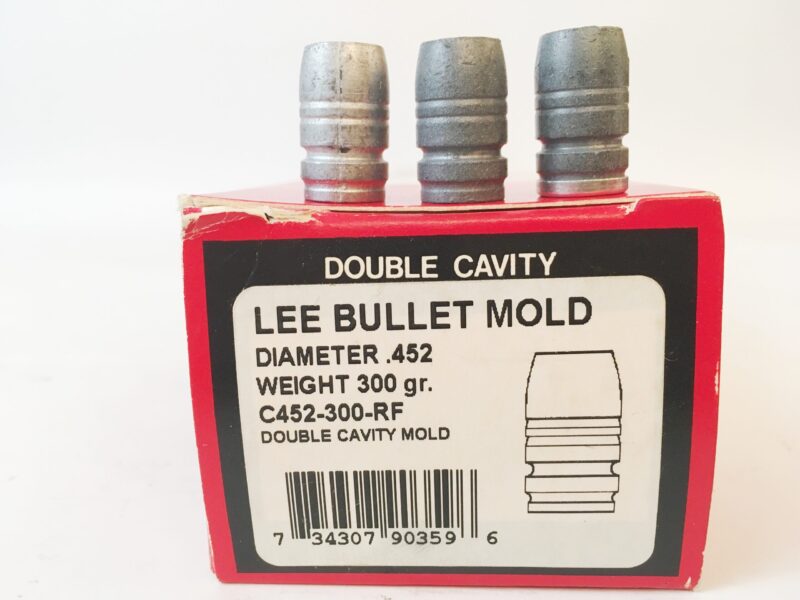
The next .45 Colt mold I got was their 300-grain radiused flat-nose slug with gas check. The nose is very wide — wide flat-nose wide. It hits hard, too! When cast of wheel weight alloy, my slugs drop at 330 grains. Loaded over a stiff charge of 22 grains of H110, sparked with a magnum pistol primer, it exceeds 1,200 fps. I’ve taken a few whitetails with this load, and it is a hammer. It is one of my favorite loads using home cast slugs from an inexpensive mold.
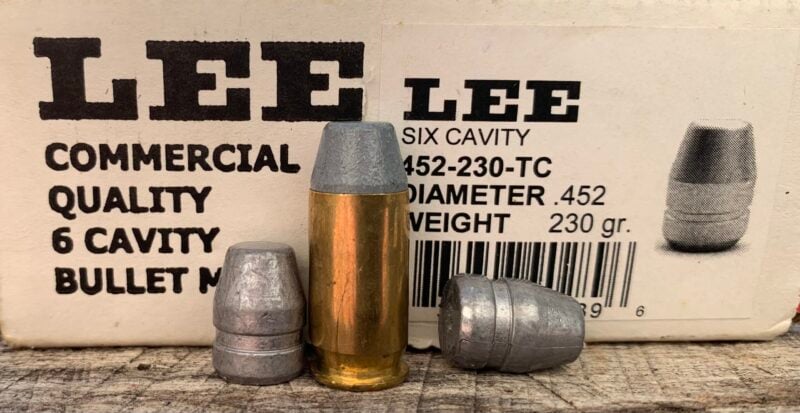
The Lee 230-grain Truncated Cone bullet feeds great in most every 1911.
It’s a popular and good choice bullet.
For the Shorties
My favorite .45 ACP bullet is the Lee 230-grain Truncated Cone (TC) bullet. It feeds like corn through a goose in most 1911s and is very accurate. Using 7 grains of Unique, or 5.3 grains of 231, velocity runs over 860 fps. I’ve even used it in the .45 Colt in a pinch, and it shoots great.
I can’t tell you how many hundreds of pounds of this bullet I’ve shot out of my .45 Colt revolvers.
It may be the most accurate of all my handgun molds.
The last bullet is the Lee 200 radiused flat-nose design. It is great for light loads in the .45 Colt and great for lighter recoiling loads in the .45 ACP/AR. Loading over 5-6 grains of 231 allows you to find the sweet spot for your gun with velocities running from low 800s to high 900s fps. I often use this bullet for gallery type, or lighter loads in the .45 Colt.
The Lee 300-grain wide flat-nose is a sledgehammer of a bullet!
Being almost full wadcutter design, it hits hard!
The Lee 300-grainer is plenty accurate too, as this 25-yard target shows.
The gun is a Mag-Na-Port custom by Ken Kelly.
This is a minimalist of tools needed to load good ammunition — all from Lee Precision.
Tank first bought a two-cavity mold of this design to “try it.”
A six-cavity mold soon followed, as the bullet shot so well.
Pictured from left to rights — bullet as cast, powder coated, sized and gas check crimped on.
Give ‘Em a Try
If you want to experiment with casting, I’d give Lee Precision a try. They make affordable equipment, especially their double cavity molds. Don’t be surprised if some of the molds become your favorites.
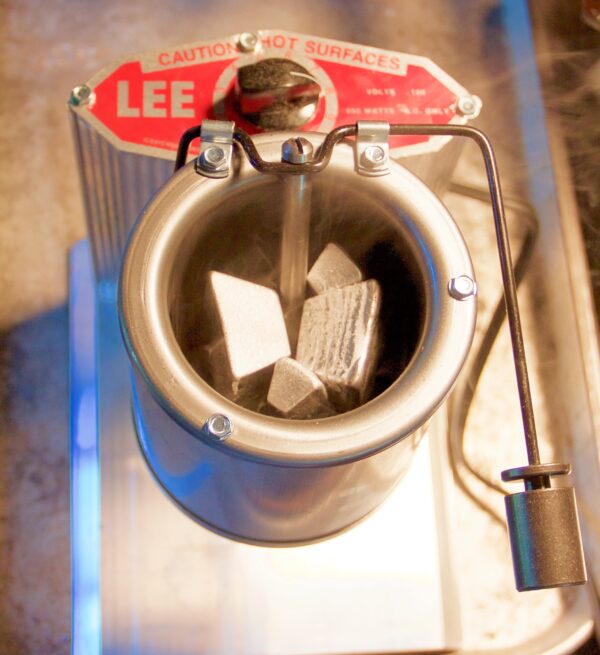
Lee Precision makes affordable casting pots too. Here’s a 10 lb. pot Tank uses
for quick, short casting sessions.
With this line up of Lee slugs, you can pretty much cover all your .45 caliber needs.
On 6 August 1945, Colonel Paul Tibbets piloted the B-29 Superfortress Enola Gay to drop the first atomic bomb on Hiroshima, Japan. Col. Tibbets had his mother’s name painted on the plane on the morning of the mission.
Part of medical training involves away rotations at rural clinics so you can get a feel for the practice of medicine someplace other than the huge teaching hospital. The student spends about a month working with a local family physician just to see what real doctors do day-to-day. Mine was a simply magnificent experience.
I was in a really small town under the tutelage of the nicest guy in the world. My time there was one of the reasons I gravitated toward something professionally similar myself. Meeting people was one of the greatest aspects of my experience in that little community. Small-town America is simply rife with characters.
One older gentleman was just eaten up with skin cancers. He was covered in them. When I inquired regarding his history, he said he had developed cancer in the Army Air Corps during World War II. That sounded like an interesting story. Wow, I had no idea.
The B-29 Superfortress was actually the most expensive weapons project of World War II.
This guy was an engine mechanic assigned to the 509th Composite Bomb Group under Colonel Paul Tibbets in the latter parts of World War II. He was responsible for maintaining the four big Wright R-3350-23 Duplex-Cyclone engines that powered the Enola Gay, the B-29 Superfortress that dropped the first atomic bomb on Hiroshima. That job changed his life.
The recent Christopher Nolan movie, “Oppenheimer” orbited around the Manhattan Project and the development of the atomic bomb. My new friend said he and his buddies had been invited out to watch the Trinity detonation. They stood in a line in the desert and were told to focus on a certain point off in the distance. By way of protective gear, he was issued a pair of tinted goggles.
He said when the bomb went off, the flash was unimaginably bright. He said they had time to laugh a bit about it before the blast wave hit them. The pressure front threw them all back bodily off their feet, though no one was hurt … at the time. He said in the aftermath of the detonation, the air smelled strongly of ozone, like you had been in the presence of a powerful electrical arc.
Here we see Little Boy, the bomb that destroyed Hiroshima, Japan, in the arming trench on the island of Tinian prior to its being loaded aboard the Enola Gay.
They all picked themselves up, brushed off the dust and dirt, and reveled in the amazing thing they had just seen. He said the first kid in his unit to develop cancer got sick six months later. It would have been sometime in 2000 when I met him. He said he was the only one of those presently left alive.
Staging the bomb into the combat theater was a herculean task. Components of the weapon were delivered to the island of Tinian aboard the cruiser USS Indianapolis. Anyone who has seen the movie “JAWS” knows that story. They delivered the bomb in complete secrecy. However, the ship was subsequently torpedoed by a Japanese submarine and sunk, leaving 890 of the original crew complement of 1,195 floating alone in the water. Over the next four days, a further 574 sailors succumbed to exposure and shark predation. Only 316 survived.
On the airfield at Tinian, the Air Corps had constructed a trench in the parking apron. This was the most sensitive weapons project of the war, so security was unbelievably tight. The plan had technicians assembling the bomb in the trench before towing the Enola Gay in place above it. The weapon was then winched into the bomb bay. My buddy said there were MPs with submachine guns posted all around the plane with orders to shoot on sight anyone who seemed even remotely threatening.
The 15-kiloton atomic blast that leveled Hiroshima was undeniably horrible. However, the two atomic bomb attacks ultimately saved countless lives.
Early in the morning on 6 August 1945, my friend needed to go over the Enola Gay’s engines one last time. He made his way out in the darkness, serviced each of the big radials in sequence, and then moved away from the big bomber. Unbeknownst to the security troops posted around the plane, he had tucked a little Brownie camera into the pocket of his flight jacket.
As he walked away from the aircraft, he surreptitiously tucked the camera under his arm and snapped a picture of the plane. No one was the wiser. He told me in all seriousness that the MPs likely would have shot him dead had he been seen taking the photograph.
The image captured the big silver bomber at a crazy angle. He later mislaid the original negative. That picture sat in a frame atop his television in his home in rural Mississippi. It is the only photograph on the planet of the Enola Gay with the bomb on board.
On the morning of 6 August, Colonel Tibbets and his crew delivered Little Boy, the first operational atomic bomb, to its target over Hiroshima, Japan. The 15-kiloton blast ultimately claimed around 75,000 lives. However, the nuclear attacks saved countless more by negating the need for an amphibious invasion of the Japanese home islands. And I got to touch just a little bit of all that in a tiny little medical clinic in rural Mississippi.
Some 1,450 men of Lord Chelmsford’s command lay dead on the South African plain at Isandhlwana. A force of 20,000 Zulu warriors under their king Cetshwayo had all but destroyed the British force comprising six companies of the 24th Regiment of Foot (2nd Warwickshire), wagon drivers, volunteers, staff and camp followers.
Another force of 4,000 Zulus was on its way to the small mission station-turned-hospital at Rorke’s Drift. Awaiting the onslaught were 84 men of B Company, 2nd Battalion, 24th Regiment of Foot; soldiers of the Natal Native Contingent; 36 hospital patients; and men of the Army Hospital Corps.
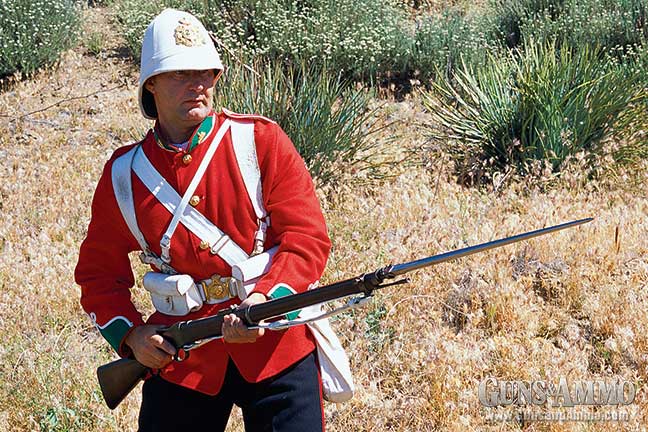
Britain’s legendary single-shot Martini-Henry rifle achieved its greatest fame during the hard-fought Zulu Wars of the late 1870s.
On January 22, 1879, while working on the bank of the Drift, Lieutenant John Chard, Royal Engineers, officer commanding at Rorke’s drift, received news of the slaughter at Isandhlwana. He rushed back to the mission to discover Lieutenant Gonville Bromhead, Commander of the men of the 2/24th, had also heard the intelligence and was preparing to move the invalids to safety in heavy ox-carts.
Chard realized that the slow-moving vehicles would never get the men clear of the Zulus, and he ordered that perimeters of biscuit boxes and mealie (maize) bags be set up to act as defensive barricades. Men of the Natal Kaffirs, retreating from Isandhlwana, arrived during these preparations and were pressed into service.
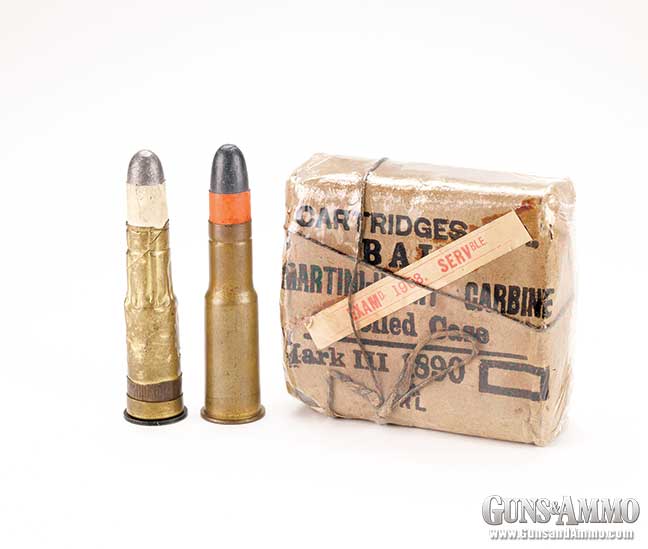
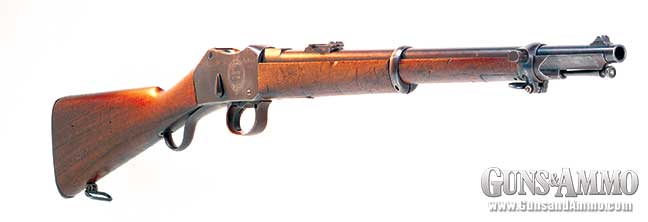
The Martini-Henry was also available in shorter cavalry and artillery (shown) carbines. As these guns were not as heavy as their infantry cousin, special lighter loads were concocted. Their paper patches were color-coded to differentiate them from the standard round.
Several members of the 2/24th were sent into the hospital to guard the patients, and the rest of the forces were positioned to await the Zulu onslaught.
The defense of the mission station at Rorke’s drift has become one of history’s most famous “last stand” type of engagements. But the battle’s notoriety with the public at large was rather late in coming.
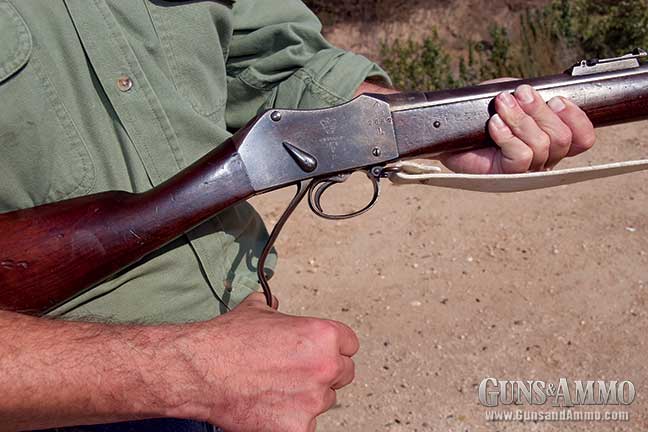
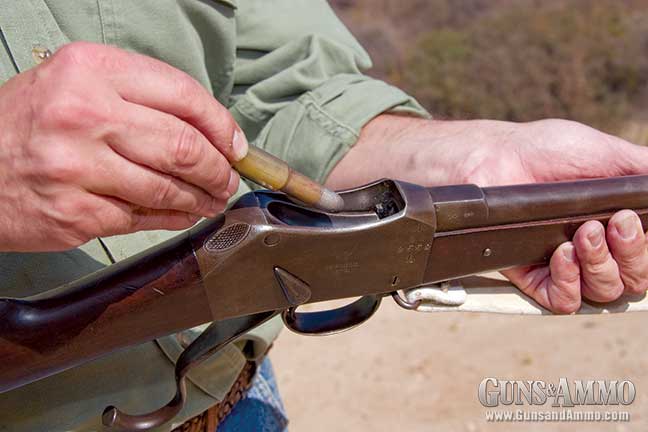
Drop the lever to open the chamber.
With the exception of die-hard military history buffs, it was largely unknown until the release, in 1964, of Cy Endfield’s epic cinematic depiction of the event, “Zulu.” Starring Stanly Baker, Jack Hawkins and a then-unknown Michael Caine, the movie, while wildly inaccurate in places, was still a stirring retelling of the event and for the most part kept pretty much to the spirit of the engagement.
Some 15 years later a prequel, “Zulu Dawn,” featuring Peter O’ Toole, Burt Lancaster and John Mills, about Isandhlwana, also by Endfield, came out, and while more accurate and authentic than its predecessor, it had little of “Zulu’s” élan.
As well as illuminating the actual Battle of Rorke’s Drift, Zulu made a rather obscure military rifle famous — the Martini-Henry. Over the years, prices on Martini-Henry rifles rose steadily and quantities diminished, until recently when International Military Antiques, in association with Atlanta Cutlery, brought a large number of them (along with accessories) out of Nepal — a boon for shooters and collectors.
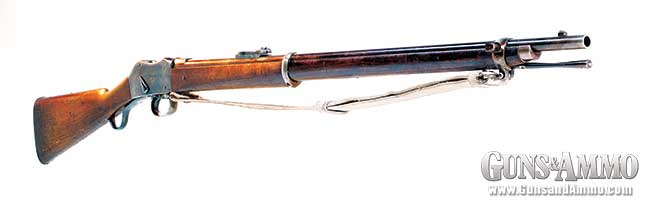
The .577-450-caliber Martini-Henry was the standard infantry rifle issued to the men of the 24th and other regular troops in the British army. Shorter carbine versions were available for cavalry and artillery.
The Martini-Henry started out life as the contrivance of American designer Henry O. Peabody. Peabody’s design was modified by Friederich von Martini in Switzerland and redesignated the “Peabody-Martini.” The British adopted the action, adding a barrel rifled with the system of Scottish gunmaker Alexander Henry and christened the rifle “Martini-Henry.”
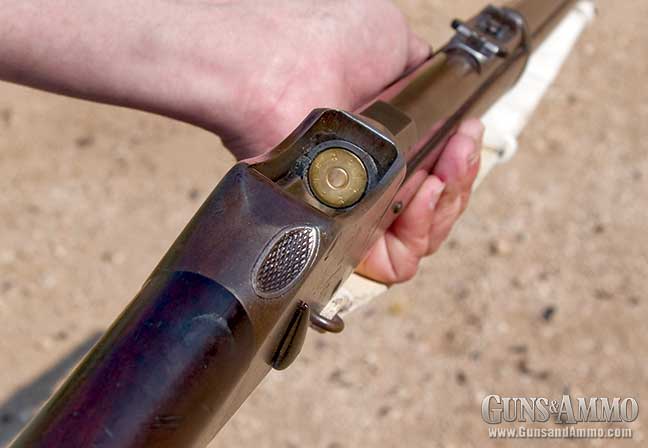
To operate the action, a lever located beneath the wrist of the stock was lowered sharply, causing the breechblock to drop and expose the chamber. This movement also operated an ejector, which pulled loose the fired cartridge case. No safety was incorporated into the system, although a cocking indicator on the right side of the receiver showed when the arm was ready to fire.
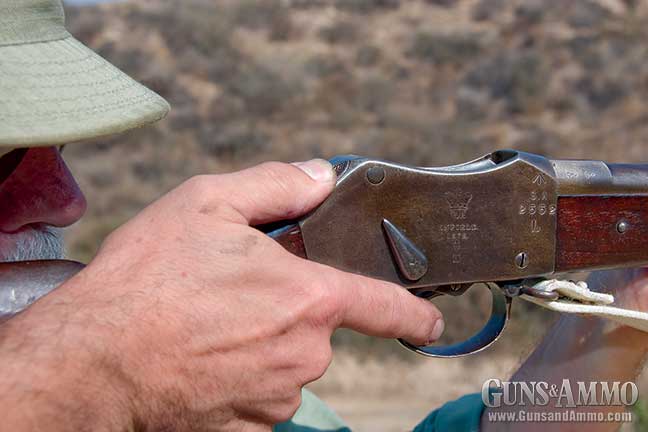
The piece is now ready to fire. There is no safety, though a cocking indicator is on the right side of the receiver where it can easily be seen or felt.
The Martini-Henry rifle was 54 inches long with a barrel length of 33.2 inches. Weight of the Martini-Henry was a hefty nine pounds. The rear sight was graduated to 1,400 yards, although the long-range shooting ability of the Martini-Henry was found to be somewhat lacking.
The cartridge adopted was a necked-down version of the earlier .577 Snider round. (Actually, Snider rifles, carbines and ammunition were still being used by some native and auxiliary troops during the Zulu War.) The .450-caliber paper-patched lead bullet weighed 480 grains and was pushed along at 1,350 fps by 85 grains of black powder.
When shooting, make use of the thumb-rest on the top of the receiver to avoid having your hand pushed into your face, as recoil is stout.
Of the Boxer variety, the round was made from coiled sheet brass with a japanned iron base. Recoil was substantial, and this, coupled with the Martini-Henry rifle’s rather straight wrist, caused many an inexperienced recruit to give himself a nosebleed when his thumb smacked into his face if he was gripping the stock incorrectly. Ordnance authorities thoughtfully provided a thumbrest on the top of the action to avoid such a happenstance.
Enlisted men were issued a triangular bayonet with a 21½-inch blade. This fastened to the barrel by means of a socket, which slipped over the muzzle and was secured by a ring that was rotated over the front barleycorn sight. Sergeants were required to carry the Pattern 1873 Sword bayonet, which had a 22½-inch wavy yataghan-style blade. Unique bayonets were also available for the artillery carbine, and special cutlass-style blades were issued to the Royal Navy.
A smart drop of the lever ejects the spent case. During tests in the late 1860s, a rate of fire of 20 rounds in 48 seconds was achieved.
Interestingly enough, while Martini-Henry rifles were featured prominently (and correctly) in the movie “Zulu,” the revolvers used were World War I-vintage Mark VI Webleys. As well, some bolt-action Long-Lee-Enfields can also be seen in the rear ranks, as there were not enough Martini-Henry rifles available to arm all the extras.
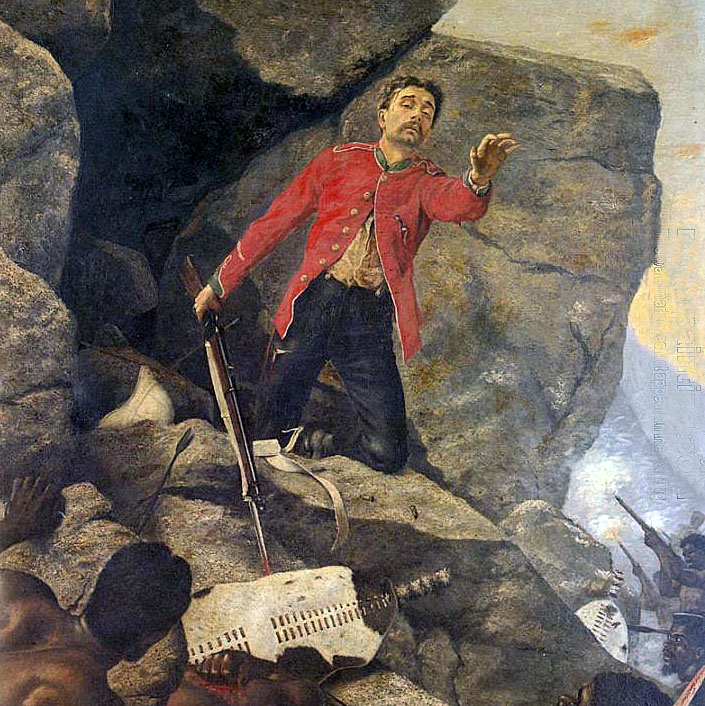
The Zulus attacked Rorke’s Drift’s meager fortifications at sunset, forcing the British to abandon the outer perimeter and retire to the inner line of biscuit boxes and mealie bags. Throwing themselves with superhuman strength at the defenses, the Zulus eventually breached the small hospital building. Privates Henry Hook and John Williams held off the attackers while chopping through a series of five inner walls to save the wounded.
The rear ladder sight was graduated to 1,400 yards, though authorities found long-range accuracy with the Martini-Henry to be disappointing.
The thatch roof of the hospital was set on fire by the Zulus — a tactical error because it allowed the British to see the attackers in the glare. Eleven invalids were lifted free of the burning building through a small window, but two of the men were speared as they made a dash for the inner perimeter.
The Zulus made repeated attacks during the night. The men loaded and fired their Martini-Henry rifles as fast as they could, causing the thin forestocks to become so hot that they had to be wrapped with rags to keep the men from burning their hands. (Experienced British troops in South Africa actually made bullock-hide covers for their guns’ forends to prevent this.)
Original .577-450 Martini-Henry loads were made of coiled brass bodies with japanned steel bases. It was found that the bases would sometimes be ripped off upon ejection (especially in Gatling guns), so eventually drawn-brass cases became standard issue.
Zulu snipers took potshots at the soldiers using old muzzleloaders and captured Martini-Henry rifles, but in the case of the latter arms, they believed that setting the slide on the rear sight as high as possible would increase the potency of the ammunition. As a result, they usually fired well over the heads of the British.
Soon even the sniping died down, and the men waited for dawn and expected new attacks. They never came. As the sun rose, the defenders of Rorke’s Drift looked out on 500 Zulu dead. The impi (Zulu regiment) had left the field.
The author has used different loads, including (from left) Kynoch smokeless, handloads and Ten-X cartridges. Though its bullet resembles an incendiary projectile that was used by the British for balloon-busting in World War I, the Ten-X load gives the best performance by far.
Of the 90 men who took part in the defense of the mission station, 70 survived the battle. Eleven men, including Lieutenants Chard and Bromhead, were given the Victoria Cross, Britain’s highest award for valor, more than for any single action in the history of the award.